Question bank

Q&A: practice questions with answers

Search questions on any topic. Filter by exam category, exam, subject and topic, try the question, then open the answer and explanation.

Courses – airGurukul

8,495 questions found.

Q8061.
The expenditures of R are 65% of his salary. If his salary increased by 10% and his savings are ₹3,150 more than previous savings, his expenditures are now 60% of his salary. His present salary is ₹______.
R का व्यय उसके वेतन का 65% है। यदि उसका वेतन 10% बढ़ जाता है और उसकी बचत पिछली बचत से ₹3,150 अधिक है, तो उसका व्यय अब उसके वेतन का 60% है। उसका वर्तमान वेतन ₹______ है।
  1. A39,000
  2. B37,500
  3. C38,500
  4. D35,000
Show answer

Concept: Savings = salary − expenditure; write both savings in terms of the old salary S.

  1. Old savings =35% of S=0.35S.
  2. New salary =1.1S, savings =40% of 1.1S=0.44S.
  3. 0.44S−0.35S=0.09S=3150⇒S=35000.
  4. Present salary =1.1×35000= ₹38,500.

Trick: The question asks the present salary – not the old ₹35,000 (option D is the trap).

Answer: (C) 38,500

अवधारणा: बचत = वेतन − व्यय; दोनों बचतों को पुराने वेतन S में लिखें।

  1. पुरानी बचत =S का 35%=0.35S.
  2. नया वेतन =1.1S, बचत =1.1S का 40%=0.44S.
  3. 0.44S−0.35S=0.09S=3150⇒S=35000.
  4. वर्तमान वेतन =1.1×35000= ₹38,500.

ट्रिक: प्रश्न वर्तमान वेतन पूछता है – पुराना ₹35,000 नहीं (विकल्प D जाल है)।

उत्तर: (C) 38,500
RRB NTPC Undergraduate CBT 1MathematicsPercentage (income and savings)RRB NTPC Undergraduate CBT 1 2025 · 8 May Shift 2 →
Q8062.
The 5-digit number 7a35b is divisible by 45, where a and b are positive integers. What is the value of (a + b)?
5-अंकीय संख्या 7a35b, 45 से विभाज्य है, जहाँ a और b धनात्मक पूर्णांक हैं। (a + b) का मान क्या है?
  1. A7
  2. B5
  3. C12
  4. D14
Show answer

Concept: Divisible by 45 ⇔ divisible by both 5 (last digit 0 or 5) and 9 (digit sum multiple of 9).

  1. b is a positive integer ⇒ b=5 (not 0).
  2. Digit sum =7+a+3+5+5=20+a ⇒ a=7 (sum 27).
  3. a+b=7+5=12.

Trick: "Positive" rules out b=0; then only one a in 0–9 makes the sum a multiple of 9.

Answer: (C) 12

अवधारणा: 45 से विभाज्य ⇔ 5 (अंतिम अंक 0 या 5) और 9 (अंकों का योग 9 का गुणज) दोनों से विभाज्य।

  1. b धनात्मक पूर्णांक ⇒ b=5 (0 नहीं)।
  2. अंकों का योग =7+a+3+5+5=20+a ⇒ a=7 (योग 27)।
  3. a+b=7+5=12.

ट्रिक: "धनात्मक" से b=0 बाहर; फिर 0–9 में केवल एक a योग को 9 का गुणज बनाता है।

उत्तर: (C) 12

RRB NTPC Undergraduate CBT 1MathematicsDivisibility (45 = 5 × 9)RRB NTPC Undergraduate CBT 1 2025 · 8 May Shift 2 →
Q8063.
Lekhraj sells an article at a profit of 25%. If the cost price is increased by 20% and the selling price is reduced by 10%, what percentage loss will Lekhraj incur?
लेखराज एक वस्तु को 25% लाभ पर बेचता है। यदि क्रय मूल्य 20% बढ़ा दिया जाए और विक्रय मूल्य 10% घटा दिया जाए, तो लेखराज को कितने प्रतिशत हानि होगी?
  1. A6.25%
  2. B7.5%
  3. C6.5%
  4. D7.25%
Show answer

Concept: Assume CP = 100; loss% is always on the (new) cost price.

  1. CP =100, SP =125.
  2. New CP =120, new SP =125×0.9=112.5.
  3. Loss =7.5; loss% =7.5120×100=6.25%.

Trick: New SP/CP =1.25×0.91.2=0.9375 ⇒ 6.25% loss.

Answer: (A) 6.25%

अवधारणा: CP = 100 मानें; हानि% हमेशा (नए) क्रय मूल्य पर निकलता है।

  1. CP =100, SP =125.
  2. नया CP =120, नया SP =125×0.9=112.5.
  3. हानि =7.5; हानि% =7.5120×100=6.25%.

ट्रिक: नया SP/CP =1.25×0.91.2=0.9375 ⇒ 6.25% हानि।

उत्तर: (A) 6.25%

RRB NTPC Undergraduate CBT 1MathematicsProfit and lossRRB NTPC Undergraduate CBT 1 2025 · 8 May Shift 2 →
Q8064.
The average of 5 consecutive integers is 10. What is the smallest integer?
5 क्रमागत पूर्णांकों का औसत 10 है। सबसे छोटा पूर्णांक क्या है?
  1. A9
  2. B6
  3. C8
  4. D7
Show answer

Concept: For an odd count of consecutive integers the average is the middle term.

  1. Middle (3rd) integer =10 ⇒ numbers are 8,9,10,11,12.
  2. Smallest =8.

Trick: Smallest =average−n−12=10−2=8.

Answer: (C) 8

अवधारणा: विषम संख्या में क्रमागत पूर्णांकों का औसत बीच वाला पद होता है।

  1. बीच का (तीसरा) पूर्णांक =10 ⇒ संख्याएँ 8,9,10,11,12.
  2. सबसे छोटा =8.

ट्रिक: सबसे छोटा =औसत−n−12=10−2=8.

उत्तर: (C) 8

RRB NTPC Undergraduate CBT 1MathematicsAverage of consecutive integersRRB NTPC Undergraduate CBT 1 2025 · 8 May Shift 2 →
Q8065.
If x is the mean proportional between (a+b) and (a-b), then find the value of x.
यदि x, (a+b) और (a-b) के बीच मध्यानुपाती (mean proportional) है, तो x का मान ज्ञात कीजिए।
  1. Aa−b
  2. Ba2+b2
  3. Ca+b
  4. Da2−b2
Show answer

Concept: Mean proportional between p and q is pq.

  1. x=(a+b)(a−b).
  2. (a+b)(a−b)=a2−b2⇒x=a2−b2.

Yaad rakhein: (a+b)(a−b)=a2−b2 – never a2+b2 (option B is the trap).

Answer: (D) a2−b2

अवधारणा: p और q का मध्यानुपाती (mean proportional) =pq.

  1. x=(a+b)(a−b).
  2. (a+b)(a−b)=a2−b2⇒x=a2−b2.

याद रखें: (a+b)(a−b)=a2−b2 – कभी a2+b2 नहीं (विकल्प B जाल है)।

उत्तर: (D) a2−b2

RRB NTPC Undergraduate CBT 1MathematicsMean proportionalRRB NTPC Undergraduate CBT 1 2025 · 8 May Shift 2 →
Q8066.
Which of the following letter-number clusters will replace the question mark (?) in the given series to make it logically complete?
HDK 10, LIO 15, PNS 20, TSW 25, ?
दी गई शृंखला में प्रश्नचिह्न (?) के स्थान पर निम्नलिखित में से कौन-सा अक्षर-संख्या समूह आएगा जिससे शृंखला तार्किक रूप से पूर्ण हो जाए?
HDK 10, LIO 15, PNS 20, TSW 25, ?
  1. AXYB 30
  2. BYYB 30
  3. CYXA 28
  4. DXXA 30
Show answer

Concept: Check each position of the letter cluster and the number separately.

  1. 1st letters H(8), L(12), P(16), T(20): +4 → X(24).
  2. 2nd letters D(4), I(9), N(14), S(19): +5 → 19+5=24 = X.
  3. 3rd letters K(11), O(15), S(19), W(23): +4 → 23+4=27→1 = A (wrap after Z).
  4. Numbers 10, 15, 20, 25: +5 → 30. Term = XXA 30.

Trick: Write positions A=1…Z=26 and count beyond 26 cyclically (27→1).

Answer: (D) XXA 30

अवधारणा: अक्षर-समूह की हर स्थिति और संख्या को अलग-अलग जाँचें।

  1. पहले अक्षर H(8), L(12), P(16), T(20): +4 → X(24)।
  2. दूसरे अक्षर D(4), I(9), N(14), S(19): +5 → 19+5=24 = X।
  3. तीसरे अक्षर K(11), O(15), S(19), W(23): +4 → 23+4=27→1 = A (Z के बाद फिर A)।
  4. संख्याएँ 10, 15, 20, 25: +5 → 30। पद = XXA 30।

ट्रिक: A=1…Z=26 लिखें और 26 के बाद चक्रीय गिनें (27→1)।

उत्तर: (D) XXA 30

RRB NTPC Undergraduate CBT 1General Intelligence and ReasoningAlphanumeric SeriesRRB NTPC Undergraduate CBT 1 2025 · 8 May Shift 2 →
Q8067.
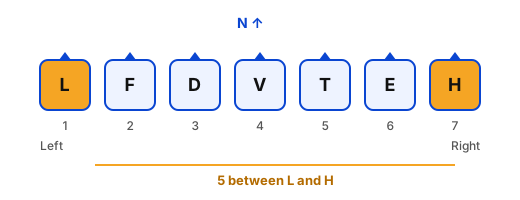
Seven people, L, V, H, D, E, F and T, are sitting in a row, facing north.
Only four people sit to the right of D. V sits fourth from the left end. E is the immediate neighbour of H and T. F sits third to the left of T.
How many people sit between L and H?
सात व्यक्ति, L, V, H, D, E, F और T, एक पंक्ति में उत्तर की ओर मुख करके बैठे हैं।
D के दाईं ओर केवल चार व्यक्ति बैठे हैं। V बाएँ छोर से चौथे स्थान पर बैठा है। E, H और T का निकटतम पड़ोसी है। F, T के बाईं ओर तीसरे स्थान पर बैठा है।
L और H के बीच कितने व्यक्ति बैठे हैं?
  1. AFiveपाँच
  2. BThreeतीन
  3. CTwoदो
  4. DFourचार
Show answer

Concept: Fix the definite positions first (D and V), then place the rest using the remaining clues.

  1. Four people right of D → D is 3rd from left; V is 4th.
  2. F is 3rd to the left of T: T cannot be at 4, 6 or 7 (F would land on V/D), so T = 5, F = 2.
  3. E is neighbour of both H and T → E = 6, H = 7; L takes seat 1.
  4. Row: L F D V T E H. Between L(1) and H(7) there are 5 people.

Trick: 'Only n people to the right' pins a seat exactly: position =7−n from the left.

Answer: (A) Five

अवधारणा: पहले निश्चित स्थान (D और V) तय करें, फिर बाकी सुरागों से शेष लोग बैठाएँ।

  1. D के दाएँ चार लोग → D बाएँ से तीसरा; V चौथा।
  2. F, T के बाएँ तीसरा: T 4, 6 या 7 पर नहीं हो सकता (F, V/D पर आ जाता), अतः T = 5, F = 2।
  3. E, H और T दोनों का पड़ोसी → E = 6, H = 7; L सीट 1 पर।
  4. पंक्ति: L F D V T E H। L(1) और H(7) के बीच 5 लोग।

ट्रिक: 'दाएँ केवल n लोग' सीट पक्की कर देता है: बाएँ से स्थान =7−n।

उत्तर: (A) Five (पाँच)

RRB NTPC Undergraduate CBT 1General Intelligence and ReasoningLinear Seating ArrangementRRB NTPC Undergraduate CBT 1 2025 · 8 May Shift 2 →
Q8068.
Select the option that represents the correct order of the given words as they would appear in an English dictionary.
1. Mistake
2. Mild
3. Mist
4. Migrate
5. Milk
उस विकल्प का चयन कीजिए जो दिए गए शब्दों के उस सही क्रम को दर्शाता है जिस क्रम में वे अंग्रेज़ी शब्दकोश में आएँगे।
1. Mistake
2. Mild
3. Mist
4. Migrate
5. Milk
  1. A4, 2, 5, 3, 1
  2. B5, 3, 1, 2, 4
  3. C4, 2, 1, 5, 3
  4. D2, 3, 5, 4, 1
Show answer

Concept: Compare words letter by letter; a shorter word comes before its extension (Mist before Mistake).

  1. All start with 'Mi'; 3rd letters: g (Migrate), l (Mild, Milk), s (Mist, Mistake) → g < l < s.
  2. Mild vs Milk: 4th letter d < k → Mild, Milk.
  3. Mist vs Mistake: Mist is a prefix → Mist first.
  4. Order: Migrate(4), Mild(2), Milk(5), Mist(3), Mistake(1).

Trick: Prefix rule: the shorter word always comes first (Mist → Mistake).

Answer: (A) 4, 2, 5, 3, 1

अवधारणा: शब्दों की तुलना अक्षर-दर-अक्षर करें; छोटा शब्द अपने विस्तार से पहले आता है (Mist, Mistake से पहले)।

  1. सब 'Mi' से शुरू; तीसरे अक्षर: g (Migrate), l (Mild, Milk), s (Mist, Mistake) → g < l < s।
  2. Mild बनाम Milk: चौथा अक्षर d < k → Mild, Milk।
  3. Mist बनाम Mistake: Mist उपसर्ग है → Mist पहले।
  4. क्रम: Migrate(4), Mild(2), Milk(5), Mist(3), Mistake(1)।

ट्रिक: उपसर्ग नियम: छोटा शब्द हमेशा पहले (Mist → Mistake)।

उत्तर: (A) 4, 2, 5, 3, 1

RRB NTPC Undergraduate CBT 1General Intelligence and ReasoningDictionary OrderRRB NTPC Undergraduate CBT 1 2025 · 8 May Shift 2 →
Q8069.
In a certain code language,
A % B means ‘A is the father of B’,
A € B means ‘A is the wife of B’,
A = B means ‘A is the brother of B’, and
A ? B means ‘A is the daughter of B’.
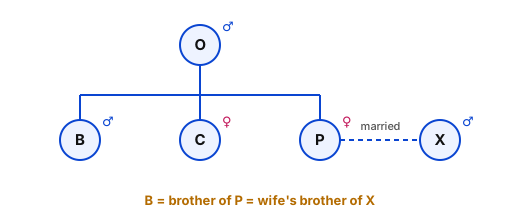
Based on the above, how is B related to X if 'B = C ? O % P € X'?
एक निश्चित कूट भाषा में,
A % B का अर्थ है 'A, B का पिता है',
A € B का अर्थ है 'A, B की पत्नी है',
A = B का अर्थ है 'A, B का भाई है', और
A ? B का अर्थ है 'A, B की पुत्री है'।
उपरोक्त के आधार पर, यदि 'B = C ? O % P € X' है, तो B, X से किस प्रकार संबंधित है?
  1. ABrotherभाई
  2. BWife's fatherपत्नी का पिता
  3. CWife's brotherपत्नी का भाई
  4. DFatherपिता
Show answer

Concept: Decode each symbol from left to right and build the family tree.

  1. B = C → B is brother of C; C ? O → C is daughter of O; so O is father of B and C.
  2. O % P → O is father of P; hence B, C, P are siblings.
  3. P € X → P is wife of X.
  4. B is the brother of X's wife → wife's brother (brother-in-law).

Trick: Trace generation first (O on top, B/C/P below), then attach spouses with a dashed line.

Answer: (C) Wife's brother

अवधारणा: हर प्रतीक को बाएँ से दाएँ डिकोड कर परिवार-वृक्ष बनाएँ।

  1. B = C → B, C का भाई; C ? O → C, O की बेटी; अतः O, B और C का पिता।
  2. O % P → O, P का पिता; अतः B, C, P भाई-बहन।
  3. P € X → P, X की पत्नी।
  4. B, X की पत्नी का भाई → साला (wife's brother)।

ट्रिक: पहले पीढ़ी (O ऊपर, B/C/P नीचे) बनाएँ, फिर जीवनसाथी को बिंदीदार रेखा से जोड़ें।

उत्तर: (C) Wife's brother (साला)

RRB NTPC Undergraduate CBT 1General Intelligence and ReasoningBlood Relations (Coded)RRB NTPC Undergraduate CBT 1 2025 · 8 May Shift 2 →
Q8070.
In a certain code language, ‘PINS’ is coded as ‘3247’ and ‘HIPS’ is coded as ‘4627’. What is the code for ‘H’ in the given code language?
एक निश्चित कूट भाषा में, 'PINS' को '3247' के रूप में कूटबद्ध किया जाता है और 'HIPS' को '4627' के रूप में कूटबद्ध किया जाता है। दी गई कूट भाषा में 'H' का कूट क्या है?
  1. A6
  2. B4
  3. C2
  4. D7
Show answer

Concept: Letters common to both words get the common digits; the leftover letter gets the leftover digit.

  1. PINS → 3 2 4 7; HIPS → 4 6 2 7.
  2. Common letters I, P, S ↔ common digits 2, 4, 7.
  3. Leftover: N ↔ 3 (in PINS) and H ↔ 6 (in HIPS).

Trick: Code questions with two words: 'uncommon letter = uncommon digit'.

Answer: (A) 6

अवधारणा: दोनों शब्दों के साझा अक्षरों को साझा अंक मिलते हैं; बचा अक्षर = बचा अंक।

  1. PINS → 3 2 4 7; HIPS → 4 6 2 7।
  2. साझा अक्षर I, P, S ↔ साझा अंक 2, 4, 7।
  3. बचे: N ↔ 3 (PINS में) और H ↔ 6 (HIPS में)।

ट्रिक: दो शब्दों वाले कोड: 'असाझा अक्षर = असाझा अंक'।

उत्तर: (A) 6

RRB NTPC Undergraduate CBT 1General Intelligence and ReasoningCoding–DecodingRRB NTPC Undergraduate CBT 1 2025 · 8 May Shift 2 →
Q8071.
In the following number-pairs, the second number is obtained by applying certain mathematical operations to the first number. Select the set in which the numbers are related in the same way as are the numbers of the following sets.
(NOTE: Operations should be performed on the whole numbers, without breaking down the numbers into their constituent digits. E.g. 13 – Operations on 13 such as adding / subtracting /multiplying etc. to 13 can be performed. Breaking down 13 into 1 and 3 and then performing mathematical operations on 1 and 3 is not allowed.)
54, 110
56, 114
निम्नलिखित संख्या-युग्मों में, दूसरी संख्या पहली संख्या पर कुछ निश्चित गणितीय संक्रियाएँ करके प्राप्त की गई है। उस समुच्चय का चयन कीजिए जिसमें संख्याएँ उसी प्रकार संबंधित हैं जिस प्रकार निम्नलिखित समुच्चयों की संख्याएँ संबंधित हैं।
(नोट: संक्रियाएँ पूर्ण संख्याओं पर की जानी चाहिए, संख्याओं को उनके घटक अंकों में तोड़े बिना। उदाहरण के लिए 13 – 13 पर संक्रियाएँ जैसे 13 में जोड़ना/घटाना/गुणा करना आदि की जा सकती हैं। 13 को 1 और 3 में तोड़कर फिर 1 और 3 पर गणितीय संक्रियाएँ करने की अनुमति नहीं है।)
54, 110
56, 114
  1. A62, 126
  2. B58, 120
  3. C45, 90
  4. D48, 96
Show answer

Concept: Find one operation on the whole first number that gives the second in both given pairs.

  1. 54×2+2=110 ✓ and 56×2+2=114 ✓ → rule: 2n+2.
  2. Option A: 62×2+2=126 ✓.
  3. B: 2(58)+2=118≠120; C: 2(45)+2=92≠90; D: 2(48)+2=98≠96.

Trick: When the second number is a little more than double, test 2n+k first.

Answer: (A) 62, 126

अवधारणा: ऐसी एक संक्रिया खोजें जो पूरी पहली संख्या पर लगाकर दोनों जोड़ों में दूसरी संख्या दे।

  1. 54×2+2=110 ✓ और 56×2+2=114 ✓ → नियम: 2n+2।
  2. विकल्प A: 62×2+2=126 ✓।
  3. B: 2(58)+2=118≠120; C: 2(45)+2=92≠90; D: 2(48)+2=98≠96।

ट्रिक: दूसरी संख्या दोगुने से थोड़ी ज्यादा हो तो पहले 2n+k जाँचें।

उत्तर: (A) 62, 126

RRB NTPC Undergraduate CBT 1General Intelligence and ReasoningNumber AnalogyRRB NTPC Undergraduate CBT 1 2025 · 8 May Shift 2 →
Q8072.
Refer to the following series and answer the question. (Counting to be done from left to right only.) (All numbers are single-digit numbers only.)
(Left) 9 7 6 4 3 5 7 6 4 6 7 6 9 8 7 7 6 6 7 6 5 7 6 8 7 5 6 (Right)
How many such even digits are there, each of which is immediately preceded by a perfect square and immediately followed by an even digit? (NOTE: 1 is also a perfect square)
निम्नलिखित शृंखला को देखिए और प्रश्न का उत्तर दीजिए। (गिनती केवल बाएँ से दाएँ की जानी है।) (सभी संख्याएँ केवल एक-अंकीय संख्याएँ हैं।)
(बाएँ) 9 7 6 4 3 5 7 6 4 6 7 6 9 8 7 7 6 6 7 6 5 7 6 8 7 5 6 (दाएँ)
ऐसे कितने सम अंक हैं, जिनमें से प्रत्येक के ठीक पहले एक पूर्ण वर्ग और ठीक बाद एक सम अंक है? (नोट: 1 भी एक पूर्ण वर्ग है)
  1. AOneएक
  2. BThreeतीन
  3. CTwoदो
  4. DNoneकोई नहीं
Show answer

Concept: We need a triple 'perfect square – even digit – even digit' (squares: 1, 4, 9).

  1. Mark every even digit whose left neighbour is 1, 4 or 9: … 4 6 7 … (6 after 4), … 9 8 7 … (8 after 9).
  2. In both cases the right neighbour is 7 (odd), so the condition fails.
  3. No other even digit follows a 1, 4 or 9 → count = 0.

Trick: First scan only for the squares (1, 4, 9) – then check their right neighbours; it is much faster than checking every digit.

Answer: (D) None

अवधारणा: हमें 'पूर्ण वर्ग – सम अंक – सम अंक' तिकड़ी चाहिए (वर्ग: 1, 4, 9)।

  1. ऐसे सम अंक चिह्नित करें जिनके बाईं ओर 1, 4 या 9 हो: … 4 6 7 … (4 के बाद 6), … 9 8 7 … (9 के बाद 8)।
  2. दोनों में दाईं ओर 7 (विषम) है, अतः शर्त पूरी नहीं होती।
  3. कोई अन्य सम अंक 1, 4 या 9 के बाद नहीं आता → गिनती = 0।

ट्रिक: पहले केवल वर्ग (1, 4, 9) खोजें और उनके दाएँ पड़ोसी देखें – हर अंक जाँचने से कहीं तेज।

उत्तर: (D) None (कोई नहीं)

RRB NTPC Undergraduate CBT 1General Intelligence and ReasoningNumber Series CountingRRB NTPC Undergraduate CBT 1 2025 · 8 May Shift 2 →
Q8073.
​Based on the English alphabetical order, three of the following four letter-clusters are alike in a certain way and thus form a group. Which is the one that DOES NOT belong to that group?
(Note: The odd one out is not based on the number of consonants/vowels or their position in the letter-cluster.)
अंग्रेज़ी वर्णमाला क्रम के आधार पर, निम्नलिखित चार अक्षर-समूहों में से तीन एक निश्चित प्रकार से समान हैं और इस प्रकार एक समूह बनाते हैं। वह कौन-सा है जो उस समूह से संबंधित नहीं है?
(नोट: असंगत अक्षर-समूह व्यंजनों/स्वरों की संख्या या अक्षर-समूह में उनकी स्थिति पर आधारित नहीं है।)
  1. AOKM
  2. BUQV
  3. CRNS
  4. DLHM
Show answer

Concept: Write the alphabetical positions and look at the gaps between consecutive letters.

  1. UQV: 21, 17, 22 → −4, +5; RNS: 18, 14, 19 → −4, +5; LHM: 12, 8, 13 → −4, +5.
  2. OKM: 15, 11, 13 → −4, +2 – the second gap breaks the pattern.
  3. So OKM is the odd one.

Trick: In three of four clusters the 3rd letter is just one step after the 1st (U→V, R→S, L→M); O→M is not.

Answer: (A) OKM

अवधारणा: अक्षरों के वर्णमाला स्थान लिखकर क्रमागत अंतर देखें।

  1. UQV: 21, 17, 22 → −4, +5; RNS: 18, 14, 19 → −4, +5; LHM: 12, 8, 13 → −4, +5।
  2. OKM: 15, 11, 13 → −4, +2 – दूसरा अंतर पैटर्न तोड़ता है।
  3. अतः OKM विषम है।

ट्रिक: तीन समूहों में तीसरा अक्षर पहले से ठीक एक कदम आगे है (U→V, R→S, L→M); O→M नहीं।

उत्तर: (A) OKM

RRB NTPC Undergraduate CBT 1General Intelligence and ReasoningOdd One Out (Letters)RRB NTPC Undergraduate CBT 1 2025 · 8 May Shift 2 →
Q8074.
In the following triad, each group of letters is related to the subsequent one following a certain logic. Select, from the given options, the one which follows the same logic. TREK - RTEK - KRTE
MAPS - AMPS - SAMP
निम्नलिखित त्रिक में, अक्षरों का प्रत्येक समूह एक निश्चित तर्क के अनुसार अगले समूह से संबंधित है। दिए गए विकल्पों में से उसका चयन कीजिए जो उसी तर्क का पालन करता है। TREK - RTEK - KRTE
MAPS - AMPS - SAMP
  1. AMANY - AMNY - YANM
  2. BOPEN - OEPN - NEPO
  3. CSIDE - ISDE - IDES
  4. DWISE - IWSE - EIWS
Show answer

Concept: Find how the letters move in each step of the given triads.

  1. TREK → RTEK: first two letters swap. RTEK → KRTE: last letter moves to the front.
  2. MAPS → AMPS (swap) → SAMP (last to front) ✓ same logic.
  3. WISE → IWSE (swap) → EIWS (E moved to front) ✓.
  4. A: YAMN expected (given YANM); B: POEN expected; C: EISD expected – all wrong.

Trick: Check the 2nd step with the last letter only: it must jump to position 1 with the rest unchanged.

Answer: (D) WISE - IWSE - EIWS

अवधारणा: दिए गए त्रिकों में हर चरण में अक्षर कैसे खिसकते हैं, देखें।

  1. TREK → RTEK: पहले दो अक्षर आपस में बदलते हैं। RTEK → KRTE: अंतिम अक्षर आगे आ जाता है।
  2. MAPS → AMPS (अदला-बदली) → SAMP (अंतिम आगे) ✓ वही तर्क।
  3. WISE → IWSE (अदला-बदली) → EIWS (E आगे) ✓।
  4. A: YAMN होना चाहिए (दिया YANM); B: POEN चाहिए; C: EISD चाहिए – सब गलत।

ट्रिक: दूसरा चरण केवल अंतिम अक्षर से जाँचें: वह स्थान 1 पर आए और बाकी ज्यों के त्यों रहें।

उत्तर: (D) WISE - IWSE - EIWS

RRB NTPC Undergraduate CBT 1General Intelligence and ReasoningLetter RearrangementRRB NTPC Undergraduate CBT 1 2025 · 8 May Shift 2 →
Q8075.
Each letter in the word LANGUID is arranged in the English alphabetical order. How many letters are there in the English alphabetical order between the letter which is third from the left and the one which is third from the right in the new letter cluster thus formed?
शब्द LANGUID के प्रत्येक अक्षर को अंग्रेज़ी वर्णमाला क्रम में व्यवस्थित किया जाता है। इस प्रकार बने नए अक्षर-समूह में बाएँ से तीसरे अक्षर और दाएँ से तीसरे अक्षर के बीच अंग्रेज़ी वर्णमाला क्रम में कितने अक्षर हैं?
  1. A2
  2. B6
  3. C5
  4. D4
Show answer

Concept: Arrange the letters alphabetically, locate the required two letters, then count the letters between them in the alphabet.

  1. LANGUID → A, D, G, I, L, N, U.
  2. 3rd from left = G (7); 3rd from right = L (12).
  3. Letters between G and L: H, I, J, K → 12−7−1=4.

Trick: Letters strictly between positions a and b = b−a−1.

Answer: (D) 4

अवधारणा: अक्षरों को वर्णमाला क्रम में लगाएँ, दोनों अक्षर पहचानें, फिर उनके बीच वर्णमाला के अक्षर गिनें।

  1. LANGUID → A, D, G, I, L, N, U।
  2. बाएँ से तीसरा = G (7); दाएँ से तीसरा = L (12)।
  3. G और L के बीच: H, I, J, K → 12−7−1=4।

ट्रिक: स्थान a और b के बीच के अक्षर = b−a−1।

उत्तर: (D) 4

RRB NTPC Undergraduate CBT 1General Intelligence and ReasoningAlphabet TestRRB NTPC Undergraduate CBT 1 2025 · 8 May Shift 2 →
Q8076.
Based on the alphabetical order, three of the following four are alike in a certain way and thus form a group. Which is the one that does not belong to that group?
(Note: The odd man out is not based on the number of consonants/vowels or their position in the letter cluster.)
वर्णमाला क्रम के आधार पर, निम्नलिखित चार में से तीन एक निश्चित प्रकार से समान हैं और इस प्रकार एक समूह बनाते हैं। वह कौन-सा है जो उस समूह से संबंधित नहीं है?
(नोट: असंगत अक्षर-समूह व्यंजनों/स्वरों की संख्या या अक्षर-समूह में उनकी स्थिति पर आधारित नहीं है।)
  1. AEGF
  2. BBDC
  3. CVYW
  4. DHJI
Show answer

Concept: Convert to positions and compare the gaps.

  1. EGF: 5, 7, 6 → +2, −1; BDC: 2, 4, 3 → +2, −1; HJI: 8, 10, 9 → +2, −1.
  2. VYW: 22, 25, 23 → +3, −2 – different.
  3. So VYW is the odd one.

Trick: Pattern 'x, x+2, x+1' = three consecutive letters with the last two swapped (E F G → E G F); V W X would give VXW, not VYW.

Answer: (C) VYW

अवधारणा: स्थान लिखकर अंतर तुलना करें।

  1. EGF: 5, 7, 6 → +2, −1; BDC: 2, 4, 3 → +2, −1; HJI: 8, 10, 9 → +2, −1।
  2. VYW: 22, 25, 23 → +3, −2 – अलग।
  3. अतः VYW विषम है।

ट्रिक: पैटर्न 'x, x+2, x+1' = तीन क्रमागत अक्षर जिनमें अंतिम दो बदले हैं (E F G → E G F); V W X से VXW बनता, VYW नहीं।

उत्तर: (C) VYW

RRB NTPC Undergraduate CBT 1General Intelligence and ReasoningOdd One Out (Letters)RRB NTPC Undergraduate CBT 1 2025 · 8 May Shift 2 →
Q8077.
If 1 is added to each odd digit and 1 is subtracted from each even digit in the number 47321568, which of the following digits will be first from the left in the new number thus formed?
यदि संख्या 47321568 में प्रत्येक विषम अंक में 1 जोड़ा जाए और प्रत्येक सम अंक में से 1 घटाया जाए, तो इस प्रकार बनी नई संख्या में निम्नलिखित में से कौन-सा अंक बाएँ से पहला होगा?
  1. A5
  2. B8
  3. C3
  4. D7
Show answer

Concept: Apply the rule digit by digit: odd digit +1, even digit −1.

  1. 4 7 3 2 1 5 6 8 → 3 8 4 1 2 6 5 7.
  2. New number = 38412657; its first digit from the left is 3.
  3. (Only the first digit was really needed: 4 is even → 4−1=3.)

Trick: Read the question before working: when only the first digit is asked, transform just that digit.

Answer: (C) 3

अवधारणा: नियम अंक-दर-अंक लगाएँ: विषम अंक +1, सम अंक −1।

  1. 4 7 3 2 1 5 6 8 → 3 8 4 1 2 6 5 7।
  2. नई संख्या = 38412657; बाएँ से पहला अंक 3।
  3. (वास्तव में केवल पहला अंक चाहिए था: 4 सम → 4−1=3।)

ट्रिक: हल से पहले प्रश्न पढ़ें: केवल पहला अंक पूछा हो तो केवल वही बदलें।

उत्तर: (C) 3

RRB NTPC Undergraduate CBT 1General Intelligence and ReasoningNumber OperationsRRB NTPC Undergraduate CBT 1 2025 · 8 May Shift 2 →
Q8078.
What should come in place of the question mark (?) in the given series to make it logically complete?
ON35, MP44, KR53, ?
दी गई शृंखला को तार्किक रूप से पूर्ण करने के लिए प्रश्नचिह्न (?) के स्थान पर क्या आना चाहिए?
ON35, MP44, KR53, ?
  1. AJT65
  2. BIU63
  3. CJU62
  4. DIT62
Show answer

Concept: Treat the two letters and the number as three independent series.

  1. 1st letters O(15) → M(13) → K(11) → ? : −2 → I(9).
  2. 2nd letters N(14) → P(16) → R(18) → ? : +2 → T(20).
  3. Numbers 35 → 44 → 53 → ? : +9 → 62. Answer IT62.

Trick: Opposite-moving letter pairs (one −2, other +2) are a common NTPC pattern.

Answer: (D) IT62

अवधारणा: दो अक्षरों और संख्या को तीन स्वतंत्र श्रृंखलाएँ मानें।

  1. पहले अक्षर O(15) → M(13) → K(11) → ? : −2 → I(9)।
  2. दूसरे अक्षर N(14) → P(16) → R(18) → ? : +2 → T(20)।
  3. संख्याएँ 35 → 44 → 53 → ? : +9 → 62। उत्तर IT62।

ट्रिक: विपरीत दिशा में चलते अक्षर-युग्म (एक −2, दूसरा +2) NTPC का आम पैटर्न है।

उत्तर: (D) IT62

RRB NTPC Undergraduate CBT 1General Intelligence and ReasoningAlphanumeric SeriesRRB NTPC Undergraduate CBT 1 2025 · 8 May Shift 2 →
Q8079.
In a certain code language, ‘unit flash zebra’ is coded as ' mi de cz' and ‘zebra dance king’ is coded as ‘de uv id’. How is ‘zebra’ coded in the given language?
एक निश्चित कूट भाषा में, 'unit flash zebra' को 'mi de cz' के रूप में कूटबद्ध किया जाता है और 'zebra dance king' को 'de uv id' के रूप में कूटबद्ध किया जाता है। दी गई भाषा में 'zebra' को किस प्रकार कूटबद्ध किया जाता है?
  1. Ami
  2. Bcz
  3. Cuv
  4. Dde
Show answer

Concept: The word common to both sentences has the code common to both.

  1. 'unit flash zebra' → mi de cz; 'zebra dance king' → de uv id.
  2. Only 'zebra' appears in both sentences; only 'de' appears in both codes.
  3. So zebra = de.

Trick: Common word ↔ common code; eliminate codes that appear once.

Answer: (D) de

अवधारणा: जो शब्द दोनों वाक्यों में है, उसका कोड भी दोनों में साझा होगा।

  1. 'unit flash zebra' → mi de cz; 'zebra dance king' → de uv id।
  2. केवल 'zebra' दोनों वाक्यों में है; केवल 'de' दोनों कोडों में।
  3. अतः zebra = de।

ट्रिक: साझा शब्द ↔ साझा कोड; एक बार आने वाले कोड हटा दें।

उत्तर: (D) de

RRB NTPC Undergraduate CBT 1General Intelligence and ReasoningCoding–DecodingRRB NTPC Undergraduate CBT 1 2025 · 8 May Shift 2 →
Q8080.
What should come in place of the ‘?’ in the given series?
10 13 22 41 66 101 ?
दी गई शृंखला में '?' के स्थान पर क्या आना चाहिए?
10 13 22 41 66 101 ?
  1. A164
  2. B124
  3. C142
  4. D146
Show answer

Concept: Take successive differences; here the differences grow by an alternating amount.

  1. Differences: 3, 9, 19, 25, 35.
  2. Second differences: +6, +10, +6, +10 → next +6 → difference =35+6=41.
  3. Missing term =101+41=142.

Trick: If first differences look random, take the second differences – an alternating 6,10,6,10 shows up.

Answer: (C) 142

अवधारणा: क्रमागत अंतर लें; यहाँ अंतर बारी-बारी से बढ़ते हैं।

  1. अंतर: 3, 9, 19, 25, 35।
  2. द्वितीय अंतर: +6, +10, +6, +10 → अगला +6 → अंतर =35+6=41।
  3. लुप्त पद =101+41=142।

ट्रिक: पहले अंतर अनियमित लगें तो द्वितीय अंतर लें – बारी-बारी 6,10,6,10 दिखता है।

उत्तर: (C) 142

RRB NTPC Undergraduate CBT 1General Intelligence and ReasoningNumber SeriesRRB NTPC Undergraduate CBT 1 2025 · 8 May Shift 2 →