Question bank

Q&A: practice questions with answers

Search questions on any topic. Filter by exam category, exam, subject and topic, try the question, then open the answer and explanation.

Courses – airGurukul

8,495 questions found.

Q8441.
A fruit seller sold mangoes at ₹600 per box last month. This month, he first increased the price by 10% due to transportation costs and then offered a discount of 15% on the increased price. What is the final price of one box of mangoes?
एक फल विक्रेता ने पिछले महीने आम ₹600 प्रति पेटी की दर से बेचे। इस महीने, उसने परिवहन लागत के कारण पहले मूल्य में 10% की वृद्धि की और फिर बढ़े हुए मूल्य पर 15% की छूट दी। आम की एक पेटी का अंतिम मूल्य क्या है?
  1. A₹571
  2. B₹541
  3. C₹561
  4. D₹551
Show answer

Concept: Apply the changes one after another as multipliers.

  1. After 10% increase: 600×1.1=660.
  2. After 15% discount: 660×0.85=561.

Trick: Net change =10−15−10×15100=−6.5%; 600×0.935=561.

Answer: (C) ₹561

अवधारणा: परिवर्तनों को एक के बाद एक गुणक (multiplier) के रूप में लगाएँ।

  1. 10% वृद्धि के बाद: 600×1.1=660।
  2. 15% छूट के बाद: 660×0.85=561।

ट्रिक: शुद्ध परिवर्तन =10−15−10×15100=−6.5%; 600×0.935=561।

उत्तर: (C) ₹561

RRB NTPC Undergraduate CBT 1MathematicsSuccessive Percentage ChangeRRB NTPC Undergraduate CBT 1 2025 · 7 May Shift 1 →
Q8442.
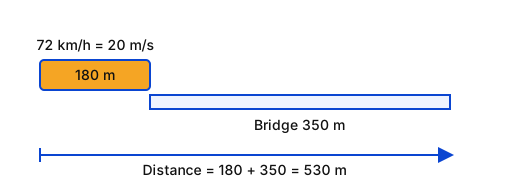
A train of length 180 meters is running at a speed of 72 km/h. How much time will it take to cross a bridge 350 meters long?
180 मीटर लंबी एक रेलगाड़ी 72 km/h की चाल से चल रही है। 350 मीटर लंबे पुल को पार करने में उसे कितना समय लगेगा?
  1. A26.5 seconds26.5 सेकंड
  2. B24.5 seconds24.5 सेकंड
  3. C23.5 seconds23.5 सेकंड
  4. D27.5 seconds27.5 सेकंड
Show answer

Concept: To cross a bridge the train covers (its own length + bridge length).

  1. Speed =72×518=20 m/s.
  2. Distance =180+350=530 m.
  3. Time =53020=26.5 s.

Trick: km/h → m/s: multiply by 518 (72 → 20).

Answer: (A) 26.5 seconds

अवधारणा: पुल पार करने में ट्रेन (अपनी लंबाई + पुल की लंबाई) तय करती है।

  1. चाल =72×518=20 m/s।
  2. दूरी =180+350=530 m।
  3. समय =53020=26.5 s।

ट्रिक: km/h → m/s: 518 से गुणा करें (72 → 20)।

उत्तर: (A) 26.5 सेकंड

RRB NTPC Undergraduate CBT 1MathematicsTrainsRRB NTPC Undergraduate CBT 1 2025 · 7 May Shift 1 →
Q8443.
The sum of two positive numbers is 27 and their product is 170. The positive difference between them is:
दो धनात्मक संख्याओं का योग 27 और उनका गुणनफल 170 है। उनके बीच का धनात्मक अंतर है:
  1. A7
  2. B12
  3. C19
  4. D2
Show answer

Concept: (a−b)2=(a+b)2−4ab.

  1. (a−b)2=272−4×170=729−680=49.
  2. a−b=7.

Trick: Check: 17×10=170, 17+10=27, difference 7.

Answer: (A) 7

अवधारणा: (a−b)2=(a+b)2−4ab।

  1. (a−b)2=272−4×170=729−680=49।
  2. a−b=7।

ट्रिक: जाँच: 17×10=170, 17+10=27, अंतर 7।

उत्तर: (A) 7

RRB NTPC Undergraduate CBT 1MathematicsAlgebraic IdentitiesRRB NTPC Undergraduate CBT 1 2025 · 7 May Shift 1 →
Q8444.
A streaming service charges ₹150 per month. If you buy an annual plan (12 months) with a 15% discount, what is your total savings (in ₹) compared to paying monthly for a year?
एक स्ट्रीमिंग सेवा ₹150 प्रति माह शुल्क लेती है। यदि आप 15% छूट के साथ वार्षिक योजना (12 माह) खरीदते हैं, तो एक वर्ष तक मासिक भुगतान करने की तुलना में आपकी कुल बचत (₹ में) कितनी होगी?
  1. A180
  2. B300
  3. C240
  4. D270
Show answer

Concept: Savings = discount % of the yearly monthly-payment total.

  1. Monthly for a year: 150×12=1800.
  2. Savings =15% of 1800=270.

Trick: 10% of 1800 =180, 5%=90; total 270.

Answer: (D) 270

अवधारणा: बचत = वार्षिक मासिक-भुगतान योग का छूट %।

  1. एक वर्ष का मासिक भुगतान: 150×12=1800।
  2. बचत =1800 का 15%=270।

ट्रिक: 1800 का 10%=180, 5%=90; कुल 270।

उत्तर: (D) 270

RRB NTPC Undergraduate CBT 1MathematicsPercentageRRB NTPC Undergraduate CBT 1 2025 · 7 May Shift 1 →
Q8445.
If the interest on a sum of ₹y at 10% per annum compounded annually for 2 years is ₹462, then the total amount payable at the end of the two-year period will be _________.
यदि ₹y की धनराशि पर 10% वार्षिक दर से वार्षिक रूप से संयोजित चक्रवृद्धि ब्याज 2 वर्ष में ₹462 है, तो दो वर्ष की अवधि के अंत में देय कुल मिश्रधन _________ होगा।
  1. A₹2,762
  2. B₹2,962
  3. C₹2,662
  4. D₹2,862
Show answer

Concept: CI for 2 years at 10% =21% of principal (since 1.12=1.21).

  1. 0.21y=462 ⟹ y=2200.
  2. Amount =2200+462=2662.

Trick: 21% → 462, so 1% → 22 and 121% → 2662.

Answer: (C) ₹2,662

अवधारणा: 10% पर 2 वर्ष का CI = मूलधन का 21% (क्योंकि 1.12=1.21)।

  1. 0.21y=462 ⟹ y=2200।
  2. मिश्रधन =2200+462=2662।

ट्रिक: 21% → 462, अतः 1% → 22 और 121% → 2662।

उत्तर: (C) ₹2,662

RRB NTPC Undergraduate CBT 1MathematicsCompound InterestRRB NTPC Undergraduate CBT 1 2025 · 7 May Shift 1 →
Q8446.
Find the diameter of a sphere of surface area 28962 cm2. (round off to the closest integer) (Use π=227)
28962 cm2 पृष्ठीय क्षेत्रफल वाले गोले का व्यास ज्ञात कीजिए। (निकटतम पूर्णांक तक पूर्णांकित कीजिए) (π=227 का प्रयोग कीजिए)
  1. A108 cm
  2. B48 cm
  3. C98 cm
  4. D96 cm
Show answer

Concept: Surface area of sphere =4πr2.

  1. 4×227×r2=28962 ⟹ r2=28962×788≈2303.8.
  2. r≈48 cm (since 482=2304).
  3. Diameter =2r=96 cm.

Trick: 2896288≈329, ×7≈2304=482. Don't stop at r – the question asks the diameter.

Answer: (D) 96 cm

अवधारणा: गोले का पृष्ठीय क्षेत्रफल =4πr2।

  1. 4×227×r2=28962 ⟹ r2=28962×788≈2303.8।
  2. r≈48 cm (क्योंकि 482=2304)।
  3. व्यास =2r=96 cm।

ट्रिक: 2896288≈329, ×7≈2304=482। r पर न रुकें – प्रश्न व्यास पूछ रहा है।

उत्तर: (D) 96 cm

RRB NTPC Undergraduate CBT 1MathematicsMensuration – SphereRRB NTPC Undergraduate CBT 1 2025 · 7 May Shift 1 →
Q8447.
The value of a machine depreciates by 10% every year. What is the total percentage depreciation after 2 years?
एक मशीन के मूल्य में प्रति वर्ष 10% का अवमूल्यन होता है। 2 वर्ष बाद कुल प्रतिशत अवमूल्यन कितना होगा?
  1. A21%
  2. B20%
  3. C19%
  4. D22%
Show answer

Concept: Two successive changes of a% and b% give net a+b+ab100.

  1. −10−10+(−10)(−10)100=−20+1=−19%.
  2. Check: 100→90→81, fall =19%.

Trick: Depreciation is less than 20% because the second 10% acts on a smaller value.

Answer: (C) 19%

अवधारणा: a% और b% के दो क्रमिक परिवर्तनों का शुद्ध प्रभाव a+b+ab100।

  1. −10−10+(−10)(−10)100=−20+1=−19%।
  2. जाँच: 100→90→81, कमी =19%।

ट्रिक: अवमूल्यन 20% से कम है क्योंकि दूसरा 10% छोटे मान पर लगता है।

उत्तर: (C) 19%

RRB NTPC Undergraduate CBT 1MathematicsSuccessive Percentage ChangeRRB NTPC Undergraduate CBT 1 2025 · 7 May Shift 1 →
Q8448.
A shopkeeper offers the following schemes on toys of the same marked price. (A) Successive discounts of 16% and 29% on any number of toys bought.
(B) Successive discounts of 4%, 34% and 37% on any number of toys bought. (C) 12% discount on the first 4 toys and 27% discount on each toy thereon.
(D) 4 toys free of cost on buying 10 toys.
A customer wants to buy 10 toys. Which of the above schemes is the least beneficial to her?
एक दुकानदार समान अंकित मूल्य वाले खिलौनों पर निम्नलिखित योजनाएँ देता है। (A) किसी भी संख्या में खरीदे गए खिलौनों पर 16% और 29% की क्रमिक छूट।
(B) किसी भी संख्या में खरीदे गए खिलौनों पर 4%, 34% और 37% की क्रमिक छूट। (C) पहले 4 खिलौनों पर 12% छूट और उसके बाद प्रत्येक खिलौने पर 27% छूट।
(D) 10 खिलौने खरीदने पर 4 खिलौने निःशुल्क।
एक ग्राहक 10 खिलौने खरीदना चाहती है। उपरोक्त में से कौन-सी योजना उसके लिए सबसे कम लाभदायक है?
  1. AB
  2. BC
  3. CA
  4. DD
Show answer

Concept: Compare what fraction of the marked price (MP) of 10 toys the customer actually pays under each scheme.

  1. (A) 0.84×0.71=0.5964 → pays 59.64%.
  2. (B) 0.96×0.66×0.63=0.3992 → pays 39.92% (discount ≈60.1%).
  3. (C) 4×0.88+6×0.7310=0.79 → pays 79%.
  4. (D) Buying 10 toys she pays full price for 10 (the 4 free toys are extra, not a price cut); effectively 1014≈71.4% per toy.
  5. Scheme B stands apart from the other three – it is the only one with a discount above 50%.

Trick: Multiply the "paid" fractions (1−d); never add the discount percentages.

Answer: (B) B

अवधारणा: प्रत्येक योजना में ग्राहक 10 खिलौनों के अंकित मूल्य (MP) का कितना अंश वास्तव में देती है, इसकी तुलना करें।

  1. (A) 0.84×0.71=0.5964 → 59.64% भुगतान।
  2. (B) 0.96×0.66×0.63=0.3992 → 39.92% भुगतान (छूट ≈60.1%)।
  3. (C) 4×0.88+6×0.7310=0.79 → 79% भुगतान।
  4. (D) 10 खिलौने खरीदने पर 10 का पूरा मूल्य (4 मुफ्त खिलौने अतिरिक्त हैं, मूल्य में कटौती नहीं); प्रभावी रूप से प्रति खिलौना 1014≈71.4%।
  5. योजना B अन्य तीनों से अलग है – केवल इसी में छूट 50% से अधिक है।

ट्रिक: "भुगतान" अंशों (1−d) को गुणा करें; छूट प्रतिशत कभी न जोड़ें।

उत्तर: (B) B

RRB NTPC Undergraduate CBT 1MathematicsSuccessive DiscountsRRB NTPC Undergraduate CBT 1 2025 · 7 May Shift 1 →
Q8449.
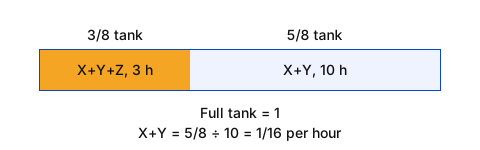
Pipes X, Y, and Z together can fill a tank in 8 hours. If all three work together for 3 hours, and then pipe Z is closed, the remaining tank is filled by X and Y in 10 hours. In how many hours can pipe Z alone fill the empty tank?
पाइप X, Y और Z मिलकर एक टंकी को 8 घंटे में भर सकते हैं। यदि तीनों 3 घंटे तक एक साथ कार्य करते हैं और फिर पाइप Z को बंद कर दिया जाता है, तो शेष टंकी को X और Y 10 घंटे में भरते हैं। पाइप Z अकेला खाली टंकी को कितने घंटे में भर सकता है?
  1. A18
  2. B16
  3. C32
  4. D24
Show answer

Concept: Work per hour =1time; split the tank into the part filled with Z and without Z.

  1. X+Y+Z fill 18 per hour ⟹ in 3 h: 38; remaining 58.
  2. X+Y fill 58 in 10 h ⟹ 580=116 per hour.
  3. Z =18−116=116 ⟹ Z alone takes 16 h.

Trick: Take tank =16 units: all three =2/h, X+Y =10÷10=1/h, so Z =1/h → 16 h.

Answer: (B) 16

अवधारणा: प्रति घंटा कार्य =1समय; टंकी को Z के साथ और Z के बिना भरे भाग में बाँटें।

  1. X+Y+Z प्रति घंटा 18 ⟹ 3 h में 38; शेष 58।
  2. X+Y 58 को 10 h में ⟹ 580=116 प्रति घंटा।
  3. Z =18−116=116 ⟹ Z अकेले 16 h।

ट्रिक: टंकी =16 इकाई लें: तीनों =2/h, X+Y =10÷10=1/h, अतः Z =1/h → 16 h।

उत्तर: (B) 16

RRB NTPC Undergraduate CBT 1MathematicsPipes and CisternsRRB NTPC Undergraduate CBT 1 2025 · 7 May Shift 1 →
Q8450.
Two bells are rung at intervals of 1,764 seconds and 2,268 seconds, respectively. They are rung together at the start. After how much time will the two bells ring together again for the first time?
दो घंटियाँ क्रमशः 1,764 सेकंड और 2,268 सेकंड के अंतराल पर बजती हैं। शुरुआत में वे एक साथ बजती हैं। कितने समय बाद दोनों घंटियाँ पहली बार फिर से एक साथ बजेंगी?
  1. A4 hours 24 minutes 36 seconds4 घंटे 24 मिनट 36 सेकंड
  2. B4 hours 36 minutes 24 seconds4 घंटे 36 मिनट 24 सेकंड
  3. C4 hours 18 minutes 12 seconds4 घंटे 18 मिनट 12 सेकंड
  4. D4 hours 12 minutes 18 seconds4 घंटे 12 मिनट 18 सेकंड
Show answer

Concept: Bells ring together again after LCM of the intervals.

  1. 1764=22×32×72, 2268=22×34×7.
  2. LCM =22×34×72=4×81×49=15876 s.
  3. 15876=14400+1476 ⟹ 4 h + 24 min 36 s.

Trick: HCF =252; LCM =1764×2268252=7×2268=15876.

Answer: (A) 4 hours 24 minutes 36 seconds

अवधारणा: घंटियाँ अंतरालों के LCM के बाद फिर साथ बजेंगी।

  1. 1764=22×32×72, 2268=22×34×7।
  2. LCM =22×34×72=4×81×49=15876 s।
  3. 15876=14400+1476 ⟹ 4 h + 24 min 36 s।

ट्रिक: HCF =252; LCM =1764×2268252=7×2268=15876।

उत्तर: (A) 4 घंटे 24 मिनट 36 सेकंड

RRB NTPC Undergraduate CBT 1MathematicsLCM – BellsRRB NTPC Undergraduate CBT 1 2025 · 7 May Shift 1 →
Q8451.
Two taps can fill a cistern in 2 hours and 37 hours, respectively. A third tap can empty it in 37 hours. How long (in hours) will it take to fill half of the empty cistern if all the taps are opened together?
दो नल एक हौज़ को क्रमशः 2 घंटे और 37 घंटे में भर सकते हैं। एक तीसरा नल इसे 37 घंटे में खाली कर सकता है। यदि सभी नल एक साथ खोल दिए जाएँ, तो खाली हौज़ का आधा भाग भरने में कितना समय (घंटों में) लगेगा?
  1. A3
  2. B1
  3. C2
  4. D4
Show answer

Concept: Net rate = sum of filling rates − emptying rate.

  1. Net per hour =12+137−137=12.
  2. Half cistern =12÷12=1 hour.

Trick: The 37-hour filler and the 37-hour emptier cancel each other – only the 2-hour tap matters.

Answer: (B) 1

अवधारणा: शुद्ध दर = भरने की दरों का योग − खाली करने की दर।

  1. प्रति घंटा शुद्ध =12+137−137=12।
  2. आधी टंकी =12÷12=1 घंटा।

ट्रिक: 37 घंटे वाला भरने वाला और 37 घंटे वाला खाली करने वाला नल एक-दूसरे को काट देते हैं – केवल 2 घंटे वाला नल मायने रखता है।

उत्तर: (B) 1

RRB NTPC Undergraduate CBT 1MathematicsPipes and CisternsRRB NTPC Undergraduate CBT 1 2025 · 7 May Shift 1 →
Q8452.
The ratio of two numbers is 3 : 5. If 6 is subtracted from each, the resulting numbers are in the ratio 1 : 2. Find the difference between the two original numbers.
दो संख्याओं का अनुपात 3 : 5 है। यदि प्रत्येक में से 6 घटाया जाए, तो प्राप्त संख्याएँ 1 : 2 के अनुपात में हो जाती हैं। दोनों मूल संख्याओं के बीच का अंतर ज्ञात कीजिए।
  1. A14
  2. B16
  3. C10
  4. D12
Show answer

Concept: Let the numbers be 3x and 5x and use the new ratio.

  1. 3x−65x−6=12 ⟹ 6x−12=5x−6 ⟹ x=6.
  2. Numbers: 18 and 30; difference =12.

Trick: Difference =2x; once x=6, answer =12 directly.

Answer: (D) 12

अवधारणा: संख्याएँ 3x और 5x मानकर नया अनुपात लगाएँ।

  1. 3x−65x−6=12 ⟹ 6x−12=5x−6 ⟹ x=6।
  2. संख्याएँ: 18 और 30; अंतर =12।

ट्रिक: अंतर =2x; x=6 मिलते ही उत्तर =12।

उत्तर: (D) 12

RRB NTPC Undergraduate CBT 1MathematicsRatio and ProportionRRB NTPC Undergraduate CBT 1 2025 · 7 May Shift 1 →
Q8453.
If a two-digit number has a digit sum of 9 and adding 27 reverses its digits, determine the unit digit of the number.
यदि किसी दो अंकों की संख्या के अंकों का योग 9 है और उसमें 27 जोड़ने पर उसके अंक पलट जाते हैं, तो उस संख्या का इकाई अंक ज्ञात कीजिए।
  1. A3
  2. B5
  3. C4
  4. D6
Show answer

Concept: Number =10a+b; reversing gives 10b+a, and the difference is 9(b−a).

  1. 9(b−a)=27 ⟹ b−a=3.
  2. a+b=9 ⟹ b=6, a=3; number =36.
  3. Unit digit =6 (check: 36+27=63).

Trick: Adding 9k reverses digits ⟹ digits differ by k (here k=3).

Answer: (D) 6

अवधारणा: संख्या =10a+b; पलटने पर 10b+a, अंतर 9(b−a)।

  1. 9(b−a)=27 ⟹ b−a=3।
  2. a+b=9 ⟹ b=6, a=3; संख्या =36।
  3. इकाई अंक =6 (जाँच: 36+27=63)।

ट्रिक: 9k जोड़ने पर अंक पलटें ⟹ अंकों का अंतर k (यहाँ k=3)।

उत्तर: (D) 6

RRB NTPC Undergraduate CBT 1MathematicsNumber System – DigitsRRB NTPC Undergraduate CBT 1 2025 · 7 May Shift 1 →
Q8454.
Simplify the following expression using the BODMAS rule:
34+(56×910)−23
BODMAS नियम का प्रयोग करके निम्नलिखित व्यंजक को सरल कीजिए:
34+(56×910)−23
  1. A35
  2. B65
  3. C135
  4. D56
Show answer

Concept: Bracket first, then multiplication, then addition/subtraction left to right.

  1. 56×910=4560=34.
  2. 34+34=32.
  3. 32−23=9−46=56.

Trick: Cancel before multiplying: 56×910=12×32.

Answer: (D) 56

अवधारणा: पहले कोष्ठक, फिर गुणा, फिर बाएँ से दाएँ जोड़/घटाव।

  1. 56×910=4560=34।
  2. 34+34=32।
  3. 32−23=9−46=56।

ट्रिक: गुणा से पहले काटें: 56×910=12×32।

उत्तर: (D) 56

RRB NTPC Undergraduate CBT 1MathematicsSimplification – BODMASRRB NTPC Undergraduate CBT 1 2025 · 7 May Shift 1 →
Q8455.
The arithmetic mean of the first 15 numbers is 82. The mean is reduced by 6 when one of the numbers is removed. Find the number that is excluded?
प्रथम 15 संख्याओं का समांतर माध्य 82 है। एक संख्या हटा देने पर माध्य 6 कम हो जाता है। हटाई गई संख्या ज्ञात कीजिए।
  1. A142
  2. B100
  3. C166
  4. D164
Show answer

Concept: Excluded number = old total − new total.

  1. Old total =15×82=1230.
  2. New mean =76, new total =14×76=1064.
  3. Excluded =1230−1064=166.

Trick: Removed number = new mean + (fall in mean × original count) =76+6×15=166.

Answer: (C) 166

अवधारणा: हटाई गई संख्या = पुराना योग − नया योग।

  1. पुराना योग =15×82=1230।
  2. नया औसत =76, नया योग =14×76=1064।
  3. हटाई संख्या =1230−1064=166।

ट्रिक: हटाई संख्या = नया औसत + (औसत में कमी × मूल संख्या) =76+6×15=166।

उत्तर: (C) 166

RRB NTPC Undergraduate CBT 1MathematicsAverageRRB NTPC Undergraduate CBT 1 2025 · 7 May Shift 1 →
Q8456.
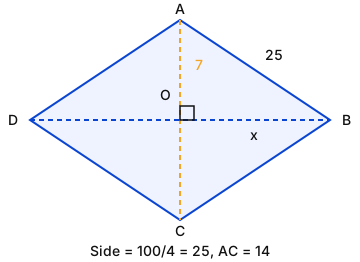
The perimeter of a rhombus is 100 meters and one of its diagonals is 14 meters long. What is the length of the other diagonal?
एक समचतुर्भुज का परिमाप 100 मीटर है और उसका एक विकर्ण 14 मीटर लंबा है। दूसरे विकर्ण की लंबाई क्या है?
  1. A48 meters48 मीटर
  2. B40 meters40 मीटर
  3. C42 meters42 मीटर
  4. D50 meters50 मीटर
Show answer

Concept: Diagonals of a rhombus bisect each other at right angles, so each side is the hypotenuse of a right triangle with legs = half-diagonals.

  1. Side =1004=25 m; half of given diagonal =7 m.
  2. Half of other diagonal =252−72=576=24 m.
  3. Other diagonal =2×24=48 m.

Yaad rakhein: (7,24,25) is a Pythagorean triplet.

Answer: (A) 48 meters

अवधारणा: समचतुर्भुज के विकर्ण एक-दूसरे को समकोण पर समद्विभाजित करते हैं, अतः भुजा उस समकोण त्रिभुज का कर्ण है जिसकी भुजाएँ अर्ध-विकर्ण हैं।

  1. भुजा =1004=25 m; दिए विकर्ण का आधा =7 m।
  2. दूसरे विकर्ण का आधा =252−72=576=24 m।
  3. दूसरा विकर्ण =2×24=48 m।

याद रखें: (7,24,25) पाइथागोरस त्रिक है।

उत्तर: (A) 48 मीटर

RRB NTPC Undergraduate CBT 1MathematicsRhombusRRB NTPC Undergraduate CBT 1 2025 · 7 May Shift 1 →
Q8457.
Which of the ratios given below is the greatest among them?
नीचे दिए गए अनुपातों में से कौन-सा अनुपात सबसे बड़ा है?
  1. A5 : 8
  2. B3 : 5
  3. C7 : 11
  4. D4 : 7
Show answer

Concept: Convert each ratio to a decimal and compare.

  1. 58=0.625, 35=0.6, 711≈0.636, 47≈0.571.
  2. Greatest =711.

Trick: Compare 58 and 711 by cross-multiplying: 5×11=55<7×8=56, so 711 is bigger.

Answer: (C) 7 : 11

अवधारणा: प्रत्येक अनुपात को दशमलव में बदलकर तुलना करें।

  1. 58=0.625, 35=0.6, 711≈0.636, 47≈0.571।
  2. सबसे बड़ा =711।

ट्रिक: 58 और 711 की वज्र-गुणन से तुलना: 5×11=55<7×8=56, अतः 711 बड़ा।

उत्तर: (C) 7 : 11

RRB NTPC Undergraduate CBT 1MathematicsComparison of RatiosRRB NTPC Undergraduate CBT 1 2025 · 7 May Shift 1 →
Q8458.
If 4sinθ+cosecθ=4, 0∘<θ<90∘, then the value of sin3θ+cos3θ is
यदि 4sinθ+cosecθ=4, 0∘<θ<90∘ है, तो sin3θ+cos3θ का मान है
  1. A-1
  2. B0
  3. C1
  4. D2
Show answer

Concept: Multiply by sinθ to get a perfect square in sinθ.

  1. 4sinθ+1sinθ=4 ⟹ 4sin2θ−4sinθ+1=0 ⟹ (2sinθ−1)2=0.
  2. sinθ=12 ⟹ θ=30∘.
  3. sin90∘+cos90∘=1+0=1.

Trick: x+1x=2 type (here 2sinθ+12sinθ=2) forces x=1, i.e. 2sinθ=1.

Answer: (C) 1

अवधारणा: sinθ से गुणा करने पर sinθ में पूर्ण वर्ग बनता है।

  1. 4sinθ+1sinθ=4 ⟹ 4sin2θ−4sinθ+1=0 ⟹ (2sinθ−1)2=0।
  2. sinθ=12 ⟹ θ=30∘।
  3. sin90∘+cos90∘=1+0=1।

ट्रिक: x+1x=2 प्रकार (यहाँ 2sinθ+12sinθ=2) से x=1, अर्थात 2sinθ=1।

उत्तर: (C) 1

RRB NTPC Undergraduate CBT 1MathematicsTrigonometryRRB NTPC Undergraduate CBT 1 2025 · 7 May Shift 1 →
Q8459.
In a class, the average score of 8 boys is 56 and the average score of 4 girls is 80. What is the average score of all 12 students?
एक कक्षा में 8 लड़कों का औसत प्राप्तांक 56 और 4 लड़कियों का औसत प्राप्तांक 80 है। सभी 12 विद्यार्थियों का औसत प्राप्तांक क्या है?
  1. A62
  2. B66
  3. C68
  4. D64
Show answer

Concept: Combined average =total of all scorestotal students.

  1. Boys total =8×56=448; girls total =4×80=320.
  2. Average =76812=64.

Trick: Ratio 8:4=2:1, so the average lies 13 of the way from 56 to 80: 56+8=64.

Answer: (D) 64

अवधारणा: संयुक्त औसत =सभी अंकों का योगकुल विद्यार्थी।

  1. लड़कों का योग =8×56=448; लड़कियों का =4×80=320।
  2. औसत =76812=64।

ट्रिक: अनुपात 8:4=2:1, अतः औसत 56 से 80 की ओर 13 दूरी पर: 56+8=64।

उत्तर: (D) 64

RRB NTPC Undergraduate CBT 1MathematicsWeighted AverageRRB NTPC Undergraduate CBT 1 2025 · 7 May Shift 1 →
Q8460.
The 7-digit number 46A484B is divisible by 24. What is the minimum value of (A + B)?
7 अंकों की संख्या 46A484B, 24 से विभाज्य है। (A + B) का न्यूनतम मान क्या है?
  1. A6
  2. B3
  3. C1
  4. D4
Show answer

Concept: Divisible by 24 ⟺ divisible by both 8 and 3.

  1. By 8: last three digits 84B must be divisible by 8 ⟹ B=0 (840) or B=8 (848).
  2. By 3: digit sum =4+6+A+4+8+4+B=26+A+B must be a multiple of 3.
  3. With B=0: A=1 works (27) ⟹ A+B=1, the minimum.

Trick: Try the smallest B first; the smallest A that fixes the digit sum gives the minimum.

Answer: (C) 1

अवधारणा: 24 से विभाज्य ⟺ 8 और 3 दोनों से विभाज्य।

  1. 8 से: अंतिम तीन अंक 84B 8 से विभाज्य ⟹ B=0 (840) या B=8 (848)।
  2. 3 से: अंकों का योग =4+6+A+4+8+4+B=26+A+B, 3 का गुणज।
  3. B=0 पर A=1 (27) ⟹ A+B=1, न्यूनतम।

ट्रिक: पहले सबसे छोटा B लें; अंक-योग ठीक करने वाला सबसे छोटा A न्यूनतम देता है।

उत्तर: (C) 1

RRB NTPC Undergraduate CBT 1MathematicsDivisibilityRRB NTPC Undergraduate CBT 1 2025 · 7 May Shift 1 →