Question bank

Q&A: practice questions with answers

Search questions on any topic. Filter by exam category, exam, subject and topic, try the question, then open the answer and explanation.

Courses – airGurukul

8,495 questions found.

Q841.
A number, when decreased by 7%, gives 3720. The number is:
एक संख्या में 7% की कमी करने पर 3720 प्राप्त होता है। वह संख्या है:
  1. A12000
  2. B8000
  3. C4000
  4. D2000
Show answer

Concept: If a number is decreased by r%, the result is (100−r)% of the number.

  1. After a 7% decrease, 93% of the number =3720.
  2. Number =3720×10093.
  3. 372093=40, so number =40×100=4000.

Trick: Check options: 7% of 4000=280 and 4000−280=3720 ✔.

Answer: (C) 4000

अवधारणा: यदि किसी संख्या को r% घटाया जाए, तो परिणाम संख्या का (100−r)% होता है।

  1. 7% घटाने पर संख्या का 93%=3720।
  2. संख्या =3720×10093।
  3. 372093=40, अतः संख्या =40×100=4000।

ट्रिक: विकल्प जाँचें: 4000 का 7%=280 और 4000−280=3720 ✔।

उत्तर: (C) 4000

RRB NTPC Undergraduate CBT 1MathematicsPercentageRRB NTPC Undergraduate CBT 1 2024 · 22 Aug Shift 1 →
Q842.
Simplify: 3((73)x2−22x+19)−7(x2+9x−14)
सरल कीजिए: 3((73)x2−22x+19)−7(x2+9x−14)
  1. A−129x − 155
  2. B−129x + 155
  3. C129x + 155
  4. D129x − 155
Show answer

Concept: Open brackets by multiplying each term, then combine like terms.

  1. 3(73x2−22x+19)=7x2−66x+57.
  2. −7(x2+9x−14)=−7x2−63x+98.
  3. Add: x2 terms: 7x2−7x2=0; x terms: −66x−63x=−129x; constants: 57+98=155.
  4. Result: −129x+155.

Trick: Put x=0: expression =3(19)−7(−14)=57+98=155, so the constant must be +155 → only (B) fits with −129x.

Answer: (B) −129x+155

अवधारणा: कोष्ठक के हर पद से गुणा करके कोष्ठक खोलें, फिर समान पदों को जोड़ें।

  1. 3(73x2−22x+19)=7x2−66x+57।
  2. −7(x2+9x−14)=−7x2−63x+98।
  3. जोड़ें: x2 पद: 7x2−7x2=0; x पद: −66x−63x=−129x; अचर: 57+98=155।
  4. परिणाम: −129x+155।

ट्रिक: x=0 रखें: मान =3(19)−7(−14)=155, अतः अचर +155 होगा → केवल (B)।

उत्तर: (B) −129x+155

RRB NTPC Undergraduate CBT 1MathematicsAlgebra – SimplificationRRB NTPC Undergraduate CBT 1 2024 · 22 Aug Shift 1 →
Q843.
The sum of five numbers is 655. The average of the first two numbers is 80 and the third number is 102. Find the average of the remaining two numbers.
पाँच संख्याओं का योग 655 है। पहली दो संख्याओं का औसत 80 है और तीसरी संख्या 102 है। शेष दो संख्याओं का औसत ज्ञात कीजिए।
  1. A196.5
  2. B182
  3. C183
  4. D197.5
Show answer

Concept: Sum = average × number of items.

  1. Sum of first two numbers =2×80=160.
  2. Third number =102.
  3. Sum of remaining two =655−160−102=393.
  4. Average of remaining two =3932=196.5.

Trick: Odd sum 393 ⇒ average ends in .5 → only 196.5 or 197.5; 3932=196.5.

Answer: (A) 196.5

अवधारणा: योग = औसत × संख्याओं की गिनती।

  1. पहली दो संख्याओं का योग =2×80=160।
  2. तीसरी संख्या =102।
  3. शेष दो का योग =655−160−102=393।
  4. शेष दो का औसत =3932=196.5।

ट्रिक: योग 393 विषम ⇒ औसत .5 पर समाप्त → 3932=196.5।

उत्तर: (A) 196.5

RRB NTPC Undergraduate CBT 1MathematicsAverageRRB NTPC Undergraduate CBT 1 2024 · 22 Aug Shift 1 →
Q844.
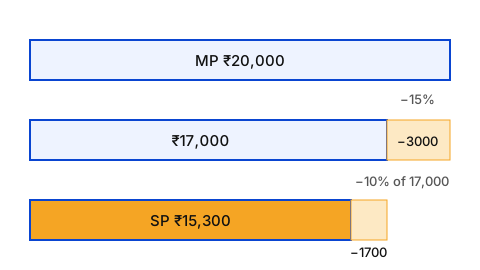
A mobile phone is marked at ₹20,000. During a festive sale, a store offers two
successive discounts — 15% first and then 10%. What is the final selling price of the mobile?
एक मोबाइल फ़ोन का अंकित मूल्य ₹20,000 है। एक त्योहारी सेल के दौरान, एक स्टोर दो
क्रमिक छूट देता है — पहले 15% और फिर 10%। मोबाइल का अंतिम विक्रय मूल्य क्या है?
  1. A₹15,000
  2. B₹15,500
  3. C₹15,300
  4. D₹16,000
Show answer

Concept: For successive discounts a% and b%: SP=MP×100−a100×100−b100.

  1. After 15%: 20000×85100=17000.
  2. After 10% more: 17000×90100=15300.
  3. Final SP = ₹15,300.

Trick: Net discount =a+b−ab100=15+10−1.5=23.5%; 23.5% of 20000=4700; 20000−4700=15300.

Answer: (C) ₹15,300

अवधारणा: क्रमिक छूट a% और b% हो तो: SP=MP×100−a100×100−b100।

  1. 15% छूट के बाद: 20000×85100=17000।
  2. फिर 10% छूट: 17000×90100=15300।
  3. अंतिम विक्रय मूल्य = ₹15,300।

ट्रिक: कुल छूट =a+b−ab100=15+10−1.5=23.5%; 20000 का 23.5%=4700; 20000−4700=15300।

उत्तर: (C) ₹15,300

RRB NTPC Undergraduate CBT 1MathematicsSuccessive discountsRRB NTPC Undergraduate CBT 1 2024 · 22 Aug Shift 1 →
Q845.
Which of the following numbers is divisible by 22?
निम्नलिखित में से कौन-सी संख्या 22 से विभाज्य है?
  1. A7467614
  2. B6136901
  3. C6580350
  4. D8132950
Show answer

Concept: 22=2×11, so the number must be even AND divisible by 11 (difference of sums of alternate digits =0 or a multiple of 11).

  1. 6136901 is odd → out.
  2. 7467614: digits from right 4,1,6,7,6,4,7. Odd places: 4+6+6+7=23; even places: 1+7+4=12; difference =11 ✔.
  3. 6580350: 0+3+8+6=17, 5+0+5=10, difference 7 ✘. 8132950: 0+9+3+8=20, 5+2+1=8, difference 12 ✘.

Trick: First drop odd numbers, then apply the 11-test only to the even ones.

Answer: (A) 7467614

अवधारणा: 22=2×11, अतः संख्या सम हो और 11 से विभाज्य हो (एकांतर अंकों के योगों का अंतर 0 या 11 का गुणज)।

  1. 6136901 विषम है → बाहर।
  2. 7467614: दाएँ से अंक 4,1,6,7,6,4,7। विषम स्थान: 4+6+6+7=23; सम स्थान: 1+7+4=12; अंतर =11 ✔।
  3. 6580350: 17−10=7 ✘; 8132950: 20−8=12 ✘।

ट्रिक: पहले विषम संख्याएँ हटाएँ, फिर केवल सम संख्याओं पर 11 का नियम लगाएँ।

उत्तर: (A) 7467614

RRB NTPC Undergraduate CBT 1MathematicsDivisibility rulesRRB NTPC Undergraduate CBT 1 2024 · 22 Aug Shift 1 →
Q846.
Manisha bought a toy for ₹940, decorated it at a cost of ₹10 and sold the toy for ₹659. Find the loss or profit percentage.
मनीषा ने एक खिलौना ₹940 में खरीदा, ₹10 की लागत से उसे सजाया और खिलौने को ₹659 में बेच दिया। हानि या लाभ प्रतिशत ज्ञात कीजिए।
  1. A58219% profit58219% लाभ
  2. B58219% loss58219% हानि
  3. C582% loss582% हानि
  4. D59219% profit59219% लाभ
Show answer

Concept: Total cost price includes all expenses; Loss%=LossCP×100.

  1. CP =940+10=950; SP =659. Since SP < CP, there is a loss.
  2. Loss =950−659=291.
  3. Loss% =291950×100=29100950=58219% ≈30.63%.

Trick: SP is below CP, so reject both "profit" options at once; then 291950×100=58219.

Answer: (B) 58219% loss

अवधारणा: कुल क्रय मूल्य में सभी खर्च जुड़ते हैं; हानि%=हानिक्रय मूल्य×100।

  1. क्रय मूल्य =940+10=950; विक्रय मूल्य =659। SP < CP, अतः हानि।
  2. हानि =950−659=291।
  3. हानि% =291950×100=29100950=58219% ≈30.63%।

ट्रिक: SP, CP से कम है, इसलिए "लाभ" वाले दोनों विकल्प तुरंत हटाएँ; फिर 58219।

उत्तर: (B) 58219% हानि

RRB NTPC Undergraduate CBT 1MathematicsProfit and lossRRB NTPC Undergraduate CBT 1 2024 · 22 Aug Shift 1 →
Q847.
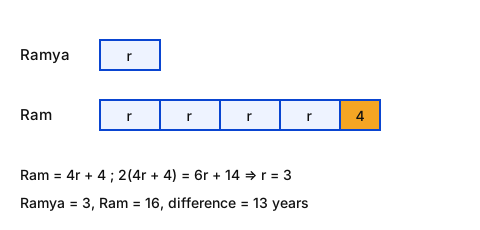
If 2 times the age of Ram is 14 years more than 6 times the age of Ramya, and 4 times the age of Ramya is 4 years less than the age of Ram, then what is the difference (in years) between the ages of Ram and Ramya?
यदि राम की आयु का 2 गुना, रम्या की आयु के 6 गुने से 14 वर्ष अधिक है, और रम्या की आयु का 4 गुना, राम की आयु से 4 वर्ष कम है, तो राम और रम्या की आयु के बीच का अंतर (वर्षों में) कितना है?
  1. A15
  2. B17
  3. C13
  4. D14
Show answer

Concept: Let Ram's age =R and Ramya's age =r; translate each sentence into an equation.

  1. "2 times Ram is 14 more than 6 times Ramya": 2R=6r+14 ⇒ R=3r+7.
  2. "4 times Ramya is 4 less than Ram": 4r=R−4 ⇒ R=4r+4.
  3. 3r+7=4r+4 ⇒ r=3, R=16.
  4. Difference =16−3=13 years.

Trick: Equate the two expressions of R directly: 3r+7=4r+4.

Answer: (C) 13

अवधारणा: राम की आयु =R और रम्या की आयु =r मानें; हर वाक्य को समीकरण में बदलें।

  1. "राम की आयु का 2 गुना, रम्या की आयु के 6 गुने से 14 अधिक": 2R=6r+14 ⇒ R=3r+7।
  2. "रम्या की आयु का 4 गुना, राम की आयु से 4 कम": 4r=R−4 ⇒ R=4r+4।
  3. 3r+7=4r+4 ⇒ r=3, R=16।
  4. अंतर =16−3=13 वर्ष।

ट्रिक: R के दोनों रूप बराबर करें: 3r+7=4r+4।

उत्तर: (C) 13

RRB NTPC Undergraduate CBT 1MathematicsAges – linear equationsRRB NTPC Undergraduate CBT 1 2024 · 22 Aug Shift 1 →
Q848.
If the third proportional of 4 and 22 be x, then what is the value of x?
यदि 4 और 22 का तृतीयानुपाती x है, तो x का मान क्या है?
  1. A122
  2. B121
  3. C123
  4. D119
Show answer

Concept: Third proportional of a and b is x such that a:b=b:x, i.e. x=b2a.

  1. 4:22=22:x.
  2. x=2224=4844=121.

Trick: Third proportional =(second)2first.

Answer: (B) 121

अवधारणा: a और b का तृतीय समानुपाती x वह है जिसके लिए a:b=b:x, अर्थात् x=b2a।

  1. 4:22=22:x।
  2. x=2224=4844=121।

ट्रिक: तृतीय समानुपाती =(दूसरा)2पहला।

उत्तर: (B) 121

RRB NTPC Undergraduate CBT 1MathematicsRatio – Third proportionalRRB NTPC Undergraduate CBT 1 2024 · 22 Aug Shift 1 →
Q849.
The value of 121+0.0121−7.84 is ______.
121+0.0121−7.84 का मान ______ है।
  1. A3.9
  2. B8.31
  3. C7.73
  4. D10.34
Show answer

Concept: For a decimal, take the square root of the digits and halve the number of decimal places.

  1. 121=11.
  2. 0.0121=0.11 (4 decimal places → 2).
  3. 7.84=2.8 since 282=784.
  4. 11+0.11−2.8=8.31.

Trick: Decimal places in the square root = half of those under the root.

Answer: (B) 8.31

अवधारणा: दशमलव संख्या का वर्गमूल: अंकों का वर्गमूल लें और दशमलव स्थान आधे कर दें।

  1. 121=11।
  2. 0.0121=0.11 (4 दशमलव स्थान → 2)।
  3. 7.84=2.8 क्योंकि 282=784।
  4. 11+0.11−2.8=8.31।

ट्रिक: वर्गमूल में दशमलव स्थान = मूल संख्या के दशमलव स्थानों का आधा।

उत्तर: (B) 8.31

RRB NTPC Undergraduate CBT 1MathematicsSquare roots of decimalsRRB NTPC Undergraduate CBT 1 2024 · 22 Aug Shift 1 →
Q850.
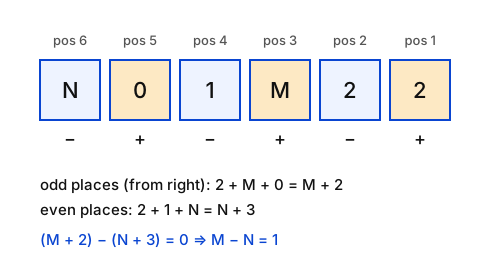
If the 6-digit number N01M22 is divisible by 11, then which of the options below can give a possible correct relation between M and N?
यदि 6 अंकों की संख्या N01M22, 11 से विभाज्य है, तो नीचे दिए गए विकल्पों में से कौन-सा विकल्प M और N के बीच संभावित सही संबंध दे सकता है?
  1. AM - N = 1
  2. BM + N = -1
  3. CM - N = 5
  4. DM = N
Show answer

Concept: A number is divisible by 11 if (sum of digits at odd places) − (sum at even places), counted from the right, is 0 or a multiple of 11.

  1. N01M22 from right: odd places 2,M,0 → M+2; even places 2,1,N → N+3.
  2. Condition: (M+2)−(N+3)=M−N−1 must be 0 or ±11.
  3. Since M,N are digits, M−N−1=0 ⇒ M−N=1 (e.g. M=3,N=2: 201322=11×18302).
  4. M−N=5 gives 4, M=N gives −1; M+N=−1 is impossible for digits.

Trick: Mark alternate digits +,− from the right and set the total to 0.

Answer: (A) M−N=1

अवधारणा: कोई संख्या 11 से विभाज्य है यदि दाएँ से (विषम स्थानों के अंकों का योग) − (सम स्थानों का योग) 0 या 11 का गुणज हो।

  1. N01M22 में दाएँ से विषम स्थान 2,M,0 → M+2; सम स्थान 2,1,N → N+3।
  2. शर्त: (M+2)−(N+3)=M−N−1 का मान 0 या ±11।
  3. M,N अंक हैं, अतः M−N−1=0 ⇒ M−N=1 (जैसे M=3,N=2: 201322=11×18302)।
  4. M−N=5 से 4, M=N से −1; अंकों के लिए M+N=−1 असंभव।

ट्रिक: दाएँ से अंकों पर +,− बारी-बारी लगाएँ और योग 0 रखें।

उत्तर: (A) M−N=1

RRB NTPC Undergraduate CBT 1MathematicsDivisibility by 11RRB NTPC Undergraduate CBT 1 2024 · 22 Aug Shift 1 →
Q851.
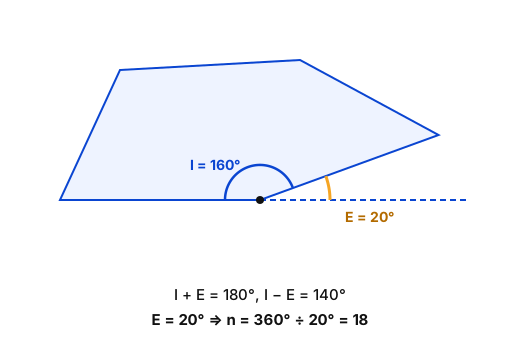
If the difference between an interior angle and exterior angle of a regular polygon is 140°, then the number of sides of the polygon is equal to:
यदि किसी सम बहुभुज के एक आंतरिक कोण और बाह्य कोण का अंतर 140° है, तो बहुभुज की भुजाओं की संख्या किसके बराबर है?
  1. A12
  2. B14
  3. C18
  4. D16
Show answer

Concept: At every vertex of a polygon, interior angle + exterior angle =180∘; for a regular polygon n=360∘exterior angle.

  1. I+E=180∘ and I−E=140∘.
  2. Subtracting: 2E=40∘⇒E=20∘ (and I=160∘).
  3. n=360∘20∘=18.

Trick: Exterior angle =180∘−difference2=180∘−140∘2=20∘, then divide 360 by it.

Answer: (C) 18

अवधारणा: हर शीर्ष पर अंतः कोण + बाह्य कोण =180∘; सम बहुभुज में n=360∘बाह्य कोण।

  1. I+E=180∘ तथा I−E=140∘।
  2. घटाने पर: 2E=40∘⇒E=20∘ (और I=160∘)।
  3. n=360∘20∘=18।

ट्रिक: बाह्य कोण =180∘−अंतर2=20∘, फिर 360 को इससे भाग दें।

उत्तर: (C) 18

RRB NTPC Undergraduate CBT 1MathematicsPolygon anglesRRB NTPC Undergraduate CBT 1 2024 · 22 Aug Shift 1 →
Q852.
Find the simple interest (in ₹) on ₹1,200 at an interest rate of 4% per month for 1 month.
₹1,200 पर 4% प्रति माह की ब्याज दर से 1 माह का साधारण ब्याज (₹ में) ज्ञात कीजिए।
  1. A₹8
  2. B₹24
  3. C₹4
  4. D₹48
Show answer

Concept: SI=P×R×T100, with R and T in the same time unit (here per month and months).

  1. P=1200, R=4% per month, T=1 month.
  2. SI=1200×4×1100=48.

Trick: 4% of 1200: 12×4=48 — 1% of a hundreds-number is just that number ÷ 100.

Answer: (D) ₹48

अवधारणा: SI=P×R×T100; R और T की इकाई समान हो (यहाँ प्रति माह और माह)।

  1. P=1200, R=4% प्रति माह, T=1 माह।
  2. SI=1200×4×1100=48।

ट्रिक: 1200 का 1% = 12, तो 4% = 12×4=48।

उत्तर: (D) ₹48

RRB NTPC Undergraduate CBT 1MathematicsSimple interestRRB NTPC Undergraduate CBT 1 2024 · 22 Aug Shift 1 →
Q853.
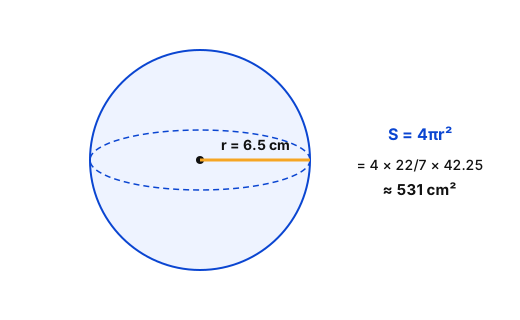
Find the surface area (rounded off to the nearest integer) of a sphere of radius 6.5 cm. (Take π = 22/7)
6.5 cm त्रिज्या वाले एक गोले का पृष्ठीय क्षेत्रफल (निकटतम पूर्णांक तक पूर्णांकित) ज्ञात कीजिए। (π = 22/7 लीजिए)
  1. A534 cm2
  2. B540 cm2
  3. C531 cm2
  4. D530 cm2
Show answer

Concept: Surface area of a sphere =4πr2.

  1. r2=6.52=42.25.
  2. 4×227×42.25=88×42.257=37187.
  3. 37187≈531.14≈531cm2.

Trick: 4πr2=887r2 — multiply r2 by 88 and divide by 7.

Answer: (C) 531cm2

अवधारणा: गोले का पृष्ठीय क्षेत्रफल =4πr2।

  1. r2=6.52=42.25।
  2. 4×227×42.25=37187।
  3. 37187≈531.14≈531cm2।

ट्रिक: 4πr2=887r2 — r2 को 88 से गुणा कर 7 से भाग दें।

उत्तर: (C) 531cm2

RRB NTPC Undergraduate CBT 1MathematicsSurface area of sphereRRB NTPC Undergraduate CBT 1 2024 · 22 Aug Shift 1 →
Q854.
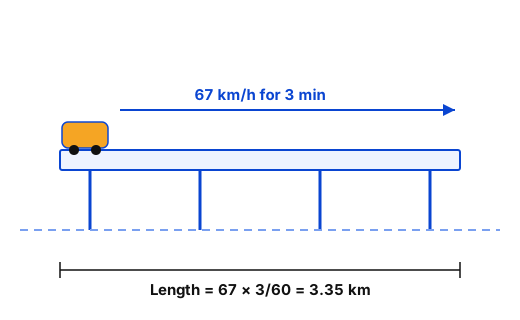
A man driving a car at a speed of 67 km/hr crosses a bridge in 3 minutes. Find the length of the bridge.
67 km/hr की चाल से कार चला रहा एक व्यक्ति 3 मिनट में एक पुल पार करता है। पुल की लंबाई ज्ञात कीजिए।
  1. A2.46 km
  2. B3.35 km
  3. C2.84 km
  4. D2.51 km
Show answer

Concept: Distance = Speed × Time; convert minutes to hours first. (A car's own length is negligible.)

  1. Time =3 min =360=120 h.
  2. Length of bridge =67×120=3.35km.

Trick: In 3 minutes a vehicle covers 120 of its km/h speed: 67÷20=3.35.

Answer: (B) 3.35 km

अवधारणा: दूरी = चाल × समय; पहले मिनट को घंटे में बदलें (कार की लंबाई नगण्य मानी जाती है)।

  1. समय =3 मिनट =360=120 घंटा।
  2. पुल की लंबाई =67×120=3.35km।

ट्रिक: 3 मिनट में दूरी = चाल (km/h) ÷20: 67÷20=3.35।

उत्तर: (B) 3.35 km

RRB NTPC Undergraduate CBT 1MathematicsSpeed, distance and timeRRB NTPC Undergraduate CBT 1 2024 · 22 Aug Shift 1 →
Q855.
The HCF and LCM of two numbers are 11 and 792, respectively. If one number is 88, then find the other number.
दो संख्याओं का HCF और LCM क्रमशः 11 और 792 है। यदि एक संख्या 88 है, तो दूसरी संख्या ज्ञात कीजिए।
  1. A99
  2. B97
  3. C93
  4. D89
Show answer

Concept: Product of two numbers = HCF × LCM.

  1. 88×x=11×792.
  2. x=11×79288=7928=99.

Trick: Check: 99=11×9 and 88=11×8; LCM =11×8×9=792 ✓.

Answer: (A) 99

अवधारणा: दो संख्याओं का गुणनफल = HCF × LCM।

  1. 88×x=11×792।
  2. x=11×79288=7928=99।

ट्रिक: जाँच: 99=11×9, 88=11×8; LCM =11×72=792 ✓।

उत्तर: (A) 99

RRB NTPC Undergraduate CBT 1MathematicsHCF and LCMRRB NTPC Undergraduate CBT 1 2024 · 22 Aug Shift 1 →
Q856.
A company offers three schemes of successive discounts.
First: 25%, 10%
Second: 20 %, 15%
Third: 30%, 5%
Which scheme is best for the company?
एक कंपनी क्रमिक छूट की तीन योजनाएँ प्रस्तुत करती है।
पहली: 25%, 10%
दूसरी: 20 %, 15%
तीसरी: 30%, 5%
कंपनी के लिए कौन-सी योजना सबसे अच्छी है?
  1. AFirst schemeपहली योजना
  2. BThird schemeतीसरी योजना
  3. CAll the schemes are sameसभी योजनाएँ समान हैं
  4. DSecond schemeदूसरी योजना
Show answer

Concept: Two successive discounts a% and b% equal a single discount of a+b−ab100 %. The scheme with the LEAST discount is best for the company.

  1. First: 25+10−250100=32.5%.
  2. Second: 20+15−300100=32%.
  3. Third: 30+5−150100=33.5%.
  4. Least discount =32% → Second scheme.

Trick: Best for the buyer = biggest discount; best for the seller/company = smallest discount.

Answer: (D) Second scheme

अवधारणा: दो क्रमिक छूट a%, b% = एकल छूट a+b−ab100 %। कंपनी के लिए वही योजना अच्छी है जिसमें छूट सबसे कम हो।

  1. पहली: 25+10−2.5=32.5%।
  2. दूसरी: 20+15−3=32%।
  3. तीसरी: 30+5−1.5=33.5%।
  4. सबसे कम छूट 32% → दूसरी योजना।

ट्रिक: ग्राहक के लिए सबसे अधिक छूट, कंपनी (विक्रेता) के लिए सबसे कम छूट वाली योजना अच्छी।

उत्तर: (D) दूसरी योजना (Second scheme)

RRB NTPC Undergraduate CBT 1MathematicsSuccessive discountsRRB NTPC Undergraduate CBT 1 2024 · 22 Aug Shift 1 →
Q857.
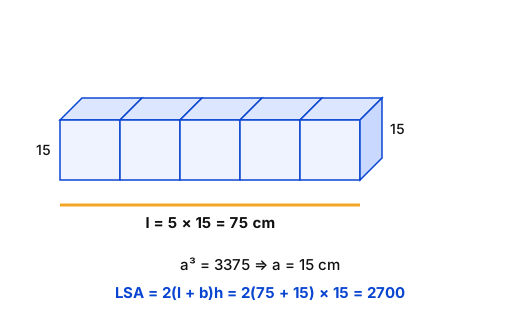
Five solid cubes, each of volume 3375 cm3, are joined end to end to form a cuboid. What is the lateral surface area (in cm2) of the cuboid?
पाँच ठोस घन, जिनमें से प्रत्येक का आयतन 3375 cm3 है, को सिरे से सिरा मिलाकर एक घनाभ बनाया जाता है। घनाभ का पार्श्व पृष्ठीय क्षेत्रफल (cm2 में) कितना है?
  1. A2700
  2. B2409
  3. C2801
  4. D2694
Show answer

Concept: Lateral surface area of a cuboid =2(l+b)h.

  1. Side of each cube: a3=3375⇒a=15cm.
  2. Five cubes in a row: l=75, b=15, h=15.
  3. LSA =2(75+15)×15=2×90×15=2700cm2.

Trick: For n cubes of side a joined in a line, LSA =2(n+1)a2=2×6×225=2700.

Answer: (A) 2700

अवधारणा: घनाभ का पार्श्व पृष्ठीय क्षेत्रफल (LSA) =2(l+b)h।

  1. प्रत्येक घन की भुजा: a3=3375⇒a=15cm।
  2. पाँच घन एक पंक्ति में: l=75, b=15, h=15।
  3. LSA =2(75+15)×15=2700cm2।

ट्रिक: n घन एक सीध में: LSA =2(n+1)a2=2×6×225=2700।

उत्तर: (A) 2700

RRB NTPC Undergraduate CBT 1MathematicsCube and cuboidRRB NTPC Undergraduate CBT 1 2024 · 22 Aug Shift 1 →
Q858.
Anjali can do a certain piece of work in 21 days. Anjali and Ayushi can together do the same work in 12 days, and Anjali, Ayushi and Ankita can do the same work together in 8 days. In how many days can Anjali and Ankita do the same work?
अंजलि किसी कार्य को 21 दिनों में कर सकती है। अंजलि और आयुषी मिलकर उसी कार्य को 12 दिनों में कर सकती हैं, और अंजलि, आयुषी और अंकिता मिलकर उसी कार्य को 8 दिनों में कर सकती हैं। अंजलि और अंकिता मिलकर उसी कार्य को कितने दिनों में कर सकती हैं?
  1. A476
  2. B577
  3. C485
  4. D565
Show answer

Concept: One-day work adds up: if a group does a job in d days, its one-day work is 1d.

  1. Anjali =121; Ayushi =112−121=7−484=128.
  2. Ankita =18−112=3−224=124.
  3. Anjali + Ankita =121+124=8+7168=15168=556.
  4. Days =565.

Trick: Take total work = LCM(21, 12, 8) = 168 units: Anjali 8/day, all three 21/day, Anjali+Ayushi 14/day → Ankita 7/day → 1688+7=565.

Answer: (D) 565 days

अवधारणा: एक दिन का काम जुड़ता है: कोई समूह काम d दिन में करे तो एक दिन का काम 1d।

  1. अंजलि =121; आयुषी =112−121=128।
  2. अंकिता =18−112=124।
  3. अंजलि + अंकिता =121+124=15168=556।
  4. दिन =565।

ट्रिक: कुल काम = LCM(21, 12, 8) = 168 इकाई: अंजलि 8/दिन, तीनों 21/दिन, अंजलि+आयुषी 14/दिन → अंकिता 7/दिन → 16815=565।

उत्तर: (D) 565 दिन

RRB NTPC Undergraduate CBT 1MathematicsTime and workRRB NTPC Undergraduate CBT 1 2024 · 22 Aug Shift 1 →
Q859.
If M=1+cosA1−cosA−cosecA−cotA, and A is an acute angle, then value of M is
यदि M=1+cosA1−cosA−cosecA−cotA, और A एक न्यून कोण है, तो M का मान है
  1. A1
  2. B0
  3. C2
  4. D-1
Show answer

Concept: Rationalise: 1+cosA1−cosA=1+cosAsinA, using 1−cos2A=sin2A.

  1. Multiply inside by 1+cosA1+cosA: (1+cosA)2sin2A=1+cosAsinA (positive for acute A).
  2. 1+cosAsinA=cosecA+cotA.
  3. M=(cosecA+cotA)−cosecA−cotA=0.

Trick: Put A=60∘: 1.50.5=3 and cosec60∘+cot60∘=23+13=3, so M=0.

Answer: (B) 0

अवधारणा: परिमेयकरण: 1+cosA1−cosA=1+cosAsinA, क्योंकि 1−cos2A=sin2A।

  1. अंश-हर को (1+cosA) से गुणा: (1+cosA)2sin2A=1+cosAsinA (न्यून कोण A के लिए धनात्मक)।
  2. 1+cosAsinA=cosecA+cotA।
  3. M=(cosecA+cotA)−cosecA−cotA=0।

ट्रिक: A=60∘ रखें: 3−23−13=0।

उत्तर: (B) 0

RRB NTPC Undergraduate CBT 1MathematicsTrigonometric identitiesRRB NTPC Undergraduate CBT 1 2024 · 22 Aug Shift 1 →
Q860.
The sum of two numbers is 52 and their LCM is 627. The two numbers are:
दो संख्याओं का योग 52 है और उनका LCM 627 है। दोनों संख्याएँ हैं:
  1. A19, 33
  2. B12, 40
  3. C17, 35
  4. D24, 28
Show answer

Concept: When the sum and LCM are given, test options: the pair must add to 52 and have LCM 627.

  1. 627=3×11×19=19×33.
  2. 19 and 33 are co-prime, so LCM =19×33=627 ✓ and 19+33=52 ✓.
  3. Others fail: LCM(12, 40) = 120, LCM(17, 35) = 595, LCM(24, 28) = 168.

Trick: Factorise the LCM and look for two factors whose sum is 52.

Answer: (A) 19, 33

अवधारणा: योग और LCM दिए हों तो विकल्प जाँचें: जोड़ी का योग 52 और LCM 627 हो।

  1. 627=3×11×19=19×33।
  2. 19 और 33 सह-अभाज्य हैं, अतः LCM =627 ✓ और 19+33=52 ✓।
  3. बाकी: LCM(12, 40) = 120, LCM(17, 35) = 595, LCM(24, 28) = 168।

ट्रिक: LCM के गुणनखंड करें और ऐसे दो गुणनखंड खोजें जिनका योग 52 हो।

उत्तर: (A) 19, 33

RRB NTPC Undergraduate CBT 1MathematicsHCF and LCMRRB NTPC Undergraduate CBT 1 2024 · 22 Aug Shift 1 →