Question bank

Q&A: practice questions with answers

Search questions on any topic. Filter by exam category, exam, subject and topic, try the question, then open the answer and explanation.

Courses – airGurukul

8,495 questions found.

Q861.
In covering a distance of 156 km, Abhay takes 5 hours more than Sameer. If Abhay doubles his speed, then he would take 8 hours less than Sameer. Abhay's speed is:
156 km की दूरी तय करने में अभय, समीर से 5 घंटे अधिक लेता है। यदि अभय अपनी चाल दोगुनी कर दे, तो वह समीर से 8 घंटे कम लेगा। अभय की चाल है:
  1. A16 km/hr
  2. B1 km/hr
  3. C6 km/hr
  4. D7 km/hr
Show answer

Concept: Time =DistanceSpeed. Let Abhay's speed be a and Sameer's time be t.

  1. 156a=t+5 … (1)
  2. With double speed: 1562a=78a=t−8 … (2)
  3. (1) − (2): 78a=13⇒a=6km/h.
  4. Check: Abhay 26 h, Sameer 21 h, doubled speed 13 h =21−8 ✓.

Trick: Doubling speed halves the time: half of Abhay's time is saved, and that saving =5+8=13 h, so full time =26 h → 156÷26=6.

Answer: (C) 6 km/hr

अवधारणा: समय =दूरीचाल। अभय की चाल a तथा समीर का समय t मानें।

  1. 156a=t+5 … (1)
  2. दोगुनी चाल: 78a=t−8 … (2)
  3. (1) − (2): 78a=13⇒a=6km/h।
  4. जाँच: अभय 26 घंटे, समीर 21 घंटे, दोगुनी चाल पर 13 घंटे =21−8 ✓।

ट्रिक: चाल दोगुनी → समय आधा; बचा समय =5+8=13 घंटे = आधा समय, तो पूरा समय 26 घंटे → 156÷26=6।

उत्तर: (C) 6 km/hr

RRB NTPC Undergraduate CBT 1MathematicsSpeed, distance and timeRRB NTPC Undergraduate CBT 1 2024 · 22 Aug Shift 1 →
Q862.
Evaluate: (-9) - (-60) ÷ (-10) + (-2) × 6
मान ज्ञात कीजिए: (-9) - (-60) ÷ (-10) + (-2) × 6
  1. A-27
  2. B-30
  3. C-26
  4. D-29
Show answer

Concept: BODMAS: do division and multiplication before addition and subtraction; watch the signs.

  1. (−60)÷(−10)=6.
  2. (−2)×6=−12.
  3. (−9)−6+(−12)=−9−6−12=−27.

Trick: Negative ÷ negative = positive; then simply add all negatives: 9+6+12=27.

Answer: (A) −27

अवधारणा: BODMAS: पहले भाग और गुणा, फिर जोड़-घटाव; चिह्नों का ध्यान रखें।

  1. (−60)÷(−10)=6।
  2. (−2)×6=−12।
  3. (−9)−6+(−12)=−27।

ट्रिक: ऋणात्मक ÷ ऋणात्मक = धनात्मक; फिर सभी ऋणात्मक जोड़ें: 9+6+12=27।

उत्तर: (A) −27

RRB NTPC Undergraduate CBT 1MathematicsSimplification (BODMAS)RRB NTPC Undergraduate CBT 1 2024 · 22 Aug Shift 1 →
Q863.
The product of two positive numbers is 10125. If the first number is five times the second number, then the sum of the two numbers is:
दो धनात्मक संख्याओं का गुणनफल 10125 है। यदि पहली संख्या, दूसरी संख्या की पाँच गुनी है, तो दोनों संख्याओं का योग है:
  1. A265
  2. B286
  3. C264
  4. D270
Show answer

Concept: Write both numbers in terms of one variable and use the product.

  1. Second =x, first =5x.
  2. 5x2=10125⇒x2=2025⇒x=45.
  3. Sum =x+5x=6x=270.

Trick: 2025=452 is worth remembering (also a year!).

Answer: (D) 270

अवधारणा: दोनों संख्याओं को एक चर में लिखकर गुणनफल का प्रयोग करें।

  1. दूसरी =x, पहली =5x।
  2. 5x2=10125⇒x2=2025⇒x=45।
  3. योग =6x=270।

ट्रिक: 2025=452 याद रखें।

उत्तर: (D) 270

RRB NTPC Undergraduate CBT 1MathematicsNumbersRRB NTPC Undergraduate CBT 1 2024 · 22 Aug Shift 1 →
Q864.
If the interest earned during the 2nd year on a certain sum is ₹5,214, and the rate of interest is 10% per annum compounded annually, then the sum is:
यदि किसी निश्चित धनराशि पर 2रे वर्ष के दौरान अर्जित ब्याज ₹5,214 है, और ब्याज की दर 10% वार्षिक, वार्षिक रूप से चक्रवृद्धि है, तो धनराशि है:
  1. A₹47,755
  2. B₹46,650
  3. C₹47,320
  4. D₹47,400
Show answer

Concept: CI of the 2nd year = interest on (P + 1st year interest) =P×R100×(1+R100).

  1. 2nd-year interest =P×0.1×1.1=0.11P.
  2. 0.11P=5214⇒P=52140.11=47400.

Trick: At 10%, 1st year interest =10% of P, 2nd year =11% of P. So P=5214×10011.

Answer: (D) ₹47,400

अवधारणा: दूसरे वर्ष का CI = (P + पहले वर्ष का ब्याज) पर ब्याज =P×R100×(1+R100)।

  1. दूसरे वर्ष का ब्याज =P×0.1×1.1=0.11P।
  2. 0.11P=5214⇒P=47400।

ट्रिक: 10% पर पहले वर्ष ब्याज = P का 10%, दूसरे वर्ष = P का 11%; P=5214×10011।

उत्तर: (D) ₹47,400

RRB NTPC Undergraduate CBT 1MathematicsCompound interestRRB NTPC Undergraduate CBT 1 2024 · 22 Aug Shift 1 →
Q865.
A trader claims to sell pulses at a profit of 3%, but also dishonestly uses a weight which is 15% less than what is mentioned on it. Find the total percentage of profit earned by the trader. (Round off the answer to the nearest whole number.)
एक व्यापारी 3% लाभ पर दालें बेचने का दावा करता है, परंतु साथ ही बेईमानी से ऐसे बाट का उपयोग करता है जो उस पर अंकित भार से 15% कम है। व्यापारी द्वारा अर्जित कुल लाभ प्रतिशत ज्ञात कीजिए। (उत्तर को निकटतम पूर्ण संख्या तक पूर्णांकित कीजिए।)
  1. A26%
  2. B20%
  3. C21%
  4. D16%
Show answer

Concept: With a false weight the trader gives only 85% of the goods but charges the price of 100%, plus 3% profit on that price.

  1. Cost of goods actually given =0.85 (per unit of true price).
  2. Money received =1.03.
  3. Profit %=1.03−0.850.85×100=1885×100≈21.18%≈21%.

Trick: Profit %=(100+p)−(100−w)100−w×100=103−8585×100.

Answer: (C) 21%

अवधारणा: कम तौल से व्यापारी केवल 85% माल देता है पर दाम 100% का लेता है, और उस पर 3% लाभ भी।

  1. वास्तव में दिए माल का क्रय मूल्य =0.85।
  2. प्राप्त राशि =1.03।
  3. लाभ%=1.03−0.850.85×100=1885×100≈21%।

ट्रिक: लाभ%=(100+p)−(100−w)100−w×100=103−8585×100।

उत्तर: (C) 21%

RRB NTPC Undergraduate CBT 1MathematicsProfit and loss (false weight)RRB NTPC Undergraduate CBT 1 2024 · 22 Aug Shift 1 →
Q866.
Kushal and Brijesh together invested ₹63,300 in a business. At the end of the year, out of a total profit of ₹17,600, Brijesh's share was ₹2,200. What was the difference between their investments?
कुशल और बृजेश ने मिलकर एक व्यवसाय में ₹63,300 का निवेश किया। वर्ष के अंत में, ₹17,600 के कुल लाभ में से बृजेश का हिस्सा ₹2,200 था। उनके निवेशों के बीच कितना अंतर था?
  1. A₹48,876
  2. B₹45,979
  3. C₹47,475
  4. D₹46,154
Show answer

Concept: For the same period, profit is shared in the ratio of investments.

  1. Brijesh's share =220017600=18 of profit, so Kushal's =78.
  2. Investment ratio K : B =7:1; total =63300, so 1 part =633008=7912.5.
  3. Difference =7−1=6 parts =6×7912.5=47475.

Trick: Difference =7−18×63300=34×63300=47475.

Answer: (C) ₹47,475

अवधारणा: समान अवधि हो तो लाभ निवेश के अनुपात में बँटता है।

  1. बृजेश का हिस्सा =220017600=18, कुशल का =78।
  2. निवेश अनुपात K : B =7:1; 1 भाग =633008=7912.5।
  3. अंतर =6 भाग =6×7912.5=47475।

ट्रिक: अंतर =68×63300=34×63300=47475।

उत्तर: (C) ₹47,475

RRB NTPC Undergraduate CBT 1MathematicsPartnershipRRB NTPC Undergraduate CBT 1 2024 · 22 Aug Shift 1 →
Q867.
Pipe A can fill a tank in 13 hours, pipe B can fill the same tank in 29 hours and pipe C can fill the same tank in 10 hours. The time taken by them to fill the same tank if they operate together is::
पाइप A एक टंकी को 13 घंटे में भर सकता है, पाइप B उसी टंकी को 29 घंटे में भर सकता है और पाइप C उसी टंकी को 10 घंटे में भर सकता है। यदि वे एक साथ कार्य करें, तो उसी टंकी को भरने में उनके द्वारा लिया गया समय है:
  1. A11582797 hours11582797 घंटे
  2. B3582797 hours3582797 घंटे
  3. C4582797 hours4582797 घंटे
  4. D10582797 hours10582797 घंटे
Show answer

Concept: Pipes working together: add their one-hour work.

  1. 113+129+110=290+130+3773770=7973770.
  2. Time =3770797 hours.
  3. 797×4=3188, remainder 3770−3188=582, so time =4582797 hours.

Trick: Estimate first: C alone takes 10 h, so together it must be well below 10 h; and 3770797≈4.7, so only 4582797 fits.

Answer: (C) 4582797 hours

अवधारणा: साथ चलने पर एक घंटे का काम जोड़ें।

  1. 113+129+110=290+130+3773770=7973770।
  2. समय =3770797 घंटे।
  3. 797×4=3188, शेष 582, अतः समय =4582797 घंटे।

ट्रिक: अनुमान: अकेला C 10 घंटे लेता है, तो साथ में समय 10 से काफ़ी कम होगा; 3770797≈4.7।

उत्तर: (C) 4582797 घंटे

RRB NTPC Undergraduate CBT 1MathematicsPipes and cisternsRRB NTPC Undergraduate CBT 1 2024 · 22 Aug Shift 1 →
Q868.
The average runs scored by a batsman in 23 matches is 42. In the next 10 matches, the batsman scored an average of 14 runs. Find his average runs scored (rounded off to two decimal places) in all the 33 matches.
एक बल्लेबाज़ द्वारा 23 मैचों में बनाए गए रनों का औसत 42 है। अगले 10 मैचों में बल्लेबाज़ ने 14 रन का औसत बनाया। सभी 33 मैचों में उसके द्वारा बनाए गए रनों का औसत (दो दशमलव स्थानों तक पूर्णांकित) ज्ञात कीजिए।
  1. A33.52
  2. B32.52
  3. C35.52
  4. D34.52
Show answer

Concept: Overall average =total runstotal matches.

  1. Runs in 23 matches =23×42=966.
  2. Runs in next 10 =10×14=140.
  3. Average =966+14033=110633≈33.52.

Trick: Deviation method: 42−10×(42−14)33=42−28033=42−8.48=33.52.

Answer: (A) 33.52

अवधारणा: कुल औसत =कुल रनकुल मैच।

  1. 23 मैचों के रन =23×42=966।
  2. अगले 10 के रन =10×14=140।
  3. औसत =110633≈33.52।

ट्रिक: विचलन विधि: 42−10×2833=42−8.48=33.52।

उत्तर: (A) 33.52

RRB NTPC Undergraduate CBT 1MathematicsAverageRRB NTPC Undergraduate CBT 1 2024 · 22 Aug Shift 1 →
Q869.
The income of Raman is ₹60,500. He saves 26% of his income. If his income increases by 17% and expenditure increases by 50%, then his savings will:
रमन की आय ₹60,500 है। वह अपनी आय का 26% बचाता है। यदि उसकी आय में 17% की वृद्धि होती है और व्यय में 50% की वृद्धि होती है, तो उसकी बचत:
  1. Aincrease by ₹12,099₹12,099 बढ़ जाएगी
  2. Bdecrease by ₹12,095₹12,095 घट जाएगी
  3. Cdecrease by ₹12,100₹12,100 घट जाएगी
  4. Dincrease by ₹12,098₹12,098 बढ़ जाएगी
Show answer

Concept: Savings = Income − Expenditure; apply each percentage change to its own base.

  1. Savings =26% of 60500 =15730; expenditure =60500−15730=44770.
  2. New income =1.17×60500=70785; new expenditure =1.5×44770=67155.
  3. New savings =70785−67155=3630.
  4. Change =3630−15730=−12100 → decrease of ₹12,100.

Trick: Change in savings = change in income − change in expenditure =10285−22385=−12100.

Answer: (C) decrease by ₹12,100

अवधारणा: बचत = आय − व्यय; हर प्रतिशत परिवर्तन अपने आधार पर लगाएँ।

  1. बचत =60500 का 26%=15730; व्यय =44770।
  2. नई आय =1.17×60500=70785; नया व्यय =1.5×44770=67155।
  3. नई बचत =70785−67155=3630।
  4. परिवर्तन =3630−15730=−12100 → ₹12,100 की कमी।

ट्रिक: बचत में बदलाव = आय में बदलाव − व्यय में बदलाव =10285−22385=−12100।

उत्तर: (C) ₹12,100 की कमी (decrease by ₹12,100)

RRB NTPC Undergraduate CBT 1MathematicsIncome, expenditure and savingsRRB NTPC Undergraduate CBT 1 2024 · 22 Aug Shift 1 →
Q870.
Mr. Sharma, Mr. Gupta and Ms. Sinha invested ₹4,000, ₹8,000 and ₹6,000, respectively, in a business. Mr. Sharma left the business after 6 months. If after 8 months, there was a gain of ₹34,000, then what will be the share of Mr. Gupta?
श्री शर्मा, श्री गुप्ता और सुश्री सिन्हा ने एक व्यवसाय में क्रमशः ₹4,000, ₹8,000 और ₹6,000 का निवेश किया। श्री शर्मा ने 6 माह बाद व्यवसाय छोड़ दिया। यदि 8 माह बाद ₹34,000 का लाभ हुआ, तो श्री गुप्ता का हिस्सा कितना होगा?
  1. A₹12,000
  2. B₹20,000
  3. C₹16,000
  4. D₹14,000
Show answer

Concept: Profit share ∝ investment × time.

  1. Sharma: 4000×6=24000; Gupta: 8000×8=64000; Sinha: 6000×8=48000.
  2. Ratio =24:64:48=3:8:6 (total 17).
  3. Gupta's share =817×34000=16000.

Trick: Cancel the 1000s and common factors early: (4×6):(8×8):(6×8)=3:8:6.

Answer: (C) ₹16,000

अवधारणा: लाभ का हिस्सा ∝ निवेश × समय।

  1. शर्मा: 4000×6=24000; गुप्ता: 8000×8=64000; सिन्हा: 6000×8=48000।
  2. अनुपात =3:8:6 (कुल 17)।
  3. गुप्ता का हिस्सा =817×34000=16000।

ट्रिक: हज़ार हटाकर सरल करें: (4×6):(8×8):(6×8)=3:8:6।

उत्तर: (C) ₹16,000

RRB NTPC Undergraduate CBT 1MathematicsPartnershipRRB NTPC Undergraduate CBT 1 2024 · 22 Aug Shift 1 →
Q871.
Based on the English alphabetical order, three of the following four letter-cluster pairs are alike in a certain way and thus form a group. Which letter-cluster pair DOES NOT belong to that group?
(Note: The odd one out is not based on the number of consonants/vowels or their position in the letter-cluster.)
अंग्रेज़ी वर्णमाला क्रम के आधार पर, निम्नलिखित चार अक्षर-समूह युग्मों में से तीन किसी निश्चित प्रकार से एकसमान हैं और इस प्रकार एक समूह बनाते हैं। कौन-सा अक्षर-समूह युग्म उस समूह से संबंधित नहीं है?
(ध्यान दें: असंगत अक्षर-समूह, उस अक्षर-समूह में व्यंजनों/स्वरों की संख्या या उनके स्थान पर आधारित नहीं है।)
  1. AGI-LE
  2. BJL-OH
  3. CMO-RK
  4. DDF-IC
Show answer

Concept: Check the letter gaps inside each pair: 1st→2nd, 2nd→3rd, 3rd→4th letter.

  1. GI-LE: G +2 I, I +3 L, L −7 E.
  2. JL-OH: J +2 L, L +3 O, O −7 H; MO-RK: M +2 O, O +3 R, R −7 K.
  3. DF-IC: D +2 F, F +3 I, but I −6 C → breaks the pattern.

Trick: Write positions (G7, I9, L12, E5) and compare differences; the last gap is the giveaway.

Answer: (D) DF-IC

अवधारणा: हर जोड़ी में अक्षरों का अंतर देखें: पहला→दूसरा, दूसरा→तीसरा, तीसरा→चौथा।

  1. GI-LE: G +2 I, I +3 L, L −7 E।
  2. JL-OH: +2, +3, −7; MO-RK: +2, +3, −7।
  3. DF-IC: +2, +3, पर I −6 C → अलग।

ट्रिक: स्थानांक लिखें (G7, I9, L12, E5) और अंतर मिलाएँ; अंतिम अंतर से ही विषम पकड़ में आता है।

उत्तर: (D) DF-IC

RRB NTPC Undergraduate CBT 1General Intelligence and ReasoningLetter-cluster odd one outRRB NTPC Undergraduate CBT 1 2024 · 22 Aug Shift 1 →
Q872.
What will come in the place of the question mark (?) in the following equation, if ‘÷’ and ‘×’ are interchanged and ‘−‘ and ‘+’ are interchanged?
117 + 16 − 10 × 2 ÷ 2 − 68 + 10 × 5 − 9 = ?
यदि ‘÷’ और ‘×’ को आपस में बदल दिया जाए तथा ‘−‘ और ‘+’ को आपस में बदल दिया जाए, तो निम्नलिखित समीकरण में प्रश्न चिह्न (?) के स्थान पर क्या आएगा?
117 + 16 − 10 × 2 ÷ 2 − 68 + 10 × 5 − 9 = ?
  1. A124
  2. B96
  3. C168
  4. D186
Show answer

Concept: Swap the signs first, then solve with BODMAS.

  1. After swapping: 117−16+10÷2×2+68−10÷5+9.
  2. 10÷2×2=10 and 10÷5=2.
  3. 117−16+10+68−2+9=186.

Trick: Rewrite the whole expression once with new signs before calculating — avoids sign slips.

Answer: (D) 186

अवधारणा: पहले चिह्न बदलें, फिर BODMAS लगाएँ।

  1. बदलने के बाद: 117−16+10÷2×2+68−10÷5+9।
  2. 10÷2×2=10 और 10÷5=2।
  3. 117−16+10+68−2+9=186।

ट्रिक: नए चिह्नों के साथ पूरा व्यंजक एक बार दोबारा लिखें, फिर हल करें।

उत्तर: (D) 186

RRB NTPC Undergraduate CBT 1General Intelligence and ReasoningMathematical operationsRRB NTPC Undergraduate CBT 1 2024 · 22 Aug Shift 1 →
Q873.
Based on the English alphabetical order, three of the following four letter-clusters are alike in a certain way and thus form a group. Which letter-cluster DOES NOT belong to that group?
(Note: The odd one out is not based on the number of consonants/vowels or their position in the letter-cluster.)
अंग्रेज़ी वर्णमाला क्रम के आधार पर, निम्नलिखित चार अक्षर-समूहों में से तीन किसी निश्चित प्रकार से एकसमान हैं और इस प्रकार एक समूह बनाते हैं। कौन-सा अक्षर-समूह उस समूह से संबंधित नहीं है?
(ध्यान दें: असंगत अक्षर-समूह, उस अक्षर-समूह में व्यंजनों/स्वरों की संख्या या उनके स्थान पर आधारित नहीं है।)
  1. AINS
  2. BQBA
  3. CTYD
  4. DUZE
Show answer

Concept: Find the gap between consecutive letters (positions, counting cyclically after Z).

  1. INS: I(9) +5 N(14) +5 S(19).
  2. TYD: T(20) +5 Y(25) +5 D(4, after Z); UZE: U(21) +5 Z(26) +5 E(5).
  3. QBA: Q(17) → B(2) → A(1) — not +5, +5.

Trick: Use the EJOTY landmarks (5, 10, 15, 20, 25) to count +5 jumps fast.

Answer: (B) QBA

अवधारणा: क्रमागत अक्षरों का अंतर देखें (Z के बाद फिर A से गिनें)।

  1. INS: I(9) +5 N(14) +5 S(19)।
  2. TYD: T(20) +5 Y(25) +5 D; UZE: U(21) +5 Z(26) +5 E।
  3. QBA: Q(17) → B(2) → A(1) — +5, +5 नहीं।

ट्रिक: EJOTY (5, 10, 15, 20, 25) से +5 की छलांग जल्दी गिनें।

उत्तर: (B) QBA

RRB NTPC Undergraduate CBT 1General Intelligence and ReasoningLetter-cluster odd one outRRB NTPC Undergraduate CBT 1 2024 · 22 Aug Shift 1 →
Q874.
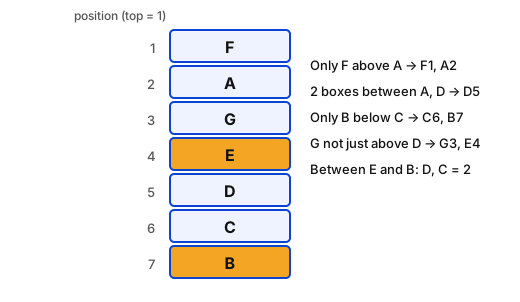
Seven boxes, A, B, C, D, E, F and G, are kept one over the other but not necessarily in the same order.
Only F is kept above A. Only two boxes are kept between A and D. Only B is kept below C. G is not kept immediately above D.
How many boxes are kept between B and E?
सात बक्से, A, B, C, D, E, F और G, एक के ऊपर एक रखे गए हैं, परंतु आवश्यक नहीं कि इसी क्रम में हों।
A के ऊपर केवल F रखा गया है। A और D के बीच केवल दो बक्से रखे गए हैं। C के नीचे केवल B रखा गया है। G को D के ठीक ऊपर नहीं रखा गया है।
B और E के बीच कितने बक्से रखे गए हैं?
  1. A1
  2. B4
  3. C3
  4. D2
Show answer

Concept: Number positions from the top (1) to the bottom (7) and place the fixed clues first.

  1. Only F above A → F at 1, A at 2.
  2. Two boxes between A and D → D at 5. Only B below C → C at 6, B at 7.
  3. E and G fill 3, 4; G is not immediately above D (not 4) → G 3, E 4.
  4. Between E (4) and B (7): D and C → 2 boxes.

Trick: 'Only X above Y' puts X at the top and Y second — always start from such clues.

Answer: (D) 2

अवधारणा: स्थान ऊपर से (1) नीचे (7) तक गिनें और पहले निश्चित संकेत लगाएँ।

  1. केवल F, A के ऊपर → F 1, A 2।
  2. A और D के बीच दो → D 5। केवल B, C के नीचे → C 6, B 7।
  3. E, G को 3, 4 में; G, D के ठीक ऊपर नहीं (4 नहीं) → G 3, E 4।
  4. E (4) और B (7) के बीच: D, C → 2 बॉक्स।

ट्रिक: 'केवल X, Y के ऊपर' का अर्थ X सबसे ऊपर और Y दूसरा — ऐसे संकेत से शुरू करें।

उत्तर: (D) 2

RRB NTPC Undergraduate CBT 1General Intelligence and ReasoningBox arrangementRRB NTPC Undergraduate CBT 1 2024 · 22 Aug Shift 1 →
Q875.
What should come in place of the question mark (?) in the given series based on the English alphabetical order?
RUM ORJ LOG ILD ?
अंग्रेज़ी वर्णमाला क्रम के आधार पर दी गई शृंखला में प्रश्न चिह्न (?) के स्थान पर क्या आना चाहिए?
RUM ORJ LOG ILD ?
  1. AFJA
  2. BFIA
  3. CFIB
  4. DFJB
Show answer

Concept: Track each letter position separately.

  1. 1st letters: R, O, L, I → −3 each → F.
  2. 2nd letters: U, R, O, L → −3 → I.
  3. 3rd letters: M, J, G, D → −3 → A.

Trick: All three positions move −3 together, so just shift ILD back by 3: FIA.

Answer: (B) FIA

अवधारणा: हर स्थान के अक्षर को अलग से देखें।

  1. पहले अक्षर: R, O, L, I → −3 → F।
  2. दूसरे: U, R, O, L → −3 → I।
  3. तीसरे: M, J, G, D → −3 → A।

ट्रिक: तीनों अक्षर −3 से चलते हैं, तो ILD को 3 पीछे करें: FIA।

उत्तर: (B) FIA

RRB NTPC Undergraduate CBT 1General Intelligence and ReasoningLetter seriesRRB NTPC Undergraduate CBT 1 2024 · 22 Aug Shift 1 →
Q876.
Read the given statements and conclusions carefully. Assuming that the information given in the statements is true, even if it appears to be at variance with commonly known facts, decide which of the given conclusions logically follow(s) from the statements.
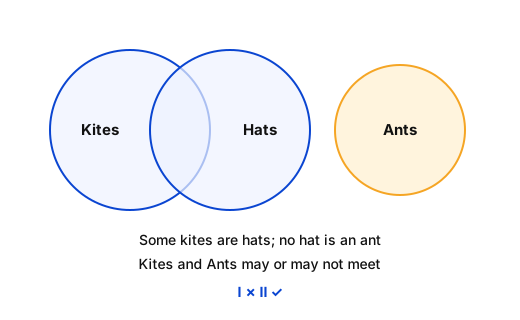
Statements: Some kites are hats. No hat is a ant.
Conclusion (I): Some kites are ants.
Conclusion (II): Some hats are kites.
दिए गए कथनों और निष्कर्षों को ध्यानपूर्वक पढ़िए। यह मानते हुए कि कथनों में दी गई जानकारी सत्य है, भले ही वह सामान्य रूप से ज्ञात तथ्यों से भिन्न प्रतीत होती हो, निर्णय लीजिए कि दिए गए निष्कर्षों में से कौन-सा/कौन-से निष्कर्ष कथनों का तार्किक रूप से अनुसरण करता है/करते हैं।
कथन: कुछ पतंगें, टोपियाँ हैं। कोई टोपी, चींटी नहीं है।
निष्कर्ष (I): कुछ पतंगें, चींटियाँ हैं।
निष्कर्ष (II): कुछ टोपियाँ, पतंगें हैं।
  1. AOnly conclusion (I) follows.केवल निष्कर्ष (I) अनुसरण करता है।
  2. BOnly conclusion (II) follows.केवल निष्कर्ष (II) अनुसरण करता है।
  3. CNeither conclusion (I) nor (II) follows.न तो निष्कर्ष (I) और न ही (II) अनुसरण करता है।
  4. DBoth conclusions (I) and (II) follow.दोनों निष्कर्ष (I) और (II) अनुसरण करते हैं।
Show answer

Concept: 'Some A are B' can be reversed to 'Some B are A'. A link through a 'No' statement gives no definite 'Some' conclusion.

  1. II: 'Some kites are hats' → 'Some hats are kites' (conversion) → follows.
  2. I: Hats and ants never meet, but kites outside hats may or may not be ants → not definite → does not follow.

Yaad rakhein: Some + No ⇒ only 'Some A are not C'; never 'Some A are C'.

Answer: (B) Only conclusion (II) follows.

अवधारणा: 'कुछ A, B हैं' को उलटकर 'कुछ B, A हैं' लिख सकते हैं। 'कोई नहीं' वाले कथन से होकर निश्चित 'कुछ' निष्कर्ष नहीं बनता।

  1. II: 'कुछ पतंग टोपियाँ हैं' → 'कुछ टोपियाँ पतंग हैं' → अनुसरण करता है।
  2. I: टोपी और चींटी कभी नहीं मिलते, पर टोपी से बाहर वाली पतंगें चींटी हो भी सकती हैं, नहीं भी → निश्चित नहीं।

याद रखें: कुछ + कोई नहीं ⇒ केवल 'कुछ A, C नहीं हैं'; 'कुछ A, C हैं' कभी नहीं।

उत्तर: (B) केवल निष्कर्ष (II) अनुसरण करता है।

RRB NTPC Undergraduate CBT 1General Intelligence and ReasoningSyllogismRRB NTPC Undergraduate CBT 1 2024 · 22 Aug Shift 1 →
Q877.
Each of the digits in the number 7231456 is arranged in ascending order from left to right. What will be the sum of the digits which are second from the left and second from the right in the new number thus formed?
संख्या 7231456 के प्रत्येक अंक को बाएँ से दाएँ आरोही क्रम में व्यवस्थित किया जाता है। इस प्रकार बनी नई संख्या में बाएँ से दूसरे और दाएँ से दूसरे अंकों का योग क्या होगा?
  1. A7
  2. B10
  3. C8
  4. D5
Show answer

Concept: Rearrange the digits as asked, then pick positions.

  1. Digits 7, 2, 3, 1, 4, 5, 6 in ascending order: 1234567.
  2. 2nd from left = 2; 2nd from right = 6.
  3. Sum =2+6=8.

Trick: Ascending order of 1–7 is just 1234567 — no writing needed.

Answer: (C) 8

अवधारणा: अंकों को बताए क्रम में लगाकर स्थान चुनें।

  1. 7, 2, 3, 1, 4, 5, 6 आरोही क्रम में: 1234567।
  2. बाएँ से दूसरा = 2; दाएँ से दूसरा = 6।
  3. योग =2+6=8।

ट्रिक: 1–7 का आरोही क्रम सीधा 1234567 है।

उत्तर: (C) 8

RRB NTPC Undergraduate CBT 1General Intelligence and ReasoningDigit arrangementRRB NTPC Undergraduate CBT 1 2024 · 22 Aug Shift 1 →
Q878.
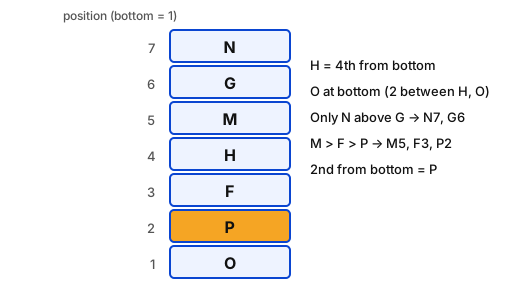
Seven boxes F, G, H, M, N, O and P are kept one over the other but not necessarily in the same order.Only three boxes are kept below H. Only two boxes are kept between H and O. Only N is kept above G. F is kept at some place below M and at some place above P. Which box is kept at second position from the bottom?
सात बक्से F, G, H, M, N, O और P एक के ऊपर एक रखे गए हैं, परंतु आवश्यक नहीं कि इसी क्रम में हों। H के नीचे केवल तीन बक्से रखे गए हैं। H और O के बीच केवल दो बक्से रखे गए हैं। G के ऊपर केवल N रखा गया है। F को M के नीचे किसी स्थान पर और P के ऊपर किसी स्थान पर रखा गया है। नीचे से दूसरे स्थान पर कौन-सा बक्सा रखा गया है?
  1. AF
  2. BP
  3. CG
  4. DN
Show answer

Concept: Number positions from the bottom (1) to the top (7).

  1. Only three below H → H at 4. Two boxes between H and O → O at 1 or 7.
  2. Only N above G → N at 7, G at 6; so O at 1.
  3. M above F above P in 2, 3, 5 → P 2, F 3, M 5.
  4. Second from bottom = P.

Trick: When a clue fixes the top two (N, G), the 'either-end' box (O) is forced to the other end.

Answer: (B) P

अवधारणा: स्थान नीचे से (1) ऊपर (7) तक गिनें।

  1. H के नीचे केवल तीन → H 4। H और O के बीच दो → O 1 या 7।
  2. केवल N, G के ऊपर → N 7, G 6; अतः O 1।
  3. M > F > P (ऊपर से) 2, 3, 5 में → P 2, F 3, M 5।
  4. नीचे से दूसरा = P।

ट्रिक: ऊपर के दो स्थान (N, G) तय हुए तो O अपने-आप नीचे वाले छोर पर जाएगा।

उत्तर: (B) P

RRB NTPC Undergraduate CBT 1General Intelligence and ReasoningBox arrangementRRB NTPC Undergraduate CBT 1 2024 · 22 Aug Shift 1 →
Q879.
What should come in place of the question mark (?) in the given series?
1200, 1200, 1800, 3600, 9000, ?
दी गई शृंखला में प्रश्न चिह्न (?) के स्थान पर क्या आना चाहिए?
1200, 1200, 1800, 3600, 9000, ?
  1. A18000
  2. B12000
  3. C15000
  4. D27000
Show answer

Concept: Check ratios of consecutive terms.

  1. 1200×1=1200, ×1.5=1800, ×2=3600, ×2.5=9000.
  2. Multipliers rise by 0.5, so next =9000×3=27000.

Trick: When terms grow fast, try multiplication factors: 1, 1.5, 2, 2.5, 3.

Answer: (D) 27000

अवधारणा: क्रमागत पदों का अनुपात देखें।

  1. 1200×1=1200, ×1.5=1800, ×2=3600, ×2.5=9000।
  2. गुणक 0.5 से बढ़ता है, अतः अगला =9000×3=27000।

ट्रिक: पद तेज़ी से बढ़ें तो गुणक देखें: 1, 1.5, 2, 2.5, 3।

उत्तर: (D) 27000

RRB NTPC Undergraduate CBT 1General Intelligence and ReasoningNumber seriesRRB NTPC Undergraduate CBT 1 2024 · 22 Aug Shift 1 →
Q880.
Refer to the following number and symbol series and answer the question that follows. All numbers are single-digits. Counting to be done from left to right only.
(Left) & 1 # 6 * ^ @ 3 & $ 7 Ω $ 2 # 6 @ 2 % 9 (Right)
If all the symbols are dropped from the series, which of the following will be third from the left?
निम्नलिखित संख्या और प्रतीक शृंखला को देखिए और उसके बाद आने वाले प्रश्न का उत्तर दीजिए। सभी संख्याएँ एक-अंकीय हैं। गिनती केवल बाएँ से दाएँ की जानी है।
(बाएँ) & 1 # 6 * ^ @ 3 & $ 7 Ω $ 2 # 6 @ 2 % 9 (दाएँ)
यदि शृंखला से सभी प्रतीक हटा दिए जाएँ, तो निम्नलिखित में से कौन-सा बाएँ से तीसरे स्थान पर होगा?
  1. A6
  2. B3
  3. C7
  4. D1
Show answer

Concept: Drop the symbols, keep only the digits in order.

  1. Digits from left: 1, 6, 3, 7, 2, 6, 2, 9.
  2. Third from left = 3.

Trick: No need to rewrite all — just count digits from the left until the third one.

Answer: (B) 3

अवधारणा: प्रतीक हटाकर केवल अंक क्रम में रखें।

  1. बाएँ से अंक: 1, 6, 3, 7, 2, 6, 2, 9।
  2. बाएँ से तीसरा = 3।

ट्रिक: पूरी श्रृंखला लिखने की ज़रूरत नहीं — बाएँ से अंक गिनते जाएँ।

उत्तर: (B) 3

RRB NTPC Undergraduate CBT 1General Intelligence and ReasoningNumber-symbol seriesRRB NTPC Undergraduate CBT 1 2024 · 22 Aug Shift 1 →