Question bank

Q&A: practice questions with answers

Search questions on any topic. Filter by exam category, exam, subject and topic, try the question, then open the answer and explanation.

Courses – airGurukul

2,900 questions found.

Q81.
In a certain code language,
A × B means ‘A is the mother of B’,
A – B means ‘A is the brother of B’,
A + B means ‘A is the wife of B’ and
A * B means ‘A is the father of B’.
How is H related to J if ‘H + I * O × D – J’?
एक निश्चित कूट भाषा में,
A × B का अर्थ है ‘A, B की माता है’,
A – B का अर्थ है ‘A, B का भाई है’,
A + B का अर्थ है ‘A, B की पत्नी है’ और
A * B का अर्थ है ‘A, B का पिता है’।
यदि ‘H + I * O × D – J’ है, तो H का J से क्या संबंध है?
  1. AMotherमाता
  2. BMother's motherमाता की माता
  3. CMother's sisterमाता की बहन
  4. DSisterबहन
Show answer

Concept: Decode the symbols one by one and draw the tree.
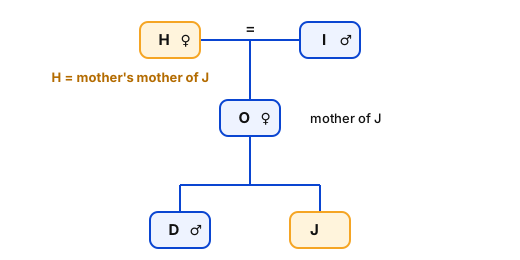
  1. H + I → H is the wife of I.
  2. I * O → I is the father of O, so H is the mother of O.
  3. O × D → O is the mother of D; D – J → D is the brother of J, so O is also J's mother.
  4. H is the mother of J's mother → mother's mother.

Trick: Two generations up on the mother's side = mother's mother (maternal grandmother).

Answer: (B) Mother's mother

अवधारणा: चिह्नों को एक-एक करके डिकोड करें और वंश-वृक्ष बनाएँ।

  1. H + I → H, I की पत्नी है।
  2. I * O → I, O का पिता है, अतः H, O की माँ है।
  3. O × D → O, D की माँ; D – J → D, J का भाई, अतः O, J की भी माँ।
  4. H, J की माँ की माँ है → माँ की माँ (नानी)।

ट्रिक: माँ की ओर दो पीढ़ी ऊपर = माँ की माँ (नानी)।

उत्तर: (B) माँ की माँ
RRB NTPC Undergraduate CBT 1General Intelligence and ReasoningCoded Blood RelationsRRB NTPC Undergraduate CBT 1 2025 · 20 Jun Shift 3 →
Q82.
What should come in place of the ‘?’ in the given series?
6 15 29 54 84 125 ?
दी गई श्रृंखला में ‘?’ के स्थान पर क्या आना चाहिए?
6 15 29 54 84 125 ?
  1. A173
  2. B177
  3. C179
  4. D171
Show answer

Concept: Look at the differences between consecutive terms.

  1. Differences: 9, 14, 25, 30, 41.
  2. Pattern of these differences: +5,+11,+5,+11 → next is +5.
  3. Next difference =41+5=46, so ?=125+46=171.

Trick: When the differences are irregular, take differences once more – an alternating pattern often appears.

Answer: (D) 171

अवधारणा: क्रमागत पदों का अंतर देखें।

  1. अंतर: 9, 14, 25, 30, 41।
  2. इन अंतरों में बदलाव: +5,+11,+5,+11 → अगला +5।
  3. अगला अंतर =41+5=46, अतः ?=125+46=171।

ट्रिक: अंतर अनियमित हों तो उनका भी अंतर लें – एकांतर पैटर्न मिलता है।

उत्तर: (D) 171

RRB NTPC Undergraduate CBT 1General Intelligence and ReasoningNumber SeriesRRB NTPC Undergraduate CBT 1 2025 · 20 Jun Shift 3 →
Q83.
Which of the following letter-number clusters will replace the question mark (?) in the given series to make it logically complete?
BDF 2 FHJ 5 JLN 8 NPR 11 ?
निम्नलिखित में से कौन-सा अक्षर-संख्या समूह दी गई श्रृंखला में प्रश्न चिह्न (?) का स्थान लेकर उसे तार्किक रूप से पूर्ण करेगा?
BDF 2 FHJ 5 JLN 8 NPR 11 ?
  1. ARTV 14
  2. BSVX 14
  3. CSSV 14
  4. DRUV 14
Show answer

Concept: Track each letter position and the number separately.

  1. First letters: B, F, J, N → +4 each → next R.
  2. Second letters: D, H, L, P → T; third letters: F, J, N, R → V.
  3. Numbers: 2, 5, 8, 11 → +3 → 14.
  4. Missing term = RTV 14.

Trick: Each cluster has letters 2 apart (B_D_F); just add 4 to the first letter and fill the rest.

Answer: (A) RTV 14

अवधारणा: हर अक्षर-स्थान और संख्या को अलग-अलग देखें।

  1. पहले अक्षर: B, F, J, N → हर बार +4 → अगला R।
  2. दूसरे अक्षर: D, H, L, P → T; तीसरे: F, J, N, R → V।
  3. संख्याएँ: 2, 5, 8, 11 → +3 → 14।
  4. लुप्त पद = RTV 14।

ट्रिक: हर समूह में अक्षर 2-2 के अंतर पर हैं (B_D_F); पहले अक्षर में 4 जोड़ें, बाकी भरें।

उत्तर: (A) RTV 14

RRB NTPC Undergraduate CBT 1General Intelligence and ReasoningLetter-Number SeriesRRB NTPC Undergraduate CBT 1 2025 · 20 Jun Shift 3 →
Q84.
Read the given statements and conclusions carefully. You have to take the given statements to be true even if they seem to be at variance from commonly known facts. You have to decide which conclusions logically follow/s from the given statements. Statements: Some pens are markers. All markers are stands.
Conclusion (I) : Some pens are stands
Conclusion (II) : All stands are markers
दिए गए कथनों और निष्कर्षों को ध्यानपूर्वक पढ़िए। आपको दिए गए कथनों को सत्य मानना है, भले ही वे सामान्यतः ज्ञात तथ्यों से भिन्न प्रतीत होते हों। आपको निर्णय करना है कि कौन-सा/से निष्कर्ष दिए गए कथनों का तार्किक रूप से अनुसरण करता है/करते हैं। कथन: कुछ पेन, मार्कर हैं। सभी मार्कर, स्टैंड हैं।
निष्कर्ष (I) : कुछ पेन, स्टैंड हैं
निष्कर्ष (II) : सभी स्टैंड, मार्कर हैं
  1. ABoth conclusions (I) and (II) followनिष्कर्ष (I) और (II) दोनों अनुसरण करते हैं
  2. BOnly conclusion (I) followsकेवल निष्कर्ष (I) अनुसरण करता है
  3. COnly conclusion (II) followsकेवल निष्कर्ष (II) अनुसरण करता है
  4. DNeither conclusion (I) nor (II) followsन तो निष्कर्ष (I) और न ही (II) अनुसरण करता है
Show answer

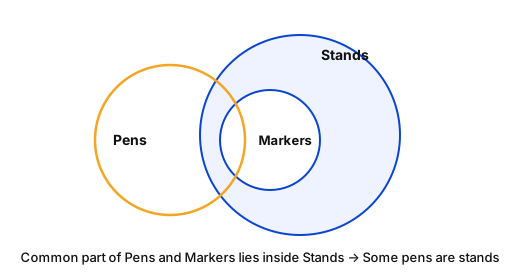
Concept: Draw the Venn diagram with the minimum overlap allowed by the statements.

  1. Some pens are markers → Pens and Markers overlap.
  2. All markers are stands → Markers circle lies inside Stands.
  3. The pens that are markers are therefore also stands → Conclusion I follows.
  4. Stands may contain many things that are not markers → II (All stands are markers) does not follow.

Trick: Some A are B + All B are C ⇒ Some A are C. ‘All B are C’ never reverses to ‘All C are B’.

Answer: (B) Only conclusion (I) follows

अवधारणा: कथनों के अनुसार न्यूनतम मेल वाला वेन आरेख बनाएँ।

  1. कुछ पेन मार्कर हैं → पेन और मार्कर आंशिक रूप से मिलते हैं।
  2. सभी मार्कर स्टैंड हैं → मार्कर का वृत्त स्टैंड के अंदर।
  3. जो पेन मार्कर हैं वे स्टैंड भी हैं → निष्कर्ष I सही।
  4. स्टैंड में कई ऐसी चीज़ें हो सकती हैं जो मार्कर नहीं → II (सभी स्टैंड मार्कर हैं) अनुसरण नहीं करता।

ट्रिक: कुछ A, B + सभी B, C ⇒ कुछ A, C। ‘सभी B, C’ उलटकर ‘सभी C, B’ नहीं होता।

उत्तर: (B) केवल निष्कर्ष (I) अनुसरण करता है

RRB NTPC Undergraduate CBT 1General Intelligence and ReasoningSyllogismRRB NTPC Undergraduate CBT 1 2025 · 20 Jun Shift 3 →
Q85.
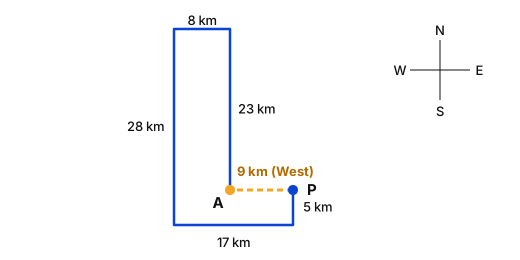
Rishi starts from Point A and drives 23 km towards the north. He then takes a left turn, drives 8 km, turns left and drives 28 km. He then takes a left turn and drives 17 km. He takes a final left turn, drives 5 km and stops at Point P. How far (shortest distance) and towards which direction should he drive in order to reach Point A again? (All turns are 90-degree turns only unless specified.)
ऋषि बिंदु A से चलना शुरू करता है और उत्तर की ओर 23 km गाड़ी चलाता है। फिर वह बाएँ मुड़ता है, 8 km गाड़ी चलाता है, बाएँ मुड़ता है और 28 km गाड़ी चलाता है। फिर वह बाएँ मुड़ता है और 17 km गाड़ी चलाता है। वह अंतिम बार बाएँ मुड़ता है, 5 km गाड़ी चलाता है और बिंदु P पर रुक जाता है। बिंदु A पर फिर से पहुँचने के लिए उसे कितनी दूरी (न्यूनतम दूरी) तक और किस दिशा में गाड़ी चलानी चाहिए? (जब तक निर्दिष्ट न हो, सभी मोड़ केवल 90 डिग्री के मोड़ हैं।)
  1. A8 km to the westपश्चिम की ओर 8 km
  2. B9 km to the westपश्चिम की ओर 9 km
  3. C9 km to the eastपूर्व की ओर 9 km
  4. D8 km to the eastपूर्व की ओर 8 km
Show answer

Concept: Take A as the origin, with east and north positive, and follow each move.

  1. 23 km north → (0,23); left turn = west 8 km → (−8,23).
  2. Left = south 28 km → (−8,−5); left = east 17 km → (9,−5).
  3. Left = north 5 km → P at (9,0) – on the same horizontal line as A.
  4. P is 9 km east of A, so he must drive 9 km to the west.

Trick: East–west net: 17−8=9 km east; north–south net: 23+5−28=0.

Answer: (B) 9 km to the west

अवधारणा: A को मूल बिंदु मानें (पूर्व और उत्तर धनात्मक) और हर चाल लिखें।

  1. उत्तर 23 km → (0,23); बाएँ = पश्चिम 8 km → (−8,23)।
  2. बाएँ = दक्षिण 28 km → (−8,−5); बाएँ = पूर्व 17 km → (9,−5)।
  3. बाएँ = उत्तर 5 km → P (9,0) पर – A की ही क्षैतिज रेखा पर।
  4. P, A से 9 km पूर्व है, अतः उसे 9 km पश्चिम जाना होगा।

ट्रिक: पूर्व–पश्चिम कुल: 17−8=9 km पूर्व; उत्तर–दक्षिण कुल: 23+5−28=0।

उत्तर: (B) 9 km पश्चिम की ओर

RRB NTPC Undergraduate CBT 1General Intelligence and ReasoningDirection and DistanceRRB NTPC Undergraduate CBT 1 2025 · 20 Jun Shift 3 →
Q86.
Which of the following letter-number clusters will replace the question mark (?) in the given series to make it logically complete?
BVY 32, WQT 16, RLO 8, MGJ 4, ?
निम्नलिखित में से कौन-सा अक्षर-संख्या समूह दी गई श्रृंखला में प्रश्न चिह्न (?) का स्थान लेकर उसे तार्किक रूप से पूर्ण करेगा?
BVY 32, WQT 16, RLO 8, MGJ 4, ?
  1. AREX 4
  2. BHCD 2
  3. CLFY 8
  4. DHBE 2
Show answer

Concept: Track each letter position with its alphabet number (A = 1 … Z = 26) and the number separately.

  1. First letters: B(2) → W(23) → R(18) → M(13): each step −5 (B − 5 wraps to W) → next 13−5=8 = H.
  2. Second letters: V → Q → L → G (−5) → B; third letters: Y → T → O → J (−5) → E.
  3. Numbers: 32, 16, 8, 4 → ÷2 → 2.
  4. Missing term = HBE 2.

Trick: All three letters move back 5 together, the number halves.

Answer: (D) HBE 2

अवधारणा: हर अक्षर-स्थान को उसके क्रमांक (A = 1 … Z = 26) से और संख्या को अलग देखें।

  1. पहले अक्षर: B(2) → W(23) → R(18) → M(13): हर बार −5 (B − 5 = W, चक्र में) → अगला 13−5=8 = H।
  2. दूसरे अक्षर: V → Q → L → G (−5) → B; तीसरे: Y → T → O → J (−5) → E।
  3. संख्याएँ: 32, 16, 8, 4 → ÷2 → 2।
  4. लुप्त पद = HBE 2।

ट्रिक: तीनों अक्षर साथ-साथ 5 पीछे, संख्या आधी।

उत्तर: (D) HBE 2

RRB NTPC Undergraduate CBT 1General Intelligence and ReasoningLetter-Number SeriesRRB NTPC Undergraduate CBT 1 2025 · 20 Jun Shift 3 →
Q87.
Each of the digits in the number 3749685 is arranged in ascending order from left to right. The position of how many digits will remain unchanged as compared to that in the original number?
संख्या 3749685 के प्रत्येक अंक को बाएँ से दाएँ आरोही क्रम में व्यवस्थित किया जाता है। मूल संख्या की तुलना में कितने अंकों का स्थान अपरिवर्तित रहेगा?
  1. AThreeतीन
  2. BNoneकोई नहीं
  3. CTwoदो
  4. DOneएक
Show answer

Concept: Write the original number and the ascending-order number one below the other and compare position by position.

  1. Original: 3 7 4 9 6 8 5.
  2. Ascending: 3 4 5 6 7 8 9.
  3. Same digit at the same place: 1st (3) and 6th (8).
  4. So two digits keep their positions.

Trick: Compare column by column – never count by memory.

Answer: (C) Two

अवधारणा: मूल संख्या और आरोही क्रम वाली संख्या एक के नीचे एक लिखकर हर स्थान की तुलना करें।

  1. मूल: 3 7 4 9 6 8 5।
  2. आरोही: 3 4 5 6 7 8 9।
  3. समान स्थान पर समान अंक: पहला (3) और छठा (8)।
  4. अतः दो अंकों की स्थिति नहीं बदलती।

ट्रिक: स्तंभ-दर-स्तंभ मिलाएँ – याद से न गिनें।

उत्तर: (C) दो

RRB NTPC Undergraduate CBT 1General Intelligence and ReasoningDigit ArrangementRRB NTPC Undergraduate CBT 1 2025 · 20 Jun Shift 3 →
Q88.
Based on the English alphabetical order, three of the following four letter-cluster pairs are alike in a certain way and thus form a group. Which is the one that does not belong to that group?
(Note: The odd one out is not based on the number of consonants/vowels or their position in the letter-cluster pairs.)
अंग्रेज़ी वर्णमाला क्रम के आधार पर, निम्नलिखित चार अक्षर-समूह युग्मों में से तीन किसी निश्चित प्रकार से एकसमान हैं और इस प्रकार एक समूह बनाते हैं। वह कौन-सा युग्म है जो उस समूह से संबंधित नहीं है?
(ध्यान दें: असंगत युग्म, व्यंजनों/स्वरों की संख्या या अक्षर-समूह युग्मों में उनके स्थान पर आधारित नहीं है।)
  1. AVB-TN
  2. BSY – QK
  3. CKQ-IC
  4. DPV – MH
Show answer

Concept: Compare each letter of the first cluster with the matching letter of the second (A = 1 … Z = 26).

  1. VB-TN: V−2=T, B+12=N.
  2. SY-QK: S−2=Q, Y+12=K (25 + 12 = 37, 37−26=11). KQ-IC: K−2=I, Q+12=C.
  3. PV-MH: P−3=M (not −2), V+12=H → the first rule breaks.
  4. So PV – MH is the odd one.

Trick: Check the simple shift (first letters) first – the odd pair often fails there.

Answer: (D) PV – MH

अवधारणा: पहले समूह के हर अक्षर की तुलना दूसरे समूह के संगत अक्षर से करें (A = 1 … Z = 26)।

  1. VB-TN: V−2=T, B+12=N।
  2. SY-QK: S−2=Q, Y+12=K (25 + 12 = 37, 37−26=11)। KQ-IC: K−2=I, Q+12=C।
  3. PV-MH: P−3=M (−2 नहीं), V+12=H → पहला नियम टूटता है।
  4. अतः PV – MH विषम है।

ट्रिक: पहले आसान बदलाव (पहले अक्षर) जाँचें – विषम युग्म अक्सर वहीं पकड़ा जाता है।

उत्तर: (D) PV – MH

RRB NTPC Undergraduate CBT 1General Intelligence and ReasoningOdd One Out – Letter PairsRRB NTPC Undergraduate CBT 1 2025 · 20 Jun Shift 3 →
Q89.
In a certain code language, ‘tale jaw bow’ is coded as 'vl ud np' and ‘law bow fresh’ is coded as ‘pq re ud’. How is ‘bow’ coded in the given language?
एक निश्चित कूट भाषा में, ‘tale jaw bow’ को ‘vl ud np’ के रूप में कूटबद्ध किया जाता है और ‘law bow fresh’ को ‘pq re ud’ के रूप में कूटबद्ध किया जाता है। उस भाषा में ‘bow’ को किस प्रकार कूटबद्ध किया जाता है?
  1. Aud
  2. Bpq
  3. Cnp
  4. Dvl
Show answer

Concept: A word common to two sentences gets the code common to both coded sentences.

  1. ‘tale jaw bow’ → vl ud np.
  2. ‘law bow fresh’ → pq re ud.
  3. Common word = bow; common code = ud → bow = ud.

Trick: Match the common word with the common code – order of codes does not matter.

Answer: (A) ud

अवधारणा: दो वाक्यों में समान शब्द का कोड दोनों कोडित वाक्यों में समान कोड होता है।

  1. ‘tale jaw bow’ → vl ud np।
  2. ‘law bow fresh’ → pq re ud।
  3. समान शब्द = bow; समान कोड = ud → bow = ud।

ट्रिक: समान शब्द ↔ समान कोड – कोडों का क्रम मायने नहीं रखता।

उत्तर: (A) ud

RRB NTPC Undergraduate CBT 1General Intelligence and ReasoningCoding-Decoding – Common WordsRRB NTPC Undergraduate CBT 1 2025 · 20 Jun Shift 3 →
Q90.
Select the pair which follows the same pattern as that followed by the two pairs given below. Both pairs follow the same pattern.
VUT−PON
TSR−NML
उस युग्म का चयन कीजिए जो उसी पैटर्न का अनुसरण करता है जिसका अनुसरण नीचे दिए गए दो युग्म करते हैं। दोनों युग्म समान पैटर्न का अनुसरण करते हैं।
VUT−PON
TSR−NML
  1. AYWU−SRQ
  2. BYXW−RRP
  3. CYXW−SRQ
  4. DYWU−RQP
Show answer

Concept: Find how each letter of the first cluster changes into the second (A = 1 … Z = 26).

  1. VUT – PON: V(22)−6=P(16), U−6=O, T−6=N; also each cluster is three consecutive letters going backward.
  2. TSR – NML: again −6 for every letter.
  3. YXW: consecutive backward ✓; Y(25)−6=S(19), X−6=R, W−6=Q → SRQ.
  4. YWU is not consecutive; RRP and RQP give a wrong shift.

Trick: First-letter check: Y − 6 = S, so only options starting with S survive.

Answer: (C) YXW−SRQ

अवधारणा: पहले समूह का हर अक्षर दूसरे में कैसे बदला, देखें (A = 1 … Z = 26)।

  1. VUT – PON: V(22)−6=P(16), U−6=O, T−6=N; हर समूह में तीन लगातार उल्टे अक्षर।
  2. TSR – NML: फिर हर अक्षर −6।
  3. YXW: लगातार उल्टे ✓; Y(25)−6=S(19), X−6=R, W−6=Q → SRQ।
  4. YWU लगातार नहीं है; RRP और RQP में अंतर गलत है।

ट्रिक: पहला अक्षर जाँचें: Y − 6 = S, अतः S से शुरू होने वाला विकल्प ही बचता है।

उत्तर: (C) YXW−SRQ

RRB NTPC Undergraduate CBT 1General Intelligence and ReasoningLetter Pair AnalogyRRB NTPC Undergraduate CBT 1 2025 · 20 Jun Shift 3 →
Q91.
Each vowel in the word PERBLAD is changed to the letter immediately following it in the English alphabetical order, and each consonant is changed to the letter immediately preceding it in the English alphabetical order. How many letters will appear exactly twice in the new group of letters thus formed?
शब्द PERBLAD में प्रत्येक स्वर को अंग्रेज़ी वर्णमाला क्रम में उसके ठीक बाद वाले अक्षर में बदल दिया जाता है, और प्रत्येक व्यंजन को अंग्रेज़ी वर्णमाला क्रम में उसके ठीक पहले वाले अक्षर में बदल दिया जाता है। इस प्रकार बने अक्षरों के नए समूह में कितने अक्षर ठीक दो बार आएँगे?
  1. AOneएक
  2. BTwoदो
  3. CThreeतीन
  4. DZeroशून्य
Show answer

Concept: Vowels move one letter forward; consonants move one letter back.

  1. P → O, E → F, R → Q, B → A, L → K, A → B, D → C.
  2. New group: O F Q A K B C.
  3. All seven letters are different, so no letter appears twice → zero.

Trick: Write the new letters in alphabetical order (A B C F K O Q) – repeats become obvious at once.

Answer: (D) Zero

अवधारणा: स्वर एक अक्षर आगे, व्यंजन एक अक्षर पीछे।

  1. P → O, E → F, R → Q, B → A, L → K, A → B, D → C।
  2. नया समूह: O F Q A K B C।
  3. सातों अक्षर अलग हैं, कोई अक्षर दो बार नहीं → शून्य।

ट्रिक: नए अक्षरों को वर्णक्रम में लिखें (A B C F K O Q) – दोहराव तुरंत दिख जाता है।

उत्तर: (D) शून्य

RRB NTPC Undergraduate CBT 1General Intelligence and ReasoningLetter CodingRRB NTPC Undergraduate CBT 1 2025 · 20 Jun Shift 3 →
Q92.
Which two numbers should be interchanged to make the given equation correct? (6 × 14) ÷ 2 + 18 × 4 - 28 ÷ 7 + 34 = 87
दिए गए समीकरण को सही बनाने के लिए किन दो संख्याओं को आपस में बदला जाना चाहिए? (6 × 14) ÷ 2 + 18 × 4 - 28 ÷ 7 + 34 = 87
  1. A7 and 47 और 4
  2. B14 and 1814 और 18
  3. C6 and 46 और 4
  4. D4 and 24 और 2
Show answer

Concept: Try each option, then solve using BODMAS.

  1. As given: (6×14)÷2+18×4−28÷7+34=42+72−4+34=144≠87.
  2. Interchange 4 and 2: (6×14)÷4+18×2−28÷7+34.
  3. =21+36−4+34=87 ✓.

Trick: The value must fall from 144 to 87 – swap numbers so that a big term (18 × 4) shrinks.

Answer: (D) 4 and 2

अवधारणा: हर विकल्प आज़माएँ और BODMAS से हल करें।

  1. जैसा दिया है: (6×14)÷2+18×4−28÷7+34=42+72−4+34=144≠87।
  2. 4 और 2 बदलें: (6×14)÷4+18×2−28÷7+34।
  3. =21+36−4+34=87 ✓।

ट्रिक: मान 144 से 87 करना है – ऐसी अदला-बदली करें जिससे बड़ा पद (18 × 4) छोटा हो।

उत्तर: (D) 4 और 2

RRB NTPC Undergraduate CBT 1General Intelligence and ReasoningMathematical Operations – InterchangeRRB NTPC Undergraduate CBT 1 2025 · 20 Jun Shift 3 →
Q93.
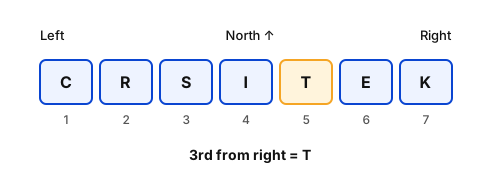
Seven people, S, T, I, C, K, E and R, are sitting in a row, facing north. Only two people sit between C and I. Only K sits to the right of E. Only one person sits between I and E. S sits at some place to the right of R but at some place to the left of T. Who sits third from the right end of the line?
सात व्यक्ति, S, T, I, C, K, E और R, एक पंक्ति में उत्तर की ओर मुख करके बैठे हैं। C और I के बीच केवल दो व्यक्ति बैठे हैं। E के दाईं ओर केवल K बैठा है। I और E के बीच केवल एक व्यक्ति बैठा है। S, R के दाईं ओर कहीं बैठा है लेकिन T के बाईं ओर कहीं बैठा है। पंक्ति के दाएँ छोर से तीसरे स्थान पर कौन बैठा है?
  1. AC
  2. BI
  3. CS
  4. DT
Show answer

Concept: All face north, so left and right are the solver's left and right. Fix the sure positions first.

  1. Only K is to the right of E → K at the right end (7), E at 6.
  2. One person between I and E → I at 4. Two people between C and I → C at 1 (7 is taken).
  3. R, S, T fill 2, 3, 5 in the order R – S – T (S between R and T) → R 2, S 3, T 5.
  4. Row: C R S I T E K → third from the right is T.

Trick: Clues with ‘only’ (only K to the right) lock the end seats – start there.

Answer: (D) T

अवधारणा: सभी उत्तर की ओर मुख किए हैं, इसलिए बायाँ-दायाँ हमारे जैसा ही है। पहले निश्चित स्थान भरें।

  1. केवल K, E के दाएँ है → K दाएँ छोर (7) पर, E 6 पर।
  2. I और E के बीच एक व्यक्ति → I 4 पर। C और I के बीच दो → C 1 पर (7 भरा है)।
  3. R, S, T स्थान 2, 3, 5 पर R – S – T क्रम में → R 2, S 3, T 5।
  4. पंक्ति: C R S I T E K → दाएँ से तीसरा T।

ट्रिक: ‘केवल’ वाले संकेत (केवल K दाएँ) छोर की सीट तय करते हैं – वहीं से शुरू करें।

उत्तर: (D) T

RRB NTPC Undergraduate CBT 1General Intelligence and ReasoningLinear Seating ArrangementRRB NTPC Undergraduate CBT 1 2025 · 20 Jun Shift 3 →
Q94.
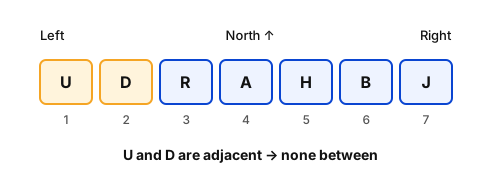
Seven people, A, B, U, D, R, H and J, are sitting in a row, facing north.
Only five people sit to the right of D. Only four people sit to the left of H. R is the immediate neighbour of A and D. J sits to the immediate right of B.
How many people sit between U and D?
सात व्यक्ति, A, B, U, D, R, H और J, एक पंक्ति में उत्तर की ओर मुख करके बैठे हैं।
D के दाईं ओर केवल पाँच व्यक्ति बैठे हैं। H के बाईं ओर केवल चार व्यक्ति बैठे हैं। R, A और D का निकटतम पड़ोसी है। J, B के ठीक दाईं ओर बैठा है।
U और D के बीच कितने व्यक्ति बैठे हैं?
  1. ATwoदो
  2. BOneएक
  3. CNoneकोई नहीं
  4. DThreeतीन
Show answer

Concept: Facing north, left–right is the same as ours. Place the people fixed by count clues first.

  1. Five people to the right of D → D is 2nd from the left. Four people to the left of H → H is 5th.
  2. R is the neighbour of both A and D → R at 3 and A at 4 (R at 1 would leave no seat for A).
  3. Seats 1, 6, 7 remain; J is immediately right of B → B 6, J 7, so U 1.
  4. Row: U D R A H B J → U and D are adjacent, no one between them.

Trick: ‘n people to the right’ in a row of 7 means position 7−n from the left.

Answer: (C) None

अवधारणा: उत्तर की ओर मुख – बायाँ-दायाँ हमारे जैसा। पहले संख्या वाले संकेतों से स्थान तय करें।

  1. D के दाएँ पाँच लोग → D बाएँ से दूसरा। H के बाएँ चार लोग → H पाँचवाँ।
  2. R, A और D दोनों का पड़ोसी → R 3 पर, A 4 पर (R 1 पर हो तो A के लिए जगह नहीं)।
  3. स्थान 1, 6, 7 बचे; J, B के ठीक दाएँ → B 6, J 7, अतः U 1।
  4. पंक्ति: U D R A H B J → U और D पास-पास, बीच में कोई नहीं।

ट्रिक: 7 की पंक्ति में ‘n लोग दाएँ’ = बाएँ से स्थान 7−n।

उत्तर: (C) कोई नहीं

RRB NTPC Undergraduate CBT 1General Intelligence and ReasoningLinear Seating ArrangementRRB NTPC Undergraduate CBT 1 2025 · 20 Jun Shift 3 →
Q95.
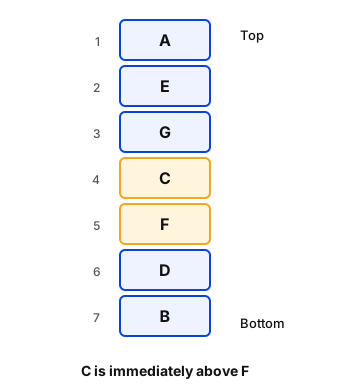
Seven boxes A, B, C, D, E, F and G are kept one over the other but not necessarily in the same order. Only three boxes are kept above C. Only one box is kept between D and C. Only three boxes are kept between D and E. E is kept at some place above C. G is kept immediately below E. F is kept at one of the places above B. A is not kept immediately above or below D. Which box is kept immediately above F?
सात बक्से A, B, C, D, E, F और G एक के ऊपर एक रखे गए हैं, लेकिन यह आवश्यक नहीं है कि इसी क्रम में हों। C के ऊपर केवल तीन बक्से रखे गए हैं। D और C के बीच केवल एक बक्सा रखा गया है। D और E के बीच केवल तीन बक्से रखे गए हैं। E, C के ऊपर कहीं रखा गया है। G, E के ठीक नीचे रखा गया है। F, B के ऊपर के स्थानों में से किसी एक स्थान पर रखा गया है। A, D के ठीक ऊपर या ठीक नीचे नहीं रखा गया है। F के ठीक ऊपर कौन-सा बक्सा रखा गया है?
  1. AD
  2. BG
  3. CA
  4. DC
Show answer

Concept: Number the positions 1 (top) to 7 (bottom) and place the fixed boxes first.

  1. Three boxes above C → C at 4. One box between D and C → D at 2 or 6.
  2. Three boxes between D and E, and E above C → D at 6, E at 2. G just below E → G at 3.
  3. Positions 1, 5, 7 remain for A, B, F. A not next to D (5 or 7) → A at 1; F above B → F 5, B 7.
  4. Stack: A, E, G, C, F, D, B → box just above F is C.

Trick: Test both cases of an ‘either–or’ clue; the one that breaks a later rule is dropped.

Answer: (D) C

अवधारणा: स्थानों को 1 (ऊपर) से 7 (नीचे) क्रमांक दें और पहले निश्चित बॉक्स रखें।

  1. C के ऊपर तीन बॉक्स → C 4 पर। D और C के बीच एक → D 2 या 6 पर।
  2. D और E के बीच तीन, और E, C के ऊपर → D 6, E 2। G, E के ठीक नीचे → G 3।
  3. स्थान 1, 5, 7 पर A, B, F। A, D के पास (5 या 7) नहीं → A 1; F, B के ऊपर → F 5, B 7।
  4. क्रम: A, E, G, C, F, D, B → F के ठीक ऊपर C।

ट्रिक: ‘या’ वाले संकेत के दोनों केस जाँचें; जो आगे के नियम तोड़े, उसे हटाएँ।

उत्तर: (D) C

RRB NTPC Undergraduate CBT 1General Intelligence and ReasoningBox ArrangementRRB NTPC Undergraduate CBT 1 2025 · 20 Jun Shift 3 →
Q96.
Which of the following letter-number clusters will replace the question mark (?) in the given series to make it logically complete?
ADG 3 EHK 6 ILO 9 MPS 12 ?
निम्नलिखित में से कौन-सा अक्षर-संख्या समूह दी गई श्रृंखला में प्रश्न चिह्न (?) का स्थान लेकर उसे तार्किक रूप से पूर्ण करेगा?
ADG 3 EHK 6 ILO 9 MPS 12 ?
  1. ARUX 15
  2. BQTV 15
  3. CQTW 15
  4. DQSW 15
Show answer

Concept: Follow each letter position and the number separately.

  1. First letters: A, E, I, M → +4 → Q.
  2. Second letters: D, H, L, P → T; third letters: G, K, O, S → W.
  3. Numbers: 3, 6, 9, 12 → +3 → 15.
  4. Missing term = QTW 15.

Trick: Inside each cluster letters are 3 apart (A_ _D_ _G) – Q, T, W keeps this gap.

Answer: (C) QTW 15

अवधारणा: हर अक्षर-स्थान और संख्या को अलग-अलग देखें।

  1. पहले अक्षर: A, E, I, M → +4 → Q।
  2. दूसरे अक्षर: D, H, L, P → T; तीसरे: G, K, O, S → W।
  3. संख्याएँ: 3, 6, 9, 12 → +3 → 15।
  4. लुप्त पद = QTW 15।

ट्रिक: हर समूह में अक्षर 3-3 के अंतर पर (A_ _D_ _G) – Q, T, W में भी यही अंतर।

उत्तर: (C) QTW 15

RRB NTPC Undergraduate CBT 1General Intelligence and ReasoningLetter-Number SeriesRRB NTPC Undergraduate CBT 1 2025 · 20 Jun Shift 3 →
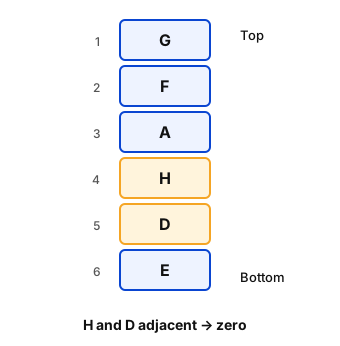
Q97.
Six boxes D, E, F, G, H and A are kept one over the other but not necessarily in the same order. Only three boxes are kept below A. Only two boxes are kept between A and E. No box is kept above G. H is kept at some place below F and at some place above D. How many boxes are kept between H and D?
छह बक्से D, E, F, G, H और A एक के ऊपर एक रखे गए हैं, लेकिन यह आवश्यक नहीं है कि इसी क्रम में हों। A के नीचे केवल तीन बक्से रखे गए हैं। A और E के बीच केवल दो बक्से रखे गए हैं। G के ऊपर कोई बक्सा नहीं रखा गया है। H, F के नीचे कहीं और D के ऊपर कहीं रखा गया है। H और D के बीच कितने बक्से रखे गए हैं?
  1. AZeroशून्य
  2. BOneएक
  3. CTwoदो
  4. DThreeतीन
Show answer

Concept: Number positions 1 (top) to 6 (bottom).

  1. No box above G → G at 1. Three boxes below A → A at 3.
  2. Two boxes between A and E → E at 6.
  3. Positions 2, 4, 5 remain; F above H above D → F 2, H 4, D 5.
  4. H and D are adjacent → zero boxes between them.

Trick: ‘No box above X’ means X is on top – the easiest anchor.

Answer: (A) Zero

अवधारणा: स्थानों को 1 (ऊपर) से 6 (नीचे) क्रमांक दें।

  1. G के ऊपर कोई बॉक्स नहीं → G 1 पर। A के नीचे तीन बॉक्स → A 3 पर।
  2. A और E के बीच दो बॉक्स → E 6 पर।
  3. स्थान 2, 4, 5 बचे; F के नीचे H और H के नीचे D → F 2, H 4, D 5।
  4. H और D पास-पास → बीच में शून्य बॉक्स।

ट्रिक: ‘X के ऊपर कोई नहीं’ = X सबसे ऊपर – सबसे आसान शुरुआत।

उत्तर: (A) शून्य

RRB NTPC Undergraduate CBT 1General Intelligence and ReasoningBox ArrangementRRB NTPC Undergraduate CBT 1 2025 · 20 Jun Shift 3 →
Q98.
In the following number-pairs, the second number is obtained by applying certain mathematical operations to the first number. Select the set in which the numbers are related in the same way as are the numbers of the following sets.
(NOTE: Operations should be performed on the whole numbers, without breaking down the numbers into their constituent digits. E.g. 13 – Operations on 13 such as adding / subtracting /multiplying etc. to 13 can be performed. Breaking down 13 into 1 and 3 and then performing mathematical operations on 1 and 3 is not allowed.)
89, 104
157, 172
निम्नलिखित संख्या-युग्मों में, दूसरी संख्या पहली संख्या पर कुछ निश्चित गणितीय संक्रियाएँ करके प्राप्त की जाती है। उस समुच्चय का चयन कीजिए जिसमें संख्याएँ उसी प्रकार संबंधित हैं जिस प्रकार निम्नलिखित समुच्चयों की संख्याएँ संबंधित हैं।
(ध्यान दें: संख्याओं को उनके घटक अंकों में विभाजित किए बिना, संक्रियाएँ पूर्ण संख्याओं पर की जानी चाहिए। उदाहरण के लिए, 13 – 13 पर संक्रियाएँ जैसे 13 में जोड़ना/घटाना/गुणा करना आदि किया जा सकता है। 13 को 1 और 3 में विभाजित करके फिर 1 और 3 पर गणितीय संक्रियाएँ करने की अनुमति नहीं है।)
89, 104
157, 172
  1. A56, 72
  2. B97, 111
  3. C39, 64
  4. D138, 153
Show answer

Concept: Find the operation that turns the first number into the second in both given pairs.

  1. 104−89=15 and 172−157=15 → rule: add 15.
  2. 138+15=153 ✓.
  3. Others: 56+15=71≠72, 97+15=112≠111, 39+15=54≠64.

Trick: Small, equal differences → simple addition rule; check the difference first.

Answer: (D) 138, 153

अवधारणा: दोनों युग्मों में पहली संख्या से दूसरी संख्या बनाने वाली संक्रिया खोजें।

  1. 104−89=15 और 172−157=15 → नियम: 15 जोड़ें।
  2. 138+15=153 ✓।
  3. अन्य: 56+15=71≠72, 97+15=112≠111, 39+15=54≠64।

ट्रिक: छोटे और समान अंतर → जोड़ का नियम; पहले अंतर देखें।

उत्तर: (D) 138, 153

RRB NTPC Undergraduate CBT 1General Intelligence and ReasoningNumber Pair AnalogyRRB NTPC Undergraduate CBT 1 2025 · 20 Jun Shift 3 →
Q99.
In a certain code language, ‘bat view month’ is coded as 'nd wz nh' and ‘oven month gum’ is coded as ‘on ju wz’. How is ‘month’ coded in the given language?
एक निश्चित कूट भाषा में, ‘bat view month’ को ‘nd wz nh’ के रूप में कूटबद्ध किया जाता है और ‘oven month gum’ को ‘on ju wz’ के रूप में कूटबद्ध किया जाता है। उस भाषा में ‘month’ को किस प्रकार कूटबद्ध किया जाता है?
  1. Anh
  2. Bon
  3. Cwz
  4. Dnd
Show answer

Concept: A word common to two sentences has the code common to both coded sentences.

  1. ‘bat view month’ → nd wz nh.
  2. ‘oven month gum’ → on ju wz.
  3. Common word = month; common code = wz → month = wz.

Trick: Common word ↔ common code – ignore positions.

Answer: (C) wz

अवधारणा: दो वाक्यों में समान शब्द का कोड दोनों कोडित वाक्यों में समान होता है।

  1. ‘bat view month’ → nd wz nh।
  2. ‘oven month gum’ → on ju wz।
  3. समान शब्द = month; समान कोड = wz → month = wz।

ट्रिक: समान शब्द ↔ समान कोड – क्रम पर ध्यान न दें।

उत्तर: (C) wz

RRB NTPC Undergraduate CBT 1General Intelligence and ReasoningCoding-Decoding – Common WordsRRB NTPC Undergraduate CBT 1 2025 · 20 Jun Shift 3 →
Q100.
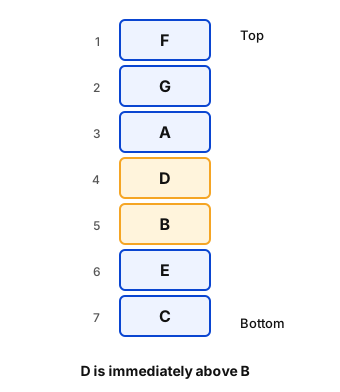
Seven boxes A, B, C, D, E, F and G are kept one over the other but not necessarily in the same order. Only three boxes are kept below D. Only two boxes are kept between D and C. Only F is kept above G. B is kept at some place below A and some place above E. Which box is kept immediately above B?
सात बक्से A, B, C, D, E, F और G एक के ऊपर एक रखे गए हैं, लेकिन यह आवश्यक नहीं है कि इसी क्रम में हों। D के नीचे केवल तीन बक्से रखे गए हैं। D और C के बीच केवल दो बक्से रखे गए हैं। G के ऊपर केवल F रखा गया है। B, A के नीचे कहीं और E के ऊपर कहीं रखा गया है। B के ठीक ऊपर कौन-सा बक्सा रखा गया है?
  1. AC
  2. BA
  3. CF
  4. DD
Show answer

Concept: Number the positions 1 (top) to 7 (bottom).

  1. Only F above G → F at 1, G at 2. Three boxes below D → D at 4.
  2. Two boxes between D and C → C at 1 or 7; 1 is F, so C at 7.
  3. Positions 3, 5, 6 remain; A above B above E → A 3, B 5, E 6.
  4. Stack: F, G, A, D, B, E, C → box just above B is D.

Trick: ‘Only F above G’ fixes the top two boxes at once.

Answer: (D) D

अवधारणा: स्थानों को 1 (ऊपर) से 7 (नीचे) क्रमांक दें।

  1. केवल F, G के ऊपर → F 1, G 2। D के नीचे तीन बॉक्स → D 4।
  2. D और C के बीच दो → C 1 या 7; 1 पर F है, अतः C 7।
  3. स्थान 3, 5, 6 बचे; A के नीचे B, B के नीचे E → A 3, B 5, E 6।
  4. क्रम: F, G, A, D, B, E, C → B के ठीक ऊपर D।

ट्रिक: ‘केवल F, G के ऊपर’ से ऊपर के दो बॉक्स तुरंत तय।

उत्तर: (D) D

RRB NTPC Undergraduate CBT 1General Intelligence and ReasoningBox ArrangementRRB NTPC Undergraduate CBT 1 2025 · 20 Jun Shift 3 →