Question bank

Q&A: practice questions with answers

Search questions on any topic. Filter by exam category, exam, subject and topic, try the question, then open the answer and explanation.

Courses – airGurukul

120 questions found.

Q61.
Find the fourth proportional to 20.5, 21.5 and 22.5.
20.5, 21.5 और 22.5 का चतुर्थानुपाती ज्ञात कीजिए।
  1. A20.5
  2. B22
  3. C24
  4. D23.5
Show answer

Concept: Fourth proportional to a,b,c is x with a:b=c:x, so x=b×ca. With powers of the same base, add/subtract exponents.

  1. x=21.5×22.520.5
  2. =21.5+2.5−0.5=23.5

Trick: Fourth proportional = (2nd × 3rd) ÷ 1st. For same base: multiply → add powers, divide → subtract powers.

Answer: (D) 23.5

अवधारणा: a,b,c का चतुर्थानुपाती (fourth proportional) x है जहाँ a:b=c:x, अतः x=b×ca। समान आधार की घातों में घातांक जोड़ते/घटाते हैं।

  1. x=21.5×22.520.5
  2. =21.5+2.5−0.5=23.5

ट्रिक: चतुर्थानुपाती = (दूसरा × तीसरा) ÷ पहला। समान आधार: गुणा → घात जोड़ें, भाग → घात घटाएँ।

उत्तर: (D) 23.5
RRB NTPC Undergraduate CBT 2MathematicsProportionRRB NTPC Undergraduate CBT 2 2025 · 17 Sep Shift 1 →
Q62.
Evaluate: (−37) + (−56) ÷ (−3) × 3
मान ज्ञात कीजिए: (−37) + (−56) ÷ (−3) × 3
  1. A21
  2. B15
  3. C19
  4. D17
Show answer

Concept: Apply BODMAS: division and multiplication (left to right) before addition.

  1. (−56)÷(−3)=563, then 563×3=56
  2. (−37)+56=19

Trick: Negative ÷ negative = positive. The ÷3 and ×3 cancel, leaving −37+56.

Answer: (C) 19

अवधारणा: BODMAS लागू करें: जोड़ से पहले भाग और गुणा (बाएँ से दाएँ)।

  1. (−56)÷(−3)=563, फिर 563×3=56
  2. (−37)+56=19

ट्रिक: ऋण ÷ ऋण = धन। ÷3 और ×3 कट जाते हैं, बचता है −37+56।

उत्तर: (C) 19

RRB NTPC Undergraduate CBT 2MathematicsSimplification (BODMAS)RRB NTPC Undergraduate CBT 2 2025 · 17 Sep Shift 1 →
Q63.
7% of a number is what percentage of the 9% of the same number? (Rounded off to two decimal places.)
किसी संख्या का 7%, उसी संख्या के 9% का कितना प्रतिशत है? (दो दशमलव स्थानों तक पूर्णांकित)
  1. A43.75%
  2. B21.87%
  3. C78.57%
  4. D77.78%
Show answer

Concept: Required percentage =partwhole×100; the number itself cancels out.

  1. 7% of N9% of N×100=79×100
  2. =77.777…%≈77.78%

Trick: Such questions never depend on the number — just divide the two percentages: 79=0.7778.

Answer: (D) 77.78%

अवधारणा: अभीष्ट प्रतिशत =भागपूर्ण×100; संख्या स्वयं कट जाती है।

  1. N का 7%N का 9%×100=79×100
  2. =77.777…%≈77.78%

ट्रिक: ऐसे प्रश्न संख्या पर निर्भर नहीं करते — बस दोनों प्रतिशतों का भाग करें: 79=0.7778।

उत्तर: (D) 77.78%

RRB NTPC Undergraduate CBT 2MathematicsPercentageRRB NTPC Undergraduate CBT 2 2025 · 17 Sep Shift 1 →
Q64.
Find the total number of prime factors of the number 58×67×114.
संख्या 58×67×114 के अभाज्य गुणनखंडों की कुल संख्या ज्ञात कीजिए।
  1. A26
  2. B22
  3. C28
  4. D30
Show answer

Concept: Write every base as a product of primes; the total number of prime factors is the sum of all exponents (counted with repetition).

  1. 67=(2×3)7=27×37
  2. N=58×27×37×114
  3. Total prime factors =8+7+7+4=26

Trick: Only 6 is composite here — split it first. (Distinct primes would be 4; total prime factors counts repetition.)

Answer: (A) 26

अवधारणा: हर आधार को अभाज्य संख्याओं के गुणनफल में लिखें; कुल अभाज्य गुणनखंड = सभी घातांकों का योग (पुनरावृत्ति सहित)।

  1. 67=(2×3)7=27×37
  2. N=58×27×37×114
  3. कुल अभाज्य गुणनखंड =8+7+7+4=26

ट्रिक: यहाँ केवल 6 भाज्य है — उसे पहले तोड़ें। (भिन्न अभाज्य 4 होते; 'कुल' में पुनरावृत्ति गिनी जाती है।)

उत्तर: (A) 26

RRB NTPC Undergraduate CBT 2MathematicsNumber System – Prime FactorsRRB NTPC Undergraduate CBT 2 2025 · 17 Sep Shift 1 →
Q65.
If 25% of A is equal to 40% of B, and 30% of B is equal to 45% of C, then A:B:C is:
यदि A का 25%, B के 40% के बराबर है और B का 30%, C के 45% के बराबर है, तो A:B:C है:
  1. A8:5:3
  2. B12:9:7
  3. C24:14:9
  4. D24:15:10
Show answer

Concept: Convert each percentage relation into a ratio, then combine by making the common term (B) equal.

  1. 25%A=40%B⇒AB=4025=85
  2. 30%B=45%C⇒BC=4530=32
  3. Make B equal: A:B=24:15, B:C=15:10 → A:B:C=24:15:10

Trick: pA=qB gives A:B=q:p (the numbers swap sides).

Answer: (D) 24:15:10

अवधारणा: हर प्रतिशत संबंध को अनुपात में बदलें, फिर उभयनिष्ठ पद (B) को बराबर करके जोड़ें।

  1. 25%A=40%B⇒AB=4025=85
  2. 30%B=45%C⇒BC=4530=32
  3. B बराबर करें: A:B=24:15, B:C=15:10 → A:B:C=24:15:10

ट्रिक: pA=qB से A:B=q:p (संख्याएँ पक्ष बदल लेती हैं)।

उत्तर: (D) 24:15:10

RRB NTPC Undergraduate CBT 2MathematicsRatioRRB NTPC Undergraduate CBT 2 2025 · 17 Sep Shift 1 →
Q66.
If the average of three numbers is 15 and two of the numbers are 10 and 20, what is the third number?
यदि तीन संख्याओं का औसत 15 है और उनमें से दो संख्याएँ 10 और 20 हैं, तो तीसरी संख्या क्या है?
  1. A10
  2. B15
  3. C20
  4. D25
Show answer

Concept: Sum = average × number of terms.

  1. Sum of three numbers =15×3=45
  2. Third number =45−(10+20)=15

Trick: If two numbers average to the given mean (here 10+202=15), the third must equal the mean itself.

Answer: (B) 15

अवधारणा: योग = औसत × पदों की संख्या।

  1. तीन संख्याओं का योग =15×3=45
  2. तीसरी संख्या =45−(10+20)=15

ट्रिक: यदि दो संख्याओं का औसत दिए गए औसत के बराबर है (यहाँ 10+202=15), तो तीसरी संख्या भी औसत ही होगी।

उत्तर: (B) 15

RRB NTPC Undergraduate CBT 2MathematicsAverageRRB NTPC Undergraduate CBT 2 2025 · 17 Sep Shift 1 →
Q67.
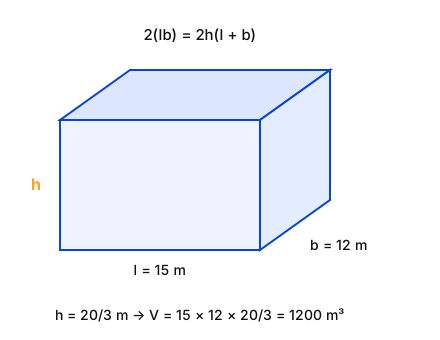
A water tank is of cuboidal shape having length 15 m and breadth 12 m. The sum of the area of the floor and ceiling of the tank is same as the area of four walls of the tank. How many liters of rainwater can be collected in this tank?
एक पानी की टंकी घनाभाकार है जिसकी लंबाई 15 m और चौड़ाई 12 m है। टंकी के फर्श और छत के क्षेत्रफलों का योग टंकी की चारों दीवारों के क्षेत्रफल के बराबर है। इस टंकी में कितने लीटर वर्षा जल एकत्र किया जा सकता है?
  1. A1000 × 102 liters1000 × 102 लीटर
  2. B1200 × 102 liters1200 × 102 लीटर
  3. C1200 litres1200 लीटर
  4. D1200 × 103 liters1200 × 103 लीटर
Show answer

Concept: Floor + ceiling =2lb; four walls =2h(l+b). Volume =lbh, and 1m3=1000 litres.

  1. 2×15×12=2h(15+12)⇒360=54h⇒h=203m
  2. Volume =15×12×203=1200m3
  3. =1200×1000=1200×103 litres

Trick: Floor + ceiling = walls ⇒ h=lbl+b. Then always convert m³ → litres by ×1000.

Answer: (D) 1200×103 liters

अवधारणा: फर्श + छत =2lb; चार दीवारें =2h(l+b)। आयतन =lbh, और 1m3=1000 लीटर।

  1. 2×15×12=2h(15+12)⇒360=54h⇒h=203m
  2. आयतन =15×12×203=1200m3
  3. =1200×1000=1200×103 लीटर

ट्रिक: फर्श + छत = दीवारें ⇒ h=lbl+b। फिर m³ → लीटर के लिए ×1000 करें।

उत्तर: (D) 1200×103 लीटर

RRB NTPC Undergraduate CBT 2MathematicsMensuration – CuboidRRB NTPC Undergraduate CBT 2 2025 · 17 Sep Shift 1 →
Q68.
A, B and C together can complete a certain work in 37 days. B and C together can complete the same work in 74 days. B is 50% more efficient than A. A, B and C work together for 28 days. B alone will complete the remaining work in:
A, B और C मिलकर एक निश्चित कार्य को 37 दिनों में पूरा कर सकते हैं। B और C मिलकर उसी कार्य को 74 दिनों में पूरा कर सकते हैं। B, A से 50% अधिक कार्यकुशल है। A, B और C 28 दिनों तक एक साथ कार्य करते हैं। शेष कार्य को B अकेले कितने दिनों में पूरा करेगा?
  1. A9 days9 दिन
  2. B13 days13 दिन
  3. C12 days12 दिन
  4. D14 days14 दिन
Show answer

Concept: Work per day =1days. Efficiency of B =1.5× efficiency of A.

  1. A's one-day work =137−174=174
  2. B's one-day work =32×174=3148
  3. Work done in 28 days =2837, remaining =937
  4. B alone: 937÷3148=937×1483=12 days

Trick: Take total work =148 units: group does 4/day, A does 2/day, B does 3/day. Remaining 148−28×4=36 units ⇒36÷3=12 days.

Answer: (C) 12 days

अवधारणा: प्रतिदिन कार्य =1दिन। B की दक्षता =1.5× A की दक्षता।

  1. A का एक दिन का कार्य =137−174=174
  2. B का एक दिन का कार्य =32×174=3148
  3. 28 दिन में कार्य =2837, शेष =937
  4. B अकेला: 937÷3148=937×1483=12 दिन

ट्रिक: कुल कार्य =148 इकाई लें: समूह 4/दिन, A 2/दिन, B 3/दिन। शेष 148−28×4=36 इकाई ⇒36÷3=12 दिन।

उत्तर: (C) 12 दिन

RRB NTPC Undergraduate CBT 2MathematicsTime and WorkRRB NTPC Undergraduate CBT 2 2025 · 17 Sep Shift 1 →
Q69.
Evaluate: 11 − 12 ÷ 12 × 8
मान ज्ञात कीजिए: 11 − 12 ÷ 12 × 8
  1. A3
  2. B4
  3. C2
  4. D1
Show answer

Concept: Division and multiplication first (left to right), then subtraction.

  1. 12÷12=1, then 1×8=8
  2. 11−8=3

Trick: Never subtract first: 11−12 is the classic trap. Resolve the ÷ and × chain before touching −.

Answer: (A) 3

अवधारणा: पहले भाग और गुणा (बाएँ से दाएँ), फिर घटाव।

  1. 12÷12=1, फिर 1×8=8
  2. 11−8=3

ट्रिक: पहले घटाना मत: 11−12 आम जाल है। − से पहले ÷ और × की श्रृंखला हल करें।

उत्तर: (A) 3

RRB NTPC Undergraduate CBT 2MathematicsSimplification (BODMAS)RRB NTPC Undergraduate CBT 2 2025 · 17 Sep Shift 1 →
Q70.
A cyclist travels the first 30 km at 20 km/h, the next 50 km at 25 km/h, and the final 20 km at 10 km/h. What is the cyclist's average speed for the entire 100 km trip (round off to the nearest integer)?
एक साइकिल सवार पहले 30 km की दूरी 20 km/h की चाल से, अगले 50 km की दूरी 25 km/h की चाल से और अंतिम 20 km की दूरी 10 km/h की चाल से तय करता है। पूरी 100 km की यात्रा के लिए साइकिल सवार की औसत चाल क्या है (निकटतम पूर्णांक तक पूर्णांकित)?
  1. A18 km/h
  2. B20 km/h
  3. C19 km/h
  4. D21 km/h
Show answer

Concept: Average speed =total distancetotal time (never the average of speeds).

  1. Times: 3020=1.5 h, 5025=2 h, 2010=2 h → total 5.5 h
  2. Average speed =1005.5=18.18≈18km/h

Trick: Different distances at different speeds → compute each time separately; the slow 10 km/h stretch pulls the average well below 20.

Answer: (A) 18 km/h

अवधारणा: औसत चाल =कुल दूरीकुल समय (चालों का औसत कभी नहीं)।

  1. समय: 3020=1.5 h, 5025=2 h, 2010=2 h → कुल 5.5 h
  2. औसत चाल =1005.5=18.18≈18km/h

ट्रिक: अलग-अलग दूरियाँ अलग चालों पर → हर भाग का समय अलग निकालें; धीमा 10 km/h वाला हिस्सा औसत को 20 से काफी नीचे खींच देता है।

उत्तर: (A) 18 km/h

RRB NTPC Undergraduate CBT 2MathematicsSpeed – Average SpeedRRB NTPC Undergraduate CBT 2 2025 · 17 Sep Shift 1 →
Q71.
If 5 workers, working 8 hours a day for 12 days, produce 2400 units, then how many units will 10 workers, working 8 hours a day for 12 days, produce, assuming the productivity of each worker remains constant?
यदि 5 श्रमिक, प्रतिदिन 8 घंटे काम करते हुए 12 दिनों में 2400 इकाइयाँ बनाते हैं, तो 10 श्रमिक, प्रतिदिन 8 घंटे काम करते हुए 12 दिनों में कितनी इकाइयाँ बनाएँगे, यह मानते हुए कि प्रत्येक श्रमिक की उत्पादकता स्थिर रहती है?
  1. A3600 units3600 इकाइयाँ
  2. B4800 units4800 इकाइयाँ
  3. C6000 units6000 इकाइयाँ
  4. D2400 units2400 इकाइयाँ
Show answer

Concept: Units produced ∝ workers × hours × days.

  1. Hours and days unchanged; workers doubled (5→10)
  2. Units =2400×105=4800

Trick: M1H1D1W1=M2H2D2W2 — change only the quantity that changed.

Answer: (B) 4800 units

अवधारणा: उत्पादित इकाइयाँ ∝ श्रमिक × घंटे × दिन।

  1. घंटे और दिन समान; श्रमिक दोगुने (5→10)
  2. इकाइयाँ =2400×105=4800

ट्रिक: M1H1D1W1=M2H2D2W2 — केवल वही राशि बदलें जो बदली है।

उत्तर: (B) 4800 इकाई

RRB NTPC Undergraduate CBT 2MathematicsChain Rule (Work)RRB NTPC Undergraduate CBT 2 2025 · 17 Sep Shift 1 →
Q72.
Krish has ₹1,352, which he divides between his two sons, Veer and Nitin. Both invest their respective amounts at an annual compound interest rate of 8%. If the amounts accumulated by Veer after 18 years and by Nitin after 19 years are equal, how much money (in ₹) did Krish give to Nitin?
कृष के पास ₹1,352 हैं, जिन्हें वह अपने दो पुत्रों वीर और नितिन के बीच बाँटता है। दोनों अपनी-अपनी राशि 8% वार्षिक चक्रवृद्धि ब्याज की दर से निवेश करते हैं। यदि 18 वर्ष बाद वीर द्वारा और 19 वर्ष बाद नितिन द्वारा संचित राशियाँ बराबर हैं, तो कृष ने नितिन को कितनी राशि (₹ में) दी?
  1. A702
  2. B802
  3. C500
  4. D650
Show answer

Concept: Amount =P(1+r100)n. Equal amounts after different years ⇒ principals are in inverse ratio of the extra growth.

  1. V(1.08)18=N(1.08)19⇒V=1.08N
  2. V:N=108:100=27:25
  3. Nitin's share =2552×1352=25×26=650

Trick: One extra year of CI at r% ⇒ shares are (100+r):100. At 8%: 27:25; 1352÷52=26.

Answer: (D) 650

अवधारणा: मिश्रधन =P(1+r100)n। अलग-अलग वर्षों बाद बराबर मिश्रधन ⇒ मूलधन अतिरिक्त वृद्धि के व्युत्क्रम अनुपात में।

  1. V(1.08)18=N(1.08)19⇒V=1.08N
  2. V:N=108:100=27:25
  3. नितिन का भाग =2552×1352=25×26=650

ट्रिक: r% पर एक अतिरिक्त वर्ष ⇒ भाग (100+r):100। 8% पर 27:25; 1352÷52=26।

उत्तर: (D) 650

RRB NTPC Undergraduate CBT 2MathematicsCompound InterestRRB NTPC Undergraduate CBT 2 2025 · 17 Sep Shift 1 →
Q73.
The monthly incomes of two friends Mohan and David are in the ratio 6 : 8, respectively and each of them saves ₹51,000 every month. If the ratio of their monthly expenditure is 2 : 4, find the monthly income of Mohan (in ₹).
दो मित्रों मोहन और डेविड की मासिक आय क्रमशः 6 : 8 के अनुपात में है और उनमें से प्रत्येक हर महीने ₹51,000 बचाता है। यदि उनके मासिक व्यय का अनुपात 2 : 4 है, तो मोहन की मासिक आय (₹ में) ज्ञात कीजिए।
  1. A76,500
  2. B77,500
  3. C1,07,100
  4. D75,500
Show answer

Concept: Expenditure = Income − Savings. Set incomes as 6x,8x and use the expenditure ratio.

  1. 6x−510008x−51000=24=12
  2. 12x−102000=8x−51000⇒4x=51000⇒x=12750
  3. Mohan's income =6×12750=76,500

Trick: Equal savings: income difference = expenditure difference. Incomes differ by 2x, expenditures by y (ratio 1:2) ⇒ y=2x, 6x−y=51000⇒x=12750.

Answer: (A) 76,500

अवधारणा: व्यय = आय − बचत। आय 6x,8x मानें और व्यय अनुपात का प्रयोग करें।

  1. 6x−510008x−51000=24=12
  2. 12x−102000=8x−51000⇒4x=51000⇒x=12750
  3. मोहन की आय =6×12750=76,500

ट्रिक: बराबर बचत: आय का अंतर = व्यय का अंतर। आय का अंतर 2x, व्यय y (अनुपात 1:2) ⇒ y=2x, 6x−y=51000⇒x=12750।

उत्तर: (A) 76,500

RRB NTPC Undergraduate CBT 2MathematicsRatio – Income & ExpenditureRRB NTPC Undergraduate CBT 2 2025 · 17 Sep Shift 1 →
Q74.
A gun is fired at a distance of 1.45 km from a place. The sound was heard after 5 seconds. The speed (m/s) at which sound travels is?
किसी स्थान से 1.45 km की दूरी पर एक बंदूक चलाई जाती है। उसकी आवाज़ 5 सेकंड बाद सुनाई दी। ध्वनि किस चाल (m/s) से चलती है?
  1. A290 m/s
  2. B145 m/s
  3. C240 m/s
  4. D300 m/s
Show answer

Concept: Speed =distancetime; convert km to metres first.

  1. 1.45km=1450m
  2. Speed =14505=290m/s

Trick: Match units before dividing: km → m (×1000). 1450÷5=290.

Answer: (A) 290 m/s

अवधारणा: चाल =दूरीसमय; पहले km को m में बदलें।

  1. 1.45km=1450m
  2. चाल =14505=290m/s

ट्रिक: भाग देने से पहले इकाइयाँ मिलाएँ: km → m (×1000)। 1450÷5=290।

उत्तर: (A) 290 m/s

RRB NTPC Undergraduate CBT 2MathematicsSpeed, Distance, TimeRRB NTPC Undergraduate CBT 2 2025 · 17 Sep Shift 1 →
Q75.
A laptop is marked at ₹45,000. A shopkeeper offers a discount of 25% on the marked price. After the discount, the laptop is sold with an additional 10% tax on the selling price. What is the final price of the laptop after the discount and tax?
एक लैपटॉप का अंकित मूल्य ₹45,000 है। एक दुकानदार अंकित मूल्य पर 25% की छूट देता है। छूट के बाद, लैपटॉप को विक्रय मूल्य पर 10% अतिरिक्त कर के साथ बेचा जाता है। छूट और कर के बाद लैपटॉप का अंतिम मूल्य क्या है?
  1. A₹33,750
  2. B₹37,125
  3. C₹37,500
  4. D₹34,650
Show answer

Concept: Successive changes multiply: price ×(1−discount)×(1+tax).

  1. After 25% discount: 45000×34=33750
  2. After 10% tax: 33750×1.1=37125

Trick: −25% then +10% is a net −17.5% (by a+b+ab100): 45000×0.825=37125.

Answer: (B) ₹37,125

अवधारणा: क्रमिक परिवर्तन गुणा होते हैं: मूल्य ×(1−छूट)×(1+कर)।

  1. 25% छूट के बाद: 45000×34=33750
  2. 10% कर के बाद: 33750×1.1=37125

ट्रिक: −25% फिर +10% = कुल −17.5% (a+b+ab100 से): 45000×0.825=37125।

उत्तर: (B) ₹37,125

RRB NTPC Undergraduate CBT 2MathematicsDiscount and TaxRRB NTPC Undergraduate CBT 2 2025 · 17 Sep Shift 1 →
Q76.
A shopkeeper professes to sell his goods at a 5% loss but uses a false balance and gains 40%. The actual weight (rounded off to one decimal place) he uses for 1 kg is:
एक दुकानदार अपना माल 5% हानि पर बेचने का दावा करता है, लेकिन गलत तराज़ू का उपयोग करता है और 40% लाभ कमाता है। 1 kg के लिए वह वास्तव में जो भार (एक दशमलव स्थान तक पूर्णांकित) उपयोग करता है, वह है:
  1. A675.3 gm
  2. B680.9 gm
  3. C678.6 gm
  4. D682.8 gm
Show answer

Concept: Selling at a 5% 'loss' means SP =0.95× CP of 1 kg. Actual gain 40% means true cost of goods given =SP1.4.

  1. SP of '1 kg' =0.95C (C = cost of a real kg)
  2. True cost of goods handed over =0.95C1.4=0.6786C
  3. Weight given =0.6786×1000≈678.6 g

Trick: False-weight formula: weight used=1000×100−loss%100+gain%=1000×95140.

Answer: (C) 678.6 gm

अवधारणा: 5% 'हानि' पर बेचना यानी SP =0.95× 1 kg का CP। वास्तविक 40% लाभ यानी दिए गए माल की असली लागत =SP1.4।

  1. '1 kg' का SP =0.95C (C = असली 1 kg की लागत)
  2. दिए गए माल की असली लागत =0.95C1.4=0.6786C
  3. दिया गया भार =0.6786×1000≈678.6 g

ट्रिक: गलत बाट सूत्र: प्रयुक्त भार=1000×100−हानि%100+लाभ%=1000×95140।

उत्तर: (C) 678.6 gm

RRB NTPC Undergraduate CBT 2MathematicsProfit & Loss – False WeightRRB NTPC Undergraduate CBT 2 2025 · 17 Sep Shift 1 →
Q77.
How many spherical lead shots of radius 3 cm can be made out of a solid cuboid of lead having dimensions 54 cm × 44 cm × 30 cm? (Take π=227)
54 cm × 44 cm × 30 cm विमाओं वाले सीसे के एक ठोस घनाभ से 3 cm त्रिज्या की कितनी गोलाकार सीसे की गोलियाँ बनाई जा सकती हैं? (π=227 लीजिए)
  1. A620
  2. B640
  3. C630
  4. D600
Show answer

Concept: Number of shots =volume of cuboidvolume of one sphere, sphere volume =43πr3.

  1. Cuboid =54×44×30=71280cm3
  2. One shot =43×227×27=7927cm3
  3. N=71280×7792=90×7=630

Trick: Cancel before multiplying: 71280÷792=90 (since 792×90=71280), then ×7.

Answer: (C) 630

अवधारणा: गोलियों की संख्या =घनाभ का आयतनएक गोले का आयतन, गोले का आयतन =43πr3।

  1. घनाभ =54×44×30=71280cm3
  2. एक गोली =43×227×27=7927cm3
  3. N=71280×7792=90×7=630

ट्रिक: गुणा से पहले काटें: 71280÷792=90 (792×90=71280), फिर ×7।

उत्तर: (C) 630

RRB NTPC Undergraduate CBT 2MathematicsMensuration – Volume ConversionRRB NTPC Undergraduate CBT 2 2025 · 17 Sep Shift 1 →
Q78.
Arrange the ratios in the ascending order: 6:7, 11:12, 21:23, 31:35, 43:45.
अनुपातों को आरोही क्रम में व्यवस्थित कीजिए: 6:7, 11:12, 21:23, 31:35, 43:45.
  1. A6:7, 31:35, 21:23, 11:12, 43:45
  2. B6:7, 31:35, 11:12, 21:23, 43:45
  3. C6:7, 31:35, 11:12, 43:45, 21:23
  4. D6:7, 11:12, 21:23, 31:35, 43:45
Show answer

Concept: Compare each ratio by its decimal value, or by how far it is below 1.

  1. 67=0.857, 3135=0.886, 2123=0.913, 1112=0.917, 4345=0.956
  2. Ascending: 6:7<31:35<21:23<11:12<43:45

Trick: Each ratio is 1−kd: deficits 17,435,223,112,245. Larger deficit ⇒ smaller ratio. Watch 21:23 vs 11:12: 223=0.087>112=0.083.

Answer: (A) 6:7, 31:35, 21:23, 11:12, 43:45

अवधारणा: हर अनुपात की तुलना दशमलव मान से, या 1 से कितना कम है, उससे करें।

  1. 67=0.857, 3135=0.886, 2123=0.913, 1112=0.917, 4345=0.956
  2. आरोही क्रम: 6:7<31:35<21:23<11:12<43:45

ट्रिक: हर अनुपात 1−kd है: कमी 17,435,223,112,245। बड़ी कमी ⇒ छोटा अनुपात। 21:23 बनाम 11:12 ध्यान दें: 223=0.087>112=0.083।

उत्तर: (A) 6:7, 31:35, 21:23, 11:12, 43:45

RRB NTPC Undergraduate CBT 2MathematicsComparison of RatiosRRB NTPC Undergraduate CBT 2 2025 · 17 Sep Shift 1 →
Q79.
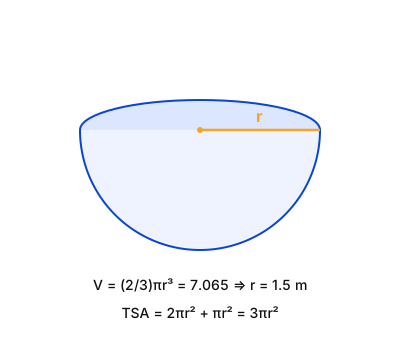
Find the total surface area of a hemispherical bowl whose volume is 7.065m3. (Take π=3.14)
एक अर्धगोलाकार कटोरे का कुल पृष्ठीय क्षेत्रफल ज्ञात कीजिए जिसका आयतन 7.065m3 है। (π=3.14 लीजिए)
  1. A21.195 m2
  2. B18.125 m2
  3. C28.365 m2
  4. D35.125 m2
Show answer

Concept: Hemisphere: volume =23πr3, total surface area =3πr2 (curved 2πr2 + flat top πr2).

  1. 23×3.14×r3=7.065⇒r3=7.065×36.28=3.375
  2. r=1.5m
  3. TSA =3×3.14×(1.5)2=3×3.14×2.25=21.195m2

Trick: 3.375=1.53 is worth memorising (like 0.125=0.53). Check with options: TSA of a hemisphere =3πr2, not 2πr2.

Answer: (A) 21.195 m²

अवधारणा: अर्धगोला: आयतन =23πr3, कुल पृष्ठीय क्षेत्रफल =3πr2 (वक्र 2πr2 + ऊपरी समतल πr2)।

  1. 23×3.14×r3=7.065⇒r3=7.065×36.28=3.375
  2. r=1.5m
  3. TSA =3×3.14×(1.5)2=3×3.14×2.25=21.195m2

ट्रिक: 3.375=1.53 याद रखें (जैसे 0.125=0.53)। अर्धगोले का TSA =3πr2 है, 2πr2 नहीं।

उत्तर: (A) 21.195 m²

RRB NTPC Undergraduate CBT 2MathematicsMensuration – HemisphereRRB NTPC Undergraduate CBT 2 2025 · 17 Sep Shift 1 →
Q80.
A student's marks were incorrectly entered as 68 instead of 59. Due to this, the average marks of the class got increase by 1.8. What is the number of students in the class?
एक विद्यार्थी के अंक गलती से 59 के स्थान पर 68 दर्ज कर दिए गए। इसके कारण कक्षा के औसत अंकों में 1.8 की वृद्धि हो गई। कक्षा में विद्यार्थियों की संख्या क्या है?
  1. A7
  2. B4
  3. C6
  4. D5
Show answer

Concept: Change in total = change in average × number of students.

  1. Excess entered =68−59=9
  2. n×1.8=9⇒n=5

Trick: Wrong-entry questions: n=difference of entrieschange in average.

Answer: (D) 5

अवधारणा: कुल में परिवर्तन = औसत में परिवर्तन × विद्यार्थियों की संख्या।

  1. अधिक दर्ज अंक =68−59=9
  2. n×1.8=9⇒n=5

ट्रिक: गलत प्रविष्टि वाले प्रश्न: n=प्रविष्टियों का अंतरऔसत में परिवर्तन।

उत्तर: (D) 5

RRB NTPC Undergraduate CBT 2MathematicsAverage – Error CorrectionRRB NTPC Undergraduate CBT 2 2025 · 17 Sep Shift 1 →