Question bank

Q&A: practice questions with answers

Search questions on any topic. Filter by exam category, exam, subject and topic, try the question, then open the answer and explanation.

Courses – airGurukul

494 questions found.

Q401.
As per Article 280(1) of the Constitution, the Finance Commission is to be constituted:
संविधान के अनुच्छेद 280(1) के अनुसार, वित्त आयोग का गठन किया जाना है:
  1. AEvery four years or earlierप्रत्येक चार वर्ष या उससे पहले
  2. BEvery three yearsप्रत्येक तीन वर्ष
  3. CEvery five years or earlierप्रत्येक पाँच वर्ष या उससे पहले
  4. DEvery seven years or earlierप्रत्येक सात वर्ष या उससे पहले
Show answer

Concept: Article 280(1) directs the President to constitute a Finance Commission.

  1. It is constituted every fifth year or at such earlier time as the President considers necessary – i.e. 'every five years or earlier'.
  2. It has a Chairman and four other members; it recommends the sharing of taxes between the Union and States and grants-in-aid.
  3. 16th Finance Commission (Chairman Arvind Panagariya) covers 2026–31.

Yaad rakhein: Art. 280 = Finance Commission = 5 years (or earlier); Art. 243-I = State Finance Commission.

Answer: (C) Every five years or earlier

अवधारणा: अनुच्छेद 280(1) के अनुसार राष्ट्रपति वित्त आयोग का गठन करते हैं।

  1. इसका गठन हर पाँचवें वर्ष या उससे पहले, जब राष्ट्रपति आवश्यक समझें, किया जाता है – अर्थात 'हर पाँच वर्ष या उससे पहले'।
  2. इसमें एक अध्यक्ष और चार अन्य सदस्य होते हैं; यह केंद्र-राज्य कर विभाजन और सहायता अनुदान की सिफारिश करता है।
  3. 16वाँ वित्त आयोग (अध्यक्ष अरविंद पनगढ़िया) 2026–31 के लिए है।

याद रखें: अनु. 280 = वित्त आयोग = 5 वर्ष (या पहले); अनु. 243-I = राज्य वित्त आयोग।

उत्तर: (C) हर पाँच वर्ष या उससे पहले
RRB Technician Grade I (Signal)General AwarenessFinance Commission – Article 280RRB Technician Grade I (Signal) 2025 · 13 Mar Shift 1 →
Q402.
Shri C. P. Radhakrishnan was sworn in as _____ Vice President of India.
श्री सी. पी. राधाकृष्णन ने भारत के _____ उपराष्ट्रपति के रूप में शपथ ली।
  1. A12th12वें
  2. B15th15वें
  3. C14th14वें
  4. D13th13वें
Show answer

Concept: The Vice President is elected by an electoral college of both Houses of Parliament (Article 66).

  1. C. P. Radhakrishnan, former Governor of Maharashtra, was sworn in as the 15th Vice President of India on 12 September 2025 by President Droupadi Murmu.
  2. He won the 9 September 2025 election (452 votes) against B. Sudershan Reddy, after Jagdeep Dhankhar (14th VP) resigned in July 2025.

Yaad rakhein: Dhankhar = 14th → C.P. Radhakrishnan = 15th (Sept 2025).

Answer: (B) 15th

अवधारणा: उपराष्ट्रपति का चुनाव संसद के दोनों सदनों के निर्वाचक मंडल द्वारा होता है (अनुच्छेद 66)।

  1. महाराष्ट्र के पूर्व राज्यपाल सी. पी. राधाकृष्णन ने 12 सितंबर 2025 को भारत के 15वें उपराष्ट्रपति के रूप में राष्ट्रपति द्रौपदी मुर्मू के समक्ष शपथ ली।
  2. जगदीप धनखड़ (14वें VP) के जुलाई 2025 में त्यागपत्र के बाद 9 सितंबर 2025 के चुनाव में उन्होंने बी. सुदर्शन रेड्डी को हराया (452 मत)।

याद रखें: धनखड़ = 14वें → सी.पी. राधाकृष्णन = 15वें (सितंबर 2025)।

उत्तर: (B) 15वें

RRB Technician Grade I (Signal)General AwarenessCurrent Affairs – Vice President of IndiaRRB Technician Grade I (Signal) 2025 · 13 Mar Shift 1 →
Q403.
Which of the following pairs of peaks and their approximate heights is matched INCORRECTLY?
निम्नलिखित में से शिखरों और उनकी अनुमानित ऊँचाइयों का कौन-सा युग्म गलत सुमेलित है?
  1. AKanchenjunga - 8598 mकंचनजंगा - 8598 m
  2. BDodabetta - 2637 mडोडाबेट्टा - 2637 m
  3. CNanga Parbat - 7026 mनंगा पर्वत - 7026 m
  4. DAnaimudi - 2695 mअनाईमुडी - 2695 m
Show answer

Concept: Check each peak's standard height.

  1. Kanchenjunga ≈ 8586 m (older texts give 8598 m) – acceptable; Dodabetta (Nilgiris) = 2637 m ✓; Anaimudi (highest in South India) = 2695 m ✓.
  2. Nanga Parbat = 8126 m, the ninth-highest peak in the world (western anchor of the Himalayas, in PoK). '7026 m' is wrong by 1100 m, so this pair is mismatched.

Yaad rakhein: All Himalayan 8000-ers: Everest 8849, K2 8611, Kanchenjunga 8586, Nanga Parbat 8126 m.

Answer: (C) Nanga Parbat – 7026 m

अवधारणा: हर शिखर की मानक ऊँचाई जाँचें।

  1. कंचनजंगा ≈ 8586 m (पुरानी पुस्तकों में 8598 m) – स्वीकार्य; डोडाबेट्टा (नीलगिरि) = 2637 m ✓; अनाईमुडी (दक्षिण भारत का सर्वोच्च) = 2695 m ✓।
  2. नंगा पर्वत = 8126 m, विश्व का नौवाँ सबसे ऊँचा शिखर (हिमालय का पश्चिमी छोर, PoK में)। '7026 m' लगभग 1100 m गलत है, अतः यह युग्म असंगत है।

याद रखें: 8000 m वाले शिखर: एवरेस्ट 8849, K2 8611, कंचनजंगा 8586, नंगा पर्वत 8126 m।

उत्तर: (C) नंगा पर्वत – 7026 m

RRB Technician Grade I (Signal)General AwarenessPhysical Geography – Mountain PeaksRRB Technician Grade I (Signal) 2025 · 13 Mar Shift 1 →
Q404.
Which of the following was NOT a key component of the 1991 industrial reforms in India?
निम्नलिखित में से कौन-सा भारत में 1991 के औद्योगिक सुधारों का प्रमुख घटक नहीं था?
  1. AExpansion of the public sector in key industriesप्रमुख उद्योगों में सार्वजनिक क्षेत्र का विस्तार
  2. BEncouraging Foreign Direct Investment (FDI)प्रत्यक्ष विदेशी निवेश (FDI) को प्रोत्साहन
  3. CAbolition of the Monopolies and Restrictive Trade Practices (MRTP) Actएकाधिकार और अवरोधक व्यापार व्यवहार (MRTP) अधिनियम की समाप्ति
  4. DDelicensing of industriesउद्योगों का विलाइसेंसीकरण (delicensing)
Show answer

Concept: The New Industrial Policy 1991 = Liberalisation, Privatisation, Globalisation (LPG).

  1. Key steps: delicensing of most industries, abolition of the MRTP asset limit, opening to FDI (up to 51% automatic in many sectors), and reducing the industries reserved for the public sector from 17 to 8 (later 2–3).
  2. 'Expansion of the public sector' was the pre-1991 (1956 policy) approach, not a 1991 reform – so it is the odd one out.

Yaad rakhein: 1991 = less licence, less MRTP, less public sector, more FDI.

Answer: (A) Expansion of the public sector in key industries

अवधारणा: नई औद्योगिक नीति 1991 = उदारीकरण, निजीकरण, वैश्वीकरण (LPG)।

  1. मुख्य कदम: अधिकांश उद्योगों का लाइसेंस-मुक्त होना, MRTP की संपत्ति सीमा समाप्त, FDI के लिए खुलापन (कई क्षेत्रों में 51% स्वतः), और सार्वजनिक क्षेत्र के लिए आरक्षित उद्योग 17 से घटाकर 8 (बाद में 2–3)।
  2. 'सार्वजनिक क्षेत्र का विस्तार' 1991 से पहले (1956 नीति) की सोच थी, 1991 का सुधार नहीं – इसलिए यही अलग है।

याद रखें: 1991 = कम लाइसेंस, कम MRTP, कम सार्वजनिक क्षेत्र, अधिक FDI।

उत्तर: (A) प्रमुख उद्योगों में सार्वजनिक क्षेत्र का विस्तार

RRB Technician Grade I (Signal)General AwarenessEconomic Reforms of 1991RRB Technician Grade I (Signal) 2025 · 13 Mar Shift 1 →
Q405.
What will come in the place of ‘?’ in the following equation, if ‘+’ and ‘-’ are interchanged and ‘x’ and ‘÷’ are interchanged?
297 x 11 - 17 ÷ 18 + 91 =?
यदि ‘+’ और ‘-’ को परस्पर बदल दिया जाए तथा ‘x’ और ‘÷’ को परस्पर बदल दिया जाए, तो निम्नलिखित समीकरण में ‘?’ के स्थान पर क्या आएगा?
297 x 11 - 17 ÷ 18 + 91 =?
  1. A242
  2. B245
  3. C248
  4. D240
Show answer

Concept: Replace the signs as told, then apply BODMAS.

  1. Interchanging ‘+’↔‘−’ and ‘×’↔‘÷’: 297÷11+17×18−91
  2. 297÷11=27 and 17×18=306
  3. 27+306−91=242

Trick: Write the new expression first, then do ÷ and × before + and −.

Answer: (A) 242

अवधारणा: बताए अनुसार चिह्न बदलें, फिर BODMAS लगाएँ।

  1. ‘+’↔‘−’ और ‘×’↔‘÷’ बदलने पर: 297÷11+17×18−91
  2. 297÷11=27 और 17×18=306
  3. 27+306−91=242

ट्रिक: पहले नया व्यंजक लिखें, फिर ÷ और × को + और − से पहले हल करें।

उत्तर: (A) 242

RRB Technician Grade I (Signal)General Intelligence and ReasoningMathematical Operations – Sign InterchangeRRB Technician Grade I (Signal) 2025 · 13 Mar Shift 1 →
Q406.
A question is followed by two statements numbered I and II. You have to decide whether the data provided in the statements are sufficient to answer the question. Read both the statements and select the most appropriate answer.
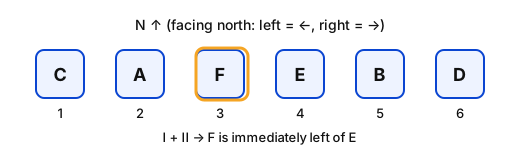
Six people, A, B, C, D, E and F, are sitting in a straight line, facing north. Who sits to the immediate left of E?
I. B sits fourth to the right of C. Only one person sits between C and F. D sits third to the right of F.
II. C sits at the extreme left end of the line. Only two people sit between C and E. A sits fourth to the left of D.
एक प्रश्न के बाद I और II क्रमांकित दो कथन दिए गए हैं। आपको यह निर्णय करना है कि कथनों में दिए गए आँकड़े प्रश्न का उत्तर देने के लिए पर्याप्त हैं या नहीं। दोनों कथनों को पढ़िए और सबसे उपयुक्त उत्तर चुनिए।
छह व्यक्ति, A, B, C, D, E और F, एक सीधी पंक्ति में उत्तर की ओर मुख करके बैठे हैं। E के ठीक बाएँ कौन बैठा है?
I. B, C के दाएँ चौथे स्थान पर बैठा है। C और F के बीच केवल एक व्यक्ति बैठा है। D, F के दाएँ तीसरे स्थान पर बैठा है।
II. C पंक्ति के सबसे बाएँ छोर पर बैठा है। C और E के बीच केवल दो व्यक्ति बैठे हैं। A, D के बाएँ चौथे स्थान पर बैठा है।
  1. AThe data in both Statements I and II put together (and not independently) are sufficient to answer the question.कथन I और II दोनों के आँकड़े मिलाकर (और अलग-अलग नहीं) प्रश्न का उत्तर देने के लिए पर्याप्त हैं।
  2. BThe data in Statement I alone is sufficient to answer the question while data in Statement II is not.अकेले कथन I के आँकड़े प्रश्न का उत्तर देने के लिए पर्याप्त हैं, जबकि कथन II के आँकड़े पर्याप्त नहीं हैं।
  3. CThe data in Statement II alone is sufficient to answer the question while data in Statement I is not.अकेले कथन II के आँकड़े प्रश्न का उत्तर देने के लिए पर्याप्त हैं, जबकि कथन I के आँकड़े पर्याप्त नहीं हैं।
  4. DThe data in both Statements I and II put together are NOT sufficient to answer the question.कथन I और II दोनों के आँकड़े मिलाकर भी प्रश्न का उत्तर देने के लिए पर्याप्त नहीं हैं।
Show answer

Concept: Facing north, 'right' means towards the right end. Number the seats 1–6 from left.

  1. Statement I: B is 4th right of C → C = 1 (F = 3, D = 6, B = 5) is the only fit. A and E can be at 2 or 4 → left of E not fixed. Not sufficient.
  2. Statement II: C = 1, E = 4, A 4th left of D → A = 2, D = 6; B/F at 3 and 5 → left of E is B or F. Not sufficient.
  3. Together: F = 3 (from I) → F is immediately left of E. Sufficient.

Trick: Fix the extreme-end person first; count how many unknowns remain next to the asked person.

Answer: (A) Both statements together are sufficient

अवधारणा: उत्तर की ओर मुख होने पर 'दाएँ' = दाएँ सिरे की ओर। सीटें बाएँ से 1–6।

  1. कथन I: B, C के दाएँ चौथा → केवल C = 1 (F = 3, D = 6, B = 5) संभव। A और E सीट 2 या 4 पर → E के बाएँ कौन, तय नहीं। अपर्याप्त।
  2. कथन II: C = 1, E = 4, A, D के बाएँ चौथा → A = 2, D = 6; B/F सीट 3 और 5 पर → E के बाएँ B या F। अपर्याप्त।
  3. दोनों मिलाकर: F = 3 (कथन I से) → F, E के ठीक बाएँ। पर्याप्त।

ट्रिक: पहले सिरे वाले व्यक्ति को स्थिर करें; फिर देखें पूछे गए व्यक्ति के पास कितने अनिश्चित बचे।

उत्तर: (A) दोनों कथन मिलकर पर्याप्त हैं

RRB Technician Grade I (Signal)General Intelligence and ReasoningData Sufficiency – Linear SeatingRRB Technician Grade I (Signal) 2025 · 13 Mar Shift 1 →
Q407.
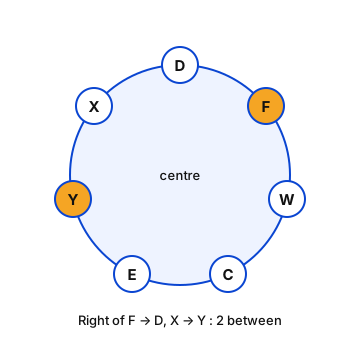
Seven people, C, D, E, F, W, X and Y, are sitting around a circular table facing the centre of the table. Only two people sit between C and D when counted from the left of D. X sits to the immediate right of D. Only three people sit between D and E. F sits to the immediate right of W. How many people sit between Y and F when counted from the right of F?
सात व्यक्ति, C, D, E, F, W, X और Y, एक वृत्ताकार मेज़ के चारों ओर केंद्र की ओर मुख करके बैठे हैं। D के बाएँ से गिनने पर C और D के बीच केवल दो व्यक्ति बैठे हैं। X, D के ठीक दाएँ बैठा है। D और E के बीच केवल तीन व्यक्ति बैठे हैं। F, W के ठीक दाएँ बैठा है। F के दाएँ से गिनने पर Y और F के बीच कितने व्यक्ति बैठे हैं?
  1. AThreeतीन
  2. BZeroशून्य
  3. COneएक
  4. DTwoदो
Show answer

Concept: Facing the centre, a person's left is clockwise and right is anticlockwise.

  1. Start with D. Two people between C and D from D's left → going clockwise: D, _, _, C.
  2. X is immediate right of D (anticlockwise seat). Three between D and E → E is opposite side: D, _, _, C, E.
  3. Remaining three seats (two between D and C, one between E and X) take F, W, Y. F immediate right of W → W, F fill the two seats after D (clockwise W, then F nearer D). Y takes the seat between E and X.
  4. From F's right: D, X, then Y → two people between.

Trick: Facing centre: left = clockwise. Place the person with most clues (D) first.

Answer: (D) Two

अवधारणा: केंद्र की ओर मुख होने पर व्यक्ति का बायाँ = दक्षिणावर्त (clockwise), दायाँ = वामावर्त।

  1. D से शुरू करें। D के बाएँ से C और D के बीच दो लोग → दक्षिणावर्त: D, _, _, C।
  2. X, D के ठीक दाएँ (वामावर्त सीट)। D और E के बीच तीन → E दूसरी ओर: D, _, _, C, E।
  3. बची तीन सीटों (D–C के बीच दो, E–X के बीच एक) पर F, W, Y। F, W के ठीक दाएँ → D के बाद की दो सीटों पर W, F (F, D के पास)। Y, E और X के बीच।
  4. F के दाएँ से: D, X, फिर Y → बीच में दो लोग।

ट्रिक: केंद्र की ओर मुख: बायाँ = clockwise। सबसे अधिक सूचना वाले व्यक्ति (D) को पहले रखें।

उत्तर: (D) दो

RRB Technician Grade I (Signal)General Intelligence and ReasoningCircular Seating ArrangementRRB Technician Grade I (Signal) 2025 · 13 Mar Shift 1 →
Q408.
Refer to the following number and symbol series and answer the question that follows. Counting to be done from left to right only.
(Left) 1 3 € £ 7 4 6 ¥ 2 8 $ 6 3 1 ◇ 1 3 9 ○ 2 5 ☆7 5 9 (Right)
How many such symbols are there that are immediately preceded by an odd number but not immediately followed by an even number?
निम्नलिखित संख्या और प्रतीक शृंखला को देखिए और उसके बाद दिए गए प्रश्न का उत्तर दीजिए। गिनती केवल बाएँ से दाएँ की ओर की जानी है।
(बाएँ) 1 3 € £ 7 4 6 ¥ 2 8 $ 6 3 1 ◇ 1 3 9 ○ 2 5 ☆7 5 9 (दाएँ)
ऐसे कितने प्रतीक हैं जिनके ठीक पहले एक विषम संख्या है, परंतु ठीक बाद एक सम संख्या नहीं है?
  1. AFourचार
  2. BOneएक
  3. CTwoदो
  4. DThreeतीन
Show answer

Concept: Check every symbol: left neighbour must be an odd number, right neighbour must NOT be an even number.

  1. € : 3 before (odd), £ after (not an even number) → ✓
  2. £ (before: €), ¥ (before: 6), $ (before: 8) → ✗
  3. ◇ : 1 before, 1 after → ✓; ○ : 9 before but 2 after (even) → ✗; ☆ : 5 before, 7 after → ✓
  4. Total = 3

Trick: 'Not followed by an even number' includes being followed by a symbol or an odd number.

Answer: (D) Three

अवधारणा: हर प्रतीक जाँचें: बाईं ओर विषम संख्या हो और दाईं ओर सम संख्या न हो।

  1. € : पहले 3 (विषम), बाद में £ (सम संख्या नहीं) → ✓
  2. £ (पहले €), ¥ (पहले 6), $ (पहले 8) → ✗
  3. ◇ : पहले 1, बाद 1 → ✓; ○ : पहले 9 पर बाद 2 (सम) → ✗; ☆ : पहले 5, बाद 7 → ✓
  4. कुल = 3

ट्रिक: 'सम संख्या के बाद नहीं' में प्रतीक या विषम संख्या का आना भी शामिल है।

उत्तर: (D) तीन

RRB Technician Grade I (Signal)General Intelligence and ReasoningNumber–Symbol SeriesRRB Technician Grade I (Signal) 2025 · 13 Mar Shift 1 →
Q409.
Based on the English alphabetical order, three of the following four letter-clusters are alike in a certain way and thus form a group. Which letter-cluster DOES NOT belong to that group?
(Note: The odd one out is not based on the number of consonants/vowels or their position in the letter-cluster.)
अंग्रेज़ी वर्णमाला क्रम के आधार पर, निम्नलिखित चार अक्षर-समूहों में से तीन एक निश्चित प्रकार से समान हैं और इस प्रकार एक समूह बनाते हैं। कौन-सा अक्षर-समूह उस समूह से संबंधित नहीं है?
(नोट: असंगत विकल्प व्यंजनों/स्वरों की संख्या या अक्षर-समूह में उनकी स्थिति पर आधारित नहीं है।)
  1. AMHJ
  2. BRMO
  3. CTOQ
  4. DKEH
Show answer

Concept: Convert letters to positions and compare the gaps.

  1. MHJ: 13, 8, 10 → −5,+2
  2. RMO: 18, 13, 15 → −5,+2; TOQ: 20, 15, 17 → −5,+2
  3. KEH: 11, 5, 8 → −6,+3 → different pattern

Trick: Memorise positions with EJOTY (E=5, J=10, O=15, T=20, Y=25) for quick counting.

Answer: (D) KEH

अवधारणा: अक्षरों को स्थान-संख्या में बदलकर अंतर तुलना करें।

  1. MHJ: 13, 8, 10 → −5,+2
  2. RMO: 18, 13, 15 → −5,+2; TOQ: 20, 15, 17 → −5,+2
  3. KEH: 11, 5, 8 → −6,+3 → अलग पैटर्न

ट्रिक: EJOTY (E=5, J=10, O=15, T=20, Y=25) याद रखें, गिनती तेज होगी।

उत्तर: (D) KEH

RRB Technician Grade I (Signal)General Intelligence and ReasoningLetter Cluster ClassificationRRB Technician Grade I (Signal) 2025 · 13 Mar Shift 1 →
Q410.
In a certain code language,
A + B means ‘A is the son of B’,
A – B means ‘A is the brother of B’,
A x B means ‘A is the wife of B’, and
A ÷ B means ‘A is the father of B’.
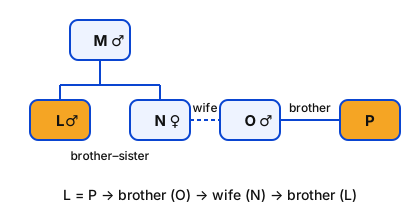
Based on the above, how is L related to P if ‘L + M ÷ N x O – P’?
एक निश्चित कूट भाषा में,
A + B का अर्थ है ‘A, B का पुत्र है’,
A – B का अर्थ है ‘A, B का भाई है’,
A x B का अर्थ है ‘A, B की पत्नी है’, और
A ÷ B का अर्थ है ‘A, B का पिता है’।
उपर्युक्त के आधार पर, यदि ‘L + M ÷ N x O – P’ है, तो L, P से किस प्रकार संबंधित है?
  1. ABrother’s wife’s fatherभाई की पत्नी का पिता
  2. BWife’s fatherपत्नी का पिता
  3. CWife’s brotherपत्नी का भाई
  4. DBrother’s wife’s brotherभाई की पत्नी का भाई
Show answer

Concept: Decode each symbol step by step and build the family tree.

  1. L + M: L is son of M; M ÷ N: M is father of N → L and N are siblings (L is N's brother).
  2. N × O: N is wife of O; O − P: O is brother of P.
  3. So from P: P's brother = O; O's wife = N; N's brother = L. L is P's brother's wife's brother.

Trick: Read the chain from the person asked about (P) backwards to L.

Answer: (D) Brother's wife's brother

अवधारणा: हर चिह्न को क्रम से डिकोड करके वंश-वृक्ष बनाएँ।

  1. L + M: L, M का पुत्र; M ÷ N: M, N का पिता → L और N भाई-बहन (L, N का भाई)।
  2. N × O: N, O की पत्नी; O − P: O, P का भाई।
  3. P से देखें: P का भाई = O; O की पत्नी = N; N का भाई = L। अतः L, P के भाई की पत्नी का भाई है।

ट्रिक: जिसके बारे में पूछा है (P) उससे उल्टा चलते हुए L तक शृंखला पढ़ें।

उत्तर: (D) भाई की पत्नी का भाई

RRB Technician Grade I (Signal)General Intelligence and ReasoningBlood Relations – CodedRRB Technician Grade I (Signal) 2025 · 13 Mar Shift 1 →
Q411.
Refer to the following number and symbol series and answer the question that follows. Counting to be done from left to right only. All numbers are single-digit numbers. (Left) 9 1 @ $ 5 1 # 5 9 $ 1 & 4 + 7 = ! 5 & 4 ? (Right)
How many such symbols are there each of which is immediately preceded by a number and also immediately followed by another number?
निम्नलिखित संख्या और प्रतीक शृंखला को देखिए और उसके बाद दिए गए प्रश्न का उत्तर दीजिए। गिनती केवल बाएँ से दाएँ की ओर की जानी है। सभी संख्याएँ एक-अंकीय संख्याएँ हैं। (बाएँ) 9 1 @ $ 5 1 # 5 9 $ 1 & 4 + 7 = ! 5 & 4 ? (दाएँ)
ऐसे कितने प्रतीक हैं जिनमें से प्रत्येक के ठीक पहले एक संख्या है और ठीक बाद भी एक अन्य संख्या है?
  1. ATHREEतीन
  2. BFIVEपाँच
  3. CFOURचार
  4. DSIXछह
Show answer

Concept: A symbol qualifies only if both its neighbours are numbers.

  1. Series: 9 1 @ $ 5 1 # 5 9 $ 1 & 4 + 7 = ! 5 & 4 ?
  2. @ (next is $) ✗; $ (previous @) ✗; # (1…5) ✓; $ (9…1) ✓; & (1…4) ✓; + (4…7) ✓; = (next !) ✗; ! (previous =) ✗; & (5…4) ✓; ? (last) ✗
  3. Count = 5

Trick: Two adjacent symbols can never both qualify – cross them out quickly.

Answer: (B) FIVE

अवधारणा: प्रतीक तभी गिना जाएगा जब उसके दोनों पड़ोसी संख्याएँ हों।

  1. शृंखला: 9 1 @ $ 5 1 # 5 9 $ 1 & 4 + 7 = ! 5 & 4 ?
  2. @ (आगे $) ✗; $ (पीछे @) ✗; # (1…5) ✓; $ (9…1) ✓; & (1…4) ✓; + (4…7) ✓; = (आगे !) ✗; ! (पीछे =) ✗; & (5…4) ✓; ? (अंतिम) ✗
  3. गिनती = 5

ट्रिक: दो सटे हुए प्रतीक कभी दोनों नहीं गिने जा सकते – उन्हें तुरंत काट दें।

उत्तर: (B) पाँच (FIVE)

RRB Technician Grade I (Signal)General Intelligence and ReasoningNumber–Symbol SeriesRRB Technician Grade I (Signal) 2025 · 13 Mar Shift 1 →
Q412.
Refer to the given letter, number and symbol series and answer the question that follows. Counting to be done from left to right only.
(Left) F 5 @ £ T 7 Y € V D © 3 € 6 % X 1 Z £ € G * (Right)
If all the numbers are dropped from the series, which of the following will be sixth from the left?
दी गई अक्षर, संख्या और प्रतीक शृंखला को देखिए और उसके बाद दिए गए प्रश्न का उत्तर दीजिए। गिनती केवल बाएँ से दाएँ की ओर की जानी है।
(बाएँ) F 5 @ £ T 7 Y € V D © 3 € 6 % X 1 Z £ € G * (दाएँ)
यदि शृंखला से सभी संख्याएँ हटा दी जाएँ, तो निम्नलिखित में से कौन-सा बाएँ से छठा होगा?
  1. AY
  2. B€
  3. C£
  4. DT
Show answer

Concept: Drop the digits and count from the left.

  1. Numbers 5, 7, 3, 6, 1 are removed.
  2. New series: F @ £ T Y € V D © € % X Z £ € G *
  3. 6th from left = €

Trick: Strike the numbers on paper and count only the survivors – avoid counting in the head.

Answer: (B) €

अवधारणा: अंक हटाकर बाएँ से गिनें।

  1. संख्याएँ 5, 7, 3, 6, 1 हटाईं।
  2. नई शृंखला: F @ £ T Y € V D © € % X Z £ € G *
  3. बाएँ से छठा = €

ट्रिक: कागज पर अंकों को काटकर केवल बचे हुए को गिनें – मन में गिनने से गलती होती है।

उत्तर: (B) €

RRB Technician Grade I (Signal)General Intelligence and ReasoningLetter–Symbol SeriesRRB Technician Grade I (Signal) 2025 · 13 Mar Shift 1 →
Q413.
In the following triad, each group of letters is related to the subsequent one following a certain logic. Select from the given options, the one which follows the same logic. MAKE – MEKA – AEMK
LOAD – LDAO - ODLA
निम्नलिखित त्रिक (triad) में, अक्षरों का प्रत्येक समूह एक निश्चित तर्क के अनुसार अपने अगले समूह से संबंधित है। दिए गए विकल्पों में से वह विकल्प चुनिए जो उसी तर्क का पालन करता है। MAKE – MEKA – AEMK
LOAD – LDAO - ODLA
  1. AWIND – WDNI – IDWN
  2. BVIEW – WVIE – EWIV
  3. CRENT – RTEN – ENRT
  4. DGROW – ROWG – ORGW
Show answer

Concept: Find how letter positions move in each step.

  1. MAKE (1234) → MEKA: 2nd and 4th letters swap (1-4-3-2).
  2. MEKA → AEMK: new order = (4, 2, 1, 3) of MEKA.
  3. Check: LOAD → LDAO (swap 2,4) → ODLA (4,2,1,3) ✓.
  4. WIND → WDNI (swap 2,4) → IDWN (4,2,1,3) ✓. Others fail at the first step (VIEW→WVIE, GROW→ROWG).

Trick: Test the first step only – most wrong options break there.

Answer: (A) WIND – WDNI – IDWN

अवधारणा: हर चरण में अक्षरों के स्थान कैसे बदलते हैं, देखें।

  1. MAKE (1234) → MEKA: दूसरा और चौथा अक्षर आपस में बदले (1-4-3-2)।
  2. MEKA → AEMK: MEKA का क्रम (4, 2, 1, 3)।
  3. जाँच: LOAD → LDAO (2,4 बदले) → ODLA (4,2,1,3) ✓।
  4. WIND → WDNI (2,4 बदले) → IDWN (4,2,1,3) ✓। बाकी पहले चरण में ही गलत (VIEW→WVIE, GROW→ROWG)।

ट्रिक: केवल पहला चरण जाँचें – अधिकतर गलत विकल्प वहीं कट जाते हैं।

उत्तर: (A) WIND – WDNI – IDWN

RRB Technician Grade I (Signal)General Intelligence and ReasoningLetter Rearrangement – TriadsRRB Technician Grade I (Signal) 2025 · 13 Mar Shift 1 →
Q414.
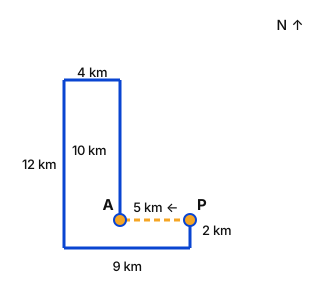
Vijay starts from point A and drives 10 km towards North. He then takes a left turn, drives 4 km, turns left and drives 12 km. He then takes a left turn and drives 9 km. He takes a final left turn, drives 2 km and stops at point P. How far (shortest distance) and towards which direction should he drive in order to reach point A again? (All turns are 90 degrees turns only unless specified)
विजय बिंदु A से चलना शुरू करता है और उत्तर की ओर 10 km गाड़ी चलाता है। फिर वह बाएँ मुड़ता है, 4 km गाड़ी चलाता है, बाएँ मुड़ता है और 12 km गाड़ी चलाता है। फिर वह बाएँ मुड़ता है और 9 km गाड़ी चलाता है। वह अंतिम बार बाएँ मुड़ता है, 2 km गाड़ी चलाता है और बिंदु P पर रुक जाता है। बिंदु A पर पुनः पहुँचने के लिए उसे कितनी दूर (न्यूनतम दूरी) और किस दिशा में गाड़ी चलानी चाहिए? (जब तक अन्यथा न कहा जाए, सभी मोड़ केवल 90 डिग्री के मोड़ हैं)
  1. A5 km to the east5 km पूर्व की ओर
  2. B4 km to the east4 km पूर्व की ओर
  3. C4 km to the west4 km पश्चिम की ओर
  4. D5 km to the west5 km पश्चिम की ओर
Show answer

Concept: Track the position as coordinates; a left turn from N→W→S→E→N.

  1. A(0,0) → North 10 km → (0,10) → left = West 4 km → (−4,10)
  2. Left = South 12 km → (−4,−2) → left = East 9 km → (5,−2)
  3. Left = North 2 km → P(5, 0). P is 5 km east of A.
  4. So he must drive 5 km towards the west to reach A.

Trick: Net east–west = −4+9=5 km east; net north–south = 10−12+2=0 → return journey is straight west.

Answer: (D) 5 km to the west

अवधारणा: स्थिति को निर्देशांक में लिखें; बायाँ मोड़ N→W→S→E→N।

  1. A(0,0) → उत्तर 10 km → (0,10) → बाएँ = पश्चिम 4 km → (−4,10)
  2. बाएँ = दक्षिण 12 km → (−4,−2) → बाएँ = पूर्व 9 km → (5,−2)
  3. बाएँ = उत्तर 2 km → P(5, 0)। P, A से 5 km पूर्व में है।
  4. अतः A पहुँचने के लिए 5 km पश्चिम की ओर चलना होगा।

ट्रिक: शुद्ध पूर्व–पश्चिम = −4+9=5 km पूर्व; शुद्ध उत्तर–दक्षिण = 10−12+2=0 → वापसी सीधे पश्चिम।

उत्तर: (D) 5 km पश्चिम की ओर

RRB Technician Grade I (Signal)General Intelligence and ReasoningDirection SenseRRB Technician Grade I (Signal) 2025 · 13 Mar Shift 1 →
Q415.
10 is related to 22 following a certain logic. Following the same logic, 24 is related to 50. To which of the given options is 6 related, following the same logic?
(NOTE: Operations should be performed on the whole numbers, without breaking down the numbers into their constituent digits. E.g. 13 – Operations on 13 such as adding to/subtracting from/multiplying with 13 can be performed. Breaking down 13 into 1 and 3 and then performing mathematical operations on 1 and 3 is not allowed.)
10 एक निश्चित तर्क के अनुसार 22 से संबंधित है। उसी तर्क के अनुसार, 24, 50 से संबंधित है। उसी तर्क के अनुसार, 6 दिए गए विकल्पों में से किससे संबंधित है?
(नोट: संक्रियाएँ पूर्ण संख्याओं पर की जानी चाहिए, संख्याओं को उनके घटक अंकों में तोड़े बिना। उदाहरण के लिए 13 – 13 पर संक्रियाएँ जैसे 13 में जोड़ना/13 से घटाना/13 से गुणा करना आदि की जा सकती हैं। 13 को 1 और 3 में तोड़कर फिर 1 और 3 पर गणितीय संक्रियाएँ करने की अनुमति नहीं है।)
  1. A18
  2. B16
  3. C14
  4. D12
Show answer

Concept: Find one rule that fits both given pairs.

  1. 10×2+2=22 ✓
  2. 24×2+2=50 ✓
  3. 6×2+2=14

Trick: When the second number is a little more than double, test 2n+k first.

Answer: (C) 14

अवधारणा: ऐसा नियम खोजें जो दोनों दिए गए युग्मों पर लागू हो।

  1. 10×2+2=22 ✓
  2. 24×2+2=50 ✓
  3. 6×2+2=14

ट्रिक: दूसरी संख्या दोगुने से थोड़ी अधिक हो तो पहले 2n+k जाँचें।

उत्तर: (C) 14

RRB Technician Grade I (Signal)General Intelligence and ReasoningNumber AnalogyRRB Technician Grade I (Signal) 2025 · 13 Mar Shift 1 →
Q416.
Each of M, N, O, P, Q, R and S plays a game on a different day of a week starting from Monday and ending on Sunday of the same week. M plays the game on Wednesday. Only two persons play the games between M and Q. O plays the game on the day immediately before R but not on Thursday. Only two persons play the games between N and S. N does not play the game on the last day. On which day does P play the game?
M, N, O, P, Q, R और S में से प्रत्येक एक ही सप्ताह के सोमवार से शुरू होकर रविवार तक समाप्त होने वाले सप्ताह के अलग-अलग दिन एक खेल खेलता है। M बुधवार को खेल खेलता है। M और Q के बीच केवल दो व्यक्ति खेल खेलते हैं। O, R के ठीक पहले वाले दिन खेल खेलता है, परंतु गुरुवार को नहीं। N और S के बीच केवल दो व्यक्ति खेल खेलते हैं। N अंतिम दिन खेल नहीं खेलता है। P किस दिन खेल खेलता है?
  1. AMondayसोमवार
  2. BTuesdayमंगलवार
  3. CThursdayगुरुवार
  4. DFridayशुक्रवार
Show answer

Concept: Fix the definite clue first, then use the 'immediately before' pair.

  1. M = Wednesday. Two persons between M and Q → Q = Saturday (Sunday before Wednesday is impossible).
  2. O–R are consecutive days, O not Thursday: only Mon–Tue is free → O = Monday, R = Tuesday.
  3. Left: Thu, Fri, Sun for N, S, P. Two between N and S and N not on Sunday → N = Thursday, S = Sunday.
  4. Hence P = Friday.

Trick: 'Two persons between' = 3 days apart; count the gaps on a 7-box strip.

Answer: (D) Friday

अवधारणा: पहले निश्चित सूचना रखें, फिर 'ठीक पहले' वाली जोड़ी लगाएँ।

  1. M = बुधवार। M और Q के बीच दो व्यक्ति → Q = शनिवार (बुधवार से पहले रविवार संभव नहीं)।
  2. O–R लगातार दिन, O गुरुवार नहीं: केवल सोम–मंगल खाली → O = सोमवार, R = मंगलवार।
  3. बचे: गुरु, शुक्र, रवि – N, S, P के लिए। N और S के बीच दो और N रविवार को नहीं → N = गुरुवार, S = रविवार।
  4. अतः P = शुक्रवार।

ट्रिक: 'बीच में दो व्यक्ति' = 3 दिन का अंतर; 7 खानों की पट्टी पर गिनें।

उत्तर: (D) शुक्रवार

RRB Technician Grade I (Signal)General Intelligence and ReasoningScheduling Puzzle – Days of WeekRRB Technician Grade I (Signal) 2025 · 13 Mar Shift 1 →
Q417.
LF 58 is related to ID 49 in a certain way. In the same way, YK 36 is related to VI 27. To which of the following is RO 61 related, following the same logic?
LF 58 एक निश्चित प्रकार से ID 49 से संबंधित है। उसी प्रकार, YK 36, VI 27 से संबंधित है। उसी तर्क के अनुसार, RO 61 निम्नलिखित में से किससे संबंधित है?
  1. AOM 52
  2. BOV 53
  3. COG 55
  4. DOH 59
Show answer

Concept: Apply the same shift to letters and the same change to the number.

  1. LF 58 → ID 49: L−3 = I, F−2 = D, 58−9=49
  2. YK 36 → VI 27: Y−3 = V, K−2 = I, 36−9=27 ✓
  3. RO 61 → R−3 = O, O−2 = M, 61−9=52 → OM 52

Trick: Check the number part first (−9) – it eliminates three options at once.

Answer: (A) OM 52

अवधारणा: अक्षरों पर वही खिसकाव और संख्या पर वही परिवर्तन लगाएँ।

  1. LF 58 → ID 49: L−3 = I, F−2 = D, 58−9=49
  2. YK 36 → VI 27: Y−3 = V, K−2 = I, 36−9=27 ✓
  3. RO 61 → R−3 = O, O−2 = M, 61−9=52 → OM 52

ट्रिक: पहले संख्या भाग (−9) जाँचें – तीन विकल्प एक साथ कट जाते हैं।

उत्तर: (A) OM 52

RRB Technician Grade I (Signal)General Intelligence and ReasoningLetter–Number AnalogyRRB Technician Grade I (Signal) 2025 · 13 Mar Shift 1 →
Q418.
Select the triad which follows the same pattern as that followed by the two triads given below. Both triads follow the same pattern.
HN-JF-MO
MS-OK-RT
वह त्रिक (triad) चुनिए जो नीचे दिए गए दो त्रिकों द्वारा अनुसरण किए गए पैटर्न का ही अनुसरण करता है। दोनों त्रिक एक ही पैटर्न का अनुसरण करते हैं।
HN-JF-MO
MS-OK-RT
  1. APV-SN-UY
  2. BPU-SN-WY
  3. CPV-RN-UW
  4. DOU-SM-WY
Show answer

Concept: Compare first letters across the three pairs, and second letters separately.

  1. HN–JF–MO: first letters H(8)→J(10)→M(13): +2,+3; second letters N(14)→F(6)→O(15): −8,+9.
  2. MS–OK–RT: M(13)→O(15)→R(18): +2,+3; S(19)→K(11)→T(20): −8,+9 ✓
  3. PV–RN–UW: P(16)→R(18)→U(21): +2,+3; V(22)→N(14)→W(23): −8,+9 ✓
  4. Other options fail on the first letters (P→S is +3, O→S is +4).

Trick: Check only the first-letter chain (+2,+3) – it leaves a single option.

Answer: (C) PV-RN-UW

अवधारणा: तीनों युग्मों के पहले अक्षर अलग और दूसरे अक्षर अलग तुलना करें।

  1. HN–JF–MO: पहले अक्षर H(8)→J(10)→M(13): +2,+3; दूसरे N(14)→F(6)→O(15): −8,+9।
  2. MS–OK–RT: M(13)→O(15)→R(18): +2,+3; S(19)→K(11)→T(20): −8,+9 ✓
  3. PV–RN–UW: P(16)→R(18)→U(21): +2,+3; V(22)→N(14)→W(23): −8,+9 ✓
  4. बाकी विकल्प पहले अक्षरों पर ही गलत (P→S +3, O→S +4)।

ट्रिक: केवल पहले अक्षरों की शृंखला (+2,+3) जाँचें – एक ही विकल्प बचता है।

उत्तर: (C) PV-RN-UW

RRB Technician Grade I (Signal)General Intelligence and ReasoningLetter Triad PatternRRB Technician Grade I (Signal) 2025 · 13 Mar Shift 1 →
Q419.
19 is related to 64 following a certain logic. Following the same logic, 28 is related to 91. To which of the following is 44 related, following the same logic?
(NOTE: Operations should be performed on the whole numbers, without breaking down the numbers into their constituent digits. E.g. 13 – Operations on 13 such as adding / subtracting / multiplying etc. to 13 can be performed. Breaking down 13 into 1 and 3 and then performing mathematical operations on 1 and 3 is not allowed.)
19 एक निश्चित तर्क के अनुसार 64 से संबंधित है। उसी तर्क के अनुसार, 28, 91 से संबंधित है। उसी तर्क के अनुसार, 44 निम्नलिखित में से किससे संबंधित है?
(नोट: संक्रियाएँ पूर्ण संख्याओं पर की जानी चाहिए, संख्याओं को उनके घटक अंकों में तोड़े बिना। उदाहरण के लिए 13 – 13 पर संक्रियाएँ जैसे 13 में जोड़ना / घटाना / गुणा करना आदि की जा सकती हैं। 13 को 1 और 3 में तोड़कर फिर 1 और 3 पर गणितीय संक्रियाएँ करने की अनुमति नहीं है।)
  1. A193
  2. B131
  3. C113
  4. D139
Show answer

Concept: Find a rule of the form an+b satisfying both pairs.

  1. 19×3+7=64 ✓
  2. 28×3+7=91 ✓
  3. 44×3+7=132+7=139

Trick: Differences: 64−19=45, 91−28=63 – both multiples of 9? No, but (64−7)/19=3=(91−7)/28; test ×3 when the result is about three times.

Answer: (D) 139

अवधारणा: an+b रूप का नियम खोजें जो दोनों युग्मों पर लागू हो।

  1. 19×3+7=64 ✓
  2. 28×3+7=91 ✓
  3. 44×3+7=132+7=139

ट्रिक: परिणाम लगभग तिगुना हो तो ×3 जाँचें: 64−57=7 और 91−84=7 – दोनों में +7।

उत्तर: (D) 139

RRB Technician Grade I (Signal)General Intelligence and ReasoningNumber AnalogyRRB Technician Grade I (Signal) 2025 · 13 Mar Shift 1 →
Q420.
What is the difference between Reply and Forward in email?
ईमेल में Reply और Forward के बीच क्या अंतर है?
  1. AReply sends your response only to the original sender, while Forward sends the email to a new recipient.Reply आपका उत्तर केवल मूल प्रेषक को भेजता है, जबकि Forward ईमेल को एक नए प्राप्तकर्ता को भेजता है।
  2. BReply sends the email to all contacts, Forward sends it to none.Reply ईमेल को सभी संपर्कों को भेजता है, Forward इसे किसी को नहीं भेजता।
  3. CReply deletes the original message, while Forward saves it.Reply मूल संदेश को हटा देता है, जबकि Forward इसे सहेज लेता है।
  4. DReply encrypts the email, Forward does not.Reply ईमेल को एन्क्रिप्ट करता है, Forward नहीं करता।
Show answer

Concept: Reply and Forward differ in who receives the message.

  1. Reply sends your response back to the original sender only (Reply All → sender + all recipients).
  2. Forward sends a copy of the received mail (with attachments) to a new recipient of your choice.
  3. Neither deletes, encrypts or broadcasts the mail – options B, C, D are wrong.

Yaad rakhein: Reply = back to sender; Forward = onward to someone new.

Answer: (A) Reply sends your response only to the original sender, while Forward sends the email to a new recipient.

अवधारणा: Reply और Forward में अंतर यह है कि संदेश किसे जाता है।

  1. Reply आपका उत्तर केवल मूल प्रेषक को भेजता है (Reply All → प्रेषक + सभी प्राप्तकर्ता)।
  2. Forward प्राप्त मेल की प्रति (अटैचमेंट सहित) आपके चुने नए प्राप्तकर्ता को भेजता है।
  3. कोई भी मेल को मिटाता, एन्क्रिप्ट या सबको नहीं भेजता – विकल्प B, C, D गलत।

याद रखें: Reply = प्रेषक को वापस; Forward = किसी नए को आगे।

उत्तर: (A) Reply उत्तर केवल मूल प्रेषक को भेजता है, Forward ईमेल नए प्राप्तकर्ता को भेजता है।

RRB Technician Grade I (Signal)Basics of Computers and ApplicationEmail – Reply vs ForwardRRB Technician Grade I (Signal) 2025 · 13 Mar Shift 1 →