Question bank

Q&A: practice questions with answers

Search questions on any topic. Filter by exam category, exam, subject and topic, try the question, then open the answer and explanation.

Courses – airGurukul

494 questions found.

Q441.
If E and F are two mutually exclusive events such that P(E)=16 and P(F)=12, then find the P(not E and not F).
यदि E और F दो परस्पर अपवर्जी (mutually exclusive) घटनाएँ इस प्रकार हैं कि P(E)=16 और P(F)=12, तो P(not E and not F) ज्ञात कीजिए।
  1. A23
  2. B56
  3. C12
  4. D13
Show answer

Concept: For mutually exclusive events P(E∪F)=P(E)+P(F), and 'not E and not F' is the complement of E∪F.

  1. P(E∪F)=16+12=16+36=46=23
  2. P(not E and not F)=1−P(E∪F)=1−23=13

Trick: De Morgan: P(E′∩F′)=1−P(E∪F).

Answer: (D) 13

अवधारणा: परस्पर अपवर्जी घटनाओं के लिए P(E∪F)=P(E)+P(F), और 'न E न F' E∪F का पूरक है।

  1. P(E∪F)=16+12=16+36=46=23
  2. P(न E न F)=1−P(E∪F)=1−23=13

ट्रिक: डी मॉर्गन: P(E′∩F′)=1−P(E∪F)।

उत्तर: (D) 13

RRB Technician Grade I (Signal)MathematicsProbability – Mutually Exclusive EventsRRB Technician Grade I (Signal) 2025 · 13 Mar Shift 1 →
Q442.
The coordinates of the centroid of the triangle ABC whose vertices are A(-16, 13), B(-2, -9) and C(2, 13), is
त्रिभुज ABC, जिसके शीर्ष A(-16, 13), B(-2, -9) और C(2, 13) हैं, के केंद्रक (centroid) के निर्देशांक हैं:
  1. A(−143,183)
  2. B(−163,153)
  3. C(−173,173)
  4. D(−163,173)
Show answer

Concept: Centroid G=(x1+x2+x33,y1+y2+y33).

  1. x=−16+(−2)+23=−163
  2. y=13+(−9)+133=173
  3. G=(−163,173)

Trick: Centroid = average of the three vertices; do x and y sums separately.

Answer: (D) (−163,173)

अवधारणा: केन्द्रक G=(x1+x2+x33,y1+y2+y33)।

  1. x=−16+(−2)+23=−163
  2. y=13+(−9)+133=173
  3. G=(−163,173)

ट्रिक: केन्द्रक = तीनों शीर्षों का औसत; x और y के योग अलग-अलग करें।

उत्तर: (D) (−163,173)

RRB Technician Grade I (Signal)MathematicsCoordinate Geometry – CentroidRRB Technician Grade I (Signal) 2025 · 13 Mar Shift 1 →
Q443.
Simplify (2.5 × 0.48 ÷ 0.6) + (3.5 + 1.6 ÷ 0.8) − (4.8 × 0.25 ÷ 0.8).
सरल कीजिए: (2.5 × 0.48 ÷ 0.6) + (3.5 + 1.6 ÷ 0.8) − (4.8 × 0.25 ÷ 0.8)।
  1. A8
  2. B6
  3. C7
  4. D5
Show answer

Concept: Solve inside each bracket first, doing × and ÷ before +.

  1. 2.5×0.48÷0.6=1.2÷0.6=2
  2. 3.5+1.6÷0.8=3.5+2=5.5
  3. 4.8×0.25÷0.8=1.2÷0.8=1.5
  4. 2+5.5−1.5=6

Trick: Convert to fractions: 0.48÷0.6=4860=0.8, 0.25÷0.8=2580 – fewer decimal slips.

Answer: (B) 6

अवधारणा: पहले हर कोष्ठक के अंदर हल करें, × और ÷ को + से पहले।

  1. 2.5×0.48÷0.6=1.2÷0.6=2
  2. 3.5+1.6÷0.8=3.5+2=5.5
  3. 4.8×0.25÷0.8=1.2÷0.8=1.5
  4. 2+5.5−1.5=6

ट्रिक: भिन्न में बदलें: 0.48÷0.6=4860=0.8, 0.25÷0.8=2580 – दशमलव की गलती कम होगी।

उत्तर: (B) 6

RRB Technician Grade I (Signal)MathematicsSimplification – Decimals (BODMAS)RRB Technician Grade I (Signal) 2025 · 13 Mar Shift 1 →
Q444.
The HCF of two numbers, each having three digits, is 19 and their LCM is 760. The number of such pairs is:
तीन अंकों वाली दो संख्याओं का HCF 19 है और उनका LCM 760 है। ऐसे युग्मों की संख्या है:
  1. A0
  2. B3
  3. C2
  4. D1
Show answer

Concept: If HCF =h, the numbers are ha and hb with a,b coprime and ab=LCMh.

  1. ab=76019=40; coprime pairs: (1,40) and (5,8)
  2. (1,40)⇒19,760 – but 19 is a two-digit number, rejected.
  3. (5,8)⇒95,152 – both three-digit ✓
  4. Number of such pairs =1

Trick: Pairs with ab=40: (1,40),(5,8) only ((2,20),(4,10) are not coprime); then apply the digit condition.

Answer: (D) 1

अवधारणा: यदि HCF =h हो तो संख्याएँ ha और hb होंगी, जहाँ a,b सह-अभाज्य और ab=LCMh।

  1. ab=76019=40; सह-अभाज्य युग्म: (1,40) और (5,8)
  2. (1,40)⇒19,760 – पर 19 दो अंकों की है, अस्वीकृत।
  3. (5,8)⇒95,152 – दोनों तीन अंकों की ✓
  4. ऐसे युग्मों की संख्या =1

ट्रिक: ab=40 वाले युग्म: केवल (1,40),(5,8) ((2,20),(4,10) सह-अभाज्य नहीं); फिर अंकों की शर्त लगाएँ।

उत्तर: (D) 1

RRB Technician Grade I (Signal)MathematicsHCF and LCM – Number of PairsRRB Technician Grade I (Signal) 2025 · 13 Mar Shift 1 →
Q445.
A hemispherical bowl has 992π3cm3 of water in it. If a ball of radius 2 cm is dropped into the bowl, the water level is raised up to the height of the bowl without any extra spillage of water out of the bowl. What is the radius of the bowl?
एक अर्धगोलाकार कटोरे में 992π3cm3 पानी है। यदि 2 cm त्रिज्या की एक गेंद कटोरे में डाल दी जाए, तो पानी का स्तर कटोरे की ऊँचाई तक बढ़ जाता है और कटोरे से बाहर पानी का कोई अतिरिक्त छलकाव नहीं होता। कटोरे की त्रिज्या क्या है?
  1. A8 cm
  2. B6 cm
  3. C4 cm
  4. D2 cm
Show answer

Concept: Volume of hemisphere =23πR3, volume of sphere =43πr3. After the ball sinks, water + ball exactly fill the bowl.

  1. Ball volume =43π(2)3=32π3cm3.
  2. Bowl volume =992π3+32π3=1024π3.
  3. 23πR3=1024π3⇒R3=512⇒R=8cm.

Trick: Keep π and 13 as they are; only 2R3=1024 needs solving. 512=83.

Answer: (A) 8cm (the ball's radius is 2 cm, not the bowl's).

अवधारणा: अर्धगोले का आयतन (volume) =23πR3, गोले का आयतन =43πr3। गेंद डूबने पर पानी + गेंद मिलकर पूरा कटोरा भरते हैं।

  1. गेंद का आयतन =43π(2)3=32π3cm3।
  2. कटोरे का आयतन =992π3+32π3=1024π3।
  3. 23πR3=1024π3⇒R3=512⇒R=8cm।

ट्रिक: π और 13 को वैसे ही रहने दें; केवल 2R3=1024 हल करना है। 512=83।

उत्तर: (A) 8cm (2 cm गेंद की त्रिज्या है, कटोरे की नहीं)।

RRB Technician Grade I (Signal)MathematicsMensuration – sphere & hemisphereRRB Technician Grade I (Signal) 2025 · 13 Mar Shift 1 →
Q446.
The angles of a triangle are (2x+5)∘, x∘ and (3x−17)∘. Find the value of x.
एक त्रिभुज के कोण (2x+5)∘, x∘ और (3x−17)∘ हैं। x का मान ज्ञात कीजिए।
  1. A32
  2. B48
  3. C40
  4. D24
Show answer

Concept: The three angles of a triangle always add up to 180∘.

  1. (2x+5)+x+(3x−17)=180.
  2. 6x−12=180⇒6x=192.
  3. x=32. Check: 69∘+32∘+79∘=180∘.

Trick: Add the x terms and the constants separately: 6x and −12.

Answer: (A) x=32

अवधारणा: त्रिभुज के तीनों कोणों का योग सदैव 180∘ होता है।

  1. (2x+5)+x+(3x−17)=180।
  2. 6x−12=180⇒6x=192।
  3. x=32। जाँच: 69∘+32∘+79∘=180∘।

ट्रिक: x वाले पद और अचर अलग-अलग जोड़ें: 6x और −12।

उत्तर: (A) x=32

RRB Technician Grade I (Signal)MathematicsAngle sum of a triangleRRB Technician Grade I (Signal) 2025 · 13 Mar Shift 1 →
Q447.
Triangle ABC is similar to triangle PQR. AM and PS are altitudes and AN and PT are medians. If AMPS=35, the area of triangle PQR is 150 cm2 and BC = 6 cm, then the sum of the lengths of AM and QR is:
त्रिभुज ABC, त्रिभुज PQR के समरूप है। AM और PS शीर्षलंब (altitudes) हैं तथा AN और PT माध्यिकाएँ (medians) हैं। यदि AMPS=35, त्रिभुज PQR का क्षेत्रफल 150 cm2 है और BC = 6 cm है, तो AM और QR की लंबाइयों का योग है:
  1. A38 cm
  2. B28 cm
  3. C24 cm
  4. D36 cm
Show answer

Concept: In similar triangles, corresponding altitudes, medians and sides are all in the same ratio k, and areas are in the ratio k2.

  1. k=AMPS=35, so BCQR=35⇒QR=6×53=10cm.
  2. ar(ABC)ar(PQR)=925⇒ar(ABC)=150×925=54cm2.
  3. 12×BC×AM=54⇒3AM=54⇒AM=18cm.
  4. AM+QR=18+10=28cm.

Trick: Any linear ratio (side, altitude, median) =k; area ratio =k2. The median data is extra information.

Answer: (B) 28cm

अवधारणा: समरूप त्रिभुजों में संगत शीर्षलंब (altitude), माध्यिका (median) और भुजाएँ एक ही अनुपात k में होती हैं, और क्षेत्रफल k2 के अनुपात में।

  1. k=AMPS=35, अतः BCQR=35⇒QR=6×53=10cm।
  2. ar(ABC)ar(PQR)=925⇒ar(ABC)=150×925=54cm2।
  3. 12×BC×AM=54⇒3AM=54⇒AM=18cm।
  4. AM+QR=18+10=28cm।

ट्रिक: कोई भी रैखिक अनुपात (भुजा, शीर्षलंब, माध्यिका) =k; क्षेत्रफल अनुपात =k2। माध्यिका की जानकारी अतिरिक्त है।

उत्तर: (B) 28cm

RRB Technician Grade I (Signal)MathematicsSimilar triangles – altitudes & areasRRB Technician Grade I (Signal) 2025 · 13 Mar Shift 1 →
Q448.
A cylindrical pillar is 28 cm in diameter and 25 m in height. Find the cost of painting the curved surface of the pillar at the rate of ₹50 per m2. (Use π=227)
एक बेलनाकार स्तंभ का व्यास 28 cm और ऊँचाई 25 m है। ₹50 प्रति m2 की दर से स्तंभ के वक्र पृष्ठ (curved surface) को पेंट करने की लागत ज्ञात कीजिए। (π=227 का प्रयोग कीजिए)
  1. A₹1100
  2. B₹1138
  3. C₹1080
  4. D₹1072
Show answer

Concept: Curved surface area of a cylinder =2πrh. Convert cm to m first.

  1. r=282=14cm=0.14m, h=25m.
  2. CSA =2×227×0.14×25=22m2.
  3. Cost =22×50= ₹1100.

Trick: 227×0.14=0.44; then 2×0.44×25=22.

Answer: (A) ₹1100

अवधारणा: बेलन का वक्र पृष्ठीय क्षेत्रफल (CSA) =2πrh। पहले cm को m में बदलें।

  1. r=282=14cm=0.14m, h=25m।
  2. CSA =2×227×0.14×25=22m2।
  3. लागत =22×50= ₹1100।

ट्रिक: 227×0.14=0.44; फिर 2×0.44×25=22।

उत्तर: (A) ₹1100

RRB Technician Grade I (Signal)MathematicsMensuration – cylinder CSARRB Technician Grade I (Signal) 2025 · 13 Mar Shift 1 →
Q449.
Given that 1120.17 = x, 1120.94 = y and xz = y6 , then the value of z is close to:
दिया गया है कि 1120.17 = x, 1120.94 = y और xz = y6 है, तो z का मान लगभग है:
  1. A34.19
  2. B34.73
  3. C33.18
  4. D32.2
Show answer

Concept: (am)n=amn. Write both sides as powers of 112 and equate the exponents.

  1. xz=1120.17z and y6=1120.94×6=1125.64.
  2. 0.17z=5.64⇒z=5.640.17=56417.
  3. z≈33.18.

Trick: Same base ⇒ equate exponents. 17×33=561, remainder 3 ⇒ 33.18.

Answer: (C) 33.18

अवधारणा: (am)n=amn। दोनों पक्षों को 112 की घात में लिखकर घातांक बराबर करें।

  1. xz=1120.17z तथा y6=1120.94×6=1125.64।
  2. 0.17z=5.64⇒z=5.640.17=56417।
  3. z≈33.18।

ट्रिक: आधार समान ⇒ घातांक बराबर। 17×33=561, शेष 3 ⇒ 33.18।

उत्तर: (C) 33.18

RRB Technician Grade I (Signal)MathematicsLaws of exponentsRRB Technician Grade I (Signal) 2025 · 13 Mar Shift 1 →
Q450.
The following table represents the marks obtained by six students in an aptitude test. Study the data carefully and answer the question given below by matching the following.
StudentABCDEF
Marks485052556065
Match the following (standard deviation values are rounded off to two decimal places):
List IList II
A. Standard deviation of the entire datasetI. 5.88
B. Standard deviation of only the middle four values (B, C, D, E)II. 3.77
C. Standard deviation of only the first three values (A, B, C)III. 4.08
D. Standard deviation of only the last three values (D, E, F)IV. 1.63
निम्नलिखित तालिका छह विद्यार्थियों द्वारा एक अभिक्षमता परीक्षा (aptitude test) में प्राप्त अंकों को दर्शाती है। आँकड़ों का सावधानीपूर्वक अध्ययन कीजिए और निम्नलिखित का सुमेलन करके नीचे दिए गए प्रश्न का उत्तर दीजिए।
विद्यार्थीABCDEF
अंक485052556065
निम्नलिखित का सुमेलन कीजिए (मानक विचलन के मान दशमलव के दो स्थानों तक पूर्णांकित हैं):
सूची Iसूची II
A. संपूर्ण डेटासेट का मानक विचलन (standard deviation)I. 5.88
B. केवल बीच के चार मानों (B, C, D, E) का मानक विचलनII. 3.77
C. केवल पहले तीन मानों (A, B, C) का मानक विचलनIII. 4.08
D. केवल अंतिम तीन मानों (D, E, F) का मानक विचलनIV. 1.63
  1. AA − I, B − II, C − IV, D − III
  2. BA − II, B − IV, C − III, D −I
  3. CA − I, B − II, C − III, D − IV
  4. DA − II, B − IV, C − I, D − III
Show answer

Concept: Standard deviation σ=∑(x−x¯)2n. Compute each subset separately.

  1. All six (48, 50, 52, 55, 60, 65): x¯=55, ∑(x−x¯)2=49+25+9+0+25+100=208, σ=34.67≈5.88 → I.
  2. Middle four (50, 52, 55, 60): x¯=54.25, ∑=56.75, σ=14.19≈3.77 → II.
  3. First three (48, 50, 52): x¯=50, ∑=8, σ=2.67≈1.63 → IV.
  4. Last three (55, 60, 65): x¯=60, ∑=50, σ=16.67≈4.08 → III.

Trick: Equally spaced triples: gap 2 gives σ=223=1.63; gap 5 gives 523=4.08. The wider spread (D) must have the larger σ, so C–IV and D–III.

Answer: (A) A − I, B − II, C − IV, D − III

अवधारणा: मानक विचलन (standard deviation) σ=∑(x−x¯)2n। हर उपसमूह के लिए अलग गणना करें।

  1. सभी छह (48, 50, 52, 55, 60, 65): x¯=55, ∑(x−x¯)2=208, σ=34.67≈5.88 → I।
  2. बीच के चार (50, 52, 55, 60): x¯=54.25, ∑=56.75, σ=14.19≈3.77 → II।
  3. पहले तीन (48, 50, 52): x¯=50, ∑=8, σ=2.67≈1.63 → IV।
  4. अंतिम तीन (55, 60, 65): x¯=60, ∑=50, σ=16.67≈4.08 → III।

ट्रिक: समान अंतराल वाली तीन संख्याएँ: अंतर 2 ⇒ σ=223=1.63; अंतर 5 ⇒ 523=4.08। अधिक फैलाव (D) का σ बड़ा होगा, अतः C–IV, D–III।

उत्तर: (A) A − I, B − II, C − IV, D − III

RRB Technician Grade I (Signal)MathematicsStatistics – standard deviationRRB Technician Grade I (Signal) 2025 · 13 Mar Shift 1 →
Q451.
Find the product of all the possible values of ‘a’ for a2 x2 + a3/2x + 3 = 0 to be a quadratic equation with discriminant 28a.
a2 x2 + a3/2x + 3 = 0 के विविक्तकर (discriminant) 28a वाला द्विघात समीकरण होने के लिए ‘a’ के सभी संभव मानों का गुणनफल ज्ञात कीजिए।
  1. A0
  2. B14
  3. C-12
  4. D-28
Show answer

Concept: For ax2+bx+c=0, discriminant D=b2−4ac. Here a→a2, b→a3/2, c→3.

  1. D=(a3/2)2−4·a2·3=a3−12a2.
  2. Given D=28a: a3−12a2−28a=0⇒a(a2−12a−28)=0.
  3. a≠0 (else it is not quadratic), so a2−12a−28=0; product of roots =ca=−28.

Trick: You need not solve for a: product of roots of a2−12a−28=0 is simply −28.

Answer: (D) −28

अवधारणा: ax2+bx+c=0 के लिए विविक्तकर (discriminant) D=b2−4ac। यहाँ a→a2, b→a3/2, c→3।

  1. D=(a3/2)2−4·a2·3=a3−12a2।
  2. दिया है D=28a: a3−12a2−28a=0⇒a(a2−12a−28)=0।
  3. a≠0 (नहीं तो द्विघात नहीं रहेगा), अतः a2−12a−28=0; मूलों का गुणनफल =ca=−28।

ट्रिक: a निकालने की ज़रूरत नहीं: a2−12a−28=0 के मूलों का गुणनफल सीधे −28।

उत्तर: (D) −28

RRB Technician Grade I (Signal)MathematicsQuadratic equations – discriminantRRB Technician Grade I (Signal) 2025 · 13 Mar Shift 1 →
Q452.
If the sum of the 8th and the 12th terms of an AP is 100, and the 20th term is 95, then what is the 7th term?
यदि किसी समांतर श्रेढ़ी (AP) के 8वें और 12वें पदों का योग 100 है, और 20वाँ पद 95 है, तो 7वाँ पद क्या है?
  1. A37.5
  2. B38.5
  3. C39.5
  4. D36.5
Show answer

Concept: Tn=a+(n−1)d. Form two equations and solve for a and d.

  1. T8+T12=(a+7d)+(a+11d)=2a+18d=100⇒a+9d=50.
  2. T20=a+19d=95. Subtract: 10d=45⇒d=4.5, a=50−40.5=9.5.
  3. T7=a+6d=9.5+27=36.5.

Trick: T8+T12=2T10, so T10=50; then T20−T10=10d=45.

Answer: (D) 36.5

अवधारणा: Tn=a+(n−1)d। दो समीकरण बनाकर a और d निकालें।

  1. T8+T12=(a+7d)+(a+11d)=2a+18d=100⇒a+9d=50।
  2. T20=a+19d=95। घटाने पर: 10d=45⇒d=4.5, a=50−40.5=9.5।
  3. T7=a+6d=9.5+27=36.5।

ट्रिक: T8+T12=2T10, अतः T10=50; फिर T20−T10=10d=45।

उत्तर: (D) 36.5

RRB Technician Grade I (Signal)MathematicsArithmetic progression – nth termRRB Technician Grade I (Signal) 2025 · 13 Mar Shift 1 →
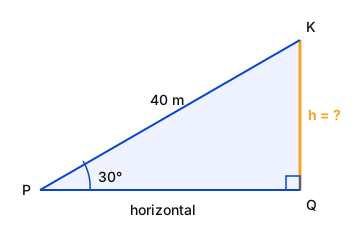
Q453.
A kite is flying in the sky. A person is holding the kite with 40 m long tightly stretched string. Find the height of the kite (in meters) if the angle made by the string with the horizontal is 30 degrees.
आकाश में एक पतंग उड़ रही है। एक व्यक्ति 40 m लंबी कसकर तनी हुई डोरी से पतंग को थामे हुए है। यदि डोरी द्वारा क्षैतिज के साथ बनाया गया कोण 30 डिग्री है, तो पतंग की ऊँचाई (मीटर में) ज्ञात कीजिए।
  1. A20
  2. B30
  3. C15
  4. D10
Show answer

Concept: The string is the hypotenuse; height is the side opposite the angle, so sinθ=heightstring.

  1. sin30∘=h40.
  2. h=40×12=20m.

Trick: In a 30∘ right triangle the side opposite 30∘ is half the hypotenuse.

Answer: (A) 20m

अवधारणा: डोरी कर्ण (hypotenuse) है; ऊँचाई कोण के सामने की भुजा है, अतः sinθ=ऊँचाईडोरी।

  1. sin30∘=h40।
  2. h=40×12=20m।

ट्रिक: 30∘ वाले समकोण त्रिभुज में 30∘ के सामने की भुजा कर्ण की आधी होती है।

उत्तर: (A) 20m

RRB Technician Grade I (Signal)MathematicsHeights and distancesRRB Technician Grade I (Signal) 2025 · 13 Mar Shift 1 →
Q454.
If a = 18 and d = 30, then sum of first 6 terms of the A.P. is?
यदि a = 18 और d = 30 है, तो समांतर श्रेढ़ी (A.P.) के पहले 6 पदों का योग क्या है?
  1. A555
  2. B558
  3. C559
  4. D561
Show answer

Concept: Sn=n2[2a+(n−1)d].

  1. S6=62[2×18+5×30].
  2. =3[36+150]=3×186=558.

Trick: For n=6, S6=3(2a+5d) — one line.

Answer: (B) 558

अवधारणा: Sn=n2[2a+(n−1)d]।

  1. S6=62[2×18+5×30]।
  2. =3[36+150]=3×186=558।

ट्रिक: n=6 के लिए S6=3(2a+5d) — एक ही लाइन में।

उत्तर: (B) 558

RRB Technician Grade I (Signal)MathematicsArithmetic progression – sumRRB Technician Grade I (Signal) 2025 · 13 Mar Shift 1 →
Q455.
In a test, Chris has to answer two questions. The probability that he will answer the first question correctly is 15. If he answers the first question correctly, the probability that he will answer the second question correctly is 56. If Chris does not answer the first question correctly, the probability that he will answer the second question correctly is 14. Find the probability that Chris will answer the second question INCORRECTLY.
[Note: Assume that each question will be answered — either correctly or incorrectly.]
एक परीक्षा में, क्रिस को दो प्रश्नों के उत्तर देने हैं। उसके द्वारा पहले प्रश्न का सही उत्तर देने की प्रायिकता 15 है। यदि वह पहले प्रश्न का सही उत्तर देता है, तो उसके द्वारा दूसरे प्रश्न का सही उत्तर देने की प्रायिकता 56 है। यदि क्रिस पहले प्रश्न का सही उत्तर नहीं देता है, तो उसके द्वारा दूसरे प्रश्न का सही उत्तर देने की प्रायिकता 14 है। क्रिस द्वारा दूसरे प्रश्न का गलत उत्तर देने की प्रायिकता ज्ञात कीजिए।
[नोट: मान लीजिए कि प्रत्येक प्रश्न का उत्तर दिया जाएगा — या तो सही या गलत।]
  1. A1930
  2. B35
  3. C23
  4. D710
Show answer

Concept: Split on the first question: P(2nd correct)=P(Q1 correct)·P(Q2|Q1)+P(Q1 wrong)·P(Q2|Q1―).

  1. P(2nd correct)=15×56+45×14=16+15=1130.
  2. P(2nd incorrect)=1−1130=1930.

Trick: Find the probability of 'correct' first (easier), then subtract from 1.

Answer: (A) 1930

अवधारणा: पहले प्रश्न के आधार पर बाँटें: P(2nd correct)=P(Q1 correct)·P(Q2|Q1)+P(Q1 wrong)·P(Q2|Q1―)।

  1. P(2nd correct)=15×56+45×14=16+15=1130।
  2. P(2nd incorrect)=1−1130=1930।

ट्रिक: पहले 'सही' की प्रायिकता निकालें (आसान), फिर 1 में से घटाएँ।

उत्तर: (A) 1930

RRB Technician Grade I (Signal)MathematicsProbability – total probabilityRRB Technician Grade I (Signal) 2025 · 13 Mar Shift 1 →
Q456.
Find the coordinates of a point P on the x-axis which is equidistant from the points A(2,3) and B(–4,5).
x-अक्ष पर उस बिंदु P के निर्देशांक ज्ञात कीजिए जो बिंदुओं A(2,3) और B(–4,5) से समदूरस्थ है।
  1. A(3,0)
  2. B(−7,0)
  3. C(−73,0)
  4. D(14,0)
Show answer

Concept: A point on the x-axis is P(x,0). Equidistant ⇒ PA2=PB2.

  1. (x−2)2+32=(x+4)2+52.
  2. x2−4x+13=x2+8x+41⇒−12x=28.
  3. x=−73, so P(−73,0). Check (3,0): PA2=10, PB2=74 — not equal.

Trick: Square the distances; the x2 terms cancel and a linear equation remains.

Answer: (C) (−73,0)

अवधारणा: x-अक्ष पर बिंदु P(x,0) होता है। समदूरस्थ ⇒ PA2=PB2।

  1. (x−2)2+32=(x+4)2+52।
  2. x2−4x+13=x2+8x+41⇒−12x=28।
  3. x=−73, अतः P(−73,0)। जाँच (3,0): PA2=10, PB2=74 — बराबर नहीं।

ट्रिक: दूरियों का वर्ग करें; x2 कट जाता है और रैखिक समीकरण बचता है।

उत्तर: (C) (−73,0)

RRB Technician Grade I (Signal)MathematicsCoordinate geometry – distance formulaRRB Technician Grade I (Signal) 2025 · 13 Mar Shift 1 →
Q457.
If X and Y are two sets such that X ∪ Y has 56 elements, X has 45 elements and Y has 33 elements, how many elements does X ∩ Y have ?
यदि X और Y दो समुच्चय इस प्रकार हैं कि X ∪ Y में 56 अवयव हैं, X में 45 अवयव हैं और Y में 33 अवयव हैं, तो X ∩ Y में कितने अवयव हैं?
  1. A13
  2. B22
  3. C19
  4. D25
Show answer

Concept: n(X∪Y)=n(X)+n(Y)−n(X∩Y).

  1. 56=45+33−n(X∩Y).
  2. n(X∩Y)=78−56=22.

Trick: Overlap = (sum of the two sets) − (union).

Answer: (B) 22

अवधारणा: n(X∪Y)=n(X)+n(Y)−n(X∩Y)।

  1. 56=45+33−n(X∩Y)।
  2. n(X∩Y)=78−56=22।

ट्रिक: सर्वनिष्ठ (overlap) = दोनों का योग − सम्मिलन।

उत्तर: (B) 22

RRB Technician Grade I (Signal)MathematicsSets – union and intersectionRRB Technician Grade I (Signal) 2025 · 13 Mar Shift 1 →
Q458.
If the roots of the equation x2−5x+6=0 are α and β, find the value of α2+β2:
यदि समीकरण x2−5x+6=0 के मूल α और β हैं, तो α2+β2 का मान ज्ञात कीजिए:
  1. A13
  2. B6
  3. C12
  4. D5
Show answer

Concept: For x2−5x+6=0: α+β=5, αβ=6; α2+β2=(α+β)2−2αβ.

  1. α2+β2=52−2×6=25−12=13.
  2. Check: roots are 2 and 3, 4+9=13.

Trick: x2−5x+6 factors as (x−2)(x−3) — roots 2 and 3 instantly.

Answer: (A) 13

अवधारणा: x2−5x+6=0 के लिए: α+β=5, αβ=6; α2+β2=(α+β)2−2αβ।

  1. α2+β2=52−2×6=25−12=13।
  2. जाँच: मूल 2 और 3 हैं, 4+9=13।

ट्रिक: x2−5x+6=(x−2)(x−3) — मूल 2 और 3 तुरंत मिल जाते हैं।

उत्तर: (A) 13

RRB Technician Grade I (Signal)MathematicsQuadratic equations – sum & product of rootsRRB Technician Grade I (Signal) 2025 · 13 Mar Shift 1 →
Q459.
The number of elements in the Power set P(S) of the set S = {1, 2, 3, 4, 5, 6 ,7, 8} is:
समुच्चय S = {1, 2, 3, 4, 5, 6 ,7, 8} के घात समुच्चय (Power set) P(S) में अवयवों की संख्या है:
  1. A250
  2. B256
  3. C247
  4. D258
Show answer

Concept: A set with n elements has 2n subsets, so n(P(S))=2n.

  1. n(S)=8.
  2. n(P(S))=28=256.

Trick: 28=256 — remember 210=1024 and work down.

Answer: (B) 256

अवधारणा: n अवयवों वाले समुच्चय के 2n उपसमुच्चय होते हैं, अतः n(P(S))=2n।

  1. n(S)=8।
  2. n(P(S))=28=256।

याद रखें: 28=256 — 210=1024 याद रखें और नीचे आएँ।

उत्तर: (B) 256

RRB Technician Grade I (Signal)MathematicsSets – power setRRB Technician Grade I (Signal) 2025 · 13 Mar Shift 1 →
Q460.
Two transistor biasing circuits have stability factors S₁ = 101 and S₂ = 15. Which circuit offers better thermal stability?
दो ट्रांजिस्टर बायसिंग परिपथों के स्थायित्व गुणक (stability factors) S₁ = 101 और S₂ = 15 हैं। कौन-सा परिपथ बेहतर तापीय स्थायित्व (thermal stability) प्रदान करता है?
  1. ABoth have equal stabilityदोनों का स्थायित्व समान है
  2. BCircuit 1परिपथ 1
  3. CCannot be comparedतुलना नहीं की जा सकती
  4. DCircuit 2परिपथ 2
Show answer

Concept: Stability factor S=dICdICO tells how much collector current changes with leakage current. A smaller S means better thermal stability.

  1. S1=101 is typical of fixed bias (worst case, S=1+β).
  2. S2=15 is much smaller, so IC drifts less with temperature.
  3. Hence circuit 2 is thermally more stable.

Trick: Lower S = better stability; ideal S=1. Voltage-divider bias gives small S.

Answer: (D) Circuit 2

अवधारणा: स्थायित्व गुणांक (stability factor) S=dICdICO बताता है कि लीकेज धारा बदलने पर कलेक्टर धारा कितनी बदलती है। छोटा S = बेहतर तापीय स्थायित्व।

  1. S1=101 फिक्स्ड बायस जैसा है (सबसे खराब, S=1+β)।
  2. S2=15 बहुत छोटा है, अतः ताप बदलने पर IC कम बदलेगा।
  3. इसलिए परिपथ 2 अधिक स्थिर है।

याद रखें: कम S = बेहतर स्थायित्व; आदर्श S=1। वोल्टेज-डिवाइडर बायस में S छोटा होता है।

उत्तर: (D) परिपथ 2 (Circuit 2)

RRB Technician Grade I (Signal)Basic Science and EngineeringTransistor biasing – stability factorRRB Technician Grade I (Signal) 2025 · 13 Mar Shift 1 →