Question bank

Q&A: practice questions with answers

Search questions on any topic. Filter by exam category, exam, subject and topic, try the question, then open the answer and explanation.

Courses – airGurukul

494 questions found.

Q81.
Which factor does NOT affect the magnitude of motional EMF in a conductor?
कौन-सा कारक किसी चालक में गतिक विद्युत वाहक बल (motional EMF) के परिमाण को प्रभावित नहीं करता है?
  1. AThe speed of the conductorचालक की चाल
  2. BThe length of the conductorचालक की लंबाई
  3. CThe resistance of the conductorचालक का प्रतिरोध
  4. DThe angle between the conductor's velocity and the magnetic fieldचालक के वेग और चुंबकीय क्षेत्र के बीच का कोण
Show answer

Concept: Motional EMF ε=Blvsinθ.

  1. It depends on field B, length l, speed v and the angle θ between v and B.
  2. Resistance of the conductor affects only the induced current (I=ε/R), not the EMF itself.

Yaad rakhein: EMF is "cause", current is "effect" — R changes the effect only.

Answer: (C) The resistance of the conductor

अवधारणा: गतिक EMF ε=Blvsinθ।

  1. यह क्षेत्र B, लंबाई l, चाल v और v-B के बीच कोण θ पर निर्भर है।
  2. चालक का प्रतिरोध केवल प्रेरित धारा (I=ε/R) बदलता है, EMF नहीं।

याद रखें: EMF "कारण" है, धारा "प्रभाव" — R केवल प्रभाव बदलता है।

उत्तर: (C) The resistance of the conductor
RRB Technician Grade I (Signal)Basic Science and EngineeringMotional EMFRRB Technician Grade I (Signal) 2024 · 20 Dec Shift 1 →
Q82.
A copper ring is dropped into a region with a constant magnetic field directed upwards. What happens to the ring according to Lenz's law?
एक ताँबे की वलय (ring) को ऊपर की ओर निर्देशित एक नियत चुंबकीय क्षेत्र वाले क्षेत्र में गिराया जाता है। लेंज़ के नियम (Lenz's law) के अनुसार वलय के साथ क्या होता है?
  1. AIts motion remains unaffected by the magnetic field.इसकी गति चुंबकीय क्षेत्र से अप्रभावित रहती है।
  2. BIt slows down as it falls.गिरते समय यह धीमी हो जाती है।
  3. CIt is pushed upwards by the magnetic field.इसे चुंबकीय क्षेत्र द्वारा ऊपर की ओर धकेला जाता है।
  4. DIt accelerates downwards faster than in free fall.यह मुक्त पतन की तुलना में अधिक तेज़ी से नीचे की ओर त्वरित होती है।
Show answer

Concept: Lenz's law: the induced current opposes the change that produces it (energy conservation).

  1. As the ring enters/moves through the field, flux through it changes and eddy/induced current flows.
  2. The induced current experiences a magnetic force opposing the motion — a retarding force upward.
  3. So the ring falls slower than free fall; it is not pushed up or made faster.

Yaad rakhein: Induction always "brakes" the motion (magnetic braking).

Answer: (B) It slows down as it falls.

अवधारणा: लेन्ज़ का नियम: प्रेरित धारा उस परिवर्तन का विरोध करती है जिससे वह बनी (ऊर्जा संरक्षण)।

  1. वलय के क्षेत्र में प्रवेश/गति से फ्लक्स बदलता है और प्रेरित धारा बहती है।
  2. प्रेरित धारा पर गति के विरुद्ध चुंबकीय बल लगता है — ऊपर की ओर मंदक बल।
  3. अतः वलय मुक्त पतन से धीमी गिरती है; न ऊपर धकेली जाती है, न तेज़ होती है।

याद रखें: प्रेरण हमेशा गति पर "ब्रेक" लगाता है (magnetic braking)।

उत्तर: (B) It slows down as it falls.

RRB Technician Grade I (Signal)Basic Science and EngineeringLenz's law – falling ringRRB Technician Grade I (Signal) 2024 · 20 Dec Shift 1 →
Q83.
Select the most appropriate option to fill in the blanks.
A thermistor can have region of ________ determined by the construction material or the temperature of the material. The change in
temperature can be due to internal effects such as current through the thermistor or due to external effects of _____.
रिक्त स्थानों की पूर्ति के लिए सबसे उपयुक्त विकल्प चुनिए।
एक थर्मिस्टर (thermistor) में निर्माण सामग्री या सामग्री के तापमान द्वारा निर्धारित ________ का क्षेत्र हो सकता है। तापमान में परिवर्तन
आंतरिक प्रभावों, जैसे थर्मिस्टर से प्रवाहित धारा, के कारण या _____ के बाह्य प्रभावों के कारण हो सकता है।
  1. Apositive temperature coefficients; heating onlyधनात्मक ताप गुणांक; केवल तापन
  2. Bpositive or negative temperature coefficients; heating or coolingधनात्मक या ऋणात्मक ताप गुणांक; तापन या शीतलन
  3. Cnegative temperature coefficients; cooling onlyऋणात्मक ताप गुणांक; केवल शीतलन
  4. Dpositive or negative temperature coefficients; heating onlyधनात्मक या ऋणात्मक ताप गुणांक; केवल तापन
Show answer

Concept: A thermistor is a temperature-sensitive resistor; it may be NTC (resistance falls with temperature) or PTC (resistance rises).

  1. Whether the coefficient is positive or negative is decided by the construction material (metal oxides etc.) and the temperature region.
  2. The temperature change can come from self-heating by the current, or from the surroundings — which may heat or cool it.

Yaad rakhein: NTC for temperature sensing; PTC for self-resetting fuses/over-current protection.

Answer: (B) positive or negative temperature coefficients; heating or cooling

अवधारणा: थर्मिस्टर तापमान-संवेदी प्रतिरोधक है; यह NTC (ताप बढ़ने पर प्रतिरोध घटे) या PTC (प्रतिरोध बढ़े) हो सकता है।

  1. गुणांक धनात्मक या ऋणात्मक होना निर्माण-पदार्थ (metal oxides आदि) और तापमान-परास पर निर्भर है।
  2. तापमान में बदलाव धारा से self-heating या बाहरी परिवेश से हो सकता है — जो गर्म या ठंडा दोनों कर सकता है।

याद रखें: NTC – तापमान मापन; PTC – self-resetting fuse/over-current सुरक्षा।

उत्तर: (B) positive or negative temperature coefficients; heating or cooling

RRB Technician Grade I (Signal)Basic Science and EngineeringThermistorRRB Technician Grade I (Signal) 2024 · 20 Dec Shift 1 →
Q84.
At 25°C, the barrier potential for germanium is approximately equal to:
25°C पर, जर्मेनियम के लिए रोधिका विभव (barrier potential) लगभग बराबर होता है:
  1. A0.3 V
  2. B0.7 V
  3. C0.1 V
  4. D1.1 V
Show answer

Concept: The barrier (knee) potential of a p-n junction depends on the semiconductor material.

  1. Germanium: about 0.3V at 25∘C; silicon: about 0.7V.
  2. Barrier potential decreases by roughly 2mV per ∘C rise in temperature.

Yaad rakhein: Ge = 0.3 V, Si = 0.7 V.

Answer: (A) 0.3 V

अवधारणा: p-n संधि का रोधिका (knee) विभव अर्धचालक पदार्थ पर निर्भर करता है।

  1. जर्मेनियम: 25∘C पर लगभग 0.3V; सिलिकॉन: लगभग 0.7V।
  2. तापमान 1∘C बढ़ने पर रोधिका विभव लगभग 2mV घटता है।

याद रखें: Ge = 0.3 V, Si = 0.7 V।

उत्तर: (A) 0.3 V

RRB Technician Grade I (Signal)Basic Science and EngineeringBarrier potential – germaniumRRB Technician Grade I (Signal) 2024 · 20 Dec Shift 1 →
Q85.
Which of the following is NOT the member of microcontroller Intel 8051 series?
निम्नलिखित में से कौन-सा माइक्रोकंट्रोलर Intel 8051 श्रृंखला का सदस्य नहीं है?
  1. A80C31BH
  2. B8044AH
  3. C80C51BH
  4. D87C51
Show answer

Concept: The MCS-51 (8051) family includes 8051, 8031 (ROM-less), 8751 (EPROM) and their CMOS versions 80C51BH, 80C31BH, 87C51.

  1. 80C51BH, 80C31BH and 87C51 are standard 8051-series members.
  2. 8044AH is Intel's RUPI-44 serial communication controller (8051 core with an SDLC/HDLC interface) — a separate product line, not listed as an 8051-series microcontroller.

Yaad rakhein: 8051 family numbers contain "51" or "31"; 8044 is the odd one.

Answer: (B) 8044AH

अवधारणा: MCS-51 (8051) परिवार में 8051, 8031 (ROM-less), 8751 (EPROM) और इनके CMOS संस्करण 80C51BH, 80C31BH, 87C51 आते हैं।

  1. 80C51BH, 80C31BH और 87C51 मानक 8051-series सदस्य हैं।
  2. 8044AH Intel का RUPI-44 serial communication controller है (SDLC/HDLC interface वाला) — अलग product line, 8051-series microcontroller की सूची में नहीं।

याद रखें: 8051 परिवार के नंबरों में "51" या "31" होता है; 8044 अलग है।

उत्तर: (B) 8044AH

RRB Technician Grade I (Signal)Basic Science and EngineeringIntel 8051 familyRRB Technician Grade I (Signal) 2024 · 20 Dec Shift 1 →
Q86.
Which of the following statements is true regarding Lenz's Law?
लेंज़ के नियम (Lenz's Law) के संबंध में निम्नलिखित में से कौन-सा कथन सत्य है?
  1. AThe induced current always opposes the change in magnetic flux that produced it.प्रेरित धारा सदैव उस चुंबकीय फ्लक्स परिवर्तन का विरोध करती है जिसने उसे उत्पन्न किया।
  2. BThe induced current always assists the change in magnetic flux that produced it.प्रेरित धारा सदैव उस चुंबकीय फ्लक्स परिवर्तन में सहायता करती है जिसने उसे उत्पन्न किया।
  3. CLenz's Law does not relate to electromagnetic induction.लेंज़ का नियम विद्युत-चुंबकीय प्रेरण से संबंधित नहीं है।
  4. DThe direction of the induced current depends on the amount of magnetic flux.प्रेरित धारा की दिशा चुंबकीय फ्लक्स की मात्रा पर निर्भर करती है।
Show answer

Concept: Lenz's law gives the direction of induced EMF/current: it opposes the change in magnetic flux that causes it.

  1. This is a consequence of conservation of energy — the induced current must do work against the cause.
  2. The direction depends on whether flux is increasing or decreasing, not on the amount of flux (option D wrong).

Yaad rakhein: The minus sign in ε=−dϕdt is Lenz's law.

Answer: (A) The induced current always opposes the change in magnetic flux that produced it.

अवधारणा: लेन्ज़ का नियम प्रेरित EMF/धारा की दिशा बताता है: यह उस फ्लक्स-परिवर्तन का विरोध करती है जिससे वह उत्पन्न हुई।

  1. यह ऊर्जा संरक्षण का परिणाम है — प्रेरित धारा को कारण के विरुद्ध कार्य करना पड़ता है।
  2. दिशा फ्लक्स बढ़ने/घटने पर निर्भर है, फ्लक्स की मात्रा पर नहीं (विकल्प D गलत)।

याद रखें: ε=−dϕdt का ऋण चिह्न ही लेन्ज़ का नियम है।

उत्तर: (A) The induced current always opposes the change in magnetic flux that produced it.

RRB Technician Grade I (Signal)Basic Science and EngineeringLenz's lawRRB Technician Grade I (Signal) 2024 · 20 Dec Shift 1 →
Q87.
Which of the following statements correctly describes the energy band diagram for conductors, semiconductors, and insulators?
निम्नलिखित में से कौन-सा कथन चालकों, अर्धचालकों (semiconductors) और विद्युतरोधियों (insulators) के ऊर्जा बैंड आरेख का सही वर्णन करता है?
  1. AConductors have a wide forbidden gap, semiconductors have a narrow-forbidden gap, and insulators have no forbidden gap.चालकों में चौड़ा वर्जित अंतराल (forbidden gap) होता है, अर्धचालकों में संकरा वर्जित अंतराल होता है, और विद्युतरोधियों में कोई वर्जित अंतराल नहीं होता।
  2. BConductors have no forbidden gap, semiconductors have a narrow-forbidden gap, and insulators have a wide forbidden gap.चालकों में कोई वर्जित अंतराल (forbidden gap) नहीं होता, अर्धचालकों में संकरा वर्जित अंतराल होता है, और विद्युतरोधियों में चौड़ा वर्जित अंतराल होता है।
  3. CConductors have a narrow-forbidden gap, semiconductors have no forbidden gap, and insulators have a wide forbidden gap.चालकों में संकरा वर्जित अंतराल (forbidden gap) होता है, अर्धचालकों में कोई वर्जित अंतराल नहीं होता, और विद्युतरोधियों में चौड़ा वर्जित अंतराल होता है।
  4. DConductors have a wide forbidden gap, semiconductors have no forbidden gap, and insulators have a narrow-forbidden gap.चालकों में चौड़ा वर्जित अंतराल (forbidden gap) होता है, अर्धचालकों में कोई वर्जित अंतराल नहीं होता, और विद्युतरोधियों में संकरा वर्जित अंतराल होता है।
Show answer

Concept: The forbidden energy gap Eg between the valence band and the conduction band decides whether a material conducts.

  1. Conductors: valence and conduction bands overlap – no forbidden gap, electrons flow freely.
  2. Semiconductors (Si, Ge): narrow gap of about 1eV, so a little energy (heat/light) lifts electrons into the conduction band.
  3. Insulators: wide gap (>5eV), so electrons cannot cross at ordinary temperatures.

Yaad rakhein: Gap order – conductor 0 < semiconductor ≈1eV < insulator >5eV.

Answer: (B) Conductors have no forbidden gap, semiconductors a narrow gap and insulators a wide gap.

अवधारणा: संयोजकता बैंड (valence band) और चालन बैंड (conduction band) के बीच का वर्जित ऊर्जा अंतराल (forbidden gap) Eg तय करता है कि पदार्थ चालक है या नहीं।

  1. चालक: दोनों बैंड एक-दूसरे पर चढ़े रहते हैं – कोई वर्जित अंतराल नहीं, इलेक्ट्रॉन आसानी से बहते हैं।
  2. अर्धचालक (Si, Ge): लगभग 1eV का छोटा अंतराल, थोड़ी ऊर्जा (ऊष्मा/प्रकाश) से इलेक्ट्रॉन चालन बैंड में चले जाते हैं।
  3. विद्युतरोधी: बड़ा अंतराल (>5eV), सामान्य ताप पर इलेक्ट्रॉन इसे पार नहीं कर पाते।

याद रखें: अंतराल का क्रम – चालक 0 < अर्धचालक ≈1eV < विद्युतरोधी >5eV।

उत्तर: (B) चालक में कोई वर्जित अंतराल नहीं, अर्धचालक में संकरा और विद्युतरोधी में चौड़ा अंतराल होता है।

RRB Technician Grade I (Signal)Basic Science and EngineeringEnergy band diagramRRB Technician Grade I (Signal) 2024 · 20 Dec Shift 1 →
Q88.
EMF of a thermocouple is approximately a _____ function of the temperature difference between the junctions.
किसी तापयुग्म (thermocouple) का विद्युत वाहक बल (EMF) संधियों के बीच तापांतर का लगभग एक _____ फलन होता है।
  1. Aparabolicपरवलयिक (parabolic)
  2. Bhyperbolicअतिपरवलयिक (hyperbolic)
  3. Cexponentialचरघातांकी (exponential)
  4. Dlinearरैखिक (linear)
Show answer

Concept: A thermocouple works on the Seebeck effect – an emf is produced when its two junctions are at different temperatures.

  1. Over its working range the emf is approximately proportional to the temperature difference: E≈α(T1−T2), where α is the Seebeck coefficient.
  2. Exactly, E=aθ+bθ2 (slightly parabolic), but the second term is small, so the relation is treated as linear for measurement.

Yaad rakhein: Thermocouple → Seebeck effect → emf ∝ temperature difference (linear).

Answer: (D) linear

अवधारणा: थर्मोकपल सीबेक प्रभाव (Seebeck effect) पर काम करता है – दोनों संधियों (junctions) के ताप अलग होने पर emf उत्पन्न होता है।

  1. कार्य-परास में emf लगभग ताप-अंतर के समानुपाती होता है: E≈α(T1−T2), जहाँ α सीबेक गुणांक है।
  2. सटीक रूप में E=aθ+bθ2 (थोड़ा परवलयिक) है, पर दूसरा पद बहुत छोटा होता है, इसलिए मापन में इसे रैखिक (linear) माना जाता है।

याद रखें: थर्मोकपल → सीबेक प्रभाव → emf ∝ ताप-अंतर (रैखिक)।

उत्तर: (D) linear

RRB Technician Grade I (Signal)Basic Science and EngineeringThermocoupleRRB Technician Grade I (Signal) 2024 · 20 Dec Shift 1 →
Q89.
The magnetic field inside a long straight solenoid carrying current is _____________.
धारावाही लंबी सीधी परिनालिका (solenoid) के भीतर चुंबकीय क्षेत्र _____________ होता है।
  1. Astrongest at the endsसिरों पर सबसे प्रबल
  2. Buniformएकसमान
  3. Cnon-uniformअसमान
  4. Dzeroशून्य
Show answer

Concept: For a long solenoid the field inside is B=μ0nI (n = turns per unit length) – it does not depend on the position inside.

  1. The fields of the closely wound turns add up to give parallel, equally spaced field lines inside – a uniform field along the axis.
  2. At the ends the field drops to about half (12μ0nI), and outside it is nearly zero – so options (A), (C), (D) are wrong.

Yaad rakhein: Long solenoid ≈ bar magnet with a uniform field inside, almost zero outside.

Answer: (B) uniform

अवधारणा: लंबी परिनालिका (solenoid) के अंदर क्षेत्र B=μ0nI (n = प्रति इकाई लंबाई फेरे) – यह अंदर की स्थिति पर निर्भर नहीं करता।

  1. पास-पास लिपटे फेरों के क्षेत्र जुड़कर अंदर समांतर, समान दूरी वाली क्षेत्र-रेखाएँ बनाते हैं – अक्ष के अनुदिश एकसमान (uniform) क्षेत्र।
  2. सिरों पर क्षेत्र लगभग आधा (12μ0nI) रह जाता है और बाहर लगभग शून्य – इसलिए (A), (C), (D) गलत हैं।

याद रखें: लंबी परिनालिका ≈ छड़ चुंबक – अंदर एकसमान क्षेत्र, बाहर लगभग शून्य।

उत्तर: (B) uniform

RRB Technician Grade I (Signal)Basic Science and EngineeringMagnetic field of a solenoidRRB Technician Grade I (Signal) 2024 · 20 Dec Shift 1 →
Q90.
In Faraday's experiment, if the magnetic flux through a loop increases linearly with time, the induced EMF is _____________.
फैराडे के प्रयोग में, यदि किसी लूप से गुज़रने वाला चुंबकीय फ्लक्स समय के साथ रैखिक रूप से बढ़ता है, तो प्रेरित विद्युत वाहक बल (EMF) _____________ होता है।
  1. Aconstantनियत
  2. Bproportional to the square of timeसमय के वर्ग के समानुपाती
  3. Cinversely proportional to timeसमय के व्युत्क्रमानुपाती
  4. Dzeroशून्य
Show answer

Concept: Faraday's law: induced emf e=−dϕdt – it depends on the rate of change of flux, not on the flux itself.

  1. Flux increases linearly: ϕ=kt.
  2. e=−dϕdt=−k = a constant value.
  3. It would be zero only if the flux did not change at all.

Trick: Flux ∝ t ⇒ slope constant ⇒ emf constant.

Answer: (A) constant

अवधारणा: फैराडे का नियम: प्रेरित emf e=−dϕdt – यह फ्लक्स की परिवर्तन दर पर निर्भर करता है, फ्लक्स पर नहीं।

  1. फ्लक्स रैखिक रूप से बढ़ता है: ϕ=kt।
  2. e=−dϕdt=−k = एक नियत मान।
  3. emf शून्य तभी होता जब फ्लक्स बिल्कुल न बदलता।

ट्रिक: फ्लक्स ∝ t ⇒ ढाल नियत ⇒ emf नियत।

उत्तर: (A) constant

RRB Technician Grade I (Signal)Basic Science and EngineeringFaraday's lawRRB Technician Grade I (Signal) 2024 · 20 Dec Shift 1 →
Q91.
A particle of mass m starts from rest and moves with a constant acceleration a along a straight line. What is the relationship between the distance travelled x and the kinetic energy K of the particle?
m द्रव्यमान का एक कण विराम से चलना प्रारंभ करता है और एक सरल रेखा में नियत त्वरण a से गति करता है। कण द्वारा चली गई दूरी x और उसकी गतिज ऊर्जा K के बीच क्या संबंध है?
  1. AK∝x
  2. BK∝x2
  3. CK∝x
  4. DK∝x3
Show answer

Concept: Work-energy theorem: the work done by the net force equals the gain in kinetic energy, K=F·x.

  1. Starting from rest, v2=u2+2ax=2ax.
  2. K=12mv2=12m(2ax)=max.
  3. Since m and a are constant, K∝x – a straight-line (linear) relation.

Trick: Constant force ⇒ K=Fx ⇒ K∝x (not x or x2).

Answer: (C) K∝x

अवधारणा: कार्य-ऊर्जा प्रमेय: नेट बल द्वारा किया गया कार्य गतिज ऊर्जा में वृद्धि के बराबर होता है, K=F·x।

  1. विराम से चलने पर v2=u2+2ax=2ax।
  2. K=12mv2=12m(2ax)=max।
  3. m और a नियत हैं, अतः K∝x – सीधी रेखा (रैखिक) संबंध।

ट्रिक: नियत बल ⇒ K=Fx ⇒ K∝x (x या x2 नहीं)।

उत्तर: (C) K∝x

RRB Technician Grade I (Signal)Basic Science and EngineeringKinetic energy and distanceRRB Technician Grade I (Signal) 2024 · 20 Dec Shift 1 →
Q92.
Which of the following combinations represents a derived unit?
निम्नलिखित में से कौन-सा संयोजन व्युत्पन्न इकाई (derived unit) को दर्शाता है?
  1. AMetre, Kilogram, Ampereमीटर, किलोग्राम, ऐम्पियर
  2. BKelvin, Mole, Ampereकेल्विन, मोल, ऐम्पियर
  3. CMetre, Second, Kilogramमीटर, सेकंड, किलोग्राम
  4. DVolt, Newton, Jouleवोल्ट, न्यूटन, जूल
Show answer

Concept: SI has seven fundamental units (m, kg, s, A, K, mol, cd); any unit formed by combining them is a derived unit.

  1. Volt =kg m2s−3A−1, Newton =kg m s−2, Joule =kg m2s−2 – all derived.
  2. Options (A), (B), (C) contain only fundamental units (metre, kilogram, ampere, kelvin, mole, second).

Yaad rakhein: Units named after scientists (volt, newton, joule, watt, pascal) are always derived.

Answer: (D) Volt, Newton, Joule

अवधारणा: SI में सात मूल मात्रक (m, kg, s, A, K, mol, cd) हैं; इनके संयोजन से बना कोई भी मात्रक व्युत्पन्न (derived) मात्रक है।

  1. वोल्ट =kg m2s−3A−1, न्यूटन =kg m s−2, जूल =kg m2s−2 – सभी व्युत्पन्न।
  2. विकल्प (A), (B), (C) में केवल मूल मात्रक हैं (मीटर, किलोग्राम, ऐम्पियर, केल्विन, मोल, सेकंड)।

याद रखें: वैज्ञानिकों के नाम वाले मात्रक (volt, newton, joule, watt, pascal) हमेशा व्युत्पन्न होते हैं।

उत्तर: (D) Volt, Newton, Joule

RRB Technician Grade I (Signal)Basic Science and EngineeringFundamental and derived unitsRRB Technician Grade I (Signal) 2024 · 20 Dec Shift 1 →
Q93.
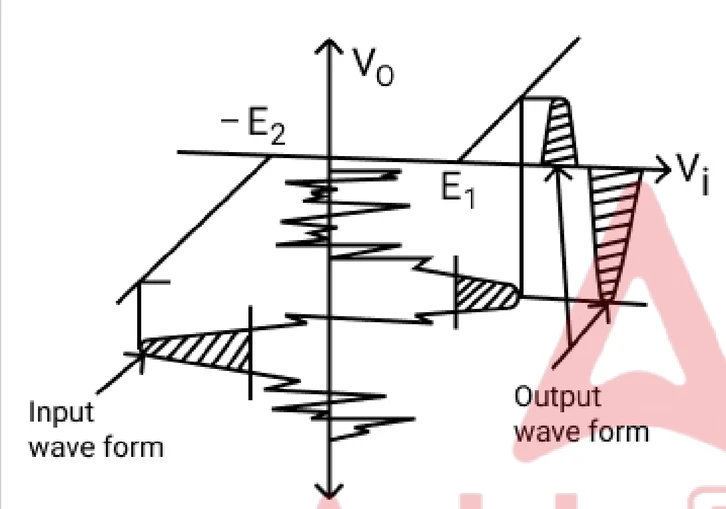
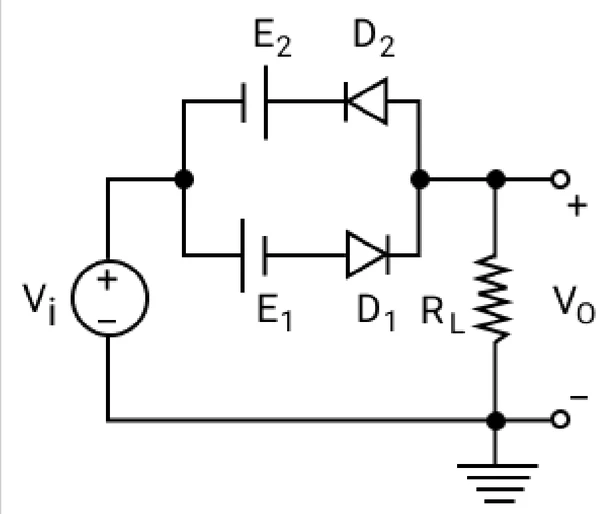
In the given circuit, if the input voltage lies between +E1 and −E2, then output is zero.

Input and output characteristics are shown below.

The region between +E1 and −E2 is known as _____.
दिए गए परिपथ में, यदि इनपुट वोल्टता +E1 और −E2 के बीच हो, तो आउटपुट शून्य होता है।

इनपुट और आउटपुट अभिलक्षण (characteristics) नीचे दर्शाए गए हैं।

+E1 और −E2 के बीच के क्षेत्र को _____ कहा जाता है।
  1. Aactive zoneसक्रिय क्षेत्र (active zone)
  2. Bcut off zoneकट-ऑफ क्षेत्र (cut off zone)
  3. Csaturation zoneसंतृप्ति क्षेत्र (saturation zone)
  4. Ddead zoneमृत क्षेत्र (dead zone)
Show answer

Concept: In this two-diode circuit each diode conducts only when the input exceeds its battery voltage; between the two thresholds both diodes stay off and no output appears.

  1. For Vi>+E1, D1 conducts and output follows Vi−E1; for Vi<−E2, D2 conducts.
  2. For −E2<Vi<+E1 both diodes are reverse biased, so Vo=0 – the transfer curve is flat.
  3. This flat band where the input produces no output is called the dead zone (dead band).

Yaad rakhein: Input present but output zero = dead zone; cut-off and saturation are transistor regions, not diode-clipper terms.

Answer: (D) dead zone

अवधारणा: इस दो-डायोड परिपथ में हर डायोड तभी चालन करता है जब इनपुट उसकी बैटरी वोल्टता से अधिक हो; दोनों सीमाओं के बीच दोनों डायोड बंद रहते हैं और कोई आउटपुट नहीं आता।

  1. Vi>+E1 पर D1 चालन करता है और आउटपुट Vi−E1 के अनुसार चलता है; Vi<−E2 पर D2 चालन करता है।
  2. −E2<Vi<+E1 के लिए दोनों डायोड पश्च-अभिनत (reverse biased) हैं, अतः Vo=0 – transfer curve सपाट है।
  3. जहाँ इनपुट होते हुए भी आउटपुट शून्य रहता है, उस सपाट भाग को dead zone (dead band) कहते हैं।

याद रखें: इनपुट है पर आउटपुट शून्य = dead zone; cut-off और saturation ट्रांजिस्टर के क्षेत्र हैं, डायोड-क्लिपर के नहीं।

उत्तर: (D) dead zone

RRB Technician Grade I (Signal)Basic Science and EngineeringDiode clipper / dead zoneRRB Technician Grade I (Signal) 2024 · 20 Dec Shift 1 →
Q94.
The range of electrostatic voltmeter can be extended with the help of:
स्थिरवैद्युत वोल्टमीटर (electrostatic voltmeter) का परास (range) किसकी सहायता से बढ़ाया जा सकता है:
  1. AResistance Potential Dividerप्रतिरोध विभव विभाजक (Resistance Potential Divider)
  2. BRegisterरजिस्टर (Register)
  3. CCapacitance Potential Dividerधारिता विभव विभाजक (Capacitance Potential Divider)
  4. DCapacitorसंधारित्र (Capacitor)
Show answer

Concept: An electrostatic voltmeter measures voltage by the force between charged plates. Its range is extended by a potential divider, not by a series resistor as in ordinary voltmeters.

  1. With a resistance potential divider the instrument reads only a known fraction of the total voltage (used for DC and low-frequency AC); for pure AC a capacitance divider is also used.
  2. A plain resistor or capacitor in series cannot give a fixed multiplying factor for an instrument that draws almost no current, so options (B) and (D) are wrong.

Yaad rakhein: Electrostatic voltmeter range ↑ → potential divider (resistance / capacitance).

Answer: (A) Resistance Potential Divider

अवधारणा: स्थिरवैद्युत वोल्टमीटर आवेशित प्लेटों के बीच बल से वोल्टता मापता है। इसका परास (range) पोटेंशियल डिवाइडर से बढ़ाया जाता है, साधारण वोल्टमीटर की तरह श्रेणी प्रतिरोध से नहीं।

  1. प्रतिरोध पोटेंशियल डिवाइडर (resistance potential divider) से यंत्र कुल वोल्टता का एक ज्ञात अंश ही पढ़ता है (DC और कम आवृत्ति AC के लिए); शुद्ध AC के लिए धारिता (capacitance) डिवाइडर भी प्रयोग होता है।
  2. केवल श्रेणी में प्रतिरोध या संधारित्र लगाने से लगभग शून्य धारा लेने वाले इस यंत्र के लिए नियत गुणक नहीं मिलता, अतः (B) और (D) गलत हैं।

याद रखें: स्थिरवैद्युत वोल्टमीटर का परास ↑ → पोटेंशियल डिवाइडर (प्रतिरोध / धारिता)।

उत्तर: (A) Resistance Potential Divider

RRB Technician Grade I (Signal)Basic Science and EngineeringElectrostatic voltmeterRRB Technician Grade I (Signal) 2024 · 20 Dec Shift 1 →
Q95.
Which of the following statements for Piezoelectric transducer is correct?
दाबविद्युत ट्रांसड्यूसर (Piezoelectric transducer) के लिए निम्नलिखित में से कौन-सा कथन सही है?
  1. APiezoelectric transducer can be used for the measurement of static displacement only.दाबविद्युत ट्रांसड्यूसर का उपयोग केवल स्थैतिक विस्थापन (static displacement) के मापन के लिए किया जा सकता है।
  2. BPiezoelectric transducer can be used for the measurement of dynamic displacement only.दाबविद्युत ट्रांसड्यूसर का उपयोग केवल गतिक विस्थापन (dynamic displacement) के मापन के लिए किया जा सकता है।
  3. CPiezoelectric transducer can be used for the measurement of both static and dynamic displacement.दाबविद्युत ट्रांसड्यूसर का उपयोग स्थैतिक और गतिक दोनों विस्थापनों के मापन के लिए किया जा सकता है।
  4. DPiezoelectric transducer cannot be used for the measurement of both static and dynamic displacement.दाबविद्युत ट्रांसड्यूसर का उपयोग स्थैतिक और गतिक दोनों में से किसी भी विस्थापन के मापन के लिए नहीं किया जा सकता है।
Show answer

Concept: A piezoelectric crystal (quartz, Rochelle salt) produces charge only while the applied force is changing; under a steady force the charge leaks away through the crystal and amplifier resistance.

  1. Hence it responds to dynamic (varying) displacement, vibration, shock and pressure, but cannot hold a reading for a static displacement.
  2. Its high natural frequency makes it ideal for vibration and accelerometer applications.

Yaad rakhein: Piezo = dynamic only; for static displacement use LVDT or strain gauge.

Answer: (B) Piezoelectric transducer can be used for the measurement of dynamic displacement only.

अवधारणा: पीज़ोइलेक्ट्रिक क्रिस्टल (quartz, Rochelle salt) तभी आवेश देता है जब लगाया गया बल बदल रहा हो; स्थिर बल पर आवेश क्रिस्टल और amplifier के प्रतिरोध से रिस (leak) जाता है।

  1. इसलिए यह गतिक (dynamic) विस्थापन, कंपन, झटके और दाब को मापता है, पर स्थैतिक (static) विस्थापन का पाठ्यांक नहीं रख पाता।
  2. उच्च प्राकृतिक आवृत्ति के कारण यह कंपन और accelerometer के लिए आदर्श है।

याद रखें: Piezo = केवल dynamic; static विस्थापन के लिए LVDT या strain gauge।

उत्तर: (B) Piezoelectric transducer can be used for the measurement of dynamic displacement only.

RRB Technician Grade I (Signal)Basic Science and EngineeringPiezoelectric transducerRRB Technician Grade I (Signal) 2024 · 20 Dec Shift 1 →
Q96.
A machine performs work W in time t, and its power output is P. If the machine’s power output is doubled, how much time will it take to perform the same amount of work?
एक मशीन समय t में कार्य W करती है, और उसका शक्ति निर्गत (power output) P है। यदि मशीन का शक्ति निर्गत दुगुना कर दिया जाए, तो उतना ही कार्य करने में उसे कितना समय लगेगा?
  1. At/2
  2. Bt/4
  3. C2t
  4. Dt
Show answer

Concept: Power is the rate of doing work: P=Wt, so for fixed work t=WP, i.e. t∝1P.

  1. Original: t=WP.
  2. New power 2P: t′=W2P=t2.

Trick: Double the power → half the time (inverse relation).

Answer: (A) t2

अवधारणा: शक्ति कार्य करने की दर है: P=Wt, अतः समान कार्य के लिए t=WP, यानी t∝1P।

  1. पहले: t=WP।
  2. नई शक्ति 2P: t′=W2P=t2।

ट्रिक: शक्ति दोगुनी → समय आधा (व्युत्क्रम संबंध)।

उत्तर: (A) t2

RRB Technician Grade I (Signal)Basic Science and EngineeringPower, work and timeRRB Technician Grade I (Signal) 2024 · 20 Dec Shift 1 →
Q97.
Which factor does NOT affect the resistivity of a material?
कौन-सा कारक किसी पदार्थ की प्रतिरोधकता (resistivity) को प्रभावित नहीं करता है?
  1. AAtomic structureपरमाणु संरचना
  2. BMaterial typeपदार्थ का प्रकार
  3. CLength of the conductorचालक की लंबाई
  4. DTemperatureतापमान
Show answer

Concept: Resistivity ρ is a property of the material; resistance R=ρlA depends on dimensions.

  1. ρ depends on the material and its atomic structure (free-electron density) and on temperature.
  2. Length and area change R, not ρ – a long and a short copper wire have the same resistivity.

Yaad rakhein: Resistance → size matters; resistivity → only material and temperature.

Answer: (C) Length of the conductor

अवधारणा: प्रतिरोधकता (resistivity) ρ पदार्थ का गुण है; प्रतिरोध R=ρlA आकार पर निर्भर करता है।

  1. ρ पदार्थ और उसकी परमाणु संरचना (मुक्त इलेक्ट्रॉन घनत्व) तथा ताप पर निर्भर करती है।
  2. लंबाई और क्षेत्रफल R बदलते हैं, ρ नहीं – लंबे और छोटे ताँबे के तार की प्रतिरोधकता समान होती है।

याद रखें: प्रतिरोध → आकार मायने रखता है; प्रतिरोधकता → केवल पदार्थ और ताप।

उत्तर: (C) Length of the conductor

RRB Technician Grade I (Signal)Basic Science and EngineeringResistivityRRB Technician Grade I (Signal) 2024 · 20 Dec Shift 1 →
Q98.
If a body falls freely under gravity from rest, what fraction of its initial potential energy has been converted into kinetic energy when it has fallen to half of its initial height?
यदि कोई पिंड विराम से गुरुत्व के अंतर्गत मुक्त रूप से गिरता है, तो अपनी प्रारंभिक ऊँचाई के आधे तक गिरने पर उसकी प्रारंभिक स्थितिज ऊर्जा का कितना भाग गतिज ऊर्जा में परिवर्तित हो चुका होगा?
  1. A1/2
  2. B7/8
  3. C1/4
  4. D3/4
Show answer

Concept: In free fall, total mechanical energy is conserved: loss in PE = gain in KE.

  1. Initial PE =mgh; at half height PE =mgh2=12mgh.
  2. KE gained =mgh−12mgh=12mgh, i.e. 12 of the initial PE.

Trick: PE ∝ height, so fraction of PE converted = fraction of height fallen =12.

Answer: (A) 12

अवधारणा: मुक्त पतन में कुल यांत्रिक ऊर्जा संरक्षित रहती है: PE में कमी = KE में वृद्धि।

  1. प्रारंभिक PE =mgh; आधी ऊँचाई पर PE =mgh2=12mgh।
  2. प्राप्त KE =mgh−12mgh=12mgh, यानी प्रारंभिक PE का 12।

ट्रिक: PE ∝ ऊँचाई, इसलिए बदली गई PE का अंश = गिरी हुई ऊँचाई का अंश =12।

उत्तर: (A) 12

RRB Technician Grade I (Signal)Basic Science and EngineeringConservation of mechanical energyRRB Technician Grade I (Signal) 2024 · 20 Dec Shift 1 →
Q99.
Which of the following is the correct equation for power (P) in terms of energy (E) and time (t)?
ऊर्जा (E) और समय (t) के पदों में शक्ति (P) के लिए निम्नलिखित में से कौन-सा समीकरण सही है?
  1. AP = E/t
  2. BP = E/t2
  3. CP = E + t
  4. DP = E × t
Show answer

Concept: Power is the rate at which energy is transferred or work is done.

  1. P=Et; SI unit watt =J/s.
  2. E×t, E+t or Et2 do not have the unit of watt, so they are wrong.

Yaad rakhein: Watt = joule per second → P=Et.

Answer: (A) P=Et

अवधारणा: शक्ति (power) वह दर है जिससे ऊर्जा स्थानांतरित होती है या कार्य होता है।

  1. P=Et; SI मात्रक वाट =J/s।
  2. E×t, E+t या Et2 का मात्रक वाट नहीं बनता, अतः वे गलत हैं।

याद रखें: वाट = जूल प्रति सेकंड → P=Et।

उत्तर: (A) P=Et

RRB Technician Grade I (Signal)Basic Science and EngineeringPower formulaRRB Technician Grade I (Signal) 2024 · 20 Dec Shift 1 →
Q100.
Two resistors, R1​ and R2, are connected in series across a voltage source. If the power dissipated by R1​ is 4 times the power dissipated by R2​, what is the ratio of their resistances R1 : R2​?
दो प्रतिरोधक R1​ और R2 एक वोल्टता स्रोत के साथ श्रेणीक्रम (series) में संयोजित हैं। यदि R1​ द्वारा क्षयित शक्ति R2​ द्वारा क्षयित शक्ति की 4 गुनी है, तो उनके प्रतिरोधों का अनुपात R1 : R2​ क्या है?
  1. A1 : 4
  2. B16 : 1
  3. C1 : 16
  4. D4 : 1
Show answer

Concept: In series the same current I flows through both resistors, so P=I2R gives P∝R.

  1. P1P2=I2R1I2R2=R1R2.
  2. P1=4P2⇒R1:R2=4:1.

Trick: Series → P∝R; parallel → P∝1R (then the answer would be 1:4).

Answer: (D) 4 : 1

अवधारणा: श्रेणी में दोनों प्रतिरोधों से समान धारा I बहती है, अतः P=I2R से P∝R।

  1. P1P2=I2R1I2R2=R1R2।
  2. P1=4P2⇒R1:R2=4:1।

ट्रिक: श्रेणी → P∝R; समांतर → P∝1R (तब उत्तर 1:4 होता)।

उत्तर: (D) 4 : 1

RRB Technician Grade I (Signal)Basic Science and EngineeringPower in series resistorsRRB Technician Grade I (Signal) 2024 · 20 Dec Shift 1 →