Question bank

Q&A: practice questions with answers

Search questions on any topic. Filter by exam category, exam, subject and topic, try the question, then open the answer and explanation.

Courses – airGurukul

900 questions found.

Q1.
What sum of money (in ₹) will yield ₹700 as simple interest in 2 years at 8% per annum?
कितनी धनराशि (₹ में) 8% वार्षिक दर से 2 वर्ष में ₹700 साधारण ब्याज देगी?
  1. A4375
  2. B4575
  3. C3875
  4. D4775
Show answer

Concept: SI = P×R×T100, so P=SI×100R×T.

  1. SI = ₹700, R = 8%, T = 2 years
  2. P=700×1008×2=7000016
  3. P= ₹4375

Trick: In 2 years at 8%, total interest = 16% of P. So 16%=700→1%=43.75→100%= ₹4375.

Answer: (A) 4375

अवधारणा: साधारण ब्याज = P×R×T100, इसलिए P=SI×100R×T।

  1. SI = ₹700, R = 8%, T = 2 वर्ष
  2. P=700×1008×2=7000016
  3. P= ₹4375

ट्रिक: 2 वर्ष में 8% की दर से कुल ब्याज = P का 16%। 16%=700→1%=43.75→100%= ₹4375।

उत्तर: (A) 4375

RRB Technician Grade IIIMathematicsSimple interest – finding principalRRB Technician Grade III 2026 · 10 Mar Shift 3 →
Q2.
In a class, there are 36 boys and 24 girls. By what percentage should the number of girls be increased so that it becomes equal to the number of boys?
एक कक्षा में 36 लड़के और 24 लड़कियाँ हैं। लड़कियों की संख्या में कितने प्रतिशत की वृद्धि की जाए कि वह लड़कों की संख्या के बराबर हो जाए?
  1. A30%
  2. B40%
  3. C60%
  4. D50%
Show answer

Concept: % increase = (increase/original value) × 100.

  1. Girls = 24, boys = 36
  2. Increase needed = 36−24=12
  3. % increase = 1224×100=50%

Trick: 12 is exactly half of 24, so the increase is 50%.

Answer: (D) 50%

अवधारणा: % वृद्धि = (वृद्धि/मूल मान) × 100।

  1. लड़कियाँ = 24, लड़के = 36
  2. आवश्यक वृद्धि = 36−24=12
  3. % वृद्धि = 1224×100=50%

ट्रिक: 12, 24 का ठीक आधा है, इसलिए वृद्धि 50% है।

उत्तर: (D) 50%

RRB Technician Grade IIIMathematicsPercentage increaseRRB Technician Grade III 2026 · 10 Mar Shift 3 →
Q3.
When one-third of a number is increased by 10, the result is 65. Find the sum of the digits of the original number.
जब किसी संख्या के एक-तिहाई में 10 की वृद्धि की जाती है, तो परिणाम 65 प्राप्त होता है। मूल संख्या के अंकों का योग ज्ञात कीजिए।
  1. A9
  2. B14
  3. C11
  4. D12
Show answer

Concept: Form an equation from the statement and solve it.

  1. Let the number = n. Then n3+10=65
  2. n3=55→n=165
  3. Sum of digits = 1+6+5=12

Trick: Work backwards: 65−10=55, then 55×3=165.

Answer: (D) 12

अवधारणा: कथन से समीकरण बनाकर हल करें।

  1. माना संख्या = n, तो n3+10=65
  2. n3=55→n=165
  3. अंकों का योग = 1+6+5=12

ट्रिक: उल्टा चलें: 65−10=55, फिर 55×3=165।

उत्तर: (D) 12

RRB Technician Grade IIIMathematicsLinear equation – number problemRRB Technician Grade III 2026 · 10 Mar Shift 3 →
Q4.
In a family, the sum of the ages of a father and son is 50 years. 10 years from now, the difference in their ages will be 20 years. Find the ratio of the son's age to the father's age.
एक परिवार में पिता और पुत्र की आयु का योग 50 वर्ष है। अब से 10 वर्ष बाद, उनकी आयु का अंतर 20 वर्ष होगा। पुत्र की आयु और पिता की आयु का अनुपात ज्ञात कीजिए।
  1. A3:7
  2. B4:7
  3. C5:8
  4. D2:7
Show answer

Concept: The difference between two people's ages never changes with time.

  1. Difference after 10 years = 20 → present difference F−S=20
  2. F+S=50
  3. Adding: 2F=70→F=35, S=15
  4. S : F = 15 : 35 = 3 : 7

Trick: Sum 50 and difference 20 → bigger = 50+202=35, smaller = 50−202=15.

Answer: (A) 3:7

अवधारणा: दो व्यक्तियों की आयु का अंतर समय के साथ नहीं बदलता।

  1. 10 वर्ष बाद अंतर = 20 → अभी भी F−S=20
  2. F+S=50
  3. जोड़ने पर: 2F=70→F=35, S=15
  4. S : F = 15 : 35 = 3 : 7

ट्रिक: योग 50, अंतर 20 → बड़ा = 50+202=35, छोटा = 50−202=15।

उत्तर: (A) 3:7

RRB Technician Grade IIIMathematicsProblems on agesRRB Technician Grade III 2026 · 10 Mar Shift 3 →
Q5.
Which of the following numbers is divisible by both 17 and 13?
निम्नलिखित में से कौन-सी संख्या 17 और 13 दोनों से विभाज्य है?
  1. A22372
  2. B21401
  3. C21658
  4. D20049
Show answer

Concept: A number divisible by both 13 and 17 (co-primes) is divisible by 13×17=221.

  1. Test each option with 221
  2. 21658÷221=98 exactly (221×98=21658)
  3. Others leave remainders, e.g. 22372=221×101+51

Trick: 221×100=22100. Subtract 221 twice: 22100−442=21658 — matches option C.

Answer: (C) 21658

अवधारणा: 13 और 17 (सह-अभाज्य) दोनों से विभाज्य संख्या, 13×17=221 से विभाज्य होगी।

  1. हर विकल्प को 221 से जाँचें
  2. 21658÷221=98 पूरा (221×98=21658)
  3. बाकी में शेष बचता है, जैसे 22372=221×101+51

ट्रिक: 221×100=22100; इसमें से 221 दो बार घटाएँ: 22100−442=21658 — विकल्प C।

उत्तर: (C) 21658

RRB Technician Grade IIIMathematicsDivisibility by 13 and 17RRB Technician Grade III 2026 · 10 Mar Shift 3 →
Q6.
A cylindrical rod has an outer curved surface area of 7900 cm2. If the length of the rod is 3 cm, then the outer radius (in cm) of the rod, correct to two places of decimal, is: (Take π=227)
एक बेलनाकार छड़ का बाहरी वक्र पृष्ठीय क्षेत्रफल 7900 cm2 है। यदि छड़ की लंबाई 3 cm है, तो दशमलव के दो स्थानों तक सही, छड़ की बाहरी त्रिज्या (cm में) है: (π=227 लीजिए)
  1. A419.12
  2. B417.52
  3. C418.94
  4. D420.85
Show answer

Concept: Curved surface area of a cylinder = 2πrh.

  1. 2×(227)×r×3=7900
  2. 1327r=7900
  3. r=7900×7132=55300132≈418.94 cm

Trick: 132×419=55308, slightly more than 55300, so r is just below 419 → 418.94.

Answer: (C) 418.94

अवधारणा: बेलन का वक्र पृष्ठीय क्षेत्रफल = 2πrh।

  1. 2×(227)×r×3=7900
  2. 1327r=7900
  3. r=7900×7132=55300132≈418.94 cm

ट्रिक: 132×419=55308, जो 55300 से थोड़ा ज़्यादा है, अतः r, 419 से थोड़ा कम → 418.94।

उत्तर: (C) 418.94

RRB Technician Grade IIIMathematicsCurved surface area of cylinderRRB Technician Grade III 2026 · 10 Mar Shift 3 →
Q7.
A can do a piece of work in 63 hours; B and C together can do it in 48 hours, while A and C together can do it in 36 hours. How long (in hours) will B alone take to do it?
A किसी कार्य को 63 घंटे में कर सकता है; B और C मिलकर उसे 48 घंटे में कर सकते हैं, जबकि A और C मिलकर उसे 36 घंटे में कर सकते हैं। B अकेले उसे करने में कितना समय (घंटों में) लेगा?
  1. A112
  2. B114
  3. C111
  4. D113
Show answer

Concept: Work per hour = 1time; subtract combined rates to get a single person's rate.

  1. A=163, A+C=136 → C=136−163=7−4252=184
  2. B+C=148 → B=148−184=7−4336=1112
  3. B alone takes 112 hours

Trick: Use LCM total work = 1008 units: A=16, A+C=28 → C=12, B+C=21 → B=9; 10089=112.

Answer: (A) 112

अवधारणा: प्रति घंटा कार्य = 1/समय; संयुक्त दर में से घटाकर एक व्यक्ति की दर निकालें।

  1. A=163, A+C=136 → C=136−163=7−4252=184
  2. B+C=148 → B=148−184=7−4336=1112
  3. B अकेले 112 घंटे लेगा

ट्रिक: LCM से कुल कार्य = 1008 इकाई: A=16, A+C=28 → C=12, B+C=21 → B=9; 10089=112।

उत्तर: (A) 112

RRB Technician Grade IIIMathematicsTime and work – individual timeRRB Technician Grade III 2026 · 10 Mar Shift 3 →
Q8.
If 40 pages are printed in 5 minutes by a printer, how many pages will be printed in 3 hours?
यदि एक प्रिंटर द्वारा 5 मिनट में 40 पृष्ठ मुद्रित किए जाते हैं, तो 3 घंटे में कितने पृष्ठ मुद्रित होंगे?
  1. A1810
  2. B1440
  3. C1620
  4. D1560
Show answer

Concept: Find the rate per minute, then multiply by total minutes.

  1. Rate = 405=8 pages per minute
  2. 3 hours = 180 minutes
  3. Pages = 8×180=1440

Trick: In 1 hour = 12 lots of 5 min → 40×12=480 pages; ×3=1440.

Answer: (B) 1440

अवधारणा: प्रति मिनट दर निकालें, फिर कुल मिनटों से गुणा करें।

  1. दर = 405=8 पेज प्रति मिनट
  2. 3 घंटे = 180 मिनट
  3. पेज = 8×180=1440

ट्रिक: 1 घंटे में 5-5 मिनट के 12 भाग → 40×12=480 पेज; ×3=1440।

उत्तर: (B) 1440

RRB Technician Grade IIIMathematicsUnitary method – rateRRB Technician Grade III 2026 · 10 Mar Shift 3 →
Q9.
If 2tanA=3, then the value of (secA+tanA−1)(secA−tanA+1) is:
यदि 2tanA=3 है, तो (secA+tanA−1)(secA−tanA+1) का मान है:
  1. A3
  2. B23
  3. C2
  4. D13
Show answer

Concept: Use (x+y)(x−y)=x2−y2 with sec2A−tan2A=1.

  1. Expression = [secA+(tanA−1)][secA−(tanA−1)]
  2. =sec2A−(tanA−1)2=sec2A−tan2A+2tanA−1
  3. =1+2tanA−1=2tanA
  4. 2tanA=3 (given)

Trick: This expression always simplifies to 2tanA — so just read the given value: 3.

Answer: (A) 3

अवधारणा: (x+y)(x−y)=x2−y2 तथा sec2A−tan2A=1 का प्रयोग करें।

  1. व्यंजक = [secA+(tanA−1)][secA−(tanA−1)]
  2. =sec2A−(tanA−1)2=sec2A−tan2A+2tanA−1
  3. =1+2tanA−1=2tanA
  4. दिया है 2tanA=3

ट्रिक: यह व्यंजक हमेशा 2tanA बनता है — इसलिए सीधे उत्तर 3।

उत्तर: (A) 3

RRB Technician Grade IIIMathematicsTrigonometric identity – sec²A − tan²A = 1RRB Technician Grade III 2026 · 10 Mar Shift 3 →
Q10.
If a+b=12 and ab=8, then the numerical value of (ab+ba) will be:
यदि a+b=12 और ab=8 है, तो (ab+ba) का संख्यात्मक मान होगा:
  1. A20
  2. B12
  3. C16
  4. D14
Show answer

Concept: ab+ba=a2+b2ab and a2+b2=(a+b)2−2ab.

  1. a2+b2=122−2×8=144−16=128
  2. ab+ba=1288=16

Trick: Direct formula: ab+ba=(a+b)2ab−2=1448−2=18−2=16.

Answer: (C) 16

अवधारणा: ab+ba=a2+b2ab तथा a2+b2=(a+b)2−2ab।

  1. a2+b2=122−2×8=144−16=128
  2. ab+ba=1288=16

ट्रिक: सीधा सूत्र: ab+ba=(a+b)2ab−2=1448−2=18−2=16।

उत्तर: (C) 16

RRB Technician Grade IIIMathematicsAlgebraic identities – a/b + b/aRRB Technician Grade III 2026 · 10 Mar Shift 3 →
Q11.
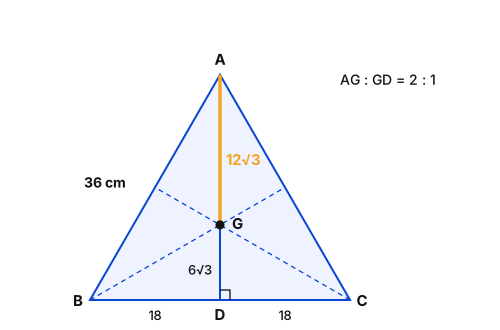
G is the centroid of the equilateral triangle ABC. If AB = 36 cm, then length (in cm) of AG is:
G, समबाहु त्रिभुज ABC का केन्द्रक है। यदि AB = 36 cm है, तो AG की लंबाई (cm में) है:
  1. A86
  2. B103
  3. C66
  4. D123
Show answer

Concept: Centroid divides each median in 2 : 1; median of equilateral triangle = 32× side.

  1. Median = 32×36=183 cm
  2. AG=23×183=123 cm

Trick: In an equilateral triangle, AG = circumradius = side3 = 363=123.

Answer: (D) 123

अवधारणा: केन्द्रक प्रत्येक माध्यिका को 2 : 1 में बाँटता है; समबाहु त्रिभुज की माध्यिका = 32× भुजा।

  1. माध्यिका = 32×36=183 cm
  2. AG=23×183=123 cm

ट्रिक: समबाहु त्रिभुज में AG = परिवृत्त त्रिज्या = भुजा/3 = 363=123।

उत्तर: (D) 123

RRB Technician Grade IIIMathematicsCentroid of equilateral triangleRRB Technician Grade III 2026 · 10 Mar Shift 3 →
Q12.
Find the value of 38−[27−(90÷5−(12−18÷6)÷3)].
38−[27−(90÷5−(12−18÷6)÷3)] का मान ज्ञात कीजिए।
  1. A26
  2. B22
  3. C25
  4. D24
Show answer

Concept: Solve innermost bracket first; inside a bracket, ÷ before −.

  1. 18÷6=3 → 12−3=9 → 9÷3=3
  2. 90÷5=18 → 18−3=15
  3. 27−15=12
  4. 38−12=26

Trick: Remember the order: innermost ( ) → { } → [ ], and division before subtraction in each.

Answer: (A) 26

अवधारणा: सबसे अंदर का कोष्ठक पहले; कोष्ठक के अंदर ÷ पहले, फिर −।

  1. 18÷6=3 → 12−3=9 → 9÷3=3
  2. 90÷5=18 → 18−3=15
  3. 27−15=12
  4. 38−12=26

ट्रिक: क्रम याद रखें: सबसे अंदर का ( ) → { } → [ ], और हर जगह भाग पहले, घटाना बाद में।

उत्तर: (A) 26

RRB Technician Grade IIIMathematicsSimplification – BODMAS with bracketsRRB Technician Grade III 2026 · 10 Mar Shift 3 →
Q13.
A dealer buys two articles X and Y for ₹3,400 each. He marks each of them at the same price. He sells X by giving two successive discounts of 10% and 50% and still earns ₹323 as profit. If he sells Y at a single discount of 28%, then what is the profit
percentage on Y?
एक व्यापारी दो वस्तुएँ X और Y, प्रत्येक ₹3,400 में खरीदता है। वह उनमें से प्रत्येक पर समान मूल्य अंकित करता है। वह X को 10% और 50% की दो क्रमिक छूट देकर बेचता है और फिर भी ₹323 का लाभ अर्जित करता है। यदि वह Y को 28% की एकल छूट पर बेचता है, तो Y पर लाभ
प्रतिशत क्या है?
  1. A75%
  2. B75.2%
  3. C74%
  4. D74.2%
Show answer

Concept: SP=MP×(1−d1)(1−d2); profit % = profitCP×100.

  1. SP of X = 3400+323= ₹3723=MP×0.9×0.5=0.45MP
  2. SP of Y = MP×0.72=3723×0.720.45=3723×1.6= ₹5956.80
  3. Profit on Y = 5956.80−3400=2556.80
  4. Profit % = 2556.803400×100=75.2%

Trick: No need to find MP: SP(Y)SP(X)=0.720.45=1.6, so SP(Y)=1.6×3723.

Answer: (B) 75.2%

अवधारणा: SP=MP×(1−d1)(1−d2); लाभ % = लाभ/CP × 100।

  1. X का SP = 3400+323= ₹3723=MP×0.9×0.5=0.45MP
  2. Y का SP = MP×0.72=3723×0.720.45=3723×1.6= ₹5956.80
  3. Y पर लाभ = 5956.80−3400=2556.80
  4. लाभ % = 2556.803400×100=75.2%

ट्रिक: MP निकालने की ज़रूरत नहीं: SP(Y)SP(X)=0.720.45=1.6, अतः SP(Y)=1.6×3723।

उत्तर: (B) 75.2%

RRB Technician Grade IIIMathematicsSuccessive discounts and profit %RRB Technician Grade III 2026 · 10 Mar Shift 3 →
Q14.
Two persons A and B start from the same point. A walks at 5 km/h. After 't' hours B starts and catches A after 2 hours of his own walking. If B’s speed is 8 km/h, what is the value of 't'?
दो व्यक्ति A और B एक ही बिंदु से चलना प्रारंभ करते हैं। A 5 km/h की चाल से चलता है। 't' घंटे बाद B चलना प्रारंभ करता है और स्वयं 2 घंटे चलने के बाद A को पकड़ लेता है। यदि B की चाल 8 km/h है, तो 't' का मान क्या है?
  1. A1.5
  2. B1.2
  3. C1.4
  4. D1.3
Show answer

Concept: When B catches A, both have covered the same distance from the start.

  1. B's distance = 8×2=16 km
  2. A walked (t + 2) hours: 5(t+2)=16
  3. t+2=3.2 → t=1.2 hours

Trick: Relative speed 3 km/h for 2 h closes 6 km = A's head start 5t → t=65=1.2.

Answer: (B) 1.2

अवधारणा: जब B, A को पकड़ता है तो दोनों ने शुरुआती बिंदु से बराबर दूरी तय की होती है।

  1. B की दूरी = 8×2=16 km
  2. A ने (t + 2) घंटे चला: 5(t+2)=16
  3. t+2=3.2 → t=1.2 घंटे

ट्रिक: सापेक्ष चाल 3 km/h, 2 घंटे में 6 km का अंतर पाटा = A की बढ़त 5t → t=65=1.2।

उत्तर: (B) 1.2

RRB Technician Grade IIIMathematicsSpeed – catching upRRB Technician Grade III 2026 · 10 Mar Shift 3 →
Q15.
Given that 740.45 = x, 740.12 = y and xz = y2, then the value of z is close to:
दिया गया है कि 740.45 = x, 740.12 = y और xz = y2 है, तो z का मान लगभग है:
  1. A2.52
  2. B0.53
  3. C3.99
  4. D1.45
Show answer

Concept: If am=an (same base), then m=n. (Question reads: 740.45=x, 740.12=y and xz=y2.)

  1. xz=(740.45)z=740.45z
  2. y2=(740.12)2=740.24
  3. 0.45z=0.24 → z=2445=815≈0.53

Trick: Equate powers directly: 0.45z=2×0.12 → z=0.240.45≈0.53.

Answer: (B) 0.53

अवधारणा: यदि am=an (समान आधार), तो m=n। (प्रश्न: 740.45=x, 740.12=y तथा xz=y2)

  1. xz=(740.45)z=740.45z
  2. y2=(740.12)2=740.24
  3. 0.45z=0.24 → z=2445=815≈0.53

ट्रिक: सीधे घात बराबर करें: 0.45z=2×0.12 → z=0.240.45≈0.53।

उत्तर: (B) 0.53

RRB Technician Grade IIIMathematicsLaws of exponentsRRB Technician Grade III 2026 · 10 Mar Shift 3 →
Q16.
A can complete a piece of work in 10 days and B can complete the same work in 15 days, when each works individually. Both A and B work together for 3 days. After that, B leaves the work, and A alone completes the remaining work. How many days will A take to finish the remaining work alone?
A किसी कार्य को 10 दिनों में पूरा कर सकता है और B उसी कार्य को 15 दिनों में पूरा कर सकता है, जब प्रत्येक अकेले कार्य करता है। A और B दोनों मिलकर 3 दिनों तक कार्य करते हैं। इसके बाद, B कार्य छोड़ देता है, और A अकेले शेष कार्य पूरा करता है। A को अकेले शेष कार्य पूरा करने में कितने दिन लगेंगे?
  1. A8 days8 दिन
  2. B5 days5 दिन
  3. C6 days6 दिन
  4. D10 days10 दिन
Show answer

Concept: Work done = rate × time; remaining work ÷ rate of the person left.

  1. A + B per day = 110+115=16
  2. In 3 days = 36=12 work done
  3. Remaining 12 by A: 12÷110=5 days

Trick: Total work = 30 units: A = 3, B = 2 per day. 3 days → 15 units; left 15÷3=5 days.

Answer: (B) 5 days

अवधारणा: किया गया कार्य = दर × समय; शेष कार्य ÷ बचे व्यक्ति की दर।

  1. A + B का एक दिन का कार्य = 110+115=16
  2. 3 दिन में = 36=12 कार्य
  3. शेष 12 को A: 12÷110=5 दिन

ट्रिक: कुल कार्य = 30 इकाई: A = 3, B = 2 प्रतिदिन। 3 दिन में 15 इकाई; शेष 15÷3=5 दिन।

उत्तर: (B) 5 दिन

RRB Technician Grade IIIMathematicsTime and work – one person leavesRRB Technician Grade III 2026 · 10 Mar Shift 3 →
Q17.
A, B, and C invested money in the ratio of 2 : 3 : 4 for periods in the ratio of 6 : 4 : 3, respectively. If the total profit is ₹1,32,000, what is the share of C?
A, B और C ने क्रमशः 6 : 4 : 3 के अनुपात वाली अवधियों के लिए 2 : 3 : 4 के अनुपात में धन निवेश किया। यदि कुल लाभ ₹1,32,000 है, तो C का हिस्सा क्या है?
  1. A₹45,000
  2. B₹43,000
  3. C₹42,000
  4. D₹44,000
Show answer

Concept: Profit is shared in the ratio of (capital × time).

  1. A : B : C = 2×6:3×4:4×3=12:12:12=1:1:1
  2. C's share = 1,32,0003= ₹44,000

Trick: All products are 12 — equal shares, so just divide profit by 3.

Answer: (D) ₹44,000

अवधारणा: लाभ (पूँजी × समय) के अनुपात में बँटता है।

  1. A : B : C = 2×6:3×4:4×3=12:12:12=1:1:1
  2. C का हिस्सा = 1,32,0003= ₹44,000

ट्रिक: तीनों गुणनफल 12 हैं — हिस्से बराबर, इसलिए लाभ को सीधे 3 से भाग दें।

उत्तर: (D) ₹44,000

RRB Technician Grade IIIMathematicsPartnership – capital × timeRRB Technician Grade III 2026 · 10 Mar Shift 3 →
Q18.
The average age of six girls increases by four months, if a 12 - year old girl is replaced by a new girl. The age of the new girl is:
यदि 12 वर्ष की एक लड़की के स्थान पर एक नई लड़की को रखा जाता है, तो छह लड़कियों की औसत आयु में चार महीने की वृद्धि हो जाती है। नई लड़की की आयु है:
  1. A16 years16 वर्ष
  2. B15 years15 वर्ष
  3. C14 years14 वर्ष
  4. D13 years13 वर्ष
Show answer

Concept: New member = old member + (number × change in average).

  1. Increase in total = 6×4 months = 24 months = 2 years
  2. New girl = 12+2=14 years

Trick: Replacement shortcut: new = old + n × increase → 12+6×13=14.

Answer: (C) 14 years

अवधारणा: नया सदस्य = पुराना सदस्य + (संख्या × औसत में परिवर्तन)।

  1. कुल में वृद्धि = 6×4 महीने = 24 महीने = 2 वर्ष
  2. नई लड़की = 12+2=14 वर्ष

ट्रिक: शॉर्टकट: नया = पुराना + n × वृद्धि → 12+6×13=14।

उत्तर: (C) 14 वर्ष

RRB Technician Grade IIIMathematicsAverage – replacementRRB Technician Grade III 2026 · 10 Mar Shift 3 →
Q19.
During a sale, 44% of the goods are sold at a profit of 47%. Of the remaining goods, 25% are sold at a profit of 22%, and the rest are sold at a loss of 38%. If the overall profit is x%, what is the value of x?
एक सेल के दौरान, 44% माल 47% के लाभ पर बेचा जाता है। शेष माल में से 25% को 22% के लाभ पर बेचा जाता है, और बाकी को 38% की हानि पर बेचा जाता है। यदि कुल लाभ x% है, तो x का मान क्या है?
  1. A18.5
  2. B18
  3. C7.8
  4. D12.4
Show answer

Concept: Overall profit % = sum of (share of goods × profit/loss %).

  1. 44% at +47%: 0.44×47=+20.68
  2. Remaining 56%: 25% of it = 14% at +22%: 0.14×22=+3.08
  3. Rest 42% at −38%: 0.42×38=−15.96
  4. x=20.68+3.08−15.96=7.8

Trick: Take total goods worth ₹100: profits 20.68 + 3.08, loss 15.96 → net ₹7.8 on ₹100.

Answer: (C) 7.8

अवधारणा: कुल लाभ % = (माल का भाग × लाभ/हानि %) का योग।

  1. 44% पर +47%: 0.44×47=+20.68
  2. शेष 56% का 25% = 14% पर +22%: 0.14×22=+3.08
  3. बाकी 42% पर −38%: 0.42×38=−15.96
  4. x=20.68+3.08−15.96=7.8

ट्रिक: कुल माल ₹100 का मानें: लाभ 20.68 + 3.08, हानि 15.96 → शुद्ध ₹7.8।

उत्तर: (C) 7.8

RRB Technician Grade IIIMathematicsOverall profit % – mixed salesRRB Technician Grade III 2026 · 10 Mar Shift 3 →
Q20.
A trapezium has parallel sides of lengths 17 cm and 29 cm, and the distance between them is 15 cm. What is the area of the trapezium?
एक समलंब की समांतर भुजाओं की लंबाई 17 cm और 29 cm है, और उनके बीच की दूरी 15 cm है। समलंब का क्षेत्रफल क्या है?
  1. A335 cm2
  2. B315 cm2
  3. C325 cm2
  4. D345 cm2
Show answer

Concept: Area of trapezium = 12× (sum of parallel sides) × height.

  1. Sum of parallel sides = 17+29=46 cm
  2. Area = 12×46×15=23×15=345cm2

Trick: Average of parallel sides (23) × height (15) = 345.

Answer: (D) 345 cm2

अवधारणा: समलंब का क्षेत्रफल = 12× (समांतर भुजाओं का योग) × ऊँचाई।

  1. समांतर भुजाओं का योग = 17+29=46 cm
  2. क्षेत्रफल = 12×46×15=23×15=345cm2

ट्रिक: समांतर भुजाओं का औसत (23) × ऊँचाई (15) = 345।

उत्तर: (D) 345 cm2

RRB Technician Grade IIIMathematicsArea of trapeziumRRB Technician Grade III 2026 · 10 Mar Shift 3 →