RRB Technician Grade III 2026 · Shift 3

RRB Technician Grade III 10 Mar 2026 Shift 3 – Question Paper

100 questions · 100 marks · 90 minutes · +1 for a correct answer, −1/3 for a wrong one. With answer key and detailed solutions in Hindi and English.

Test Series – airGurukul

Paper pattern

SectionQuestionsMarks
Mathematics2525
General Intelligence and Reasoning2525
General Science4040
General Awareness1010

Sample questions from this paper

Q1.
What sum of money (in ₹) will yield ₹700 as simple interest in 2 years at 8% per annum?
कितनी धनराशि (₹ में) 8% वार्षिक दर से 2 वर्ष में ₹700 साधारण ब्याज देगी?
  1. A4375
  2. B4575
  3. C3875
  4. D4775
Show answer

Concept: SI = P × R × T/100, so P = SI × 100/(R × T).

  1. SI = ₹700, R = 8%, T = 2 years
  2. P = 700 × 100/(8 × 2) = 70000/16
  3. P = ₹4375

Trick: In 2 years at 8%, total interest = 16% of P. So 16% = 700 → 1% = 43.75 → 100% = ₹4375.

Answer: (A) ₹4375

अवधारणा: साधारण ब्याज = P × R × T/100, इसलिए P = SI × 100/(R × T)।

  1. SI = ₹700, R = 8%, T = 2 वर्ष
  2. P = 700 × 100/(8 × 2) = 70000/16
  3. P = ₹4375

ट्रिक: 2 वर्ष में 8% की दर से कुल ब्याज = P का 16%। 16% = 700 → 1% = 43.75 → 100% = ₹4375।

उत्तर: (A) ₹4375
RRB Technician Grade IIIMathematicsSimple interest – finding principal
Q26.
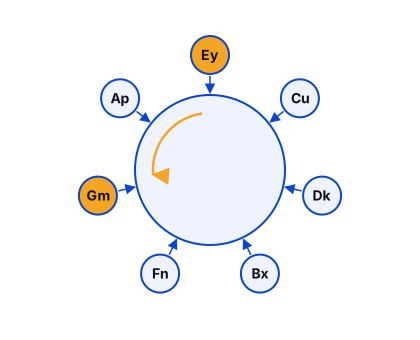
Ap, Bx, Cu, Dk, Ey, Fn and Gm are sitting around a circular table facing the centre. Dk sits to the immediate right of Bx. Cu is the immediate neighbour of Ey and Dk. Fn sits second to the right of Ap. What is the position of Gm with respect to Ey?
Ap, Bx, Cu, Dk, Ey, Fn और Gm एक वृत्ताकार मेज़ के चारों ओर केंद्र की ओर मुख करके बैठे हैं। Dk, Bx के ठीक दाईं ओर बैठा है। Cu, Ey और Dk का निकटतम पड़ोसी है। Fn, Ap के दाईं ओर दूसरे स्थान पर बैठा है। Ey के सापेक्ष Gm का स्थान क्या है?
  1. AThird to the rightदाईं ओर तीसरा
  2. BImmediate leftठीक बाईं ओर
  3. CSecond to the leftबाईं ओर दूसरा
  4. DSecond to the rightदाईं ओर दूसरा
Show answer

Concept: Facing the centre: right = anticlockwise, left = clockwise.

  1. Dk is immediate right of Bx; Cu is next to Dk on the other side, and Ey next to Cu → clockwise order: Ey, Cu, Dk, Bx
  2. Three seats remain after Bx. Fn is second to the right of Ap → only fit: Bx, Fn, Gm, Ap (clockwise), then back to Ey
  3. Moving right (anticlockwise) from Ey: Ap (1st), Gm (2nd)

Trick: Fix the chain Ey–Cu–Dk–Bx first; only one placement of Ap–Fn fits in the 3 empty seats.

Answer: (D) Second to the right

अवधारणा: केंद्र की ओर मुख: दायाँ = वामावर्त, बायाँ = दक्षिणावर्त।

  1. Dk, Bx के तुरंत दाएँ; Cu, Dk का दूसरी ओर का पड़ोसी और Ey, Cu के पास → दक्षिणावर्त क्रम: Ey, Cu, Dk, Bx
  2. Bx के बाद तीन सीटें बचती हैं। Fn, Ap के दाएँ दूसरा → केवल यह क्रम: Bx, Fn, Gm, Ap (दक्षिणावर्त), फिर Ey
  3. Ey से दाईं ओर (वामावर्त): Ap (पहला), Gm (दूसरा)

ट्रिक: पहले Ey–Cu–Dk–Bx की श्रृंखला तय करें; खाली 3 सीटों में Ap–Fn की एक ही व्यवस्था बैठती है।

उत्तर: (D) Second to the right

RRB Technician Grade IIIGeneral Intelligence and ReasoningCircular seating arrangement
Q51.
The difference in electrical conductivity between diamond and graphite arises because:
हीरे और ग्रेफाइट के बीच विद्युत चालकता (electrical conductivity) में अंतर का कारण है:
  1. AGraphite has delocalized electrons; diamond does notग्रेफाइट में विस्थानीकृत (delocalized) इलेक्ट्रॉन होते हैं; हीरे में नहीं
  2. BDiamond has metallic bonding, graphite does notहीरे में धात्विक आबंधन होता है, ग्रेफाइट में नहीं
  3. CDiamond has tightly packed ionsहीरे में दृढ़तापूर्वक संकुलित आयन होते हैं
  4. DBoth have free electrons, but in different numbersदोनों में मुक्त इलेक्ट्रॉन होते हैं, परंतु भिन्न संख्या में
Show answer

Concept: Electrical conduction needs free (mobile) electrons.

  1. Graphite: each C bonds to 3 others; the 4th electron is delocalised → conducts
  2. Diamond: each C bonds to 4 others; no free electron → insulator
  3. Both are covalent, not metallic or ionic

Yaad rakhein: Graphite is the only non-metal that is a good conductor — used as electrodes.

Answer: (A) Graphite has delocalized electrons; diamond does not

अवधारणा: विद्युत चालन के लिए मुक्त (गतिशील) इलेक्ट्रॉन चाहिए।

  1. ग्रेफाइट: हर C तीन C से जुड़ा; चौथा इलेक्ट्रॉन मुक्त (delocalised) → चालक
  2. हीरा: हर C चार C से जुड़ा; कोई मुक्त इलेक्ट्रॉन नहीं → कुचालक
  3. दोनों सहसंयोजी हैं, धात्विक या आयनिक नहीं

याद रखें: ग्रेफाइट एकमात्र अधातु है जो अच्छा चालक है — इलेक्ट्रोड में प्रयोग।

उत्तर: (A) Graphite has delocalized electrons; diamond does not

RRB Technician Grade IIIGeneral ScienceAllotropes of carbon – conductivity
Q91.
Provincial autonomy in provinces in place of dyarchy was introduced by which of the following British Indian government legislations?
प्रांतों में द्वैध शासन के स्थान पर प्रांतीय स्वायत्तता निम्नलिखित में से किस ब्रिटिश भारत सरकार के अधिनियम द्वारा प्रारंभ की गई थी?
  1. AIndian Councils Act of 1909भारतीय परिषद अधिनियम, 1909
  2. BGovernment of India Act of 1935भारत सरकार अधिनियम, 1935
  3. CIndian Councils Act of 1892भारतीय परिषद अधिनियम, 1892
  4. DGovernment of India Act of 1919भारत सरकार अधिनियम, 1919
Show answer

Concept: The GoI Act 1935 abolished dyarchy in provinces and introduced provincial autonomy.

  1. Act of 1919 (Montagu–Chelmsford) introduced dyarchy in provinces
  2. Act of 1935 ended it in provinces and proposed dyarchy at the Centre instead
  3. 1909 (Morley–Minto) = separate electorates for Muslims

Yaad rakhein: 1935 Act also provided for an All-India Federation, a Federal Court (1937) and the RBI.

Answer: (B) Government of India Act of 1935

अवधारणा: भारत सरकार अधिनियम 1935 ने प्रांतों में द्वैध शासन समाप्त कर प्रांतीय स्वायत्तता दी।

  1. 1919 अधिनियम (मॉन्टेग्यू–चेम्सफोर्ड) ने प्रांतों में द्वैध शासन शुरू किया
  2. 1935 अधिनियम ने प्रांतों में इसे खत्म कर केंद्र में द्वैध शासन का प्रावधान किया
  3. 1909 (मॉर्ले–मिंटो) = मुसलमानों के लिए पृथक निर्वाचन

याद रखें: 1935 अधिनियम में अखिल भारतीय संघ, संघीय न्यायालय (1937) और RBI का प्रावधान भी था।

उत्तर: (B) Government of India Act of 1935

RRB Technician Grade IIIGeneral AwarenessGovernment of India Act 1935 – provincial autonomy

See all 100 solutions

More RRB Technician Grade III papers

Download our app

Study smarter with the airGurukul App

Your complete exam-prep companion - classes, practice, and progress tracking.

Learn anytime, anywhere - live classes, tests, notes, and updates in one place.

GET IT ONGoogle Play

Have a query? We’re here to help

Fill out the form and our team will get back to you as soon as possible.

  • Ask your questions related to admission, courses, fees, or facilities
  • Share your details so our team can contact you easily
  • Get accurate information from our support team
  • Quick and simple form submission process

All fields marked * are required.