Question bank

Q&A: practice questions with answers

Search questions on any topic. Filter by exam category, exam, subject and topic, try the question, then open the answer and explanation.

Courses – airGurukul

3,200 questions found.

Q2521.
A man sells two articles for ₹42000 each. He gets a profit of 45% on one article and loses 45% on the other article. What is his overall profit or loss (to the nearest integer) in this transaction?
एक व्यक्ति दो वस्तुएँ प्रत्येक ₹42000 में बेचता है। उसे एक वस्तु पर 45% का लाभ होता है और दूसरी वस्तु पर 45% की हानि होती है। इस लेन-देन में उसका कुल लाभ या हानि (निकटतम पूर्णांक तक) कितना है?
  1. A₹21329 profit₹21329 लाभ
  2. B₹21429 profit₹21429 लाभ
  3. C₹21329 loss₹21329 हानि
  4. D₹21429 loss₹21429 हानि
Show answer

Concept: When two items are sold at the same SP with x% gain and x% loss, there is always a loss.

  1. CP1=420001.45= ₹28,965.52
  2. CP2=420000.55= ₹76,363.64
  3. Total CP = ₹1,05,329.16; Total SP = ₹84,000
  4. Loss = ₹21,329 (to nearest rupee)

Trick: 'Profit' options are eliminated instantly – equal x% gain/loss on same SP is always a loss (x2100%=20.25%).

Answer: (C) ₹21329 loss

अवधारणा: समान SP पर x% लाभ और x% हानि हो तो कुल मिलाकर हमेशा हानि होती है।

  1. CP1=420001.45= ₹28,965.52
  2. CP2=420000.55= ₹76,363.64
  3. कुल CP = ₹1,05,329.16; कुल SP = ₹84,000
  4. हानि = ₹21,329

ट्रिक: 'लाभ' वाले विकल्प तुरंत हटाएँ – ऐसी स्थिति में सदा हानि (x2100%=20.25%)।

उत्तर: (C) ₹21329 हानि

RRB Technician Grade IIIMathematicsSame SP, equal profit and loss %RRB Technician Grade III 2025 · 10 Mar Shift 1 →
Q2522.
Pipe A can fill a tank in 12 hours, pipe B in 15 hours, and an outlet C can empty it in 20 hours. A and B are opened together for 5 hours, and then C is also opened. Find the total time to fill the tank.
पाइप A एक टंकी को 12 घंटे में, पाइप B 15 घंटे में भर सकता है, और एक निकास पाइप C इसे 20 घंटे में खाली कर सकता है। A और B को एक साथ 5 घंटे के लिए खोला जाता है, और फिर C को भी खोल दिया जाता है। टंकी को भरने में लगने वाला कुल समय ज्ञात कीजिए।
  1. A7.5 hours7.5 घंटे
  2. B6 hours6 घंटे
  3. C5.5 hours5.5 घंटे
  4. D6.5 hours6.5 घंटे
Show answer

Concept: Take LCM of 12, 15, 20 = 60 units as tank capacity.

  1. Rates: A = 5, B = 4, C = −3 units/h
  2. A + B for 5 h = 9×5=45 units; left = 15
  3. A + B + C = 6 units/h → 15÷6=2.5 h
  4. Total = 5+2.5=7.5 hours

Trick: LCM-unit method avoids fractions completely.

Answer: (A) 7.5 hours

अवधारणा: टंकी की क्षमता = LCM(12, 15, 20) = 60 इकाई मानें।

  1. दर: A = 5, B = 4, C = −3 इकाई/घंटा
  2. A + B, 5 घंटे में = 45 इकाई; शेष = 15
  3. A + B + C = 6 इकाई/घंटा → 15÷6=2.5 घंटे
  4. कुल = 5+2.5=7.5 घंटे

ट्रिक: LCM-इकाई विधि से भिन्नों से बचें।

उत्तर: (A) 7.5 घंटे

RRB Technician Grade IIIMathematicsPipes and cisterns – inlet with outletRRB Technician Grade III 2025 · 10 Mar Shift 1 →
Q2523.
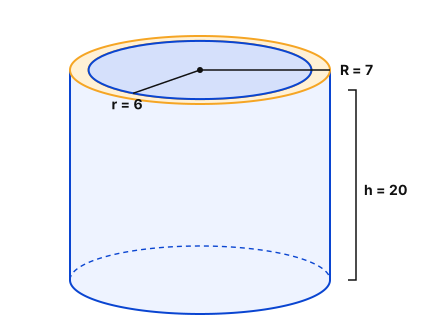
A hollow cylindrical pipe has an external radius of 7 cm, internal radius of 6 cm, and height of 20 cm. Find the total surface area of the pipe (both ends included). (Use π=227)
एक खोखले बेलनाकार पाइप की बाह्य त्रिज्या 7 cm, आंतरिक त्रिज्या 6 cm और ऊँचाई 20 cm है। पाइप का संपूर्ण पृष्ठीय क्षेत्रफल (दोनों सिरों सहित) ज्ञात कीजिए। (π=227 लीजिए)
  1. A1600 cm²
  2. B1716 cm²
  3. C1485 cm²
  4. D1670 cm²
Show answer

Concept: TSA=2πh(R+r)+2π(R2−r2).

  1. Curved (outer + inner) = 2×227×20×13=114407
  2. Two rings = 2×227×(49−36)=5727
  3. TSA = 11440+5727=120127=1716cm2

Trick: Take 2π(R+r) common: 2×227×13×(h+R−r)=5727×21=1716.

Answer: (B) 1716 cm²

अवधारणा: TSA=2πh(R+r)+2π(R2−r2)।

  1. वक्र (बाहरी + भीतरी) = 2×227×20×13=114407
  2. दोनों छल्ले = 2×227×13=5727
  3. TSA = 120127=1716cm2

ट्रिक: 2π(R+r) सामान्य लें: 2×227×13×(20+1)=1716।

उत्तर: (B) 1716 cm²

RRB Technician Grade IIIMathematicsHollow cylinder – total surface areaRRB Technician Grade III 2025 · 10 Mar Shift 1 →
Q2524.
What is the mode of the following data?
47, 43, 50, 46, 46, 40, 54, 54, 40, 54, 42, 48, 44, 55, 52, 45, 41, 41
निम्नलिखित आँकड़ों का बहुलक क्या है?
47, 43, 50, 46, 46, 40, 54, 54, 40, 54, 42, 48, 44, 55, 52, 45, 41, 41
  1. A40
  2. B46
  3. C41
  4. D54
Show answer

Concept: Mode = the value that occurs most often.

  1. 54 appears 3 times
  2. 40, 41, 46 appear only 2 times each
  3. Mode = 54

Trick: Scan only the option values and count them – fastest way.

Answer: (D) 54

अवधारणा: बहुलक = सबसे अधिक बार आने वाला मान।

  1. 54 तीन बार आता है
  2. 40, 41, 46 केवल दो-दो बार
  3. बहुलक = 54

ट्रिक: केवल विकल्पों वाली संख्याएँ गिनें – सबसे तेज़ तरीका।

उत्तर: (D) 54

RRB Technician Grade IIIMathematicsMode of ungrouped dataRRB Technician Grade III 2025 · 10 Mar Shift 1 →
Q2525.
Which number, when added to each of the numbers 2, 3, 11 and 13, will make the resulting numbers in proportion?
संख्याओं 2, 3, 11 और 13 में से प्रत्येक में कौन-सी संख्या जोड़ने पर परिणामी संख्याएँ समानुपात में होंगी?
  1. A6
  2. B4
  3. C5
  4. D7
Show answer

Concept: For a : b = c : d, product of extremes = product of means.

  1. (2+x)(13+x)=(3+x)(11+x)
  2. 26+15x+x2=33+14x+x2
  3. x=7

Trick: Shortcut x=bc−ada+d−b−c=33−2615−14=7. Check: 9 : 10 = 18 : 20 ✓.

Answer: (D) 7

अवधारणा: a : b = c : d में बाह्य पदों का गुणनफल = मध्य पदों का गुणनफल।

  1. (2+x)(13+x)=(3+x)(11+x)
  2. 26+15x=33+14x
  3. x=7

ट्रिक: x=bc−ada+d−b−c=71=7। जाँच: 9 : 10 = 18 : 20 ✓।

उत्तर: (D) 7

RRB Technician Grade IIIMathematicsProportion – number to be addedRRB Technician Grade III 2025 · 10 Mar Shift 1 →
Q2526.
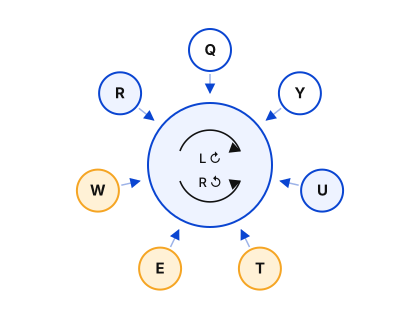
E, R, U, T, Y, W and Q are sitting around a circular table, facing the centre of the table. Only two people sit between T and Q when counted from the left of Q. Only three people sit between W and U when counted from the right of U. E sits to the immediate right of W. Y is an immediate neighbour of U as well as Q.
How many people sit between R and U when counted from the right of R?
E, R, U, T, Y, W और Q एक वृत्ताकार मेज़ के चारों ओर मेज़ के केंद्र की ओर मुख करके बैठे हैं। Q के बाईं ओर से गिनने पर T और Q के बीच केवल दो व्यक्ति बैठे हैं। U के दाईं ओर से गिनने पर W और U के बीच केवल तीन व्यक्ति बैठे हैं। E, W के ठीक दाईं ओर बैठा है। Y, U और Q दोनों का निकटतम पड़ोसी है।
R के दाईं ओर से गिनने पर R और U के बीच कितने व्यक्ति बैठे हैं?
  1. A2
  2. B4
  3. C1
  4. D3
Show answer

Concept: Facing the centre, 'right' is anticlockwise and 'left' is clockwise. Fix Q, place T, then use Y (neighbour of both U and Q).

  1. T is third to the left of Q (two people between). Y must sit next to both Q and U, so the only way is Q, Y, U, T going leftwards (clockwise) from Q.
  2. W is fourth to the right of U (three people between): going right from U the seats are Y, Q, then the next free seat, then W. So W is to the right of Q's right-neighbour R, and E (immediately right of W) fills the seat before T. Order going right: R, W, E, T, U, Y, Q.
  3. Check: E is immediately right of W; between U and W (from U's right) sit Y, Q, R – three people.
  4. From R going right: W, E, T, then U → 3 people between R and U.

Trick: Place the two-neighbour person (Y) first – it locks Q, Y, U together and the rest follows.

Answer: (D) 3

अवधारणा: केंद्र की ओर मुख होने पर 'दायाँ' = वामावर्त और 'बायाँ' = दक्षिणावर्त। Q तय करें, T रखें, फिर Y (U और Q दोनों का पड़ोसी) बैठाएँ।

  1. T, Q के बाईं ओर तीसरे स्थान पर है (बीच में दो लोग)। Y को Q और U दोनों के पास बैठना है, अतः Q से बाईं ओर क्रम Q, Y, U, T बनता है।
  2. W, U के दाईं ओर चौथे स्थान पर है (बीच में Y, Q और एक अन्य व्यक्ति R)। E, W के ठीक दाईं ओर T से पहले वाली सीट पर। दाईं ओर चलते हुए पूरा क्रम: R, W, E, T, U, Y, Q।
  3. जाँच: E, W के ठीक दाईं ओर है; U के दाईं ओर से U और W के बीच Y, Q, R – तीन लोग।
  4. R से दाईं ओर: W, E, T, फिर U → R और U के बीच 3 लोग।

याद रखें: दोनों ओर के पड़ोसी वाले व्यक्ति (Y) को पहले बैठाएँ – इससे Q, Y, U एक साथ तय हो जाते हैं।

उत्तर: (D) 3

RRB Technician Grade IIIGeneral Intelligence and ReasoningCircular seating arrangementRRB Technician Grade III 2025 · 10 Mar Shift 1 →
Q2527.
What should come in place of ‘?’ in the given series?
6, 7, 11, 20, 36, 61, ?
दी गई श्रृंखला में प्रश्न चिह्न ‘?’ के स्थान पर क्या आना चाहिए?
6, 7, 11, 20, 36, 61, ?
  1. A97
  2. B105
  3. C95
  4. D110
Show answer

Concept: Differences between terms are perfect squares 12,22,32,…

  1. 7−6=1, 11−7=4, 20−11=9, 36−20=16, 61−36=25
  2. Next difference = 62=36
  3. ? = 61+36=97

Trick: When differences grow fast but irregularly, test squares/cubes first.

Answer: (A) 97

अवधारणा: पदों के अंतर पूर्ण वर्ग 12,22,32,… हैं।

  1. अंतर: 1, 4, 9, 16, 25
  2. अगला अंतर = 62=36
  3. ? = 61+36=97

ट्रिक: अंतर तेज़ी से बढ़ें तो पहले वर्ग/घन जाँचें।

उत्तर: (A) 97

RRB Technician Grade IIIGeneral Intelligence and ReasoningNumber series – squares of differencesRRB Technician Grade III 2025 · 10 Mar Shift 1 →
Q2528.
In a certain code language,
A + B means ‘A is the sister of B’
A − B means ‘A is the brother of B’
A × B means ‘A is the wife of B’
A ÷ B means ‘A is the father of B’
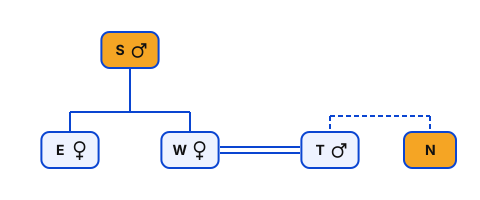
Based on the above, how is S related to N if ‘S ÷ E + W × T − N’?
एक निश्चित कूट भाषा में,
A + B का अर्थ है ‘A, B की बहन है’
A − B का अर्थ है ‘A, B का भाई है’
A × B का अर्थ है ‘A, B की पत्नी है’
A ÷ B का अर्थ है ‘A, B का पिता है’
उपर्युक्त के आधार पर, यदि ‘S ÷ E + W × T − N’ है, तो S का N से क्या संबंध है?
  1. ABrother's wife's fatherभाई की पत्नी का पिता
  2. BBrother's fatherभाई का पिता
  3. CBrother's wife's brotherभाई की पत्नी का भाई
  4. DWife's fatherपत्नी का पिता
Show answer

Concept: Decode each symbol from left to right and build the family tree.

  1. S ÷ E: S is father of E; E + W: E is sister of W → S is father of W too
  2. W × T: W is wife of T
  3. T − N: T is brother of N
  4. So W = N's brother's wife, and S = N's brother's wife's father

Trick: Read the chain backwards from N: N → brother (T) → wife (W) → father (S).

Answer: (A) Brother's wife's father

अवधारणा: हर चिह्न को बाएँ से दाएँ डिकोड कर वंश-वृक्ष बनाएँ।

  1. S ÷ E: S, E का पिता; E + W: E, W की बहन → S, W का भी पिता
  2. W × T: W, T की पत्नी
  3. T − N: T, N का भाई
  4. S = N के भाई की पत्नी का पिता

ट्रिक: N से उल्टा चलें: N → भाई (T) → पत्नी (W) → पिता (S)।

उत्तर: (A) भाई की पत्नी का पिता

RRB Technician Grade IIIGeneral Intelligence and ReasoningCoded blood relationsRRB Technician Grade III 2025 · 10 Mar Shift 1 →
Q2529.
Based on the English alphabetical order, three of the following four letter-cluster pairs are alike in a certain way and thus form a group. Which letter-cluster pair DOES NOT belong to that group?
(Note: The odd one out is not based on the number of consonants/vowels or their position in the letter-cluster.)
अंग्रेज़ी वर्णमाला क्रम के आधार पर, निम्नलिखित चार अक्षर-समूह युग्मों में से तीन किसी निश्चित प्रकार से एकसमान हैं और इस प्रकार एक समूह बनाते हैं। कौन-सा अक्षर-समूह युग्म उस समूह से संबंधित नहीं है?
(ध्यान दें: असंगत अक्षर-समूह, उस अक्षर-समूह में व्यंजनों/स्वरों की संख्या या उनके स्थान पर आधारित नहीं है।)
  1. AUX−XD
  2. BFI−JM
  3. CDG−HK
  4. DSV−WZ
Show answer

Concept: Check the letter gaps inside and between the clusters.

  1. FI−JM: F +3 I, I +1 J, J +3 M
  2. DG−HK and SV−WZ follow the same +3, +1, +3 pattern
  3. UX−XD: U +3 X, X +0 X, X +6 D → breaks the pattern

Trick: Write positions (U = 21, X = 24, D = 4/30) and check one gap at a time.

Answer: (A) UX−XD

अवधारणा: क्लस्टर के अंदर और बीच के अक्षर-अंतर जाँचें।

  1. FI−JM: F +3 I, I +1 J, J +3 M
  2. DG−HK और SV−WZ भी +3, +1, +3
  3. UX−XD: +3, +0, +6 → नियम टूटता है

ट्रिक: स्थान संख्या लिखें और एक-एक अंतर जाँचें।

उत्तर: (A) UX−XD

RRB Technician Grade IIIGeneral Intelligence and ReasoningLetter-cluster pairs – odd one outRRB Technician Grade III 2025 · 10 Mar Shift 1 →
Q2530.
Based on the English alphabetical order, three of the following four letter-cluster pairs are alike in a certain way and thus form a group. Which is the one that does not belong to that group?
(Note: The odd one out is not based on the number of consonants/vowels or their position in the letter-cluster.)
अंग्रेज़ी वर्णमाला क्रम के आधार पर, निम्नलिखित चार अक्षर-समूह युग्मों में से तीन किसी निश्चित प्रकार से एकसमान हैं और इस प्रकार एक समूह बनाते हैं। वह कौन-सा युग्म है जो उस समूह से संबंधित नहीं है?
(ध्यान दें: असंगत अक्षर-समूह, उस अक्षर-समूह में व्यंजनों/स्वरों की संख्या या उनके स्थान पर आधारित नहीं है।)
  1. ADI - AF
  2. BXB - UY
  3. CQR - MP
  4. DKO - HL
Show answer

Concept: Compare each letter of the first cluster with the matching letter of the second.

  1. DI − AF: D −3 A, I −3 F
  2. XB − UY: −3, −3; KO − HL: −3, −3
  3. QR − MP: Q −4 M, R −2 P → odd

Trick: Only check the first letters: D→A, X→U, K→H are −3, but Q→M is −4.

Answer: (C) QR - MP

अवधारणा: पहले क्लस्टर के अक्षरों की तुलना दूसरे के संगत अक्षरों से करें।

  1. DI − AF: −3, −3
  2. XB − UY: −3, −3; KO − HL: −3, −3
  3. QR − MP: −4, −2 → विषम

ट्रिक: केवल पहले अक्षर देखें: D→A, X→U, K→H में −3, पर Q→M में −4।

उत्तर: (C) QR - MP

RRB Technician Grade IIIGeneral Intelligence and ReasoningLetter-cluster pairs – odd one outRRB Technician Grade III 2025 · 10 Mar Shift 1 →
Q2531.
VRHM is related to XTJO in a certain way based on the English alphabetical order. In the same way, DZPU is related to FBRW. To which of the given options is JVFA related, following the same logic?
अंग्रेज़ी वर्णमाला क्रम के आधार पर VRHM एक निश्चित प्रकार से XTJO से संबंधित है। उसी प्रकार, DZPU, FBRW से संबंधित है। समान तर्क का अनुसरण करते हुए, JVFA दिए गए विकल्पों में से किससे संबंधित है?
  1. ALXCD
  2. BLXHC
  3. CLKIO
  4. DLCFD
Show answer

Concept: Each letter moves forward by 2.

  1. VRHM → XTJO: +2 each
  2. DZPU → FBRW: +2 each (Z → B wraps around)
  3. JVFA → L X H C

Trick: Check just one letter per option: F + 2 = H → only LXHC has H third.

Answer: (B) LXHC

अवधारणा: हर अक्षर 2 आगे जाता है।

  1. VRHM → XTJO: हर अक्षर +2
  2. DZPU → FBRW: +2 (Z → B)
  3. JVFA → L X H C

ट्रिक: F + 2 = H – केवल LXHC के तीसरे स्थान पर H है।

उत्तर: (B) LXHC

RRB Technician Grade IIIGeneral Intelligence and ReasoningLetter analogy – +2 shiftRRB Technician Grade III 2025 · 10 Mar Shift 1 →
Q2532.
What should come in place of ‘?’ in the given series?
47 54 63 70 79 ?
दी गई श्रृंखला में प्रश्न चिह्न ‘?’ के स्थान पर क्या आना चाहिए?
47 54 63 70 79 ?
  1. A88
  2. B83
  3. C86
  4. D84
Show answer

Concept: Differences alternate +7, +9.

  1. 47 +7 = 54, +9 = 63, +7 = 70, +9 = 79
  2. Next: 79 + 7 = 86

Yaad rakhein: Two alternating differences are a very common RRB pattern.

Answer: (C) 86

अवधारणा: अंतर बारी-बारी से +7, +9 हैं।

  1. 47 +7 = 54, +9 = 63, +7 = 70, +9 = 79
  2. अगला: 79 + 7 = 86

याद रखें: दो अंतर बारी-बारी से – RRB में आम पैटर्न।

उत्तर: (C) 86

RRB Technician Grade IIIGeneral Intelligence and ReasoningNumber series – alternating additionRRB Technician Grade III 2025 · 10 Mar Shift 1 →
Q2533.
What will come in the place of the question mark (?) in the following equation, if ‘+’ and ‘–’ are interchanged and ‘×’ and ‘÷’ are interchanged?
48 – 96 × 12 ÷ 4 + 32 = ?
यदि ‘+’ और ‘–’ को आपस में बदल दिया जाए तथा ‘×’ और ‘÷’ को आपस में बदल दिया जाए, तो निम्नलिखित समीकरण में प्रश्न चिह्न (?) के स्थान पर क्या आएगा?
48 – 96 × 12 ÷ 4 + 32 = ?
  1. A43
  2. B42
  3. C46
  4. D48
Show answer

Concept: Swap + ↔ − and × ↔ ÷, then apply BODMAS.

  1. New: 48+96÷12×4−32
  2. 96÷12=8; 8×4=32
  3. 48+32−32=48

Trick: +32 and −32 cancel, so the answer is just 48.

Answer: (D) 48

अवधारणा: + ↔ − और × ↔ ÷ बदलें, फिर BODMAS लगाएँ।

  1. नया: 48+96÷12×4−32
  2. 96÷12=8; 8×4=32
  3. 48+32−32=48

ट्रिक: +32 और −32 कट जाते हैं, उत्तर सीधा 48।

उत्तर: (D) 48

RRB Technician Grade IIIGeneral Intelligence and ReasoningMathematical operations – sign interchangeRRB Technician Grade III 2025 · 10 Mar Shift 1 →
Q2534.
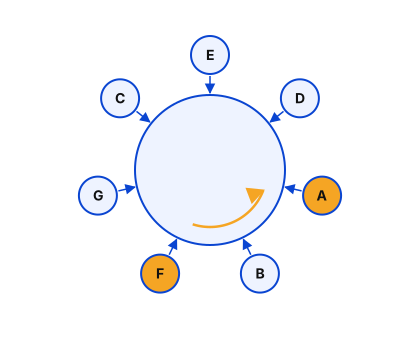
A, B, C, D, E, F and G are sitting around a circular table facing the centre. Only two people are seated between E and F when counted from the right of E. Only two people are seated between F and D when counted from the left of D. Only three people are seated between E and B when counted from the left of B. C is seated to the immediate left of G. How many people are seated between A and F when counted from the right of F?
A, B, C, D, E, F और G एक वृत्ताकार मेज़ के चारों ओर केंद्र की ओर मुख करके बैठे हैं। E के दाईं ओर से गिनने पर E और F के बीच केवल दो व्यक्ति बैठे हैं। D के बाईं ओर से गिनने पर F और D के बीच केवल दो व्यक्ति बैठे हैं। B के बाईं ओर से गिनने पर E और B के बीच केवल तीन व्यक्ति बैठे हैं। C, G के ठीक बाईं ओर बैठा है। F के दाईं ओर से गिनने पर A और F के बीच कितने व्यक्ति बैठे हैं?
  1. A3
  2. B1
  3. C2
  4. D4
Show answer

Concept: Facing centre: right = anticlockwise. Place E first, then F, D, B, and the C–G pair.

  1. Going right from E: E, _, _, F (two between)
  2. D is 3 places to F's right; B is 4 places to E's right
  3. C immediate left of G fills the rest: order to the right from E = E, C, G, F, B, A, D
  4. From F to the right: B is between F and A → 1 person

Trick: 'Only two between' in 7 seats means 3 steps one way and 4 steps the other way.

Answer: (B) 1

अवधारणा: केंद्र की ओर मुख: दायाँ = वामावर्त। पहले E, फिर F, D, B और C–G जोड़ी रखें।

  1. E से दाएँ: E, _, _, F
  2. D, F से 3 स्थान दाएँ; B, E से 4 स्थान दाएँ
  3. C, G के ठीक बाएँ → E से दाएँ क्रम: E, C, G, F, B, A, D
  4. F से दाएँ A तक बीच में केवल B → 1

ट्रिक: 7 सीटों में 'दो बीच में' = एक ओर 3 कदम, दूसरी ओर 4 कदम।

उत्तर: (B) 1

RRB Technician Grade IIIGeneral Intelligence and ReasoningCircular seating arrangementRRB Technician Grade III 2025 · 10 Mar Shift 1 →
Q2535.
Based on the English alphabetical order, three of the following four letter-cluster pairs are alike in a certain way and thus form a group. Which letter-cluster pair DOES NOT belong to that group?
(Note: The odd one out is not based on the number of consonants/vowels or their position in the letter-cluster.)
अंग्रेज़ी वर्णमाला क्रम के आधार पर, निम्नलिखित चार अक्षर-समूह युग्मों में से तीन किसी निश्चित प्रकार से एकसमान हैं और इस प्रकार एक समूह बनाते हैं। कौन-सा अक्षर-समूह युग्म उस समूह से संबंधित नहीं है?
(ध्यान दें: असंगत अक्षर-समूह, उस अक्षर-समूह में व्यंजनों/स्वरों की संख्या या उनके स्थान पर आधारित नहीं है।)
  1. AKU - MT
  2. BOV - QX
  3. CHO - JQ
  4. DDK - FM
Show answer

Concept: Compare letter-by-letter shifts between the two clusters.

  1. OV − QX: +2, +2
  2. HO − JQ: +2, +2; DK − FM: +2, +2
  3. KU − MT: K +2 M, but U −1 T → odd

Trick: The second letter going backwards (U → T) gives it away immediately.

Answer: (A) KU - MT

अवधारणा: दोनों क्लस्टर के अक्षरों का खिसकाव तुलना करें।

  1. OV − QX: +2, +2
  2. HO − JQ, DK − FM: +2, +2
  3. KU − MT: +2, पर U → T = −1 → विषम

ट्रिक: दूसरा अक्षर पीछे जा रहा है (U → T) – तुरंत पहचानें।

उत्तर: (A) KU - MT

RRB Technician Grade IIIGeneral Intelligence and ReasoningLetter-cluster pairs – odd one outRRB Technician Grade III 2025 · 10 Mar Shift 1 →
Q2536.
Refer to the following series and answer the question. (All numbers are single-digit numbers only. Counting to be done from left to right.)
(Left) 7 9 2 6 1 2 6 4 8 2 7 5 9 8 6 5 4 2 2 1 3 (Right)
How many such even digits are there, each of the which is immediately preceded by a perfect square and immediately followed by an even digit? (NOTE: 1 is also a perfect square)
निम्नलिखित श्रृंखला को देखिए और प्रश्न का उत्तर दीजिए। (सभी संख्याएँ केवल एक अंक वाली संख्याएँ हैं। गिनती बाएँ से दाएँ की जानी है।)
(बाएँ) 7 9 2 6 1 2 6 4 8 2 7 5 9 8 6 5 4 2 2 1 3 (दाएँ)
ऐसे कितने सम अंक हैं, जिनमें से प्रत्येक के ठीक पहले एक पूर्ण वर्ग है और ठीक बाद एक सम अंक है? (ध्यान दें: 1 भी एक पूर्ण वर्ग है)
  1. AThreeतीन
  2. BFiveपाँच
  3. CFourचार
  4. DTwoदो
Show answer

Concept: Find even digits with a perfect square (1, 4, 9) just before and an even digit just after.

  1. 9 2 6 ✓; 1 2 6 ✓; 4 8 2 ✓
  2. 9 8 6 ✓; 4 2 2 ✓
  3. Total = 5

Trick: First mark every 1, 4, 9; then check only the digit right after each.

Answer: (B) Five

अवधारणा: ऐसे सम अंक जिनके ठीक पहले पूर्ण वर्ग (1, 4, 9) और ठीक बाद सम अंक हो।

  1. 9 2 6 ✓; 1 2 6 ✓; 4 8 2 ✓
  2. 9 8 6 ✓; 4 2 2 ✓
  3. कुल = 5

ट्रिक: पहले सभी 1, 4, 9 चिह्नित करें, फिर केवल उनके बाद वाला अंक जाँचें।

उत्तर: (B) पाँच

RRB Technician Grade IIIGeneral Intelligence and ReasoningNumber series – digit conditionsRRB Technician Grade III 2025 · 10 Mar Shift 1 →
Q2537.
In a certain code language, ‘DUKE’ is coded as ‘8123’ and ‘DESK’ is coded as ‘2314’. What is the code for ‘S’ in that language?
एक निश्चित कूट भाषा में, ‘DUKE’ को ‘8123’ लिखा जाता है और ‘DESK’ को ‘2314’ लिखा जाता है। उस भाषा में ‘S’ के लिए कूट क्या है?
  1. A8
  2. B4
  3. C1
  4. D2
Show answer

Concept: Letters common to both words take the digits common to both codes.

  1. DUKE = 8123, DESK = 2314
  2. Common letters D, E, K ↔ common digits 1, 2, 3
  3. Leftover: U = 8 and S = 4

Trick: Cancel the common part; the leftover letter gets the leftover digit.

Answer: (B) 4

अवधारणा: दोनों शब्दों के सामान्य अक्षर दोनों कोड के सामान्य अंकों से मिलते हैं।

  1. DUKE = 8123, DESK = 2314
  2. सामान्य अक्षर D, E, K ↔ सामान्य अंक 1, 2, 3
  3. बचे: U = 8 और S = 4

ट्रिक: सामान्य भाग हटाएँ; बचा अक्षर = बचा अंक।

उत्तर: (B) 4

RRB Technician Grade IIIGeneral Intelligence and ReasoningCoding – common letter methodRRB Technician Grade III 2025 · 10 Mar Shift 1 →
Q2538.
Each letter in the word DEARTHS is changed to the letter immediately following it in the English alphabetical order and then all the letters thus formed are arranged in alphabetical order. Which of the following letters will be fourth from the right in the new group of letters thus formed?
शब्द DEARTHS के प्रत्येक अक्षर को अंग्रेज़ी वर्णमाला क्रम में उसके ठीक अगले अक्षर से बदल दिया जाता है और फिर इस प्रकार बने सभी अक्षरों को वर्णमाला क्रम में व्यवस्थित किया जाता है। इस प्रकार बने अक्षरों के नए समूह में दाएँ से चौथा अक्षर निम्नलिखित में से कौन-सा होगा?
  1. AE
  2. BF
  3. CI
  4. DS
Show answer

Concept: Shift each letter +1, then sort alphabetically.

  1. DEARTHS → E F B S U I T
  2. Sorted: B E F I S T U
  3. 4th from right: U, T, S, I → I

Trick: In a 7-letter group, 4th from right = 4th from left (the middle).

Answer: (C) I

अवधारणा: हर अक्षर +1 करें, फिर वर्णक्रम में लगाएँ।

  1. DEARTHS → E F B S U I T
  2. क्रम: B E F I S T U
  3. दाएँ से चौथा: U, T, S, I → I

ट्रिक: 7 अक्षरों में दाएँ से चौथा = बाएँ से चौथा (बीच वाला)।

उत्तर: (C) I

RRB Technician Grade IIIGeneral Intelligence and ReasoningLetter shifting and arrangingRRB Technician Grade III 2025 · 10 Mar Shift 1 →
Q2539.
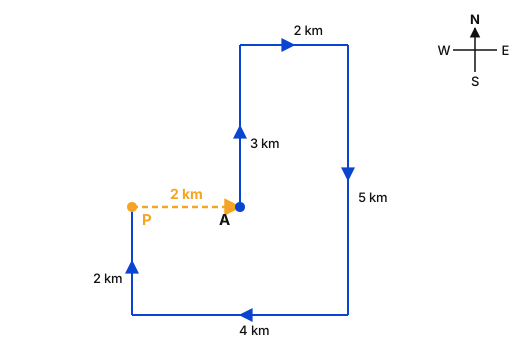
Anu starts from Point A and drives 3 km towards the north. He then takes a right turn, drives 2 km, turns right and drives 5 km. He then takes a right turn and drives 4 km. He takes a final right turn, drives 2 km and stops at Point P. How far (shortest distance) and towards which direction should he drive in order to reach Point A again? (All turns are 90-degree turns only unless specified.)
अनु बिंदु A से चलना शुरू करता है और उत्तर की ओर 3 km गाड़ी चलाता है। फिर वह दाएँ मुड़ता है, 2 km गाड़ी चलाता है, दाएँ मुड़ता है और 5 km गाड़ी चलाता है। फिर वह दाएँ मुड़ता है और 4 km गाड़ी चलाता है। वह अंतिम बार दाएँ मुड़ता है, 2 km गाड़ी चलाता है और बिंदु P पर रुक जाता है। बिंदु A पर पुनः पहुँचने के लिए उसे कितनी दूरी (न्यूनतम दूरी) तक और किस दिशा में गाड़ी चलानी चाहिए? (जब तक निर्दिष्ट न हो, सभी मोड़ केवल 90 डिग्री के मोड़ हैं।)
  1. A6 km to the eastपूर्व की ओर 6 km
  2. B4 km to the westपश्चिम की ओर 4 km
  3. C2 km to the eastपूर्व की ओर 2 km
  4. D8 km to the Northउत्तर की ओर 8 km
Show answer

Concept: Track net north–south and east–west movement.

  1. North 3, right → East 2, right → South 5, right → West 4, right → North 2
  2. North–south: 3 − 5 + 2 = 0
  3. East–west: 2 − 4 = 2 km west of A
  4. So A is 2 km to the east of P

Trick: Four right turns bring you back to the start direction – just add the opposite legs.

Answer: (C) 2 km to the east

अवधारणा: उत्तर–दक्षिण और पूर्व–पश्चिम का शुद्ध विस्थापन निकालें।

  1. उत्तर 3, दाएँ → पूर्व 2, दाएँ → दक्षिण 5, दाएँ → पश्चिम 4, दाएँ → उत्तर 2
  2. उत्तर–दक्षिण: 3 − 5 + 2 = 0
  3. पूर्व–पश्चिम: 2 − 4 = A से 2 km पश्चिम
  4. A तक जाने के लिए 2 km पूर्व

ट्रिक: विपरीत दिशाओं की दूरियाँ घटाएँ – शुद्ध विस्थापन तुरंत मिलता है।

उत्तर: (C) पूर्व की ओर 2 km

RRB Technician Grade IIIGeneral Intelligence and ReasoningDirection sense – shortest distanceRRB Technician Grade III 2025 · 10 Mar Shift 1 →
Q2540.
Seven boxes A, B, C, D, E, F and G are kept one over the other but not necessarily in the same order. Only two boxes are kept below D. Only three boxes are kept between E and D. C is kept above A but below G. B is kept above F but below A. Which box is kept immediately above A?
सात बक्से A, B, C, D, E, F और G एक के ऊपर एक रखे गए हैं, परंतु आवश्यक नहीं कि इसी क्रम में हों। D के नीचे केवल दो बक्से रखे गए हैं। E और D के बीच केवल तीन बक्से रखे गए हैं। C, A के ऊपर परंतु G के नीचे रखा गया है। B, F के ऊपर परंतु A के नीचे रखा गया है। A के ठीक ऊपर कौन-सा बक्सा रखा गया है?
  1. AC
  2. BG
  3. CE
  4. DD
Show answer

Concept: Number positions 1 (bottom) to 7 (top).

  1. Two below D → D = 3; three between E and D → E = 7
  2. Chain G > C > A > B > F fills 6, 5, 4, 2, 1
  3. G = 6, C = 5, A = 4, B = 2, F = 1
  4. Immediately above A is C

Trick: A 5-box chain into exactly 5 free slots forces a single order.

Answer: (A) C

अवधारणा: स्थान 1 (नीचे) से 7 (ऊपर) तक मानें।

  1. D के नीचे दो → D = 3; E और D के बीच तीन → E = 7
  2. क्रम G > C > A > B > F → 6, 5, 4, 2, 1
  3. G = 6, C = 5, A = 4, B = 2, F = 1
  4. A के ठीक ऊपर C

ट्रिक: 5 बक्सों की शृंखला ठीक 5 खाली स्थानों में – एक ही क्रम संभव।

उत्तर: (A) C

RRB Technician Grade IIIGeneral Intelligence and ReasoningBox arrangement (vertical)RRB Technician Grade III 2025 · 10 Mar Shift 1 →