RRB Technician Grade III 2026 · Shift 1

RRB Technician Grade III 10 Mar 2026 Shift 1 – Question Paper

100 questions · 100 marks · 90 minutes · +1 for a correct answer, −1/3 for a wrong one. With answer key and detailed solutions in Hindi and English.

Test Series – airGurukul

Paper pattern

SectionQuestionsMarks
Mathematics2525
General Intelligence and Reasoning2525
General Science4040
General Awareness1010

Sample questions from this paper

Q1.
If 15 notebooks cost ₹240, then how many notebooks can be bought with ₹992?
यदि 15 नोटबुक का मूल्य ₹240 है, तो ₹992 में कितनी नोटबुक खरीदी जा सकती हैं?
  1. A62
  2. B64
  3. C60
  4. D66
Show answer

Concept: Find the cost of one item, then divide the money available by it.

  1. Cost of 1 notebook = 240÷15= ₹16
  2. Notebooks for ₹992 = 992÷16=62

Trick: 992÷16: 16×60=960, remaining 32=16×2, so 62.

Answer: (A) 62

अवधारणा: पहले एक वस्तु का मूल्य निकालें, फिर कुल राशि को उससे भाग दें।

  1. 1 नोटबुक का मूल्य = 240÷15= ₹16
  2. ₹992 में नोटबुक = 992÷16=62

ट्रिक: 16×60=960, बचे 32=16×2, इसलिए 62।

उत्तर: (A) 62

RRB Technician Grade IIIMathematicsUnitary method – cost and quantity
Q26.
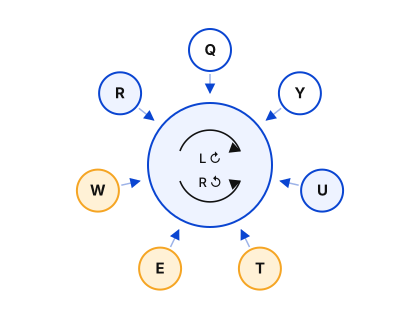
E, R, U, T, Y, W and Q are sitting around a circular table, facing the centre of the table. Only two people sit between T and Q when counted from the left of Q. Only three people sit between W and U when counted from the right of U. E sits to the immediate right of W. Y is an immediate neighbour of U as well as Q.
How many people sit between R and U when counted from the right of R?
E, R, U, T, Y, W और Q एक वृत्ताकार मेज़ के चारों ओर मेज़ के केंद्र की ओर मुख करके बैठे हैं। Q के बाईं ओर से गिनने पर T और Q के बीच केवल दो व्यक्ति बैठे हैं। U के दाईं ओर से गिनने पर W और U के बीच केवल तीन व्यक्ति बैठे हैं। E, W के ठीक दाईं ओर बैठा है। Y, U और Q दोनों का निकटतम पड़ोसी है।
R के दाईं ओर से गिनने पर R और U के बीच कितने व्यक्ति बैठे हैं?
  1. A2
  2. B4
  3. C1
  4. D3
Show answer

Concept: Facing the centre, 'right' is anticlockwise and 'left' is clockwise. Fix Q, place T, then use Y (neighbour of both U and Q).

  1. T is third to the left of Q (two people between). Y must sit next to both Q and U, so the only way is Q, Y, U, T going leftwards (clockwise) from Q.
  2. W is fourth to the right of U (three people between): going right from U the seats are Y, Q, then the next free seat, then W. So W is to the right of Q's right-neighbour R, and E (immediately right of W) fills the seat before T. Order going right: R, W, E, T, U, Y, Q.
  3. Check: E is immediately right of W; between U and W (from U's right) sit Y, Q, R – three people.
  4. From R going right: W, E, T, then U → 3 people between R and U.

Trick: Place the two-neighbour person (Y) first – it locks Q, Y, U together and the rest follows.

Answer: (D) 3

अवधारणा: केंद्र की ओर मुख होने पर 'दायाँ' = वामावर्त और 'बायाँ' = दक्षिणावर्त। Q तय करें, T रखें, फिर Y (U और Q दोनों का पड़ोसी) बैठाएँ।

  1. T, Q के बाईं ओर तीसरे स्थान पर है (बीच में दो लोग)। Y को Q और U दोनों के पास बैठना है, अतः Q से बाईं ओर क्रम Q, Y, U, T बनता है।
  2. W, U के दाईं ओर चौथे स्थान पर है (बीच में Y, Q और एक अन्य व्यक्ति R)। E, W के ठीक दाईं ओर T से पहले वाली सीट पर। दाईं ओर चलते हुए पूरा क्रम: R, W, E, T, U, Y, Q।
  3. जाँच: E, W के ठीक दाईं ओर है; U के दाईं ओर से U और W के बीच Y, Q, R – तीन लोग।
  4. R से दाईं ओर: W, E, T, फिर U → R और U के बीच 3 लोग।

याद रखें: दोनों ओर के पड़ोसी वाले व्यक्ति (Y) को पहले बैठाएँ – इससे Q, Y, U एक साथ तय हो जाते हैं।

उत्तर: (D) 3

RRB Technician Grade IIIGeneral Intelligence and ReasoningCircular seating arrangement
Q51.
Which of the following methods is commonly used to extract metals low in the activity series, such as mercury and copper, from their ores?
सक्रियता श्रेणी में निचले स्थान पर स्थित धातुओं, जैसे पारा और ताँबा, को उनके अयस्कों से निष्कर्षित करने के लिए सामान्यतः निम्नलिखित में से कौन-सी विधि उपयोग की जाती है?
  1. ADisplacement by carbon monoxide gasकार्बन मोनोऑक्साइड गैस द्वारा विस्थापन
  2. BReduction with aluminium powderऐलुमिनियम चूर्ण द्वारा अपचयन
  3. CRoastingभर्जन (Roasting)
  4. DElectrolysis of molten oreगलित अयस्क का विद्युत-अपघटन
Show answer

Concept: Metals low in the activity series are obtained just by heating (roasting) their sulphide ores in air.

  1. Cinnabar: 2HgS + 3O₂ → 2HgO + 2SO₂ (roasting); 2HgO → 2Hg + O₂ on further heating
  2. Copper: 2Cu₂S + 3O₂ → 2Cu₂O + 2SO₂; then Cu₂S + 2Cu₂O → 6Cu + SO₂
  3. Electrolysis is needed only for highly reactive metals like Na, Al

Yaad rakhein: Low reactivity → heat alone; middle (Zn, Fe) → reduction with C; top (Na, K, Al) → electrolysis.

Answer: (C) Roasting

अवधारणा: कम सक्रिय धातुएँ उनके सल्फाइड अयस्क को हवा में गर्म (भर्जन) करने से ही मिल जाती हैं।

  1. सिनेबार: 2HgS + 3O₂ → 2HgO + 2SO₂; गर्म करने पर 2HgO → 2Hg + O₂
  2. कॉपर: Cu₂S का भर्जन → Cu₂O; फिर Cu₂S + 2Cu₂O → 6Cu + SO₂
  3. विद्युत-अपघटन केवल Na, Al जैसी अधिक सक्रिय धातुओं के लिए

याद रखें: कम सक्रिय → केवल ताप; मध्यम (Zn, Fe) → कार्बन से अपचयन; अधिक सक्रिय → विद्युत-अपघटन।

उत्तर: (C) Roasting (भर्जन)

RRB Technician Grade IIIGeneral ScienceExtraction of metals low in reactivity series
Q91.
Keshab Chandra Sen was a prominent leader of which of the following reform movements in India?
केशवचंद्र सेन भारत में निम्नलिखित में से किस सुधार आंदोलन के एक प्रमुख नेता थे?
  1. APrarthana Samajप्रार्थना समाज
  2. BBrahmo Samajब्रह्म समाज
  3. CArya Samajआर्य समाज
  4. DRamakrishna Missionरामकृष्ण मिशन
Show answer

Concept: Keshab Chandra Sen was a leading figure of the Brahmo Samaj.

  1. Brahmo Samaj was founded by Raja Ram Mohan Roy (1828)
  2. Keshab Chandra Sen joined it and later formed the Brahmo Samaj of India (1866)
  3. Prarthana Samaj (1867) was set up with his inspiration, but he led the Brahmo movement

Yaad rakhein: Arya Samaj – Dayanand Saraswati (1875); Ramakrishna Mission – Swami Vivekananda (1897).

Answer: (B) Brahmo Samaj

अवधारणा: केशव चंद्र सेन ब्रह्म समाज के प्रमुख नेता थे।

  1. ब्रह्म समाज की स्थापना राजा राममोहन राय ने (1828) की
  2. केशव चंद्र सेन ने बाद में 'भारतवर्षीय ब्रह्म समाज' (1866) बनाया
  3. प्रार्थना समाज (1867) उनकी प्रेरणा से बना, पर वे ब्रह्म आंदोलन के नेता थे

याद रखें: आर्य समाज – दयानंद सरस्वती (1875); रामकृष्ण मिशन – स्वामी विवेकानंद (1897)।

उत्तर: (B) Brahmo Samaj (ब्रह्म समाज)

RRB Technician Grade IIIGeneral AwarenessSocio-religious reform – Brahmo Samaj

See all 100 solutions

More RRB Technician Grade III papers

Download our app

Study smarter with the airGurukul App

Your complete exam-prep companion - classes, practice, and progress tracking.

Learn anytime, anywhere - live classes, tests, notes, and updates in one place.

GET IT ONGoogle Play

Have a query? We’re here to help

Fill out the form and our team will get back to you as soon as possible.

  • Ask your questions related to admission, courses, fees, or facilities
  • Share your details so our team can contact you easily
  • Get accurate information from our support team
  • Quick and simple form submission process

All fields marked * are required.