Question bank

Q&A: practice questions with answers

Search questions on any topic. Filter by exam category, exam, subject and topic, try the question, then open the answer and explanation.

Courses – airGurukul

3,200 questions found.

Q2561.
Which of the following statements best explains the functional advantage of the pollen tube formation in the process of fertilisation in flowering plants?
निम्नलिखित में से कौन-सा कथन पुष्पी पौधों में निषेचन की प्रक्रिया में पराग नलिका बनने के कार्यात्मक लाभ की सबसे अच्छी व्याख्या करता है?
  1. AIt allows the pollen grain to attach firmly to the stigma for self-pollination to occur efficientlyयह परागकण को वर्तिकाग्र से मज़बूती से जुड़ने देती है ताकि स्व-परागण कुशलतापूर्वक हो सके
  2. BIt helps the pollen grain to release its stored nutrients for the ovule to develop into a seedयह परागकण को अपने संचित पोषक तत्व मुक्त करने में सहायता करती है ताकि बीजांड बीज में विकसित हो सके
  3. CIt ensures direct transfer of the male germ-cell to the ovary, preventing wastage of pollen grainsयह नर जनन-कोशिका का अंडाशय तक सीधा स्थानांतरण सुनिश्चित करती है, जिससे परागकणों की बर्बादी रुकती है
  4. DIt enables the ovary to release egg cells toward the pollen grain for fusion to take placeयह अंडाशय को संलयन के लिए परागकण की ओर अंड कोशिकाएँ मुक्त करने में सक्षम बनाती है
Show answer

Concept: The pollen tube carries the male germ-cell from stigma through style to the ovule.

  1. Pollen lands on stigma and grows a tube through the style
  2. Tube enters the ovule and releases the male gamete near the egg
  3. Male gamete need not travel by water – direct, efficient delivery

Yaad rakhein: After fertilisation, ovule → seed and ovary → fruit.

Answer: (C) It ensures direct transfer of the male germ-cell to the ovary, preventing wastage of pollen grains

अवधारणा: पराग नलिका नर युग्मक को वर्तिकाग्र से वर्तिका होते हुए बीजांड तक ले जाती है।

  1. पराग वर्तिकाग्र पर गिरकर नलिका बनाता है
  2. नलिका बीजांड में पहुँचकर नर युग्मक छोड़ती है
  3. नर युग्मक सीधे पहुँचता है – पानी की ज़रूरत नहीं

याद रखें: निषेचन के बाद बीजांड → बीज, अंडाशय → फल।

उत्तर: (C) यह नर जनन-कोशिका का अंडाशय तक सीधा स्थानांतरण सुनिश्चित करती है, जिससे परागकणों की बर्बादी रुकती है

RRB Technician Grade IIIGeneral SciencePollen tube and fertilisationRRB Technician Grade III 2025 · 10 Mar Shift 1 →
Q2562.
The far point of a myopic person is 80 cm in front of the eye. Assuming the far point for normal vision is infinity, what is the required power (P) of the corrective lens?
एक निकट-दृष्टि दोष (myopia) से ग्रसित व्यक्ति का दूर बिंदु आँख के सामने 80 cm पर है। यह मानते हुए कि सामान्य दृष्टि के लिए दूर बिंदु अनंत पर होता है, संशोधक लेंस की आवश्यक क्षमता (P) कितनी है?
  1. A+0.80 D
  2. B+1.25 D
  3. C-0.80 D
  4. D-1.25 D
Show answer

Concept: Myopia is corrected by a concave lens with f = −(far point).

  1. f=−80cm=−0.8m
  2. P=1f=1−0.8=−1.25 D

Trick: Myopia → minus power; P=−100far point (cm)=−10080.

Answer: (D) -1.25 D

अवधारणा: निकट-दृष्टि दोष अवतल लेंस से ठीक होता है, f = −(दूर बिंदु)।

  1. f=−80cm=−0.8m
  2. P=1f=−1.25 D

ट्रिक: निकट-दृष्टि → ऋणात्मक क्षमता; P=−10080।

उत्तर: (D) -1.25 D

RRB Technician Grade IIIGeneral ScienceMyopia correction – lens powerRRB Technician Grade III 2025 · 10 Mar Shift 1 →
Q2563.
Which of the following statements is/are true regarding the speed of sound?
(i) The speed of sound decreases with an increase in the temperature of the medium. (ii) The speed of sound in solid state is greater than the speed of sound in gaseous state under the same external conditions.
(iii) The speed of sound is independent of the properties of the medium through which it travels.
ध्वनि की चाल के संबंध में निम्नलिखित में से कौन-सा/से कथन सत्य है/हैं?
(i) माध्यम के तापमान में वृद्धि के साथ ध्वनि की चाल घटती है। (ii) समान बाह्य परिस्थितियों में, ठोस अवस्था में ध्वनि की चाल गैसीय अवस्था में ध्वनि की चाल से अधिक होती है।
(iii) ध्वनि की चाल उस माध्यम के गुणों से स्वतंत्र होती है जिसमें से होकर वह गमन करती है।
  1. ABoth (i) and (ii)(i) और (ii) दोनों
  2. BBoth (i) and (iii)(i) और (iii) दोनों
  3. COnly (iii)केवल (iii)
  4. DOnly (ii)केवल (ii)
Show answer

Concept: Speed of sound depends on the medium and its temperature.

  1. (i) False – speed increases with temperature
  2. (ii) True – solids > liquids > gases
  3. (iii) False – it depends on elasticity and density of the medium

Yaad rakhein: Speed of sound in air at 25 °C ≈ 346 m/s; in steel ≈ 5960 m/s.

Answer: (D) Only (ii)

अवधारणा: ध्वनि की चाल माध्यम और उसके ताप पर निर्भर करती है।

  1. (i) गलत – ताप बढ़ने पर चाल बढ़ती है
  2. (ii) सही – ठोस > द्रव > गैस
  3. (iii) गलत – माध्यम की प्रत्यास्थता और घनत्व पर निर्भर

याद रखें: 25 °C पर वायु में चाल ≈ 346 m/s; स्टील में ≈ 5960 m/s।

उत्तर: (D) केवल (ii)

RRB Technician Grade IIIGeneral ScienceSpeed of sound – factorsRRB Technician Grade III 2025 · 10 Mar Shift 1 →
Q2564.
Why is electrolysis used for the extraction of metals high up in the reactivity series, such as sodium and aluminum?
सक्रियता श्रेणी में ऊपर स्थित धातुओं, जैसे सोडियम और ऐलुमिनियम, के निष्कर्षण के लिए विद्युत-अपघटन (electrolysis) का उपयोग क्यों किया जाता है?
  1. ABecause these metals exist in native stateक्योंकि ये धातुएँ मुक्त अवस्था में पाई जाती हैं
  2. BBecause these metals have low melting pointsक्योंकि इन धातुओं के गलनांक कम होते हैं
  3. CBecause these metals cannot be reduced by carbon or hydrogenक्योंकि इन धातुओं को कार्बन या हाइड्रोजन द्वारा अपचयित नहीं किया जा सकता
  4. DBecause these metals form volatile oxidesक्योंकि ये धातुएँ वाष्पशील ऑक्साइड बनाती हैं
Show answer

Concept: Very reactive metals hold oxygen more strongly than carbon does.

  1. Na, K, Ca, Mg, Al have more affinity for oxygen than carbon
  2. So carbon/hydrogen cannot reduce their oxides
  3. They are obtained by electrolysis of molten chlorides/oxides (metal deposits at cathode)

Yaad rakhein: Aluminium is extracted by electrolysis of molten alumina (Al₂O₃).

Answer: (C) Because these metals cannot be reduced by carbon or hydrogen

अवधारणा: अत्यधिक सक्रिय धातुएँ ऑक्सीजन को कार्बन से अधिक मज़बूती से पकड़ती हैं।

  1. Na, K, Ca, Mg, Al की ऑक्सीजन से बंधुता कार्बन से अधिक
  2. इसलिए कार्बन/हाइड्रोजन इनके ऑक्साइड का अपचयन नहीं कर सकते
  3. इन्हें गलित क्लोराइड/ऑक्साइड के विद्युत-अपघटन से प्राप्त करते हैं (धातु कैथोड पर)

याद रखें: एल्युमिनियम गलित एल्यूमिना (Al₂O₃) के विद्युत-अपघटन से मिलता है।

उत्तर: (C) क्योंकि इन धातुओं को कार्बन या हाइड्रोजन द्वारा अपचयित नहीं किया जा सकता

RRB Technician Grade IIIGeneral ScienceElectrolytic reduction of reactive metalsRRB Technician Grade III 2025 · 10 Mar Shift 1 →
Q2565.
Two resistors of 5Ω and 15 Ω are connected in series to a battery of 10 V. How much will flow through the circuit?
5Ω और 15 Ω के दो प्रतिरोधक 10 V की बैटरी से श्रेणीक्रम में जुड़े हैं। परिपथ से कितना प्रवाहित होगा?
  1. A0.5 A
  2. B200 A
  3. C2 A
  4. D0.4 A
Show answer

Concept: In series, R=R1+R2; then I=VR.

  1. R=5+15=20Ω
  2. I=1020=0.5 A

Trick: Current can't exceed V/smallest R = 105=2 A; series current is always less, so 0.5 A.

Answer: (A) 0.5 A

अवधारणा: श्रेणी में R=R1+R2; फिर I=VR।

  1. R=5+15=20Ω
  2. I=1020=0.5 A

ट्रिक: श्रेणी में धारा सबसे छोटे प्रतिरोध वाली धारा (2 A) से कम ही होगी।

उत्तर: (A) 0.5 A

RRB Technician Grade IIIGeneral ScienceOhm's law – series resistanceRRB Technician Grade III 2025 · 10 Mar Shift 1 →
Q2566.
Which of the following correctly differentiates ligament from tendon in human connective tissue?
मानव संयोजी ऊतक में स्नायुबंधन (ligament) और कंडरा (tendon) के बीच सही अंतर निम्नलिखित में से कौन-सा है?
  1. ALigament connects bone to bone; tendon connects muscle to boneस्नायुबंधन अस्थि को अस्थि से जोड़ता है; कंडरा पेशी को अस्थि से जोड़ता है
  2. BTendon is elastic, while ligament is completely non-elasticकंडरा प्रत्यास्थ होता है, जबकि स्नायुबंधन पूर्णतः अप्रत्यास्थ होता है
  3. CLigament connects muscle to bone, while tendon connects bone to boneस्नायुबंधन पेशी को अस्थि से जोड़ता है, जबकि कंडरा अस्थि को अस्थि से जोड़ता है
  4. DBoth ligament and tendon connect bones to bones but differ in colorस्नायुबंधन और कंडरा दोनों अस्थियों को अस्थियों से जोड़ते हैं परंतु रंग में भिन्न होते हैं
Show answer

Concept: Ligament joins bone to bone; tendon joins muscle to bone.

  1. Ligament: elastic, strong – holds bones together at joints
  2. Tendon: fibrous, very strong, limited flexibility – attaches muscle to bone

Trick: Ligament – 'L' for 'Link bones'; Tendon – 'T' for 'Tie muscle to bone'.

Answer: (A) Ligament connects bone to bone; tendon connects muscle to bone

अवधारणा: स्नायु (लिगामेंट) हड्डी को हड्डी से; कंडरा (टेंडन) पेशी को हड्डी से जोड़ता है।

  1. लिगामेंट: लचीला, मज़बूत – जोड़ों पर हड्डियाँ जोड़ता है
  2. टेंडन: रेशेदार, बहुत मज़बूत, कम लचीला – पेशी को हड्डी से जोड़ता है

ट्रिक: Ligament = 'L' for 'Link bones'; Tendon = 'T' for 'Tie muscle'।

उत्तर: (A) स्नायुबंधन अस्थि को अस्थि से जोड़ता है; कंडरा पेशी को अस्थि से जोड़ता है

RRB Technician Grade IIIGeneral ScienceConnective tissue – ligament and tendonRRB Technician Grade III 2025 · 10 Mar Shift 1 →
Q2567.
Why is vegetative propagation useful for agriculture purposes?
कृषि प्रयोजनों के लिए कायिक प्रवर्धन (vegetative propagation) क्यों उपयोगी है?
  1. AIt increases genetic variationयह आनुवंशिक विविधता बढ़ाता है
  2. BIt requires seeds for every generationइसमें प्रत्येक पीढ़ी के लिए बीजों की आवश्यकता होती है
  3. CIt produces identical plants rapidlyयह तेज़ी से एकसमान पौधे उत्पन्न करता है
  4. DIt prevents diseases naturallyयह प्राकृतिक रूप से रोगों को रोकता है
Show answer

Concept: Vegetative propagation produces new plants from stem, root or leaf without seeds.

  1. Offspring are genetically identical to the parent – desirable traits are kept
  2. Plants grow and bear fruits faster (e.g. banana, rose, sugarcane)
  3. It reduces variation, so option 'increases genetic variation' is wrong

Yaad rakhein: Seedless plants like banana and orange (some varieties) are grown only this way.

Answer: (C) It produces identical plants rapidly

अवधारणा: कायिक प्रवर्धन में तना, जड़ या पत्ती से बिना बीज नए पौधे बनते हैं।

  1. संतति आनुवंशिक रूप से जनक जैसी – अच्छे गुण बने रहते हैं
  2. पौधे जल्दी फल देते हैं (केला, गुलाब, गन्ना)
  3. विविधता नहीं बढ़ती – पहला विकल्प गलत

याद रखें: केले जैसे बीजरहित पौधे इसी से उगाए जाते हैं।

उत्तर: (C) यह तेज़ी से एकसमान पौधे उत्पन्न करता है

RRB Technician Grade IIIGeneral ScienceVegetative propagation – advantagesRRB Technician Grade III 2025 · 10 Mar Shift 1 →
Q2568.
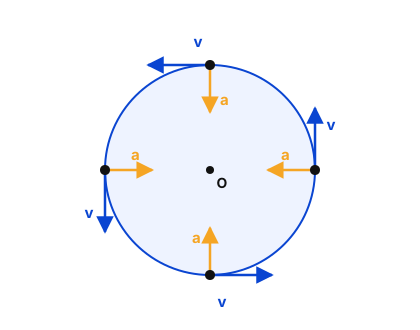
Which of the following is the best example of uniform circular motion?
निम्नलिखित में से कौन-सा एकसमान वृत्तीय गति का सबसे अच्छा उदाहरण है?
  1. AA roller coaster on a loopलूप पर चलता रोलर कोस्टर
  2. BA racing car on a curved track slowing downवक्र पथ पर धीमी होती रेसिंग कार
  3. CMoon revolving around the Earth in a circular orbitवृत्ताकार कक्षा में पृथ्वी की परिक्रमा करता चंद्रमा
  4. DA yo-yo being swung in a vertical circle at changing speedबदलती चाल से ऊर्ध्वाधर वृत्त में घुमाया जा रहा यो-यो
Show answer

Concept: Uniform circular motion = constant speed on a circular path.

  1. Moon moves in a nearly circular orbit at almost constant speed
  2. Roller coaster, slowing racing car and changing-speed yo-yo all change speed → not uniform

Trick: Eliminate every option with 'slowing' or 'changing speed'.

Answer: (C) Moon revolving around the Earth in a circular orbit

अवधारणा: एकसमान वृत्तीय गति = वृत्ताकार पथ पर नियत चाल।

  1. चंद्रमा लगभग वृत्ताकार कक्षा में लगभग नियत चाल से घूमता है
  2. रोलर कोस्टर, धीमी होती कार, बदलती चाल वाला यो-यो – चाल बदलती है

ट्रिक: 'धीमा होना' या 'बदलती चाल' वाले विकल्प हटाएँ।

उत्तर: (C) वृत्ताकार कक्षा में पृथ्वी की परिक्रमा करता चंद्रमा

RRB Technician Grade IIIGeneral ScienceUniform circular motionRRB Technician Grade III 2025 · 10 Mar Shift 1 →
Q2569.
An object has a mass of 12 kg and moves with a constant speed of 8 m/s. How much kinetic energy does it have?
एक वस्तु का द्रव्यमान 12 kg है और वह 8 m/s की स्थिर चाल से गति करती है। उसमें कितनी गतिज ऊर्जा है?
  1. A256 J
  2. B768 J
  3. C512 J
  4. D384 J
Show answer

Concept: KE = 12mv2.

  1. KE=12×12×82
  2. =6×64=384 J

Trick: 12×12=6, so KE=6×64 directly.

Answer: (D) 384 J

अवधारणा: गतिज ऊर्जा = 12mv2।

  1. KE=12×12×82
  2. =6×64=384 J

ट्रिक: 12×12=6 → 6×64=384।

उत्तर: (D) 384 J

RRB Technician Grade IIIGeneral ScienceKinetic energyRRB Technician Grade III 2025 · 10 Mar Shift 1 →
Q2570.
Which of the following correctly represents the unit mass of a molecule of water (H₂O)?
निम्नलिखित में से कौन-सा जल (H₂O) के एक अणु के इकाई द्रव्यमान को सही रूप से दर्शाता है?
  1. A18 u
  2. B10 u
  3. C16 u
  4. D20 u
Show answer

Concept: Molecular mass = sum of atomic masses (H = 1 u, O = 16 u).

  1. H2O=2×1+16
  2. =18 u

Yaad rakhein: 1 mole of water = 18 g.

Answer: (A) 18 u

अवधारणा: आणविक द्रव्यमान = परमाणु द्रव्यमानों का योग (H = 1 u, O = 16 u)।

  1. H2O=2×1+16
  2. =18 u

याद रखें: 1 मोल जल = 18 g।

उत्तर: (A) 18 u

RRB Technician Grade IIIGeneral ScienceMolecular massRRB Technician Grade III 2025 · 10 Mar Shift 1 →
Q2571.
Which of the following is correct for substitution reaction?
प्रतिस्थापन अभिक्रिया के लिए निम्नलिखित में से कौन-सा सही है?
  1. AA reaction where hydrogen is added to a compound.वह अभिक्रिया जिसमें किसी यौगिक में हाइड्रोजन जोड़ा जाता है।
  2. BA reaction where a compound breaks down into simpler substances.वह अभिक्रिया जिसमें एक यौगिक सरल पदार्थों में टूट जाता है।
  3. CA reaction where atoms or groups in a molecule are replaced by another atom or group.वह अभिक्रिया जिसमें किसी अणु के परमाणु या समूह किसी अन्य परमाणु या समूह द्वारा प्रतिस्थापित हो जाते हैं।
  4. DA reaction where two compounds combine to form one.वह अभिक्रिया जिसमें दो यौगिक मिलकर एक यौगिक बनाते हैं।
Show answer

Concept: In substitution, one atom/group in a molecule is replaced by another.

  1. Example: CH4+Cl2→CH3Cl+HCl (in sunlight) – H replaced by Cl
  2. Adding H₂ = addition (hydrogenation); breaking down = decomposition; two combine = combination

Yaad rakhein: Saturated hydrocarbons (alkanes) show substitution; unsaturated ones show addition.

Answer: (C) A reaction where atoms or groups in a molecule are replaced by another atom or group.

अवधारणा: प्रतिस्थापन में अणु का एक परमाणु/समूह दूसरे से बदल जाता है।

  1. उदाहरण: CH4+Cl2→CH3Cl+HCl (सूर्य प्रकाश में)
  2. H₂ जोड़ना = योगात्मक; टूटना = अपघटन; दो का मिलना = संयोजन

याद रखें: संतृप्त हाइड्रोकार्बन प्रतिस्थापन, असंतृप्त योगात्मक अभिक्रिया देते हैं।

उत्तर: (C) वह अभिक्रिया जिसमें किसी अणु के परमाणु या समूह किसी अन्य परमाणु या समूह द्वारा प्रतिस्थापित हो जाते हैं।

RRB Technician Grade IIIGeneral ScienceSubstitution reactionRRB Technician Grade III 2025 · 10 Mar Shift 1 →
Q2572.
If the speed of light in a medium is 2.25 × 10⁸ m/s, its refractive index is ________.
यदि किसी माध्यम में प्रकाश की चाल 2.25 × 10⁸ m/s है, तो उसका अपवर्तनांक ________ है।
  1. A0.75
  2. B1.33
  3. C1.75
  4. D1.50
Show answer

Concept: n = speed of light in vacuum ÷ speed in medium.

  1. n=3×1082.25×108
  2. =32.25=43≈1.33

Yaad rakhein: n=1.33 is the refractive index of water.

Answer: (B) 1.33

अवधारणा: n = निर्वात में प्रकाश की चाल ÷ माध्यम में चाल।

  1. n=3×1082.25×108
  2. =43≈1.33

याद रखें: n=1.33 जल का अपवर्तनांक है।

उत्तर: (B) 1.33

RRB Technician Grade IIIGeneral ScienceRefractive indexRRB Technician Grade III 2025 · 10 Mar Shift 1 →
Q2573.
The motion of an athlete running along a circular path with constant speed is an example of accelerated motion because ___________.
एक वृत्ताकार पथ पर स्थिर चाल से दौड़ते हुए धावक की गति त्वरित गति का एक उदाहरण है क्योंकि ___________।
  1. AThe mass of the athlete is constantधावक का द्रव्यमान स्थिर है
  2. BThe athlete's speed is increasingधावक की चाल बढ़ रही है
  3. CA constant external force is appliedएक स्थिर बाह्य बल लगाया जाता है
  4. DThe direction of motion changes continuouslyगति की दिशा निरंतर बदलती रहती है
Show answer

Concept: Velocity has direction; changing direction means changing velocity → acceleration.

  1. On a circle, the direction of motion changes at every point
  2. So velocity changes even when speed is constant
  3. Hence uniform circular motion is accelerated

Yaad rakhein: This acceleration points towards the centre (centripetal acceleration).

Answer: (D) The direction of motion changes continuously

अवधारणा: वेग में दिशा शामिल है; दिशा बदले तो वेग बदलता है → त्वरण।

  1. वृत्त पर हर बिंदु पर गति की दिशा बदलती है
  2. चाल नियत होने पर भी वेग बदलता है
  3. इसलिए एकसमान वृत्तीय गति त्वरित है

याद रखें: यह त्वरण केंद्र की ओर होता है (अभिकेंद्र त्वरण)।

उत्तर: (D) गति की दिशा निरंतर बदलती रहती है

RRB Technician Grade IIIGeneral ScienceCircular motion is acceleratedRRB Technician Grade III 2025 · 10 Mar Shift 1 →
Q2574.
How much energy will be available to the tertiary consumer if a food chain begins with 5000 J of energy at the producer level?
यदि किसी आहार श्रृंखला का आरंभ उत्पादक स्तर पर 5000 J ऊर्जा से होता है, तो तृतीयक उपभोक्ता को कितनी ऊर्जा उपलब्ध होगी?
  1. A0.5 J
  2. B500 J
  3. C5 J
  4. D50 J
Show answer

Concept: Only about 10% of energy passes to the next trophic level.

  1. Producer 5000 J → primary consumer 500 J
  2. → secondary consumer 50 J
  3. → tertiary consumer 5 J

Trick: Tertiary = 3 steps up → divide by 103: 50001000=5 J.

Answer: (C) 5 J

अवधारणा: अगले पोषी स्तर तक केवल लगभग 10% ऊर्जा पहुँचती है।

  1. उत्पादक 5000 J → प्राथमिक उपभोक्ता 500 J
  2. → द्वितीयक 50 J
  3. → तृतीयक 5 J

ट्रिक: तृतीयक = 3 स्तर ऊपर → 5000÷103=5 J।

उत्तर: (C) 5 J

RRB Technician Grade IIIGeneral Science10% law of energy transferRRB Technician Grade III 2025 · 10 Mar Shift 1 →
Q2575.
Which of the following pairs are isotopes?
निम्नलिखित में से कौन-से युग्म समस्थानिक हैं?
  1. A¹H and ²H¹H और ²H
  2. B¹⁶O and ¹⁶F¹⁶O और ¹⁶F
  3. C¹²C and ¹⁴N¹²C और ¹⁴N
  4. D⁴⁰Ca and ⁴⁰Ar⁴⁰Ca और ⁴⁰Ar
Show answer

Concept: Isotopes: same atomic number (same element), different mass numbers.

  1. 1H and 2H are both hydrogen (Z=1) with mass 1 and 2 → isotopes
  2. 40Ca and 40Ar: same mass, different elements → isobars
  3. 12C and 14N: different elements

Trick: Isotopes must be the same element symbol – only 1H/2H has that.

Answer: (A) ¹H and ²H

अवधारणा: समस्थानिक: समान परमाणु क्रमांक (एक ही तत्व), भिन्न द्रव्यमान संख्या।

  1. 1H और 2H दोनों हाइड्रोजन (Z=1), द्रव्यमान 1 और 2 → समस्थानिक
  2. 40Ca और 40Ar: समान द्रव्यमान, भिन्न तत्व → समभारिक
  3. 12C और 14N: भिन्न तत्व

ट्रिक: समस्थानिक में तत्व का प्रतीक एक ही होगा – केवल 1H/2H।

उत्तर: (A) ¹H और ²H

RRB Technician Grade IIIGeneral ScienceIsotopesRRB Technician Grade III 2025 · 10 Mar Shift 1 →
Q2576.
A constant force of 21 N moves a body through 3 m in its own direction. Work done is _____.
21 N का एक स्थिर बल किसी पिंड को उसकी अपनी दिशा में 3 m तक विस्थापित करता है। किया गया कार्य _____ है।
  1. A24 J
  2. B63 J
  3. C18 J
  4. D7 J
Show answer

Concept: W=F×s (force along displacement).

  1. W=21×3
  2. =63 J

Yaad rakhein: 1 joule = work done when 1 N moves a body 1 m in its direction.

Answer: (B) 63 J

अवधारणा: कार्य W=F×s (बल की दिशा में विस्थापन)।

  1. W=21×3
  2. =63 J

याद रखें: 1 जूल = 1 N बल से 1 m विस्थापन में किया गया कार्य।

उत्तर: (B) 63 J

RRB Technician Grade IIIGeneral ScienceWork done by a forceRRB Technician Grade III 2025 · 10 Mar Shift 1 →
Q2577.
How much work is required to move a charge of 3 C between two points that have a potential difference of 15 V?
15 V विभवांतर वाले दो बिंदुओं के बीच 3 C आवेश को ले जाने में कितना कार्य आवश्यक है?
  1. A21 J
  2. B45 J
  3. C14 J
  4. D5 J
Show answer

Concept: W=V×Q.

  1. W=15×3
  2. =45 J

Yaad rakhein: 1 volt = 1 joule per coulomb.

Answer: (B) 45 J

अवधारणा: W=V×Q।

  1. W=15×3
  2. =45 J

याद रखें: 1 वोल्ट = 1 जूल प्रति कूलॉम।

उत्तर: (B) 45 J

RRB Technician Grade IIIGeneral ScienceWork done in moving a chargeRRB Technician Grade III 2025 · 10 Mar Shift 1 →
Q2578.
Which of the following correctly represents a diatomic element?
निम्नलिखित में से कौन-सा एक द्विपरमाणुक तत्व को सही रूप से दर्शाता है?
  1. AH₂
  2. BHe
  3. CH
  4. DCO
Show answer

Concept: A diatomic element has two atoms of the same element in one molecule.

  1. H₂: two H atoms → diatomic element
  2. He: monoatomic; H: a single atom
  3. CO: diatomic but a compound, not an element

Yaad rakhein: Common diatomic elements: H₂, N₂, O₂, F₂, Cl₂, Br₂, I₂.

Answer: (A) H₂

अवधारणा: द्विपरमाणुक तत्व के एक अणु में उसी तत्व के दो परमाणु होते हैं।

  1. H₂: दो H परमाणु → द्विपरमाणुक तत्व
  2. He: एकपरमाणुक; H: एक परमाणु
  3. CO: द्विपरमाणुक पर यौगिक है, तत्व नहीं

याद रखें: द्विपरमाणुक तत्व: H₂, N₂, O₂, F₂, Cl₂, Br₂, I₂।

उत्तर: (A) H₂

RRB Technician Grade IIIGeneral ScienceAtomicity – diatomic elementsRRB Technician Grade III 2025 · 10 Mar Shift 1 →
Q2579.
Which condition is required for methane to undergo a substitution reaction with chlorine?
मेथेन की क्लोरीन के साथ प्रतिस्थापन अभिक्रिया होने के लिए कौन-सी परिस्थिति आवश्यक है?
  1. AAcidic mediumअम्लीय माध्यम
  2. BHeatऊष्मा
  3. CElectric currentविद्युत धारा
  4. DSunlightसूर्य का प्रकाश
Show answer

Concept: Methane reacts with chlorine only in the presence of sunlight.

  1. CH₄ + Cl₂ —sunlight→ CH₃Cl + HCl
  2. Sunlight breaks Cl₂ into reactive Cl atoms that replace H
  3. In the dark at room temperature there is no reaction

Yaad rakhein: Repeating it gives CH₂Cl₂, CHCl₃ (chloroform) and CCl₄.

Answer: (D) Sunlight

अवधारणा: मेथेन क्लोरीन से केवल सूर्य के प्रकाश में अभिक्रिया करता है।

  1. CH₄ + Cl₂ —सूर्य प्रकाश→ CH₃Cl + HCl
  2. प्रकाश Cl₂ को सक्रिय Cl परमाणुओं में तोड़ता है
  3. अंधेरे में अभिक्रिया नहीं होती

याद रखें: आगे CH₂Cl₂, CHCl₃ (क्लोरोफॉर्म), CCl₄ बनते हैं।

उत्तर: (D) सूर्य का प्रकाश

RRB Technician Grade IIIGeneral ScienceChlorination of methaneRRB Technician Grade III 2025 · 10 Mar Shift 1 →
Q2580.
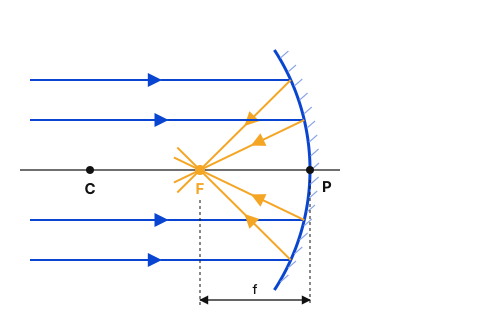
The principal focus of a concave mirror is:
अवतल दर्पण का मुख्य फोकस है:
  1. AThe point where rays parallel to the principal axis converge after reflectionवह बिंदु जहाँ मुख्य अक्ष के समांतर किरणें परावर्तन के बाद अभिसरित होती हैं
  2. BThe pole of the mirrorदर्पण का ध्रुव
  3. CThe center of curvature of the mirrorदर्पण का वक्रता केंद्र
  4. DA point on the mirror where all rays meetदर्पण पर वह बिंदु जहाँ सभी किरणें मिलती हैं
Show answer

Concept: Rays parallel to the principal axis meet at the principal focus after reflection.

  1. Concave mirror converges parallel rays to a real point F
  2. F lies midway between pole P and centre of curvature C: f=R2
  3. Pole and C are different points

Yaad rakhein: For a convex mirror, the rays only appear to diverge from F (virtual focus).

Answer: (A) The point where rays parallel to the principal axis converge after reflection

अवधारणा: मुख्य अक्ष के समांतर किरणें परावर्तन के बाद मुख्य फोकस पर मिलती हैं।

  1. अवतल दर्पण समांतर किरणों को वास्तविक बिंदु F पर मिलाता है
  2. F, ध्रुव P और वक्रता केंद्र C के बीच: f=R2
  3. ध्रुव और C अलग बिंदु हैं

याद रखें: उत्तल दर्पण में किरणें F से फैलती प्रतीत होती हैं (आभासी फोकस)।

उत्तर: (A) वह बिंदु जहाँ मुख्य अक्ष के समांतर किरणें परावर्तन के बाद अभिसरित होती हैं

RRB Technician Grade IIIGeneral SciencePrincipal focus of a concave mirrorRRB Technician Grade III 2025 · 10 Mar Shift 1 →