Question bank

Q&A: practice questions with answers

Search questions on any topic. Filter by exam category, exam, subject and topic, try the question, then open the answer and explanation.

Courses – airGurukul

3,200 questions found.

Q2721.
Simplify: [(120−24÷(4+2))×2−(50÷5+6)]+[(18+12×2−8)−(9÷3+5)]
सरल कीजिए: [(120−24÷(4+2))×2−(50÷5+6)]+[(18+12×2−8)−(9÷3+5)]
  1. A252
  2. B242
  3. C262
  4. D232
Show answer

Concept: Innermost brackets first, then ÷/× before +/−.

Solution:

  1. 24÷6=4→(120−4)×2=232; 50÷5+6=16→232−16=216.
  2. 18+24−8=34; 9÷3+5=8→34−8=26.
  3. Total = 216+26=242.

Yaad rakhein: Inside each bracket solve ÷ first — in 24÷(4+2), compute (4+2) first.

Answer: (B) 242

अवधारणा: पहले भीतरी कोष्ठक, फिर ÷/×, फिर +/−।

हल:

  1. 24÷6=4→(120−4)×2=232; 50÷5+6=16→232−16=216
  2. 18+24−8=34; 9÷3+5=8→34−8=26
  3. कुल = 216+26=242

याद रखें: पहले हर कोष्ठक का भीतरी ÷ हल करें — 24÷(4+2) में पहले (4+2)।

उत्तर: (B) 242

RRB Technician Grade IIIMathematicsSimplification – BODMASRRB Technician Grade III 2025 · 9 Mar Shift 2 →
Q2722.
Find the fourth proportional to 3.5, 7.5, and 6.3.
3.5, 7.5 और 6.3 का चतुर्थानुपाती ज्ञात कीजिए।
  1. A13.5
  2. B11.5
  3. C14.5
  4. D12.5
Show answer

Concept: Fourth proportional of a, b, c = bca.

Solution:

  1. x=7.5×6.33.5.
  2. 6.33.5=1.8.
  3. x=7.5×1.8=13.5.

Trick: Spot 6.33.5=95 first, then 7.5×95=13.5.

Answer: (A) 13.5

अवधारणा: a, b, c का चतुर्थानुपाती = bca

हल:

  1. x=7.5×6.33.5
  2. 6.33.5=1.8
  3. x=7.5×1.8=13.5

ट्रिक: पहले 6.33.5=95 देखें, फिर 7.5×95=13.5।

उत्तर: (A) 13.5

RRB Technician Grade IIIMathematicsFourth proportionalRRB Technician Grade III 2025 · 9 Mar Shift 2 →
Q2723.
If the lateral surface area of a cylinder is 775.8 cm2 and its height is 24 cm, then find its volume. (Use π = 3.14 and round off to two decimal places.)
यदि एक बेलन का पार्श्व पृष्ठीय क्षेत्रफल 775.8 cm2 है और इसकी ऊँचाई 24 cm है, तो इसका आयतन ज्ञात कीजिए। (π = 3.14 का प्रयोग कीजिए और दो दशमलव स्थानों तक पूर्णांकित कीजिए।)
  1. A1962.74 cm3
  2. B1984.78 cm3
  3. C2016.67 cm3
  4. D1996.63 cm3
Show answer

Concept: CSA=2πrh,V=πr2h, so V=CSA×r2.

Solution:

  1. r=775.82×3.14×24=775.8150.72≈5.1473 cm.
  2. V=775.8×5.14732.
  3. V≈1996.63cm3.

Trick: V=CSA×r2 skips recomputing π and h.

Answer: (D) 1996.63 cm3

अवधारणा: CSA=2πrh,V=πr2h, अतः V=CSA×r2

हल:

  1. r=775.82×3.14×24=775.8150.72≈5.1473 cm
  2. V=775.8×5.14732
  3. V≈1996.63cm3

ट्रिक: V=CSA×r2 — π और h दोबारा नहीं लगाने पड़ते।

उत्तर: (D) 1996.63 cm3

RRB Technician Grade IIIMathematicsCylinder – volume from curved surface areaRRB Technician Grade III 2025 · 9 Mar Shift 2 →
Q2724.
Naveena's monthly income is ₹84,000. She spends 25% of his income on house rent, 20% on groceries, 15% on other household expenses, and saves the remaining amount. How much money (in ₹) does she save every month?
नवीना की मासिक आय ₹84,000 है। वह अपनी आय का 25% मकान किराए पर, 20% किराने के सामान पर, 15% अन्य घरेलू खर्चों पर व्यय करती है और शेष राशि की बचत करती है। वह प्रति माह कितनी धनराशि (₹ में) बचाती है?
  1. A32,000
  2. B32,600
  3. C33,600
  4. D33,000
Show answer

Concept: Savings % = 100 − total spending %.

Solution:

  1. Spending = 25+20+15=60%.
  2. Savings = 40% of 84,000 = ₹33,600.

Trick: 10% of 84,000 = 8,400 → 40%=4×8,400=33,600.

Answer: (C) 33,600

अवधारणा: बचत % = 100 − कुल खर्च %

हल:

  1. खर्च = 25+20+15=60%
  2. बचत = 84,000 का 40% = ₹33,600

ट्रिक: 84,000 का 10% = 8,400 → 40% = 33,600।

उत्तर: (C) 33,600

RRB Technician Grade IIIMathematicsPercentage – savingsRRB Technician Grade III 2025 · 9 Mar Shift 2 →
Q2725.
A 200 m long train passes a man standing on a platform in 10 seconds. How long will it take to cross another 350 m long train running at 60 km/h in the opposite direction?
200 m लंबी एक ट्रेन प्लेटफॉर्म पर खड़े एक व्यक्ति को 10 सेकंड में पार करती है। विपरीत दिशा में 60 km/h की चाल से चल रही 350 m लंबी दूसरी ट्रेन को पार करने में इसे कितना समय लगेगा?
  1. A15 seconds15 सेकंड
  2. B12 seconds12 सेकंड
  3. C14 seconds14 सेकंड
  4. D16 seconds16 सेकंड
Show answer

Concept: Opposite direction: relative speed = sum; distance = sum of lengths.

Solution:

  1. Train speed = 20010=20 m/s.
  2. Other train = 60×518=503 m/s; relative = 20+503=1103 m/s.
  3. Distance = 200+350=550 m.
  4. Time = 550×3110=15 s.

Trick: 20 m/s = 72 km/h; 72+60=132 km/h =1103 m/s → 550÷1103=15 s.

Answer: (A) 15 seconds

अवधारणा: विपरीत दिशा: सापेक्ष चाल = योग; दूरी = दोनों लंबाइयों का योग।

हल:

  1. ट्रेन की चाल = 20010=20 m/s
  2. दूसरी ट्रेन = 60×518=503 m/s; सापेक्ष =1103 m/s
  3. दूरी = 200+350=550 m
  4. समय = 550×3110=15 सेकंड

ट्रिक: 20 m/s = 72 km/h; 72+60=132 km/h =1103 m/s → 15 सेकंड।

उत्तर: (A) 15 सेकंड

RRB Technician Grade IIIMathematicsTrains – crossing in opposite directionRRB Technician Grade III 2025 · 9 Mar Shift 2 →
Q2726.
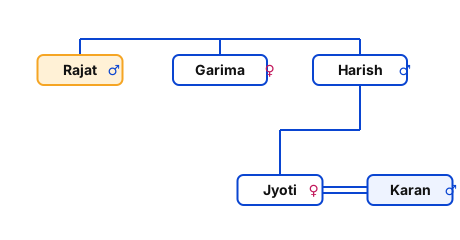
Rajat is the brother of Garima. Garima is the sister of Harish. Harish is the father of Jyoti. Jyoti is the wife of Karan. How is Rajat related to Karan?
रजत, गरिमा का भाई है। गरिमा, हरीश की बहन है। हरीश, ज्योति का पिता है। ज्योति, करण की पत्नी है। रजत का करण से क्या संबंध है?
  1. AWife's father's fatherपत्नी के पिता के पिता
  2. BWife's father's brotherपत्नी के पिता के भाई
  3. CWife's mother's fatherपत्नी की माता के पिता
  4. DWife`s mother`s brotherपत्नी की माता के भाई
Show answer

Concept: Build the family tree step by step.

Solution:

  1. Rajat, Garima and Harish are siblings → Rajat is Harish's brother.
  2. Harish is Jyoti's father; Jyoti is Karan's wife.
  3. So Rajat = Karan's wife's father's brother.

Trick: Start from Karan: wife (Jyoti) → her father (Harish) → his brother (Rajat).

Answer: (B) Wife's father's brother

अवधारणा: चरणबद्ध परिवार वृक्ष बनाएँ।

हल:

  1. रजत, गरिमा और हरीश भाई-बहन → रजत हरीश का भाई
  2. हरीश, ज्योति का पिता; ज्योति, करन की पत्नी
  3. अतः रजत = करन की पत्नी के पिता का भाई

ट्रिक: करन से शुरू करें: पत्नी (ज्योति) → उसके पिता (हरीश) → उनके भाई (रजत)।

उत्तर: (B) पत्नी के पिता के भाई

RRB Technician Grade IIIGeneral Intelligence and ReasoningBlood relationRRB Technician Grade III 2025 · 9 Mar Shift 2 →
Q2727.
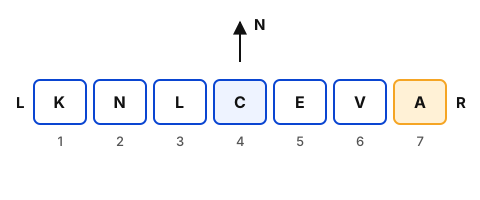
Seven people, A, V, C, L, E, K and N, are sitting in a row, facing north. Only four people sit to the left of E. Only four people sit to the right of L. Only one person sits between K and L. V sits to the immediate left of A. C does not sit to the left of N. Who sits third to the right of C?
सात व्यक्ति A, V, C, L, E, K और N एक पंक्ति में उत्तर की ओर मुख करके बैठे हैं। E के बाईं ओर केवल चार व्यक्ति बैठे हैं। L के दाईं ओर केवल चार व्यक्ति बैठे हैं। K और L के बीच केवल एक व्यक्ति बैठा है। V, A के ठीक बाईं ओर बैठा है। C, N के बाईं ओर नहीं बैठा है। C के दाईं ओर तीसरे स्थान पर कौन बैठा है?
  1. AA
  2. BL
  3. CE
  4. DK
Show answer

Concept: Fix definite positions first (left-right counts).

Solution:

  1. Positions 1–7 from left: E = 5 (4 on left), L = 3 (4 on right).
  2. One between K and L → K = 1 (5 is taken).
  3. V immediately left of A → only free pair 6–7: V = 6, A = 7.
  4. C not left of N → N = 2, C = 4; third right of C = 7 = A.

Trick: Seat counts like 'four to the left' give exact positions — place them first.

Answer: (A) A

अवधारणा: पहले निश्चित स्थान तय करें।

हल:

  1. बाएँ से 1–7: E = 5, L = 3
  2. K और L के बीच एक → K = 1
  3. V, A के ठीक बाएँ → खाली जोड़ी 6–7: V = 6, A = 7
  4. C, N के बाएँ नहीं → N = 2, C = 4; C के तीसरे दाएँ = 7 = A

ट्रिक: 'बाएँ चार लोग' जैसे संकेत से सीधा स्थान मिलता है — पहले उन्हें रखें।

उत्तर: (A) A

RRB Technician Grade IIIGeneral Intelligence and ReasoningLinear seating arrangementRRB Technician Grade III 2025 · 9 Mar Shift 2 →
Q2728.
If ‘A’ stands for ‘÷’, ‘B’ stands for ‘×’, ‘C’ stands for ‘+’ and ‘D’ stands for ‘−’, what will come in place of the question mark (?) in the following equation?
3 B 2 D 12 A 4 C 3 = ?
यदि ‘A’ का अर्थ ‘÷’, ‘B’ का अर्थ ‘×’, ‘C’ का अर्थ ‘+’ और ‘D’ का अर्थ ‘−’ है, तो निम्नलिखित समीकरण में प्रश्न चिह्न (?) के स्थान पर क्या आएगा?
3 B 2 D 12 A 4 C 3 = ?
  1. A6
  2. B8
  3. C12
  4. D4
Show answer

Concept: Replace letters with signs, then apply BODMAS.

Solution:

  1. 3×2−12÷4+3.
  2. =6−3+3=6.

Yaad rakhein: After substitution always do ÷ and × before + and −.

Answer: (A) 6

अवधारणा: अक्षरों को चिह्नों से बदलें, फिर BODMAS।

हल:

  1. 3×2−12÷4+3
  2. =6−3+3=6

याद रखें: प्रतिस्थापन के बाद पहले ÷ और ×, फिर + और −।

उत्तर: (A) 6

RRB Technician Grade IIIGeneral Intelligence and ReasoningMathematical operations – symbol substitutionRRB Technician Grade III 2025 · 9 Mar Shift 2 →
Q2729.
Each letter in the word LANDMARK is arranged in alphabetical order. How many letters are there in the English alphabetical order between the letter which is fourth from the left and the one which is second from the right in the new letter cluster thus formed?
शब्द LANDMARK के प्रत्येक अक्षर को वर्णमाला क्रम में व्यवस्थित किया जाता है। इस प्रकार बने नए अक्षर-समूह में बाएँ से चौथे अक्षर और दाएँ से दूसरे अक्षर के बीच अंग्रेज़ी वर्णमाला क्रम में कितने अक्षर हैं?
  1. A2
  2. B3
  3. C4
  4. D5
Show answer

Concept: Rearrange letters alphabetically, then count positions.

Solution:

  1. LANDMARK → A A D K L M N R.
  2. 4th from left = K; 2nd from right = N.
  3. Letters between K and N in the alphabet: L, M = 2.

Yaad rakhein: K = 11, N = 14 → letters between = 14 − 11 − 1 = 2.

Answer: (A) 2

अवधारणा: अक्षरों को वर्णानुक्रम में लगाएँ, फिर स्थान गिनें।

हल:

  1. LANDMARK → A A D K L M N R
  2. बाएँ से 4था = K; दाएँ से 2रा = N
  3. K और N के बीच: L, M = 2

याद रखें: K = 11, N = 14 → बीच के अक्षर = 14 − 11 − 1 = 2।

उत्तर: (A) 2

RRB Technician Grade IIIGeneral Intelligence and ReasoningLetter arrangement – alphabetical orderRRB Technician Grade III 2025 · 9 Mar Shift 2 →
Q2730.
What should come in place of ? in the given series based on the English alphabetical order?
DGYL XKTQ ROOV LSJA ?
अंग्रेज़ी वर्णमाला क्रम के आधार पर दी गई शृंखला में ? के स्थान पर क्या आना चाहिए?
DGYL XKTQ ROOV LSJA ?
  1. AEVDE
  2. BEWEE
  3. CFVDF
  4. DFWEF
Show answer

Concept: Track each letter position separately.

Solution:

  1. 1st: D, X, R, L → −6 each → F.
  2. 2nd: G, K, O, S → +4 → W.
  3. 3rd: Y, T, O, J → −5 → E.
  4. 4th: L, Q, V, A → +5 → F. Answer FWEF.

Trick: First letter alone (F) leaves FVDF/FWEF; 2nd letter +4 → W picks FWEF.

Answer: (D) FWEF

अवधारणा: हर स्थान के अक्षर अलग-अलग देखें।

हल:

  1. पहला: D, X, R, L → −6 → F
  2. दूसरा: G, K, O, S → +4 → W
  3. तीसरा: Y, T, O, J → −5 → E
  4. चौथा: L, Q, V, A → +5 → F; उत्तर FWEF

ट्रिक: पहले अक्षर F से दो विकल्प बचते हैं; दूसरा +4 → W से FWEF।

उत्तर: (D) FWEF

RRB Technician Grade IIIGeneral Intelligence and ReasoningLetter seriesRRB Technician Grade III 2025 · 9 Mar Shift 2 →
Q2731.
What will come in the place of ‘?’ in the following equation, if ‘+’ and ‘-’ are interchanged and ‘x’ and ‘÷’ are interchanged?
3 ÷ 5 + 16 x 8 - 8 = ?
यदि ‘+’ और ‘-’ को आपस में बदल दिया जाए तथा ‘x’ और ‘÷’ को आपस में बदल दिया जाए, तो निम्नलिखित समीकरण में ‘?’ के स्थान पर क्या आएगा?
3 ÷ 5 + 16 x 8 - 8 = ?
  1. A21
  2. B18
  3. C17
  4. D20
Show answer

Concept: Swap the signs first, then apply BODMAS.

Solution:

  1. 3÷5+16×8−8 becomes 3×5−16÷8+8.
  2. =15−2+8=21.

Yaad rakhein: Do not solve before swapping — rewrite the full expression first.

Answer: (A) 21

अवधारणा: पहले चिह्न बदलें, फिर BODMAS।

हल:

  1. 3÷5+16×8−8 → 3×5−16÷8+8
  2. =15−2+8=21

याद रखें: बदलने से पहले हल न करें — पूरा व्यंजक दोबारा लिखें।

उत्तर: (A) 21

RRB Technician Grade IIIGeneral Intelligence and ReasoningMathematical operations – interchange of signsRRB Technician Grade III 2025 · 9 Mar Shift 2 →
Q2732.
Select the set in which the numbers are related in the same way as are the numbers of the following sets.
(Note: Operations should be performed on the whole numbers, without breaking down the numbers into their constituent digits. E.g. 13 – Operations on 13 such as
adding/subtracting/multiplying to 13 can be performed. Breaking down 13 into 1 and 3 and then performing mathematical operations on 1 and 3 is not allowed.)
(5, 18, 24)
(9, 22, 28)
उस समुच्चय का चयन कीजिए जिसमें संख्याएँ उसी प्रकार संबंधित हैं जिस प्रकार निम्नलिखित समुच्चयों की संख्याएँ संबंधित हैं।
(ध्यान दें: संक्रियाएँ संख्याओं को उनके घटक अंकों में तोड़े बिना, पूर्ण संख्याओं पर की जानी चाहिए। उदाहरण के लिए, 13 – 13 पर संक्रियाएँ जैसे
13 में जोड़ना/घटाना/गुणा करना आदि किया जा सकता है। 13 को 1 और 3 में तोड़कर फिर 1 और 3 पर गणितीय संक्रियाएँ करने की अनुमति नहीं है।)
(5, 18, 24)
(9, 22, 28)
  1. A(6, 19, 13)
  2. B(4, 17, 11)
  3. C(11, 36, 42)
  4. D(8, 21, 27)
Show answer

Concept: Find the rule linking the numbers in given sets.

Solution:

  1. (5, 18, 24): 5 + 13 = 18, 18 + 6 = 24.
  2. (9, 22, 28): 9 + 13 = 22, 22 + 6 = 28.
  3. (8, 21, 27): 8 + 13 = 21, 21 + 6 = 27 ✓.

Trick: Check differences: given sets have +13, +6; only (8, 21, 27) shows +13, +6.

Answer: (D) (8, 21, 27)

अवधारणा: दिए समूहों का नियम खोजें।

हल:

  1. (5, 18, 24): +13, +6
  2. (9, 22, 28): +13, +6
  3. (8, 21, 27): +13, +6 ✓

ट्रिक: अंतर देखें: +13, +6 सिर्फ (8, 21, 27) में।

उत्तर: (D) (8, 21, 27)

RRB Technician Grade IIIGeneral Intelligence and ReasoningNumber set analogyRRB Technician Grade III 2025 · 9 Mar Shift 2 →
Q2733.
In a certain code language,
P + Q means ‘P is the mother of Q’
P – Q means ‘P is the sister of Q’
P x Q means ‘P is the father of Q’
P ÷ Q means ‘P is the daughter of Q’
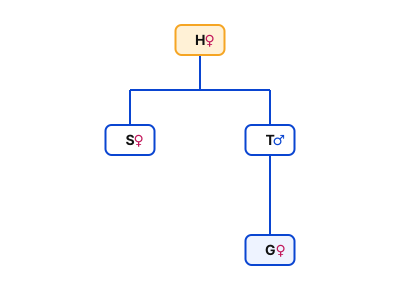
Based on the above, how is H related to G if ‘H + S – T x G ÷ P’?
एक निश्चित कूट भाषा में,
P + Q का अर्थ है ‘P, Q की माता है’
P – Q का अर्थ है ‘P, Q की बहन है’
P x Q का अर्थ है ‘P, Q का पिता है’
P ÷ Q का अर्थ है ‘P, Q की पुत्री है’
उपर्युक्त के आधार पर, यदि ‘H + S – T x G ÷ P’ है, तो H का G से क्या संबंध है?
  1. AFather’s sisterपिता की बहन
  2. BFather’s motherपिता की माता
  3. CMother’s motherमाता की माता
  4. DSisterबहन
Show answer

Concept: Decode each symbol and chain the relations.

Solution:

  1. H + S: H is mother of S.
  2. S − T: S is sister of T → H is also T's mother.
  3. T × G: T is father of G.
  4. So H is G's father's mother. (G ÷ P only tells G is P's daughter.)

Trick: Read from G backwards: G's father = T, T's mother = H.

Answer: (B) Father’s mother

अवधारणा: हर चिह्न को खोलें और संबंध जोड़ें।

हल:

  1. H + S: H, S की माँ
  2. S − T: S, T की बहन → H, T की भी माँ
  3. T × G: T, G का पिता
  4. अतः H = G के पिता की माँ

ट्रिक: G से पीछे चलें: G का पिता T, T की माँ H।

उत्तर: (B) पिता की माता

RRB Technician Grade IIIGeneral Intelligence and ReasoningCoded blood relationRRB Technician Grade III 2025 · 9 Mar Shift 2 →
Q2734.
Rajdeep ranked 64th from the top and 23rd from the bottom in his class. How many students are there in his class?
रजदीप अपनी कक्षा में ऊपर से 64वें और नीचे से 23वें स्थान पर है। उसकी कक्षा में कितने विद्यार्थी हैं?
  1. A87
  2. B84
  3. C86
  4. D85
Show answer

Concept: Total = rank from top + rank from bottom − 1.

Solution:

  1. Total = 64 + 23 − 1 = 86.

Yaad rakhein: Subtract 1 because the person is counted in both ranks.

Answer: (C) 86

अवधारणा: कुल = ऊपर से रैंक + नीचे से रैंक − 1

हल:

  1. कुल = 64 + 23 − 1 = 86

याद रखें: 1 घटाते हैं क्योंकि वह व्यक्ति दोनों ओर गिना गया है।

उत्तर: (C) 86

RRB Technician Grade IIIGeneral Intelligence and ReasoningRankingRRB Technician Grade III 2025 · 9 Mar Shift 2 →
Q2735.
Based on the English alphabetical order, three of the following four letter-cluster pairs are alike in a certain way and thus form a group. Which is the one that does not belong to that group?(Note: The odd one out is not based on the number of
consonants/vowels or their position in the letter-cluster.)
अंग्रेज़ी वर्णमाला क्रम के आधार पर, निम्नलिखित चार अक्षर-समूह युग्मों में से तीन किसी निश्चित प्रकार से एकसमान हैं और इस प्रकार एक समूह बनाते हैं। वह कौन-सा युग्म है जो उस समूह से संबंधित नहीं है?(ध्यान दें: असंगत युग्म, व्यंजनों/स्वरों की संख्या या अक्षर-समूह में उनके स्थान पर आधारित नहीं है।)
  1. AME – HA
  2. BWO – QI
  3. CTL – NF
  4. DYQ – SK
Show answer

Concept: Compare positional shifts of letters.

Solution:

  1. WO–QI: −6, −6; TL–NF: −6, −6; YQ–SK: −6, −6.
  2. ME–HA: M→H = −5, E→A = −4.
  3. ME–HA breaks the −6 pattern.

Yaad rakhein: Learn EJOTY (5, 10, 15, 20, 25) to get letter positions fast.

Answer: (A) ME – HA

अवधारणा: अक्षरों का स्थानांतर तुलना करें।

हल:

  1. WO–QI, TL–NF, YQ–SK: −6, −6
  2. ME–HA: −5, −4
  3. ME–HA नियम तोड़ता है

याद रखें: EJOTY (5, 10, 15, 20, 25) याद रखें — स्थान जल्दी मिलते हैं।

उत्तर: (A) ME – HA

RRB Technician Grade IIIGeneral Intelligence and ReasoningOdd one out – letter pairsRRB Technician Grade III 2025 · 9 Mar Shift 2 →
Q2736.
In a certain code language, ‘KEPT’ is coded as ‘7523’ and ‘OKAY’ is coded as ‘4136’. What is the code for ‘K’ in that language?
एक निश्चित कूट भाषा में, ‘KEPT’ को ‘7523’ और ‘OKAY’ को ‘4136’ के रूप में कूटबद्ध किया जाता है। उस भाषा में ‘K’ का कूट क्या है?
  1. A1
  2. B5
  3. C3
  4. D7
Show answer

Concept: Common letter ↔ common digit.

Solution:

  1. KEPT = 7523, OKAY = 4136.
  2. Common letter: K; common digit: 3.
  3. So K = 3.

Trick: Ignore order; just match the shared letter with the shared digit.

Answer: (C) 3

अवधारणा: उभयनिष्ठ अक्षर ↔ उभयनिष्ठ अंक

हल:

  1. KEPT = 7523, OKAY = 4136
  2. साझा अक्षर K; साझा अंक 3
  3. अतः K = 3

ट्रिक: क्रम पर ध्यान न दें; साझा अक्षर = साझा अंक।

उत्तर: (C) 3

RRB Technician Grade IIIGeneral Intelligence and ReasoningCoding – common letter methodRRB Technician Grade III 2025 · 9 Mar Shift 2 →
Q2737.
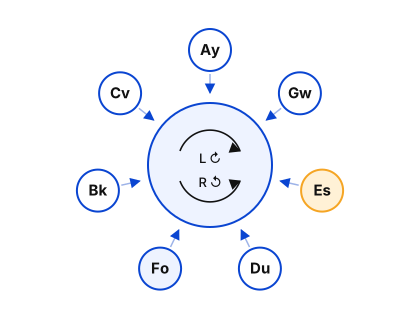
Ay, Bk, Cv, Du, Es, Fo and Gw are sitting around a circular table facing the centre. Cv sits to the immediate right of Ay. Du sits third to the left of Ay. Bk is the immediate neighbour of Fo and Cv. Gw is not an immediate neighbour of Du. What is the position of Es with respect to Fo?
Ay, Bk, Cv, Du, Es, Fo और Gw एक वृत्ताकार मेज़ के चारों ओर केंद्र की ओर मुख करके बैठे हैं। Cv, Ay के ठीक दाईं ओर बैठा है। Du, Ay के बाईं ओर तीसरे स्थान पर बैठा है। Bk, Fo और Cv दोनों का निकटतम पड़ोसी है। Gw, Du का निकटतम पड़ोसी नहीं है। Fo के सापेक्ष Es का स्थान क्या है?
  1. AThird to the leftबाईं ओर तीसरा
  2. BImmediate leftठीक बाईं ओर
  3. CImmediate rightठीक दाईं ओर
  4. DSecond to the rightदाईं ओर दूसरा
Show answer

Concept: Facing centre: left = clockwise, right = anticlockwise.

Solution:

  1. Number seats clockwise; Ay = 0, Cv (immediate right) = 6, Du (third left) = 3.
  2. Bk next to Cv and Fo → Bk = 5, Fo = 4.
  3. Gw not next to Du → Gw = 1, Es = 2.
  4. Es is two seats anticlockwise from Fo → second to the right.

Trick: Fix the person named most often (Ay) first, then place others around.

Answer: (D) Second to the right

अवधारणा: केंद्र की ओर मुख: बायाँ = दक्षिणावर्त, दायाँ = वामावर्त।

हल:

  1. दक्षिणावर्त क्रमांक: Ay = 0, Cv = 6, Du = 3
  2. Bk, Cv और Fo के बीच → Bk = 5, Fo = 4
  3. Gw, Du के पास नहीं → Gw = 1, Es = 2
  4. Es, Fo से दो स्थान वामावर्त → दाएँ से दूसरा

ट्रिक: सबसे अधिक बार आए व्यक्ति (Ay) को पहले रखें।

उत्तर: (D) दाईं ओर दूसरा

RRB Technician Grade IIIGeneral Intelligence and ReasoningCircular seating arrangementRRB Technician Grade III 2025 · 9 Mar Shift 2 →
Q2738.
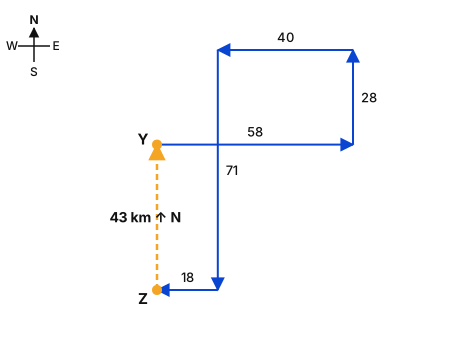
Natesh starts from point Y and drives 58 km towards East. He then takes a left turn, drives 28 km, turns left and drives 40 km. He then takes a left turn and drives 71 km. He takes a right turn, drives 18 km to stop at point Z. How far (shortest distance) and towards which direction should he drive in order to reach point Y again? (All turns are 90-degree turns only unless specified.)
नतेश बिंदु Y से चलना शुरू करता है और पूर्व की ओर 58 km गाड़ी चलाता है। फिर वह बाएँ मुड़ता है, 28 km गाड़ी चलाता है, बाएँ मुड़ता है और 40 km गाड़ी चलाता है। फिर वह बाएँ मुड़ता है और 71 km गाड़ी चलाता है। वह दाएँ मुड़ता है, 18 km गाड़ी चलाकर बिंदु Z पर रुक जाता है। बिंदु Y पर पुनः पहुँचने के लिए उसे कितनी दूरी (न्यूनतम दूरी) और किस दिशा में गाड़ी चलानी चाहिए? (जब तक निर्दिष्ट न हो, सभी मोड़ केवल 90 डिग्री के हैं।)
  1. A43 km towards northउत्तर की ओर 43 km
  2. B45 km towards westपश्चिम की ओर 45 km
  3. C39 km towards southदक्षिण की ओर 39 km
  4. D41 km towards northउत्तर की ओर 41 km
Show answer

Concept: Use coordinates: East +x, North +y.

Solution:

  1. E 58 → (58, 0); left N 28 → (58, 28); left W 40 → (18, 28).
  2. Left S 71 → (18, −43); right (W) 18 → (0, −43) = Z.
  3. Y is at (0, 0) → 43 km towards north.

Trick: Net x: 58 − 40 − 18 = 0; net y: 28 − 71 = −43 → go 43 km north.

Answer: (A) 43 km towards north

अवधारणा: निर्देशांक लें: पूर्व +x, उत्तर +y।

हल:

  1. पूर्व 58 → (58, 0); बाएँ उत्तर 28 → (58, 28); बाएँ पश्चिम 40 → (18, 28)
  2. बाएँ दक्षिण 71 → (18, −43); दाएँ (पश्चिम) 18 → (0, −43) = Z
  3. Y (0, 0) → 43 km उत्तर

ट्रिक: x: 58 − 40 − 18 = 0; y: 28 − 71 = −43 → 43 km उत्तर।

उत्तर: (A) उत्तर की ओर 43 km

RRB Technician Grade IIIGeneral Intelligence and ReasoningDirection senseRRB Technician Grade III 2025 · 9 Mar Shift 2 →
Q2739.
Select the pair which follows the same pattern as that followed by the two pairs given below. Both pairs follow the same pattern.
CVT : DXW
OBL : PDO
उस युग्म का चयन कीजिए जो उसी पैटर्न का अनुसरण करता है जिसका अनुसरण नीचे दिए गए दो युग्म करते हैं। दोनों युग्म एक ही पैटर्न का अनुसरण करते हैं।
CVT : DXW
OBL : PDO
  1. ASKP : TLQ
  2. BDXG : EZK
  3. CNAU : OCX
  4. DHZE : IAG
Show answer

Concept: Find letter-wise shift.

Solution:

  1. CVT → DXW: +1, +2, +3.
  2. OBL → PDO: +1, +2, +3.
  3. NAU → OCX: +1, +2, +3 ✓.

Trick: Check the third letter first (+3): only U→X fits.

Answer: (C) NAU : OCX

अवधारणा: हर अक्षर का खिसकाव देखें।

हल:

  1. CVT → DXW: +1, +2, +3
  2. OBL → PDO: +1, +2, +3
  3. NAU → OCX: +1, +2, +3 ✓

ट्रिक: पहले तीसरा अक्षर (+3) जाँचें: केवल U→X सही।

उत्तर: (C) NAU : OCX

RRB Technician Grade IIIGeneral Intelligence and ReasoningLetter analogyRRB Technician Grade III 2025 · 9 Mar Shift 2 →
Q2740.
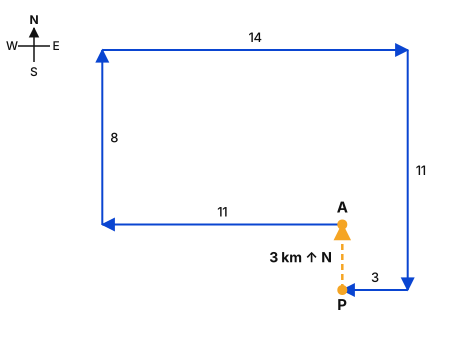
Dhiraj starts from Point A and drives 11 km towards west. He then takes a right turn, drives 8 km, turns right and drives 14 km. He then takes a right turn and drives 11 km. He takes a final right turn, drives 3 km and stops at Point P. How far (shortest distance) and towards which direction should he drive in order to reach Point A again?
(All turns are 90° turns only unless specified.)
धीरज बिंदु A से चलना शुरू करता है और पश्चिम की ओर 11 km गाड़ी चलाता है। फिर वह दाएँ मुड़ता है, 8 km गाड़ी चलाता है, दाएँ मुड़ता है और 14 km गाड़ी चलाता है। फिर वह दाएँ मुड़ता है और 11 km गाड़ी चलाता है। वह अंतिम बार दाएँ मुड़ता है, 3 km गाड़ी चलाता है और बिंदु P पर रुक जाता है। बिंदु A पर पुनः पहुँचने के लिए उसे कितनी दूरी (न्यूनतम दूरी) और किस दिशा में गाड़ी चलानी चाहिए?
(जब तक निर्दिष्ट न हो, सभी मोड़ केवल 90° के हैं।)
  1. A5 km to the westपश्चिम की ओर 5 km
  2. B3 km to the northउत्तर की ओर 3 km
  3. C3 km to the southदक्षिण की ओर 3 km
  4. D3 km to the eastपूर्व की ओर 3 km
Show answer

Concept: Use coordinates: East +x, North +y.

Solution:

  1. W 11 → (−11, 0); right N 8 → (−11, 8); right E 14 → (3, 8).
  2. Right S 11 → (3, −3); right W 3 → (0, −3) = P.
  3. A is at (0, 0) → 3 km north.

Trick: Net x: −11 + 14 − 3 = 0; net y: 8 − 11 = −3 → 3 km north.

Answer: (B) 3 km to the north

अवधारणा: निर्देशांक लें: पूर्व +x, उत्तर +y।

हल:

  1. पश्चिम 11 → (−11, 0); दाएँ उत्तर 8 → (−11, 8); दाएँ पूर्व 14 → (3, 8)
  2. दाएँ दक्षिण 11 → (3, −3); दाएँ पश्चिम 3 → (0, −3) = P
  3. A (0, 0) → 3 km उत्तर

ट्रिक: x: −11 + 14 − 3 = 0; y: 8 − 11 = −3 → 3 km उत्तर।

उत्तर: (B) उत्तर की ओर 3 km

RRB Technician Grade IIIGeneral Intelligence and ReasoningDirection senseRRB Technician Grade III 2025 · 9 Mar Shift 2 →