Question bank

Q&A: practice questions with answers

Search questions on any topic. Filter by exam category, exam, subject and topic, try the question, then open the answer and explanation.

Courses – airGurukul

3,200 questions found.

Q2741.
BIRD is related to CLSG in a certain way based on the English alphabetical order. In the same way, RAIN is related to SDJQ. To which of the given options is STAR related, following the same logic?
अंग्रेज़ी वर्णमाला क्रम के आधार पर BIRD एक निश्चित प्रकार से CLSG से संबंधित है। उसी प्रकार, RAIN, SDJQ से संबंधित है। समान तर्क का अनुसरण करते हुए, STAR दिए गए विकल्पों में से किससे संबंधित है?
  1. ATWCV
  2. BTWBU
  3. CUWCV
  4. DUVCU
Show answer

Concept: Find letter-wise shift.

Solution:

  1. BIRD → CLSG: +1, +3, +1, +3.
  2. RAIN → SDJQ: +1, +3, +1, +3.
  3. STAR → T W B U.

Trick: Alternating +1, +3: second letter T + 3 = W leaves TWBU/UWCV; first S + 1 = T → TWBU.

Answer: (B) TWBU

अवधारणा: हर अक्षर का खिसकाव देखें।

हल:

  1. BIRD → CLSG: +1, +3, +1, +3
  2. RAIN → SDJQ: +1, +3, +1, +3
  3. STAR → TWBU

ट्रिक: +1, +3 बारी-बारी: S+1 = T, T+3 = W, A+1 = B → TWBU।

उत्तर: (B) TWBU
RRB Technician Grade IIIGeneral Intelligence and ReasoningLetter coding analogyRRB Technician Grade III 2025 · 9 Mar Shift 2 →
Q2742.
The position(s) of how many letters will remain unchanged if each letter in the word "VISCOMETRY" is arranged in alphabetical order?
यदि शब्द "VISCOMETRY" के प्रत्येक अक्षर को वर्णमाला क्रम में व्यवस्थित किया जाए, तो कितने अक्षरों का/के स्थान अपरिवर्तित रहेगा/रहेंगे?
  1. AOneएक
  2. BThreeतीन
  3. CTwoदो
  4. DFourचार
Show answer

Concept: Sort the word and compare position by position.

Solution:

  1. VISCOMETRY → C E I M O R S T V Y.
  2. Compare: 5th O = O, 8th T = T, 10th Y = Y.
  3. 3 letters unchanged.

Yaad rakhein: Write both words one below the other and tick matches — avoids errors.

Answer: (B) Three

अवधारणा: शब्द को क्रम में लगाकर स्थान-दर-स्थान मिलाएँ।

हल:

  1. VISCOMETRY → C E I M O R S T V Y
  2. 5वाँ O, 8वाँ T, 10वाँ Y वही रहे
  3. 3 अक्षर अपरिवर्तित

याद रखें: दोनों शब्द एक के नीचे एक लिखकर मिलान करें।

उत्तर: (B) तीन

RRB Technician Grade IIIGeneral Intelligence and ReasoningLetter arrangement – unchanged positionsRRB Technician Grade III 2025 · 9 Mar Shift 2 →
Q2743.
What should come in place of ‘?’ in the given series?
24 35 40 51 56 ?
दी गई शृंखला में ‘?’ के स्थान पर क्या आना चाहिए?
24 35 40 51 56 ?
  1. A67
  2. B69
  3. C70
  4. D68
Show answer

Concept: Look at differences.

Solution:

  1. 35 − 24 = 11, 40 − 35 = 5, 51 − 40 = 11, 56 − 51 = 5.
  2. Pattern +11, +5 → next 56 + 11 = 67.

Trick: Alternate differences repeat: +11, +5, +11, +5, +11.

Answer: (A) 67

अवधारणा: अंतर देखें।

हल:

  1. अंतर: +11, +5, +11, +5
  2. अगला: 56 + 11 = 67

ट्रिक: अंतर बारी-बारी दोहराते हैं: +11, +5।

उत्तर: (A) 67

RRB Technician Grade IIIGeneral Intelligence and ReasoningNumber seriesRRB Technician Grade III 2025 · 9 Mar Shift 2 →
Q2744.
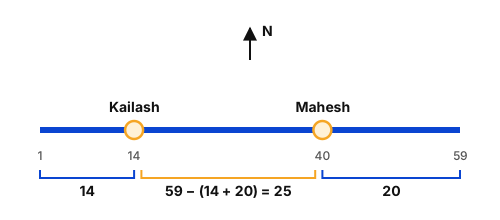
All 59 people are standing in a row facing North. Mahesh is 20th from the right end, while Kailash is 14th from the left end. How many people are there between Mahesh and Kailash?
कुल 59 व्यक्ति उत्तर की ओर मुख करके एक पंक्ति में खड़े हैं। महेश दाएँ छोर से 20वें स्थान पर है, जबकि कैलाश बाएँ छोर से 14वें स्थान पर है। महेश और कैलाश के बीच कितने व्यक्ति हैं?
  1. A24
  2. B23
  3. C25
  4. D26
Show answer

Concept: Between = Total − (left rank + right rank) when they don't overlap.

Solution:

  1. Mahesh from left = 59 − 20 + 1 = 40.
  2. Kailash = 14th from left.
  3. Between = 40 − 14 − 1 = 25.

Trick: Direct: 59 − (20 + 14) = 25.

Answer: (C) 25

अवधारणा: बीच के लोग = कुल − (दोनों स्थानों का योग), यदि ओवरलैप न हो।

हल:

  1. महेश बाएँ से = 59 − 20 + 1 = 40
  2. कैलाश बाएँ से 14वाँ
  3. बीच = 40 − 14 − 1 = 25

ट्रिक: सीधा: 59 − (20 + 14) = 25।

उत्तर: (C) 25

RRB Technician Grade IIIGeneral Intelligence and ReasoningRanking – people betweenRRB Technician Grade III 2025 · 9 Mar Shift 2 →
Q2745.
Based on the alphabetical order, three of the following four are alike in a certain way and thus form a group. Which is the one that does not belong to that group?
(Note: The odd man out is not based on the number of consonants/vowels or their position in the letter cluster.)
वर्णमाला क्रम के आधार पर, निम्नलिखित चार में से तीन किसी निश्चित प्रकार से एकसमान हैं और इस प्रकार एक समूह बनाते हैं। वह कौन-सा है जो उस समूह से संबंधित नहीं है?
(ध्यान दें: असंगत, व्यंजनों/स्वरों की संख्या या अक्षर-समूह में उनके स्थान पर आधारित नहीं है।)
  1. ADEK
  2. BGHN
  3. CNOU
  4. DNOD
Show answer

Concept: Check gaps between letters.

Solution:

  1. DEK: D→E +1, E→K +6.
  2. GHN: +1, +6; NOU: +1, +6.
  3. NOD: N→O +1 but O→D is −11 — odd one.

Yaad rakhein: In odd-one-out, test the gap pattern on every option, not just the first two letters.

Answer: (D) NOD

अवधारणा: अक्षरों के बीच का अंतर देखें।

हल:

  1. DEK: +1, +6
  2. GHN: +1, +6; NOU: +1, +6
  3. NOD: +1 पर O→D = −11 — विषम

याद रखें: हर विकल्प पर पूरा पैटर्न जाँचें।

उत्तर: (D) NOD

RRB Technician Grade IIIGeneral Intelligence and ReasoningOdd one out – letter clustersRRB Technician Grade III 2025 · 9 Mar Shift 2 →
Q2746.
Based on the English alphabetical order, three of the following four letter-cluster pairs are alike in a certain way and thus form a group. Which letter-cluster pair DOES NOT belong to that group?
(Note: The odd one out is not based on the number of consonants/vowels or their position in the letter-cluster.)
अंग्रेज़ी वर्णमाला क्रम के आधार पर, निम्नलिखित चार अक्षर-समूह युग्मों में से तीन किसी निश्चित प्रकार से एकसमान हैं और इस प्रकार एक समूह बनाते हैं। कौन-सा अक्षर-समूह युग्म उस समूह से संबंधित नहीं है?
(ध्यान दें: असंगत युग्म, व्यंजनों/स्वरों की संख्या या अक्षर-समूह में उनके स्थान पर आधारित नहीं है।)
  1. AAB−EF
  2. BXY−AE
  3. CNO−RS
  4. DJK−NO
Show answer

Concept: Compare shift from first cluster to second.

Solution:

  1. AB−EF, NO−RS, JK−NO: each letter +4.
  2. XY−AE: X→A +3, Y→E +6.
  3. XY−AE is odd.

Trick: Same-gap pairs: 2nd cluster also consecutive (EF, RS, NO); AE is not consecutive.

Answer: (B) XY−AE

अवधारणा: पहले से दूसरे समूह का खिसकाव देखें।

हल:

  1. AB−EF, NO−RS, JK−NO: हर अक्षर +4
  2. XY−AE: +3, +6
  3. XY−AE विषम

ट्रिक: बाकी में दूसरा समूह भी क्रमागत है (EF, RS, NO); AE क्रमागत नहीं।

उत्तर: (B) XY−AE

RRB Technician Grade IIIGeneral Intelligence and ReasoningOdd one out – letter pairsRRB Technician Grade III 2025 · 9 Mar Shift 2 →
Q2747.
Select the pair which follows the same pattern as that followed by the two set of pairs given below. Both pairs follow the same pattern.
CMO : DKP
WKL : XIM
उस युग्म का चयन कीजिए जो उसी पैटर्न का अनुसरण करता है जिसका अनुसरण नीचे दिए गए दो युग्म करते हैं। दोनों युग्म एक ही पैटर्न का अनुसरण करते हैं।
CMO : DKP
WKL : XIM
  1. AOIY : PGZ
  2. BHFC : HDC
  3. CGFR : GDR
  4. DDQG : DNH
Show answer

Concept: Find letter-wise shift.

Solution:

  1. CMO → DKP: +1, −2, +1.
  2. WKL → XIM: +1, −2, +1.
  3. OIY → PGZ: +1, −2, +1 ✓.

Trick: First letter must change by +1 — only OIY→PGZ does (others keep it same).

Answer: (A) OIY : PGZ

अवधारणा: हर अक्षर का खिसकाव देखें।

हल:

  1. CMO → DKP: +1, −2, +1
  2. WKL → XIM: +1, −2, +1
  3. OIY → PGZ: +1, −2, +1 ✓

ट्रिक: पहला अक्षर +1 बदलना चाहिए — केवल OIY→PGZ में ऐसा है।

उत्तर: (A) OIY : PGZ

RRB Technician Grade IIIGeneral Intelligence and ReasoningLetter analogyRRB Technician Grade III 2025 · 9 Mar Shift 2 →
Q2748.
In a certain code language, ‘GODS’ is coded as ‘7642’ and ‘DIVE’ is coded as ‘1357’. What is the code for ‘D’ in that language?
एक निश्चित कूट भाषा में, ‘GODS’ को ‘7642’ और ‘DIVE’ को ‘1357’ के रूप में कूटबद्ध किया जाता है। उस भाषा में ‘D’ का कूट क्या है?
  1. A3
  2. B7
  3. C4
  4. D1
Show answer

Concept: Common letter ↔ common digit.

Solution:

  1. GODS = 7642, DIVE = 1357.
  2. Common letter: D; common digit: 7.
  3. So D = 7.

Trick: Ignore order; match the shared letter with the shared digit.

Answer: (B) 7

अवधारणा: उभयनिष्ठ अक्षर ↔ उभयनिष्ठ अंक

हल:

  1. GODS = 7642, DIVE = 1357
  2. साझा अक्षर D; साझा अंक 7
  3. अतः D = 7

ट्रिक: क्रम छोड़ें; साझा अक्षर = साझा अंक।

उत्तर: (B) 7

RRB Technician Grade IIIGeneral Intelligence and ReasoningCoding – common letter methodRRB Technician Grade III 2025 · 9 Mar Shift 2 →
Q2749.
Refer to the following letter series and answer the question. Counting to be done from left to right.
(Left) M M C R V I K Z J N L U W X W F O Y X F G(Right)
How many such consonants are there, each of which is immediately preceded by a vowel and also immediately followed by a vowel?
निम्नलिखित अक्षर शृंखला को देखिए और प्रश्न का उत्तर दीजिए। गिनती बाएँ से दाएँ की जानी है।
(बाएँ) M M C R V I K Z J N L U W X W F O Y X F G (दाएँ)
ऐसे कितने व्यंजन हैं, जिनमें से प्रत्येक के ठीक पहले एक स्वर है और ठीक बाद में भी एक स्वर है?
  1. AOneएक
  2. BThreeतीन
  3. CNoneकोई नहीं
  4. DTwoदो
Show answer

Concept: Need pattern Vowel–Consonant–Vowel.

Solution:

  1. Vowels present: I, U, O only.
  2. After I comes K, then Z (consonant); after U comes W, then X; after O comes Y, then X.
  3. No consonant has a vowel on both sides → none.

Trick: Only look at the letters right after each vowel — just 3 checks.

Answer: (C) None

अवधारणा: पैटर्न चाहिए: स्वर–व्यंजन–स्वर।

हल:

  1. स्वर केवल I, U, O
  2. I के बाद K फिर Z; U के बाद W फिर X; O के बाद Y फिर X
  3. कोई व्यंजन दोनों ओर स्वर से घिरा नहीं → शून्य

ट्रिक: केवल हर स्वर के बाद वाले अक्षर देखें — सिर्फ 3 जाँच।

उत्तर: (C) कोई नहीं

RRB Technician Grade IIIGeneral Intelligence and ReasoningLetter series – vowel/consonant conditionsRRB Technician Grade III 2025 · 9 Mar Shift 2 →
Q2750.
Refer to the following series and answer the question (All numbers are single-digit numbers only. Counting is to be done from left to right.)
(Left) 2 8 1 3 5 2 6 7 3 4 9 6 7 8 4 1 3 4 6 (Right)
How many such even digits are there each of which is immediately preceded by an odd digit and immediately followed by an even digit?
निम्नलिखित शृंखला को देखिए और प्रश्न का उत्तर दीजिए (सभी संख्याएँ केवल एक अंक वाली संख्याएँ हैं। गिनती बाएँ से दाएँ की जानी है।)
(बाएँ) 2 8 1 3 5 2 6 7 3 4 9 6 7 8 4 1 3 4 6 (दाएँ)
ऐसे कितने सम अंक हैं, जिनमें से प्रत्येक के ठीक पहले एक विषम अंक है और ठीक बाद में एक सम अंक है?
  1. AFourचार
  2. BTwoदो
  3. CThreeतीन
  4. DOneएक
Show answer

Concept: Pattern needed: Odd – Even – Even.

Solution:

  1. 5 2 6 ✓ (2 after 5, before 6).
  2. 7 8 4 ✓.
  3. 3 4 6 ✓ (end).
  4. Others (3 4 9, 9 6 7) fail → 3.

Trick: Scan for odd digits and check the next two digits are both even.

Answer: (C) Three

अवधारणा: पैटर्न चाहिए: विषम – सम – सम।

हल:

  1. 5 2 6 ✓
  2. 7 8 4 ✓
  3. 3 4 6 ✓
  4. बाकी (3 4 9, 9 6 7) नहीं → 3

ट्रिक: हर विषम अंक के बाद के दो अंक सम हैं या नहीं, बस यही देखें।

उत्तर: (C) तीन

RRB Technician Grade IIIGeneral Intelligence and ReasoningNumber series – odd/even conditionsRRB Technician Grade III 2025 · 9 Mar Shift 2 →
Q2751.
A student heats 10 g of calcium carbonate in a closed container. It decomposes into 5.6 g of calcium oxide and carbon dioxide gas. What will be the mass of carbon dioxide produced?
एक विद्यार्थी 10 g कैल्शियम कार्बोनेट को एक बंद पात्र में गर्म करता है। यह 5.6 g कैल्शियम ऑक्साइड और कार्बन डाइऑक्साइड गैस में विघटित हो जाता है। उत्पन्न कार्बन डाइऑक्साइड का द्रव्यमान कितना होगा?
  1. A5.0 g
  2. B15.6 g
  3. C4.4 g
  4. D10.0 g
Show answer

Concept: In a chemical reaction, total mass of reactants = total mass of products.

Solution:

  1. CaCO₃ → CaO + CO₂.
  2. 10 g = 5.6 g + mass of CO₂.
  3. CO₂ = 10 − 5.6 = 4.4 g.

Trick: Molar check: 100 g CaCO₃ → 56 g CaO + 44 g CO₂; so 10 g gives 4.4 g.

Answer: (C) 4.4 g

अवधारणा: रासायनिक अभिक्रिया में अभिकारकों का कुल द्रव्यमान = उत्पादों का कुल द्रव्यमान।

हल:

  1. CaCO₃ → CaO + CO₂
  2. 10 g = 5.6 g + CO₂
  3. CO₂ = 10 − 5.6 = 4.4 g

ट्रिक: मोलर जाँच: 100 g → 56 g CaO + 44 g CO₂; अतः 10 g से 4.4 g।

उत्तर: (C) 4.4 g

RRB Technician Grade IIIGeneral ScienceLaw of conservation of massRRB Technician Grade III 2025 · 9 Mar Shift 2 →
Q2752.
The versatile nature of carbon is responsible for the formation of which of the following types of compounds?
कार्बन की सर्वतोमुखी प्रकृति (versatile nature) निम्नलिखित में से किस प्रकार के यौगिकों के निर्माण के लिए उत्तरदायी है?
  1. AOrganic compoundsकार्बनिक यौगिक
  2. BInorganic compoundsअकार्बनिक यौगिक
  3. CMetallic compoundsधात्विक यौगिक
  4. DIonic compoundsआयनिक यौगिक
Show answer

Concept: Catenation and tetravalency let carbon form millions of compounds.

Solution:

  1. Carbon bonds with itself (catenation) forming chains, branches and rings.
  2. Valency 4 lets it bond with H, O, N, S, halogens.
  3. These form the huge family of organic compounds.

Yaad rakhein: Catenation is strongest in carbon; silicon shows it only to a limited extent.

Answer: (A) Organic compounds

अवधारणा: श्रृंखलन और चतुःसंयोजकता से कार्बन लाखों यौगिक बनाता है।

हल:

  1. कार्बन स्वयं से जुड़कर श्रृंखला, शाखा और वलय बनाता है (श्रृंखलन)
  2. संयोजकता 4 से H, O, N, S, हैलोजन से जुड़ता है
  3. इनसे कार्बनिक यौगिक बनते हैं

याद रखें: श्रृंखलन गुण कार्बन में सबसे अधिक है; सिलिकॉन में सीमित।

उत्तर: (A) कार्बनिक यौगिक

RRB Technician Grade IIIGeneral ScienceVersatile nature of carbonRRB Technician Grade III 2025 · 9 Mar Shift 2 →
Q2753.
Which of the following statements about natural acid-base indicators is correct?
प्राकृतिक अम्ल-क्षारक सूचकों के बारे में निम्नलिखित में से कौन-सा कथन सही है?
  1. ARed litmus turns blue in acids.अम्लों में लाल लिटमस नीला हो जाता है।
  2. BTurmeric turns red in basic solution.क्षारकीय विलयन में हल्दी लाल हो जाती है।
  3. CMethyl orange is a natural indicator extracted from turmeric.मेथिल ऑरेंज, हल्दी से निकाला गया एक प्राकृतिक सूचक है।
  4. DChina rose (Hibiscus) extract turns green in acids.गुड़हल (Hibiscus) का निष्कर्ष अम्लों में हरा हो जाता है।
Show answer

Concept: Turmeric is a natural indicator: yellow in acid/neutral, reddish-brown in base.

  1. Turmeric (haldi) turns red/reddish-brown in basic solution — e.g. a haldi stain turns red with soap. So (B) is correct.
  2. Red litmus turns blue in bases, not acids — (A) is wrong.
  3. Methyl orange is a synthetic indicator, not obtained from turmeric — (C) is wrong.
  4. China rose extract turns dark pink (magenta) in acids and green in bases — so 'green in acids' (D) is wrong.

Trick: China rose: acid → magenta, base → green; turmeric: base → red.

Answer: (B) Turmeric turns red in basic solution.

अवधारणा: हल्दी एक प्राकृतिक सूचक है: अम्ल/उदासीन में पीली, क्षार में लाल-भूरी।

  1. हल्दी क्षारकीय विलयन में लाल/लाल-भूरी हो जाती है — जैसे हल्दी का दाग साबुन से लाल हो जाता है। अतः (B) सही है।
  2. लाल लिटमस क्षारकों में नीला होता है, अम्लों में नहीं — (A) गलत।
  3. मेथिल ऑरेंज एक संश्लेषित सूचक है, हल्दी से प्राप्त नहीं — (C) गलत।
  4. गुड़हल का निष्कर्ष अम्ल में गहरा गुलाबी (मैजेंटा) और क्षारक में हरा होता है — अतः 'अम्लों में हरा' (D) गलत।

याद रखें: गुड़हल: अम्ल → मैजेंटा, क्षारक → हरा; हल्दी: क्षारक → लाल।

उत्तर: (B) क्षारकीय विलयन में हल्दी लाल हो जाती है।

RRB Technician Grade IIIGeneral ScienceNatural acid–base indicatorsRRB Technician Grade III 2025 · 9 Mar Shift 2 →
Q2754.
An echo is heard in 6 s. If the distance of the reflecting surface from the source is 990 m, then how much is the speed of sound?
एक प्रतिध्वनि 6 s में सुनाई देती है। यदि परावर्तक पृष्ठ की स्रोत से दूरी 990 m है, तो ध्वनि की चाल कितनी है?
  1. A660 m/s
  2. B165 m/s
  3. C330 m/s
  4. D1320 m/s
Show answer

Concept: Echo travels to the surface and back: v=2dt.

Solution:

  1. Total distance = 2×990=1980 m.
  2. v=19806=330 m/s.

Trick: Forgetting the 2 gives 165 m/s — a trap option.

Answer: (C) 330 m/s

अवधारणा: प्रतिध्वनि में ध्वनि जाकर लौटती है: v=2dt

हल:

  1. कुल दूरी = 2×990=1980 m
  2. v=19806=330 m/s

ट्रिक: 2 भूलने पर 165 m/s आता है — ट्रैप विकल्प।

उत्तर: (C) 330 m/s

RRB Technician Grade IIIGeneral ScienceEcho – speed of soundRRB Technician Grade III 2025 · 9 Mar Shift 2 →
Q2755.
If the gravitational force experienced by a body of mass 'm' on the surface of Earth is 'X' N. If the mass of the body is tripled, what will be the value of the gravitational force experienced by the body?
यदि पृथ्वी की सतह पर द्रव्यमान 'm' वाले किसी पिंड द्वारा अनुभव किया गया गुरुत्वाकर्षण बल 'X' N है। यदि पिंड का द्रव्यमान तीन गुना कर दिया जाए, तो पिंड द्वारा अनुभव किए गए गुरुत्वाकर्षण बल का मान क्या होगा?
  1. AX/9 N
  2. BX/3 N
  3. CX N
  4. D3X N
Show answer

Concept: Weight F = mg, so F ∝ m on the same planet.

Solution:

  1. F = mg = X.
  2. Mass tripled → F = 3mg = 3X N.

Yaad rakhein: g does not depend on the body's own mass; only F (weight) changes.

Answer: (D) 3X N

अवधारणा: भार F = mg, अतः एक ही ग्रह पर F ∝ m।

हल:

  1. F = mg = X
  2. द्रव्यमान तिगुना → F = 3X N

याद रखें: g वस्तु के द्रव्यमान पर निर्भर नहीं; केवल भार बदलता है।

उत्तर: (D) 3X N

RRB Technician Grade IIIGeneral ScienceGravitational force – dependence on massRRB Technician Grade III 2025 · 9 Mar Shift 2 →
Q2756.
An object is placed at 100 cm on the left of a convex lens of focal length 40 cm. Where should a screen be placed to right of the lens so that the image formed is real, inverted and smaller in size as compared to the object size?
एक वस्तु को 40 cm फोकस दूरी वाले उत्तल लेंस के बाईं ओर 100 cm पर रखा गया है। लेंस के दाईं ओर पर्दा कहाँ रखा जाना चाहिए ताकि बनने वाला प्रतिबिंब वास्तविक, उल्टा और वस्तु के आकार की तुलना में छोटा हो?
  1. AThe screen should be placed at 40 cm from the lens.पर्दे को लेंस से 40 cm पर रखा जाना चाहिए।
  2. BThe screen should be placed anywhere between 20 cm and 40 cm from the lens.पर्दे को लेंस से 20 cm और 40 cm के बीच कहीं भी रखा जाना चाहिए।
  3. CThe screen should be placed anywhere between 40 cm and 80 cm from the lens.पर्दे को लेंस से 40 cm और 80 cm के बीच कहीं भी रखा जाना चाहिए।
  4. DThe screen should be beyond 100 cm from the lens.पर्दे को लेंस से 100 cm से आगे रखा जाना चाहिए।
Show answer

Concept: Object beyond 2F → image between F and 2F, real, inverted, diminished.

Solution:

  1. f = 40 cm → 2F = 80 cm; object at 100 cm is beyond 2F.
  2. Image forms between F and 2F on the other side: 40–80 cm.
  3. (Exact: 1v=140−1100→v≈66.7 cm, within range.)

Yaad rakhein: Object at 2F → image at 2F, same size; object between F and 2F → image beyond 2F, enlarged.

Answer: (C) The screen should be placed anywhere between 40 cm and 80 cm from the lens.

अवधारणा: वस्तु 2F से परे → प्रतिबिंब F और 2F के बीच, वास्तविक, उल्टा, छोटा।

हल:

  1. f = 40 cm → 2F = 80 cm; वस्तु 100 cm पर, 2F से परे
  2. प्रतिबिंब दूसरी ओर 40–80 cm के बीच
  3. (सटीक: v≈66.7 cm, सीमा के भीतर)

याद रखें: वस्तु 2F पर → प्रतिबिंब 2F पर, समान आकार; F और 2F के बीच → 2F से परे, बड़ा।

उत्तर: (C) पर्दे को लेंस से 40 cm और 80 cm के बीच कहीं भी रखा जाना चाहिए।

RRB Technician Grade IIIGeneral ScienceConvex lens – image formationRRB Technician Grade III 2025 · 9 Mar Shift 2 →
Q2757.
Which of the following is a molecule formed by two atoms of the same element?
निम्नलिखित में से कौन-सा एक ही तत्व के दो परमाणुओं से बना अणु है?
  1. AH₂
  2. BH₂O
  3. CCO
  4. DO₃
Show answer

Concept: A molecule of two atoms of the same element is a homonuclear diatomic molecule.

Solution:

  1. H₂: two H atoms ✓.
  2. H₂O and CO contain different elements; O₃ has three atoms (triatomic).

Yaad rakhein: Diatomic elements: H₂, N₂, O₂, F₂, Cl₂, Br₂, I₂.

Answer: (A) H₂

अवधारणा: एक ही तत्व के दो परमाणुओं से बना अणु = समनाभिकीय द्विपरमाणुक अणु।

हल:

  1. H₂: दो H परमाणु ✓
  2. H₂O, CO में भिन्न तत्व; O₃ में तीन परमाणु (त्रिपरमाणुक)

याद रखें: द्विपरमाणुक तत्व: H₂, N₂, O₂, F₂, Cl₂, Br₂, I₂।

उत्तर: (A) H₂

RRB Technician Grade IIIGeneral ScienceHomonuclear diatomic moleculeRRB Technician Grade III 2025 · 9 Mar Shift 2 →
Q2758.
Meristematic tissue in plants is mainly characterized by:
पौधों में विभज्योतक ऊतक (meristematic tissue) की मुख्य विशेषता है:
  1. APermanent storage cells.स्थायी भंडारण कोशिकाएँ।
  2. BMature cells with thick walls.मोटी भित्ति वाली परिपक्व कोशिकाएँ।
  3. CSmall, actively dividing cells with thin walls.पतली भित्ति वाली छोटी, सक्रिय रूप से विभाजित होने वाली कोशिकाएँ।
  4. DLarge, highly vacuolated cells.बड़ी, अत्यधिक रिक्तिकायुक्त कोशिकाएँ।
Show answer

Concept: Meristems are growth tissues that keep dividing.

Solution:

  1. Cells are small, thin-walled, with dense cytoplasm and prominent nucleus.
  2. They lack (or have very small) vacuoles and divide actively.
  3. Thick walls and storage are features of permanent tissues.

Yaad rakhein: Types: apical (length), lateral (girth), intercalary (at nodes/leaf base).

Answer: (C) Small, actively dividing cells with thin walls.

अवधारणा: विभज्योतक वृद्धि करने वाला ऊतक है जो लगातार विभाजित होता है।

हल:

  1. कोशिकाएँ छोटी, पतली भित्ति, सघन कोशिकाद्रव्य और स्पष्ट केंद्रक
  2. रिक्तिका नहीं (या बहुत छोटी); सक्रिय विभाजन
  3. मोटी भित्ति और संग्रह स्थायी ऊतकों के लक्षण हैं

याद रखें: प्रकार: शीर्षस्थ (लंबाई), पार्श्व (मोटाई), अंतर्वेशी (पर्वसंधि/पत्ती आधार)।

उत्तर: (C) पतली भित्ति वाली छोटी, सक्रिय रूप से विभाजित होने वाली कोशिकाएँ।

RRB Technician Grade IIIGeneral ScienceMeristematic tissueRRB Technician Grade III 2025 · 9 Mar Shift 2 →
Q2759.
Which of the following statements are correct?
1. Colloids appear homogeneous because their particles are very small.
2. Colloids are truly homogeneous at the molecular level.
3. Colloidal particles scatter light.
4. Milk is a colloidal solution.
निम्नलिखित में से कौन-से कथन सही हैं?
1. कोलॉइड समांगी प्रतीत होते हैं क्योंकि उनके कण बहुत छोटे होते हैं।
2. कोलॉइड आण्विक स्तर पर वास्तव में समांगी होते हैं।
3. कोलॉइडी कण प्रकाश का प्रकीर्णन करते हैं।
4. दूध एक कोलॉइडी विलयन है।
  1. A2 and 4 onlyकेवल 2 और 4
  2. B1, 2, 3 and 41, 2, 3 और 4
  3. C1 and 2 onlyकेवल 1 और 2
  4. D1, 3 and 4 onlyकेवल 1, 3 और 4
Show answer

Concept: Colloids look homogeneous but are actually heterogeneous.

Solution:

  1. 1 ✓: particles are tiny, so they appear uniform.
  2. 2 ✗: at molecular level they are heterogeneous (dispersed phase + medium).
  3. 3 ✓ Tyndall effect; 4 ✓ milk is an emulsion (colloid).

Trick: Eliminate statement 2 → only option without 2 is '1, 3 and 4 only'.

Answer: (D) 1, 3 and 4 only

अवधारणा: कोलॉइड समांगी दिखते हैं पर वास्तव में विषमांगी होते हैं।

हल:

  1. 1 ✓: कण बहुत छोटे, इसलिए एकसमान दिखते हैं
  2. 2 ✗: आणविक स्तर पर विषमांगी (परिक्षिप्त प्रावस्था + माध्यम)
  3. 3 ✓ टिंडल प्रभाव; 4 ✓ दूध इमल्शन (कोलॉइड)

ट्रिक: कथन 2 हटाएँ → '1, 3 और 4' ही बचता है।

उत्तर: (D) केवल 1, 3 और 4

RRB Technician Grade IIIGeneral ScienceColloids – propertiesRRB Technician Grade III 2025 · 9 Mar Shift 2 →
Q2760.
If a velocity–time graph shows a horizontal straight line, the object is moving with ________.
यदि वेग–समय ग्राफ एक क्षैतिज सरल रेखा दर्शाता है, तो वस्तु ________ के साथ गति कर रही है।
  1. ANo velocityशून्य वेग
  2. BConstant velocityनियत वेग
  3. CNon-uniform accelerationअसमान त्वरण
  4. DZero displacementशून्य विस्थापन
Show answer

Concept: Slope of v–t graph = acceleration.

Solution:

  1. Horizontal line → slope 0 → acceleration 0.
  2. Velocity stays the same → constant (uniform) velocity.

Yaad rakhein: Horizontal x–t graph = at rest; horizontal v–t graph = constant velocity.

Answer: (B) Constant velocity

अवधारणा: v–t ग्राफ का ढलान = त्वरण।

हल:

  1. क्षैतिज रेखा → ढलान 0 → त्वरण 0
  2. वेग अपरिवर्तित → नियत वेग

याद रखें: क्षैतिज x–t ग्राफ = विराम; क्षैतिज v–t ग्राफ = नियत वेग।

उत्तर: (B) नियत वेग

RRB Technician Grade IIIGeneral ScienceVelocity–time graphRRB Technician Grade III 2025 · 9 Mar Shift 2 →