Question bank

Q&A: practice questions with answers

Search questions on any topic. Filter by exam category, exam, subject and topic, try the question, then open the answer and explanation.

Courses – airGurukul

3,200 questions found.

Q2841.
In a certain code language, ‘PART’ is coded as ‘7642’ and ‘TWIN’ is coded as ‘1356’. What is the code for ‘T’ in that language?
एक निश्चित कूट भाषा में, ‘PART’ को ‘7642’ और ‘TWIN’ को ‘1356’ के रूप में कूटबद्ध किया जाता है। उस भाषा में ‘T’ के लिए कूट क्या है?
  1. A6
  2. B1
  3. C2
  4. D3
Show answer

Concept: The only common letter takes the only common digit.

  1. PART = 7642, TWIN = 1356.
  2. Common letter: T; common digit: 6.
  3. So T = 6.

Trick: One common letter + one common digit = direct answer.

Answer: (A) 6

अवधारणा: एकमात्र उभयनिष्ठ अक्षर = एकमात्र उभयनिष्ठ अंक।

हल:

  1. PART = 7642, TWIN = 1356
  2. उभयनिष्ठ अक्षर T; उभयनिष्ठ अंक 6
  3. T = 6

ट्रिक: एक उभयनिष्ठ अक्षर + एक उभयनिष्ठ अंक = सीधा उत्तर।

उत्तर: (A) 6
RRB Technician Grade IIIGeneral Intelligence and ReasoningCoding – common letterRRB Technician Grade III 2025 · 9 Mar Shift 1 →
Q2842.
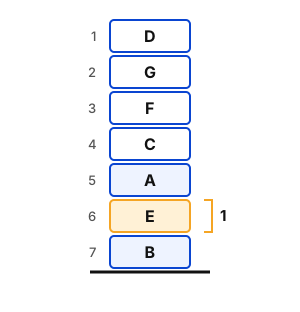
Seven boxes A, B, C, D, E, F and G are kept one over the other but not necessarily in the same order. Only five boxes are kept above E. Only two boxes are kept between F and E. C is kept immediately above A. G is kept below D but above F. How many boxes are kept between B and A?
सात बक्से A, B, C, D, E, F और G एक के ऊपर एक रखे गए हैं, परंतु आवश्यक नहीं कि इसी क्रम में हों। E के ऊपर केवल पाँच बक्से रखे गए हैं। F और E के बीच केवल दो बक्से रखे गए हैं। C, A के ठीक ऊपर रखा गया है। G, D के नीचे परंतु F के ऊपर रखा गया है। B और A के बीच कितने बक्से रखे गए हैं?
  1. AThreeतीन
  2. BOneएक
  3. CFourचार
  4. DTwoदो
Show answer

Concept: Number positions from top (1) to bottom (7).

  1. Five boxes above E → E = 6th.
  2. Two between F and E → F = 3rd.
  3. G below D, above F → D = 1st, G = 2nd.
  4. C just above A → C = 4th, A = 5th; B = 7th.
  5. Between B (7) and A (5): E → one.

Trick: Positions: D, G, F, C, A, E, B (top to bottom).

Answer: (B) One

अवधारणा: ऊपर (1) से नीचे (7) तक स्थान लें।

हल:

  1. E के ऊपर पाँच → E = 6
  2. F व E के बीच दो → F = 3
  3. G, D के नीचे व F के ऊपर → D = 1, G = 2
  4. C, A के ठीक ऊपर → C = 4, A = 5; B = 7
  5. B (7) और A (5) के बीच E → एक

ट्रिक: क्रम (ऊपर से): D, G, F, C, A, E, B

उत्तर: (B) एक

RRB Technician Grade IIIGeneral Intelligence and ReasoningBox stacking puzzleRRB Technician Grade III 2025 · 9 Mar Shift 1 →
Q2843.
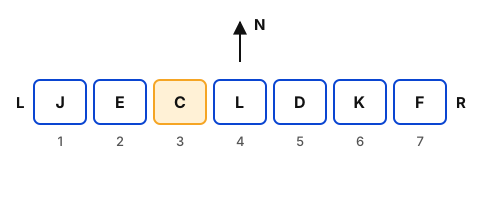
Seven people, C, D, E, F, J, K and L, are sitting in a row, facing north. Only two people sit to the right of D. Only two people sit between D and E. Only two people sit between J and L. L sits to the immediate left of D. F sits to the immediate right of K.
Who sits at the third position from the left end of the row?
सात व्यक्ति C, D, E, F, J, K और L एक पंक्ति में उत्तर की ओर मुख करके बैठे हैं। D के दाईं ओर केवल दो व्यक्ति बैठे हैं। D और E के बीच केवल दो व्यक्ति बैठे हैं। J और L के बीच केवल दो व्यक्ति बैठे हैं। L, D के ठीक बाएँ बैठा है। F, K के ठीक दाएँ बैठा है।
पंक्ति के बाएँ छोर से तीसरे स्थान पर कौन बैठा है?
  1. AC
  2. BL
  3. CE
  4. DJ
Show answer

Concept: Facing north: left end = position 1.

  1. Two to the right of D → D = 5th. L immediate left of D → L = 4th.
  2. Two between D and E → E = 2nd.
  3. Two between J and L → J = 1st or 7th. If J = 7th, K-F can't sit together; so J = 1st.
  4. K, F = 6th, 7th → C = 3rd.

Trick: Order: J E C L D K F.

Answer: (A) C

अवधारणा: उत्तर मुख: बायाँ छोर = स्थान 1

हल:

  1. D के दाएँ दो → D = 5; L, D के ठीक बाएँ → L = 4
  2. D व E के बीच दो → E = 2
  3. J व L के बीच दो → J = 1 या 7; J = 7 पर K-F साथ नहीं बैठ सकते → J = 1
  4. K, F = 6, 7 → C = 3

ट्रिक: क्रम: J E C L D K F

उत्तर: (A) C

RRB Technician Grade IIIGeneral Intelligence and ReasoningLinear seating arrangementRRB Technician Grade III 2025 · 9 Mar Shift 1 →
Q2844.
What should come in place of ? in the given series based on the English alphabetical order?
PIO VOU BUA HAG ?
अंग्रेज़ी वर्णमाला क्रम के आधार पर दी गई श्रृंखला में ? के स्थान पर क्या आना चाहिए?
PIO VOU BUA HAG ?
  1. AGNM
  2. BNGM
  3. CNMG
  4. DHMN
Show answer

Concept: Each letter position moves +6.

  1. 1st letters: P → V → B → H → N.
  2. 2nd letters: I → O → U → A → G.
  3. 3rd letters: O → U → A → G → M.
  4. Answer: NGM.

Trick: Each term's 2nd letter = 1st letter + 19 (i.e. −7) and 3rd = 2nd + 6; simply add +6 down each column.

Answer: (B) NGM

अवधारणा: हर स्थान का अक्षर +6 बढ़ता है।

हल:

  1. पहले अक्षर: P → V → B → H → N
  2. दूसरे: I → O → U → A → G
  3. तीसरे: O → U → A → G → M
  4. उत्तर: NGM

ट्रिक: हर कॉलम में +6 जोड़ें (Z के बाद फिर A से गिनें)।

उत्तर: (B) NGM

RRB Technician Grade IIIGeneral Intelligence and ReasoningLetter seriesRRB Technician Grade III 2025 · 9 Mar Shift 1 →
Q2845.
LN 17 is related to HJ 23 in a certain way. In the same way, SU 5 is related to OQ 11. To which of the following is NP 9 related, following the same logic?
LN 17 एक निश्चित प्रकार से HJ 23 से संबंधित है। उसी प्रकार, SU 5, OQ 11 से संबंधित है। समान तर्क का अनुसरण करते हुए, NP 9 निम्नलिखित में से किससे संबंधित है?
  1. AJL 13
  2. BKM 13
  3. CJL 15
  4. DKL 15
Show answer

Concept: Apply the same letter shifts and number change.

  1. LN 17 → HJ 23: both letters −4, number +6.
  2. SU 5 → OQ 11: same rule.
  3. NP 9 → J L 15.

Trick: Number +6 leaves JL 15 and KL 15; N − 4 = J → JL 15.

Answer: (C) JL 15

अवधारणा: वही अक्षर-विस्थापन और संख्या परिवर्तन लगाएँ।

हल:

  1. LN 17 → HJ 23: दोनों अक्षर −4, संख्या +6
  2. SU 5 → OQ 11: वही नियम
  3. NP 9 → JL 15

ट्रिक: संख्या +6 से JL 15, KL 15 बचे; N − 4 = J → JL 15

उत्तर: (C) JL 15

RRB Technician Grade IIIGeneral Intelligence and ReasoningAnalogy – letters and numbersRRB Technician Grade III 2025 · 9 Mar Shift 1 →
Q2846.
Select the set in which the numbers are related in the same way as are the numbers of the following sets.
(Note: Operations should be performed on the whole numbers, without breaking down the numbers into their constituent digits. E.g. 13 – Operations on 13 such as
adding/subtracting/multiplying to 13 can be performed. Breaking down 13 into 1 and 3 and then performing mathematical operations on 1 and 3 is not allowed.)
(2, 10, 38)
(4, 12, 46)
उस समुच्चय का चयन कीजिए जिसमें संख्याएँ उसी प्रकार संबंधित हैं जिस प्रकार निम्नलिखित समुच्चयों की संख्याएँ संबंधित हैं।
(नोट: संक्रियाएँ संख्याओं को उनके घटक अंकों में तोड़े बिना, पूर्ण संख्याओं पर की जानी चाहिए। उदाहरण के लिए, 13 – 13 पर संक्रियाएँ जैसे 13 में जोड़ना/घटाना/गुणा करना आदि की जा सकती हैं।
13 को 1 और 3 में तोड़ना और फिर 1 और 3 पर गणितीय संक्रियाएँ करना वर्जित है।)
(2, 10, 38)
(4, 12, 46)
  1. A(7, 15 , 58)
  2. B(6, 18, 70)
  3. C(5, 13, 54)
  4. D(3, 15, 58)
Show answer

Concept: Find the rule linking the three numbers.

  1. (2, 10, 38): 2+8=10; 10×4−2=38.
  2. (4, 12, 46): 4+8=12; 12×4−2=46 ✓.
  3. (7, 15, 58): 7+8=15; 15×4−2=58 ✓.

Trick: First check 2nd = 1st + 8: only (7, 15, 58) and (5, 13, 54) pass; 13×4−2=50≠54.

Answer: (A) (7, 15 , 58)

अवधारणा: तीनों संख्याओं का नियम खोजें।

हल:

  1. (2, 10, 38): 2+8=10; 10×4−2=38
  2. (4, 12, 46): 4+8=12; 12×4−2=46 ✓
  3. (7, 15, 58): 7+8=15; 15×4−2=58 ✓

ट्रिक: पहले दूसरी = पहली + 8 जाँचें: (7, 15, 58), (5, 13, 54) बचे; 13×4−2=50≠54

उत्तर: (A) (7, 15 , 58)

RRB Technician Grade IIIGeneral Intelligence and ReasoningNumber sets – patternRRB Technician Grade III 2025 · 9 Mar Shift 1 →
Q2847.
In a certain code language,
‘A + B’ means ‘A is the son of B’,
‘A @ B’ means ‘A is the sister of B’,
‘A # B’ means ‘A is the wife of B’ and
‘A ÷ B’ means ‘A is the father of B’.
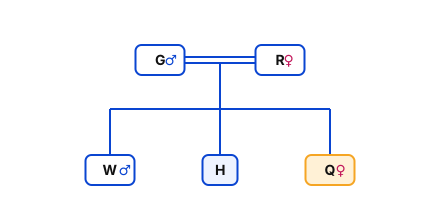
How is Q related to H if ‘Q @ W + R # G ÷ H’?
एक निश्चित कूट भाषा में,
‘A + B’ का अर्थ है ‘A, B का पुत्र है’,
‘A @ B’ का अर्थ है ‘A, B की बहन है’,
‘A # B’ का अर्थ है ‘A, B की पत्नी है’ और
‘A ÷ B’ का अर्थ है ‘A, B का पिता है’।
यदि ‘Q @ W + R # G ÷ H’ है, तो Q, H से किस प्रकार संबंधित है?
  1. ADaughterपुत्री
  2. BSisterबहन
  3. CMotherमाँ
  4. DWifeपत्नी
Show answer

Concept: Decode each symbol step by step.

  1. Q @ W: Q is sister of W. W + R: W is son of R.
  2. R # G: R is wife of G. G ÷ H: G is father of H.
  3. W and H are both children of G and R; Q is W's sister → Q is H's sister.

Trick: Q, W and H are siblings – same generation, so only 'Sister' fits.

Answer: (B) Sister

अवधारणा: प्रत्येक चिह्न को क्रम से हल करें।

हल:

  1. Q @ W: Q, W की बहन; W + R: W, R का पुत्र
  2. R # G: R, G की पत्नी; G ÷ H: G, H का पिता
  3. W और H दोनों G-R की संतान; Q, W की बहन → H की भी बहन

ट्रिक: Q, W, H भाई-बहन – एक ही पीढ़ी, इसलिए 'बहन'।

उत्तर: (B) बहन

RRB Technician Grade IIIGeneral Intelligence and ReasoningCoded blood relationsRRB Technician Grade III 2025 · 9 Mar Shift 1 →
Q2848.
What will come in place of the question mark (?) in the following equation, if ‘+’ and ‘÷’ are interchanged and ‘−’ and ‘×’ are interchanged?
536 + 67 × 9 − 22 ÷ 283 = ?
यदि ‘+’ और ‘÷’ को आपस में बदल दिया जाए तथा ‘−’ और ‘×’ को आपस में बदल दिया जाए, तो निम्नलिखित समीकरण में प्रश्नवाचक चिह्न (?) के स्थान पर क्या आएगा?
536 + 67 × 9 − 22 ÷ 283 = ?
  1. A93
  2. B102
  3. C106
  4. D97
Show answer

Concept: Swap + ↔ ÷ and − ↔ ×, then apply BODMAS.

  1. 536÷67−9×22+283
  2. =8−198+283
  3. = 93

Trick: 536÷67=8 (67×8=536) – a clean division confirms the swap is right.

Answer: (A) 93

अवधारणा: + ↔ ÷ और − ↔ × बदलें, फिर BODMAS।

हल:

  1. 536÷67−9×22+283
  2. =8−198+283
  3. = 93

ट्रिक: 536÷67=8 – पूर्ण भाग से पुष्टि होती है कि बदलाव सही है।

उत्तर: (A) 93

RRB Technician Grade IIIGeneral Intelligence and ReasoningMathematical operations – interchange of signsRRB Technician Grade III 2025 · 9 Mar Shift 1 →
Q2849.
In a certain code language,
A # B means ‘A is the mother of B’,
A + B means ‘A is the daughter of B’,
A ÷ B means ‘A is the wife of B’,
and A @ B means ‘A is the father of B’.
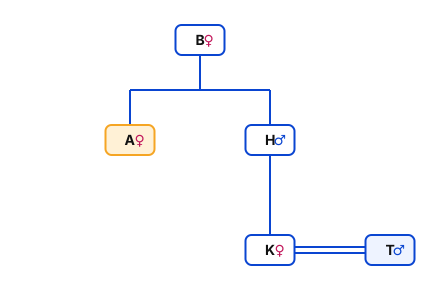
How is A related to T if ‘A + B # H @ K ÷ T’?
एक निश्चित कूट भाषा में,
A # B का अर्थ है ‘A, B की माँ है’,
A + B का अर्थ है ‘A, B की पुत्री है’,
A ÷ B का अर्थ है ‘A, B की पत्नी है’,
और A @ B का अर्थ है ‘A, B का पिता है’।
यदि ‘A + B # H @ K ÷ T’ है, तो A, T से किस प्रकार संबंधित है?
  1. AWife's sisterपत्नी की बहन
  2. BWife's father's motherपत्नी के पिता की माँ
  3. CWife's motherपत्नी की माँ
  4. DWife's father's sisterपत्नी के पिता की बहन
Show answer

Concept: Decode each symbol step by step.

  1. A + B: A is daughter of B. B # H: B is mother of H → A is H's sister.
  2. H @ K: H is father of K.
  3. K ÷ T: K is wife of T → H is T's wife's father.
  4. A = T's wife's father's sister.

Trick: Go backwards from T: T → wife K → her father H → his sister A.

Answer: (D) Wife's father's sister

अवधारणा: प्रत्येक चिह्न को क्रम से हल करें।

हल:

  1. A + B: A, B की पुत्री; B # H: B, H की माँ → A, H की बहन
  2. H @ K: H, K का पिता
  3. K ÷ T: K, T की पत्नी → H = T की पत्नी के पिता
  4. A = T की पत्नी के पिता की बहन

ट्रिक: T से पीछे चलें: T → पत्नी K → उसके पिता H → उनकी बहन A

उत्तर: (D) पत्नी के पिता की बहन

RRB Technician Grade IIIGeneral Intelligence and ReasoningCoded blood relationsRRB Technician Grade III 2025 · 9 Mar Shift 1 →
Q2850.
Refer to the following letter series and answer the question that follows. Counting to be done from left to right.
(Left) T J R M G K S M O X Z W Z D T B L N Z O L (Right)
How many such vowels are there, each of which is immediately preceded by a vowel and also immediately followed by a consonant?
निम्नलिखित अक्षर श्रृंखला को देखिए और नीचे दिए गए प्रश्न का उत्तर दीजिए। गिनती बाएँ से दाएँ की जानी है।
(बाएँ) T J R M G K S M O X Z W Z D T B L N Z O L (दाएँ)
ऐसे कितने स्वर हैं, जिनमें से प्रत्येक के ठीक पहले एक स्वर है और ठीक बाद एक व्यंजन है?
  1. ATwoदो
  2. BThreeतीन
  3. COneएक
  4. DNoneकोई नहीं
Show answer

Concept: A vowel preceded by a vowel needs two vowels side by side.

  1. Vowels in the series: O (after M) and O (after Z).
  2. Both are preceded by consonants (M, Z).
  3. No vowel is preceded by a vowel → none.

Trick: If no two vowels are adjacent, the answer is 'None' immediately.

Answer: (D) None

अवधारणा: स्वर से पहले स्वर होने के लिए दो स्वर साथ होने चाहिए।

हल:

  1. श्रृंखला में स्वर: O (M के बाद) और O (Z के बाद)
  2. दोनों से पहले व्यंजन (M, Z)
  3. कोई नहीं

ट्रिक: यदि दो स्वर साथ नहीं हैं, तो उत्तर तुरंत 'कोई नहीं'।

उत्तर: (D) कोई नहीं

RRB Technician Grade IIIGeneral Intelligence and ReasoningLetter series – vowels and consonantsRRB Technician Grade III 2025 · 9 Mar Shift 1 →
Q2851.
Which statement correctly explains the role of decomposers in an ecosystem?
कौन-सा कथन किसी पारितंत्र में अपघटकों (decomposers) की भूमिका की सही व्याख्या करता है?
  1. AThey recycle nutrients by breaking down dead organisms into simple substancesवे मृत जीवों को सरल पदार्थों में तोड़कर पोषक तत्वों का पुनर्चक्रण करते हैं
  2. BThey convert inorganic substances into complex organic compoundsवे अकार्बनिक पदार्थों को जटिल कार्बनिक यौगिकों में परिवर्तित करते हैं
  3. CThey directly provide food to carnivoresवे मांसाहारियों को सीधे भोजन प्रदान करते हैं
  4. DThey absorb sunlight to produce energy-rich compoundsवे ऊर्जा-समृद्ध यौगिक बनाने के लिए सूर्य का प्रकाश अवशोषित करते हैं
Show answer

Concept: Decomposers (bacteria, fungi) break down dead matter.

  1. They break dead plants/animals into simple substances that return to soil.
  2. These nutrients are reused by plants → nutrient recycling.
  3. Converting inorganic to organic compounds / using sunlight is the job of producers, not decomposers.

Yaad rakhein: Without decomposers, dead bodies would pile up and soil would lose nutrients.

Answer: (A) They recycle nutrients by breaking down dead organisms into simple substances

अवधारणा: अपघटक (जीवाणु, कवक) मृत पदार्थ को तोड़ते हैं।

हल:

  1. ये मृत पौधों/जंतुओं को सरल पदार्थों में तोड़कर मिट्टी में लौटाते हैं।
  2. पौधे इन पोषकों का पुनः उपयोग करते हैं → पोषक चक्रण।
  3. सूर्य प्रकाश से भोजन बनाना उत्पादकों का काम है, अपघटकों का नहीं।

याद रखें: अपघटक न हों तो मृत शरीर जमा होते रहेंगे और मिट्टी के पोषक घट जाएँगे।

उत्तर: (A) वे मृत जीवों को सरल पदार्थों में तोड़कर पोषक तत्वों का पुनर्चक्रण करते हैं

RRB Technician Grade IIIGeneral ScienceEcosystem – decomposersRRB Technician Grade III 2025 · 9 Mar Shift 1 →
Q2852.
A 90 W electric bulb does how much work in 10 seconds?
एक 90 W का विद्युत बल्ब 10 सेकंड में कितना कार्य करता है?
  1. A900 J
  2. B9 J
  3. C90 J
  4. D9000 J
Show answer

Concept: Work (energy) = Power × time.

  1. W=P×t=90W×10s
  2. = 900 J

Trick: 1 W = 1 J/s, so just multiply watts by seconds.

Answer: (A) 900 J

अवधारणा: कार्य (ऊर्जा) = शक्ति × समय

हल:

  1. W=P×t=90W×10s
  2. = 900 J

ट्रिक: 1 W = 1 J/s – वाट × सेकंड = जूल।

उत्तर: (A) 900 J

RRB Technician Grade IIIGeneral SciencePower and workRRB Technician Grade III 2025 · 9 Mar Shift 1 →
Q2853.
The weight of a body on the moon is 3 N. What will be the weight of the body on Earth?
चंद्रमा पर किसी वस्तु का भार 3 N है। पृथ्वी पर उस वस्तु का भार कितना होगा?
  1. A3 N
  2. B18 N
  3. C0.5 N
  4. D2 N
Show answer

Concept: Weight on moon = 16 of weight on Earth.

  1. WEarth=6×Wmoon
  2. =6×3=18 N

Yaad rakhein: Mass stays the same everywhere; only weight changes (gmoon≈g6).

Answer: (B) 18 N

अवधारणा: चंद्रमा पर भार = पृथ्वी पर भार का 16

हल:

  1. पृथ्वी पर भार = 6 × चंद्रमा पर भार
  2. =6×3=18 N

याद रखें: द्रव्यमान हर जगह समान रहता है, केवल भार बदलता है (चंद्रमा पर g≈g6)।

उत्तर: (B) 18 N

RRB Technician Grade IIIGeneral ScienceGravitation – weight on moonRRB Technician Grade III 2025 · 9 Mar Shift 1 →
Q2854.
If 12 J of work is done to move a charge of 2 C between two points, what is the potential difference between these points?
यदि दो बिंदुओं के बीच 2 C आवेश को ले जाने में 12 J कार्य किया जाता है, तो इन बिंदुओं के बीच विभवांतर (potential difference) कितना है?
  1. A6 V
  2. B24 V
  3. C14 V
  4. D10 V
Show answer

Concept: V=WQ.

  1. V=12J÷2C
  2. = 6 V

Yaad rakhein: 1 volt = 1 joule per coulomb.

Answer: (A) 6 V

अवधारणा: V=WQ

हल:

  1. V=12J÷2C
  2. = 6 V

याद रखें: 1 वोल्ट = 1 जूल प्रति कूलॉम।

उत्तर: (A) 6 V

RRB Technician Grade IIIGeneral ScienceElectric potential differenceRRB Technician Grade III 2025 · 9 Mar Shift 1 →
Q2855.
Thomson’s model is often referred to as the 'plum pudding model'. In this analogy, what does the 'plum' represent?
थॉमसन के मॉडल को प्रायः ‘प्लम पुडिंग मॉडल’ कहा जाता है। इस सादृश्य में ‘प्लम’ किसे निरूपित करता है?
  1. ANeutronsन्यूट्रॉन
  2. BProtonsप्रोटॉन
  3. CElectronsइलेक्ट्रॉन
  4. DAlpha particlesऐल्फा कण
Show answer

Concept: Thomson: atom = positive sphere with electrons embedded.

  1. The 'pudding' (or watermelon's red part) = positive charge spread through the atom.
  2. The 'plums' (or seeds) = electrons embedded in it.
  3. Neutrons were discovered only in 1932 (Chadwick).

Trick: Plum = Particle with minus charge (electron); pudding = positive.

Answer: (C) Electrons

अवधारणा: थॉमसन: परमाणु = धनावेशित गोला जिसमें इलेक्ट्रॉन धँसे हों।

हल:

  1. 'पुडिंग' (या तरबूज का लाल भाग) = धनावेश
  2. 'प्लम' (या बीज) = इलेक्ट्रॉन
  3. न्यूट्रॉन की खोज 1932 में (चैडविक) हुई।

ट्रिक: प्लम = ऋणात्मक कण (इलेक्ट्रॉन); पुडिंग = धनात्मक।

उत्तर: (C) इलेक्ट्रॉन

RRB Technician Grade IIIGeneral ScienceAtomic models – ThomsonRRB Technician Grade III 2025 · 9 Mar Shift 1 →
Q2856.
Which of the following statements correctly explains the position of sodium (Na) in the activity series of metals?
निम्नलिखित में से कौन-सा कथन धातुओं की सक्रियता श्रेणी में सोडियम (Na) की स्थिति की सही व्याख्या करता है?
  1. ASodium is less reactive than copper and cannot displace it from salt solution.सोडियम, कॉपर से कम अभिक्रियाशील है और उसे लवण विलयन से विस्थापित नहीं कर सकता।
  2. BSodium is less reactive than hydrogen and hence placed below it.सोडियम, हाइड्रोजन से कम अभिक्रियाशील है और इसलिए उसके नीचे रखा गया है।
  3. CSodium is more reactive than hydrogen and displaces it from acid.सोडियम, हाइड्रोजन से अधिक अभिक्रियाशील है और उसे अम्ल से विस्थापित करता है।
  4. DSodium does not react with water, hence placed at the bottom of the series.सोडियम जल से अभिक्रिया नहीं करता, इसलिए इसे श्रेणी में सबसे नीचे रखा गया है।
Show answer

Concept: Metals above hydrogen in the series displace H₂ from dilute acids.

  1. Sodium is near the top of the series (K > Na > Ca > Mg > Al …).
  2. It is more reactive than hydrogen and copper, and reacts violently even with cold water.
  3. So it displaces hydrogen from acids.

Yaad rakhein: Order mnemonic: K, Na, Ca, Mg, Al, Zn, Fe, Pb, (H), Cu, Hg, Ag, Au.

Answer: (C) Sodium is more reactive than hydrogen and displaces it from acid.

अवधारणा: सक्रियता श्रेणी में H से ऊपर की धातुएँ अम्ल से H₂ विस्थापित करती हैं।

हल:

  1. सोडियम श्रेणी में सबसे ऊपर के पास है (K > Na > Ca > Mg > Al …)।
  2. यह हाइड्रोजन व कॉपर से अधिक सक्रिय है, ठंडे पानी से भी तीव्र अभिक्रिया करता है।
  3. अतः अम्ल से हाइड्रोजन विस्थापित करता है।

याद रखें: क्रम: K, Na, Ca, Mg, Al, Zn, Fe, Pb, (H), Cu, Hg, Ag, Au

उत्तर: (C) सोडियम, हाइड्रोजन से अधिक अभिक्रियाशील है और उसे अम्ल से विस्थापित करता है।

RRB Technician Grade IIIGeneral ScienceActivity series of metalsRRB Technician Grade III 2025 · 9 Mar Shift 1 →
Q2857.
Which of the following statement about a solution is correct?
विलयन के संबंध में निम्नलिखित में से कौन-सा कथन सही है?
  1. AA solution is a homogeneous mixture in which the solute particles are not visible to the naked eye.विलयन एक समांगी मिश्रण है जिसमें विलेय के कण नंगी आँखों से दिखाई नहीं देते।
  2. BA solution is a heterogeneous mixture of two or more substances.विलयन दो या दो से अधिक पदार्थों का एक विषमांगी मिश्रण है।
  3. CThe solute in a solution settles down on standing.विलयन में विलेय, रखे रहने पर नीचे बैठ जाता है।
  4. DThe solute in a solution is always present in a greater amount than the solvent.विलयन में विलेय सदैव विलायक की तुलना में अधिक मात्रा में उपस्थित होता है।
Show answer

Concept: A solution is a homogeneous mixture.

  1. Solute particles are very small (less than 1 nm) – not visible to the naked eye.
  2. They do not settle on standing and cannot be filtered.
  3. Solvent is usually in larger amount than solute.

Yaad rakhein: Solution: below 1 nm, colloid 1–1000 nm, suspension > 1000 nm (settles).

Answer: (A) A solution is a homogeneous mixture in which the solute particles are not visible to the naked eye.

अवधारणा: विलयन एक समांगी मिश्रण है।

हल:

  1. विलेय के कण बहुत छोटे (less than 1 nm) – आँख से नहीं दिखते।
  2. खड़ा रखने पर नीचे नहीं बैठते, छानकर अलग नहीं होते।
  3. विलायक प्रायः विलेय से अधिक मात्रा में होता है।

याद रखें: विलयन: 1 nm से कम, कोलॉइड 1–1000 nm, निलंबन > 1000 nm (नीचे बैठता है)।

उत्तर: (A) विलयन एक समांगी मिश्रण है जिसमें विलेय के कण नंगी आँखों से दिखाई नहीं देते।

RRB Technician Grade IIIGeneral ScienceSolutions – propertiesRRB Technician Grade III 2025 · 9 Mar Shift 1 →
Q2858.
Which of the following compounds obeys the Law of Constant Proportions?
निम्नलिखित में से कौन-सा यौगिक स्थिर अनुपात के नियम (Law of Constant Proportions) का पालन करता है?
  1. ABrassपीतल
  2. BAirवायु
  3. CWaterजल
  4. DSoilमृदा
Show answer

Concept: A pure compound always has its elements in a fixed mass ratio.

  1. Water (H₂O) is a compound: H : O = 1 : 8 by mass, whatever its source.
  2. Brass (alloy), air and soil are mixtures – their composition varies.

Trick: Compound → fixed ratio; mixture/alloy → variable ratio. Pick the only compound.

Answer: (C) Water

अवधारणा: शुद्ध यौगिक में तत्व हमेशा निश्चित द्रव्यमान अनुपात में होते हैं।

हल:

  1. जल (H₂O) यौगिक है: H : O = 1 : 8 (द्रव्यमान से), स्रोत चाहे कोई हो।
  2. पीतल (मिश्रधातु), वायु, मिट्टी मिश्रण हैं – संघटन बदलता है।

ट्रिक: यौगिक → निश्चित अनुपात; मिश्रण/मिश्रधातु → परिवर्ती। केवल यौगिक चुनें।

उत्तर: (C) जल

RRB Technician Grade IIIGeneral ScienceLaw of constant proportionsRRB Technician Grade III 2025 · 9 Mar Shift 1 →
Q2859.
An element X has two isotopes: ₆X¹² and ₆X¹⁴. Both are electrically neutral and
chemically identical, but one of them is unstable and radioactive. Which of the following statements best explains why ₆X¹⁴ is radioactive, even though both isotopes have the same number of protons and electrons?
एक तत्व X के दो समस्थानिक (isotopes) हैं: ₆X¹² और ₆X¹⁴। दोनों विद्युत रूप से उदासीन और
रासायनिक रूप से समान हैं, परंतु उनमें से एक अस्थायी और रेडियोधर्मी है। निम्नलिखित में से कौन-सा कथन सबसे अच्छी तरह स्पष्ट करता है कि ₆X¹⁴ रेडियोधर्मी क्यों है, जबकि दोनों समस्थानिकों में प्रोटॉनों और इलेक्ट्रॉनों की संख्या समान है?
  1. ABecause ₆X¹⁴ has a smaller nucleus that cannot hold neutrons tightly, resulting in spontaneous decayक्योंकि ₆X¹⁴ का नाभिक छोटा है जो न्यूट्रॉनों को मज़बूती से नहीं बाँध सकता, जिसके परिणामस्वरूप स्वतः क्षय होता है
  2. BBecause ₆X¹⁴ has excess neutrons, causing imbalance in nuclear forcesक्योंकि ₆X¹⁴ में न्यूट्रॉन अधिक हैं, जिससे नाभिकीय बलों में असंतुलन उत्पन्न होता है
  3. CBecause ₆X¹⁴ has equal numbers of protons and neutrons, making it energetically unstableक्योंकि ₆X¹⁴ में प्रोटॉनों और न्यूट्रॉनों की संख्या समान है, जिससे यह ऊर्जात्मक रूप से अस्थायी हो जाता है
  4. DBecause ₆X¹⁴ has more electrons than protons, leading to instability in electron distributionक्योंकि ₆X¹⁴ में प्रोटॉनों से अधिक इलेक्ट्रॉन हैं, जिससे इलेक्ट्रॉन वितरण में अस्थायित्व आता है
Show answer

Concept: Nuclear stability depends on the neutron : proton ratio.

  1. ₆X¹²: 6 p, 6 n (stable). ₆X¹⁴: 6 p, 8 n.
  2. Extra neutrons upset the balance of nuclear forces → nucleus decays (C-14 is radioactive).
  3. Electrons don't affect nuclear stability; X-14 has a bigger, not smaller, nucleus.

Yaad rakhein: C-14 (radioactive) is used in carbon dating of fossils.

Answer: (B) Because ₆X¹⁴ has excess neutrons, causing imbalance in nuclear forces

अवधारणा: नाभिक की स्थिरता न्यूट्रॉन : प्रोटॉन अनुपात पर निर्भर करती है।

हल:

  1. ₆X¹²: 6 p, 6 n (स्थिर); ₆X¹⁴: 6 p, 8 n
  2. अधिक न्यूट्रॉन से नाभिकीय बलों का संतुलन बिगड़ता है → क्षय (C-14 रेडियोधर्मी)।
  3. इलेक्ट्रॉन नाभिकीय स्थिरता तय नहीं करते; X-14 का नाभिक बड़ा है, छोटा नहीं।

याद रखें: C-14 का उपयोग जीवाश्मों की आयु ज्ञात करने (कार्बन डेटिंग) में होता है।

उत्तर: (B) क्योंकि ₆X¹⁴ में न्यूट्रॉन अधिक हैं, जिससे नाभिकीय बलों में असंतुलन उत्पन्न होता है

RRB Technician Grade IIIGeneral ScienceIsotopes – nuclear stabilityRRB Technician Grade III 2025 · 9 Mar Shift 1 →
Q2860.
Which tissue in plants is primarily responsible for storage and basic metabolic functions in mature organs?
पौधों में कौन-सा ऊतक परिपक्व अंगों में मुख्य रूप से भंडारण और मूलभूत उपापचयी कार्यों के लिए उत्तरदायी है?
  1. ASclerenchymaदृढ़ोतक (Sclerenchyma)
  2. BParenchymaमृदूतक (Parenchyma)
  3. CCollenchymaस्थूलकोणोतक (Collenchyma)
  4. DEpidermisबाह्यत्वचा (Epidermis)
Show answer

Concept: Parenchyma = living, thin-walled, loosely packed cells.

  1. It stores food and water and carries out basic metabolism.
  2. Variants: chlorenchyma (photosynthesis), aerenchyma (buoyancy).
  3. Sclerenchyma (dead) gives strength; collenchyma gives flexibility.

Trick: Parenchyma = 'Packing + Pantry' tissue (filler + storage).

Answer: (B) Parenchyma

अवधारणा: मृदूतक = जीवित, पतली भित्ति वाली, ढीली व्यवस्थित कोशिकाएँ।

हल:

  1. यह भोजन व जल संचय करता है और मूल उपापचय करता है।
  2. प्रकार: हरित ऊतक (प्रकाश संश्लेषण), वायूतक (उत्प्लावन)।
  3. दृढ़ोतक (मृत) मजबूती देता है; स्थूलकोण ऊतक लचीलापन।

ट्रिक: मृदूतक = भराव + भंडार ऊतक।

उत्तर: (B) मृदूतक (Parenchyma)

RRB Technician Grade IIIGeneral SciencePlant tissues – parenchymaRRB Technician Grade III 2025 · 9 Mar Shift 1 →