Question bank

Q&A: practice questions with answers

Search questions on any topic. Filter by exam category, exam, subject and topic, try the question, then open the answer and explanation.

Courses – airGurukul

3,200 questions found.

Q3021.
Fourteen years from now, the sum of A's and B's ages will be twice the sum of their current ages. If A is currently 8 years older than B, what is A's present age?
अब से चौदह वर्ष बाद, A और B की आयु का योग उनकी वर्तमान आयु के योग का दोगुना होगा। यदि A वर्तमान में B से 8 वर्ष बड़ा है, तो A की वर्तमान आयु कितनी है?
  1. A12
  2. B10
  3. C18
  4. D16
Show answer

Concept: After 14 years, the sum of two ages increases by 2×14=28.

  1. (A+B)+28=2(A+B)⇒A+B=28
  2. A−B=8
  3. A=28+82=18

Trick: Sum and difference: larger = (sum + difference)/2.

Answer: (C) 18

अवधारणा: 14 वर्ष बाद दोनों की आयु का योग 28 बढ़ता है।

हल:

  1. (A+B)+28=2(A+B)⇒A+B=28
  2. A−B=8
  3. A=28+82=18

ट्रिक: बड़ा = (योग + अंतर)/2.

उत्तर: (C) 18

RRB Technician Grade IIIMathematicsProblems on agesRRB Technician Grade III 2025 · 6 Mar Shift 2 →
Q3022.
Anusha starts a business with ₹55,000 and after 7 months, Minal joins Anusha as her partner. After a year, the profit is divided in the ratio 8 : 3. What is Minal's contribution in the capital?
अनुषा ₹55,000 से एक व्यवसाय आरंभ करती है और 7 महीने बाद मीनल, अनुषा के साथ उसकी साझेदार के रूप में जुड़ती है। एक वर्ष बाद लाभ को 8 : 3 के अनुपात में बाँटा जाता है। पूँजी में मीनल का अंशदान कितना है?
  1. A₹50,755
  2. B₹49,410
  3. C₹49,500
  4. D₹48,745
Show answer

Concept: Profit ratio = capital × months.

  1. Anusha: 55000×12; Minal: x×5 (joins after 7 months)
  2. 660000:5x=8:3⇒40x=1980000
  3. x= ₹49,500

Trick: Check: 49500×5=247500 and 660000247500=83 ✓.

Answer: (C) ₹49,500

अवधारणा: लाभ अनुपात = पूँजी × महीने।

हल:

  1. अनुषा: 55000×12; मीनल: x×5
  2. 660000:5x=8:3⇒40x=1980000
  3. x= ₹49,500

ट्रिक: जाँच: 660000:247500=8:3 ✓.

उत्तर: (C) ₹49,500

RRB Technician Grade IIIMathematicsPartnership – late joining partnerRRB Technician Grade III 2025 · 6 Mar Shift 2 →
Q3023.
A shopkeeper sold a book at a loss of 6%. If the selling price had been increased by ₹960, there would have been a gain of 19%. What was the cost price (in ₹) of the book?
एक दुकानदार ने एक पुस्तक 6% की हानि पर बेची। यदि विक्रय मूल्य ₹960 अधिक होता, तो 19% का लाभ होता। पुस्तक का क्रय मूल्य (₹ में) क्या था?
  1. A3850
  2. B3835
  3. C3840
  4. D3845
Show answer

Concept: Change from −6% to +19% is 25% of CP.

  1. 19%−(−6%)=25% of CP
  2. 25% of CP = ₹960
  3. CP = 960×4= ₹3840

Trick: Loss → gain: add the percentages.

Answer: (C) 3840

अवधारणा: −6% से +19% तक का बदलाव = CP का 25%।

हल:

  1. 19%+6%=25%
  2. CP का 25% = ₹960
  3. CP = 960×4= ₹3840

ट्रिक: हानि से लाभ: प्रतिशत जोड़ें।

उत्तर: (C) 3840

RRB Technician Grade IIIMathematicsProfit and loss – change in SPRRB Technician Grade III 2025 · 6 Mar Shift 2 →
Q3024.
Two numbers are in the ratio of 4 : 5, and their HCF is 16. Find the LCM of the two numbers.
दो संख्याएँ 4 : 5 के अनुपात में हैं, और उनका महत्तम समापवर्तक (HCF) 16 है। दोनों संख्याओं का लघुत्तम समापवर्त्य (LCM) ज्ञात कीजिए।
  1. A360
  2. B380
  3. C340
  4. D320
Show answer

Concept: Numbers = ratio × HCF; LCM = HCF × product of ratio terms (co-prime).

  1. Numbers = 4×16=64 and 5×16=80
  2. LCM=16×4×5=320

Trick: LCM=HCF×a×b when a : b is in lowest terms.

Answer: (D) 320

अवधारणा: संख्याएँ = अनुपात × HCF; LCM = HCF × अनुपात के पदों का गुणनफल।

हल:

  1. संख्याएँ = 64 और 80
  2. LCM=16×4×5=320

ट्रिक: a : b सरलतम हो तो LCM=HCF×a×b.

उत्तर: (D) 320

RRB Technician Grade IIIMathematicsHCF and LCM – ratioRRB Technician Grade III 2025 · 6 Mar Shift 2 →
Q3025.
A dealer buys two articles X and Y for ₹1,300 each. He marks each of them at the same price. He sells X by giving two successive discounts of 84% and 25% and still earns ₹734 as profit. If he sells Y at a single discount of 87%, then what is the profit
percentage on Y?
एक व्यापारी दो वस्तुएँ X और Y, प्रत्येक ₹1,300 में खरीदता है। वह दोनों पर एक समान अंकित मूल्य अंकित करता है। वह X को 84% और 25% की दो क्रमिक छूट देकर बेचता है और फिर भी ₹734 का लाभ अर्जित करता है। यदि वह Y को 87% की एकल छूट पर बेचता है, तो Y पर लाभ
प्रतिशत कितना है?
  1. A69%
  2. B68.5%
  3. C68%
  4. D69.5%
Show answer

Concept: Successive discounts multiply: SP=MP×(1−d1)(1−d2).

  1. X: SP=MP×0.16×0.75=0.12MP=1300+734=2034⇒MP=16950
  2. Y: SP=16950×0.13=2203.5
  3. Profit = 903.5; %=903.51300×100=69.5%

Trick: 84% then 25% = 88% total off; 87% off leaves 13%, i.e. 1312 of X's SP.

Answer: (D) 69.5%

अवधारणा: क्रमिक छूट गुणा होती है: SP=MP×(1−d1)(1−d2)।

हल:

  1. X: SP=MP×0.16×0.75=0.12MP=2034⇒MP=16950
  2. Y: SP=16950×0.13=2203.5
  3. लाभ = 903.5; %=903.51300×100=69.5%

ट्रिक: Y का SP = X के SP का 1312=2034×1312=2203.5.

उत्तर: (D) 69.5%

RRB Technician Grade IIIMathematicsDiscount – successive discounts and profit %RRB Technician Grade III 2025 · 6 Mar Shift 2 →
Q3026.
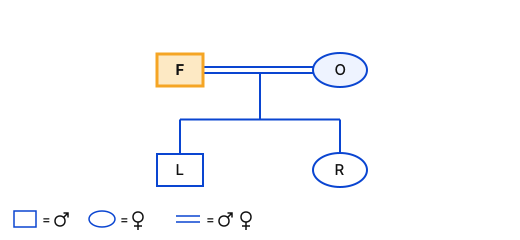
In a certain code language,
A + B means ‘A is the son of B’
A – B means ‘A is the brother of B’
A @ B means ‘A is the daughter of B’
A # B means ‘A is the father of B’
Based on the above, how is F related to O if ‘F # L – R @ O’?
एक निश्चित कूट भाषा में,
A + B का अर्थ है ‘A, B का पुत्र है’
A – B का अर्थ है ‘A, B का भाई है’
A @ B का अर्थ है ‘A, B की पुत्री है’
A # B का अर्थ है ‘A, B का पिता है’
उपर्युक्त के आधार पर, यदि ‘F # L – R @ O’ है, तो F का O से क्या संबंध है?
  1. AFatherपिता
  2. BHusbandपति
  3. CBrotherभाई
  4. DSonपुत्र
Show answer

Concept: Decode each symbol left to right and join the relations.

  1. F # L → F is father of L
  2. L – R → L is brother of R; so F is also father of R
  3. R @ O → R is daughter of O; O is the other parent (mother)
  4. F (father of R) is the husband of O

Trick: Both F and O are parents of the same child; F is male ⇒ husband.

Answer: (B) Husband

अवधारणा: हर चिह्न को बाएँ से दाएँ डिकोड करके संबंध जोड़ें।

हल:

  1. F # L → F, L का पिता
  2. L – R → L, R का भाई; अतः F, R का भी पिता
  3. R @ O → R, O की बेटी; O माँ है
  4. F, O का पति है

ट्रिक: F और O एक ही बच्चे के माता-पिता हैं; F पुरुष ⇒ पति।

उत्तर: (B) पति

RRB Technician Grade IIIGeneral Intelligence and ReasoningCoded blood relationsRRB Technician Grade III 2025 · 6 Mar Shift 2 →
Q3027.
What will come in the place of ‘?’ in the following equation, if ‘+’ and ‘-’ are interchanged and ‘x’ and ‘÷’ are interchanged?
6 ÷ 2 + 24 x 6 - 4 = ?
यदि ‘+’ और ‘-’ को आपस में बदल दिया जाए तथा ‘x’ और ‘÷’ को आपस में बदल दिया जाए, तो निम्नलिखित समीकरण में ‘?’ के स्थान पर क्या आएगा?
6 ÷ 2 + 24 x 6 - 4 = ?
  1. A12
  2. B16
  3. C10
  4. D14
Show answer

Concept: Swap the signs first, then apply BODMAS.

  1. 6÷2+24×6−4 becomes 6×2−24÷6+4
  2. =12−4+4
  3. =12

Trick: Rewrite the whole expression before calculating — avoids sign mistakes.

Answer: (A) 12

अवधारणा: पहले चिह्न बदलें, फिर BODMAS लगाएँ।

हल:

  1. 6÷2+24×6−4 → 6×2−24÷6+4
  2. =12−4+4
  3. =12

ट्रिक: गणना से पहले पूरा व्यंजक नए चिह्नों के साथ लिखें।

उत्तर: (A) 12

RRB Technician Grade IIIGeneral Intelligence and ReasoningMathematical operations – interchange of signsRRB Technician Grade III 2025 · 6 Mar Shift 2 →
Q3028.
In a certain code language, ‘door closed now’ is coded as ‘vt xg uk’ and ‘school is closed’ is coded as ‘cw uk ne’. How is ‘closed’ coded in the given language? (All the codes are two letter codes only.)
एक निश्चित कूट भाषा में, ‘door closed now’ को ‘vt xg uk’ के रूप में कूटबद्ध किया जाता है और ‘school is closed’ को ‘cw uk ne’ के रूप में कूटबद्ध किया जाता है। उस भाषा में ‘closed’ को किस प्रकार कूटबद्ध किया जाता है? (सभी कूट केवल दो अक्षरों वाले कूट हैं।)
  1. Ane
  2. Bxg
  3. Cvt
  4. Duk
Show answer

Concept: A word common to two sentences has the code common to both.

  1. 'closed' is in both: door closed now / school is closed
  2. Common code in vt xg uk and cw uk ne = uk

Trick: Common word ↔ common code.

Answer: (D) uk

अवधारणा: दोनों वाक्यों में समान शब्द का कोड भी समान होगा।

हल:

  1. 'closed' दोनों वाक्यों में है
  2. vt xg uk और cw uk ne में समान कोड = uk

ट्रिक: समान शब्द ↔ समान कोड।

उत्तर: (D) uk

RRB Technician Grade IIIGeneral Intelligence and ReasoningCoding – common word methodRRB Technician Grade III 2025 · 6 Mar Shift 2 →
Q3029.
What should come in place of ‘?’ in the given series?
44 52 61 71 82 ?
दी गई श्रृंखला में ‘?’ के स्थान पर क्या आना चाहिए?
44 52 61 71 82 ?
  1. A92
  2. B94
  3. C96
  4. D98
Show answer

Concept: Look at the differences between consecutive terms.

  1. 52 − 44 = 8, 61 − 52 = 9, 71 − 61 = 10, 82 − 71 = 11
  2. Next difference = 12 ⇒ 82 + 12 = 94

Trick: Differences +8, +9, +10, +11, +12.

Answer: (B) 94

अवधारणा: क्रमागत पदों का अंतर देखें।

हल:

  1. अंतर: 8, 9, 10, 11
  2. अगला अंतर 12 ⇒ 82 + 12 = 94

ट्रिक: अंतर +8, +9, +10, +11, +12.

उत्तर: (B) 94

RRB Technician Grade IIIGeneral Intelligence and ReasoningNumber series – increasing differencesRRB Technician Grade III 2025 · 6 Mar Shift 2 →
Q3030.
The position(s) of how many letters will remain unchanged if each letter in the word COMBINED is arranged in the English alphabetical order?
यदि शब्द COMBINED के प्रत्येक अक्षर को अंग्रेज़ी वर्णमाला क्रम में व्यवस्थित किया जाए, तो कितने अक्षरों का स्थान अपरिवर्तित रहेगा?
  1. AOneएक
  2. BTwoदो
  3. CThreeतीन
  4. DNoneएक भी नहीं
Show answer

Concept: Write the word and its alphabetical arrangement one below the other and compare position-wise.

  1. COMBINED: C O M B I N E D
  2. Sorted: B C D E I M N O
  3. Only the 5th letter I stays in the same place

Trick: Compare letter by letter in two rows — fastest way to spot matches.

Answer: (A) One

अवधारणा: शब्द और उसकी वर्णानुक्रम व्यवस्था एक के नीचे एक लिखकर स्थान मिलाएँ।

हल:

  1. COMBINED: C O M B I N E D
  2. क्रम में: B C D E I M N O
  3. केवल 5वाँ अक्षर I अपनी जगह पर रहता है

ट्रिक: दो पंक्तियों में लिखकर मिलान करें।

उत्तर: (A) एक

RRB Technician Grade IIIGeneral Intelligence and ReasoningLetter arrangement – alphabetical orderRRB Technician Grade III 2025 · 6 Mar Shift 2 →
Q3031.
Select the set in which the numbers are related in the same way as are the numbers of the following sets.
(Note: Operations should be performed on the whole numbers, without breaking down the numbers into their constituent digits. E.g. 13 – Operations on 13 such as
adding/subtracting/multiplying to 13 can be performed. Breaking down 13 into 1 and 3 and then performing mathematical operations on 1 and 3 is not allowed.)
(5, 12, 28)
(4, 11, 26)
उस समुच्चय का चयन कीजिए जिसमें संख्याएँ उसी प्रकार संबंधित हैं, जिस प्रकार निम्नलिखित समुच्चयों की संख्याएँ संबंधित हैं।
(ध्यान दें: संक्रियाएँ संख्याओं को उनके घटक अंकों में तोड़े बिना, पूर्ण संख्याओं पर की जानी चाहिए। उदाहरण के लिए 13 – 13 पर संक्रियाएँ जैसे
13 में जोड़ना/घटाना/गुणा करना आदि की जा सकती हैं। 13 को 1 और 3 में तोड़कर फिर 1 और 3 पर गणितीय संक्रियाएँ करने की अनुमति नहीं है।)
(5, 12, 28)
(4, 11, 26)
  1. A(7, 16, 36)
  2. B(8, 19, 42)
  3. C(3, 10, 16)
  4. D(6, 13, 30)
Show answer

Concept: Find the rule: 2nd = 1st + 7, 3rd = 2 × 2nd + 4.

  1. (5, 12, 28): 5+7=12, 12×2+4=28
  2. (4, 11, 26): 4+7=11, 11×2+4=26
  3. (6, 13, 30): 6+7=13, 13×2+4=30 ✓

Trick: Check the easy step first (+7): only (6, 13) and (3, 10) pass; then 10×2+4=24≠16.

Answer: (D) (6, 13, 30)

अवधारणा: नियम: दूसरा = पहला + 7, तीसरा = 2 × दूसरा + 4।

हल:

  1. (5, 12, 28): 12×2+4=28
  2. (4, 11, 26): 11×2+4=26
  3. (6, 13, 30): 6+7=13, 13×2+4=30 ✓

ट्रिक: पहले आसान चरण (+7) जाँचें — केवल (6, 13) और (3, 10) बचते हैं; 10×2+4=24≠16.

उत्तर: (D) (6, 13, 30)

RRB Technician Grade IIIGeneral Intelligence and ReasoningNumber analogy – setsRRB Technician Grade III 2025 · 6 Mar Shift 2 →
Q3032.
Refer to the following letter series and answer the question that follows. Counting to be done from left to right.
(Left) D U A L J X E I H R S B W P K T C V M F Y (Right)
How many such vowels are there, each of which is immediately preceded by a consonant and also immediately followed by a vowel?
निम्नलिखित अक्षर श्रृंखला को देखिए और उसके बाद दिए गए प्रश्न का उत्तर दीजिए। गिनती बाएँ से दाएँ की जानी है।
(बाएँ) D U A L J X E I H R S B W P K T C V M F Y (दाएँ)
ऐसे कितने स्वर हैं, जिनमें से प्रत्येक के ठीक पहले एक व्यंजन है और ठीक बाद एक स्वर भी है?
  1. AOneएक
  2. BThreeतीन
  3. CTwoदो
  4. DNoneएक भी नहीं
Show answer

Concept: Locate vowels and check the letter before and after each.

  1. Vowels: U, A, E, I
  2. U: D (consonant) before, A (vowel) after ✓; A: U before ✗
  3. E: X before, I after ✓; I: E before ✗
  4. Count = 2

Trick: Only vowels sitting in pairs (UA, EI) can qualify — take the first of each pair.

Answer: (C) Two

अवधारणा: स्वर ढूँढकर उसके पहले और बाद का अक्षर देखें।

हल:

  1. स्वर: U, A, E, I
  2. U: पहले D (व्यंजन), बाद में A (स्वर) ✓; A: पहले U ✗
  3. E: पहले X, बाद में I ✓; I ✗
  4. कुल = 2

ट्रिक: स्वर जोड़ों (UA, EI) का पहला स्वर ही शर्त पूरी करता है।

उत्तर: (C) दो

RRB Technician Grade IIIGeneral Intelligence and ReasoningLetter series – vowel/consonant conditionsRRB Technician Grade III 2025 · 6 Mar Shift 2 →
Q3033.
Based on the English alphabetical order, three of the following four letter-cluster pairs are alike in a certain way and thus form a group. Which letter-cluster pair DOES NOT belong to that group?
(Note: The odd one out is not based on the number of consonants/vowels or their position in the letter-cluster.)
अंग्रेज़ी वर्णमाला क्रम के आधार पर, निम्नलिखित चार अक्षर-समूह युग्मों में से तीन किसी निश्चित प्रकार से एकसमान हैं और इस प्रकार एक समूह बनाते हैं। कौन-सा अक्षर-समूह युग्म उस समूह से संबंधित नहीं है?
(ध्यान दें: असंगत अक्षर-समूह, उस अक्षर-समूह में व्यंजनों/स्वरों की संख्या या उनके स्थान पर आधारित नहीं है।)
  1. AAE - FB
  2. BWH - BD
  3. CGQ - LN
  4. DQK - VH
Show answer

Concept: Pattern: 1st letter +5, 2nd letter −3.

  1. AE – FB: A+5 = F, E−3 = B ✓
  2. GQ – LN ✓; QK – VH ✓
  3. WH – BD: W+5 = B, but H−3 = E, not D ✗

Trick: Use positions: A1, E5, F6, B2; W23 → 28 → 2 = B.

Answer: (B) WH - BD

अवधारणा: पैटर्न: पहला अक्षर +5, दूसरा −3।

हल:

  1. AE – FB: A+5 = F, E−3 = B ✓
  2. GQ – LN ✓; QK – VH ✓
  3. WH – BD: H−3 = E होना चाहिए, D नहीं ✗

ट्रिक: अक्षर स्थान याद रखें: E5, H8, W23.

उत्तर: (B) WH - BD

RRB Technician Grade IIIGeneral Intelligence and ReasoningLetter-cluster pairs – odd one outRRB Technician Grade III 2025 · 6 Mar Shift 2 →
Q3034.
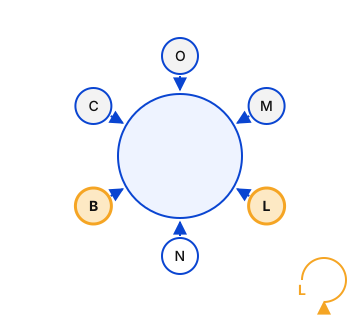
Six friends B, C, L, M, N and O are sitting around a circular table facing the center of the table. L sits fourth to the right of O. Only one person sits between M and N when counted from the left of M. L sits third to the left of C. B is an immediate neighbor of C and N. How many people sit between L and B when counted from the left of B?
छह मित्र B, C, L, M, N और O एक वृत्ताकार मेज़ के चारों ओर मेज़ के केंद्र की ओर मुख करके बैठे हैं। L, O के दाएँ से चौथे स्थान पर बैठा है। M के बाएँ से गिनने पर M और N के बीच केवल एक व्यक्ति बैठा है। L, C के बाएँ से तीसरे स्थान पर बैठा है। B, C और N का निकटतम पड़ोसी है। B के बाएँ से गिनने पर L और B के बीच कितने व्यक्ति बैठे हैं?
  1. ATwoदो
  2. BOneएक
  3. CThreeतीन
  4. DFourचार
Show answer

Concept: Fix one person, then place others step by step (6 seats; facing centre).

  1. Place O. L is 4th to the right of O (= 2nd to the left)
  2. C is 3rd to the right of L — directly opposite L, next to O
  3. B is next to C and N ⇒ B, N follow C; M takes the last seat (M–L–N check ✓)
  4. Going left from B: C, O, M, then L ⇒ 3 people

Trick: In a 6-seat circle, 3rd to the left = 3rd to the right (opposite seat).

Answer: (C) Three

अवधारणा: एक व्यक्ति को स्थिर कर बाकी को क्रम से बैठाएँ (6 सीटें, केंद्र की ओर मुख)।

हल:

  1. O को बैठाएँ; L, O के दाएँ चौथा (= बाएँ दूसरा)
  2. C, L से ठीक सामने (O के पास)
  3. B, C और N के बीच; M बची सीट पर (M और N के बीच L ✓)
  4. B के बाएँ से: C, O, M फिर L ⇒ 3 व्यक्ति

ट्रिक: 6 सीटों में तीसरा बाएँ = तीसरा दाएँ (ठीक सामने)।

उत्तर: (C) तीन

RRB Technician Grade IIIGeneral Intelligence and ReasoningCircular seating arrangementRRB Technician Grade III 2025 · 6 Mar Shift 2 →
Q3035.
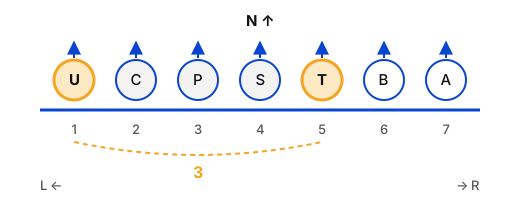
A, B, C, P, S, T and U are sitting in a straight line facing the north. Only three people are seated to the left of S. Only A is seated to the right of B. Only three people are seated between B and C. P is seated at some place to the left of T, but at some place to the right of U. How many people are seated between U and T?
A, B, C, P, S, T और U एक सीधी पंक्ति में उत्तर की ओर मुख करके बैठे हैं। S के बाईं ओर केवल तीन व्यक्ति बैठे हैं। B के दाईं ओर केवल A बैठा है। B और C के बीच केवल तीन व्यक्ति बैठे हैं। P, T के बाईं ओर किसी स्थान पर, लेकिन U के दाईं ओर किसी स्थान पर बैठा है। U और T के बीच कितने व्यक्ति बैठे हैं?
  1. AThreeतीन
  2. BTwoदो
  3. COneएक
  4. DFourचार
Show answer

Concept: Use the definite clues first (7 seats, facing north).

  1. S has 3 to the left ⇒ S = 4th
  2. Only A to the right of B ⇒ B = 6th, A = 7th
  3. 3 between B and C ⇒ C = 2nd
  4. U, P, T fill 1st, 3rd, 5th in that order ⇒ between U(1) and T(5): C, P, S = 3

Trick: Start with 'only'-type clues — they fix exact seats.

Answer: (A) Three

अवधारणा: पहले निश्चित संकेत लगाएँ (7 सीटें, उत्तर की ओर मुख)।

हल:

  1. S के बाएँ 3 ⇒ S = 4था
  2. B के दाएँ केवल A ⇒ B = 6, A = 7
  3. B और C के बीच 3 ⇒ C = 2
  4. U, P, T = 1, 3, 5 ⇒ U और T के बीच C, P, S = 3

ट्रिक: 'केवल' वाले संकेत सबसे पहले — सीट तय कर देते हैं।

उत्तर: (A) तीन

RRB Technician Grade IIIGeneral Intelligence and ReasoningLinear seating arrangementRRB Technician Grade III 2025 · 6 Mar Shift 2 →
Q3036.
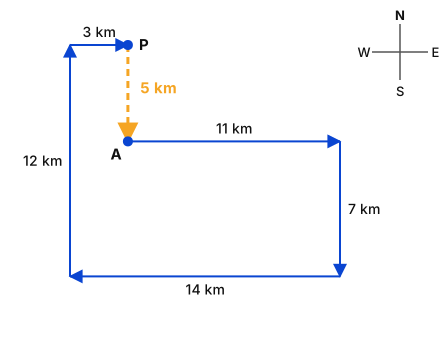
Ankur starts from Point A and drives 11 km towards east. He then takes a right turn, drives 7 km, turns right and drives 14 km. He then takes a right turn and drives 12 km. He takes a final right turn, drives 3 km and stops at Point P. How far (shortest distance) and towards which direction should he drive in order to reach Point A again?
(All turns are 90° turns only unless specified.)
अंकुर बिंदु A से चलना आरंभ करता है और पूर्व की ओर 11 km गाड़ी चलाता है। फिर वह दाएँ मुड़ता है, 7 km गाड़ी चलाता है, दाएँ मुड़ता है और 14 km गाड़ी चलाता है। फिर वह दाएँ मुड़ता है और 12 km गाड़ी चलाता है। वह अंतिम बार दाएँ मुड़ता है, 3 km गाड़ी चलाता है और बिंदु P पर रुक जाता है। बिंदु A पर पुनः पहुँचने के लिए उसे कितनी दूरी (न्यूनतम दूरी) तक और किस दिशा में गाड़ी चलानी चाहिए?
(जब तक निर्दिष्ट न किया जाए, सभी मोड़ केवल 90° के मोड़ हैं।)
  1. A5 km to the southदक्षिण की ओर 5 km
  2. B4 km to the northउत्तर की ओर 4 km
  3. C5 km to the northउत्तर की ओर 5 km
  4. D4 km to the southदक्षिण की ओर 4 km
Show answer

Concept: Track net east–west and north–south displacement.

  1. East 11 → right: South 7 → right: West 14 → right: North 12 → right: East 3
  2. East–West: 11 − 14 + 3 = 0
  3. North–South: −7 + 12 = 5 km north of A
  4. To return: 5 km to the south

Trick: Four right turns bring you back to the starting direction (East).

Answer: (A) 5 km to the south

अवधारणा: कुल पूर्व–पश्चिम और उत्तर–दक्षिण विस्थापन निकालें।

हल:

  1. पूर्व 11 → दाएँ: दक्षिण 7 → दाएँ: पश्चिम 14 → दाएँ: उत्तर 12 → दाएँ: पूर्व 3
  2. पूर्व–पश्चिम: 11 − 14 + 3 = 0
  3. उत्तर–दक्षिण: 12 − 7 = 5 km उत्तर
  4. वापसी: 5 km दक्षिण

ट्रिक: चार बार दायाँ मुड़ने पर फिर से पूर्व दिशा।

उत्तर: (A) दक्षिण की ओर 5 km

RRB Technician Grade IIIGeneral Intelligence and ReasoningDirection senseRRB Technician Grade III 2025 · 6 Mar Shift 2 →
Q3037.
What should come in place of ? in the given series based on the English alphabetical order?
LPF KOE JND IMC ?
अंग्रेज़ी वर्णमाला क्रम के आधार पर दी गई श्रृंखला में ? के स्थान पर क्या आना चाहिए?
LPF KOE JND IMC ?
  1. AHLA
  2. BHKA
  3. CHLB
  4. DHKB
Show answer

Concept: Each letter position moves one step back.

  1. 1st: L K J I → H
  2. 2nd: P O N M → L
  3. 3rd: F E D C → B

Trick: Every letter −1 ⇒ IMC − 1 = HLB.

Answer: (C) HLB

अवधारणा: हर स्थान का अक्षर एक कदम पीछे जाता है।

हल:

  1. पहला: L K J I → H
  2. दूसरा: P O N M → L
  3. तीसरा: F E D C → B

ट्रिक: हर अक्षर −1 ⇒ IMC → HLB.

उत्तर: (C) HLB

RRB Technician Grade IIIGeneral Intelligence and ReasoningLetter series – positional patternRRB Technician Grade III 2025 · 6 Mar Shift 2 →
Q3038.
Each letter in the word DANGEROUS is arranged in alphabetical order. How many letters are there in the English alphabetical order between the letter which is fourth from the left and the one which is fourth from the right in the new letter cluster thus formed?
शब्द DANGEROUS के प्रत्येक अक्षर को वर्णमाला क्रम में व्यवस्थित किया जाता है। इस प्रकार बने नए अक्षर-समूह में बाएँ से चौथे अक्षर और दाएँ से चौथे अक्षर के बीच अंग्रेज़ी वर्णमाला क्रम में कितने अक्षर हैं?
  1. A8
  2. B6
  3. C9
  4. D7
Show answer

Concept: Arrange, pick the letters, then count letters strictly between them.

  1. DANGEROUS → A D E G N O R S U
  2. 4th from left = G; 4th from right = O
  3. Between G(7) and O(15): 15 − 7 − 1 = 7 letters (H to N)

Trick: Letters between = difference of positions − 1.

Answer: (D) 7

अवधारणा: क्रम में लगाकर अक्षर चुनें, फिर बीच के अक्षर गिनें।

हल:

  1. DANGEROUS → A D E G N O R S U
  2. बाएँ से 4था = G; दाएँ से 4था = O
  3. G(7) और O(15) के बीच: 15 − 7 − 1 = 7

ट्रिक: बीच के अक्षर = स्थानों का अंतर − 1.

उत्तर: (D) 7

RRB Technician Grade IIIGeneral Intelligence and ReasoningAlphabetical arrangement – letters betweenRRB Technician Grade III 2025 · 6 Mar Shift 2 →
Q3039.
Refer to the following series and answer the question (All numbers are single-digit numbers only. Counting is to be done from left to right.)
(Left) 7 9 8 5 1 8 4 3 5 6 9 7 4 5 2 4 1 3 4 8 7 6 4 (Right)
How many such odd digits are there each of which is immediately preceded by an even digit and also immediately followed by an odd digit?
निम्नलिखित श्रृंखला को देखिए और प्रश्न का उत्तर दीजिए (सभी संख्याएँ केवल एक अंक वाली संख्याएँ हैं। गिनती बाएँ से दाएँ की जानी है।)
(बाएँ) 7 9 8 5 1 8 4 3 5 6 9 7 4 5 2 4 1 3 4 8 7 6 4 (दाएँ)
ऐसे कितने विषम अंक हैं, जिनमें से प्रत्येक के ठीक पहले एक सम अंक है और ठीक बाद एक विषम अंक भी है?
  1. AMore than threeतीन से अधिक
  2. BTwoदो
  3. CThreeतीन
  4. DOneएक
Show answer

Concept: Check every odd digit: previous even AND next odd.

  1. 8 5 1 ✓; 4 3 5 ✓; 6 9 7 ✓; 4 1 3 ✓
  2. Fail: 4 5 2 (next even), 8 7 6 (next even)
  3. Count = 4 ⇒ more than three

Trick: Scan for an even digit followed by two odd digits (even–odd–odd).

Answer: (A) More than three

अवधारणा: हर विषम अंक जाँचें: पहले सम और बाद में विषम।

हल:

  1. 8 5 1 ✓; 4 3 5 ✓; 6 9 7 ✓; 4 1 3 ✓
  2. असफल: 4 5 2, 8 7 6
  3. कुल = 4 ⇒ तीन से अधिक

ट्रिक: सम–विषम–विषम का पैटर्न खोजें।

उत्तर: (A) तीन से अधिक

RRB Technician Grade IIIGeneral Intelligence and ReasoningNumber series – digit conditionsRRB Technician Grade III 2025 · 6 Mar Shift 2 →
Q3040.
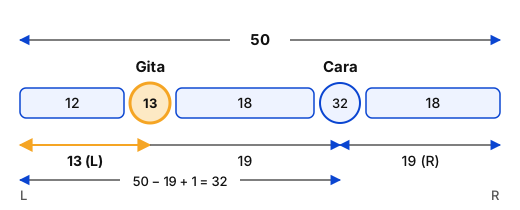
In a row of 50 people facing north, Cara is 19th from the right end. If Gita sits 19th to the left of Cara, what is Gita’s position from the left end of the line?
उत्तर की ओर मुख करके बैठे 50 व्यक्तियों की एक पंक्ति में, कारा दाएँ छोर से 19वें स्थान पर है। यदि गीता, कारा के बाएँ से 19वें स्थान पर बैठी है, तो पंक्ति के बाएँ छोर से गीता का स्थान क्या है?
  1. A13th13वाँ
  2. B14th14वाँ
  3. C15th15वाँ
  4. D16th16वाँ
Show answer

Concept: Position from left = Total − position from right + 1.

  1. Cara from left = 50 − 19 + 1 = 32nd
  2. Gita is 19 places to her left ⇒ 32 − 19 = 13th

Trick: Convert to one end first, then move.

Answer: (A) 13th

अवधारणा: बाएँ से स्थान = कुल − दाएँ से स्थान + 1।

हल:

  1. Cara बाएँ से = 50 − 19 + 1 = 32वाँ
  2. Gita 19 स्थान बाएँ ⇒ 32 − 19 = 13वाँ

ट्रिक: पहले एक ही छोर से स्थान बदलें, फिर आगे बढ़ें।

उत्तर: (A) 13वाँ

RRB Technician Grade IIIGeneral Intelligence and ReasoningRanking and position in a rowRRB Technician Grade III 2025 · 6 Mar Shift 2 →