Question bank

Q&A: practice questions with answers

Search questions on any topic. Filter by exam category, exam, subject and topic, try the question, then open the answer and explanation.

Courses – airGurukul

900 questions found.

Q41.
Select the pair which follows the same pattern as that followed by the two pairs given below. Both pairs follow the same pattern.
GAU : JDX
REF : UHI
उस युग्म का चयन कीजिए जो उसी पैटर्न का अनुसरण करता है जिसका अनुसरण नीचे दिए गए दो युग्मों द्वारा किया गया है। दोनों युग्म एक ही पैटर्न का अनुसरण करते हैं।
GAU : JDX
REF : UHI
  1. AZTD : CWH
  2. BQEW : SGY
  3. CSYI : UZL
  4. DCNH : FQK
Show answer

Concept: Each letter of the first group +3 gives the second group.

  1. GAU → JDX and REF → UHI: every letter +3
  2. CNH → C+3 F, N+3 Q, H+3 K = FQK ✓
  3. ZTD → CWG (not CWH); QEW, SYI fail

Trick: Check the first letter only: Z→C, Q→T, S→V, C→F; then confirm the rest — only CNH : FQK fully matches.

Answer: (D) CNH : FQK

अवधारणा: पहले समूह का हर अक्षर +3 करने पर दूसरा समूह।

  1. GAU → JDX और REF → UHI: हर अक्षर +3
  2. CNH → F, Q, K = FQK ✓
  3. ZTD → CWG होना चाहिए (CWH नहीं); QEW, SYI गलत

ट्रिक: हर विकल्प के तीनों अक्षर +3 करके मिलाएँ — केवल CNH : FQK पूरा मेल खाता है।

उत्तर: (D) CNH : FQK
RRB Technician Grade IIIGeneral Intelligence and ReasoningLetter pair pattern – +3 shiftRRB Technician Grade III 2026 · 10 Mar Shift 3 →
Q42.
What will come in the place of ‘?’ in the following equation, if ‘+’ and ‘-’ are interchanged and ‘x’ and ‘÷’ are interchanged?
8 ÷ 2 + 14 x 7 - 7 = ?
यदि ‘+’ और ‘-’ को आपस में बदल दिया जाए तथा ‘x’ और ‘÷’ को आपस में बदल दिया जाए, तो निम्नलिखित समीकरण में ‘?’ के स्थान पर क्या आएगा?
8 ÷ 2 + 14 x 7 - 7 = ?
  1. A12
  2. B18
  3. C14
  4. D21
Show answer

Concept: Swap the signs first, then apply BODMAS.

  1. After swapping: 8×2−14÷7+7
  2. =16−2+7
  3. =21

Trick: Rewrite the full expression with new signs before calculating — avoids mix-ups.

Answer: (D) 21

अवधारणा: पहले चिह्न बदलें, फिर BODMAS लगाएँ।

  1. बदलने के बाद: 8×2−14÷7+7
  2. =16−2+7
  3. =21

ट्रिक: गणना से पहले पूरा व्यंजक नए चिह्नों के साथ लिख लें — गलती नहीं होगी।

उत्तर: (D) 21

RRB Technician Grade IIIGeneral Intelligence and ReasoningMathematical operations – interchange of signsRRB Technician Grade III 2026 · 10 Mar Shift 3 →
Q43.
If ‘P’ stands for ‘×’, ‘Q’ stands for ‘÷’, ‘R’ stands for ‘−’ and ‘S’ stands for ‘+’, then what will come in place of the question mark (?) in the following equation?
53 R 61 S 96 P 3 Q 2 S 28 P 6 R 99 Q 3 S 32 = ?
यदि ‘P’ का अर्थ ‘×’, ‘Q’ का अर्थ ‘÷’, ‘R’ का अर्थ ‘−’ और ‘S’ का अर्थ ‘+’ है, तो निम्नलिखित समीकरण में प्रश्न चिह्न (?) के स्थान पर क्या आएगा?
53 R 61 S 96 P 3 Q 2 S 28 P 6 R 99 Q 3 S 32 = ?
  1. A348
  2. B303
  3. C365
  4. D328
Show answer

Concept: Replace letters by signs and use BODMAS.

  1. 53−61+96×3÷2+28×6−99÷3+32
  2. =53−61+144+168−33+32
  3. =329−26=303

Trick: Add all positives (53+144+168+32=397) and negatives (61+33=94) separately: 397−94=303.

Answer: (B) 303

अवधारणा: अक्षरों की जगह चिह्न रखें और BODMAS लगाएँ।

  1. 53−61+96×3÷2+28×6−99÷3+32
  2. =53−61+144+168−33+32
  3. =303

ट्रिक: धनात्मक (53+144+168+32=397) और ऋणात्मक (61+33=94) अलग जोड़ें: 397−94=303।

उत्तर: (B) 303

RRB Technician Grade IIIGeneral Intelligence and ReasoningMathematical operations – letter codingRRB Technician Grade III 2026 · 10 Mar Shift 3 →
Q44.
Refer to the following letter series and answer the question that follows. Counting to be done from left to right.
(Left) S I C X Z O A K L N T E W A Q D F H G U K O (Right)
How many such consonants are there, each of which is immediately preceded by a vowel and also immediately followed by a vowel?
निम्नलिखित अक्षर श्रृंखला को देखिए और उसके बाद दिए गए प्रश्न का उत्तर दीजिए। गिनती बाएँ से दाएँ की जानी है।
(बाएँ) S I C X Z O A K L N T E W A Q D F H G U K O (दाएँ)
ऐसे कितने व्यंजन हैं, जिनमें से प्रत्येक के ठीक पहले एक स्वर है और ठीक बाद में भी एक स्वर है?
  1. ANoneकोई नहीं
  2. BThreeतीन
  3. COneएक
  4. DTwoदो
Show answer

Concept: Look for the pattern vowel – CONSONANT – vowel.

  1. Vowels in series: I, O, A, E, A, U, O
  2. E W A → W ✓
  3. U K O → K ✓
  4. Others fail (e.g. A K L, A Q D) → total 2

Trick: Start from each vowel and see if the letter after next is also a vowel.

Answer: (D) Two

अवधारणा: पैटर्न खोजें: स्वर – व्यंजन – स्वर।

  1. श्रृंखला में स्वर: I, O, A, E, A, U, O
  2. E W A → W ✓
  3. U K O → K ✓
  4. बाकी गलत (जैसे A K L, A Q D) → कुल 2

ट्रिक: हर स्वर से शुरू करके देखें कि दो अक्षर बाद भी स्वर है या नहीं।

उत्तर: (D) दो

RRB Technician Grade IIIGeneral Intelligence and ReasoningLetter series – vowel–consonant–vowelRRB Technician Grade III 2026 · 10 Mar Shift 3 →
Q45.
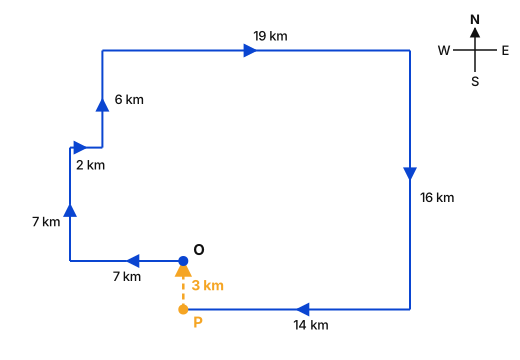
Mr. Ok starts from Point O and drives 7 km towards the west. He then takes a right turn, drives 7 km, turns right and drives 2 km. He then takes a left turn and drives 6 km. He then takes a right turn and drives 19 km. He then takes a right turn and drives 16 km. He then takes a final right turn, drives 14 km and stops at Point P. How far (shortest distance) and towards which direction should he drive in order to reach Point O again? (All turns are 90 degrees turns only unless specified.)
श्री Ok बिंदु O से चलना प्रारंभ करते हैं और पश्चिम की ओर 7 km गाड़ी चलाते हैं। फिर वे दाएँ मुड़ते हैं, 7 km गाड़ी चलाते हैं, दाएँ मुड़ते हैं और 2 km गाड़ी चलाते हैं। फिर वे बाएँ मुड़ते हैं और 6 km गाड़ी चलाते हैं। फिर वे दाएँ मुड़ते हैं और 19 km गाड़ी चलाते हैं। फिर वे दाएँ मुड़ते हैं और 16 km गाड़ी चलाते हैं। फिर वे अंतिम बार दाएँ मुड़ते हैं, 14 km गाड़ी चलाते हैं और बिंदु P पर रुक जाते हैं। पुनः बिंदु O पर पहुँचने के लिए उन्हें कितनी दूरी (न्यूनतम दूरी) तक और किस दिशा में गाड़ी चलानी चाहिए? (जब तक निर्दिष्ट न किया जाए, सभी मोड़ केवल 90 डिग्री के मोड़ हैं।)
  1. A4 km towards Southदक्षिण की ओर 4 km
  2. B4 km towards Eastपूर्व की ओर 4 km
  3. C3 km towards Northउत्तर की ओर 3 km
  4. D3 km towards Westपश्चिम की ओर 3 km
Show answer

Concept: Add East–West and North–South moves separately.

  1. Path: W 7, N 7, E 2, N 6, E 19, S 16, W 14
  2. E–W: −7 + 2 + 19 − 14 = 0
  3. N–S: 7 + 6 − 16 = −3 → P is 3 km south of O
  4. Go 3 km towards north

Trick: E–W cancels exactly, so only N–S (13 − 16) matters.

Answer: (C) 3 km towards North

अवधारणा: पूर्व–पश्चिम और उत्तर–दक्षिण गतियाँ अलग-अलग जोड़ें।

  1. मार्ग: पश्चिम 7, उत्तर 7, पूर्व 2, उत्तर 6, पूर्व 19, दक्षिण 16, पश्चिम 14
  2. पूर्व–पश्चिम: −7 + 2 + 19 − 14 = 0
  3. उत्तर–दक्षिण: 7 + 6 − 16 = −3 → P, O से 3 km दक्षिण
  4. 3 km उत्तर की ओर जाना

ट्रिक: पूर्व–पश्चिम शून्य, केवल उत्तर–दक्षिण (13 − 16) देखें।

उत्तर: (C) उत्तर की ओर 3 km

RRB Technician Grade IIIGeneral Intelligence and ReasoningDirection sense – net displacementRRB Technician Grade III 2026 · 10 Mar Shift 3 →
Q46.
In a certain code language, ‘mind your business’ is coded as ‘gv tr fy’ and ‘your turn now’ is coded as ‘cb gv kq’. How is ‘your’ coded in the given language? (All the codes are two-letter codes only.)
एक निश्चित कूट भाषा में, ‘mind your business’ को ‘gv tr fy’ लिखा जाता है और ‘your turn now’ को ‘cb gv kq’ लिखा जाता है। उसी भाषा में ‘your’ को किस प्रकार लिखा जाएगा? (सभी कूट केवल दो अक्षरों वाले कूट हैं।)
  1. Afy
  2. Bgv
  3. Ctr
  4. Dkq
Show answer

Concept: The word common to both sentences has the common code.

  1. 'mind your business' → gv tr fy
  2. 'your turn now' → cb gv kq
  3. Common word 'your' = common code gv

Trick: Spot the code present in both lines: gv.

Answer: (B) gv

अवधारणा: दोनों वाक्यों के समान शब्द का कोड भी समान होगा।

  1. 'mind your business' → gv tr fy
  2. 'your turn now' → cb gv kq
  3. समान शब्द 'your' = समान कोड gv

ट्रिक: दोनों पंक्तियों में आने वाला कोड: gv।

उत्तर: (B) gv

RRB Technician Grade IIIGeneral Intelligence and ReasoningCoding–decoding – common wordRRB Technician Grade III 2026 · 10 Mar Shift 3 →
Q47.
Based on the English alphabetical order, three of the following four letter-cluster pairs are alike in a certain way and thus form a group. Which letter-cluster pair DOES NOT belong to that group?
(Note: The odd one out is not based on the number of consonants/vowels or their position in the letter-cluster.)
अंग्रेज़ी वर्णमाला क्रम के आधार पर, निम्नलिखित चार अक्षर-समूह युग्मों में से तीन किसी निश्चित प्रकार से एक समान हैं और इस प्रकार एक समूह बनाते हैं। कौन-सा अक्षर-समूह युग्म उस समूह से संबंधित नहीं है?
(ध्यान दें: असंगत युग्म, अक्षर-समूह में व्यंजनों/स्वरों की संख्या या उनके स्थान पर आधारित नहीं है।)
  1. ADF−BD
  2. BOQ−MO
  3. CUW−SU
  4. DIK−FK
Show answer

Concept: Find the shift rule followed by three pairs.

  1. DF − BD: −2, −2
  2. OQ − MO: −2, −2; UW − SU: −2, −2
  3. IK − FK: −3, 0 → odd one

Trick: In the other pairs the 2nd cluster's last letter = 1st cluster's first letter (DF−BD, OQ−MO); IK−FK breaks it.

Answer: (D) IK−FK

अवधारणा: तीन जोड़ों का समान खिसकाव नियम खोजें।

  1. DF − BD: −2, −2
  2. OQ − MO: −2, −2; UW − SU: −2, −2
  3. IK − FK: −3, 0 → अलग

ट्रिक: बाकी में दूसरे समूह का अंतिम अक्षर = पहले समूह का पहला अक्षर (DF−BD, OQ−MO); IK−FK में नहीं।

उत्तर: (D) IK−FK

RRB Technician Grade IIIGeneral Intelligence and ReasoningOdd one out – letter pairsRRB Technician Grade III 2026 · 10 Mar Shift 3 →
Q48.
Seven boxes A, B, C, D, E, F and G are kept one over the other but not necessarily in the same order. C is not kept below G. Only five boxes are kept below E. Only one box is kept between C and E. B is kept above A but below G. F is not the topmost box. Which box is kept immediately below F?
सात डिब्बे A, B, C, D, E, F और G एक के ऊपर एक रखे गए हैं, परंतु आवश्यक नहीं कि इसी क्रम में हों। C को G के नीचे नहीं रखा गया है। E के नीचे केवल पाँच डिब्बे रखे गए हैं। C और E के बीच केवल एक डिब्बा रखा गया है। B को A के ऊपर परंतु G के नीचे रखा गया है। F सबसे ऊपर वाला डिब्बा नहीं है। F के ठीक नीचे कौन-सा डिब्बा रखा गया है?
  1. AB
  2. BD
  3. CC
  4. DE
Show answer

Concept: Number positions 1 (bottom) to 7 (top) and place fixed clues first.

  1. Five below E → E = 6
  2. One box between C and E → C = 4
  3. C not below G, and G above B above A → A = 1, B = 2, G = 3
  4. F not top → F = 5, D = 7
  5. Below F (5) is C (4)

Trick: Start with the exact clue (E at 6) — it locks C, then the A–B–G chain fits only below C.

Answer: (C) C

अवधारणा: स्थान 1 (नीचे) से 7 (ऊपर) मानकर पहले निश्चित संकेत लगाएँ।

  1. E के नीचे पाँच → E = 6
  2. C और E के बीच एक → C = 4
  3. C, G से नीचे नहीं; G > B > A → A = 1, B = 2, G = 3
  4. F सबसे ऊपर नहीं → F = 5, D = 7
  5. F (5) के ठीक नीचे C (4)

ट्रिक: निश्चित संकेत (E = 6) से शुरू करें — इससे C तय होता है और A–B–G केवल C के नीचे बैठते हैं।

उत्तर: (C) C

RRB Technician Grade IIIGeneral Intelligence and ReasoningVertical arrangement – boxesRRB Technician Grade III 2026 · 10 Mar Shift 3 →
Q49.
What should come in place of ? in the given series based on the English alphabetical order?
CHM FKK INI LQG ?
अंग्रेज़ी वर्णमाला क्रम के आधार पर दी गई श्रृंखला में प्रश्न चिह्न (?) के स्थान पर क्या आना चाहिए?
CHM FKK INI LQG ?
  1. AOTE
  2. BHGY
  3. COLI
  4. DNHG
Show answer

Concept: Track each letter position separately.

  1. 1st: C, F, I, L → O (+3)
  2. 2nd: H, K, N, Q → T (+3)
  3. 3rd: M, K, I, G → E (−2)

Trick: First letter O leaves OTE and OLI; second letter T confirms OTE.

Answer: (A) OTE

अवधारणा: हर स्थान के अक्षर को अलग से देखें।

  1. पहला: C, F, I, L → O (+3)
  2. दूसरा: H, K, N, Q → T (+3)
  3. तीसरा: M, K, I, G → E (−2)

ट्रिक: पहला अक्षर O से OTE, OLI बचे; दूसरा अक्षर T → OTE।

उत्तर: (A) OTE

RRB Technician Grade IIIGeneral Intelligence and ReasoningLetter series – three positionsRRB Technician Grade III 2026 · 10 Mar Shift 3 →
Q50.
Seven people, A, K, Q, D, E, F and N, are sitting in a row, facing north. D sits sixth from the right end of the row. Only three people sit between F and D. E is the immediate neighbour of Q and N. K sits second to the left of N. Who sits third to the left of A?
सात व्यक्ति A, K, Q, D, E, F और N एक पंक्ति में उत्तर की ओर मुख करके बैठे हैं। D पंक्ति के दाएँ छोर से छठे स्थान पर बैठा है। F और D के बीच केवल तीन व्यक्ति बैठे हैं। E, Q और N का निकटतम पड़ोसी है। K, N के बाईं ओर दूसरे स्थान पर बैठा है। A के बाईं ओर तीसरे स्थान पर कौन बैठा है?
  1. AD
  2. BQ
  3. CE
  4. DK
Show answer

Concept: Number seats 1–7 from the left (facing north) and fix definite positions first.

  1. D 6th from right → seat 2; three between F and D → F = 6
  2. E between Q and N (block Q–E–N), K two left of N
  3. Only fit: K = 1, N = 3, E = 4, Q = 5, A = 7
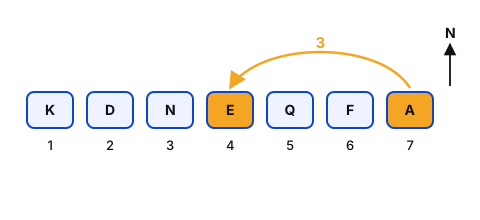
  4. Order: K D N E Q F A → third to left of A (7) = seat 4 = E

Trick: Try N's possible seats; the K–N gap of 2 plus the Q–E–N block works only with N = 3.

Answer: (C) E

अवधारणा: बाएँ से सीट 1–7 (उत्तर की ओर मुख) मानकर निश्चित स्थान पहले भरें।

  1. D दाएँ से छठा → सीट 2; F और D के बीच तीन → F = 6
  2. E, Q और N के बीच (Q–E–N ब्लॉक), K, N के बाएँ दूसरा
  3. केवल यह बैठता है: K = 1, N = 3, E = 4, Q = 5, A = 7
  4. क्रम: K D N E Q F A → A (7) के बाएँ तीसरा = सीट 4 = E

ट्रिक: N के संभव स्थान आज़माएँ; K–N का अंतर 2 और Q–E–N ब्लॉक केवल N = 3 पर बैठते हैं।

उत्तर: (C) E

RRB Technician Grade IIIGeneral Intelligence and ReasoningLinear seating arrangementRRB Technician Grade III 2026 · 10 Mar Shift 3 →
Q51.
The difference in electrical conductivity between diamond and graphite arises because:
हीरे और ग्रेफाइट के बीच विद्युत चालकता (electrical conductivity) में अंतर का कारण है:
  1. AGraphite has delocalized electrons; diamond does notग्रेफाइट में विस्थानीकृत (delocalized) इलेक्ट्रॉन होते हैं; हीरे में नहीं
  2. BDiamond has metallic bonding, graphite does notहीरे में धात्विक आबंधन होता है, ग्रेफाइट में नहीं
  3. CDiamond has tightly packed ionsहीरे में दृढ़तापूर्वक संकुलित आयन होते हैं
  4. DBoth have free electrons, but in different numbersदोनों में मुक्त इलेक्ट्रॉन होते हैं, परंतु भिन्न संख्या में
Show answer

Concept: Electrical conduction needs free (mobile) electrons.

  1. Graphite: each C bonds to 3 others; the 4th electron is delocalised → conducts
  2. Diamond: each C bonds to 4 others; no free electron → insulator
  3. Both are covalent, not metallic or ionic

Yaad rakhein: Graphite is the only non-metal that is a good conductor — used as electrodes.

Answer: (A) Graphite has delocalized electrons; diamond does not

अवधारणा: विद्युत चालन के लिए मुक्त (गतिशील) इलेक्ट्रॉन चाहिए।

  1. ग्रेफाइट: हर C तीन C से जुड़ा; चौथा इलेक्ट्रॉन मुक्त (delocalised) → चालक
  2. हीरा: हर C चार C से जुड़ा; कोई मुक्त इलेक्ट्रॉन नहीं → कुचालक
  3. दोनों सहसंयोजी हैं, धात्विक या आयनिक नहीं

याद रखें: ग्रेफाइट एकमात्र अधातु है जो अच्छा चालक है — इलेक्ट्रोड में प्रयोग।

उत्तर: (A) ग्रेफाइट में विस्थानीकृत (delocalized) इलेक्ट्रॉन होते हैं; हीरे में नहीं

RRB Technician Grade IIIGeneral ScienceAllotropes of carbon – conductivityRRB Technician Grade III 2026 · 10 Mar Shift 3 →
Q52.
Identify the product formed when copper metal is exposed to dilute hydrochloric acid.
जब कॉपर धातु को तनु हाइड्रोक्लोरिक अम्ल के संपर्क में लाया जाता है, तो बनने वाले उत्पाद की पहचान कीजिए।
  1. ASalt and chlorine gasलवण और क्लोरीन गैस
  2. BSalt and hydrogen gasलवण और हाइड्रोजन गैस
  3. CNo reactionकोई अभिक्रिया नहीं
  4. DOnly Saltकेवल लवण
Show answer

Concept: Only metals above hydrogen in the reactivity series displace H₂ from dilute acids.

  1. Copper is below hydrogen in the reactivity series
  2. So Cu cannot displace hydrogen from dilute HCl → no reaction

Yaad rakhein: Cu, Ag, Au, Pt do not react with dilute HCl.

Answer: (C) No reaction

अवधारणा: सक्रियता श्रेणी में हाइड्रोजन से ऊपर की धातुएँ ही तनु अम्ल से H₂ विस्थापित करती हैं।

  1. कॉपर सक्रियता श्रेणी में हाइड्रोजन से नीचे है
  2. इसलिए Cu तनु HCl से हाइड्रोजन नहीं हटा सकता → कोई अभिक्रिया नहीं

याद रखें: Cu, Ag, Au, Pt तनु HCl से अभिक्रिया नहीं करते।

उत्तर: (C) कोई अभिक्रिया नहीं

RRB Technician Grade IIIGeneral ScienceReactivity series – metals with acidsRRB Technician Grade III 2026 · 10 Mar Shift 3 →
Q53.
A convex mirror of focal length 'X' cm forms an image at a distance of 8 cm when the object is placed at a distance of 40 cm in front of the mirror. What is the value of X?
'X' cm फोकस दूरी वाला एक उत्तल दर्पण, वस्तु को दर्पण के सामने 40 cm की दूरी पर रखने पर 8 cm की दूरी पर प्रतिबिंब बनाता है। X का मान क्या है?
  1. A- 10 cm
  2. B+ 10 cm
  3. C- 20/3 cm
  4. D+ 20/3 cm
Show answer

Concept: 1f=1v+1u (New Cartesian signs); convex mirror image is virtual, behind mirror (v +).

  1. u=−40 cm, v=+8 cm
  2. 1f=18−140=5−140=440=110
  3. f=+10 cm

Trick: Convex mirror focal length is always positive → eliminate −10 and −203 at once.

Answer: (B) + 10 cm

अवधारणा: 1f=1v+1u (नई कार्तीय चिह्न परिपाटी); उत्तल दर्पण का प्रतिबिंब आभासी, दर्पण के पीछे (v धनात्मक)।

  1. u=−40 cm, v=+8 cm
  2. 1f=18−140=5−140=110
  3. f=+10 cm

ट्रिक: उत्तल दर्पण की फोकस दूरी सदा धनात्मक → −10 और −203 तुरंत हटाएँ।

उत्तर: (B) + 10 cm

RRB Technician Grade IIIGeneral ScienceMirror formula – convex mirrorRRB Technician Grade III 2026 · 10 Mar Shift 3 →
Q54.
If the pH of a solution is 3, what is the concentration of hydrogen ions in the solution?
यदि किसी विलयन का pH 3 है, तो विलयन में हाइड्रोजन आयनों की सांद्रता क्या है?
  1. A3×10−2M
  2. B1×10−3 M
  3. C3×10−3 M
  4. D1×10−2 M
Show answer

Concept: pH=−log[H+], so [H+]=10−pH M.

  1. pH = 3
  2. [H+]=10−3M=1×10⁻³M

Trick: pH n means [H+]=1×10−n — the number 3 goes in the power, not in front.

Answer: (B) 1×10⁻³ M

अवधारणा: pH=−log[H+], अतः [H+]=10−pH M।

  1. pH = 3
  2. [H+]=10−3M=1×10⁻³M

ट्रिक: pH n का अर्थ [H+]=1×10−n — 3 घात में जाता है, आगे नहीं।

उत्तर: (B) 1×10⁻³ M

RRB Technician Grade IIIGeneral SciencepH and hydrogen ion concentrationRRB Technician Grade III 2026 · 10 Mar Shift 3 →
Q55.
Which of the following is/are NOT true about action reaction forces?
(i) Action reaction forces are unequal in magnitude and always act in the same direction.
(ii) Action reaction forces act on different bodies.
(iii) Action reaction forces act on the same body.
क्रिया-प्रतिक्रिया बलों के बारे में निम्नलिखित में से कौन-सा/से कथन सत्य नहीं है/हैं?
(i) क्रिया-प्रतिक्रिया बल परिमाण में असमान होते हैं और सदैव एक ही दिशा में कार्य करते हैं।
(ii) क्रिया-प्रतिक्रिया बल भिन्न-भिन्न पिंडों पर कार्य करते हैं।
(iii) क्रिया-प्रतिक्रिया बल एक ही पिंड पर कार्य करते हैं।
  1. ABoth (i) and (iii)(i) और (iii) दोनों
  2. BOnly (ii)केवल (ii)
  3. COnly (iii)केवल (iii)
  4. DBoth (i) and (ii)(i) और (ii) दोनों
Show answer

Concept: Action and reaction are equal in magnitude, opposite in direction and act on different bodies.

  1. (i) says unequal and same direction → false
  2. (ii) different bodies → true
  3. (iii) same body → false
  4. NOT true: (i) and (iii)

Yaad rakhein: Because they act on different bodies, action–reaction forces never cancel each other.

Answer: (A) Both (i) and (iii)

अवधारणा: क्रिया और प्रतिक्रिया बराबर परिमाण, विपरीत दिशा और अलग-अलग पिंडों पर कार्य करते हैं।

  1. (i) असमान और समान दिशा → गलत
  2. (ii) अलग-अलग पिंड → सही
  3. (iii) एक ही पिंड → गलत
  4. गलत कथन: (i) और (iii)

याद रखें: अलग पिंडों पर लगने के कारण क्रिया–प्रतिक्रिया बल कभी एक-दूसरे को निरस्त नहीं करते।

उत्तर: (A) (i) और (iii) दोनों

RRB Technician Grade IIIGeneral ScienceNewton's third law – action and reactionRRB Technician Grade III 2026 · 10 Mar Shift 3 →
Q56.
Meristematic tissue contributes to plant growth because its cells:
विभज्योतकी ऊतक (meristematic tissue) पादप वृद्धि में योगदान देता है क्योंकि इसकी कोशिकाएँ:
  1. AHave thick secondary wallsमोटी द्वितीयक भित्तियों वाली होती हैं
  2. BContinuously divide throughout lifeजीवनभर निरंतर विभाजित होती रहती हैं
  3. CContain large central vacuolesबड़ी केंद्रीय रिक्तिकाओं से युक्त होती हैं
  4. DAre permanently differentiatedस्थायी रूप से विभेदित होती हैं
Show answer

Concept: Meristematic cells are actively dividing cells responsible for growth.

  1. They have thin cellulose walls, dense cytoplasm, prominent nucleus and no vacuoles
  2. They keep dividing to form new cells → plant grows
  3. Thick walls / differentiation belong to permanent tissues

Yaad rakhein: Meristem types: apical (length), lateral (girth), intercalary (at nodes/base of leaves).

Answer: (B) Continuously divide throughout life

अवधारणा: विभज्योतक कोशिकाएँ लगातार विभाजित होकर वृद्धि करती हैं।

  1. पतली सेलुलोस भित्ति, सघन कोशिकाद्रव्य, बड़ा केंद्रक, रिक्तिका नहीं
  2. लगातार विभाजन से नई कोशिकाएँ → पौधे की वृद्धि
  3. मोटी भित्ति/विभेदन स्थायी ऊतक के लक्षण हैं

याद रखें: विभज्योतक: शीर्षस्थ (लंबाई), पार्श्व (मोटाई), अंतर्वेशी (पर्व/पत्ती के आधार पर)।

उत्तर: (B) जीवनभर निरंतर विभाजित होती रहती हैं

RRB Technician Grade IIIGeneral ScienceMeristematic tissueRRB Technician Grade III 2026 · 10 Mar Shift 3 →
Q57.
Choose a term to complete the analogy.
Apical Meristem : Length :: Lateral Meristem : _______________
सादृश्य को पूरा करने के लिए एक पद का चयन कीजिए।
शीर्षस्थ विभज्योतक (Apical Meristem) : लंबाई :: पार्श्व विभज्योतक (Lateral Meristem) : _______________
  1. ATips of stemsतनों के शीर्ष
  2. BNodesपर्वसंधियाँ (Nodes)
  3. CGirthमोटाई (Girth)
  4. DCell differentiation onlyकेवल कोशिका विभेदन
Show answer

Concept: Apical meristem increases length; lateral meristem increases girth (thickness).

  1. Apical meristem: at root and shoot tips → length
  2. Lateral meristem (cambium): on the sides → girth of stem/root

Trick: Lateral = side → width/girth; Apical = apex → length.

Answer: (C) Girth

अवधारणा: शीर्षस्थ विभज्योतक लंबाई बढ़ाता है; पार्श्व विभज्योतक मोटाई (घेरा) बढ़ाता है।

  1. शीर्षस्थ: जड़ और तने के शीर्ष पर → लंबाई
  2. पार्श्व (कैम्बियम): किनारों पर → तने/जड़ की मोटाई

ट्रिक: पार्श्व = बगल → मोटाई; शीर्षस्थ = सिरा → लंबाई।

उत्तर: (C) मोटाई (Girth)

RRB Technician Grade IIIGeneral ScienceTypes of meristem – functionRRB Technician Grade III 2026 · 10 Mar Shift 3 →
Q58.
Two bodies A and B are travelling in uniform motion, the slope of the distance- time graph of body A is greater than the slope of the distance - time graph of body B. Which of the following statements is correct?
दो पिंड A और B एकसमान गति में चल रहे हैं, पिंड A के दूरी-समय ग्राफ का ढाल, पिंड B के दूरी-समय ग्राफ के ढाल से अधिक है। निम्नलिखित में से कौन-सा कथन सही है?
  1. AThe speed of body A is equal to the speed of body B.पिंड A की चाल, पिंड B की चाल के बराबर है।
  2. BThe speed of body A is greater than speed of body B.पिंड A की चाल, पिंड B की चाल से अधिक है।
  3. CThe speed of body A is less than the speed of body B.पिंड A की चाल, पिंड B की चाल से कम है।
  4. DThe acceleration of body A is greater than the acceleration of body B.पिंड A का त्वरण, पिंड B के त्वरण से अधिक है।
Show answer

Concept: Slope of a distance–time graph = speed.

  1. Steeper slope → more distance per unit time
  2. Slope A > slope B → speed of A > speed of B
  3. Uniform motion means zero acceleration for both, so option D is wrong

Yaad rakhein: Distance–time slope = speed; velocity–time slope = acceleration.

Answer: (B) The speed of body A is greater than speed of body B.

अवधारणा: दूरी–समय ग्राफ की ढाल = चाल।

  1. अधिक ढाल → प्रति इकाई समय अधिक दूरी
  2. A की ढाल > B की ढाल → A की चाल > B की चाल
  3. एकसमान गति में दोनों का त्वरण शून्य, अतः विकल्प D गलत

याद रखें: दूरी–समय की ढाल = चाल; वेग–समय की ढाल = त्वरण।

उत्तर: (B) पिंड A की चाल, पिंड B की चाल से अधिक है।

RRB Technician Grade IIIGeneral ScienceDistance–time graph – slopeRRB Technician Grade III 2026 · 10 Mar Shift 3 →
Q59.
Which cropping pattern maintains soil fertility through planned crop succession?
कौन-सा फसल पैटर्न नियोजित फसल अनुक्रम द्वारा मृदा की उर्वरता बनाए रखता है?
  1. ACrop rotationफसल चक्र
  2. BMonocroppingएकल फसल प्रणाली
  3. CMixed croppingमिश्रित फसल
  4. DRelay croppingरिले फसल (Relay cropping)
Show answer

Concept: Growing different crops one after another on the same land in a planned sequence.

  1. Alternating cereals with legumes restores nitrogen naturally
  2. Reduces pests and nutrient depletion → keeps soil fertile
  3. Monocropping drains the same nutrients every season

Yaad rakhein: Legumes (pulses) have Rhizobium in root nodules that fix atmospheric nitrogen.

Answer: (A) Crop rotation

अवधारणा: एक ही खेत में योजनाबद्ध क्रम में बारी-बारी से अलग फसलें उगाना।

  1. अनाज के बाद दलहन उगाने से नाइट्रोजन प्राकृतिक रूप से लौटती है
  2. कीट और पोषक कमी घटती है → मिट्टी उपजाऊ रहती है
  3. एकल फसल हर बार वही पोषक तत्व खत्म करती है

याद रखें: दलहनों की जड़ ग्रंथिकाओं में Rhizobium वायुमंडलीय नाइट्रोजन स्थिर करता है।

उत्तर: (A) फसल चक्र

RRB Technician Grade IIIGeneral ScienceCrop rotationRRB Technician Grade III 2026 · 10 Mar Shift 3 →
Q60.
A device often used in electric circuits to change the resistance without changing the voltage source is the ___________.
विद्युत परिपथों में वोल्टता स्रोत को बदले बिना प्रतिरोध (resistance) को परिवर्तित करने के लिए प्रायः उपयोग की जाने वाली युक्ति ___________ है।
  1. AFuseफ्यूज़
  2. BAmmeterऐमीटर
  3. CVoltmeterवोल्टमीटर
  4. DRheostatधारा नियंत्रक (Rheostat)
Show answer

Concept: A rheostat is a variable resistor used to change current in a circuit.

  1. Sliding the contact changes the length of wire in circuit → resistance changes
  2. Source voltage stays the same; current changes
  3. Fuse protects, ammeter measures current, voltmeter measures p.d.

Yaad rakhein: Ammeter in series, voltmeter in parallel, rheostat in series to control current.

Answer: (D) Rheostat

अवधारणा: रिओस्टेट (धारा नियंत्रक) परिवर्ती प्रतिरोधक है जो परिपथ की धारा बदलता है।

  1. स्लाइडर खिसकाने से तार की लंबाई और प्रतिरोध बदलता है
  2. स्रोत की वोल्टता वही रहती है; धारा बदलती है
  3. फ्यूज सुरक्षा, एमीटर धारा, वोल्टमीटर विभवांतर मापता है

याद रखें: एमीटर श्रेणी में, वोल्टमीटर समांतर में, रिओस्टेट श्रेणी में धारा नियंत्रण हेतु।

उत्तर: (D) धारा नियंत्रक (Rheostat)

RRB Technician Grade IIIGeneral ScienceRheostat – variable resistanceRRB Technician Grade III 2026 · 10 Mar Shift 3 →