Question bank

Q&A: practice questions with answers

Search questions on any topic. Filter by exam category, exam, subject and topic, try the question, then open the answer and explanation.

Courses – airGurukul

5,000 questions found.

Q1521.
Which word can best replace groped?
In the darkness, she groped through her bag to find the keys.
  1. AThrew
  2. BFumbled
  3. CObserved
  4. DArranged
Show answer

Concept: Grope = search blindly with the hands.

  1. In darkness she searched the bag by touch → groped.
  2. Fumbled = searched clumsily with the hands → fits.
  3. Threw, Observed (needs light), Arranged don't fit the sense.

Trick: 'In the darkness' rules out any seeing-word – think of hand actions only.

Answer: (B) Fumbled

अवधारणा: Grope = अँधेरे में हाथों से टटोलना।

हल:

  1. अँधेरे में बैग में हाथ से चाबी ढूँढी → groped।
  2. Fumbled = हाथों से अटपटे ढंग से टटोलना → सही बैठता है।
  3. Threw (फेंका), Observed (देखा – अँधेरे में संभव नहीं), Arranged (सजाया) – अर्थ नहीं मिलता।

ट्रिक: 'In the darkness' देखते ही देखने वाले शब्द हटाएँ – हाथ से जुड़ी क्रिया चुनें।

उत्तर: (B) Fumbled
SSC CHSLEnglish LanguageSynonym in context – gropedSSC CHSL 2025 · 25 Nov Shift 3 →
Q1522.
Which of the following options is NOT a meaning of the homonym 'content'?
  1. AThe subject matter or information included in a book, document, or programme
  2. BA feeling of satisfaction or quiet happiness
  3. CThe quantity or proportion of a particular substance present in something
  4. DA vessel or container used for holding liquids
Show answer

Concept: List the real senses of 'content' and remove the odd one.

  1. CONtent (noun) = subject matter of a book/programme.
  2. conTENT (adj.) = satisfied, happy.
  3. content (noun) = amount of a substance, e.g. fat content.
  4. A vessel for liquids = container, a different word.

Trick: Don't be fooled by look-alike words: content ≠ container.

Answer: (D) A vessel or container used for holding liquids

अवधारणा: 'content' के असली अर्थ लिखें और जो मेल न खाए उसे चुनें।

हल:

  1. Content = किताब/कार्यक्रम की विषय-वस्तु।
  2. Content = संतुष्ट।
  3. Content = किसी पदार्थ की मात्रा (जैसे fat content)।
  4. द्रव रखने का बर्तन = container, यह अलग शब्द है।

ट्रिक: मिलते-जुलते शब्दों से भ्रमित न हों: content ≠ container।

उत्तर: (D) A vessel or container used for holding liquids

SSC CHSLEnglish LanguageHomonym – contentSSC CHSL 2025 · 25 Nov Shift 3 →
Q1523.
Fill in the blank with the correctly spelt word.
The doctor diagnosed a rare inherited
____ condition during the examination.
  1. Ahemaglobinopathy
  2. Bhemoglobinapathy
  3. Chaemoglobinopathi
  4. Dhemoglobinopathy
Show answer

Concept: Break a medical word into its parts: hemo + globin + o + pathy.

  1. hemo (blood) + globin = hemoglobin.
  2. Linking vowel 'o' + pathy (disease) → hemoglobinopathy.
  3. (A) 'hema-', (B) '-apathy', (C) '-pathi' are wrong.

Trick: Disease words end in -opathy: neuropathy, myopathy, homeopathy.

Answer: (D) hemoglobinopathy

अवधारणा: Medical शब्द को टुकड़ों में तोड़ें: hemo + globin + o + pathy।

हल:

  1. hemo (रक्त) + globin = hemoglobin।
  2. जोड़ने वाला 'o' + pathy (रोग) → hemoglobinopathy।
  3. (A) 'hema-', (B) '-apathy', (C) '-pathi' गलत हैं।

ट्रिक: रोग वाले शब्द -opathy पर खत्म होते हैं: neuropathy, myopathy, homeopathy।

उत्तर: (D) hemoglobinopathy

SSC CHSLEnglish LanguageSpelling – hemoglobinopathySSC CHSL 2025 · 25 Nov Shift 3 →
Q1524.
Fill in the blank with the correctly spelt word.
The archaeologist studied the ____ layers of the ancient site.
  1. Astratographic
  2. Bstratigraphic
  3. Cstrategraphic
  4. Dstratigrafik
Show answer

Concept: Root 'stratum' (layer) takes the combining form strati-, plus '-graphic'.

  1. strati + graphic = stratigraphic (study of layers).
  2. (A) strato-, (C) strate- use the wrong vowel.
  3. (D) replaces 'ph' with 'f' and 'c' with 'k'.

Trick: Same root as 'stratification' – both carry 'strati'.

Answer: (B) stratigraphic

अवधारणा: 'stratum' (परत) का संयोजी रूप strati- है, उसके बाद '-graphic'।

हल:

  1. strati + graphic = stratigraphic (परतों का अध्ययन)।
  2. (A) strato-, (C) strate- – स्वर गलत।
  3. (D) में 'ph' की जगह 'f' और 'c' की जगह 'k' – गलत।

ट्रिक: 'stratification' याद रखें – इसमें भी 'strati' है।

उत्तर: (B) stratigraphic

SSC CHSLEnglish LanguageSpelling – stratigraphicSSC CHSL 2025 · 25 Nov Shift 3 →
Q1525.
Which part of the following sentence contains a spelling error?
The scholar's thesis (1) on modern histriography (2) received acclaim for its clarity, insight, (3) and analytical approach (4).
  1. A(4)
  2. B(3)
  3. C(2)
  4. D(1)
Show answer

Concept: Check each part; the error is in the word derived from 'history'.

  1. Part (2) 'histriography' drops the 'o' of histor-.
  2. Correct: historiography (history + -ography).
  3. thesis, clarity, insight, analytical approach are correct.

Trick: Keep the root intact: histor-y → histor-ical → histor-iography.

Answer: (C) (2)

अवधारणा: हर भाग जाँचें; गलती 'history' से बने शब्द में है।

हल:

  1. भाग (2) 'histriography' में histor- का 'o' छूट गया।
  2. सही वर्तनी: historiography।
  3. thesis, clarity, insight, analytical approach सही हैं।

ट्रिक: मूल शब्द न तोड़ें: histor-y → histor-ical → histor-iography।

उत्तर: (C) (2)

SSC CHSLEnglish LanguageSpotting spelling errorSSC CHSL 2025 · 25 Nov Shift 3 →
Q1526.
In this type of questions, question is provided with substitutes for various mathematical symbols, followed by a question involving calculation of an expression or choosing the correct/incorrect equation. You have to put the real signs in the given equation and then solve the questions as required. If '*' stands for ' C ', ' $ ' stands for ' × ', '!' stands for '÷', '~' stands for '+', then find the value of: 24!9∗4∗6= ?
इस प्रकार के प्रश्नों में विभिन्न गणितीय चिह्नों के स्थान पर उनके प्रतिस्थापी प्रतीक दिए जाते हैं, और उसके बाद किसी व्यंजक का मान निकालने अथवा सही/गलत समीकरण चुनने का प्रश्न पूछा जाता है। आपको दिए गए समीकरण में वास्तविक चिह्न रखकर प्रश्न को हल करना है। यदि '*' का अर्थ ' C ' है, ' $ ' का अर्थ ' × ' है, '!' का अर्थ '÷' है, '~' का अर्थ '+' है, तो निम्नलिखित का मान ज्ञात कीजिए: 24!9∗4∗6= ?
  1. A−223
  2. B−253
  3. C−213
  4. D−273
Show answer

Concept: Replace each symbol by its real sign, then apply BODMAS (÷ before −).

  1. '!' = ÷ and '*' = − → 24÷9−4−6.
  2. 24÷9=83.
  3. 83−10=8−303=−223.

Trick: Combine all subtractions first (4+6=10), then one step: 83−10.

Answer: (A) −223

अवधारणा: हर प्रतीक की जगह असली चिह्न रखें, फिर BODMAS लगाएँ (पहले ÷, फिर −)।

हल:

  1. '!' = ÷, '*' = − → 24÷9−4−6
  2. 24÷9=83
  3. 83−10=8−303=−223

ट्रिक: सारे घटाव पहले जोड़ लें (4+6=10), फिर एक ही बार: 83−10।

उत्तर: (A) −223

SSC CHSLGeneral IntelligenceSymbol substitution – BODMASSSC CHSL 2025 · 25 Nov Shift 3 →
Q1527.
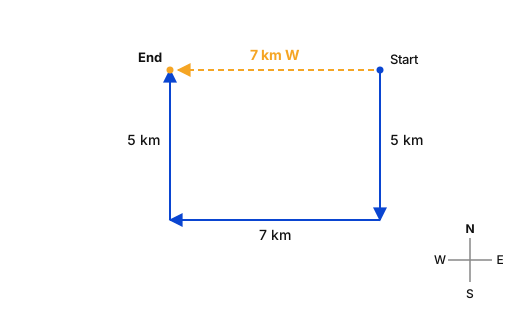
A person walks 5 km south, then 7 km west, and finally 5 km north. In which direction is he from his starting point?
एक व्यक्ति 5 km दक्षिण की ओर चलता है, फिर 7 km पश्चिम की ओर और अंत में 5 km उत्तर की ओर चलता है। वह अपने प्रारंभिक बिंदु से किस दिशा में है?
  1. ANorthउत्तर
  2. BSouthदक्षिण
  3. CEastपूर्व
  4. DWestपश्चिम
Show answer

Concept: Equal and opposite moves cancel; only the leftover move decides the direction.

  1. 5 km South and 5 km North cancel each other.
  2. Only 7 km West remains.
  3. So he is 7 km West of the start.

Trick: Net N–S = 5 − 5 = 0, net E–W = 7 W → pure West.

Answer: (D) West

अवधारणा: बराबर और उलटी दिशा की चालें आपस में कट जाती हैं; बची हुई चाल ही दिशा बताती है।

हल:

  1. 5 km दक्षिण और 5 km उत्तर – एक-दूसरे को काट देते हैं।
  2. केवल 7 km पश्चिम बचता है।
  3. अतः वह प्रारंभिक बिंदु से पश्चिम में है।

ट्रिक: उत्तर–दक्षिण = 5 − 5 = 0, पूर्व–पश्चिम = 7 पश्चिम → सीधे पश्चिम।

उत्तर: (D) पश्चिम

SSC CHSLGeneral IntelligenceDirection – net displacementSSC CHSL 2025 · 25 Nov Shift 3 →
Q1528.
A piece of paper is folded and punched as shown below in the question figures. From the given option figures, indicate how it will appear when opened.
figure
एक कागज़ को मोड़ा और छेदा गया है, जैसा कि नीचे प्रश्न आकृतियों में दर्शाया गया है। दी गई विकल्प आकृतियों में से बताइए कि खोलने पर वह कैसा दिखाई देगा।
figure
  1. Afigure
  2. Bfigure
  3. Cfigure
  4. Dfigure
Show answer

Concept: Unfold step by step: each fold doubles every punch as a mirror image across the fold line.

  1. Two folds (right→left, bottom→top) leave one quarter of the sheet.
  2. Each cut on that quarter appears 4 times on opening – mirrored across the vertical and horizontal fold lines.
  3. So the open sheet must show 4 of each shape placed symmetrically – this matches option (A).

Trick: Count first: 2 folds → every punch × 4. Reject any option where a shape appears fewer/more times or isn't mirror-symmetric.

Answer: (A) Figure (A)

अवधारणा: उलटे क्रम में खोलें: हर मोड़ पर छेद मोड़-रेखा के सापेक्ष दर्पण-प्रतिबिंब बनकर दोगुना होता है।

हल:

  1. दो मोड़ (दाएँ→बाएँ, नीचे→ऊपर) के बाद कागज़ का एक-चौथाई भाग बचता है।
  2. उस भाग पर किया गया हर छेद खोलने पर 4 बार दिखेगा – ऊर्ध्व और क्षैतिज मोड़-रेखा के दोनों ओर सममित।
  3. ऐसा सममित पैटर्न विकल्प (A) में है।

ट्रिक: पहले गिनें: 2 मोड़ → हर छेद × 4। जिस विकल्प में आकृतियों की संख्या या समरूपता गलत हो, उसे हटाएँ।

उत्तर: (A) आकृति (A)

SSC CHSLGeneral IntelligencePaper folding & punchingSSC CHSL 2025 · 25 Nov Shift 3 →
Q1529.
Pick the correct options from below.
12,27,48,75,?
नीचे दिए गए विकल्पों में से सही विकल्प चुनिए।
12,27,48,75,?
  1. A100
  2. B108
  3. C96
  4. D112
Show answer

Concept: Differences rise steadily (or the terms are 3 × perfect squares).

  1. Differences: 15, 21, 27 → each +6.
  2. Next difference = 33 → 75+33=108.
  3. Check: 3×22,3×32,3×42,3×52, 3×62=108.

Trick: All terms divisible by 3: 4, 9, 16, 25 → squares! Next 36×3=108.

Answer: (B) 108

अवधारणा: अंतर बराबर बढ़ रहा है (या पद = 3 × पूर्ण वर्ग)।

हल:

  1. अंतर: 15, 21, 27 → हर बार +6
  2. अगला अंतर 33 → 75+33=108
  3. जाँच: 3×22,3×32,3×42,3×52, 3×62=108

ट्रिक: सबको 3 से भाग दें: 4, 9, 16, 25 – वर्ग संख्याएँ! अगला 36×3=108।

उत्तर: (B) 108

SSC CHSLGeneral IntelligenceNumber series – 3n²SSC CHSL 2025 · 25 Nov Shift 3 →
Q1530.
Five friends Rahul, Ritu, Ramesh, Rohan, and Reena were born in different consecutive years starting from 2002.Reena was neither born in 2003 nor in 2006.Rahul is the oldest among all. Ritu is younger than Rohan. Ramesh was born in a leap year. Who was born in 2003?
पाँच मित्र Rahul, Ritu, Ramesh, Rohan और Reena का जन्म 2002 से आरंभ होने वाले भिन्न-भिन्न क्रमागत वर्षों में हुआ। Reena का जन्म न तो 2003 में हुआ और न ही 2006 में। Rahul सबसे बड़ा है। Ritu, Rohan से छोटी है। Ramesh का जन्म एक अधिवर्ष (leap year) में हुआ। 2003 में किसका जन्म हुआ?
  1. ARohan
  2. BRitu
  3. CReena
  4. DRamesh
Show answer

Concept: Fix the definite clues first (oldest, leap year), then fill the rest.

  1. Years: 2002–2006. Rahul (oldest) = 2002.
  2. Only leap year here is 2004 → Ramesh.
  3. Reena can't be 2003/2006 → 2005.
  4. Rohan & Ritu share 2003/2006; Ritu younger → Ritu 2006, Rohan 2003.

Trick: Leap year = divisible by 4 → in 2002–06 only 2004; that one clue locks Ramesh instantly.

Answer: (A) Rohan

अवधारणा: पहले पक्के संकेत लगाएँ (सबसे बड़ा, लीप वर्ष), फिर बाकी भरें।

हल:

  1. वर्ष: 2002–2006; Rahul सबसे बड़ा = 2002
  2. लीप वर्ष केवल 2004 → Ramesh
  3. Reena 2003/2006 नहीं → 2005
  4. Rohan व Ritu के लिए 2003/2006; Ritu छोटी → Ritu 2006, Rohan 2003

ट्रिक: लीप वर्ष = 4 से विभाज्य; 2002–06 में केवल 2004 – इससे Ramesh तुरंत तय।

उत्तर: (A) Rohan

SSC CHSLGeneral IntelligenceOrdering – birth yearsSSC CHSL 2025 · 25 Nov Shift 3 →
Q1531.
You are given a Master Address (MA) from official records. Your task is to identify the correct candidate address that matches exactly with the master address in terms of formatting, punctuation, spelling, and structure.
Master Address (MA):
H.No-21, Sector B-4, Green Valley, MG Road, Jaipur - 302015
Candidate Addresses:
आपको आधिकारिक अभिलेखों से एक मास्टर पता (MA) दिया गया है। आपका कार्य उस अभ्यर्थी पते की पहचान करना है जो प्रारूप, विराम-चिह्न, वर्तनी तथा संरचना की दृष्टि से मास्टर पते से पूर्णतः मेल खाता हो।
मास्टर पता (MA):
H.No-21, Sector B-4, Green Valley, MG Road, Jaipur - 302015 अभ्यर्थी पते:
  1. AH.No-21, Sector B-4, Green Valley, M.G. Road, Jaipur - 302015
  2. BH.No.21, Sector B-4, Green Valley, MG Road, Jaipur - 302015
  3. CH.No-21, Sector B 4, Green Valley, MG Road, Jaipur - 302015
  4. DH.No-21, Sector B-4, Green Valley, MG Road, Jaipur - 302015
Show answer

Concept: Compare symbol by symbol – dots, hyphens and spaces count.

  1. (A) 'M.G. Road' has extra dots (master: MG Road).
  2. (B) 'H.No.21' uses a dot instead of a hyphen.
  3. (C) 'Sector B 4' has a space instead of a hyphen.
  4. (D) matches exactly.

Trick: Check the punctuation-heavy parts first (H.No-21, B-4, MG) – differences hide there.

Answer: (D) H.No-21, Sector B-4, Green Valley, MG Road, Jaipur - 302015

अवधारणा: चिह्न-दर-चिह्न तुलना करें – बिंदु, हाइफ़न और स्पेस भी मायने रखते हैं।

हल:

  1. (A) में 'M.G. Road' – अतिरिक्त बिंदु।
  2. (B) में 'H.No.21' – हाइफ़न की जगह बिंदु।
  3. (C) में 'Sector B 4' – हाइफ़न की जगह स्पेस।
  4. (D) पूरी तरह मेल खाता है।

ट्रिक: जहाँ चिह्न ज़्यादा हों (H.No-21, B-4, MG) वहीं पहले देखें – अंतर वहीं छिपा होता है।

उत्तर: (D) H.No-21, Sector B-4, Green Valley, MG Road, Jaipur - 302015

SSC CHSLGeneral IntelligenceAddress matchingSSC CHSL 2025 · 25 Nov Shift 3 →
Q1532.
Identify the next number in the sequence.
6, 18, 36, 60, 90, ?
अनुक्रम में अगली संख्या ज्ञात कीजिए।
6, 18, 36, 60, 90, ?
  1. A126
  2. B132
  3. C138
  4. D144
Show answer

Concept: Second differences are constant.

  1. Differences: 12, 18, 24, 30 (each +6).
  2. Next difference = 36.
  3. 90+36=126.

Trick: Divide by 6: 1, 3, 6, 10, 15 → triangular numbers; next 21×6=126.

Answer: (A) 126

अवधारणा: अंतरों का अंतर स्थिर है।

हल:

  1. अंतर: 12, 18, 24, 30 (हर बार +6)
  2. अगला अंतर = 36
  3. 90+36=126

ट्रिक: 6 से भाग दें: 1, 3, 6, 10, 15 (त्रिकोणीय संख्याएँ); अगला 21×6=126।

उत्तर: (A) 126

SSC CHSLGeneral IntelligenceNumber series – 6 × triangularSSC CHSL 2025 · 25 Nov Shift 3 →
Q1533.
In the following question, select the number which can be placed at the sign of question mark (?) from the given alternatives.
निम्नलिखित प्रश्न में, दिए गए विकल्पों में से वह संख्या चुनिए जिसे प्रश्नवाचक चिह्न (?) के स्थान पर रखा जा सकता है।
  1. A13
  2. B14
  3. C5
  4. D9
Show answer

Concept: In each row the last number = product of the first three.

  1. Row 1: 4×6×5=120 ✓
  2. Row 2: 3×5×6=90 ✓
  3. Row 3: 5×8×?=200→40×?=200→?=5.

Trick: When the last number is large compared to the others, test multiplication first.

Answer: (C) 5

अवधारणा: हर पंक्ति में अंतिम संख्या = पहली तीन संख्याओं का गुणनफल।

हल:

  1. पंक्ति 1: 4×6×5=120 ✓
  2. पंक्ति 2: 3×5×6=90 ✓
  3. पंक्ति 3: 5×8×?=200→?=200÷40=5

ट्रिक: जब अंतिम संख्या बाकी से बहुत बड़ी हो, पहले गुणा वाला नियम आज़माएँ।

उत्तर: (C) 5

SSC CHSLGeneral IntelligenceNumber grid – product ruleSSC CHSL 2025 · 25 Nov Shift 3 →
Q1534.
In the following question, select the number which can be placed at the sign of question mark (?) from the given alternatives.
निम्नलिखित प्रश्न में, दिए गए विकल्पों में से वह संख्या चुनिए जिसे प्रश्नवाचक चिह्न (?) के स्थान पर रखा जा सकता है।
  1. A7
  2. B4
  3. C8
  4. D9
Show answer

Concept: Find one rule that links the four numbers in every box.

  1. Multiply the two upper numbers and add the lower-right one; the result is the lower-left number.
  2. 1st box: 20+9=29 ✓   2nd box: 35+5=40 ✓
  3. 3rd box: 18+?=25→?=7.

Trick: Verify any rule on two boxes before applying it to the third.

Answer: (A) 7

अवधारणा: हर बॉक्स की चारों संख्याओं को जोड़ने वाला एक ही नियम खोजें।

हल:

  1. नियम: नीचे-बायाँ=ऊपर-बायाँ×ऊपर-दायाँ+नीचे-दायाँ
  2. बॉक्स 1: 5×4+9=29 ✓; बॉक्स 2: 5×7+5=40 ✓
  3. बॉक्स 3: 3×6+?=25→?=7

ट्रिक: नियम को दो बॉक्स पर जाँचने के बाद ही तीसरे पर लगाएँ।

उत्तर: (A) 7

SSC CHSLGeneral IntelligenceNumber box – (a × b) + cSSC CHSL 2025 · 25 Nov Shift 3 →
Q1535.
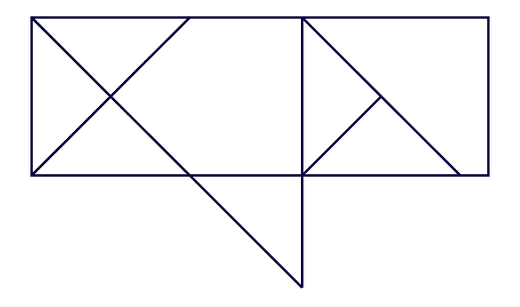
How many triangles are there in the given figure ?
figure
दी गई आकृति में कितने त्रिभुज हैं ?
figure
  1. A8
  2. B10
  3. C9
  4. D11
Show answer

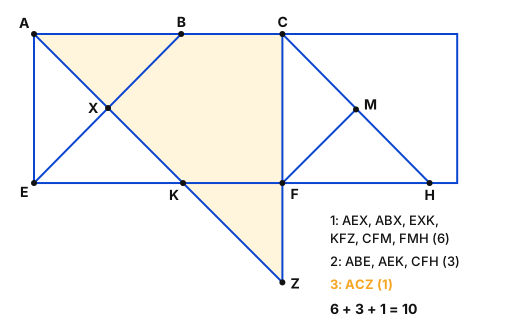
Concept: Count single regions first, then combinations of 2, 3… regions.

  1. Single small triangles: 6.
  2. Triangles made of two parts: 3.
  3. One large triangle formed by the top edge, the long slant line and the vertical line: 1.
  4. Total = 6 + 3 + 1 = 10.

Trick: Label each small region with a number and list combinations – nothing gets double counted.

Answer: (B) 10

अवधारणा: पहले एकल त्रिभुज, फिर 2, 3… भागों से बने त्रिभुज गिनें।

हल:

  1. एकल छोटे त्रिभुज: 6
  2. दो भागों से बने त्रिभुज: 3
  3. ऊपरी किनारा, लंबी तिरछी रेखा और खड़ी रेखा से बना बड़ा त्रिभुज: 1
  4. कुल = 6 + 3 + 1 = 10

ट्रिक: हर छोटे भाग पर नंबर लिखें और संयोजन सूचीबद्ध करें – दोहराव नहीं होगा।

उत्तर: (B) 10

SSC CHSLGeneral IntelligenceCounting trianglesSSC CHSL 2025 · 25 Nov Shift 3 →
Q1536.
How many triangles are there in the given figure ?
figure
दी गई आकृति में कितने त्रिभुज हैं ?
figure
  1. A22
  2. B23
  3. C24
  4. D20
Show answer

Concept: Label the points and count group by group (top part, middle crossing lines, base part, side flaps).

  1. Top small section near apex: 3.
  2. Whole figure and its two halves split by the central line: 3.
  3. Triangles from the two long crossing lines: 10.
  4. Lower part (inner line + base): 6; side flaps: 2.
  5. Total = 3 + 3 + 10 + 6 + 2 = 24.

Trick: For symmetric figures, count one half carefully, double it, then add triangles that cross the axis.

Answer: (C) 24

अवधारणा: बिंदुओं को नाम दें और भाग-दर-भाग गिनें (ऊपरी भाग, बीच की कटती रेखाएँ, नीचे का भाग, किनारे)।

हल:

  1. शीर्ष के पास छोटा भाग: 3
  2. पूरी आकृति और केंद्र-रेखा से बने दो आधे: 3
  3. दो लंबी कटती रेखाओं से: 10
  4. निचला भाग: 6; किनारे के फ्लैप: 2
  5. कुल = 3 + 3 + 10 + 6 + 2 = 24

ट्रिक: सममित आकृति में एक आधा गिनकर दोगुना करें, फिर अक्ष के आर-पार वाले त्रिभुज जोड़ें।

उत्तर: (C) 24

SSC CHSLGeneral IntelligenceCounting triangles – complex figureSSC CHSL 2025 · 25 Nov Shift 3 →
Q1537.
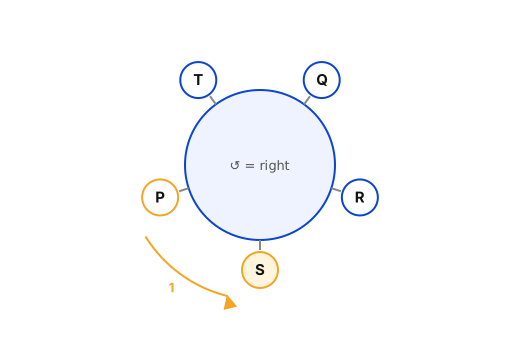
5 persons P,Q,R,S and T are sitting around a circular table facing towards the centre (not necessarily in the same order). Q is sitting second to the right of S.P is sitting second to the right of Q.R is not an immediate neighbour of P. Who is to the immediate right of P ?
5 व्यक्ति P,Q,R,S और T एक वृत्ताकार मेज़ के चारों ओर केंद्र की ओर मुख करके बैठे हैं (आवश्यक नहीं कि इसी क्रम में)। Q, S.P के दाईं ओर दूसरे स्थान पर बैठा है, Q.R के दाईं ओर दूसरे स्थान पर बैठा है, P का निकटतम पड़ोसी नहीं है। P के ठीक दाईं ओर कौन है ?
  1. AT
  2. BQ
  3. CR
  4. DS
Show answer

Concept: Facing the centre, 'right' = anticlockwise.

  1. Anticlockwise: S, _, Q, _, P (Q 2nd right of S, P 2nd right of Q).
  2. R can't sit next to P → R between S and Q; T between Q and P.
  3. Order (anticlockwise): S, R, Q, T, P → next after P is S.

Trick: With 5 seats, 'second to the right' twice = 4 steps = 1 step left. So P is just left of S, i.e. S is immediately right of P.

Answer: (D) S

अवधारणा: केंद्र की ओर मुख हो तो 'दायाँ' = वामावर्त (anticlockwise)।

हल:

  1. वामावर्त क्रम: S, _, Q, _, P
  2. R, P का पड़ोसी नहीं → R, S और Q के बीच; T, Q और P के बीच
  3. क्रम: S, R, Q, T, P → P के ठीक दाएँ S

ट्रिक: 5 सीटों में दाएँ 2 + 2 = 4 कदम = बाएँ 1 कदम; यानी S, P के ठीक दाएँ है।

उत्तर: (D) S

SSC CHSLGeneral IntelligenceCircular seating – facing centreSSC CHSL 2025 · 25 Nov Shift 3 →
Q1538.
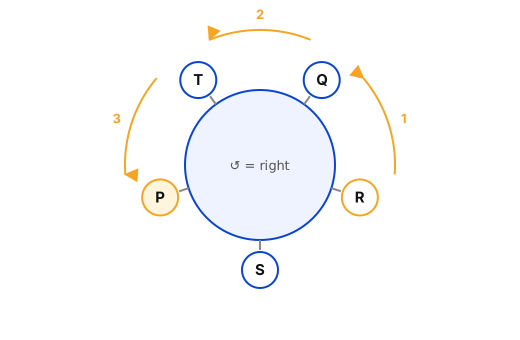
5 persons P,Q,R,S and T are sitting around a circular table facing towards the centre (not necessarily in the same order). Q is sitting second to the right of S. P is sitting second to the right of Q.R is not an immediate neighbour of P . Who is sitting third to the right of R ?
5 व्यक्ति P,Q,R,S और T एक वृत्ताकार मेज़ के चारों ओर केंद्र की ओर मुख करके बैठे हैं (आवश्यक नहीं कि इसी क्रम में)। Q, S के दाईं ओर दूसरे स्थान पर बैठा है। P, Q.R के दाईं ओर दूसरे स्थान पर बैठा है, P का निकटतम पड़ोसी नहीं है। R के दाईं ओर तीसरे स्थान पर कौन बैठा है ?
  1. AQ
  2. BP
  3. CS
  4. DT
Show answer

Concept: Build the same arrangement; facing the centre, count right = anticlockwise.

  1. Q is 2nd right of S, P is 2nd right of Q → S, _, Q, _, P.
  2. R not next to P → S, R, Q, T, P (anticlockwise).
  3. From R to the right: Q (1), T (2), P (3).

Trick: In 5 seats, 3rd to the right = 2nd to the left: from R going clockwise 2 seats → S, then P.

Answer: (B) P

अवधारणा: वही व्यवस्था बनाएँ; केंद्र की ओर मुख होने पर दाएँ = वामावर्त।

हल:

  1. Q, S के दाएँ दूसरा; P, Q के दाएँ दूसरा → S, _, Q, _, P
  2. R, P के पास नहीं → S, R, Q, T, P
  3. R से दाएँ: Q (1), T (2), P (3)

ट्रिक: 5 सीटों में दाएँ तीसरा = बाएँ दूसरा: R से बाएँ S, फिर P।

उत्तर: (B) P

SSC CHSLGeneral IntelligenceCircular seating – third to the rightSSC CHSL 2025 · 25 Nov Shift 3 →
Q1539.
A man is facing towards North. By taking which of the following combination of turns, he will be finally facing towards West?
एक व्यक्ति उत्तर दिशा की ओर मुख किए हुए है। निम्नलिखित में से मोड़ों के किस संयोजन को अपनाने पर वह अंत में पश्चिम दिशा की ओर मुख किए होगा?
  1. ALeft, Right, Left, Right, Rightबाएँ, दाएँ, बाएँ, दाएँ, दाएँ
  2. BRight, Left, Right, Left, Leftदाएँ, बाएँ, दाएँ, बाएँ, बाएँ
  3. CRight, Right, Right, Left, Leftदाएँ, दाएँ, दाएँ, बाएँ, बाएँ
  4. DRight, Right, Left, Right, Leftदाएँ, दाएँ, बाएँ, दाएँ, बाएँ
Show answer

Concept: Every Right or Left is a 90° turn; only the net turn (Lefts − Rights) matters.

  1. North → West needs a net of one Left turn.
  2. (B) R, L, R, L, L: 2 Rights, 3 Lefts → net 1 Left → West ✓ (N→E→N→E→N→W).
  3. (A), (C) and (D) each have 3 Rights, 2 Lefts → net 1 Right → East.

Trick: Don't trace each turn – just count: net = L − R. Net 1 L = West, net 1 R = East.

Answer: (B) Right, Left, Right, Left, Left

अवधारणा: हर दायाँ/बायाँ मोड़ 90° का है; केवल कुल मोड़ (बाएँ − दाएँ) मायने रखता है।

हल:

  1. उत्तर से पश्चिम = कुल 1 बायाँ मोड़।
  2. (B) R, L, R, L, L: 2 दाएँ, 3 बाएँ → कुल 1 बायाँ → पश्चिम ✓
  3. (A), (C) और (D) में 3 दाएँ, 2 बाएँ → कुल 1 दायाँ → पूर्व।

ट्रिक: हर मोड़ ट्रेस न करें – गिनें: कुल = L − R। 1 L = पश्चिम, 1 R = पूर्व।

उत्तर: (B) दाएँ, बाएँ, दाएँ, बाएँ, बाएँ

SSC CHSLGeneral IntelligenceDirection – sequence of turnsSSC CHSL 2025 · 25 Nov Shift 3 →
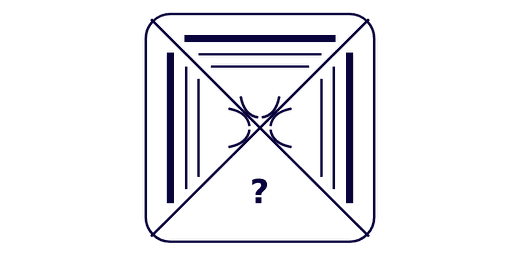
Q1540.
Which option figure will complete the pattern in the question figure? (Rotation is not allowed)
figure
कौन-सी विकल्प आकृति प्रश्न आकृति के प्रतिरूप को पूर्ण करेगी? (घुमाने की अनुमति नहीं है)
figure
  1. Afigure
  2. Bfigure
  3. Cfigure
  4. Dfigure
Show answer

Concept: The square is split by its diagonals into 4 identical triangular parts, each carrying the same design from its edge to the centre.

  1. Design in each part (edge → centre): one thick bar, two thin parallel lines, small arcs at the tip.
  2. The missing part is the bottom triangle: thick bar along the bottom edge, arcs at the top tip near the centre.
  3. Without rotation, only option (C) shows this orientation.

Trick: Read the opposite (top) part and flip it top-to-bottom – that is exactly the missing piece.

Answer: (C) Figure (C)

अवधारणा: विकर्णों से वर्ग 4 समान त्रिभुजाकार भागों में बँटा है; हर भाग में किनारे से केंद्र तक एक जैसा डिज़ाइन है।

हल:

  1. हर भाग में (किनारे → केंद्र): एक मोटी पट्टी, दो पतली समांतर रेखाएँ, सिरे पर छोटे चाप।
  2. खाली भाग नीचे वाला त्रिभुज है: मोटी पट्टी नीचे के किनारे पर, चाप ऊपर केंद्र की ओर।
  3. घुमाए बिना यही स्थिति केवल (C) में है।

ट्रिक: सामने वाले (ऊपरी) भाग को ऊपर-नीचे पलट दें – वही गायब टुकड़ा है।

उत्तर: (C) आकृति (C)

SSC CHSLGeneral IntelligencePattern completionSSC CHSL 2025 · 25 Nov Shift 3 →