Question bank

Q&A: practice questions with answers

Search questions on any topic. Filter by exam category, exam, subject and topic, try the question, then open the answer and explanation.

Courses – airGurukul

6,600 questions found.

Q1441.
Select the option that is related to the fifth letter-cluster in the same way as the second letter-cluster is related to the first letter-cluster and the fourth letter-cluster is related to the third letter-cluster.
FREE : GTHI :: GAPS : HCSW :: SOAR : ?
उस विकल्प का चयन कीजिए जो पाँचवें अक्षर-समूह से उसी प्रकार संबंधित है, जिस प्रकार दूसरा अक्षर-समूह पहले अक्षर-समूह से और चौथा अक्षर-समूह तीसरे अक्षर-समूह से संबंधित है।
FREE : GTHI :: GAPS : HCSW :: SOAR : ?
  1. ATQDU
  2. BTRDV
  3. CTQEV
  4. DTQDV
Show answer

Concept: Letters are shifted by +1,+2,+3,+4 position-wise.

  1. FREE → GTHI: F+1=G, R+2=T, E+3=H, E+4=I ✓.
  2. GAPS → HCSW: G+1, A+2, P+3, S+4 ✓.
  3. SOAR: S+1=T, O+2=Q, A+3=D, R+4=V → TQDV.

Trick: Increasing shifts 1, 2, 3, 4 — check the last letter first: R+4=V removes (A).

Answer: (D) TQDV

अवधारणा: अक्षर स्थान-क्रम से +1,+2,+3,+4 खिसकते हैं।

  1. FREE → GTHI: F+1=G, R+2=T, E+3=H, E+4=I ✓।
  2. GAPS → HCSW: G+1, A+2, P+3, S+4 ✓।
  3. SOAR: S+1=T, O+2=Q, A+3=D, R+4=V → TQDV।

ट्रिक: बढ़ते shift 1, 2, 3, 4 — अंतिम अक्षर पहले जाँचें: R+4=V।

उत्तर: (D) TQDV

SSC CPO Paper IGeneral Intelligence and ReasoningLetter AnalogySSC CPO Paper I 2024 · 27 Jun Shift 2 →
Q1442.
Select the option in which the numbers share the same relationship as that shared by the given pair of numbers.
40 − 9
उस विकल्प का चयन कीजिए जिसमें संख्याओं के बीच वही संबंध है, जो संबंध संख्याओं के दिए गए युग्म के बीच है।
40 − 9
  1. A90 − 4
  2. B120 − 4
  3. C60 − 5
  4. D100 − 6
Show answer

Concept: Look for a fixed product of the two numbers.

  1. 40×9=360.
  2. (A) 90×4=360 ✓.
  3. (B) 120×4=480, (C) 60×5=300, (D) 100×6=600 ✗.

Trick: When no sum/difference rule fits, try the product of the pair.

Answer: (A) 90 − 4

अवधारणा: दोनों संख्याओं का गुणनफल स्थिर है या नहीं, देखें।

  1. 40×9=360।
  2. (A) 90×4=360 ✓।
  3. (B) 120×4=480, (C) 60×5=300, (D) 100×6=600 ✗।

ट्रिक: जब योग/अंतर से नियम न बने तो गुणनफल आज़माएँ।

उत्तर: (A) 90 − 4

SSC CPO Paper IGeneral Intelligence and ReasoningNumber Pair RelationSSC CPO Paper I 2024 · 27 Jun Shift 2 →
Q1443.
Which of the following numbers will replace the question mark (?) in the given series? 45, 90, 154, ?, 347
निम्नलिखित में से कौन-सी संख्या दी गई शृंखला में प्रश्न चिह्न (?) को प्रतिस्थापित करेगी? 45, 90, 154, ?, 347
  1. A256
  2. B273
  3. C248
  4. D239
Show answer

Concept: Differences of the series themselves increase by a fixed pattern (second differences).

  1. 90−45=45, 154−90=64; second difference 64−45=19.
  2. Second differences rise by 2: 19, 21, 23 → next differences 64+21=85 and 85+23=108.
  3. 154+85=239 and check 239+108=347 ✓.

Trick: Test the option: 239 gives differences 45, 64, 85, 108 whose gaps are 19, 21, 23.

Answer: (D) 239

अवधारणा: अंतरों के अंतर (द्वितीय अंतर) एक निश्चित क्रम में बढ़ते हैं।

  1. 90−45=45, 154−90=64; द्वितीय अंतर 64−45=19।
  2. द्वितीय अंतर 2 से बढ़ते हैं: 19, 21, 23 → अगले अंतर 64+21=85 और 85+23=108।
  3. 154+85=239 और जाँच 239+108=347 ✓।

ट्रिक: विकल्प जाँचें: 239 से अंतर 45, 64, 85, 108 जिनके अंतर 19, 21, 23।

उत्तर: (D) 239

SSC CPO Paper IGeneral Intelligence and ReasoningNumber SeriesSSC CPO Paper I 2024 · 27 Jun Shift 2 →
Q1444.
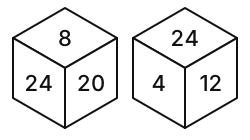
A dice has its faces marked by numbers 4, 8, 12, 16, 20 and 24. Two positions of the same dice are given below. Which face is opposite to face 16?
एक पासे के फलकों पर संख्याएँ 4, 8, 12, 16, 20 और 24 अंकित हैं। नीचे उसी पासे की दो स्थितियाँ दी गई हैं। फलक 16 के विपरीत कौन-सा फलक है?
  1. A8
  2. B12
  3. C24
  4. D4
Show answer

Concept: A face seen with four different faces is opposite the remaining face.

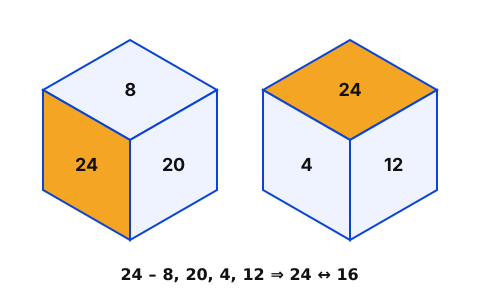
  1. Face 24 appears in both positions.
  2. With 24 we see 8, 20 (first view) and 4, 12 (second view) → 24 is adjacent to 4, 8, 12, 20.
  3. Only 16 is not adjacent to 24 → 16 is opposite 24.

Trick: List the common face's four neighbours; the number missing from the list is its opposite.

Answer: (C) 24

अवधारणा: जो फलक चार अलग फलकों के साथ दिखे, वह बचे हुए फलक के विपरीत होता है।

  1. फलक 24 दोनों स्थितियों में है।
  2. 24 के साथ 8, 20 (पहली) और 4, 12 (दूसरी) दिखते हैं → 24 के पड़ोसी 4, 8, 12, 20।
  3. केवल 16 पड़ोसी नहीं → 16 के विपरीत 24।

ट्रिक: उभयनिष्ठ फलक के चार पड़ोसी लिखें; जो संख्या छूटे वह विपरीत है।

उत्तर: (C) 24

SSC CPO Paper IGeneral Intelligence and ReasoningDiceSSC CPO Paper I 2024 · 27 Jun Shift 2 →
Q1445.
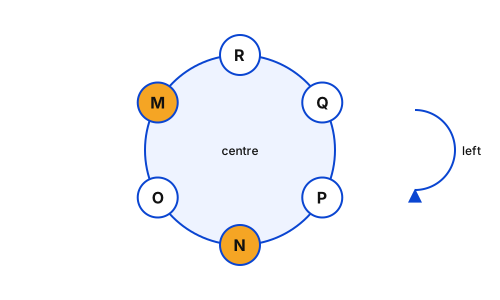
M, N, O, P, Q and R are sitting around a circular table facing the centre. O is an
immediate neighbour of M. Only two people sit between O and Q. P sits second to the left of R. N is an immediate neighbour of P. Who is sitting second to the right of M?
M, N, O, P, Q और R एक वृत्ताकार मेज़ के चारों ओर केंद्र की ओर मुख करके बैठे हैं। O, M का
निकटतम पड़ोसी है। O और Q के बीच केवल दो व्यक्ति बैठे हैं। P, R के बाईं ओर दूसरे स्थान पर बैठा है। N, P का निकटतम पड़ोसी है। M के दाईं ओर दूसरे स्थान पर कौन बैठा है?
  1. AN
  2. BQ
  3. CR
  4. DP
Show answer

Concept: Facing the centre, a person's left is the clockwise direction and right is anticlockwise.

  1. Fix R at the top; P is second to the left of R → two places clockwise.
  2. O and Q have two people between them, so they sit opposite each other: the only free opposite pair is the seat next to R (clockwise) and the seat opposite it.
  3. N must be next to P → N takes the seat after P; M takes the last seat. O must be next to M → O is between N and M, and Q sits between R and P.
  4. Clockwise order: R, Q, P, N, O, M. Second to the right (anticlockwise) of M: O, then N.

Yaad rakhein: In circular seating facing the centre: left = clockwise, right = anticlockwise.

Answer: (A) N

अवधारणा: केंद्र की ओर मुख होने पर व्यक्ति का बायाँ = दक्षिणावर्त (clockwise), दायाँ = वामावर्त।

  1. R को ऊपर रखें; P, R के बाएँ दूसरे स्थान पर → दो स्थान clockwise।
  2. O और Q के बीच दो व्यक्ति हैं, अर्थात् वे आमने-सामने हैं: केवल R के बगल (clockwise) वाली सीट और उसकी सामने वाली सीट खाली जोड़ी है।
  3. N, P के पड़ोसी → N, P के बाद वाली सीट पर; M अंतिम सीट पर। O, M का पड़ोसी → O, N और M के बीच, Q, R और P के बीच।
  4. Clockwise क्रम: R, Q, P, N, O, M. M के दाएँ (anticlockwise) दूसरा: O, फिर N।

याद रखें: केंद्र की ओर मुख: बायाँ = clockwise, दायाँ = anticlockwise।

उत्तर: (A) N

SSC CPO Paper IGeneral Intelligence and ReasoningCircular Seating ArrangementSSC CPO Paper I 2024 · 27 Jun Shift 2 →
Q1446.
Select the set in which the numbers are related in the same way as are the numbers of the following sets.
(NOTE: Operations should be performed on the whole numbers, without breaking
down the numbers into its constituent digits. E.g. 13 – Operations on 13 such as
adding /deleting /multiplying etc. to 13 can be performed. Breaking down 13 into 1 and 3 and then performing mathematical operations on 1 and 3 is not allowed)
(144, 12, 24)
(216, 18, 36)
उस समुच्चय का चयन कीजिए जिसमें संख्याएँ उसी प्रकार संबंधित हैं, जिस प्रकार निम्नलिखित समुच्चयों की संख्याएँ संबंधित हैं।
(ध्यान दें: संक्रियाएँ संख्याओं को उनके घटक अंकों में तोड़े बिना, पूर्ण संख्याओं पर की जानी चाहिए। उदाहरण के लिए 13 – 13 पर की जाने वाली संक्रियाएँ, जैसे 13 में जोड़ना/घटाना/गुणा करना आदि की जा सकती हैं। 13 को 1 और 3 में तोड़कर फिर 1 और 3 पर गणितीय संक्रियाएँ करने की अनुमति नहीं है)
(144, 12, 24)
(216, 18, 36)
  1. A(324, 29, 54)
  2. B(324, 27, 50)
  3. C(324, 27, 54)
  4. D(320, 27, 54)
Show answer

Concept: Express the first and third numbers in terms of the middle number.

  1. (144,12,24): 12×12=144, 12×2=24.
  2. (216,18,36): 18×12=216, 18×2=36 ✓.
  3. (324,27,54): 27×12=324, 27×2=54 ✓.
  4. (A) 29×2≠54; (B) 27×2≠50; (D) 27×12≠320.

Trick: First =12× middle and third =2× middle.

Answer: (C) (324, 27, 54)

अवधारणा: पहली और तीसरी संख्या को बीच वाली संख्या के रूप में लिखें।

  1. (144,12,24): 12×12=144, 12×2=24।
  2. (216,18,36): 18×12=216, 18×2=36 ✓।
  3. (324,27,54): 27×12=324, 27×2=54 ✓।
  4. (A) 29×2≠54; (B) 27×2≠50; (D) 27×12≠320।

ट्रिक: पहली =12× बीच वाली, तीसरी =2× बीच वाली।

उत्तर: (C) (324, 27, 54)

SSC CPO Paper IGeneral Intelligence and ReasoningNumber Set RelationSSC CPO Paper I 2024 · 27 Jun Shift 2 →
Q1447.
In a certain code language, ‘join the class’ is written as ‘yq pt dm’ and ‘the music class’ is written as ‘rj yq dm’. How is ‘music’ written in the given language?
एक निश्चित कूट भाषा में, ‘join the class’ को ‘yq pt dm’ लिखा जाता है और ‘the music class’ को ‘rj yq dm’ लिखा जाता है। दी गई भाषा में ‘music’ को किस प्रकार लिखा जाता है?
  1. Ayg
  2. Brj
  3. Cdm
  4. Dpt
Show answer

Concept: Common words in two sentences share common codes.

  1. 'the' and 'class' are in both sentences → their codes are the common ones: yq and dm.
  2. 'the music class' = rj yq dm → after removing yq, dm, 'music' = rj.
  3. ('join' = pt.)

Trick: Remove the codes of the words common to both sentences; what remains belongs to the unique word.

Answer: (B) rj

अवधारणा: दोनों वाक्यों में साझा शब्दों के कोड भी साझा होते हैं।

  1. 'the' और 'class' दोनों वाक्यों में हैं → उनके कोड yq और dm।
  2. 'the music class' = rj yq dm → yq, dm हटाने पर 'music' = rj।
  3. ('join' = pt।)

ट्रिक: साझा शब्दों के कोड हटाएँ; बचा कोड अनोखे शब्द का।

उत्तर: (B) rj

SSC CPO Paper IGeneral Intelligence and ReasoningCoding-Decoding (Words)SSC CPO Paper I 2024 · 27 Jun Shift 2 →
Q1448.
Which letter cluster will replace the question mark (?) to complete the given series? TWEZ, XBYG, ?, FLMU, JQGB
दी गई शृंखला को पूर्ण करने के लिए कौन-सा अक्षर-समूह प्रश्न चिह्न (?) को प्रतिस्थापित करेगा? TWEZ, XBYG, ?, FLMU, JQGB
  1. ABJEN
  2. BTWKN
  3. CBGSN
  4. DTWEH
Show answer

Concept: Track each letter position separately (moving cyclically through the alphabet).

  1. 1st letters T, X, ?, F, J: +4 → B.
  2. 2nd letters W, B, ?, L, Q: +5 → G.
  3. 3rd letters E, Y, ?, M, G: −6 → S.
  4. 4th letters Z, G, ?, U, B: +7 → N. Missing term BGSN.

Trick: Shifts +4,+5,−6,+7 — check with the next term: B+4=F ✓, S−6=M ✓.

Answer: (C) BGSN

अवधारणा: हर स्थान के अक्षर को अलग से देखें (वर्णमाला में चक्रीय गति)।

  1. पहले अक्षर T, X, ?, F, J: +4 → B।
  2. दूसरे अक्षर W, B, ?, L, Q: +5 → G।
  3. तीसरे अक्षर E, Y, ?, M, G: −6 → S।
  4. चौथे अक्षर Z, G, ?, U, B: +7 → N. लुप्त पद BGSN।

ट्रिक: Shift +4,+5,−6,+7 — अगले पद से जाँचें: B+4=F ✓, S−6=M ✓।

उत्तर: (C) BGSN

SSC CPO Paper IGeneral Intelligence and ReasoningLetter SeriesSSC CPO Paper I 2024 · 27 Jun Shift 2 →
Q1449.
Two statements are given, followed by two conclusions numbered I and II. Assuming the statements to be true, even if they seem to be at variance with commonly known facts, decide which of the conclusions logically follow(s) from the statements.
Statements:
All pineapples are papayas.
All papayas are pears.
Conclusions:
I. All pineapples are pears.
II. Some pears are pineapples.
दो कथन दिए गए हैं, जिनके बाद I और II से क्रमांकित दो निष्कर्ष दिए गए हैं। कथनों को सत्य मानते हुए, भले ही वे सामान्य रूप से ज्ञात तथ्यों से भिन्न प्रतीत होते हों, निर्णय लीजिए कि कौन-सा/से निष्कर्ष तार्किक रूप से कथनों का अनुसरण करता है/करते हैं।
कथन:
सभी अनानास, पपीते हैं।
सभी पपीते, नाशपाती हैं।
निष्कर्ष:
I. सभी अनानास, नाशपाती हैं।
II. कुछ नाशपाती, अनानास हैं।
  1. AOnly conclusion II followsकेवल निष्कर्ष II अनुसरण करता है
  2. BNeither conclusion I nor II followsन तो निष्कर्ष I और न ही II अनुसरण करता है
  3. COnly conclusion I followsकेवल निष्कर्ष I अनुसरण करता है
  4. DBoth conclusions I and II followनिष्कर्ष I और II दोनों अनुसरण करते हैं
Show answer

Concept: Two 'All' statements chain together: All A are B + All B are C ⇒ All A are C.

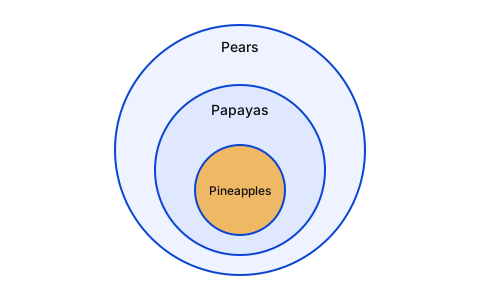
  1. Pineapples ⊂ Papayas ⊂ Pears (nested circles).
  2. I: All pineapples are pears — follows directly from the chain ✓.
  3. II: Some pears are pineapples — the converse of an 'All' statement gives 'Some' ✓.

Trick: 'All A are C' always implies 'Some C are A' (when A exists in the statements).

Answer: (D) Both conclusions I and II follow

अवधारणा: दो 'All' कथन जुड़ते हैं: All A are B + All B are C ⇒ All A are C।

  1. Pineapples ⊂ Papayas ⊂ Pears (एक-दूसरे के अंदर वृत्त)।
  2. I: All pineapples are pears — श्रृंखला से सीधे सत्य ✓।
  3. II: Some pears are pineapples — 'All' कथन का उल्टा 'Some' देता है ✓।

ट्रिक: 'All A are C' से सदैव 'Some C are A' निकलता है।

उत्तर: (D) Both conclusions I and II follow

SSC CPO Paper IGeneral Intelligence and ReasoningSyllogismSSC CPO Paper I 2024 · 27 Jun Shift 2 →
Q1450.
Select the set in which the numbers are related in the same way as are the numbers of the following sets.
(NOTE : Operations should be performed on the whole numbers, without breaking
down the numbers into its constituent digits. E.g. 13 – Operations on 13 such as
adding /deleting /multiplying etc. to 13 can be performed. Breaking down 13 into 1 and 3 and then performing mathematical operations on 1 and 3 is not allowed.)
(76, 152, 38)
(84, 168, 42)
उस समुच्चय का चयन कीजिए जिसमें संख्याएँ उसी प्रकार संबंधित हैं, जिस प्रकार निम्नलिखित समुच्चयों की संख्याएँ संबंधित हैं।
(ध्यान दें : संक्रियाएँ संख्याओं को उनके घटक अंकों में तोड़े बिना, पूर्ण संख्याओं पर की जानी चाहिए। उदाहरण के लिए 13 – 13 पर की जाने वाली संक्रियाएँ, जैसे 13 में जोड़ना/घटाना/गुणा करना आदि की जा सकती हैं। 13 को 1 और 3 में तोड़कर फिर 1 और 3 पर गणितीय संक्रियाएँ करने की अनुमति नहीं है।)
(76, 152, 38)
(84, 168, 42)
  1. A(84, 178, 42)
  2. B(96, 184, 46)
  3. C(62, 132, 33)
  4. D(68, 136, 34)
Show answer

Concept: Relate the second and third numbers to the first.

  1. (76,152,38): 76×2=152, 76÷2=38.
  2. (84,168,42): 84×2=168, 84÷2=42 ✓.
  3. (68,136,34): 68×2=136, 68÷2=34 ✓.
  4. (A) 84×2≠178; (B) 96×2≠184; (C) 62×2≠132.

Trick: Second =4× third and first =2× third: 34×2=68, 34×4=136.

Answer: (D) (68, 136, 34)

अवधारणा: दूसरी और तीसरी संख्या को पहली से जोड़ें।

  1. (76,152,38): 76×2=152, 76÷2=38।
  2. (84,168,42): 84×2=168, 84÷2=42 ✓।
  3. (68,136,34): 68×2=136, 68÷2=34 ✓।
  4. (A) 84×2≠178; (B) 96×2≠184; (C) 62×2≠132।

ट्रिक: दूसरी =4× तीसरी, पहली =2× तीसरी: 34×2=68, 34×4=136।

उत्तर: (D) (68, 136, 34)

SSC CPO Paper IGeneral Intelligence and ReasoningNumber Set RelationSSC CPO Paper I 2024 · 27 Jun Shift 2 →
Q1451.
Which Greek term was first used by Ernst Haeckel in 1866 to refer to ‘the relation of animals to both the organic as well as the inorganic environment’?
1866 में अर्नेस्ट हेकेल (Ernst Haeckel) द्वारा ‘जीवों का कार्बनिक और अकार्बनिक दोनों प्रकार के पर्यावरण से संबंध’ को संदर्भित करने के लिए सर्वप्रथम किस ग्रीक शब्द का प्रयोग किया गया था?
  1. AOekologie
  2. BEcophagie
  3. CEthnologie
  4. DOologie
Show answer

Concept: The word ‘ecology’ comes from the German/Greek-based term Oekologie, from Greek oikos (house) + logos (study).

  1. German zoologist Ernst Haeckel coined Oekologie in 1866 for the relation of animals to their organic and inorganic environment.
  2. Ethnology studies human cultures and races; oology studies bird eggs; ‘Ecophagie’ is not a scientific term.

Yaad rakhein: Haeckel – 1866 – Oekologie → Ecology (oikos = home).

Answer: (A) Oekologie

अवधारणा: ‘Ecology’ शब्द Oekologie से बना है – ग्रीक oikos (घर) + logos (अध्ययन)।

  1. जर्मन प्राणी-वैज्ञानिक अर्नस्ट हेकेल (Ernst Haeckel) ने 1866 में जीवों और उनके जैविक व अजैविक पर्यावरण के संबंध के लिए Oekologie शब्द दिया।
  2. Ethnology = मानव संस्कृतियों का अध्ययन; Oology = पक्षियों के अंडों का अध्ययन; ‘Ecophagie’ कोई वैज्ञानिक शब्द नहीं है।

याद रखें: हेकेल – 1866 – Oekologie → Ecology (oikos = घर)।

उत्तर: (A) Oekologie

SSC CPO Paper IGeneral Knowledge and General AwarenessEcology – origin of termSSC CPO Paper I 2024 · 27 Jun Shift 2 →
Q1452.
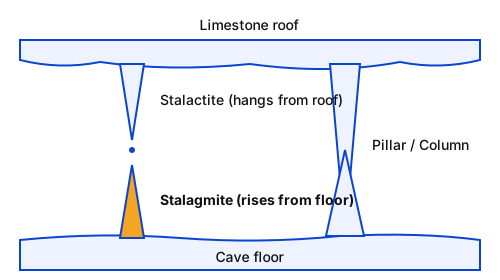
The depositional pattern of CaCO3 and other materials that extend upwards from the floor of a limestone cavern is known as:
चूना पत्थर की गुफा के फर्श से ऊपर की ओर विस्तारित CaCO3 और अन्य पदार्थों का निक्षेपण प्रतिरूप ________ कहलाता है।
  1. AHatectiteहेटेक्टाइट (Hatectite)
  2. BStalagmiteस्टैलेग्माइट (Stalagmite)
  3. CStalactiteस्टैलेक्टाइट (Stalactite)
  4. DDripstoneड्रिपस्टोन (Dripstone)
Show answer

Concept: In limestone caves, water rich in dissolved CaCO3 drips and deposits calcite, forming dripstone features.

  1. Stalactite – icicle-like deposit hanging down from the cave roof.
  2. Stalagmite – deposit rising upward from the cave floor where drops fall.
  3. When the two meet they form a pillar (column); ‘dripstone’ is the general name for all such deposits, not specifically the upward one.

Yaad rakhein: stalaG-mite grows from the Ground; stalaC-tite hangs from the Ceiling.

Answer: (B) Stalagmite

अवधारणा: चूना-पत्थर (limestone) की गुफाओं में घुले CaCO3 वाला पानी टपककर कैल्साइट जमा करता है।

  1. Stalactite (आश्चुताश्म) – गुफा की छत से नीचे लटकने वाली संरचना।
  2. Stalagmite (निलंबताश्म) – गुफा के फर्श से ऊपर की ओर उठने वाली संरचना।
  3. दोनों मिलकर स्तंभ (pillar) बनाते हैं; ‘dripstone’ ऐसी सभी जमाओं का सामान्य नाम है।

याद रखें: stalaG-mite – Ground (फर्श) से ऊपर; stalaC-tite – Ceiling (छत) से नीचे।

उत्तर: (B) Stalagmite

SSC CPO Paper IGeneral Knowledge and General AwarenessKarst landformsSSC CPO Paper I 2024 · 27 Jun Shift 2 →
Q1453.
Fundamental Duties of the Indian Constitution are mentioned in which Article?
भारतीय संविधान के मौलिक कर्तव्यों का उल्लेख किस अनुच्छेद में किया गया है?
  1. AArticle 42 Aअनुच्छेद 42 A
  2. BArticle 51अनुच्छेद 51
  3. CArticle 51 Aअनुच्छेद 51 A
  4. DArticle 42अनुच्छेद 42
Show answer

Concept: Fundamental Duties are in Part IV-A of the Constitution, which has a single Article – 51A.

  1. Added by the 42nd Amendment Act, 1976 on the recommendation of the Swaran Singh Committee (originally 10 duties).
  2. The 86th Amendment (2002) added the 11th duty (education of children aged 6–14).
  3. Article 51 is a Directive Principle (international peace and security), not the duties.

Yaad rakhein: Part IV-A → Article 51A → 11 duties; idea borrowed from the USSR constitution.

Answer: (C) Article 51 A

अवधारणा: मौलिक कर्तव्य संविधान के भाग IV-A में हैं, जिसमें केवल एक अनुच्छेद है – 51A।

  1. 42वें संशोधन अधिनियम, 1976 द्वारा स्वर्ण सिंह समिति की सिफारिश पर जोड़े गए (मूल रूप से 10 कर्तव्य)।
  2. 86वें संशोधन (2002) ने 11वाँ कर्तव्य जोड़ा (6–14 वर्ष के बच्चों की शिक्षा)।
  3. अनुच्छेद 51 नीति-निर्देशक तत्व है (अंतरराष्ट्रीय शांति और सुरक्षा)।

याद रखें: भाग IV-A → अनुच्छेद 51A → 11 कर्तव्य; विचार USSR के संविधान से।

उत्तर: (C) Article 51 A

SSC CPO Paper IGeneral Knowledge and General AwarenessFundamental DutiesSSC CPO Paper I 2024 · 27 Jun Shift 2 →
Q1454.
Thiyam Suryamukhi Devi who received the Sangeet Natak Akademi Awards 2003, is known for her contribution to the:
संगीत नाटक अकादमी पुरस्कार 2003 प्राप्त करने वाली थियाम सूर्यमुखी देवी को ________ में उनके योगदान के लिए जाना जाता है।
  1. AOdissi danceओडिसी नृत्य
  2. BGotipua danceगोटीपुआ नृत्य
  3. CManipuri danceमणिपुरी नृत्य
  4. DKathak danceकथक नृत्य
Show answer

Concept: Thiyam Suryamukhi Devi is a renowned Manipuri dancer and guru from Manipur.

  1. She received the Sangeet Natak Akademi Award (2003) for her contribution to Manipuri dance.
  2. Odissi and Gotipua belong to Odisha; Kathak is a North Indian form – none matches a Manipuri artiste.

Yaad rakhein: Manipuri names like Thiyam, Singhajit, Guru Bipin Singh → Manipuri dance.

Answer: (C) Manipuri dance

अवधारणा: थियाम सूर्यमुखी देवी मणिपुर की प्रसिद्ध मणिपुरी नृत्यांगना और गुरु हैं।

  1. उन्हें मणिपुरी नृत्य में योगदान के लिए संगीत नाटक अकादमी पुरस्कार (2003) मिला।
  2. ओडिसी और गोटीपुआ ओडिशा के नृत्य हैं; कथक उत्तर भारत का नृत्य है।

याद रखें: थियाम, सिंहजीत, गुरु बिपिन सिंह जैसे नाम → मणिपुरी नृत्य।

उत्तर: (C) Manipuri dance

SSC CPO Paper IGeneral Knowledge and General AwarenessIndian classical dance – awardeesSSC CPO Paper I 2024 · 27 Jun Shift 2 →
Q1455.
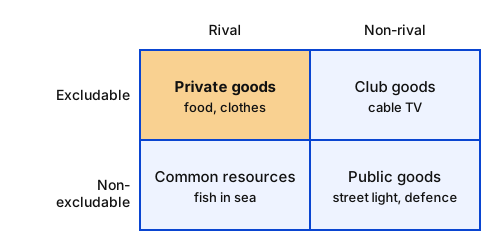
Which of the followings statements is/are true about private goods?
I. Rivalrous in consumption
II. Non-excludability
III. Negative marginal cost
निजी वस्तुओं के संबंध में निम्नलिखित में से कौन-सा/से कथन सत्य है/हैं?
I. उपभोग में प्रतिद्वंद्विता (rivalrous)
II. गैर-अपवर्जनीयता (non-excludability)
III. ऋणात्मक सीमांत लागत
  1. AOnly IIकेवल II
  2. BOnly IIIकेवल III
  3. CBoth II and IIIII और III दोनों
  4. DOnly Iकेवल I
Show answer

Concept: Goods are classified by two features: rivalry (one person’s use reduces another’s) and excludability (non-payers can be kept out).

  1. Private goods are rivalrous and excludable – e.g. food, clothes. So statement I is true.
  2. Non-excludability is a feature of public goods, so II is false.
  3. Producing an extra unit of a private good has a positive marginal cost, so III is false.

Yaad rakhein: Private = Rival + Excludable; Public = Non-rival + Non-excludable.

Answer: (D) Only I

अवधारणा: वस्तुओं को दो गुणों से बाँटा जाता है: प्रतिद्वंद्विता (rivalry) और अपवर्जनीयता (excludability)।

  1. निजी वस्तुएँ (private goods) rivalrous और excludable होती हैं – जैसे भोजन, कपड़े। अतः कथन I सही है।
  2. Non-excludability सार्वजनिक वस्तुओं (public goods) का गुण है, इसलिए II गलत है।
  3. निजी वस्तु की एक अतिरिक्त इकाई बनाने की सीमांत लागत (marginal cost) धनात्मक होती है, इसलिए III गलत है।

याद रखें: Private = Rival + Excludable; Public = Non-rival + Non-excludable।

उत्तर: (D) Only I

SSC CPO Paper IGeneral Knowledge and General AwarenessTypes of goodsSSC CPO Paper I 2024 · 27 Jun Shift 2 →
Q1456.
What is the national female workforce participation rate as per the Census of India
2011?
भारत की जनगणना
2011 के अनुसार राष्ट्रीय महिला कार्यबल भागीदारी दर कितनी है?
  1. A53.26%
  2. B30.02%
  3. C53.03%
  4. D25.51%
Show answer

Concept: Work Participation Rate (WPR) = percentage of total workers to total population.

  1. Census 2011: overall WPR =39.8%; male WPR =53.3%.
  2. Female WPR =25.51% (rural about 30%, urban about 15.4%).
  3. 53.26% is close to the male figure, a common trap.

Yaad rakhein: Census 2011 WPR – Total ≈ 40, Male ≈ 53, Female ≈ 25.5.

Answer: (D) 25.51%

अवधारणा: कार्य सहभागिता दर (WPR) = कुल जनसंख्या में श्रमिकों का प्रतिशत।

  1. जनगणना 2011: कुल WPR =39.8%; पुरुष WPR =53.3%।
  2. महिला WPR =25.51% (ग्रामीण लगभग 30%, शहरी लगभग 15.4%)।
  3. 53.26% पुरुषों के आँकड़े के करीब है – यह भ्रमित करने वाला विकल्प है।

याद रखें: जनगणना 2011 WPR – कुल ≈ 40, पुरुष ≈ 53, महिला ≈ 25.5।

उत्तर: (D) 25.51%

SSC CPO Paper IGeneral Knowledge and General AwarenessCensus 2011 – work participationSSC CPO Paper I 2024 · 27 Jun Shift 2 →
Q1457.
Who among the following is a Padma Shri Awardee for her contribution to Manipuri Dance?
निम्नलिखित में से किसे मणिपुरी नृत्य में उनके योगदान के लिए पद्म श्री से सम्मानित किया गया है?
  1. ADarshana Jhaveriदर्शना झवेरी
  2. BShovana Narayanशोवना नारायण
  3. CMrinalini Sarabhaiमृणालिनी साराभाई
  4. DAditi Rao Hydariअदिति राव हैदरी
Show answer

Concept: Darshana Jhaveri, one of the Jhaveri sisters of Mumbai, is a leading exponent and scholar of Manipuri dance.

  1. She was awarded the Padma Shri in 2002 for Manipuri dance and co-founded the Manipuri Nartanalaya.
  2. Shovana Narayan – Kathak; Mrinalini Sarabhai – Bharatanatyam/Kathakali; Aditi Rao Hydari is a film actress.

Yaad rakhein: Jhaveri sisters (Nayana, Suverna, Ranjana, Darshana) → Manipuri.

Answer: (A) Darshana Jhaveri

अवधारणा: दर्शना झवेरी, मुंबई की झवेरी बहनों में से एक, मणिपुरी नृत्य की प्रमुख कलाकार और विद्वान हैं।

  1. उन्हें मणिपुरी नृत्य के लिए 2002 में पद्म श्री मिला; उन्होंने मणिपुरी नर्तनालय की सह-स्थापना की।
  2. शोभना नारायण – कथक; मृणालिनी साराभाई – भरतनाट्यम/कथकली; अदिति राव हैदरी फिल्म अभिनेत्री हैं।

याद रखें: झवेरी बहनें → मणिपुरी नृत्य।

उत्तर: (A) Darshana Jhaveri

SSC CPO Paper IGeneral Knowledge and General AwarenessIndian dance – Padma awardeesSSC CPO Paper I 2024 · 27 Jun Shift 2 →
Q1458.
Who among the following Padma Vibhushan awardees belongs to Kalka-Bindadin
gharana of Kathak?
निम्नलिखित पद्म विभूषण पुरस्कार विजेताओं में से कौन कथक के कालका-बिंदादीन
घराने से संबंधित है?
  1. ADamyanti Deviदमयंती देवी
  2. BKelucharan Mohapatraकेलुचरण महापात्र
  3. CBirju Maharajबिरजू महाराज
  4. DSitara Deviसितारा देवी
Show answer

Concept: The Lucknow gharana of Kathak is also called the Kalka-Bindadin gharana, after the brothers Kalka Prasad and Bindadin Maharaj.

  1. Pandit Birju Maharaj, grandson of Kalka Prasad, belonged to this gharana and received the Padma Vibhushan (1986).
  2. Sitara Devi was a Kathak dancer of the Banaras style; Kelucharan Mohapatra was an Odissi guru.

Yaad rakhein: Lucknow gharana = Kalka-Bindadin = Birju Maharaj family.

Answer: (C) Birju Maharaj

अवधारणा: कथक का लखनऊ घराना कालका-बिंदादीन घराना भी कहलाता है – कालका प्रसाद और बिंदादीन महाराज भाइयों के नाम पर।

  1. पंडित बिरजू महाराज (कालका प्रसाद के पोते) इसी घराने के थे और उन्हें 1986 में पद्म विभूषण मिला।
  2. सितारा देवी बनारस शैली की कथक नृत्यांगना थीं; केलुचरण महापात्र ओडिसी गुरु थे।

याद रखें: लखनऊ घराना = कालका-बिंदादीन = बिरजू महाराज।

उत्तर: (C) Birju Maharaj

SSC CPO Paper IGeneral Knowledge and General AwarenessKathak gharanasSSC CPO Paper I 2024 · 27 Jun Shift 2 →
Q1459.
‘Vasanta’, ‘Grishma’ and ‘Varsha’ are names of _________ in India.
‘वसंत’, ‘ग्रीष्म’ और ‘वर्षा’ भारत में _________ के नाम हैं।
  1. Atraditional seasonsपारंपरिक ऋतुओं
  2. Bcyclonesचक्रवातों
  3. Clocal windsस्थानीय पवनों
  4. Dlocal stormsस्थानीय तूफ़ानों
Show answer

Concept: The traditional Indian calendar divides the year into six seasons (ritus) of two months each.

  1. Vasanta (spring), Grishma (summer), Varsha (rainy), Sharad (autumn), Hemanta (pre-winter), Shishira (winter).
  2. They are not names of cyclones, local winds (like Loo, Mango showers) or local storms.

Yaad rakhein: 6 ritus: Vasanta–Grishma–Varsha–Sharad–Hemanta–Shishira.

Answer: (A) traditional seasons

अवधारणा: पारंपरिक भारतीय पंचांग में वर्ष को दो-दो महीने की छह ऋतुओं में बाँटा गया है।

  1. वसंत, ग्रीष्म, वर्षा, शरद, हेमंत, शिशिर।
  2. ये चक्रवात, स्थानीय पवनों (जैसे लू, आम्र वर्षा) या स्थानीय तूफानों के नाम नहीं हैं।

याद रखें: 6 ऋतुएँ: वसंत–ग्रीष्म–वर्षा–शरद–हेमंत–शिशिर।

उत्तर: (A) traditional seasons

SSC CPO Paper IGeneral Knowledge and General AwarenessIndian seasonsSSC CPO Paper I 2024 · 27 Jun Shift 2 →
Q1460.
In which of the following regions is the tropical evergreen forests found in India?
भारत में उष्णकटिबंधीय सदाबहार वन निम्नलिखित में से किस क्षेत्र में पाए जाते हैं?
  1. AThar Desertथार मरुस्थल
  2. BWestern Ghatsपश्चिमी घाट
  3. CEastern Ghatsपूर्वी घाट
  4. DRann of Kutchकच्छ का रण
Show answer

Concept: Tropical evergreen forests grow where annual rainfall exceeds about 200 cm with a short dry season.

  1. In India they occur on the western slopes of the Western Ghats, the north-eastern hills and the Andaman & Nicobar Islands.
  2. Thar Desert and Rann of Kutch are arid (thorn/scrub vegetation); the Eastern Ghats are mostly deciduous.

Yaad rakhein: Evergreen = heavy rain → Western Ghats, NE India, Andamans.

Answer: (B) Western Ghats

अवधारणा: उष्णकटिबंधीय सदाबहार वन वहाँ होते हैं जहाँ वार्षिक वर्षा लगभग 200 cm से अधिक हो।

  1. भारत में ये पश्चिमी घाट की पश्चिमी ढलानों, पूर्वोत्तर की पहाड़ियों और अंडमान-निकोबार में मिलते हैं।
  2. थार मरुस्थल और कच्छ का रण शुष्क (कंटीली वनस्पति) हैं; पूर्वी घाट में मुख्यतः पर्णपाती वन हैं।

याद रखें: सदाबहार = भारी वर्षा → पश्चिमी घाट, पूर्वोत्तर, अंडमान।

उत्तर: (B) Western Ghats

SSC CPO Paper IGeneral Knowledge and General AwarenessNatural vegetation of IndiaSSC CPO Paper I 2024 · 27 Jun Shift 2 →