Question bank

Q&A: practice questions with answers

Search questions on any topic. Filter by exam category, exam, subject and topic, try the question, then open the answer and explanation.

Courses – airGurukul

4,200 questions found.

Q1001.
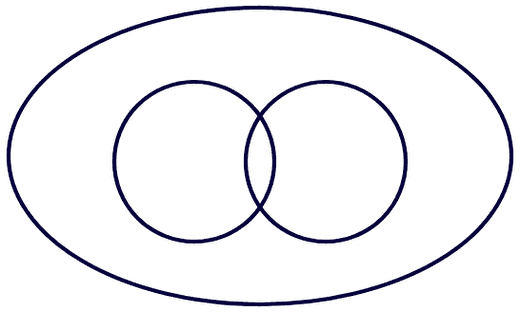
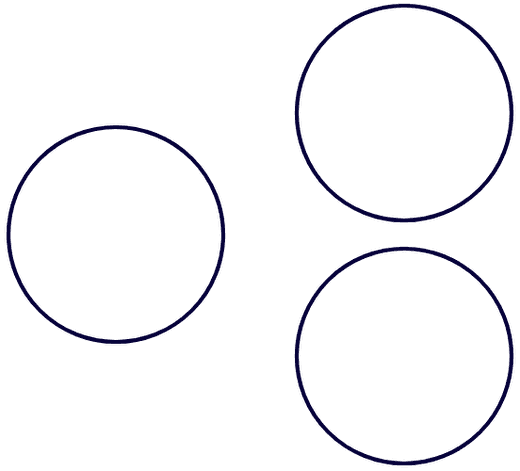
Select the Venn diagram that best illustrates the relationship between the following classes.
Doctors, Men, Tables
निम्नलिखित वर्गों के बीच के संबंध को सर्वोत्तम रूप से दर्शाने वाले वेन आरेख का चयन कीजिए।
डॉक्टर, पुरुष, मेज
  1. Afigure
  2. Bfigure
  3. Cfigure
  4. Dfigure
Show answer

Concept: Draw a circle for each class and decide: inside, overlapping or separate.
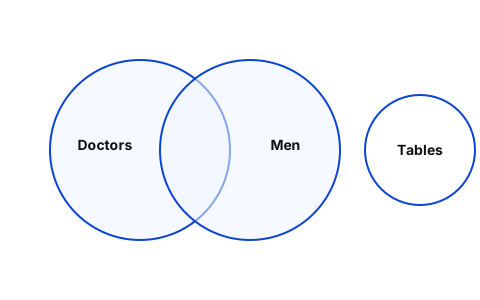
  1. Doctors and Men: a doctor may or may not be a man, and many men are not doctors → partial overlap.
  2. Tables are objects, not people → a circle completely apart from both.
  3. Required shape: two intersecting circles + one isolated circle, as shown in option (b).

Trick: First spot the 'odd' class (non-living Tables) – it must stand alone; reject any figure where it touches another circle.

Answer: (B)the figure with two linked circles and one separate circle

अवधारणा: हर वर्ग के लिए एक वृत्त; देखें कि वह अंदर है, आंशिक रूप से मिलता है या अलग है।

  1. चिकित्सक पुरुष भी हो सकता है और महिला भी; हर पुरुष चिकित्सक नहीं → ये दो वृत्त आंशिक रूप से कटेंगे।
  2. मेज़ एक वस्तु है, इसका किसी व्यक्ति से संबंध नहीं → अलग वृत्त।
  3. अतः दो कटते वृत्त + एक अलग वृत्त = विकल्प (b)।

ट्रिक: निर्जीव वर्ग (मेज़) सदा अलग रहेगा – जिस चित्र में वह किसी वृत्त को छूता है, उसे हटा दें।

उत्तर: (B)दो जुड़े वृत्त और एक अलग वृत्त
SSC GDGeneral Intelligence & ReasoningVenn diagram – two overlapping, one separateSSC GD 2025 · 19 Feb Shift 2 →
Q1002.
RGLA is related to ODHW in a certain way based on the English alphabetical order. In the same way, CTZW is related to ZQVS. To which of the given options is NBUP related, following the same logic?
अंग्रेजी वर्णमाला क्रम के आधार पर RGLA एक निश्चित प्रकार से ODHW से संबंधित है। उसी प्रकार, CTZW, ZQVS से संबंधित है। समान तर्क का अनुसरण करते हुए, NBUP दिए गए विकल्पों में से किससे संबंधित है?
  1. AHXPN
  2. BGZRO
  3. CHZPM
  4. DKYQL
Show answer

Concept: Find the shift of each letter position in the given pair and repeat it.

  1. RGLA → ODHW: R→O (−3), G→D (−3), L→H (−4), A→W (−4, wrapping past Z).
  2. Check CTZW → ZQVS: −3, −3, −4, −4 ✔.
  3. Apply to NBUP: N(14)→K(11), B(2)→Y(25) by 3 back; U(21)→Q(17), P(16)→L(12) by 4 back → KYQL.

Trick: Only option (d) starts with K (N−3); one letter is enough to pick it.

Answer: (D) KYQL

अवधारणा: दिए गए युग्म में हर स्थान का खिसकाव निकालें और वही लगाएँ।

  1. RGLA → ODHW: R→O (−3), G→D (−3), L→H (−4), A→W (−4, Z से होकर पीछे)।
  2. CTZW → ZQVS में भी −3, −3, −4, −4 ✔।
  3. NBUP पर लगाएँ: N(14)→K(11), B(2)→Y(25) तीन पीछे; U(21)→Q(17), P(16)→L(12) चार पीछे → KYQL।

ट्रिक: N−3 = K – केवल विकल्प (d) K से शुरू होता है, पहला अक्षर ही काफ़ी है।

उत्तर: (D) KYQL

SSC GDGeneral Intelligence & ReasoningLetter analogy – fixed backward shiftsSSC GD 2025 · 19 Feb Shift 2 →
Q1003.
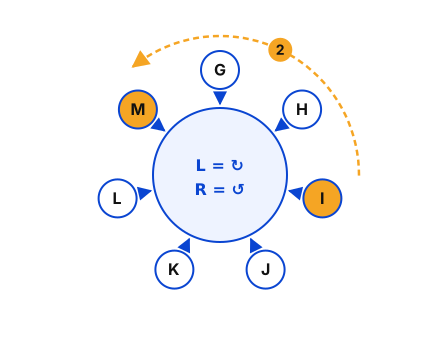
G, H, I, J, K, L and M are sitting around a circular table, facing the centre of the table(but not necessarily in the same order).
J sits third to the left of G. M sits second to the left of K. Only G sits between H and M. L is not an immediate neighbour of J. How many people sit between I and M when counted from the right of I ?
G, H, I, J, K, L और M एक वृत्ताकार मेज के चारों ओर मेज के केंद्र की ओर मुख करके बैठे हैं (आवश्यक नहीं कि इसी क्रम में हों)।
J, G के बाईं ओर तीसरे स्थान पर बैठा है। M, K के बाईं ओर दूसरे स्थान पर बैठा है। H और M के बीच केवल G बैठा है। L, J का निकटतम पड़ोसी नहीं है। I के दाईं ओर से गिनने पर I और M के बीच कितने व्यक्ति बैठे हैं?
  1. AOneएक
  2. BFourचार
  3. CThreeतीन
  4. DTwoदो
Show answer

Concept: Facing centre: left = clockwise, right = anticlockwise.

  1. Seat G at 1 (numbering clockwise). J is 3rd to G's left → seat 4.
  2. H and M are G's two neighbours (seats 2 and 7). K is 2 places right of M; M = 7 gives K = 5 (free) – M = 2 would give K = 4, taken by J. So M = 7, H = 2, K = 5.
  3. Seats 3 and 6 remain for I and L; L can't be next to J (4) → L = 6, I = 3.
  4. From I going right (anticlockwise): H(2), G(1), then M(7) → 2 people in between.

Trick: When two clues fix neighbours of one person, test both placements – one will always collide with an already-fixed seat.

Answer: (D) Two

अवधारणा: केंद्र की ओर मुख: बायाँ = घड़ी की दिशा, दायाँ = घड़ी की उल्टी दिशा।

  1. G को स्थान 1 पर रखें। J, G के बाएँ तीसरा → स्थान 4।
  2. H और M, G के दोनों पड़ोसी (2 और 7)। K, M के दाएँ दूसरा; M = 7 लेने पर K = 5 बनता है (M = 2 पर K = 4, जो J का है)। अतः M = 7, H = 2, K = 5।
  3. बचे 3 और 6 पर I, L; L, J का पड़ोसी नहीं → L = 6, I = 3।
  4. I से दाईं ओर: H, G, फिर M → बीच में 2 व्यक्ति।

ट्रिक: जब किसी व्यक्ति के दोनों पड़ोसी तय हों, दोनों संभावनाएँ जाँचें – एक हमेशा पहले से भरी सीट से टकराएगी।

उत्तर: (D) दो

SSC GDGeneral Intelligence & ReasoningCircular seating – counting between two personsSSC GD 2025 · 19 Feb Shift 2 →
Q1004.
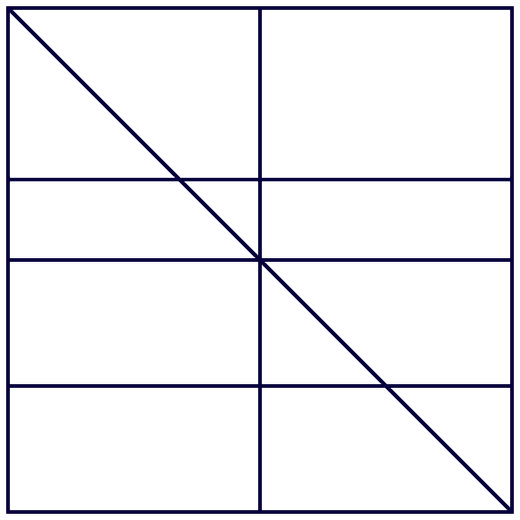
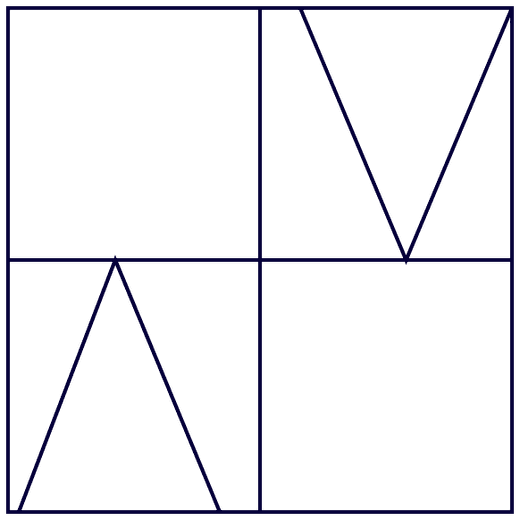
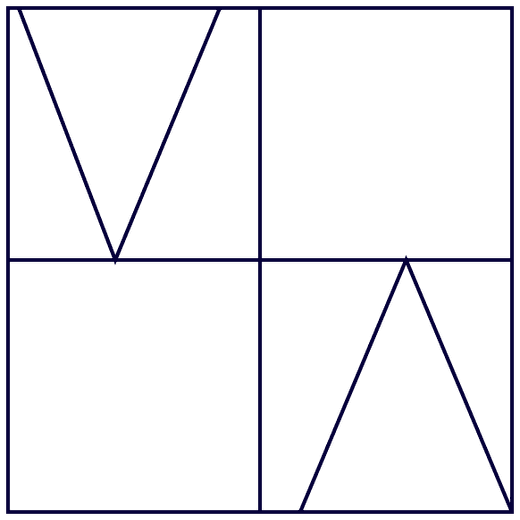
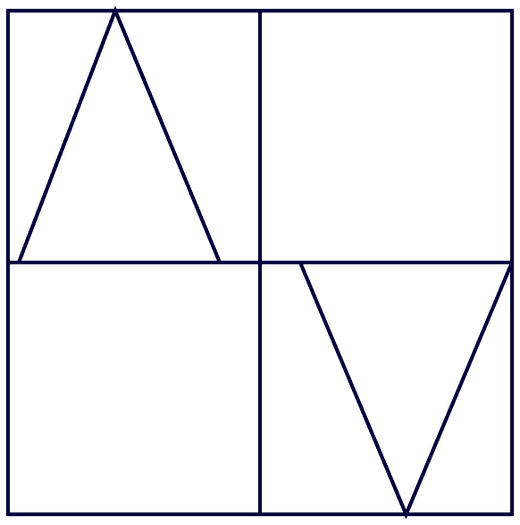
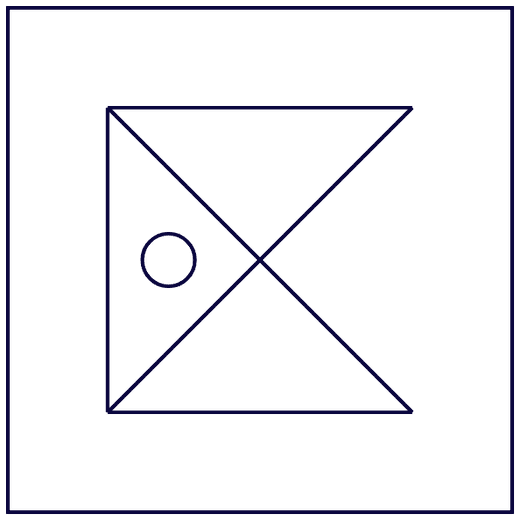
Select the option figure in which the given figure ( X ) is embedded as its part (rotation is NOT allowed).
figure
उस विकल्प आकृति का चयन कीजिए जिसमें दी गई आकृति (X) उसके एक भाग के रूप में अंतर्निहित है (घूर्णन (rotation) की अनुमति नहीं है)।
figure
  1. Afigure
  2. Bfigure
  3. Cfigure
  4. Dfigure
Show answer

Concept: The figure (X) must appear unchanged in size and direction inside the answer figure – no rotation.

  1. Note the key parts of (X): a peak on the left-bottom, a tall vertical line in the middle, and a V on the right-top.
  2. Option (b) contains all three parts in this exact order and orientation.
  3. (a) has no peak; in (c) and (d) the peak/V sit on the wrong side of the central line, so they would need rotation.

Trick: Pick one unusual part of (X) (here the V at upper right) and check only that in each option – wrong ones drop out fast.

Answer: (B)option figure (b)

अवधारणा: आकृति (X) बिना घुमाए, उसी आकार और दिशा में उत्तर आकृति में दिखनी चाहिए।

  1. (X) के मुख्य भाग: बाईं ओर नीचे एक शिखर, बीच में लंबी खड़ी रेखा, दाईं ओर ऊपर V।
  2. विकल्प (b) में ये तीनों भाग इसी क्रम और दिशा में मौजूद हैं।
  3. (a) में शिखर नहीं; (c), (d) में शिखर/V केंद्र रेखा के गलत तरफ़ हैं – घुमाना पड़ेगा।

ट्रिक: (X) का कोई विशेष भाग (जैसे ऊपर-दाएँ V) चुनें और हर विकल्प में केवल वही देखें।

उत्तर: (B)विकल्प आकृति (b)

SSC GDGeneral Intelligence & ReasoningEmbedded figureSSC GD 2025 · 19 Feb Shift 2 →
Q1005.
In a certain code language, 'PVQCB' is coded as '4' and 'MOZWITZ' is coded as ' 6 '. What is the code for 'RPAW' in the given code language?
एक निश्चित कूट भाषा में, 'PVQCB' को '4' के रूप में कूटबद्ध किया जाता है और 'MOZWITZ' को ' 6 ' के रूप में कूटबद्ध किया जाता है। दी गई कूट भाषा में 'RPAW' का कूट क्या होगा?
  1. A3
  2. B5
  3. C6
  4. D2
Show answer

Concept: Code depends only on the number of letters in the word.

  1. PVQCB: 5 letters → code 4 = 5 − 1.
  2. MOZWITZ: 7 letters → code 6 = 7 − 1.
  3. RPAW: 4 letters → 4 − 1 = 3.

Trick: When a whole word gets a single small number, first compare it with the word length.

Answer: (A) 3

अवधारणा: कोड केवल शब्द में अक्षरों की संख्या पर आधारित है।

  1. PVQCB: 5 अक्षर → कोड 4 = 5 − 1।
  2. MOZWITZ: 7 अक्षर → कोड 6 = 7 − 1।
  3. RPAW: 4 अक्षर → 4 − 1 = 3।

ट्रिक: पूरे शब्द का कोड एक छोटी संख्या हो तो पहले शब्द की लंबाई से तुलना करें।

उत्तर: (A) 3

SSC GDGeneral Intelligence & ReasoningCoding – letter count minus oneSSC GD 2025 · 19 Feb Shift 2 →
Q1006.
Based on the English alphabetical order, three of the following four letter-clusters are alike in a certain way and thus form a group. Which letter-cluster DOES NOT belong to that group?
(Note: The odd one out is not based on the number of consonants/vowels or their position in the letter-cluster.)
अंग्रेजी वर्णमाला क्रम के आधार पर, निम्नलिखित चार अक्षर-समूहों में से तीन एक निश्चित प्रकार से समान हैं और इस प्रकार एक समूह बनाते हैं। कौन-सा अक्षर-समूह उस समूह से संबंधित नहीं है?
(नोट: विषम अक्षर-समूह का आधार अक्षर-समूह में व्यंजनों/स्वरों की संख्या या उनका स्थान नहीं है।)
  1. ARWP
  2. BJOH
  3. CNSL
  4. DPUL
Show answer

Concept: Compare the gap from 1st→2nd letter and 2nd→3rd letter.

  1. RWP: R(18)→W(23) = +5, W(23)→P(16) = −7.
  2. JOH: +5, −7. NSL: +5, −7.
  3. PUL: P(16)→U(21) = +5, but U(21)→L(12) = −9 ✘.

Trick: First gap is +5 in all four, so check only the second gap – the one that differs is the answer.

Answer: (D) PUL

अवधारणा: पहले→दूसरे और दूसरे→तीसरे अक्षर का अंतर देखें।

  1. RWP: R(18)→W(23) = +5, W(23)→P(16) = −7।
  2. JOH: +5, −7; NSL: +5, −7।
  3. PUL: P→U = +5, पर U(21)→L(12) = −9 ✘।

ट्रिक: चारों में पहला अंतर +5 है, इसलिए सिर्फ़ दूसरा अंतर जाँचें।

उत्तर: (D) PUL

SSC GDGeneral Intelligence & ReasoningOdd one out – letter gapsSSC GD 2025 · 19 Feb Shift 2 →
Q1007.
A, B, C, D, E, F and G are sitting around a circular table facing the centre (but not necessarily in the same order). A is sitting to the immediate right of F and the immediate left of C. G is sitting to the immediate right of C and the immediate left of E. D is sitting to the immediate left of F and the immediate right of B. Who is sitting to the immediate left of B?
A, B, C, D, E, F और G एक वृत्ताकार मेज के चारों ओर केंद्र की ओर मुख करके बैठे हैं (आवश्यक नहीं कि इसी क्रम में हों)। A, F के ठीक दाईं ओर और C के ठीक बाईं ओर बैठा है। G, C के ठीक दाईं ओर और E के ठीक बाईं ओर बैठा है। D, F के ठीक बाईं ओर और B के ठीक दाईं ओर बैठा है। B के ठीक बाईं ओर कौन बैठा है?
  1. AE
  2. BC
  3. CG
  4. DA
Show answer

Concept: Facing centre: a person's immediate left is the next seat clockwise.

  1. A right of F and left of C → clockwise: C, A, F.
  2. G right of C, left of E → E, G, C, so chain E, G, C, A, F.
  3. D left of F, right of B → F, D, B. Full circle clockwise: E, G, C, A, F, D, B.
  4. Next seat clockwise after B is E.

Trick: 'X is immediate left of Y' and 'Y is immediate right of X' are the same fact – write each clue as a 3-letter chain and join them.

Answer: (A) E

अवधारणा: केंद्र की ओर मुख: किसी का तुरंत बायाँ = घड़ी की दिशा में अगली सीट।

  1. A, F के दाएँ और C के बाएँ → घड़ी की दिशा में: C, A, F।
  2. G, C के दाएँ और E के बाएँ → E, G, C; जोड़ने पर E, G, C, A, F।
  3. D, F के बाएँ, B के दाएँ → F, D, B। पूरा क्रम: E, G, C, A, F, D, B।
  4. B के बाद घड़ी की दिशा में E है।

ट्रिक: हर कथन को 3 अक्षरों की कड़ी बनाकर जोड़ते जाएँ – पूरा वृत्त तुरंत बन जाता है।

उत्तर: (A) E

SSC GDGeneral Intelligence & ReasoningCircular seating – immediate neighboursSSC GD 2025 · 19 Feb Shift 2 →
Q1008.
What will come in the place of the question mark '(?)' in the following equation, if ' - ' and ' ÷ ' are interchanged and ' x ' and ' + ' are interchanged? 40+24−6×12÷3= ?
यदि ' - ' और ' ÷ ' को आपस में बदल दिया जाए तथा ' x ' और ' + ' को आपस में बदल दिया जाए, तो निम्नलिखित समीकरण में प्रश्नवाचक चिह्न '(?)' के स्थान पर क्या आएगा? 40+24−6×12÷3= ?
  1. A169
  2. B167
  3. C168
  4. D166
Show answer

Concept: Swap the signs first, then solve using BODMAS.

  1. Swaps: − ↔ ÷ and × ↔ +.
  2. 40+24−6×12÷3 becomes 40×24÷6+12−3.
  3. 24÷6=4→40×4=160.
  4. 160+12−3=169.

Trick: Rewrite the full expression with new signs on paper before calculating – most errors come from swapping only half the signs.

Answer: (A) 169

अवधारणा: पहले चिह्न बदलें, फिर BODMAS से हल करें।

  1. बदलाव: − ↔ ÷ और × ↔ +।
  2. 40+24−6×12÷3→40×24÷6+12−3।
  3. 24÷6=4→40×4=160।
  4. 160+12−3=169।

ट्रिक: गणना से पहले नए चिह्नों के साथ पूरा व्यंजक दोबारा लिखें – आधे चिह्न बदलना सबसे आम गलती है।

उत्तर: (A) 169

SSC GDGeneral Intelligence & ReasoningSign interchange – BODMASSSC GD 2025 · 19 Feb Shift 2 →
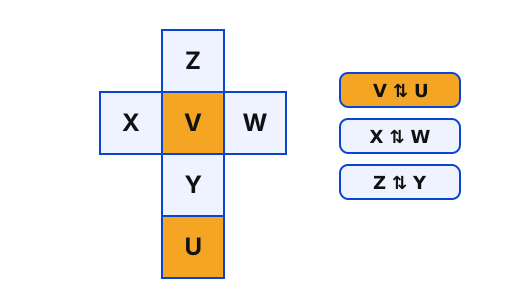
Q1009.
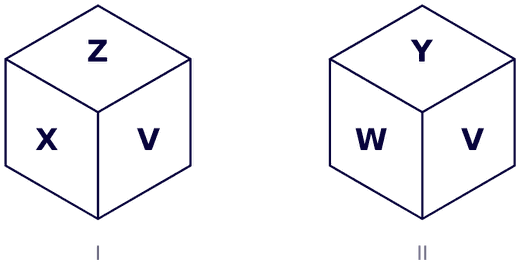
A dice has its faces marked by letters U, V, W, X, Y and Z. Two different positions of the same dice are shown. Select the letter that will be on the face opposite to the one having U ?
figure
एक पासे के फलकों पर U, V, W, X, Y और Z अक्षर अंकित हैं। एक ही पासे की दो भिन्न स्थितियाँ दर्शाई गई हैं। उस अक्षर का चयन कीजिए जो U वाले फलक के विपरीत फलक पर होगा।
figure
  1. AX
  2. BY
  3. CW
  4. DV
Show answer

Concept: A face has exactly 4 neighbours; the letter never seen beside it is opposite.

  1. V appears in both positions.
  2. Neighbours of V seen: Z, X (position 1) and Y, W (position 2) – four letters.
  3. The only remaining letter, U, is never beside V → U is opposite V.

Trick: Common face + 4 different neighbours = the 6th letter is its opposite. No need to rotate the dice mentally.

Answer: (D) V

अवधारणा: एक फलक के ठीक 4 पड़ोसी होते हैं; जो अक्षर कभी साथ न दिखे वही विपरीत है।

  1. V दोनों स्थितियों में दिख रहा है।
  2. V के पड़ोसी: Z, X (पहली स्थिति) और Y, W (दूसरी स्थिति) – चार अक्षर।
  3. बचा अक्षर U कभी V के साथ नहीं → U और V विपरीत।

ट्रिक: उभयनिष्ठ फलक + 4 अलग पड़ोसी = छठा अक्षर उसका विपरीत। पासा मन में घुमाने की ज़रूरत नहीं।

उत्तर: (D) V

SSC GDGeneral Intelligence & ReasoningDice – opposite face from common faceSSC GD 2025 · 19 Feb Shift 2 →
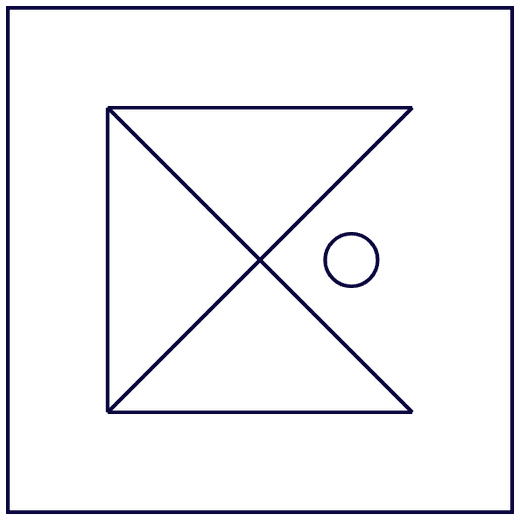
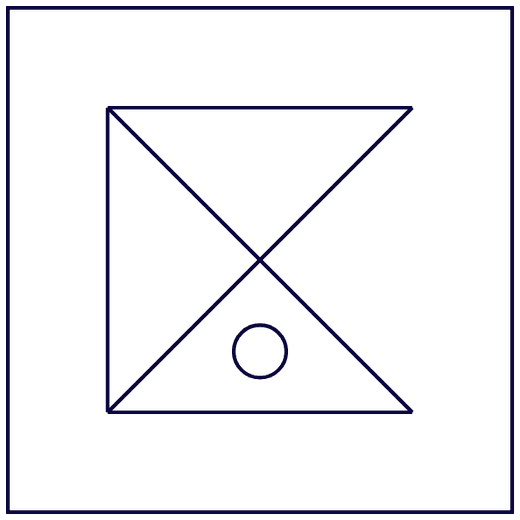
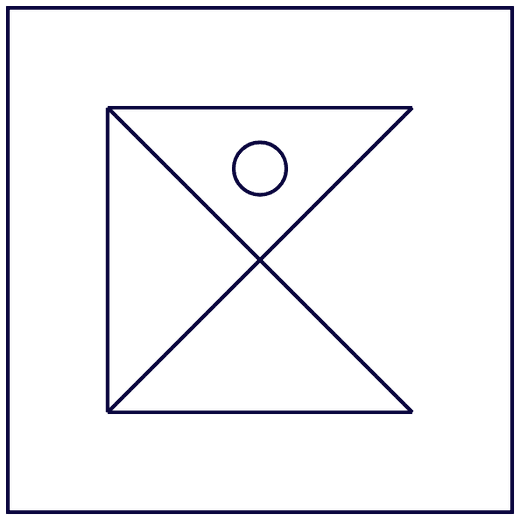
Q1010.
Select the figure from among the given options that can replace the question mark (?) in the following series.
figure
दिए गए विकल्पों में से उस आकृति का चयन कीजिए जो निम्नलिखित शृंखला में प्रश्नवाचक चिह्न (?) के स्थान पर आ सकती है।
figure
  1. Afigure
  2. Bfigure
  3. Cfigure
  4. Dfigure
Show answer

Concept: Track each moving element separately and find its cycle.

  1. The small circle moves one triangle clockwise each step: top → right → bottom → left → top.
  2. The open side of the square moves one side anticlockwise each step and completes its cycle of 4.
  3. 5th figure: circle back in the TOP triangle, right side open – only (c) shows this.

Trick: All options have the same open side, so decide using the circle alone.

Answer: (C)option figure (c)

अवधारणा: हर गतिशील भाग को अलग-अलग देखें और उसका चक्र पहचानें।

  1. छोटा वृत्त हर बार एक त्रिभुज घड़ी की दिशा में चलता है: ऊपर → दाएँ → नीचे → बाएँ → ऊपर।
  2. वर्ग की खुली भुजा हर बार एक भुजा घड़ी की उल्टी दिशा में खिसकती है; 4 में चक्र पूरा।
  3. पाँचवीं आकृति: वृत्त ऊपर वाले त्रिभुज में, दायीं भुजा खुली – केवल (c)।

ट्रिक: सभी विकल्पों में खुली भुजा एक-सी है, इसलिए केवल वृत्त की स्थिति से निर्णय करें।

उत्तर: (C)विकल्प आकृति (c)

SSC GDGeneral Intelligence & ReasoningFigure series – two moving elementsSSC GD 2025 · 19 Feb Shift 2 →
Q1011.
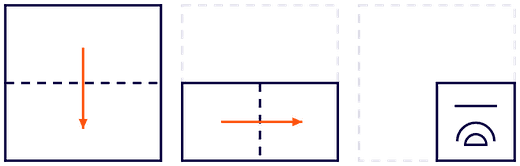
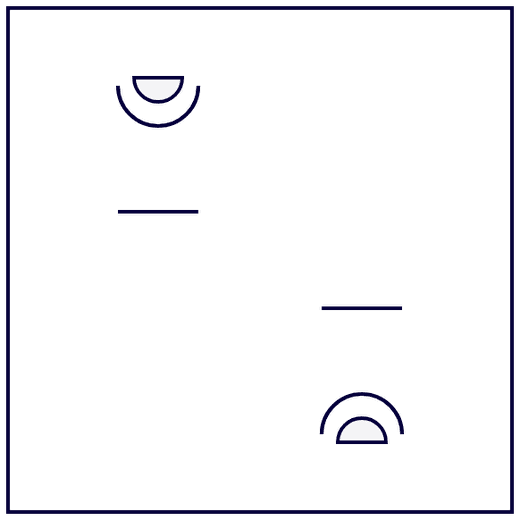
A paper is folded and punched as shown below. How will it appear when unfolded?
figure
नीचे दर्शाए अनुसार एक कागज़ को मोड़ा और छेदा जाता है। खोलने पर वह कैसा दिखाई देगा?
figure
  1. Afigure
  2. Bfigure
  3. Cfigure
  4. Dfigure
Show answer

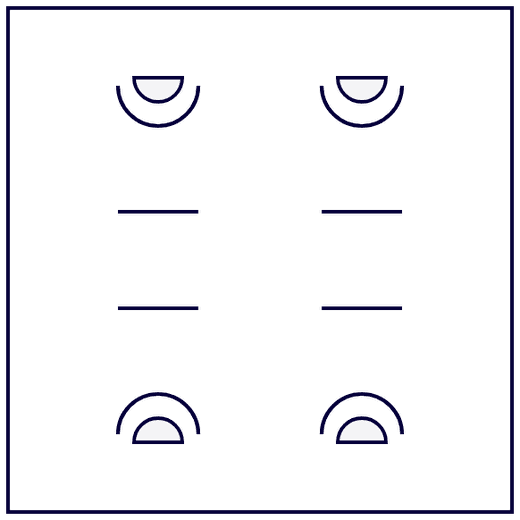
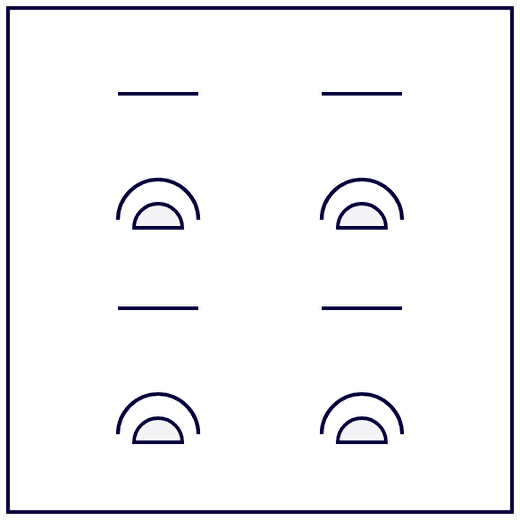
Concept: Unfold one fold at a time; each unfolding mirrors the marks across that fold line.

  1. Punches (one slit + one half-circle mark) lie in the bottom-right quarter.
  2. Undo the vertical fold → marks copied as a mirror image into the bottom-left quarter.
  3. Undo the horizontal fold → lower half mirrored into the upper half; the half-circles appear upside down there.
  4. Result: 8 marks, symmetric about both centre lines – option (a).

Trick: Count marks: punches × 2number of folds =2×4=8; reject options with fewer marks or no symmetry.

Answer: (A)option figure (a)

अवधारणा: एक-एक तह खोलें; हर बार निशान उस तह-रेखा के सापेक्ष दर्पण-प्रतिबिंब बनते हैं।

  1. छेद (एक स्लिट + एक अर्धवृत्त निशान) नीचे-दाएँ चौथाई में हैं।
  2. खड़ी तह खोलने पर ये नीचे-बाएँ चौथाई में दर्पण रूप में आते हैं।
  3. आड़ी तह खोलने पर निचला आधा ऊपर उल्टा बनता है – अर्धवृत्त उल्टे दिखेंगे।
  4. कुल 8 निशान, दोनों केंद्र रेखाओं के सापेक्ष सममित – विकल्प (a)।

ट्रिक: निशानों की संख्या = छेद × 2तहों की संख्या =2×4=8; कम निशान या असममित विकल्प हटा दें।

उत्तर: (A)विकल्प आकृति (a)

SSC GDGeneral Intelligence & ReasoningPaper folding and punchingSSC GD 2025 · 19 Feb Shift 2 →
Q1012.
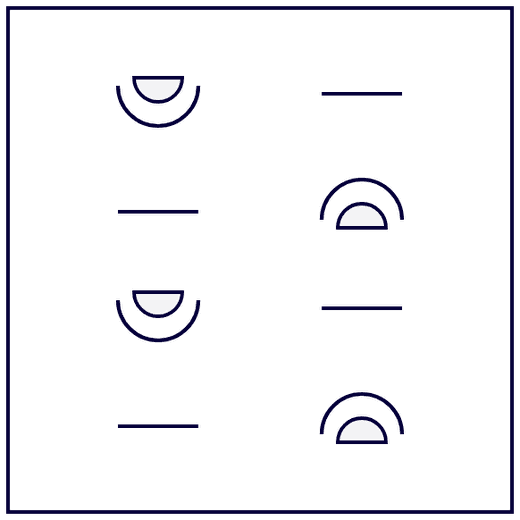
Read the given statements and conclusions carefully. Assuming that the information given in the statements is true, even if it appears to be at variance with commonly known facts, decide which of the given conclusion(s) logically follow(s) from the statement(s).
Statements:
All slippers are knives.
Some knives are rats.
Some rats are pizzas.
Conclusions:
(I) Some pizzas are slippers.
(II) Some rats are slippers.
दिए गए कथनों और निष्कर्षों को ध्यानपूर्वक पढ़िए। यह मानते हुए कि कथनों में दी गई जानकारी सत्य है, चाहे वह सामान्यतः ज्ञात तथ्यों से भिन्न प्रतीत होती हो, निर्णय कीजिए कि दिए गए निष्कर्षों में से कौन-सा/से निष्कर्ष कथनों का तार्किक रूप से अनुसरण करता है/करते हैं।
कथन:
सभी चप्पलें चाकू हैं।
कुछ चाकू चूहे हैं।
कुछ चूहे पिज़्ज़ा हैं।
निष्कर्ष:
(I) कुछ पिज़्ज़ा चप्पलें हैं।
(II) कुछ चूहे चप्पलें हैं।
  1. AOnly conclusion (I) follows.केवल निष्कर्ष (I) अनुसरण करता है।
  2. BBoth conclusions (I) and (II) follow.निष्कर्ष (I) और (II) दोनों अनुसरण करते हैं।
  3. COnly conclusion (II) follows.केवल निष्कर्ष (II) अनुसरण करता है।
  4. DNeither conclusion (I) nor (II) follows.न तो निष्कर्ष (I) और न ही निष्कर्ष (II) अनुसरण करता है।
Show answer

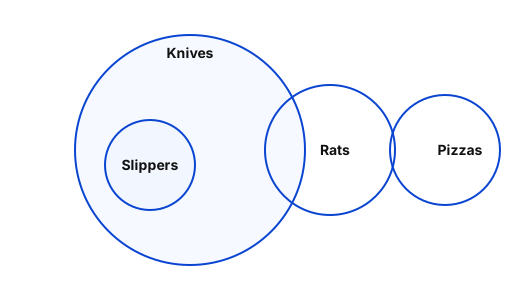
Concept: A 'definite' conclusion must hold in all valid Venn diagrams, not just one.

  1. All slippers are knives → slippers circle inside knives.
  2. Some knives are rats → rats may touch knives outside the slipper part.
  3. Some rats are pizzas → pizzas linked only with rats.
  4. So 'Some pizzas are slippers' and 'Some rats are slippers' are only possible, not certain → neither follows.

Trick: No direct link (statement) between the two terms of a conclusion → it cannot follow as a definite 'some' statement.

Answer: (D) Neither conclusion (I) nor (II) follows.

अवधारणा: निश्चित निष्कर्ष वही है जो हर वैध वेन आरेख में सही बैठे, किसी एक में नहीं।

  1. सभी चप्पलें चाकू हैं → चप्पल का वृत्त चाकू के अंदर।
  2. कुछ चाकू चूहे हैं → चूहे, चप्पल वाले भाग से बाहर भी जुड़ सकते हैं।
  3. कुछ चूहे पिज़्ज़ा हैं → पिज़्ज़ा केवल चूहों से जुड़ा।
  4. इसलिए दोनों निष्कर्ष सिर्फ़ 'हो सकते हैं' श्रेणी के हैं → दोनों असत्य माने जाएँगे।

ट्रिक: निष्कर्ष के दोनों पदों में सीधा संबंध न हो तो निश्चित 'कुछ' कथन नहीं बनता।

उत्तर: (D) न तो निष्कर्ष (I) और न ही निष्कर्ष (II) अनुसरण करता है।

SSC GDGeneral Intelligence & ReasoningSyllogism – possibility vs certaintySSC GD 2025 · 19 Feb Shift 2 →
Q1013.
What should come in place of the question mark (?) in the given series based on the English alphabetical order? KAM LDN MGO NJP ?
अंग्रेजी वर्णमाला क्रम के आधार पर दी गई शृंखला में प्रश्नवाचक चिह्न (?) के स्थान पर क्या आना चाहिए? KAM LDN MGO NJP ?
  1. AOPQ
  2. BPQR
  3. CPMQ
  4. DOMQ
Show answer

Concept: Read the 1st, 2nd and 3rd letters of each group as three separate series.

  1. 1st letters: K, L, M, N → +1 → O.
  2. 2nd letters: A, D, G, J → +3 → M.
  3. 3rd letters: M, N, O, P → +1 → Q.
  4. Next term: OMQ.

Trick: Options start with O or P – first letter O cuts to (a)/(d); middle letter M decides (d).

Answer: (D) OMQ

अवधारणा: हर समूह के पहले, दूसरे और तीसरे अक्षर को अलग-अलग श्रृंखला मानें।

  1. पहले अक्षर: K, L, M, N → +1 → O।
  2. दूसरे अक्षर: A, D, G, J → +3 → M।
  3. तीसरे अक्षर: M, N, O, P → +1 → Q।
  4. अगला पद: OMQ।

ट्रिक: पहला अक्षर O से विकल्प (a)/(d) बचते हैं; बीच का M उत्तर (d) तय करता है।

उत्तर: (D) OMQ

SSC GDGeneral Intelligence & ReasoningLetter series – position-wise patternSSC GD 2025 · 19 Feb Shift 2 →
Q1014.
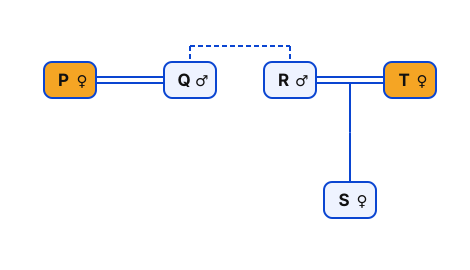
In a certain code language, ' A+B ' means ' A is the daughter of B ', ' A−B ' means ' A is the brother of B ', ' A×B ' means ' A is the wife of B′ and ' A÷B ' means ' A is the father of B '.
Based on the above, how is P related to T if ' P×Q−R÷S+T '?
एक निश्चित कूट भाषा में, ' A+B ' का अर्थ है ' A, B की पुत्री है ', ' A−B ' का अर्थ है ' A, B का भाई है ', ' A×B ' का अर्थ है ' A, B′ की पत्नी है तथा ' A÷B ' का अर्थ है ' A, B का पिता है '।
उपर्युक्त के आधार पर, P, T से किस प्रकार संबंधित है यदि ' P×Q−R÷S+T ' है?
  1. ABrother's wifeभाई की पत्नी
  2. BHusband's brother's daughterपति के भाई की पुत्री
  3. CHusband's brother's wifeपति के भाई की पत्नी
  4. DBrother's daughterभाई की पुत्री
Show answer

Concept: Decode each symbol pair one by one and connect the family links.

  1. P × Q: P is Q's wife. Q − R: Q is R's brother.
  2. R ÷ S: R is S's father. S + T: S is T's daughter → T is S's mother, so T is R's wife.
  3. Q is the brother of T's husband (R), and P is Q's wife.
  4. So P is T's husband's brother's wife.

Trick: Gender check: P is a wife (female) – reject options that need P to be a daughter; then follow the chain from T.

Answer: (C) Husband's brother's wife

अवधारणा: हर चिह्न युग्म को अलग से पढ़ें और परिवार की कड़ियाँ जोड़ें।

  1. P × Q → Q की पत्नी P है। Q − R → R का भाई Q है।
  2. R ÷ S: R, S का पिता। S + T: S, T की बेटी → T माता है, अतः T, R की पत्नी।
  3. R, T का पति है; R का भाई Q और Q की पत्नी P।
  4. अतः T के लिए P = देवरानी/जेठानी (पति के भाई की पत्नी)।

ट्रिक: P किसी की पत्नी है – 'बेटी' वाले विकल्प तुरंत हटाएँ, फिर T से कड़ी जोड़ें।

उत्तर: (C) पति के भाई की पत्नी

SSC GDGeneral Intelligence & ReasoningCoded blood relationSSC GD 2025 · 19 Feb Shift 2 →
Q1015.
LY 15 is related to JW 13 in a certain way. In the same way, DW 25 is related to BU 23. To which of the following is MR 35 related following the same logic?
LY 15 एक निश्चित प्रकार से JW 13 से संबंधित है। उसी प्रकार, DW 25, BU 23 से संबंधित है। समान तर्क का अनुसरण करते हुए, MR 35 निम्नलिखित में से किससे संबंधित है?
  1. ALQ 33
  2. BOS 33
  3. CNS 23
  4. DKP 33
Show answer

Concept: Each letter and the number change by the same fixed amount.

  1. LY 15 → JW 13: L−2 = J, Y−2 = W, 15−2 = 13.
  2. DW 25 → BU 23: same −2 rule ✔.
  3. MR 35 → M−2 = K, R−2 = P, 35−2 = 33 → KP 33.

Trick: Three options end in 33; the first letter K (M−2) picks (d) instantly.

Answer: (D) KP 33

अवधारणा: हर अक्षर और संख्या में समान निश्चित बदलाव है।

  1. LY 15 → JW 13: L−2 = J, Y−2 = W, 15−2 = 13।
  2. DW 25 → BU 23: वही −2 नियम ✔।
  3. MR 35 → K, P, 33 → KP 33।

ट्रिक: तीन विकल्पों में 33 है; पहला अक्षर K (M−2) से सीधे (d)।

उत्तर: (D) KP 33

SSC GDGeneral Intelligence & ReasoningLetter–number analogySSC GD 2025 · 19 Feb Shift 2 →
Q1016.
Select the combination of letters that when sequentially placed in the blanks of the given series, will logically complete the series.
_NRMQ_OJNH_GKEI_HBF_
अक्षरों के उस संयोजन का चयन कीजिए जिसे दी गई शृंखला के रिक्त स्थानों में क्रमिक रूप से रखने पर शृंखला तार्किक रूप से पूर्ण हो जाएगी।
_NRMQ_OJNH_GKEI_HBF_
  1. ASKMDC
  2. BSJMFC
  3. CTJLFA
  4. DTKLDA
Show answer

Concept: Split the 20 places into 5 groups of 4 and find how one group changes into the next.

  1. Groups: _NRM | Q_OJ | NH_G | KEI_ | HBF_.
  2. Known letters show each group = previous group with every letter −3 (e.g. R→O, M→J, O→L).
  3. Build: TNRM, QKOJ, NHLG, KEID, HBFA (T−3 = Q).
  4. Blanks: T, K, L, D, A.

Trick: Fill one blank and eliminate: first blank T removes (a), (b); second blank K leaves only (d).

Answer: (D) TKLDA

अवधारणा: 20 स्थानों को 4-4 अक्षरों के 5 समूहों में बाँटें और देखें कि एक समूह अगले में कैसे बदलता है।

  1. समूह: _NRM | Q_OJ | NH_G | KEI_ | HBF_।
  2. ज्ञात अक्षर बताते हैं: हर समूह = पिछला समूह, हर अक्षर −3 (जैसे R→O, M→J)।
  3. पूरा: TNRM, QKOJ, NHLG, KEID, HBFA (T−3 = Q)।
  4. रिक्त स्थान: T, K, L, D, A।

ट्रिक: एक-एक रिक्त भरते हुए विकल्प हटाएँ: T से (a), (b) बाहर; K से केवल (d) बचता है।

उत्तर: (D) TKLDA

SSC GDGeneral Intelligence & ReasoningLetter series – fill the blanksSSC GD 2025 · 19 Feb Shift 2 →
Q1017.
What should come in place of the question mark (?) in the given series?
87 91 94 98 101 ?
दी गई शृंखला में प्रश्नवाचक चिह्न (?) के स्थान पर क्या आना चाहिए?
87 91 94 98 101 ?
  1. A105
  2. B106
  3. C107
  4. D104
Show answer

Concept: Find differences between consecutive terms.

  1. 87→91 (+4), 91→94 (+3), 94→98 (+4), 98→101 (+3).
  2. Pattern +4, +3 repeats → next is +4.
  3. 101 + 4 = 105.

Trick: Alternate terms 87, 94, 101 rise by 7 and 91, 98 also by 7 → next = 98 + 7 = 105.

Answer: (A) 105

अवधारणा: क्रमागत पदों का अंतर निकालें।

  1. 87→91 (+4), 91→94 (+3), 94→98 (+4), 98→101 (+3)।
  2. +4, +3 दोहराता है → अगला +4।
  3. 101 + 4 = 105।

ट्रिक: एकांतर पद 91, 98 में +7 → अगला 98 + 7 = 105।

उत्तर: (A) 105

SSC GDGeneral Intelligence & ReasoningNumber series – alternating differencesSSC GD 2025 · 19 Feb Shift 2 →
Q1018.
In a certain code language, 'NANDA' is coded as '14-1-14-4-1' and 'GOPAL' is coded as '7-15-16-1-12'. How is 'BISWAS' coded in the given language?
एक निश्चित कूट भाषा में, 'NANDA' को '14-1-14-4-1' के रूप में कूटबद्ध किया जाता है और 'GOPAL' को '7-15-16-1-12' के रूप में कूटबद्ध किया जाता है। दी गई भाषा में 'BISWAS' को किस प्रकार कूटबद्ध किया जाएगा?
  1. A2-9-19-20-1-19
  2. B2-9-19-21-1-19
  3. C2-9-19-22-1-19
  4. D2-9-19-23-1-19
Show answer

Concept: Each letter is written as its place number in the alphabet (A = 1 … Z = 26).

  1. Check: NANDA = 14-1-14-4-1, GOPAL = 7-15-16-1-12 ✔.
  2. Letters of BISWAS in order give 2, 9, 19, 23, 1, 19 (B, I, S, W, A, S).
  3. Code: 2-9-19-23-1-19.

Trick: Options differ only in the 4th number, so find W alone: use EJOTY (5, 10, 15, 20, 25) → T = 20, so W = 23.

Answer: (D) 2-9-19-23-1-19

अवधारणा: हर अक्षर को वर्णमाला में उसके स्थान से लिखा गया है (A = 1 … Z = 26)।

  1. जाँच: NANDA = 14-1-14-4-1, GOPAL = 7-15-16-1-12 ✔।
  2. BISWAS के अक्षरों (B, I, S, W, A, S) के स्थान: 2, 9, 19, 23, 1, 19।
  3. कोड: 2-9-19-23-1-19।

ट्रिक: विकल्पों में केवल चौथी संख्या अलग है – EJOTY (5, 10, 15, 20, 25) से T = 20, अतः W = 23।

उत्तर: (D) 2-9-19-23-1-19

SSC GDGeneral Intelligence & ReasoningCoding – alphabet position valuesSSC GD 2025 · 19 Feb Shift 2 →
Q1019.
The position(s) of how many letters will remain unchanged if each of the letters in the word CREATION is arranged in the English alphabetical order?
यदि शब्द CREATION के प्रत्येक अक्षर को अंग्रेजी वर्णमाला क्रम में व्यवस्थित किया जाए, तो कितने अक्षरों का स्थान अपरिवर्तित रहेगा?
  1. ATwoदो
  2. BFourचार
  3. CThreeतीन
  4. DOneएक
Show answer

Concept: Arrange the letters alphabetically and compare place by place.

  1. CREATION → sorted: A C E I N O R T.
  2. Pairs (original-sorted): CA, RC, EE, AI, TN, IO, OR, NT.
  3. Only E (3rd place) stays the same → one letter.

Trick: Write the sorted word directly under the original – matching columns are seen at a glance.

Answer: (D) One

अवधारणा: अक्षरों को वर्णानुक्रम में लगाकर स्थान-दर-स्थान तुलना करें।

  1. CREATION → क्रम में: A C E I N O R T।
  2. युग्म (मूल-क्रमबद्ध): CA, RC, EE, AI, TN, IO, OR, NT।
  3. केवल E (तीसरा स्थान) अपरिवर्तित → एक अक्षर।

ट्रिक: क्रमबद्ध शब्द को मूल शब्द के ठीक नीचे लिखें – मेल खाते स्तंभ तुरंत दिखते हैं।

उत्तर: (D) एक

SSC GDGeneral Intelligence & ReasoningLetter positions after alphabetical arrangementSSC GD 2025 · 19 Feb Shift 2 →
Q1020.
What should come in place of the question mark (?) in the given series? 990 1000 1011 1023 1036 ?
दी गई शृंखला में प्रश्नवाचक चिह्न (?) के स्थान पर क्या आना चाहिए? 990 1000 1011 1023 1036 ?
  1. A1051
  2. B1049
  3. C1048
  4. D1050
Show answer

Concept: Differences increase by 1 each time.

  1. 990→1000 (+10), →1011 (+11), →1023 (+12), →1036 (+13).
  2. Next difference = +14.
  3. 1036 + 14 = 1050.

Trick: When differences are 10, 11, 12, 13, just add the next natural number.

Answer: (D) 1050

अवधारणा: अंतर हर बार 1 बढ़ता है।

  1. 990→1000 (+10), →1011 (+11), →1023 (+12), →1036 (+13)।
  2. अगला अंतर = +14।
  3. 1036 + 14 = 1050।

ट्रिक: अंतर 10, 11, 12, 13 हों तो अगली प्राकृत संख्या जोड़ दें।

उत्तर: (D) 1050

SSC GDGeneral Intelligence & ReasoningNumber series – increasing differencesSSC GD 2025 · 19 Feb Shift 2 →