Question bank

Q&A: practice questions with answers

Search questions on any topic. Filter by exam category, exam, subject and topic, try the question, then open the answer and explanation.

Courses – airGurukul

53,050 questions in the question bank.

Q2341.
The work functions of Caesium (Cs), Potassium (K) and Sodium (Na) are 2.14 eV, 2.30 eV and 2.75 eV respectively. If incident electromagnetic radiation has an incident energy of 2.20 eV, which of these photosensitive surfaces may emit photoelectrons?
सीज़ियम (Cs), पोटैशियम (K) तथा सोडियम (Na) के कार्य फलन क्रमशः 2.14 eV, 2.30 eV तथा 2.75 eV हैं। यदि आपतित विद्युत-चुम्बकीय विकिरण की ऊर्जा 2.20 eV है, तो इनमें से कौन-सा/से प्रकाश-सुग्राही पृष्ठ प्रकाश-इलेक्ट्रॉन उत्सर्जित कर सकता/सकते है/हैं?
  1. ACs onlyकेवल Cs
  2. BBoth Na and KNa और K दोनों
  3. CK onlyकेवल K
  4. DNa onlyकेवल Na
Show answer

Concept: Photoemission occurs only if photon energy hν≥ϕ0 (work function).

  1. Cs: 2.20 eV > 2.14 eV → emits.
  2. K: 2.20 eV < 2.30 eV → no emission.
  3. Na: 2.20 eV < 2.75 eV → no emission.

Short trick: Just compare: only the metal with work function below 2.20 eV (Cs, the most reactive alkali) qualifies.

Answer: (A) Cs only

अवधारणा: प्रकाश-उत्सर्जन तभी होता है जब फोटॉन ऊर्जा hν≥ϕ0 (कार्य फलन)।

  1. Cs: 2.20 eV > 2.14 eV → उत्सर्जन होगा।
  2. K: 2.20 eV < 2.30 eV → उत्सर्जन नहीं।
  3. Na: 2.20 eV < 2.75 eV → उत्सर्जन नहीं।

शॉर्ट ट्रिक: केवल तुलना करें: जिसका कार्य फलन 2.20 eV से कम है वही (Cs, सबसे सक्रिय क्षार धातु) उत्सर्जन करेगा।

उत्तर: (A) केवल Cs
NEET UGPhysicsDual nature – photoelectric effect (work function)NEET UG 2023 · 7 May Shift 1 →
Q2342.
The temperature of gas is −50∘C. To what temperature the gas should be heated so that the rms speed is increased by 3 times?
किसी गैस का ताप −50∘C है। गैस को किस ताप तक गर्म किया जाए कि उसकी वर्ग-माध्य-मूल (rms) चाल में 3 गुना वृद्धि हो जाए?
  1. A669∘C
  2. B3295∘C
  3. C3097 K
  4. D223 K
Show answer

Concept: vrms=3RTM⇒vrms∝T (T in kelvin).

  1. T1=−50+273=223 K
  2. “Increased by 3 times” ⇒ increase = 3v, new speed =v+3v=4v
  3. T2T1=42=16⇒T2=16×223=3568 K
  4. T2=3568−273=3295∘C

Short trick: Speed × 4 ⇒ T (kelvin) × 16. (If it meant “becomes 3 times”, T₂ = 9 × 223 = 2007 K = 1734 °C – not an option, confirming the 4× reading.)

Answer: (B) 3295∘C

अवधारणा: vrms=3RTM⇒vrms∝T (T केल्विन में)।

  1. T1=−50+273=223 K
  2. “3 गुना वृद्धि” ⇒ वृद्धि = 3v, नई चाल =v+3v=4v
  3. T2T1=42=16⇒T2=16×223=3568 K
  4. T2=3568−273=3295∘C

शॉर्ट ट्रिक: चाल × 4 ⇒ ताप (केल्विन) × 16। (यदि अर्थ “3 गुना हो जाए” होता, तो T₂ = 9 × 223 = 2007 K = 1734 °C – जो विकल्प में नहीं, अतः 4 गुना वाला अर्थ सही है।)

उत्तर: (B) 3295∘C

NEET UGPhysicsKinetic theory – rms speed and temperatureNEET UG 2023 · 7 May Shift 1 →
Q2343.
The ratio of frequencies of fundamental harmonic produced by an open pipe to that of closed pipe having the same length is:
समान लम्बाई के खुले पाइप तथा बंद पाइप द्वारा उत्पन्न मूल हार्मोनिक की आवृत्तियों का अनुपात है:
  1. A1 : 2
  2. B2 : 1
  3. C1 : 3
  4. D3 : 1
Show answer

Concept: Open pipe: L=λ2⇒fo=v2L. Closed pipe: L=λ4⇒fc=v4L.

  1. fofc=v/2Lv/4L=2
  2. Ratio = 2 : 1

Short trick: Closed pipe fundamental is an octave lower (half the frequency) than an open pipe of the same length.

Answer: (B) 2 : 1

अवधारणा: खुला पाइप: L=λ2⇒fo=v2L। बंद पाइप: L=λ4⇒fc=v4L।

  1. fofc=v/2Lv/4L=2
  2. अनुपात = 2 : 1

शॉर्ट ट्रिक: समान लम्बाई के खुले पाइप की तुलना में बंद पाइप की मूल आवृत्ति आधी (एक सप्तक नीचे) होती है।

उत्तर: (B) 2 : 1

NEET UGPhysicsWaves – organ pipesNEET UG 2023 · 7 May Shift 1 →
Q2344.
Resistance of a carbon resistor determined from colour codes is (22000±5%) Ω. The colour of third band must be:
वर्ण कोड से ज्ञात किसी कार्बन प्रतिरोधक का प्रतिरोध (22000±5%) Ω है। तीसरी पट्टी का रंग होना चाहिए:
  1. ARedलाल
  2. BGreenहरा
  3. COrangeनारंगी
  4. DYellowपीला
Show answer

Concept: Bands: 1st digit, 2nd digit, multiplier (power of 10), tolerance. Digits: Black 0, Brown 1, Red 2, Orange 3, Yellow 4, Green 5 …

  1. 22000=22×103
  2. Band 1 = 2 (Red), Band 2 = 2 (Red)
  3. Band 3 = multiplier 103 → Orange
  4. ±5% → Gold (4th band)

Short trick: “B B ROY of Great Britain has a Very Good Wife” → B0 B1 R2 O3 Y4 G5 B6 V7 G8 W9; third band = number of zeros = 3 → Orange.

Answer: (C) Orange

अवधारणा: पट्टियाँ: पहला अंक, दूसरा अंक, गुणक (10 की घात), सहनशीलता। अंक: काला 0, भूरा 1, लाल 2, नारंगी 3, पीला 4, हरा 5 …

  1. 22000=22×103
  2. पट्टी 1 = 2 (लाल), पट्टी 2 = 2 (लाल)
  3. पट्टी 3 = गुणक 103 → नारंगी
  4. ±5% → सुनहरा (चौथी पट्टी)

शॉर्ट ट्रिक: “B B ROY of Great Britain has a Very Good Wife” → B0 B1 R2 O3 Y4 G5 B6 V7 G8 W9; तीसरी पट्टी = शून्यों की संख्या = 3 → नारंगी।

उत्तर: (C) नारंगी

NEET UGPhysicsCurrent electricity – colour code of carbon resistorNEET UG 2023 · 7 May Shift 1 →
Q2345.
For Young's double slit experiment, two statements are given below:
Statement I: If screen is moved away from the plane of slits, angular separation of the fringes remains constant.
Statement II: If the monochromatic source is replaced by another monochromatic source of larger wavelength, the angular separation of fringes decreases.
In the light of the above statements, choose answer from the options given below:
यंग के द्वि-झिरी प्रयोग के लिए नीचे दो कथन दिए गए हैं:
कथन I: यदि पर्दे को झिरियों के तल से दूर ले जाया जाए, तो फ्रिंजों का कोणीय पृथक्करण नियत रहता है।
कथन II: यदि एकवर्णी स्रोत को अधिक तरंगदैर्ध्य वाले दूसरे एकवर्णी स्रोत से बदल दिया जाए, तो फ्रिंजों का कोणीय पृथक्करण घट जाता है।
उपर्युक्त कथनों के आलोक में, नीचे दिए गए विकल्पों में से उत्तर चुनिए:
  1. ABoth Statement I and Statement II are true.कथन I और कथन II दोनों सत्य हैं।
  2. BBoth Statement I and Statement II are falseकथन I और कथन II दोनों असत्य हैं।
  3. CStatement I is true but Statement II is falseकथन I सत्य है लेकिन कथन II असत्य है।
  4. DStatement I is false but Statement II is true.कथन I असत्य है लेकिन कथन II सत्य है।
Show answer

Concept: Angular fringe width θ=βD=λd – it depends only on wavelength and slit separation.

  1. Statement I: θ=λ/d has no D, so moving the screen changes linear fringe width β but not θ. True.
  2. Statement II: θ∝λ; a larger wavelength increases θ. So “decreases” is false.
  3. Hence I true, II false → option (C). (A) and (D) call II true; (B) calls I false – all wrong.

Short trick: β = λD/d changes with D; θ = λ/d does not. Red light → wider fringes, both linear and angular.

Answer: (C) Statement I is true but Statement II is false.

अवधारणा: कोणीय फ्रिंज चौड़ाई θ=βD=λd – यह केवल तरंगदैर्ध्य और झिरी-अंतराल पर निर्भर है।

  1. कथन I: θ=λ/d में D नहीं है, अतः पर्दा हटाने से रैखिक फ्रिंज चौड़ाई β बदलती है पर θ नहीं। सत्य।
  2. कथन II: θ∝λ; अधिक तरंगदैर्ध्य से θ बढ़ता है। अतः “घटता है” असत्य है।
  3. अतः I सत्य, II असत्य → विकल्प (C)। (A) और (D) II को सत्य मानते हैं; (B) I को असत्य मानता है – सभी गलत।

शॉर्ट ट्रिक: β = λD/d, D के साथ बदलता है; θ = λ/d नहीं बदलता। लाल प्रकाश → चौड़ी फ्रिंजें, रैखिक और कोणीय दोनों।

उत्तर: (C) कथन I सत्य है लेकिन कथन II असत्य है।

NEET UGPhysicsWave optics – Young’s double slit experimentNEET UG 2023 · 7 May Shift 1 →
Q2346.
A metal wire has mass (0.4±0.002) g, radius (0.3±0.001) mm and length (5±0.02) cm. The maximum possible percentage error in the measurement of density will nearly be:
एक धातु के तार का द्रव्यमान (0.4±0.002) g, त्रिज्या (0.3±0.001) mm तथा लम्बाई (5±0.02) cm है। घनत्व के मापन में अधिकतम संभावित प्रतिशत त्रुटि लगभग होगी:
  1. A1.2%
  2. B1.3%
  3. C1.6%
  4. D1.4%
Show answer

Concept: ρ=mπr2l⇒Δρρ=Δmm+2Δrr+Δll (relative errors add, powers multiply).

  1. Δmm=0.0020.4=0.5%
  2. 2Δrr=2×0.0010.3=0.667%
  3. Δll=0.025=0.4%
  4. Total = 0.5 + 0.667 + 0.4 = 1.567% ≈ 1.6%

Short trick: Write each as a percentage first (0.5, 0.33×2, 0.4) and add – the radius term is doubled because r is squared.

Answer: (C) 1.6%

अवधारणा: ρ=mπr2l⇒Δρρ=Δmm+2Δrr+Δll (आपेक्षिक त्रुटियाँ जुड़ती हैं, घात से गुणा होती हैं)।

  1. Δmm=0.0020.4=0.5%
  2. 2Δrr=2×0.0010.3=0.667%
  3. Δll=0.025=0.4%
  4. कुल = 0.5 + 0.667 + 0.4 = 1.567% ≈ 1.6%

शॉर्ट ट्रिक: पहले प्रत्येक को प्रतिशत में लिखें (0.5, 0.33×2, 0.4) और जोड़ें – त्रिज्या का पद दुगुना होता है क्योंकि r का वर्ग है।

उत्तर: (C) 1.6%

NEET UGPhysicsUnits and measurements – propagation of errorsNEET UG 2023 · 7 May Shift 1 →
Q2347.
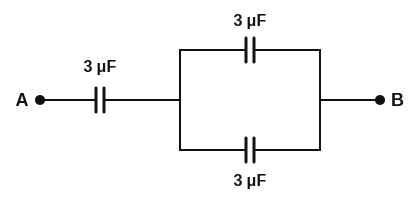
The equivalent capacitance of the system shown in the following circuit is:
निम्नलिखित परिपथ में दर्शाए गए निकाय की तुल्य धारिता है:
  1. A2 μF
  2. B3 μF
  3. C6 μF
  4. D9 μF
Show answer

Concept: Parallel: C=C1+C2; series: 1C=1C1+1C2.

  1. The two 3 μF capacitors between the junctions are in parallel: 3+3=6 μF
  2. This 6 μF is in series with the first 3 μF: C=3×63+6=189
  3. Ceq=2 μF

Short trick: Series result is always smaller than the smallest capacitor (3 μF) → only 2 μF fits.

Answer: (A) 2 μF

अवधारणा: समांतर: C=C1+C2; श्रेणी: 1C=1C1+1C2।

  1. संधियों के बीच के दो 3 μF संधारित्र समांतर में हैं: 3+3=6 μF
  2. यह 6 μF पहले 3 μF के साथ श्रेणी में है: C=3×63+6=189
  3. Ceq=2 μF

शॉर्ट ट्रिक: श्रेणी संयोजन का परिणाम सबसे छोटे संधारित्र (3 μF) से भी कम होता है → केवल 2 μF उपयुक्त।

उत्तर: (A) 2 μF

NEET UGPhysicsElectrostatics – combination of capacitorsNEET UG 2023 · 7 May Shift 1 →
Q2348.
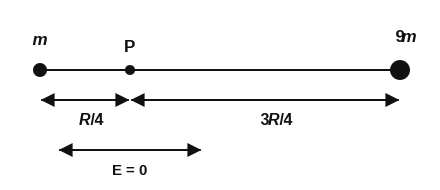
Two bodies of mass m and 9m are placed at a distance R. The gravitational potential on the line joining the bodies where the gravitational field equals zero, will be (G = gravitational constant):
द्रव्यमान m तथा 9m के दो पिंड R दूरी पर रखे हैं। पिंडों को मिलाने वाली रेखा पर उस बिंदु पर गुरुत्वीय विभव, जहाँ गुरुत्वीय क्षेत्र शून्य है, होगा (G = गुरुत्वाकर्षण नियतांक):
  1. A−8GmR
  2. B−12GmR
  3. C−16GmR
  4. D−20GmR
Show answer

Concept: Field is zero where the two pulls balance; potential is a scalar sum V=−Gm1r1−Gm2r2 (it is not zero there).

  1. At distance x from m: Gmx2=G(9m)(R−x)2⇒R−x=3x⇒x=R4
  2. V=−GmR/4−9Gm3R/4=−4GmR−12GmR
  3. V=−16GmR

Short trick: Neutral point divides R in ratio m1:m2=1:3 → R/4 and 3R/4.

Answer: (C) −16GmR

अवधारणा: जहाँ दोनों आकर्षण संतुलित हों वहाँ क्षेत्र शून्य होता है; विभव अदिश योग V=−Gm1r1−Gm2r2 है (वहाँ शून्य नहीं)।

  1. m से x दूरी पर: Gmx2=G(9m)(R−x)2⇒R−x=3x⇒x=R4
  2. V=−GmR/4−9Gm3R/4=−4GmR−12GmR
  3. V=−16GmR

शॉर्ट ट्रिक: उदासीन बिंदु R को m1:m2=1:3 के अनुपात में बाँटता है → R/4 और 3R/4।

उत्तर: (C) −16GmR

NEET UGPhysicsGravitation – neutral point and gravitational potentialNEET UG 2023 · 7 May Shift 1 →
Q2349.
The venturi-meter works on:
वेंचुरी-मीटर किस पर कार्य करता है?
  1. AHuygens’s principleहाइगेंस का सिद्धांत
  2. BBernoulli’s principleबर्नौली का सिद्धांत
  3. CThe principle of parallel axesसमांतर अक्षों का सिद्धांत
  4. DThe principle of perpendicular axesलंबवत अक्षों का सिद्धांत
Show answer

Concept: A venturi-meter measures flow speed from the pressure difference between the wide and narrow parts of a tube – Bernoulli’s principle with the equation of continuity.

  1. At the narrow throat speed is higher, so pressure is lower (P+12ρv2 = constant).
  2. Huygens’s principle is for wavefronts (optics); parallel/perpendicular axes theorems are for moment of inertia.

Short trick: Venturi-meter, atomizer, aerofoil lift, blowing-off roofs – all Bernoulli.

Answer: (B) Bernoulli’s principle

अवधारणा: वेंचुरी-मीटर नली के चौड़े और संकरे भागों के दाबान्तर से प्रवाह चाल मापता है – बर्नौली सिद्धांत तथा सांतत्य समीकरण।

  1. संकरे भाग (कंठ) पर चाल अधिक, अतः दाब कम (P+12ρv2 = नियत)।
  2. हाइगेंस सिद्धांत तरंगाग्रों (प्रकाशिकी) के लिए है; समांतर/लंबवत अक्ष प्रमेय जड़त्व आघूर्ण के लिए हैं।

शॉर्ट ट्रिक: वेंचुरी-मीटर, कणित्र (atomizer), वायुयान पंख का उत्थापन, छतों का उड़ना – सब बर्नौली।

उत्तर: (B) बर्नौली का सिद्धांत

NEET UGPhysicsMechanical properties of fluids – Bernoulli’s principleNEET UG 2023 · 7 May Shift 1 →
Q2350.
The half life of a radioactive substance is 20 minutes. In how much time, the activity of substance drops to (116)th of its initial value?
एक रेडियोधर्मी पदार्थ की अर्ध-आयु 20 मिनट है। कितने समय में पदार्थ की सक्रियता अपने प्रारंभिक मान की (116) वाँ भाग रह जाएगी?
  1. A20 minutes20 मिनट
  2. B40 minutes40 मिनट
  3. C60 minutes60 मिनट
  4. D80 minutes80 मिनट
Show answer

Concept: After n half-lives, AA0=(12)n.

  1. 116=(12)4⇒n=4
  2. t=nT1/2=4×20=80 min

Short trick: 1 → ½ → ¼ → ⅛ → 1/16: four halvings × 20 min = 80 min.

Answer: (D) 80 minutes

अवधारणा: n अर्ध-आयु के बाद AA0=(12)n।

  1. 116=(12)4⇒n=4
  2. t=nT1/2=4×20=80 मिनट

शॉर्ट ट्रिक: 1 → ½ → ¼ → ⅛ → 1/16: चार बार आधा × 20 मिनट = 80 मिनट।

उत्तर: (D) 80 मिनट

NEET UGPhysicsNuclei – radioactive decay and half-lifeNEET UG 2023 · 7 May Shift 1 →
Q2351.
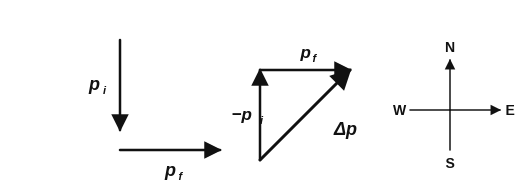
A football player is moving southward and suddenly turns eastward with the same speed to avoid an opponent. The force that acts on the player while turning is:
एक फुटबॉल खिलाड़ी दक्षिण की ओर दौड़ रहा है और प्रतिद्वंद्वी से बचने के लिए अचानक समान चाल से पूर्व की ओर मुड़ जाता है। मुड़ते समय खिलाड़ी पर लगने वाला बल है:
  1. AAlong Eastwardपूर्व की ओर
  2. BAlong Northwardउत्तर की ओर
  3. CAlong North-Eastउत्तर-पूर्व की ओर
  4. DAlong South-Westदक्षिण-पश्चिम की ओर
Show answer

Concept: F→=Δp→Δt, so the force is along the change in momentum Δp→=p→f−p→i.

  1. Take East = i^, North = j^. p→i=−pj^ (south), p→f=pi^ (east)
  2. Δp→=pi^−(−pj^)=p(i^+j^)
  3. i^+j^ points midway between East and North → North-East.

Short trick: Δp→=p→f+(−p→i): East + North = North-East.

Answer: (C) Along North-East

अवधारणा: F→=Δp→Δt, अतः बल संवेग परिवर्तन Δp→=p→f−p→i की दिशा में होता है।

  1. पूर्व = i^, उत्तर = j^ लें। p→i=−pj^ (दक्षिण), p→f=pi^ (पूर्व)
  2. Δp→=pi^−(−pj^)=p(i^+j^)
  3. i^+j^ पूर्व और उत्तर के ठीक बीच → उत्तर-पूर्व।

शॉर्ट ट्रिक: Δp→=p→f+(−p→i): पूर्व + उत्तर = उत्तर-पूर्व।

उत्तर: (C) उत्तर-पूर्व की ओर

NEET UGPhysicsLaws of motion – force as rate of change of momentumNEET UG 2023 · 7 May Shift 1 →
Q2352.
The errors in the measurement which arise due to unpredictable fluctuations in temperature and voltage supply are:
ताप तथा वोल्टता आपूर्ति में अप्रत्याशित उतार-चढ़ाव के कारण मापन में उत्पन्न होने वाली त्रुटियाँ हैं:
  1. AInstrumental errorsयंत्रीय त्रुटियाँ
  2. BPersonal errorsव्यक्तिगत त्रुटियाँ
  3. CLeast count errorsअल्पतमांक त्रुटियाँ
  4. DRandom errorsयादृच्छिक त्रुटियाँ
Show answer

Concept: NCERT: random errors occur irregularly and arise from random and unpredictable fluctuations in experimental conditions (temperature, voltage supply, mechanical vibrations).

  1. Instrumental errors come from imperfect design/calibration (systematic).
  2. Personal errors come from the observer’s bias or carelessness (systematic).
  3. Least count errors come from the resolution of the instrument.
  4. Unpredictable fluctuations → random errors.

Short trick: “Unpredictable / fluctuation / irregular” = random; reduce them by taking many readings and averaging.

Answer: (D) Random errors

अवधारणा: NCERT: यादृच्छिक त्रुटियाँ अनियमित होती हैं और प्रायोगिक परिस्थितियों (ताप, वोल्टता आपूर्ति, यांत्रिक कंपन) में यादृच्छिक, अप्रत्याशित उतार-चढ़ाव से उत्पन्न होती हैं।

  1. यंत्रीय त्रुटियाँ अपूर्ण बनावट/अंशांकन से आती हैं (क्रमबद्ध)।
  2. व्यक्तिगत त्रुटियाँ प्रेक्षक के पूर्वाग्रह या असावधानी से आती हैं (क्रमबद्ध)।
  3. अल्पतमांक त्रुटियाँ यंत्र की विभेदन क्षमता से आती हैं।
  4. अप्रत्याशित उतार-चढ़ाव → यादृच्छिक त्रुटियाँ।

शॉर्ट ट्रिक: “अप्रत्याशित / उतार-चढ़ाव / अनियमित” = यादृच्छिक; अनेक पाठ्यांक लेकर औसत करने से घटती हैं।

उत्तर: (D) यादृच्छिक त्रुटियाँ

NEET UGPhysicsUnits and measurements – types of errorsNEET UG 2023 · 7 May Shift 1 →
Q2353.
The angular acceleration of a body, moving along the circumference of a circle, is:
वृत्त की परिधि पर गतिमान किसी पिंड का कोणीय त्वरण होता है:
  1. AAlong the radius, away from centreत्रिज्या के अनुदिश, केंद्र से दूर
  2. BAlong the radius towards the centreत्रिज्या के अनुदिश, केंद्र की ओर
  3. CAlong the tangent to its positionअपनी स्थिति पर स्पर्शरेखा के अनुदिश
  4. DAlong the axis of rotationघूर्णन अक्ष के अनुदिश
Show answer

Concept: ω→ is an axial vector along the axis (right-hand rule); α→=dω→dt for a fixed axis is also along the axis.

  1. Radially inward is the centripetal (linear) acceleration, not angular.
  2. Tangential direction is that of linear velocity / tangential acceleration.
  3. Radially outward is no acceleration of uniform/non-uniform circular motion.
  4. Angular velocity and angular acceleration lie along the axis of rotation.

Short trick: Angular quantities (ω, α, τ, L) point along the axis; linear ones (v, at, ac) lie in the plane of the circle.

Answer: (D) Along the axis of rotation

अवधारणा: ω→ अक्ष के अनुदिश एक अक्षीय सदिश है (दक्षिण-हस्त नियम); स्थिर अक्ष के लिए α→=dω→dt भी अक्ष के अनुदिश होता है।

  1. त्रिज्यतः भीतर की ओर अभिकेंद्र (रैखिक) त्वरण है, कोणीय नहीं।
  2. स्पर्शरेखीय दिशा रैखिक वेग / स्पर्शरेखीय त्वरण की है।
  3. त्रिज्यतः बाहर की ओर वृत्तीय गति का कोई त्वरण नहीं होता।
  4. कोणीय वेग और कोणीय त्वरण घूर्णन अक्ष के अनुदिश होते हैं।

शॉर्ट ट्रिक: कोणीय राशियाँ (ω, α, τ, L) अक्ष के अनुदिश; रैखिक राशियाँ (v, at, ac) वृत्त के तल में।

उत्तर: (D) घूर्णन अक्ष के अनुदिश

NEET UGPhysicsRotational motion – angular acceleration as a vectorNEET UG 2023 · 7 May Shift 1 →
Q2354.
A full wave rectifier circuit consists of two p-n junction diodes, a centre-tapped transformer, capacitor and a load resistance. Which of these components remove the ac ripple from the rectified output?
एक पूर्ण तरंग दिष्टकारी परिपथ में दो p-n संधि डायोड, एक केंद्र-निष्कासित (centre-tapped) ट्रांसफॉर्मर, संधारित्र तथा एक लोड प्रतिरोध है। इनमें से कौन-सा घटक दिष्टकृत निर्गत से ac ऊर्मिका (ripple) को हटाता है?
  1. AA centre-tapped transformerकेंद्र-निष्कासित ट्रांसफॉर्मर
  2. Bp-n junction diodesp-n संधि डायोड
  3. CCapacitorसंधारित्र
  4. DLoad resistanceलोड प्रतिरोध
Show answer

Concept: A capacitor connected across the load acts as a filter: it charges at peaks and discharges slowly between them, smoothing out the ripple.

  1. Transformer only provides the two out-of-phase ac voltages.
  2. Diodes convert ac to pulsating dc (rectification), they do not smooth it.
  3. Load resistance just consumes the output.
  4. Capacitor filter removes the ac ripple.

Short trick: Diode rectifies, capacitor filters (“C for Cleaning ripple”).

Answer: (C) Capacitor

अवधारणा: लोड के समांतर जुड़ा संधारित्र फ़िल्टर का काम करता है: यह शिखरों पर आवेशित होकर बीच में धीरे-धीरे निरावेशित होता है, जिससे ऊर्मिका समतल हो जाती है।

  1. ट्रांसफॉर्मर केवल दो विपरीत कला वाली ac वोल्टताएँ देता है।
  2. डायोड ac को स्पंदमान dc में बदलते हैं (दिष्टकरण), समतल नहीं करते।
  3. लोड प्रतिरोध केवल निर्गत का उपभोग करता है।
  4. संधारित्र फ़िल्टर ac ऊर्मिका को हटाता है।

शॉर्ट ट्रिक: डायोड दिष्टकरण करता है, संधारित्र फ़िल्टर करता है।

उत्तर: (C) संधारित्र

NEET UGPhysicsSemiconductor electronics – rectifier and filterNEET UG 2023 · 7 May Shift 1 →
Q2355.
The ratio of radius of gyration of a solid sphere of mass M and radius R about its own axis to the radius of gyration of the thin hollow sphere of same mass and radius about its axis is:
द्रव्यमान M तथा त्रिज्या R के एक ठोस गोले की अपनी अक्ष के परितः घूर्णन त्रिज्या का, समान द्रव्यमान और त्रिज्या के पतले खोखले गोले की उसकी अक्ष के परितः घूर्णन त्रिज्या से अनुपात है:
  1. A3 : 5
  2. B5 : 3
  3. C2 : 5
  4. D5 : 2
Show answer

Concept: I=MK2⇒K=I/M.

  1. Solid sphere: I=25MR2⇒K1=25R
  2. Hollow sphere: I=23MR2⇒K2=23R
  3. K1K2=2/52/3=35⇒K1:K2=3:5
  4. 3 : 5 is the ratio of K2 (or of I), not of K; 5 : 3, 2 : 5 and 5 : 2 are also not equal to 3:5.

Short trick: Ratio of K = square root of ratio of I: (2/5)/(2/3)=3/5.

Answer: Bonus – the correct ratio is 3:5, which is not among the options as given; marks to all.

अवधारणा: I=MK2⇒K=I/M।

  1. ठोस गोला: I=25MR2⇒K1=25R
  2. खोखला गोला: I=23MR2⇒K2=23R
  3. K1K2=2/52/3=35⇒K1:K2=3:5
  4. 3 : 5 तो K2 (या I) का अनुपात है, K का नहीं; 5 : 3, 2 : 5 और 5 : 2 भी 3:5 के बराबर नहीं।

शॉर्ट ट्रिक: K का अनुपात = I के अनुपात का वर्गमूल: (2/5)/(2/3)=3/5।

उत्तर: बोनस – सही अनुपात 3:5 है, जो दिए गए विकल्पों में नहीं है; सभी को अंक।

NEET UGPhysicsRotational motion – radius of gyrationNEET UG 2023 · 7 May Shift 1 →
Q2356.
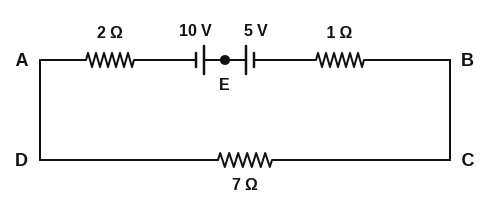
The magnitude and direction of the current in the following circuit is
निम्नलिखित परिपथ में धारा का परिमाण तथा दिशा है
  1. A0.2 A from B to A through E0.2 A, B से A की ओर E से होकर
  2. B0.5 A from A to B through E0.5 A, A से B की ओर E से होकर
  3. C59 A from A to B through E59 A, A से B की ओर E से होकर
  4. D1.5 A from B to A through E1.5 A, B से A की ओर E से होकर
Show answer

Concept: In a single loop, cells facing each other subtract: I=net emftotal resistance; current flows in the direction set by the larger cell.

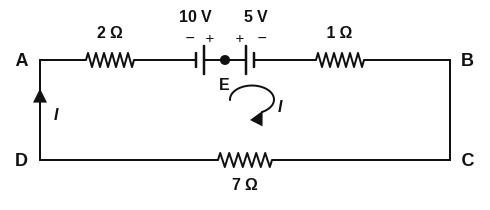
  1. Both cells have their positive plates (long lines) towards E, so they oppose each other. Net emf = 10 − 5 = 5 V.
  2. Total resistance = 2 + 1 + 7 = 10 Ω ⇒ I=510=0.5 A
  3. The 10 V cell wins; it pushes current out of its + plate, i.e. from A towards E and on to B (then B → C → D → A).

Short trick: Opposing cells: subtract emfs, add resistances; direction = the way the bigger cell pushes. Only 0.5 A matches 5/10.

Answer: (B) 0.5 A from A to B through E

अवधारणा: एकल पाश में आमने-सामने जुड़े सेल घटते हैं: I=कुल वि.वा.बलकुल प्रतिरोध; धारा बड़े सेल द्वारा निर्धारित दिशा में बहती है।

  1. दोनों सेलों की धन प्लेटें (लंबी रेखाएँ) E की ओर हैं, अतः वे एक-दूसरे का विरोध करते हैं। कुल वि.वा.बल = 10 − 5 = 5 V।
  2. कुल प्रतिरोध = 2 + 1 + 7 = 10 Ω ⇒ I=510=0.5 A
  3. 10 V का सेल प्रबल है; यह अपनी + प्लेट से धारा बाहर भेजता है, अर्थात् A से E की ओर और आगे B तक (फिर B → C → D → A)।

शॉर्ट ट्रिक: विरोधी सेल: वि.वा.बल घटाएँ, प्रतिरोध जोड़ें; दिशा = बड़ा सेल जिधर धकेले। केवल 0.5 A ही 5/10 से मेल खाता है।

उत्तर: (B) 0.5 A, A से B की ओर E से होकर

NEET UGPhysicsCurrent electricity – Kirchhoff’s loop law (opposing cells)NEET UG 2023 · 7 May Shift 1 →
Q2357.
An ac source is connected to a capacitor C. Due to decrease in its operating frequency:
एक ac स्रोत संधारित्र C से जुड़ा है। इसकी प्रचालन आवृत्ति घटाने के कारण:
  1. ACapacitive reactance decreasesधारितीय प्रतिघात घटता है
  2. BDisplacement current increasesविस्थापन धारा बढ़ती है
  3. CDisplacement current decreasesविस्थापन धारा घटती है
  4. DCapacitive reactance remains constantधारितीय प्रतिघात नियत रहता है
Show answer

Concept: XC=12πfC; the conduction current in the wires equals the displacement current between the plates, I=VXC=2πfCV.

  1. f decreases ⇒ XC increases (so (A) and (D) are wrong).
  2. I=2πfCV decreases ⇒ displacement current Id=I also decreases (so (B) is wrong).

Short trick: Capacitor “blocks” low frequency: lower f → larger XC → smaller current, conduction and displacement alike.

Answer: (C) Displacement current decreases

अवधारणा: XC=12πfC; तारों में चालन धारा प्लेटों के बीच की विस्थापन धारा के बराबर होती है, I=VXC=2πfCV।

  1. f घटने पर XC बढ़ता है (अतः (A) और (D) गलत)।
  2. I=2πfCV घटती है ⇒ विस्थापन धारा Id=I भी घटती है (अतः (B) गलत)।

शॉर्ट ट्रिक: संधारित्र निम्न आवृत्ति को “रोकता” है: कम f → अधिक XC → कम धारा, चालन और विस्थापन दोनों।

उत्तर: (C) विस्थापन धारा घटती है

NEET UGPhysicsElectromagnetic waves – displacement current in capacitorNEET UG 2023 · 7 May Shift 1 →
Q2358.
The net magnetic flux through any closed surface is:
किसी भी बंद पृष्ठ से गुजरने वाला कुल चुम्बकीय फ्लक्स है:
  1. AZeroशून्य
  2. BPositiveधनात्मक
  3. CInfinityअनंत
  4. DNegativeऋणात्मक
Show answer

Concept: Gauss’s law for magnetism: ∮B→⋅dA→=0, because isolated magnetic poles (monopoles) do not exist.

  1. Magnetic field lines are closed loops; every line that enters a closed surface also leaves it.
  2. Hence net flux is zero – never positive, negative or infinite.

Short trick: No magnetic monopole ⇒ no “magnetic charge” enclosed ⇒ flux = 0.

Answer: (A) Zero

अवधारणा: चुम्बकत्व के लिए गाउस का नियम: ∮B→⋅dA→=0, क्योंकि पृथक चुम्बकीय ध्रुव (एकल ध्रुव) नहीं होते।

  1. चुम्बकीय क्षेत्र रेखाएँ बंद लूप होती हैं; बंद पृष्ठ में प्रवेश करने वाली प्रत्येक रेखा बाहर भी निकलती है।
  2. अतः कुल फ्लक्स शून्य है – कभी धनात्मक, ऋणात्मक या अनंत नहीं।

शॉर्ट ट्रिक: चुम्बकीय एकल ध्रुव नहीं ⇒ परिबद्ध “चुम्बकीय आवेश” नहीं ⇒ फ्लक्स = 0।

उत्तर: (A) शून्य

NEET UGPhysicsMagnetism – Gauss’s law for magnetismNEET UG 2023 · 7 May Shift 1 →
Q2359.
In a plane electromagnetic wave travelling in free space, the electric field component oscillates sinusoidally at a frequency of 2.0×10¹⁰ Hz and amplitude 48 V m−1. Then the amplitude of oscillating magnetic field is: (Speed of light in free space =3×10⁸ m s−1)
मुक्त आकाश में गतिमान एक समतल विद्युत-चुम्बकीय तरंग में विद्युत क्षेत्र घटक 2.0×10¹⁰ Hz आवृत्ति तथा 48 V m−1 आयाम से ज्यावक्रीय रूप से दोलन करता है। तब दोलनशील चुम्बकीय क्षेत्र का आयाम है: (मुक्त आकाश में प्रकाश की चाल =3×10⁸ m s−1)
  1. A1.6×10−9 T
  2. B1.6×10−8 T
  3. C1.6×10−7 T
  4. D1.6×10−6 T
Show answer

Concept: In an em wave E0=cB0 (frequency is not needed).

  1. B0=E0c=483×108
  2. B0=16×10−8=1.6×10⁻⁷ T

Short trick: Frequency is a distractor; just divide E by c: 48/3 = 16 → 1.6 × 10⁻⁷ T.

Answer: (C) 1.6×10⁻⁷ T

अवधारणा: विद्युत-चुम्बकीय तरंग में E0=cB0 (आवृत्ति की आवश्यकता नहीं)।

  1. B0=E0c=483×108
  2. B0=16×10−8=1.6×10⁻⁷ T

शॉर्ट ट्रिक: आवृत्ति भ्रामक है; बस E को c से भाग दें: 48/3 = 16 → 1.6 × 10⁻⁷ T।

उत्तर: (C) 1.6×10⁻⁷ T

NEET UGPhysicsElectromagnetic waves – relation between E and BNEET UG 2023 · 7 May Shift 1 →
Q2360.
The potential energy of a long spring when stretched by 2 cm is U. If the spring is stretched by 8 cm, potential energy stored in it will be:
एक लंबी स्प्रिंग को 2 cm खींचने पर उसकी स्थितिज ऊर्जा U है। यदि स्प्रिंग को 8 cm खींचा जाए, तो उसमें संचित स्थितिज ऊर्जा होगी:
  1. A2U
  2. B4U
  3. C8U
  4. D16U
Show answer

Concept: Spring potential energy U=12kx2⇒U∝x2.

  1. U2U1=(82)2=16
  2. U2=16U

Short trick: Extension × 4 ⇒ energy × 4² = 16.

Answer: (D) 16U

अवधारणा: स्प्रिंग की स्थितिज ऊर्जा U=12kx2⇒U∝x2।

  1. U2U1=(82)2=16
  2. U2=16U

शॉर्ट ट्रिक: खिंचाव × 4 ⇒ ऊर्जा × 4² = 16।

उत्तर: (D) 16U

NEET UGPhysicsWork, energy and power – spring potential energyNEET UG 2023 · 7 May Shift 1 →