Question bank

Q&A: practice questions with answers

Search questions on any topic. Filter by exam category, exam, subject and topic, try the question, then open the answer and explanation.

Courses – airGurukul

53,050 questions in the question bank.

Q2321.
The number of molecules/ions that show linear geometry among the following is ________
SO2, BeCl2, CO2, N3−, NO2, F2O, XeF2, NO2+, I3−, O3
निम्नलिखित में से रेखीय ज्यामिति दर्शाने वाले अणुओं/आयनों की संख्या ________ है
SO2, BeCl2, CO2, N3−, NO2, F2O, XeF2, NO2+, I3−, O3
Show answer

Concept: A triatomic species is linear if the central atom has no lone pair (sp hybridisation) or if its three lone pairs occupy the equatorial plane of a trigonal bipyramid (sp3d, AX2E3).

  1. Linear: BeCl2 (sp, no lone pair), CO2 (sp), N3− (sp, 16-electron azide), XeF2 (sp3d, AX2E3), NO2+ (sp, isoelectronic with CO2), I3− (sp3d, AX2E3) → 6 species.
  2. Bent: SO2 (one lone pair), NO2 (one odd electron on N), F2O (two lone pairs), O3 (one lone pair).

Short trick: 16-valence-electron triatomics (CO2, N3−, NO2+) are always linear; add BeCl2, XeF2, I3−.

Answer: 6

अवधारणा: त्रिपरमाणुक स्पीशीज़ रेखीय होती है यदि केंद्रीय परमाणु पर कोई एकाकी युग्म न हो (sp संकरण) अथवा उसके तीन एकाकी युग्म त्रिकोणीय द्विपिरैमिड के विषुवतीय तल में हों (sp3d, AX2E3)।

  1. रेखीय: BeCl2 (sp, कोई एकाकी युग्म नहीं), CO2 (sp), N3− (sp, 16-इलेक्ट्रॉन ऐज़ाइड), XeF2 (sp3d, AX2E3), NO2+ (sp, CO2 के समइलेक्ट्रॉनिक), I3− (sp3d, AX2E3) → 6 स्पीशीज़।
  2. बंकित (bent): SO2 (एक एकाकी युग्म), NO2 (N पर एक अयुग्मित इलेक्ट्रॉन), F2O (दो एकाकी युग्म), O3 (एक एकाकी युग्म)।

शॉर्ट ट्रिक: 16-संयोजी-इलेक्ट्रॉन त्रिपरमाणुक (CO2, N3−, NO2+) सदैव रेखीय होते हैं; साथ में BeCl2, XeF2, I3− जोड़िए।

उत्तर: 6
JEE Main 2025 (January) – Paper 1 (B.E./B.Tech)ChemistryChemical Bonding – molecular geometryJEE Main 2025 (January) – Paper 1 (B.E./B.Tech) 2025 · 22 Jan Shift 1 →
Q2322.
A → B
The molecule A changes into its isomeric form B by following a first order kinetics at a temperature of 1000 K. If the energy barrier with respect to reactant energy for such isomeric transformation is 191.48 kJ mol−1 and the frequency factor is 1020, the time required for 50% molecules of A to become B is _________ picoseconds (nearest integer). [R = 8.314 J K−1 mol−1]
A → B
अणु A, 1000 K ताप पर प्रथम कोटि बलगतिकी का पालन करते हुए अपने समावयवी रूप B में परिवर्तित होता है। यदि इस समावयवी रूपांतरण के लिए अभिकारक ऊर्जा के सापेक्ष ऊर्जा अवरोध 191.48 kJ mol−1 है तथा आवृत्ति गुणांक 1020 है, तो A के 50% अणुओं के B में बदलने में लगने वाला समय _________ पिकोसेकंड (निकटतम पूर्णांक) है। [R = 8.314 J K−1 mol−1]
Show answer

Concept: Arrhenius equation k=Ae−Ea/RT; for a first order reaction t1/2=0.693k.

  1. EaRT=1914808.314×1000=23.03=2.303×10.
  2. Hence e−Ea/RT=e−2.303×10=10−10.
  3. k=1020×10−10=1010 s−1.
  4. t1/2=0.6931010=6.93×10−11 s=69.3 ps ≈69 ps.

Short trick: Whenever Ea/RT equals 2.303×n, the exponential is simply 10−n.

Answer: 69

अवधारणा: आरेनियस समीकरण k=Ae−Ea/RT; प्रथम कोटि अभिक्रिया के लिए t1/2=0.693k।

  1. EaRT=1914808.314×1000=23.03=2.303×10।
  2. अतः e−Ea/RT=e−2.303×10=10−10।
  3. k=1020×10−10=1010 s−1।
  4. t1/2=0.6931010=6.93×10−11 s=69.3 ps ≈69 ps।

शॉर्ट ट्रिक: जब भी Ea/RT=2.303×n हो, चरघातांकी पद सीधे 10−n होता है।

उत्तर: 69

JEE Main 2025 (January) – Paper 1 (B.E./B.Tech)ChemistryChemical Kinetics – Arrhenius equationJEE Main 2025 (January) – Paper 1 (B.E./B.Tech) 2025 · 22 Jan Shift 1 →
Q2323.

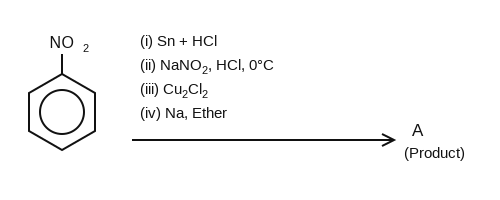
Consider the following sequence of reactions :
Molar mass of the product formed (A) is _______ g mol−1.

निम्नलिखित अभिक्रिया अनुक्रम पर विचार कीजिए :
बनने वाले उत्पाद (A) का मोलर द्रव्यमान _______ g mol−1 है।
Show answer

Concept: Diazotisation followed by Sandmeyer reaction gives a haloarene, and a haloarene with Na in dry ether (Fittig reaction) couples to a biaryl.

  1. Nitrobenzene + Sn/HCl → aniline.
  2. Aniline + NaNO2/HCl at 0°C → benzenediazonium chloride.
  3. Cu2Cl2 (Sandmeyer) → chlorobenzene.
  4. 2 C6H5Cl + 2 Na (dry ether, Fittig) → C6H5−C6H5 (biphenyl) + 2 NaCl.
  5. Molar mass of biphenyl C12H10 = 12 × 12 + 10 × 1 = 154 g mol−1.

Answer: 154

अवधारणा: डाइऐज़ोटीकरण के बाद सैंडमायर अभिक्रिया हैलोऐरीन देती है, और हैलोऐरीन शुष्क ईथर में Na के साथ (फिटिग अभिक्रिया) युग्मित होकर बाइऐरिल बनाती है।

  1. नाइट्रोबेन्ज़ीन + Sn/HCl → ऐनिलीन।
  2. ऐनिलीन + NaNO2/HCl, 0°C पर → बेन्ज़ीनडाइऐजोनियम क्लोराइड।
  3. Cu2Cl2 (सैंडमायर) → क्लोरोबेन्ज़ीन।
  4. 2 C6H5Cl + 2 Na (शुष्क ईथर, फिटिग) → C6H5−C6H5 (बाइफ़ेनिल) + 2 NaCl।
  5. बाइफ़ेनिल C12H10 का मोलर द्रव्यमान = 12 × 12 + 10 × 1 = 154 g mol−1।

उत्तर: 154

JEE Main 2025 (January) – Paper 1 (B.E./B.Tech)ChemistryHaloarenes – Fittig reactionJEE Main 2025 (January) – Paper 1 (B.E./B.Tech) 2025 · 22 Jan Shift 1 →
Q2324.
Some CO2 gas was kept in a sealed container at a pressure of 1 atm and at 273 K. This entire amount of CO2 gas was later passed through an aqueous solution of Ca(OH)2. The excess unreacted Ca(OH)2 was later neutralized with 0.1 M of 40 mL HCl. If the volume of the sealed container of CO2 was x, then x is ________ cm3 (nearest integer).
[Given : The entire amount of CO2(g) reacted with exactly half the initial amount of Ca(OH)2 present in the aqueous solution.]
कुछ CO2 गैस को 1 atm दाब तथा 273 K पर एक बंद (sealed) पात्र में रखा गया। बाद में यह सम्पूर्ण CO2 गैस Ca(OH)2 के जलीय विलयन में प्रवाहित की गई। शेष अनभिकृत Ca(OH)2 को बाद में 0.1 M के 40 mL HCl से उदासीन किया गया। यदि CO2 के बंद पात्र का आयतन x था, तो x = ________ cm3 (निकटतम पूर्णांक)।
[दिया है : CO2(g) की सम्पूर्ण मात्रा ने जलीय विलयन में उपस्थित Ca(OH)2 की प्रारंभिक मात्रा के ठीक आधे भाग से अभिक्रिया की।]
Show answer

Concept: CO2 + Ca(OH)2 → CaCO3 + H2O (1 : 1) and Ca(OH)2 + 2 HCl → CaCl2 + 2 H2O (1 : 2); at 273 K and 1 atm one mole of gas occupies 22400 cm3.

  1. Moles of HCl used = 0.1 × 40/1000 = 4 × 10⁻³ mol.
  2. Excess Ca(OH)2 = 4 × 10⁻³/2 = 2 × 10⁻³ mol.
  3. This excess is half of the initial amount, so initial Ca(OH)2 = 4 × 10⁻³ mol, and the half that reacted = 2 × 10⁻³ mol.
  4. CO2 reacts 1 : 1, so n(CO2) = 2 × 10⁻³ mol.
  5. At 1 atm, 273 K: x = 2 × 10−3 × 22400 = 44.8 cm3 ≈ 45 cm3.

Answer: 45

अवधारणा: CO2 + Ca(OH)2 → CaCO3 + H2O (1 : 1) तथा Ca(OH)2 + 2 HCl → CaCl2 + 2 H2O (1 : 2); 273 K तथा 1 atm पर एक मोल गैस 22400 cm3 आयतन घेरती है।

  1. प्रयुक्त HCl के मोल = 0.1 × 40/1000 = 4 × 10⁻³ मोल।
  2. शेष Ca(OH)2 = 4 × 10⁻³/2 = 2 × 10⁻³ मोल।
  3. यह शेष, प्रारंभिक मात्रा का आधा है, अतः प्रारंभिक Ca(OH)2 = 4 × 10⁻³ मोल, और अभिकृत आधा भाग = 2 × 10⁻³ मोल।
  4. CO2 की अभिक्रिया 1 : 1 है, अतः n(CO2) = 2 × 10⁻³ मोल।
  5. 1 atm, 273 K पर: x = 2 × 10−3 × 22400 = 44.8 cm3 ≈ 45 cm3।

उत्तर: 45

JEE Main 2025 (January) – Paper 1 (B.E./B.Tech)ChemistryMole Concept – stoichiometryJEE Main 2025 (January) – Paper 1 (B.E./B.Tech) 2025 · 22 Jan Shift 1 →
Q2325.
In Carius method for estimation of halogens, 180 mg of an organic compound produced 143.5 mg of AgCl. The percentage composition of chlorine in the compound is _______ %.
(Given : molar mass in g mol−1 of Ag : 108, Cl : 35.5)
हैलोजनों के आकलन की कैरियस विधि (Carius method) में 180 mg कार्बनिक यौगिक से 143.5 mg AgCl प्राप्त हुआ। यौगिक में क्लोरीन की प्रतिशत मात्रा _______ % है।
(दिया है : g mol−1 में मोलर द्रव्यमान, Ag : 108, Cl : 35.5)
Show answer

Concept: In the Carius method, % halogen =35.5143.5×mAgClmcompound×100 (M of AgCl = 108 + 35.5 = 143.5 g mol−1).

  1. Moles of AgCl =143.5 mg143.5 g mol−1=1×10⁻³ mol.
  2. Mass of Cl in it =10−3×35.5=35.5 mg.
  3. % Cl =35.5180×100=19.72≈20 %.

Short trick: 143.5 mg AgCl is exactly 1 mmol, which carries 35.5 mg Cl.

Answer: 20

अवधारणा: कैरियस विधि में, % हैलोजन =35.5143.5×mAgClmcompound×100 (AgCl का M = 108 + 35.5 = 143.5 g mol−1)।

  1. AgCl के मोल =143.5 mg143.5 g mol−1=1×10⁻³ मोल।
  2. इसमें Cl का द्रव्यमान =10−3×35.5=35.5 mg।
  3. % Cl =35.5180×100=19.72≈20 %।

शॉर्ट ट्रिक: 143.5 mg AgCl ठीक 1 mmol है, जिसमें 35.5 mg Cl होता है।

उत्तर: 20

JEE Main 2025 (January) – Paper 1 (B.E./B.Tech)ChemistryOrganic Analysis – Carius methodJEE Main 2025 (January) – Paper 1 (B.E./B.Tech) 2025 · 22 Jan Shift 1 →
Q2326.
The minimum wavelength of X-rays produced by an electron accelerated through a potential difference of V volts is proportional to:
V वोल्ट के विभवान्तर से त्वरित इलेक्ट्रॉन द्वारा उत्पन्न X-किरणों की न्यूनतम तरंगदैर्ध्य किसके समानुपाती होती है?
  1. AV
  2. B1V
  3. C1V
  4. DV2
Show answer

Concept: The whole kinetic energy eV of the electron can go into one X-ray photon; that photon has the largest energy and so the smallest wavelength.

  1. eV=hcλmin
  2. λmin=hceV
  3. h,c,e are constants, so λmin∝1V.

Short trick: Remember λmin(Å)≈12400V – a pure 1/V law (do not confuse with de Broglie λ∝1/V for the electron itself).

Answer: (B) 1V

अवधारणा: इलेक्ट्रॉन की पूरी गतिज ऊर्जा eV एक X-किरण फोटॉन में जा सकती है; उस फोटॉन की ऊर्जा अधिकतम और तरंगदैर्ध्य न्यूनतम होती है।

  1. eV=hcλmin
  2. λmin=hceV
  3. h,c,e नियतांक हैं, अतः λmin∝1V।

शॉर्ट ट्रिक: याद रखें λmin(Å)≈12400V – शुद्ध 1/V नियम (इलेक्ट्रॉन की दे-ब्रॉग्ली तरंगदैर्ध्य λ∝1/V से भ्रमित न हों)।

उत्तर: (B) 1V

NEET UGPhysicsDual nature – X-rays (Duane–Hunt law)NEET UG 2023 · 7 May Shift 1 →
Q2327.
A carnot engine has an efficiency of 50% when its source is at a temperature 327∘C. The temperature of the sink is:
एक कार्नो इंजन की दक्षता 50% है जब उसके स्रोत का ताप 327∘C है। सिंक (अभिगम) का ताप है:
  1. A27∘C
  2. B15∘C
  3. C100∘C
  4. D200∘C
Show answer

Concept: Carnot efficiency η=1−T2T1 with temperatures in kelvin.

  1. T1=327+273=600 K
  2. 0.5=1−T2600⇒T2=300 K
  3. T2=300−273=27∘C

Short trick: 50% efficiency means T2=T1/2 (in K): 600/2=300 K=27∘C. Never halve the Celsius value.

Answer: (A) 27∘C

अवधारणा: कार्नो दक्षता η=1−T2T1, ताप केल्विन में।

  1. T1=327+273=600 K
  2. 0.5=1−T2600⇒T2=300 K
  3. T2=300−273=27∘C

शॉर्ट ट्रिक: 50% दक्षता का अर्थ है T2=T1/2 (K में): 600/2=300 K=27∘C। सेल्सियस मान को आधा कभी न करें।

उत्तर: (A) 27∘C

NEET UGPhysicsThermodynamics – Carnot engineNEET UG 2023 · 7 May Shift 1 →
Q2328.
A bullet is fired from a gun at the speed of 280 m s−1 in the direction 30∘ above the horizontal. The maximum height attained by the bullet is (g=9.8 m s−2, sin⁡30∘=0.5):
एक गोली बन्दूक से 280 m s−1 की चाल से क्षैतिज से 30∘ ऊपर की दिशा में दागी जाती है। गोली द्वारा प्राप्त अधिकतम ऊँचाई है (g=9.8 m s−2, sin⁡30∘=0.5):
  1. A2800 m
  2. B2000 m
  3. C1000 m
  4. D3000 m
Show answer

Concept: Maximum height of a projectile H=u2sin2⁡θ2g.

  1. usin⁡θ=280×0.5=140 m s−1
  2. H=14022×9.8=1960019.6
  3. H=1000 m

Short trick: Only the vertical component matters: H=(uy)22g=140219.6; note 1402=19600.

Answer: (C) 1000 m

अवधारणा: प्रक्षेप्य की अधिकतम ऊँचाई H=u2sin2⁡θ2g।

  1. usin⁡θ=280×0.5=140 m s−1
  2. H=14022×9.8=1960019.6
  3. H=1000 m

शॉर्ट ट्रिक: केवल ऊर्ध्वाधर घटक मायने रखता है: H=(uy)22g=140219.6; ध्यान दें 1402=19600।

उत्तर: (C) 1000 m

NEET UGPhysicsKinematics – projectile motionNEET UG 2023 · 7 May Shift 1 →
Q2329.
In a series LCR circuit, the inductance L is 10 mH, capacitance C is 1 μF and resistance R is 100 Ω. The frequency at which resonance occurs is:
एक श्रेणी LCR परिपथ में प्रेरकत्व L = 10 mH, धारिता C = 1 μF तथा प्रतिरोध R = 100 Ω है। वह आवृत्ति जिस पर अनुनाद होता है, है:
  1. A15.9 rad/s
  2. B15.9 kHz
  3. C1.59 rad/s
  4. D1.59 kHz
Show answer

Concept: At resonance XL=XC, so f0=12πLC (R does not affect it).

  1. LC=10×10−3×1×10−6=10−8 s2
  2. LC=10−4 s⇒ω0=104 rad s−1
  3. f0=1042π=1591.5 Hz≈1.59 kHz

Short trick: ω0=104 rad/s is not in the options; divide by 2π≈6.28 → 1.59 kHz. Options in rad/s with 1.59 or 15.9 are traps.

Answer: (D) 1.59 kHz

अवधारणा: अनुनाद पर XL=XC, अतः f0=12πLC (R का इस पर प्रभाव नहीं)।

  1. LC=10×10−3×1×10−6=10−8 s2
  2. LC=10−4 s⇒ω0=104 rad s−1
  3. f0=1042π=1591.5 Hz≈1.59 kHz

शॉर्ट ट्रिक: ω0=104 rad/s विकल्पों में नहीं है; 2π≈6.28 से भाग दें → 1.59 kHz। rad/s वाले 1.59 या 15.9 विकल्प जाल हैं।

उत्तर: (D) 1.59 kHz

NEET UGPhysicsAlternating current – LCR resonanceNEET UG 2023 · 7 May Shift 1 →
Q2330.
Given below are two statements:
Statement I: Photovoltaic devices can convert optical radiation into electricity.
Statement II: Zener diode is designed to operate under reverse bias in breakdown region.
In the light of the above statements, choose the most appropriate answer from the options given below:
नीचे दो कथन दिए गए हैं:
कथन I: प्रकाश-वोल्टीय (photovoltaic) युक्तियाँ प्रकाशीय विकिरण को विद्युत में परिवर्तित कर सकती हैं।
कथन II: ज़ेनर डायोड को भंजन क्षेत्र (breakdown region) में पश्च बायस (reverse bias) में कार्य करने के लिए बनाया जाता है।
उपर्युक्त कथनों के आलोक में, नीचे दिए गए विकल्पों में से सबसे उपयुक्त उत्तर चुनिए:
  1. ABoth Statement I and Statement II are correct.कथन I और कथन II दोनों सही हैं।
  2. BBoth Statement I and Statement II are incorrect.कथन I और कथन II दोनों गलत हैं।
  3. CStatement I is correct but Statement II is incorrectकथन I सही है लेकिन कथन II गलत है।
  4. DStatement I is incorrect but Statement II is correct.कथन I गलत है लेकिन कथन II सही है।
Show answer

Concept: Solar cells (photovoltaic devices) generate emf from light; a Zener diode is a heavily doped diode used as a voltage regulator in reverse breakdown.

  1. Statement I: a solar cell is a p-n junction that produces an emf when light falls on it – it converts optical radiation into electrical energy. Correct.
  2. Statement II: a Zener diode is specially made to work in the reverse-bias breakdown region, where voltage stays nearly constant. Correct.
  3. Hence options (B), (C) and (D), which call either statement incorrect, are wrong.

Short trick: Photo-voltaic = light → voltage; Zener = “reverse and breakdown” – that is its job, not a fault.

Answer: (A) Both statements are correct.

अवधारणा: सौर सेल (प्रकाश-वोल्टीय युक्ति) प्रकाश से विद्युत वाहक बल उत्पन्न करता है; ज़ेनर डायोड अत्यधिक अपमिश्रित डायोड है जो पश्च भंजन में वोल्टता नियंत्रक की तरह काम करता है।

  1. कथन I: सौर सेल एक p-n संधि है जिस पर प्रकाश पड़ने से विद्युत वाहक बल उत्पन्न होता है – यह प्रकाशीय विकिरण को विद्युत ऊर्जा में बदलता है। सही।
  2. कथन II: ज़ेनर डायोड विशेष रूप से पश्च बायस के भंजन क्षेत्र में कार्य करने हेतु बनाया जाता है, जहाँ वोल्टता लगभग स्थिर रहती है। सही।
  3. अतः विकल्प (B), (C) और (D), जो किसी कथन को गलत बताते हैं, गलत हैं।

शॉर्ट ट्रिक: फोटो-वोल्टीय = प्रकाश → वोल्टता; ज़ेनर = “पश्च बायस और भंजन” – यही इसका काम है, दोष नहीं।

उत्तर: (A) दोनों कथन सही हैं।

NEET UGPhysicsSemiconductor electronics – photodiode/solar cell and Zener diodeNEET UG 2023 · 7 May Shift 1 →
Q2331.
Light travels a distance x in time t1 in air and 10x in time t2 in another denser medium. What is the critical angle for this medium?
प्रकाश वायु में t1 समय में x दूरी तथा किसी अन्य सघन माध्यम में t2 समय में 10x दूरी तय करता है। इस माध्यम के लिए क्रांतिक कोण क्या है?
  1. Asin−1⁡(t2t1)
  2. Bsin−1⁡(10t2t1)
  3. Csin−1⁡(t110t2)
  4. Dsin−1⁡(10t1t2)
Show answer

Concept: μ=cv and for the denser-to-air boundary sin⁡C=1μ=vc.

  1. Speed in air c=xt1; speed in medium v=10xt2
  2. sin⁡C=vc=10x/t2x/t1=10t1t2
  3. C=sin−1⁡(10t1t2)

Short trick: sin⁡C = (speed in denser medium)/(speed in air) – a ratio less than 1; just divide the two speeds.

Answer: (D) sin−1⁡(10t1t2)

अवधारणा: μ=cv तथा सघन-से-वायु सीमा के लिए sin⁡C=1μ=vc।

  1. वायु में चाल c=xt1; माध्यम में चाल v=10xt2
  2. sin⁡C=vc=10x/t2x/t1=10t1t2
  3. C=sin−1⁡(10t1t2)

शॉर्ट ट्रिक: sin⁡C = (सघन माध्यम में चाल)/(वायु में चाल) – 1 से कम अनुपात; बस दोनों चालों का भाग करें।

उत्तर: (D) sin−1⁡(10t1t2)

NEET UGPhysicsRay optics – refractive index and critical angleNEET UG 2023 · 7 May Shift 1 →
Q2332.
In hydrogen spectrum, the shortest wavelength in the Balmer series is λ. The shortest wavelength in the Bracket series is:
हाइड्रोजन स्पेक्ट्रम में बामर श्रेणी की लघुतम तरंगदैर्ध्य λ है। ब्रैकेट श्रेणी की लघुतम तरंगदैर्ध्य है:
  1. A2λ
  2. B4λ
  3. C9λ
  4. D16λ
Show answer

Concept: Shortest wavelength (series limit) corresponds to n2=∞: 1λmin=Rn12, i.e. λmin∝n12.

  1. Balmer: n1=2⇒λ=4R
  2. Brackett: n1=4⇒λ′=16R
  3. λ′λ=164=4⇒λ′=4λ

Short trick: Series limit ∝n12: Lyman 1, Balmer 4, Paschen 9, Brackett 16, Pfund 25 → Brackett/Balmer = 16/4 = 4.

Answer: (B) 4λ

अवधारणा: लघुतम तरंगदैर्ध्य (श्रेणी सीमा) n2=∞ के संगत है: 1λmin=Rn12, अर्थात् λmin∝n12।

  1. बामर: n1=2⇒λ=4R
  2. ब्रैकेट: n1=4⇒λ′=16R
  3. λ′λ=164=4⇒λ′=4λ

शॉर्ट ट्रिक: श्रेणी सीमा ∝n12: लाइमन 1, बामर 4, पाशन 9, ब्रैकेट 16, फुंड 25 → ब्रैकेट/बामर = 16/4 = 4।

उत्तर: (B) 4λ

NEET UGPhysicsAtoms – hydrogen spectrum series limitsNEET UG 2023 · 7 May Shift 1 →
Q2333.
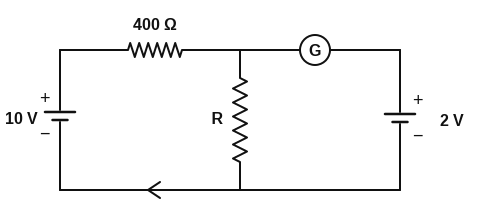
If the galvanometer G does not show any deflection in the circuit shown, the value of R is given by:
यदि दर्शाए गए परिपथ में गैल्वेनोमीटर G कोई विक्षेप नहीं दर्शाता है, तो R का मान है:
  1. A200 Ω
  2. B50 Ω
  3. C100 Ω
  4. D400 Ω
Show answer

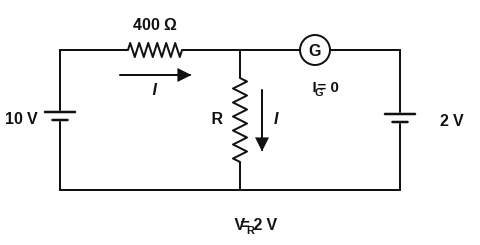
Concept: No deflection ⇒ no current in the G–2 V branch, so the p.d. across R must equal 2 V; the 10 V cell drives the same current through 400 Ω and R in series.

  1. Current I=10400+R
  2. VR=IR=10R400+R=2
  3. 10R=800+2R⇒8R=800⇒R=100 Ω
  4. Check: I=10500=150 A, drop on 400 Ω = 8 V, on R = 2 V ✓

Short trick: Potential divider: 10 V splits as 8 V : 2 V = 400 : R ⇒ R = 100 Ω.

Answer: (C) 100 Ω

अवधारणा: विक्षेप शून्य ⇒ G–2 V शाखा में धारा शून्य, अतः R के सिरों पर विभवान्तर 2 V होना चाहिए; 10 V सेल 400 Ω और R में (श्रेणी में) एक ही धारा भेजता है।

  1. धारा I=10400+R
  2. VR=IR=10R400+R=2
  3. 10R=800+2R⇒8R=800⇒R=100 Ω
  4. जाँच: I=10500=150 A, 400 Ω पर पतन = 8 V, R पर = 2 V ✓

शॉर्ट ट्रिक: विभव विभाजक: 10 V का बँटवारा 8 V : 2 V = 400 : R ⇒ R = 100 Ω।

उत्तर: (C) 100 Ω

NEET UGPhysicsCurrent electricity – Kirchhoff’s laws (null galvanometer)NEET UG 2023 · 7 May Shift 1 →
Q2334.
The amount of energy required to form a soap bubble of radius 2 cm from a soap solution is nearly: (Surface tension of soap solutions =0.03 N m−1)
साबुन के विलयन से 2 cm त्रिज्या का साबुन का बुलबुला बनाने के लिए आवश्यक ऊर्जा लगभग है: (साबुन के विलयन का पृष्ठ तनाव =0.03 N m−1)
  1. A30.16×10−4 J
  2. B5.06×10−4 J
  3. C3.01×10−4 J
  4. D50.1×10−4 J
Show answer

Concept: Work done = surface tension × increase in surface area; a bubble has two surfaces (inner and outer), so W=T×2×4πr2.

  1. r=2×10⁻² m⇒4πr2=4π×4×10−4=16π×10−4 m2
  2. W=0.03×2×16π×10−4=0.96π×10−4
  3. W=3.016×10⁻⁴ J≈3.01×10⁻⁴ J

Short trick: Bubble = 2 surfaces → W=8πr2T; a drop has only one (4πr2T). Forgetting the 2 gives 1.5×10⁻⁴ J, which is not offered.

Answer: (C) 3.01×10⁻⁴ J

अवधारणा: किया गया कार्य = पृष्ठ तनाव × पृष्ठ क्षेत्रफल में वृद्धि; बुलबुले के दो पृष्ठ (भीतरी और बाहरी) होते हैं, अतः W=T×2×4πr2।

  1. r=2×10⁻² m⇒4πr2=4π×4×10−4=16π×10−4 m2
  2. W=0.03×2×16π×10−4=0.96π×10−4
  3. W=3.016×10⁻⁴ J≈3.01×10⁻⁴ J

शॉर्ट ट्रिक: बुलबुला = 2 पृष्ठ → W=8πr2T; बूँद का केवल एक पृष्ठ (4πr2T)। 2 भूलने पर 1.5×10⁻⁴ J आता है, जो विकल्पों में नहीं है।

उत्तर: (C) 3.01×10⁻⁴ J

NEET UGPhysicsMechanical properties of fluids – surface energy of soap bubbleNEET UG 2023 · 7 May Shift 1 →
Q2335.
The magnetic energy stored in an inductor of inductance 4 μH carrying a current of 2 A is:
2 A धारा प्रवाहित करने वाले 4 μH प्रेरकत्व के प्रेरक में संचित चुम्बकीय ऊर्जा है:
  1. A4 μJ
  2. B4 mJ
  3. C8 mJ
  4. D8 μJ
Show answer

Concept: Energy stored in the magnetic field of an inductor U=12LI2.

  1. U=12×4×10−6×22
  2. U=8×10⁻⁶ J=8 μJ

Short trick: Prefix stays: μH × A² gives μJ. 12×4×4=8 → 8 μJ.

Answer: (D) 8 μJ

अवधारणा: प्रेरक के चुम्बकीय क्षेत्र में संचित ऊर्जा U=12LI2।

  1. U=12×4×10−6×22
  2. U=8×10⁻⁶ J=8 μJ

शॉर्ट ट्रिक: उपसर्ग वही रहता है: μH × A² से μJ मिलता है। 12×4×4=8 → 8 μJ।

उत्तर: (D) 8 μJ

NEET UGPhysicsElectromagnetic induction – energy stored in inductorNEET UG 2023 · 7 May Shift 1 →
Q2336.
A 12V, 60W lamp is connected to secondary of step down transformer, whose primary is connected to ac mains of 220V. Assuming the transformer to be ideal, what is the current in the primary winding?
एक 12V, 60W का लैम्प एक अपचायी (step-down) ट्रांसफॉर्मर की द्वितीयक कुंडली से जुड़ा है, जिसकी प्राथमिक कुंडली 220V के ac मेन्स से जुड़ी है। ट्रांसफॉर्मर को आदर्श मानते हुए प्राथमिक कुंडली में धारा क्या है?
  1. A0.27 A
  2. B2.7 A
  3. C3.7 A
  4. D0.37 A
Show answer

Concept: Ideal transformer: input power = output power, VpIp=VsIs.

  1. Output power = 60 W (lamp works at rated 12 V)
  2. 220×Ip=60
  3. Ip=60220=0.273 A≈0.27 A

Short trick: Primary current = power / mains voltage; secondary current would be 60/12=5 A – a step-down transformer steps current up.

Answer: (A) 0.27 A

अवधारणा: आदर्श ट्रांसफॉर्मर: निवेशी शक्ति = निर्गत शक्ति, VpIp=VsIs।

  1. निर्गत शक्ति = 60 W (लैम्प अपनी निर्धारित 12 V पर कार्य करता है)
  2. 220×Ip=60
  3. Ip=60220=0.273 A≈0.27 A

शॉर्ट ट्रिक: प्राथमिक धारा = शक्ति / मेन्स वोल्टता; द्वितीयक धारा 60/12=5 A होगी – अपचायी ट्रांसफॉर्मर धारा को बढ़ाता है।

उत्तर: (A) 0.27 A

NEET UGPhysicsAlternating current – ideal transformerNEET UG 2023 · 7 May Shift 1 →
Q2337.
An electric dipole is placed at an angle of 30∘ with an electric field of intensity 2×10⁵ N C−1. It experiences a torque equal to 4 N m. Calculate the magnitude of charge on the dipole, if the dipole length is 2 cm.
एक विद्युत द्विध्रुव 2×10⁵ N C−1 तीव्रता के विद्युत क्षेत्र से 30∘ के कोण पर रखा है। इस पर 4 N m का बल-आघूर्ण लगता है। यदि द्विध्रुव की लम्बाई 2 cm है, तो द्विध्रुव पर आवेश का परिमाण ज्ञात कीजिए।
  1. A8 mC
  2. B6 mC
  3. C4 mC
  4. D2 mC
Show answer

Concept: Torque on a dipole τ=pEsin⁡θ with p=q×2a (charge × length).

  1. 4=q×0.02×2×105×sin⁡30∘
  2. 4=q×0.02×2×105×0.5=2000q
  3. q=2×10⁻³ C=2 mC

Short trick: pEsin⁡θ=q×(0.02×10⁵)=2000q → q=4/2000 = 2 mC.

Answer: (D) 2 mC

अवधारणा: द्विध्रुव पर बल-आघूर्ण τ=pEsin⁡θ, जहाँ p=q×2a (आवेश × लम्बाई)।

  1. 4=q×0.02×2×105×sin⁡30∘
  2. 4=q×0.02×2×105×0.5=2000q
  3. q=2×10⁻³ C=2 mC

शॉर्ट ट्रिक: pEsin⁡θ=q×(0.02×10⁵)=2000q → q=4/2000 = 2 mC।

उत्तर: (D) 2 mC

NEET UGPhysicsElectrostatics – torque on electric dipoleNEET UG 2023 · 7 May Shift 1 →
Q2338.
A vehicle travels half the distance with speed v and the remaining distance with speed 2v. Its average speed is
एक वाहन आधी दूरी v चाल से तथा शेष दूरी 2v चाल से तय करता है। इसकी औसत चाल है
  1. Av3
  2. B2v3
  3. C4v3
  4. D3v4
Show answer

Concept: Average speed = total distance / total time. For equal distances it is the harmonic mean 2v1v2v1+v2.

  1. Let total distance = 2d. Time =dv+d2v=3d2v
  2. vavg=2d3d/2v=4v3

Short trick: Equal distances ⇒ 2v1v2v1+v2=2⋅v⋅2v3v=4v3; it must lie between v and 2v, which only 4v3 does.

Answer: (C) 4v3

अवधारणा: औसत चाल = कुल दूरी / कुल समय। समान दूरियों के लिए यह हरात्मक माध्य 2v1v2v1+v2 है।

  1. माना कुल दूरी = 2d। समय =dv+d2v=3d2v
  2. vavg=2d3d/2v=4v3

शॉर्ट ट्रिक: समान दूरियाँ ⇒ 2v1v2v1+v2=2⋅v⋅2v3v=4v3; उत्तर v और 2v के बीच होना चाहिए, ऐसा केवल 4v3 है।

उत्तर: (C) 4v3

NEET UGPhysicsKinematics – average speedNEET UG 2023 · 7 May Shift 1 →
Q2339.
Let a wire be suspended from the ceiling (rigid support) and stretched by a weight W attached at its free end. The longitudinal stress at any point of cross-sectional area A of the wire is:
एक तार छत (दृढ़ आधार) से लटकाया गया है तथा उसके मुक्त सिरे पर लगे भार W द्वारा खींचा गया है। तार के अनुप्रस्थ काट क्षेत्रफल A वाले किसी भी बिंदु पर अनुदैर्ध्य प्रतिबल है:
  1. A2WA
  2. BWA
  3. CW2A
  4. DZeroशून्य
Show answer

Concept: Longitudinal stress = restoring (tensile) force per unit cross-sectional area.

  1. Treating the wire as light, the tension at every section equals the hanging weight W.
  2. Stress =FA=WA
  3. 2W/A would double-count the support reaction; W/2A has no basis; zero would mean no tension.

Short trick: Tension in a light string/wire = load hung on it ⇒ stress = W/A everywhere.

Answer: (B) WA

अवधारणा: अनुदैर्ध्य प्रतिबल = प्रति एकांक अनुप्रस्थ काट क्षेत्रफल पर प्रत्यानयन (तनन) बल।

  1. तार को हल्का मानने पर प्रत्येक काट पर तनाव लटके भार W के बराबर है।
  2. प्रतिबल =FA=WA
  3. 2W/A में आधार की प्रतिक्रिया दो बार गिन ली गई है; W/2A का कोई आधार नहीं; शून्य का अर्थ होगा कोई तनाव नहीं।

शॉर्ट ट्रिक: हल्के तार/डोरी में तनाव = लटका भार ⇒ हर जगह प्रतिबल = W/A।

उत्तर: (B) WA

NEET UGPhysicsMechanical properties of solids – stressNEET UG 2023 · 7 May Shift 1 →
Q2340.
If ∮sE→⋅dS→=0 over a surface, then:
यदि किसी पृष्ठ पर ∮sE→⋅dS→=0 है, तो:
  1. Athe number of flux lines entering the surface must be equal to the number of flux lines leaving it.पृष्ठ में प्रवेश करने वाली फ्लक्स रेखाओं की संख्या, उससे बाहर निकलने वाली फ्लक्स रेखाओं की संख्या के बराबर होनी चाहिए।
  2. Bthe magnitude of electric field on the surface is constantपृष्ठ पर विद्युत क्षेत्र का परिमाण नियत है।
  3. Call the charges must necessarily be inside the surface.सभी आवेश आवश्यक रूप से पृष्ठ के अंदर होने चाहिए।
  4. Dthe electric field inside the surface is necessarily uniform.पृष्ठ के अंदर विद्युत क्षेत्र आवश्यक रूप से एकसमान है।
Show answer

Concept: Net flux through a closed surface = qenc/ε0; zero net flux means inward flux = outward flux.

  1. (A) Zero net flux ⇒ lines entering = lines leaving. Correct.
  2. (B) E can vary from point to point on the surface (e.g. a dipole field); only the total flux is zero. Wrong.
  3. (C) Charges may be outside; zero flux only says the net enclosed charge is zero. Wrong.
  4. (D) Nothing forces E inside to be uniform. Wrong.

Short trick: Zero flux tells you only about the count of lines (in = out) and net enclosed charge = 0 – nothing about E itself.

Answer: (A) Lines entering = lines leaving.

अवधारणा: बंद पृष्ठ से कुल फ्लक्स = qenc/ε0; कुल फ्लक्स शून्य का अर्थ है भीतर आने वाला फ्लक्स = बाहर जाने वाला फ्लक्स।

  1. (A) कुल फ्लक्स शून्य ⇒ प्रवेश करने वाली रेखाएँ = निकलने वाली रेखाएँ। सही।
  2. (B) पृष्ठ पर E बिंदु-दर-बिंदु बदल सकता है (जैसे द्विध्रुव क्षेत्र); केवल कुल फ्लक्स शून्य है। गलत।
  3. (C) आवेश बाहर भी हो सकते हैं; शून्य फ्लक्स केवल बताता है कि परिबद्ध कुल आवेश शून्य है। गलत।
  4. (D) अंदर E का एकसमान होना आवश्यक नहीं। गलत।

शॉर्ट ट्रिक: शून्य फ्लक्स केवल रेखाओं की संख्या (अंदर = बाहर) और परिबद्ध कुल आवेश = 0 बताता है – E के बारे में कुछ नहीं।

उत्तर: (A) प्रवेश करने वाली रेखाएँ = निकलने वाली रेखाएँ।

NEET UGPhysicsElectrostatics – Gauss’s lawNEET UG 2023 · 7 May Shift 1 →