Question bank

Q&A: practice questions with answers

Search questions on any topic. Filter by exam category, exam, subject and topic, try the question, then open the answer and explanation.

Courses – airGurukul

53,050 questions in the question bank.

Q2281.
A bob of mass m is suspended at a point O by a light string of length l and left to perform vertical motion (circular) as shown in figure. Initially, by applying horizontal velocity v0 at the point ' A ', the string becomes slack when, the bob reaches at the point ' D '. The ratio of the kinetic energy of the bob at the points B and C is
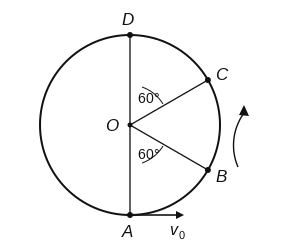
द्रव्यमान m के एक गोलक (bob) को बिन्दु O पर लम्बाई l की हल्की डोरी से लटकाया गया है और चित्र में दर्शाए अनुसार ऊर्ध्वाधर (वृत्तीय) गति करने के लिए छोड़ा गया है। प्रारम्भ में बिन्दु ' A ' पर क्षैतिज वेग v0 देने पर, गोलक के बिन्दु ' D ' पर पहुँचने पर डोरी ढीली हो जाती है। बिन्दुओं B तथा C पर गोलक की गतिज ऊर्जाओं का अनुपात है
  1. A1
  2. B2
  3. C4
  4. D3
Show answer

Concept: String just slack at the top D means vD2=gl; then use energy conservation from A. Heights: h=l(1−cos⁡θ) with θ measured at O from OA.

  1. At D: mg=mvD2l⇒vD2=gl. Energy from A to D: v02=vD2+2g(2l)=5gl.
  2. From the figure, B is 60∘ from OA: hB=l(1−cos⁡60∘)=l2; C is 60∘ from OD, i.e. 120∘ from OA: hC=l(1−cos⁡120∘)=3l2.
  3. KEB=12m(v02−2ghB)=12m(5gl−gl)=2mgl.
  4. KEC=12m(5gl−3gl)=mgl.
  5. KEBKEC=2mglmgl=2.

Short trick: With v02=5gl, KE at angle θ is 12mgl(3+2cos⁡θ): at 60∘ it is 2mgl, at 120∘ it is mgl.

Answer: (B) 2

अवधारणा: शीर्ष बिन्दु D पर डोरी के ठीक ढीली होने का अर्थ है vD2=gl; फिर A से ऊर्जा संरक्षण लगाइए। ऊँचाई: h=l(1−cos⁡θ), जहाँ θ को O पर OA से मापा गया है।

  1. D पर: mg=mvD2l⇒vD2=gl। A से D तक ऊर्जा संरक्षण: v02=vD2+2g(2l)=5gl।
  2. चित्र से, B, OA से 60∘ पर है: hB=l(1−cos⁡60∘)=l2; C, OD से 60∘ पर है, अर्थात OA से 120∘: hC=l(1−cos⁡120∘)=3l2।
  3. KEB=12m(v02−2ghB)=12m(5gl−gl)=2mgl।
  4. KEC=12m(5gl−3gl)=mgl।
  5. KEBKEC=2mglmgl=2।

शॉर्ट ट्रिक: v02=5gl के साथ, कोण θ पर KE=12mgl(3+2cos⁡θ): 60∘ पर 2mgl, 120∘ पर mgl।

उत्तर: (B) 2

JEE Main 2025 (January) – Paper 1 (B.E./B.Tech)PhysicsWork, Energy & Power – vertical circular motionJEE Main 2025 (January) – Paper 1 (B.E./B.Tech) 2025 · 22 Jan Shift 1 →
Q2282.
Given is a thin convex lens of glass (refractive index μ ) and each side having radius of curvature R. One side is polished for complete reflection. At what distance from the lens, an object be placed on the optic axis so that the image gets formed on the object itself ?
काँच (अपवर्तनांक μ) का एक पतला उत्तल लेंस दिया गया है जिसके प्रत्येक पृष्ठ की वक्रता त्रिज्या R है। एक पृष्ठ को पूर्ण परावर्तन के लिए पॉलिश (रजतित) कर दिया गया है। प्रकाशिक अक्ष पर लेंस से कितनी दूरी पर वस्तु रखी जाए कि प्रतिबिम्ब वस्तु पर ही बने?
  1. AR/μ
  2. BR/(2μ−3)
  3. CμR
  4. DR/(2μ−1)
Show answer

Concept: A silvered lens behaves as a mirror of power P=2Plens+Pmirror. The image falls back on the object when rays retrace their path, i.e. the object is at the centre of curvature of the equivalent mirror: u=2feq.

  1. Plens=(μ−1)(1R−1−R)=2(μ−1)R.
  2. The polished face is a concave mirror of focal length R2: Pmirror=2R.
  3. Peq=2Plens+Pmirror=4(μ−1)R+2R=4μ−2R, so feq=R4μ−2.
  4. Image on the object ⇒ object at centre of curvature: u=2feq=2R4μ−2=R2μ−1.

Short trick: Check with μ=1.5: u=R2, the well-known result for an equi-convex silvered lens.

Answer: (D) R/(2μ−1)

अवधारणा: रजतित लेंस एक दर्पण की भाँति व्यवहार करता है जिसकी क्षमता P=2Plens+Pmirror होती है। प्रतिबिम्ब वस्तु पर तभी बनता है जब किरणें दर्पण पर अभिलम्बवत पड़कर अपने पथ पर लौटें, अर्थात वस्तु तुल्य दर्पण के वक्रता केन्द्र पर हो: u=2feq।

  1. Plens=(μ−1)(1R−1−R)=2(μ−1)R।
  2. पॉलिश किया गया पृष्ठ R2 फोकस दूरी का अवतल दर्पण है: Pmirror=2R।
  3. Peq=2Plens+Pmirror=4(μ−1)R+2R=4μ−2R, अतः feq=R4μ−2।
  4. प्रतिबिम्ब वस्तु पर ⇒ वस्तु वक्रता केन्द्र पर: u=2feq=2R4μ−2=R2μ−1।

शॉर्ट ट्रिक: μ=1.5 रखकर जाँचिए: u=R2, जो समोत्तल रजतित लेंस का प्रसिद्ध परिणाम है।

उत्तर: (D) R/(2μ−1)

JEE Main 2025 (January) – Paper 1 (B.E./B.Tech)PhysicsRay Optics – silvered lensJEE Main 2025 (January) – Paper 1 (B.E./B.Tech) 2025 · 22 Jan Shift 1 →
Q2283.
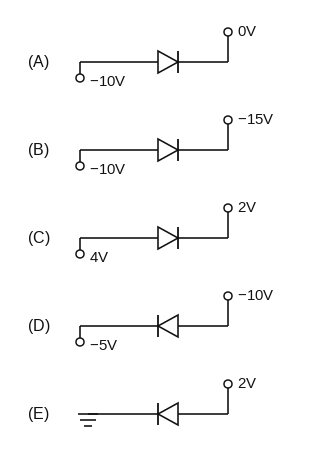
Which of the following circuits represents a forward biased diode?

Choose the correct answer from the options given below :
निम्नलिखित में से कौन-सा परिपथ अग्र अभिनत (forward biased) डायोड को दर्शाता है?

नीचे दिए गए विकल्पों में से सही उत्तर चुनिए :
  1. A(A) and (D) onlyकेवल (A) और (D)
  2. B(B), (D) and (E) onlyकेवल (B), (D) और (E)
  3. C(C) and (E) onlyकेवल (C) और (E)
  4. D(B), (C) and (E) onlyकेवल (B), (C) और (E)
Show answer

Concept: A diode is forward biased when its anode (triangle side / p-side) is at a higher potential than its cathode (bar side / n-side).

  1. (A): anode at −10 V, cathode at 0 V ⇒ anode lower ⇒ reverse biased.
  2. (B): anode at −10 V, cathode at −15 V ⇒ anode higher ⇒ forward biased.
  3. (C): anode at 4 V, cathode at 2 V ⇒ forward biased.
  4. (D): anode at −10 V, cathode at −5 V ⇒ anode lower ⇒ reverse biased.
  5. (E): anode at 2 V, cathode grounded (0 V) ⇒ forward biased.

Short trick: Ignore signs, just compare: current must enter the flat of the triangle; p-side more positive = forward.

Answer: (D) (B), (C) and (E) only

अवधारणा: डायोड तब अग्र अभिनत होता है जब उसका ऐनोड (त्रिभुज वाला सिरा / p-फलक) कैथोड (रेखा वाला सिरा / n-फलक) से उच्च विभव पर हो।

  1. (A): ऐनोड −10 V पर, कैथोड 0 V पर ⇒ ऐनोड निम्न ⇒ पश्च अभिनत।
  2. (B): ऐनोड −10 V पर, कैथोड −15 V पर ⇒ ऐनोड उच्च ⇒ अग्र अभिनत।
  3. (C): ऐनोड 4 V पर, कैथोड 2 V पर ⇒ अग्र अभिनत।
  4. (D): ऐनोड −10 V पर, कैथोड −5 V पर ⇒ ऐनोड निम्न ⇒ पश्च अभिनत।
  5. (E): ऐनोड 2 V पर, कैथोड भूसम्पर्कित (0 V) ⇒ अग्र अभिनत।

शॉर्ट ट्रिक: चिह्नों में न उलझें, केवल तुलना करें: p-फलक अधिक धनात्मक = अग्र अभिनत।

उत्तर: (D) केवल (B), (C) और (E)

JEE Main 2025 (January) – Paper 1 (B.E./B.Tech)PhysicsSemiconductors – p-n junction diodeJEE Main 2025 (January) – Paper 1 (B.E./B.Tech) 2025 · 22 Jan Shift 1 →
Q2284.

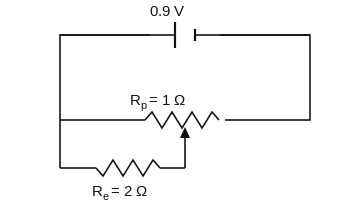
Sliding contact of a potentiometer is in the middle of the potentiometer wire having resistance Rp=1 Ω as shown in the figure. An external resistance of Re=2 Ω is connected via the sliding contact. The electric current in the circuit is :

चित्र में दर्शाए अनुसार, Rp=1 Ω प्रतिरोध वाले विभवमापी (potentiometer) के तार के मध्य में सर्पी सम्पर्क (sliding contact) है। सर्पी सम्पर्क के द्वारा Re=2 Ω का एक बाह्य प्रतिरोध जोड़ा गया है। परिपथ में विद्युत धारा है :
  1. A0.9 A
  2. B1.35 A
  3. C0.3 A
  4. D1.0 A
Show answer

Concept: The slider divides the wire into two halves of 0.5 Ω each. Re connects the slider back to one end of the wire, so it is in parallel with one half; the other half is in series.

  1. Each half of the potentiometer wire: Rp2=0.5 Ω.
  2. Parallel part: 0.5×20.5+2=12.5=0.4 Ω.
  3. Total resistance across the battery: 0.5+0.4=0.9 Ω.
  4. Current drawn from the battery: I=0.90.9=1.0 A.

Short trick: 0.5∥2=0.4; the emf 0.9 V against 0.9 Ω instantly gives 1 A.

Answer: (D) 1.0 A

अवधारणा: सर्पी सम्पर्क तार को 0.5 Ω के दो बराबर भागों में बाँटता है। Re सर्पी सम्पर्क को तार के एक सिरे से जोड़ता है, अतः वह एक आधे भाग के समान्तर क्रम में है; दूसरा आधा भाग श्रेणी में है।

  1. विभवमापी तार का प्रत्येक आधा भाग: Rp2=0.5 Ω।
  2. समान्तर भाग: 0.5×20.5+2=12.5=0.4 Ω।
  3. बैटरी के सिरों पर कुल प्रतिरोध: 0.5+0.4=0.9 Ω।
  4. बैटरी से ली गई धारा: I=0.90.9=1.0 A।

शॉर्ट ट्रिक: 0.5∥2=0.4; emf 0.9 V तथा 0.9 Ω से तुरन्त 1 A।

उत्तर: (D) 1.0 A

JEE Main 2025 (January) – Paper 1 (B.E./B.Tech)PhysicsCurrent Electricity – potentiometerJEE Main 2025 (January) – Paper 1 (B.E./B.Tech) 2025 · 22 Jan Shift 1 →
Q2285.
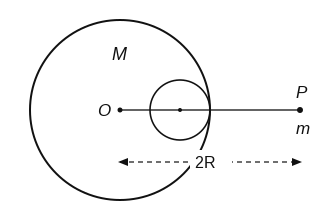
A small point of mass m is placed at a distance 2R from the centre ' O ' of a big uniform solid sphere of mass M and radius R. The gravitational force on ' m ' due to M is F1. A spherical part of radius R/3 is removed from the big sphere as shown in the figure and the gravitational force on m due to remaining part of M is found to be F2. The value of ratio F1:F2 is
द्रव्यमान m का एक छोटा बिन्दु पिण्ड, द्रव्यमान M तथा त्रिज्या R के एक बड़े समरूप ठोस गोले के केन्द्र ' O ' से 2R दूरी पर रखा है। M के कारण ' m ' पर गुरुत्वाकर्षण बल F1 है। चित्र में दर्शाए अनुसार बड़े गोले से त्रिज्या R/3 का एक गोलीय भाग निकाल दिया जाता है और M के शेष भाग के कारण m पर गुरुत्वाकर्षण बल F2 पाया जाता है। अनुपात F1:F2 का मान है
  1. A12 : 11
  2. B11 : 10
  3. C12 : 9
  4. D16 : 9
Show answer

Concept: Force of the remaining body = force of the full sphere − force of the removed sphere (superposition).

  1. F1=GMm(2R)2=GMm4R2.
  2. Removed sphere: radius R3 ⇒ mass =M(13)3=M27; its centre (tangent to the surface, from the figure) is at 2R3 from O, so its distance from m is 2R−2R3=4R3.
  3. Fcav=GM27m(4R3)2=GMm27⋅16R29=GMm48R2.
  4. F2=F1−Fcav=GMm(14−148)1R2=11GMm48R2.
  5. F1:F2=14:1148=12:11.

Short trick: Write both over 48: F1=1248, cavity takes away 148 ⇒ 12:11.

Answer: (A) 12 : 11

अवधारणा: शेष पिण्ड का बल = पूर्ण गोले का बल − निकाले गए गोले का बल (अध्यारोपण सिद्धान्त)।

  1. F1=GMm(2R)2=GMm4R2।
  2. निकाला गया गोला: त्रिज्या R3 ⇒ द्रव्यमान =M(13)3=M27; इसका केन्द्र (चित्रानुसार पृष्ठ को स्पर्श करता हुआ) O से 2R3 पर है, अतः m से इसकी दूरी 2R−2R3=4R3।
  3. Fcav=GM27m(4R3)2=GMm27⋅16R29=GMm48R2।
  4. F2=F1−Fcav=GMm(14−148)1R2=11GMm48R2।
  5. F1:F2=14:1148=12:11।

शॉर्ट ट्रिक: दोनों को 48 के हर पर लिखिए: F1=1248, कोटर 148 घटाता है ⇒ 12:11।

उत्तर: (A) 12 : 11

JEE Main 2025 (January) – Paper 1 (B.E./B.Tech)PhysicsGravitation – sphere with cavityJEE Main 2025 (January) – Paper 1 (B.E./B.Tech) 2025 · 22 Jan Shift 1 →
Q2286.
A closed organ and an open organ tube are filled by two different gases having same bulk modulus but different densities ρ1 and ρ2, respectively. The frequency of 9th harmonic of closed tube is identical with 4th harmonic of open tube. If the length of the closed tube is 10 cm and the density ratio of the gases is ρ1:ρ2=1:16, then the length of the open tube is :
एक बन्द ऑर्गन नली तथा एक खुली ऑर्गन नली को समान आयतन प्रत्यास्थता गुणांक (bulk modulus) परन्तु भिन्न घनत्वों क्रमशः ρ1 तथा ρ2 वाली दो भिन्न गैसों से भरा गया है। बन्द नली के 9वें संनादी (harmonic) की आवृत्ति, खुली नली के 4थे संनादी की आवृत्ति के बराबर है। यदि बन्द नली की लम्बाई 10 cm है तथा गैसों के घनत्वों का अनुपात ρ1:ρ2=1:16 है, तो खुली नली की लम्बाई है :
  1. A157 cm
  2. B207 cm
  3. C159 cm
  4. D209 cm
Show answer

Concept: Closed pipe: fn=nv4L (odd n); open pipe: fn=nv2L. Speed of sound v=B/ρ.

  1. v1v2=ρ2ρ1=16=4 (gas 1 in the closed tube).
  2. Equate frequencies: 9v14Lc=4v22Lo with Lc=10 cm.
  3. Lo=2v2⋅4Lc9v1⋅2⋅22=8Lc9⋅v2v1=8×109×14=209 cm.

Short trick: Lo=8Lc9⋅v2v1; since v∝1ρ, v2v1=14 directly.

Answer: (D) 209 cm

अवधारणा: बन्द नली: fn=nv4L (विषम n); खुली नली: fn=nv2L। ध्वनि की चाल v=B/ρ।

  1. v1v2=ρ2ρ1=16=4 (गैस 1 बन्द नली में है)।
  2. आवृत्तियाँ बराबर रखिए: 9v14Lc=4v22Lo, जहाँ Lc=10 cm।
  3. Lo=8Lc9⋅v2v1=8×109×14=209 cm।

शॉर्ट ट्रिक: Lo=8Lc9⋅v2v1; चूँकि v∝1ρ, v2v1=14 सीधे मिल जाता है।

उत्तर: (D) 209 cm

JEE Main 2025 (January) – Paper 1 (B.E./B.Tech)PhysicsWaves – organ pipesJEE Main 2025 (January) – Paper 1 (B.E./B.Tech) 2025 · 22 Jan Shift 1 →
Q2287.
If B is magnetic field and μ0 is permeability of free space, then the dimensions of (B/μ0) is
यदि B चुम्बकीय क्षेत्र है तथा μ0 मुक्त आकाश की चुम्बकशीलता (permeability) है, तो (B/μ0) की विमाएँ हैं
  1. AML2T−2A−1
  2. BMT−2A−1
  3. CL−1A
  4. DLT−2A−1
Show answer

Concept: Bμ0=H, the magnetic field intensity, whose SI unit is ampere per metre.

  1. From Ampere's law for a long solenoid, B=μ0nI, where n = turns per unit length.
  2. So Bμ0=nI, with unit Am.
  3. Dimensions: [L−1A].

Short trick: Remember H=Bμ0 is measured in A/m — the answer is read off directly.

Answer: (C) L−1A

अवधारणा: Bμ0=H, अर्थात चुम्बकीय क्षेत्र तीव्रता, जिसका SI मात्रक ऐम्पियर प्रति मीटर है।

  1. लम्बी परिनालिका के लिए ऐम्पियर के नियम से, B=μ0nI, जहाँ n = प्रति एकांक लम्बाई फेरे।
  2. अतः Bμ0=nI, जिसका मात्रक Am है।
  3. विमाएँ: [L−1A]।

शॉर्ट ट्रिक: याद रखिए H=Bμ0 का मात्रक A/m है — उत्तर सीधे पढ़ लीजिए।

उत्तर: (C) L−1A

JEE Main 2025 (January) – Paper 1 (B.E./B.Tech)PhysicsUnits & DimensionsJEE Main 2025 (January) – Paper 1 (B.E./B.Tech) 2025 · 22 Jan Shift 1 →
Q2288.
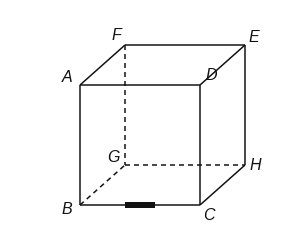
A line charge of length a2 is kept at the center of an edge BC of a cube ABCDEFGH having edge length ' a ' as shown in the figure. If the density of line charge is λ C per unit length, then the total electric flux through all the faces of the cube will be ____. (Take, ϵ0 as the free space permittivity)
भुजा-लम्बाई ' a ' वाले घन ABCDEFGH के किनारे BC के मध्य में a2 लम्बाई का एक रेखीय आवेश चित्र में दर्शाए अनुसार रखा है। यदि रेखीय आवेश का घनत्व λ C प्रति एकांक लम्बाई है, तो घन के सभी फलकों से गुजरने वाला कुल विद्युत फ्लक्स होगा ____। (ϵ0 को मुक्त आकाश की विद्युतशीलता लीजिए)
  1. Aλa2ϵ0
  2. Bλa4ϵ0
  3. Cλa16ϵ0
  4. Dλa8ϵ0
Show answer

Concept: Gauss's law with symmetry: a charge lying on an edge of a cube is shared equally by the 4 identical cubes that meet at that edge, so only 14 of its flux passes through the given cube.

  1. Charge on the line: q=λ⋅a2.
  2. The line lies along edge BC, so 4 cubes can be stacked sharing this edge symmetrically.
  3. Flux through our cube =14⋅qϵ0=λa8ϵ0.

Short trick: Edge ⇒ divide by 4; corner ⇒ divide by 8; face centre ⇒ divide by 2.

Answer: (D) λa8ϵ0

अवधारणा: सममिति के साथ गाउस का नियम: घन के किनारे पर स्थित आवेश उस किनारे पर मिलने वाले 4 सर्वसम घनों में बराबर बँटता है, अतः उसके फ्लक्स का केवल 14 भाग दिए गए घन से गुजरता है।

  1. रेखीय आवेश पर कुल आवेश: q=λ⋅a2।
  2. रेखा किनारे BC के अनुदिश है, अतः इस किनारे को साझा करते हुए 4 घन सममित रूप से रखे जा सकते हैं।
  3. हमारे घन से फ्लक्स =14⋅qϵ0=λa8ϵ0।

शॉर्ट ट्रिक: किनारा ⇒ 4 से भाग; कोना ⇒ 8 से भाग; फलक का केन्द्र ⇒ 2 से भाग।

उत्तर: (D) λa8ϵ0

JEE Main 2025 (January) – Paper 1 (B.E./B.Tech)PhysicsElectrostatics – Gauss's lawJEE Main 2025 (January) – Paper 1 (B.E./B.Tech) 2025 · 22 Jan Shift 1 →
Q2289.
Given below are two statements : Statement I : In a vernier callipers, one vernier scale division is always smaller than one main scale division. Statement II : The vernier constant is given by one main scale division multiplied by the number of vernier scale divisions. In the light of the above statements, choose the correct answer from the options given below.
नीचे दो कथन दिए गए हैं : कथन I : वर्नियर कैलिपर्स में, एक वर्नियर पैमाने का भाग सदैव एक मुख्य पैमाने के भाग से छोटा होता है। कथन II : वर्नियर नियतांक, एक मुख्य पैमाने के भाग को वर्नियर पैमाने के भागों की संख्या से गुणा करने पर प्राप्त होता है। उपर्युक्त कथनों के आलोक में, नीचे दिए गए विकल्पों में से सही उत्तर चुनिए।
  1. AStatement I is true but Statement II is falseकथन I सत्य है परन्तु कथन II असत्य है
  2. BStatement I is false but Statement II is trueकथन I असत्य है परन्तु कथन II सत्य है
  3. CBoth Statement I and Statement II are falseकथन I और कथन II दोनों असत्य हैं
  4. DBoth Statement I and Statement II are trueकथन I और कथन II दोनों सत्य हैं
Show answer

Concept: Vernier constant (least count) = 1 MSD − 1 VSD, and vernier scales can also be made with VSD larger than MSD (retrograde vernier).

  1. Statement I: In the common vernier, n VSD =(n−1) MSD so VSD < MSD; but in a retrograde (backward) vernier, n VSD =(n+1) MSD, making one VSD larger than one MSD. The word "always" makes Statement I false.
  2. Statement II: Vernier constant = 1 MSD − 1 VSD (not MSD × number of VSD). So Statement II is false.

Short trick: VC is a difference of two nearly equal divisions — any formula with a product is instantly wrong.

Answer: (C) Both Statement I and Statement II are false

अवधारणा: वर्नियर नियतांक (अल्पतमांक) = 1 MSD − 1 VSD, और वर्नियर पैमाने ऐसे भी बनते हैं जिनमें VSD, MSD से बड़ा हो (प्रतिगामी/retrograde वर्नियर)।

  1. कथन I: सामान्य वर्नियर में n VSD =(n−1) MSD, अतः VSD < MSD; परन्तु प्रतिगामी वर्नियर में n VSD =(n+1) MSD होता है, जिससे एक VSD एक MSD से बड़ा होता है। "सदैव" शब्द के कारण कथन I असत्य है।
  2. कथन II: वर्नियर नियतांक = 1 MSD − 1 VSD (MSD × भागों की संख्या नहीं)। अतः कथन II असत्य है।

शॉर्ट ट्रिक: VC दो लगभग बराबर भागों का अन्तर है — गुणा वाला कोई भी सूत्र तुरन्त गलत है।

उत्तर: (C) कथन I और कथन II दोनों असत्य हैं

JEE Main 2025 (January) – Paper 1 (B.E./B.Tech)PhysicsExperimental Skills – vernier callipersJEE Main 2025 (January) – Paper 1 (B.E./B.Tech) 2025 · 22 Jan Shift 1 →
Q2290.
The work functions of cesium (Cs) and lithium (Li) metals are 1.9 eV and 2.5 eV, respectively. If we incident a light of wavelength 550 nm on these two metal surfaces, then photo-electric effect is possible for the case of
सीज़ियम (Cs) तथा लीथियम (Li) धातुओं के कार्य फलन क्रमशः 1.9 eV तथा 2.5 eV हैं। यदि इन दोनों धातु पृष्ठों पर 550 nm तरंगदैर्ध्य का प्रकाश आपतित किया जाए, तो प्रकाश-विद्युत प्रभाव सम्भव है
  1. ABoth Cs and LiCs और Li दोनों के लिए
  2. BNeither Cs nor Liन Cs के लिए, न Li के लिए
  3. CCs onlyकेवल Cs के लिए
  4. DLi onlyकेवल Li के लिए
Show answer

Concept: Photoemission occurs only if photon energy E=hcλ≥ϕ (work function).

  1. E=1240 eV nm550 nm≈2.25 eV.
  2. For Cs: 2.25 eV>1.9 eV ⇒ photoemission possible.
  3. For Li: 2.25 eV<2.5 eV ⇒ not possible.

Short trick: Memorise E(eV)=1240λ(nm); 550 nm ≈2.25 eV sits between the two work functions.

Answer: (C) Cs only

अवधारणा: प्रकाश-विद्युत उत्सर्जन तभी होता है जब फोटॉन ऊर्जा E=hcλ≥ϕ (कार्य फलन) हो।

  1. E=1240 eV nm550 nm≈2.25 eV।
  2. Cs के लिए: 2.25 eV>1.9 eV ⇒ उत्सर्जन सम्भव।
  3. Li के लिए: 2.25 eV<2.5 eV ⇒ सम्भव नहीं।

शॉर्ट ट्रिक: E(eV)=1240λ(nm) याद रखिए; 550 nm ≈2.25 eV दोनों कार्य फलनों के बीच है।

उत्तर: (C) केवल Cs के लिए

JEE Main 2025 (January) – Paper 1 (B.E./B.Tech)PhysicsDual Nature – photoelectric effectJEE Main 2025 (January) – Paper 1 (B.E./B.Tech) 2025 · 22 Jan Shift 1 →
Q2291.
Two spherical bodies of same materials having radii 0.2 m and 0.8 m are placed in same atmosphere. The temperature of the smaller body is 800 K and temperature of the bigger body is 400 K. If the energy radiated from the smaller body is E, the energy radiated from the bigger body is (assume, effect of the surrounding temperature to be negligible),
समान पदार्थ के 0.2 m तथा 0.8 m त्रिज्याओं वाले दो गोलीय पिण्ड एक ही वातावरण में रखे हैं। छोटे पिण्ड का ताप 800 K तथा बड़े पिण्ड का ताप 400 K है। यदि छोटे पिण्ड से विकिरित ऊर्जा E है, तो बड़े पिण्ड से विकिरित ऊर्जा होगी (परिवेश के ताप का प्रभाव नगण्य मानिए),
  1. A16 E
  2. BE
  3. C64 E
  4. D256 E
Show answer

Concept: Stefan's law: radiated power P=σeAT4∝r2T4 for spheres of the same material.

  1. PbigPsmall=(r2r1)2(T2T1)4=(0.80.2)2(400800)4.
  2. =16×116=1.
  3. So the bigger body radiates the same energy E.

Short trick: Radius up 4× gives 16× area; temperature down 2× gives 116 — they cancel exactly.

Answer: (B) E

अवधारणा: स्टीफन का नियम: विकिरित शक्ति P=σeAT4∝r2T4 (समान पदार्थ के गोलों के लिए)।

  1. Pबड़ाPछोटा=(r2r1)2(T2T1)4=(0.80.2)2(400800)4।
  2. =16×116=1।
  3. अतः बड़ा पिण्ड भी उतनी ही ऊर्जा E विकिरित करता है।

शॉर्ट ट्रिक: त्रिज्या 4 गुना ⇒ क्षेत्रफल 16 गुना; ताप आधा ⇒ 116 — दोनों ठीक-ठीक निरस्त हो जाते हैं।

उत्तर: (B) E

JEE Main 2025 (January) – Paper 1 (B.E./B.Tech)PhysicsThermal Radiation – Stefan's lawJEE Main 2025 (January) – Paper 1 (B.E./B.Tech) 2025 · 22 Jan Shift 1 →
Q2292.
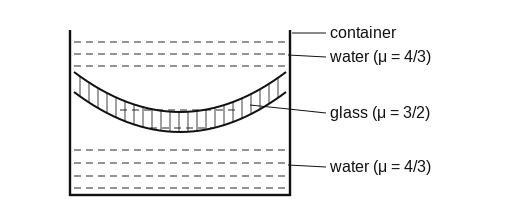
In the diagram given below, there are three lenses formed. Considering negligible thickness of each of them as compared to |R1| and |R2|, i.e., the radii of curvature for upper and lower surfaces of the glass lens, the power of the combination is
नीचे दिए गए चित्र में तीन लेंस बनते हैं। |R1| तथा |R2|, अर्थात काँच के लेंस के ऊपरी तथा निचले पृष्ठों की वक्रता त्रिज्याओं की तुलना में प्रत्येक की मोटाई नगण्य मानते हुए, संयोजन की क्षमता है
  1. A16(1|R1|−1|R2|)
  2. B−16(1|R1|+1|R2|)
  3. C16(1|R1|+1|R2|)
  4. D−16(1|R1|−1|R2|)
Show answer

Concept: For thin lenses in contact, P=P1+P2+P3 with P=(μ−1)(1Ra−1Rb). Take light travelling downward; both surfaces of the bowl-shaped glass have centres of curvature on the incident side, so Ra=−|R1|, Rb=−|R2|.

  1. Upper water lens (flat top, curved bottom): P1=(43−1)(1∞−1−|R1|)=+13|R1|.
  2. Glass lens: P2=(32−1)(1−|R1|−1−|R2|)=12(1|R2|−1|R1|).
  3. Lower water lens (curved top, flat bottom): P3=(43−1)(1−|R2|−0)=−13|R2|.
  4. Sum: P=(13−12)1|R1|+(12−13)1|R2|=−16(1|R1|−1|R2|).

Short trick: Each surface contributes ΔμR: top surface 4/3−3/2−|R1| and bottom 3/2−4/3−|R2| (air–water flat faces contribute nothing) — two terms, done.

Answer: (D) −16(1|R1|−1|R2|)

अवधारणा: सम्पर्क में रखे पतले लेंसों के लिए, P=P1+P2+P3, जहाँ P=(μ−1)(1Ra−1Rb)। प्रकाश को नीचे की ओर चलता मानिए; कटोरीनुमा काँच के दोनों पृष्ठों के वक्रता केन्द्र आपतन की ओर हैं, अतः Ra=−|R1|, Rb=−|R2|।

  1. ऊपरी जल लेंस (ऊपर समतल, नीचे वक्र): P1=(43−1)(1∞−1−|R1|)=+13|R1|।
  2. काँच का लेंस: P2=(32−1)(1−|R1|−1−|R2|)=12(1|R2|−1|R1|)।
  3. निचला जल लेंस (ऊपर वक्र, नीचे समतल): P3=(43−1)(1−|R2|−0)=−13|R2|।
  4. योग: P=(13−12)1|R1|+(12−13)1|R2|=−16(1|R1|−1|R2|)।

शॉर्ट ट्रिक: प्रत्येक पृष्ठ का योगदान ΔμR है: ऊपरी पृष्ठ 4/3−3/2−|R1| तथा निचला 3/2−4/3−|R2| (वायु–जल समतल पृष्ठों का योगदान शून्य) — केवल दो पद, काम समाप्त।

उत्तर: (D) −16(1|R1|−1|R2|)

JEE Main 2025 (January) – Paper 1 (B.E./B.Tech)PhysicsRay Optics – combination of lensesJEE Main 2025 (January) – Paper 1 (B.E./B.Tech) 2025 · 22 Jan Shift 1 →
Q2293.
Given below are two statements : one is labelled as Assertion (A) and the other is labelled as Reason (R). Assertion-(A) : If Young's double slit experiment is performed in an optically denser medium than air, then the consecutive fringes come closer. Reason-(R) : The speed of light reduces in an optically denser medium than air while its frequency does not change. In the light of the above statements, choose the most appropriate answer from the options given below :
नीचे दो कथन दिए गए हैं : एक को अभिकथन (A) तथा दूसरे को कारण (R) कहा गया है। अभिकथन-(A) : यदि यंग का द्विझिरी प्रयोग वायु की अपेक्षा प्रकाशिक रूप से सघन माध्यम में किया जाए, तो क्रमागत फ्रिंजें पास-पास आ जाती हैं। कारण-(R) : वायु की अपेक्षा प्रकाशिक रूप से सघन माध्यम में प्रकाश की चाल घट जाती है जबकि उसकी आवृत्ति अपरिवर्तित रहती है। उपर्युक्त कथनों के आलोक में, नीचे दिए गए विकल्पों में से सबसे उपयुक्त उत्तर चुनिए :
  1. ABoth (A) and (R) are true but (R) is not the correct explanation of (A)(A) और (R) दोनों सत्य हैं परन्तु (R), (A) की सही व्याख्या नहीं है
  2. BBoth (A) and (R) are true and (R) is the correct explanation of (A)(A) और (R) दोनों सत्य हैं और (R), (A) की सही व्याख्या है
  3. C(A) is true but (R) is false(A) सत्य है परन्तु (R) असत्य है
  4. D(A) is false but (R) is true(A) असत्य है परन्तु (R) सत्य है
Show answer

Concept: Fringe width β=λDd; in a medium of refractive index μ, λmedium=λairμ.

  1. In a denser medium v=cμ decreases while frequency f stays fixed, so λ=vf decreases — exactly what (R) states, and (R) is true.
  2. Smaller λ gives smaller β=λDd: fringes come closer, so (A) is true.
  3. The chain (R) ⇒ smaller λ ⇒ smaller β is precisely why (A) happens, so (R) correctly explains (A).

Short trick: In water, YDSE fringe width shrinks by μ: β′=βμ.

Answer: (B) Both (A) and (R) are true and (R) is the correct explanation of (A)

अवधारणा: फ्रिंज चौड़ाई β=λDd; अपवर्तनांक μ वाले माध्यम में λमाध्यम=λवायुμ।

  1. सघन माध्यम में v=cμ घटती है जबकि आवृत्ति f अपरिवर्तित रहती है, अतः λ=vf घट जाती है — यही (R) कहता है, अतः (R) सत्य है।
  2. छोटी λ से β=λDd छोटी होती है: फ्रिंजें पास आ जाती हैं, अतः (A) सत्य है।
  3. (R) ⇒ छोटी λ ⇒ छोटी β — यही शृंखला (A) का कारण है, अतः (R), (A) की सही व्याख्या है।

शॉर्ट ट्रिक: जल में YDSE की फ्रिंज चौड़ाई μ गुना घट जाती है: β′=βμ।

उत्तर: (B) (A) और (R) दोनों सत्य हैं और (R), (A) की सही व्याख्या है

JEE Main 2025 (January) – Paper 1 (B.E./B.Tech)PhysicsWave Optics – Young's double slit experimentJEE Main 2025 (January) – Paper 1 (B.E./B.Tech) 2025 · 22 Jan Shift 1 →
Q2294.
A parallel-plate capacitor of capacitance 40 μF is connected to a 100 V power supply. Now the intermediate space between the plates is filled with a dielectric material of dielectric constant K=2. Due to the introduction of dielectric material, the extra charge and the change in the electrostatic energy in the capacitor, respectively, are
40 μF धारिता के एक समान्तर-प्लेट संधारित्र को 100 V की विद्युत आपूर्ति से जोड़ा गया है। अब प्लेटों के बीच के स्थान को परावैद्युतांक K=2 वाले परावैद्युत पदार्थ से भर दिया जाता है। परावैद्युत पदार्थ भरने के कारण अतिरिक्त आवेश तथा संधारित्र की स्थिरवैद्युत ऊर्जा में परिवर्तन क्रमशः हैं
  1. A4 mC and 0.2 J4 mC और 0.2 J
  2. B8 mC and 2.0 J8 mC और 2.0 J
  3. C2 mC and 0.4 J2 mC और 0.4 J
  4. D2 mC and 0.2 J2 mC और 0.2 J
Show answer

Concept: Battery stays connected, so V is constant: C→KC, Q→KQ, U→KU.

  1. Initially Q1=CV=40 μF×100=4 mC; U1=12CV2=12(40×10−6)(100)2=0.2 J.
  2. With dielectric: C′=80 μF, Q2=8 mC, U2=0.4 J.
  3. Extra charge =Q2−Q1=4 mC; change in energy =U2−U1=0.2 J.

Short trick: With K=2 and battery connected, everything doubles — the increase equals the original values: 4 mC, 0.2 J.

Answer: (A) 4 mC and 0.2 J

अवधारणा: बैटरी जुड़ी रहती है, अतः V नियत: C→KC, Q→KQ, U→KU।

  1. प्रारम्भ में Q1=CV=40 μF×100=4 mC; U1=12CV2=12(40×10−6)(100)2=0.2 J।
  2. परावैद्युत भरने पर: C′=80 μF, Q2=8 mC, U2=0.4 J।
  3. अतिरिक्त आवेश =Q2−Q1=4 mC; ऊर्जा में परिवर्तन =U2−U1=0.2 J।

शॉर्ट ट्रिक: K=2 और बैटरी जुड़ी होने पर सब कुछ दोगुना — वृद्धि मूल मानों के बराबर: 4 mC, 0.2 J।

उत्तर: (A) 4 mC और 0.2 J

JEE Main 2025 (January) – Paper 1 (B.E./B.Tech)PhysicsCapacitance – effect of dielectricJEE Main 2025 (January) – Paper 1 (B.E./B.Tech) 2025 · 22 Jan Shift 1 →
Q2295.
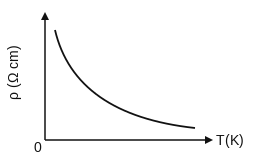
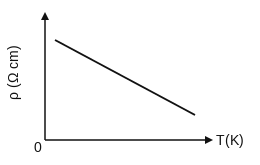
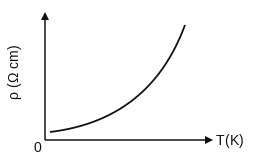
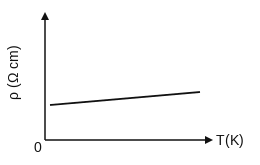
Which of the following resistivity ( ρ ) v/s temperature (T) curves is most suitable to be used in wire bound standard resistors?
निम्नलिखित में से कौन-सा प्रतिरोधकता ( ρ ) व ताप (T) वक्र तार-लिपटे मानक प्रतिरोधकों (wire bound standard resistors) में प्रयोग के लिए सर्वाधिक उपयुक्त है?
  1. A
  2. B
  3. C
  4. D
Show answer

Concept: Standard resistors must keep the same resistance at all working temperatures, so the material must have a very small temperature coefficient of resistivity — alloys like manganin and constantan.

  1. (A) shows resistivity falling sharply with T — semiconductor-like, strongly temperature dependent.
  2. (B) shows a steady linear fall — again a strong T dependence.
  3. (C) shows resistivity rising rapidly — typical of a pure metal, unsuitable.
  4. (D) shows an almost flat line: ρ nearly independent of T — exactly what an alloy such as manganin offers, hence used in standard resistors.

Short trick: Standard resistor = manganin/constantan = flat ρ–T graph.

Answer: (D) the nearly flat curve

अवधारणा: मानक प्रतिरोधकों का प्रतिरोध हर कार्यकारी ताप पर समान रहना चाहिए, अतः पदार्थ का प्रतिरोधकता ताप-गुणांक अत्यन्त छोटा होना चाहिए — मैंगनिन व कॉन्स्टेंटन जैसी मिश्रधातुएँ।

  1. (A) में प्रतिरोधकता T के साथ तेज़ी से गिरती है — अर्धचालक जैसा, ताप पर अत्यधिक निर्भर।
  2. (B) में एकसमान रैखिक गिरावट है — यह भी प्रबल ताप-निर्भरता है।
  3. (C) में प्रतिरोधकता तेज़ी से बढ़ती है — शुद्ध धातु का लक्षण, अनुपयुक्त।
  4. (D) में लगभग समतल रेखा है: ρ ताप से लगभग स्वतन्त्र — मैंगनिन जैसी मिश्रधातु का यही गुण मानक प्रतिरोधकों में काम आता है।

शॉर्ट ट्रिक: मानक प्रतिरोधक = मैंगनिन/कॉन्स्टेंटन = समतल ρ–T ग्राफ।

उत्तर: (D) लगभग समतल वक्र

JEE Main 2025 (January) – Paper 1 (B.E./B.Tech)PhysicsCurrent Electricity – resistivity of materialsJEE Main 2025 (January) – Paper 1 (B.E./B.Tech) 2025 · 22 Jan Shift 1 →
Q2296.
The driver sitting inside a parked car is watching vehicles approaching from behind with the help of his side view mirror, which is a convex mirror with radius of curvature R=2 m. Another car approaches him from behind with a uniform speed of 90 km/hr. When the car is at a distance of 24 m from him, the magnitude of the acceleration of the image of the car in the side view mirror is ' a '. The value of 100a is ______ m/s2.
एक खड़ी कार में बैठा चालक अपने पार्श्व दृश्य दर्पण (side view mirror), जो R=2 m वक्रता त्रिज्या का उत्तल दर्पण है, की सहायता से पीछे से आ रहे वाहनों को देख रहा है। एक अन्य कार पीछे से 90 km/hr की एकसमान चाल से उसकी ओर आ रही है। जब वह कार उससे 24 m की दूरी पर है, तब पार्श्व दृश्य दर्पण में कार के प्रतिबिम्ब के त्वरण का परिमाण ' a ' है। 100a का मान ______ m/s2 है।
Show answer

Concept: For a convex mirror, the image (behind the mirror) sits at y=fxx+f when the object is at distance x (magnitudes, f=R2). Differentiate twice; the object moves uniformly, so only the x˙2 term survives.

  1. f=R2=1 m; speed =90 km/hr=25 m/s, so x˙=−25 m/s, x¨=0.
  2. y=xx+1⇒y˙=x˙(x+1)2.
  3. y¨=x¨(x+1)2−2x˙2(x+1)3=−2×625253 at x=24.
  4. |a|=125015625=0.08 m/s2⇒100a=8.

Short trick: aimage=2f2v2(x+f)3 for a uniformly moving object — plug in f=1, v=25, x=24.

Answer: 8

अवधारणा: उत्तल दर्पण के लिए, वस्तु के x दूरी पर होने पर प्रतिबिम्ब (दर्पण के पीछे) y=fxx+f पर बनता है (परिमाणों में, f=R2)। दो बार अवकलन कीजिए; वस्तु एकसमान चाल से चलती है, अतः केवल x˙2 वाला पद बचता है।

  1. f=R2=1 m; चाल =90 km/hr=25 m/s, अतः x˙=−25 m/s, x¨=0।
  2. y=xx+1⇒y˙=x˙(x+1)2।
  3. y¨=x¨(x+1)2−2x˙2(x+1)3=−2×625253 (x=24 पर)।
  4. |a|=125015625=0.08 m/s2⇒100a=8।

शॉर्ट ट्रिक: एकसमान गति वाली वस्तु के लिए aप्रतिबिम्ब=2f2v2(x+f)3 — f=1, v=25, x=24 रखिए।

उत्तर: 8

JEE Main 2025 (January) – Paper 1 (B.E./B.Tech)PhysicsRay Optics – image motion in spherical mirrorJEE Main 2025 (January) – Paper 1 (B.E./B.Tech) 2025 · 22 Jan Shift 1 →
Q2297.
Two soap bubbles of radius 2 cm and 4 cm, respectively, are in contact with each other. The radius of curvature of the common surface, in cm, is ______.
क्रमशः 2 cm तथा 4 cm त्रिज्या के दो साबुन के बुलबुले एक-दूसरे के सम्पर्क में हैं। उभयनिष्ठ पृष्ठ की वक्रता त्रिज्या, cm में, ______ है।
Show answer

Concept: Excess pressure inside a soap bubble is ΔP=4Tr. The common surface bulges into the bigger bubble, and its radius follows from the pressure difference across it.

  1. P1−P0=4T2 (smaller bubble), P2−P0=4T4 (bigger bubble).
  2. Across the common surface: P1−P2=4Trc.
  3. 4Trc=4T2−4T4⇒1rc=12−14=14.
  4. rc=4 cm.

Short trick: rc=r1r2r2−r1=2×44−2=4 cm.

Answer: 4

अवधारणा: साबुन के बुलबुले के भीतर अतिरिक्त दाब ΔP=4Tr होता है। उभयनिष्ठ पृष्ठ बड़े बुलबुले की ओर उभरता है, और उसकी त्रिज्या पृष्ठ के आर-पार दाबान्तर से मिलती है।

  1. P1−P0=4T2 (छोटा बुलबुला), P2−P0=4T4 (बड़ा बुलबुला)।
  2. उभयनिष्ठ पृष्ठ के आर-पार: P1−P2=4Trc।
  3. 4Trc=4T2−4T4⇒1rc=12−14=14।
  4. rc=4 cm।

शॉर्ट ट्रिक: rc=r1r2r2−r1=2×44−2=4 cm।

उत्तर: 4

JEE Main 2025 (January) – Paper 1 (B.E./B.Tech)PhysicsMechanical Properties of Fluids – soap bubblesJEE Main 2025 (January) – Paper 1 (B.E./B.Tech) 2025 · 22 Jan Shift 1 →
Q2298.
The position vectors of two 1 kg particles, (A) and (B), are given by r→A=(α1t2i^+α2tj^+α3tk^) m and r→B=(β1ti^+β2t2j^+β3tk^) m, respectively; (α1=1 m/s2,α2=3n m/s,α3=2 m/s,β1=2 m/s,β2=−1 m/s2,β3=4p m/s), where t is time, n and p are constants. At t=1 s, |V→A|=|V→B| and velocities V→A and V→B of the particles are orthogonal to each other. At t=1 s, the magnitude of angular momentum of particle (A) with respect to the position of particle (B) is L kg m2s−1. The value of L is ______.
1 kg द्रव्यमान के दो कणों (A) तथा (B) के स्थिति सदिश क्रमशः r→A=(α1t2i^+α2tj^+α3tk^) m तथा r→B=(β1ti^+β2t2j^+β3tk^) m हैं; (α1=1 m/s2,α2=3n m/s,α3=2 m/s,β1=2 m/s,β2=−1 m/s2,β3=4p m/s), जहाँ t समय है तथा n और p नियतांक हैं। t=1 s पर, |V→A|=|V→B| तथा कणों के वेग V→A और V→B परस्पर लम्बवत हैं। t=1 s पर, कण (B) की स्थिति के सापेक्ष कण (A) के कोणीय संवेग का परिमाण L kg m2s−1 है। L का मान ______ है।
Show answer

Concept: Use the two conditions at t=1 s to find n and p, then L→=m(r→A−r→B)×V→A.

  1. V→A=(2α1t, 3n, 2)=(2,3n,2) and V→B=(2, 2β2t, 4p)=(2,−2,4p) at t=1 s.
  2. |V→A|=|V→B|: 8+9n2=8+16p2⇒3n=±4p. Orthogonality: 4−6n+8p=0.
  3. 3n=4p gives 4=0 (impossible); 3n=−4p gives 4+16p=0⇒p=−14, n=13.
  4. So V→A=(2,1,2), V→B=(2,−2,−1) (check: magnitudes 3, dot product 0).
  5. Positions at t=1: r→A=(1,1,2), r→B=(2,−1,−1); r→=r→A−r→B=(−1,2,3).
  6. L→=mr→×V→A=(2⋅2−3⋅1, 3⋅2−(−1)⋅2, −1⋅1−2⋅2)=(1,8,−5).
  7. |L→|2=1+64+25=90⇒|L→|=90⇒L=90.

Short trick: Since |L→|=L, you never need the square root — just report |r→×V→A|2.

Answer: 90

अवधारणा: t=1 s की दोनों शर्तों से n और p निकालिए, फिर L→=m(r→A−r→B)×V→A।

  1. t=1 s पर V→A=(2α1t, 3n, 2)=(2,3n,2) तथा V→B=(2, 2β2t, 4p)=(2,−2,4p)।
  2. |V→A|=|V→B|: 8+9n2=8+16p2⇒3n=±4p। लम्बवतता: 4−6n+8p=0।
  3. 3n=4p से 4=0 (असम्भव); 3n=−4p से 4+16p=0⇒p=−14, n=13।
  4. अतः V→A=(2,1,2), V→B=(2,−2,−1) (जाँच: दोनों परिमाण 3, अदिश गुणनफल 0)।
  5. t=1 पर स्थितियाँ: r→A=(1,1,2), r→B=(2,−1,−1); r→=r→A−r→B=(−1,2,3)।
  6. L→=mr→×V→A=(2⋅2−3⋅1, 3⋅2−(−1)⋅2, −1⋅1−2⋅2)=(1,8,−5)।
  7. |L→|2=1+64+25=90⇒|L→|=90⇒L=90।

शॉर्ट ट्रिक: चूँकि |L→|=L, वर्गमूल की आवश्यकता ही नहीं — सीधे |r→×V→A|2 लिख दीजिए।

उत्तर: 90

JEE Main 2025 (January) – Paper 1 (B.E./B.Tech)PhysicsRotational Motion – angular momentumJEE Main 2025 (January) – Paper 1 (B.E./B.Tech) 2025 · 22 Jan Shift 1 →
Q2299.
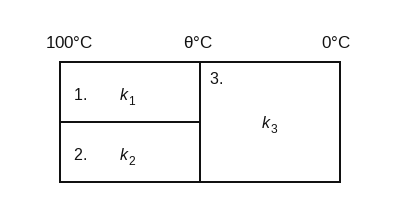
Three conductors of same length having thermal conductivity k1, k2 and k3 are connected as shown in figure.

Area of cross sections of 1st and 2nd conductor are same and for 3rd conductor it is double of the 1st conductor. The temperatures are given in the figure. In steady state condition, the value of θ is ______ ∘C. (Given : k1=60 J s−1m−1K−1, k2=120 J s−1m−1K−1, k3=135 J s−1m−1K−1)
समान लम्बाई के तीन चालक, जिनकी ऊष्मा चालकताएँ k1, k2 तथा k3 हैं, चित्र में दर्शाए अनुसार जुड़े हैं।

पहले तथा दूसरे चालक के अनुप्रस्थ काट के क्षेत्रफल समान हैं और तीसरे चालक का क्षेत्रफल पहले चालक का दोगुना है। ताप चित्र में दिए गए हैं। स्थायी अवस्था में θ का मान ______ ∘C है। (दिया है : k1=60 J s−1m−1K−1, k2=120 J s−1m−1K−1, k3=135 J s−1m−1K−1)
Show answer

Concept: In steady state, heat current into the junction = heat current out: kAΔTL for each rod, with rods 1 and 2 in parallel feeding rod 3.

  1. Heat in through rods 1 and 2 (area A each, from 100∘C to θ): (k1+k2)A(100−θ)L.
  2. Heat out through rod 3 (area 2A, from θ to 0∘C): k3⋅2A(θ−0)L.
  3. (60+120)(100−θ)=135×2θ.
  4. 18000−180θ=270θ⇒450θ=18000⇒θ=40∘C.

Short trick: Effective conductance ratio in : out =180:270=2:3, so θ divides 100→0 as θ=100×25=40.

Answer: 40

अवधारणा: स्थायी अवस्था में सन्धि में आने वाली ऊष्मा धारा = बाहर जाने वाली ऊष्मा धारा: प्रत्येक छड़ के लिए kAΔTL; छड़ 1 व 2 समान्तर क्रम में छड़ 3 को ऊष्मा देती हैं।

  1. छड़ 1 व 2 से आने वाली ऊष्मा (प्रत्येक का क्षेत्रफल A, 100∘C से θ तक): (k1+k2)A(100−θ)L।
  2. छड़ 3 से बाहर जाने वाली ऊष्मा (क्षेत्रफल 2A, θ से 0∘C तक): k3⋅2A(θ−0)L।
  3. (60+120)(100−θ)=135×2θ।
  4. 18000−180θ=270θ⇒450θ=18000⇒θ=40∘C।

शॉर्ट ट्रिक: चालकता अनुपात (अन्दर : बाहर) =180:270=2:3, अतः θ=100×25=40।

उत्तर: 40

JEE Main 2025 (January) – Paper 1 (B.E./B.Tech)PhysicsHeat Transfer – conductionJEE Main 2025 (January) – Paper 1 (B.E./B.Tech) 2025 · 22 Jan Shift 1 →
Q2300.
A particle is projected at an angle of 30∘ from horizontal at a speed of 60 m/s. The height traversed by the particle in the first second is h0 and height traversed in the last second, before it reaches the maximum height, is h1. The ratio h0:h1 is ______ [Take, g=10 m/s2]
एक कण को क्षैतिज से 30∘ कोण पर 60 m/s की चाल से प्रक्षेपित किया जाता है। पहले सेकण्ड में कण द्वारा तय की गई ऊँचाई h0 है तथा अधिकतम ऊँचाई पर पहुँचने से पहले अन्तिम सेकण्ड में तय की गई ऊँचाई h1 है। अनुपात h0:h1 ______ है [g=10 m/s2 लीजिए]
Show answer

Concept: Only the vertical motion matters: uy=usin⁡θ, y(t)=uyt−12gt2, and time to the top is uyg.

  1. uy=60sin⁡30∘=30 m/s; time to maximum height =3010=3 s.
  2. First second: h0=30(1)−5(1)2=25 m.
  3. Last second (from t=2 s to t=3 s): h1=y(3)−y(2)=(90−45)−(60−20)=45−40=5 m.
  4. h0:h1=25:5=5.

Short trick: By time reversal, the last second before the top equals the first second of free fall: h1=12g(1)2=5 m; and h0=uy−5=25 m.

Answer: 5

अवधारणा: केवल ऊर्ध्वाधर गति देखनी है: uy=usin⁡θ, y(t)=uyt−12gt2, तथा शीर्ष तक का समय uyg।

  1. uy=60sin⁡30∘=30 m/s; अधिकतम ऊँचाई तक समय =3010=3 s।
  2. पहला सेकण्ड: h0=30(1)−5(1)2=25 m।
  3. अन्तिम सेकण्ड (t=2 s से t=3 s तक): h1=y(3)−y(2)=(90−45)−(60−20)=45−40=5 m।
  4. h0:h1=25:5=5।

शॉर्ट ट्रिक: समय-व्युत्क्रमण से, शीर्ष से पहले का अन्तिम सेकण्ड मुक्त पतन के पहले सेकण्ड के बराबर है: h1=12g(1)2=5 m; तथा h0=uy−5=25 m।

उत्तर: 5

JEE Main 2025 (January) – Paper 1 (B.E./B.Tech)PhysicsKinematics – projectile motionJEE Main 2025 (January) – Paper 1 (B.E./B.Tech) 2025 · 22 Jan Shift 1 →