Q2241.
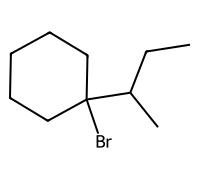
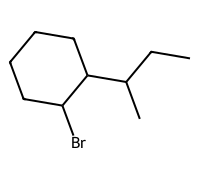
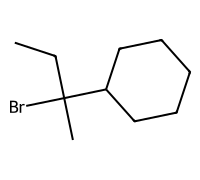
When sec-butylcyclohexane reacts with bromine in the presence of sunlight, the major product is :
जब sec-ब्यूटिलसाइक्लोहेक्सेन सूर्य के प्रकाश की उपस्थिति में ब्रोमीन से अभिक्रिया करता है, तो मुख्य उत्पाद है :
- A
- B
- C
- D
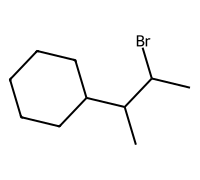
Show answer
Concept: Photochemical bromination is highly selective and substitutes the hydrogen that gives the most stable free radical (3° ≫ 2° ≫ 1°).
- sec-Butylcyclohexane has two tertiary H atoms: one on the ring carbon bearing the side chain and one on C-2 of the sec-butyl chain.
- The side-chain radical •C(CH3)(C2H5)(C6H11) is the more stabilised site: it has 6 α-hydrogens for hyperconjugation against 5 for the ring radical, and attack there is sterically easier.
- So Br goes to the side-chain tertiary carbon, giving 2-bromo-2-cyclohexylbutane, structure (C).
- (B) and (D) are secondary bromides (less favoured); (A) puts Br on the ring tertiary carbon, which is the minor tertiary product.
Short trick: Br2/hν → find the best 3° H; here it is on the chain, not the ring.
Answer: (C)
अवधारणा: प्रकाश-रासायनिक ब्रोमीनीकरण अत्यधिक वरणात्मक होता है और उसी हाइड्रोजन का प्रतिस्थापन करता है जिससे सबसे स्थायी मुक्त मूलक बने (3° ≫ 2° ≫ 1°)।
- sec-ब्यूटिलसाइक्लोहेक्सेन में दो तृतीयक H हैं : एक पार्श्व शृंखला वाले वलय कार्बन पर तथा एक sec-ब्यूटिल शृंखला के C-2 पर।
- पार्श्व शृंखला वाला मूलक •C(CH3)(C2H5)(C6H11) अधिक स्थायित्व वाला स्थल है : इसमें अतिसंयुग्मन हेतु 6 α-हाइड्रोजन हैं जबकि वलय मूलक में 5, और वहाँ आक्रमण त्रिविम दृष्टि से भी सरल है।
- अतः Br पार्श्व शृंखला के तृतीयक कार्बन पर जाता है और 2-ब्रोमो-2-साइक्लोहेक्सिलब्यूटेन, संरचना (C) बनती है।
- (B) तथा (D) द्वितीयक ब्रोमाइड हैं (कम अनुकूल); (A) में Br वलय के तृतीयक कार्बन पर है, जो गौण तृतीयक उत्पाद है।
शॉर्ट ट्रिक: Br2/hν → सर्वोत्तम 3° H खोजिए; यहाँ वह शृंखला पर है, वलय पर नहीं।
उत्तर: (C)