Question bank

Q&A: practice questions with answers

Search questions on any topic. Filter by exam category, exam, subject and topic, try the question, then open the answer and explanation.

Courses – airGurukul

53,050 questions in the question bank.

Q2261.
Using the principal values of the inverse trigonometric functions, the sum of the maximum and the minimum values of 16((sec−1⁡x)2+(cosec−1x)2) is :
प्रतिलोम त्रिकोणमितीय फलनों के मुख्य मानों का प्रयोग करते हुए, 16((sec−1⁡x)2+(cosec−1x)2) के अधिकतम तथा न्यूनतम मानों का योग है:
  1. A24π2
  2. B22π2
  3. C31π2
  4. D18π2
Show answer

Concept: For |x|≥1, sec−1⁡x+cosec−1x=π2; write everything in one variable and extremise over its actual range.

  1. Let s=sec−1⁡x∈[0,π2)∪(π2,π]. Then the expression is E=16(s2+(π2−s)2)=32(s−π4)2+2π2.
  2. Minimum at s=π4 (i.e. x=2): Emin=2π2.
  3. Maximum at the farthest end s=π (i.e. x=−1): Emax=16(π2+π24)=20π2.
  4. Sum =2π2+20π2=22π2.

Answer: (B) 22π2

अवधारणा: |x|≥1 के लिए sec−1⁡x+cosec−1x=π2; सब कुछ एक चर में लिखकर उसके वास्तविक परिसर पर चरम मान निकालिए।

  1. माना s=sec−1⁡x∈[0,π2)∪(π2,π]। तब व्यंजक E=16(s2+(π2−s)2)=32(s−π4)2+2π2।
  2. न्यूनतम s=π4 पर (अर्थात् x=2): Emin=2π2।
  3. अधिकतम सबसे दूर के सिरे s=π पर (अर्थात् x=−1): Emax=16(π2+π24)=20π2।
  4. योग =2π2+20π2=22π2।

उत्तर: (B) 22π2

JEE Main 2025 (January) – Paper 1 (B.E./B.Tech)MathematicsInverse Trigonometric Functions – rangeJEE Main 2025 (January) – Paper 1 (B.E./B.Tech) 2025 · 22 Jan Shift 1 →
Q2262.
Let f:R→R be a twice differentiable function such that f(x+y)=f(x)f(y) for all x,y∈R. If f′(0)=4a and f satisfies f″(x)−3af′(x)−f(x)=0,a>0, then the area of the region R={(x,y)∣0≤y≤f(ax),0≤x≤2} is:
माना f:R→R एक दो बार अवकलनीय फलन है जिसके लिए सभी x,y∈R के लिए f(x+y)=f(x)f(y) है। यदि f′(0)=4a है तथा f, f″(x)−3af′(x)−f(x)=0,a>0 को संतुष्ट करता है, तो क्षेत्र R={(x,y)∣0≤y≤f(ax),0≤x≤2} का क्षेत्रफल है:
  1. Ae2−1
  2. Be2+1
  3. Ce4+1
  4. De4−1
Show answer

Concept: f(x+y)=f(x)f(y) with differentiability forces f(x)=ekx, where k=f′(0).

  1. Here f(x)=e4ax. Substituting in f″−3af′−f=0: 16a2−12a2−1=0⇒4a2=1⇒a=12 (as a>0).
  2. So f(x)=e2x and f(ax)=f(x2)=ex.
  3. Area =∫02exdx=e2−1.

Answer: (A) e2−1

अवधारणा: अवकलनीयता के साथ f(x+y)=f(x)f(y) से f(x)=ekx प्राप्त होता है, जहाँ k=f′(0)।

  1. यहाँ f(x)=e4ax। f″−3af′−f=0 में रखने पर: 16a2−12a2−1=0⇒4a2=1⇒a=12 (क्योंकि a>0)।
  2. अतः f(x)=e2x तथा f(ax)=f(x2)=ex।
  3. क्षेत्रफल =∫02exdx=e2−1।

उत्तर: (A) e2−1

JEE Main 2025 (January) – Paper 1 (B.E./B.Tech)MathematicsArea Under Curves – with functional equationJEE Main 2025 (January) – Paper 1 (B.E./B.Tech) 2025 · 22 Jan Shift 1 →
Q2263.
The area of the region, inside the circle (x−23)2+y2=12 and outside the parabola y2=23x is :
वृत्त (x−23)2+y2=12 के अंदर तथा परवलय y2=23x के बाहर स्थित क्षेत्र का क्षेत्रफल है:
  1. A3π+8
  2. B6π−16
  3. C3π−8
  4. D6π−8
Show answer

Concept: Required area = (area of circle) − (area inside both curves); integrate with respect to y using symmetry.

  1. Intersection: (x−23)2+23x=12⇒x2−23x=0⇒x=0,23; points (0,0) and (23,±23).
  2. For 0≤y≤23 the common region runs from the parabola x=y223 to the circle x=23+12−y2.
  3. Upper-half common area =∫023(23+12−y2−y223)dy=12+3π−4=8+3π (the middle term is a quarter circle of radius 23).
  4. Common area =2(8+3π)=16+6π; required area =12π−(16+6π)=6π−16.

Answer: (B) 6π−16

अवधारणा: अभीष्ट क्षेत्रफल = (वृत्त का क्षेत्रफल) − (दोनों वक्रों के अंदर का उभयनिष्ठ क्षेत्रफल); सममिति का प्रयोग कर y के सापेक्ष समाकलन कीजिए।

  1. प्रतिच्छेदन: (x−23)2+23x=12⇒x2−23x=0⇒x=0,23; बिंदु (0,0) तथा (23,±23)।
  2. 0≤y≤23 के लिए उभयनिष्ठ क्षेत्र परवलय x=y223 से वृत्त x=23+12−y2 तक फैला है।
  3. ऊपरी आधे का उभयनिष्ठ क्षेत्रफल =∫023(23+12−y2−y223)dy=12+3π−4=8+3π (बीच वाला पद त्रिज्या 23 के वृत्त का चौथाई भाग है)।
  4. उभयनिष्ठ क्षेत्रफल =2(8+3π)=16+6π; अभीष्ट क्षेत्रफल =12π−(16+6π)=6π−16।

उत्तर: (B) 6π−16

JEE Main 2025 (January) – Paper 1 (B.E./B.Tech)MathematicsArea Under Curves – circle and parabolaJEE Main 2025 (January) – Paper 1 (B.E./B.Tech) 2025 · 22 Jan Shift 1 →
Q2264.
Let the foci of a hyperbola be (1,14) and (1,−12). If it passes through the point (1,6), then the length of its latus-rectum is :
माना एक अतिपरवलय की नाभियाँ (1,14) तथा (1,−12) हैं। यदि यह बिंदु (1,6) से होकर जाता है, तो इसके नाभिलम्ब की लंबाई है:
  1. A245
  2. B256
  3. C1445
  4. D2885
Show answer

Concept: For a hyperbola, |d1−d2|=2a where d1,d2 are distances from the foci; latus rectum =2b2a with b2=c2−a2.

  1. Centre =(1,1), 2c=26⇒c=13; the transverse axis is vertical (along x=1).
  2. For (1,6): d1=|14−6|=8, d2=|6+12|=18⇒2a=|18−8|=10⇒a=5.
  3. b2=c2−a2=169−25=144.
  4. Latus rectum =2b2a=2885.

Answer: (D) 2885

अवधारणा: अतिपरवलय के लिए |d1−d2|=2a, जहाँ d1,d2 नाभियों से दूरियाँ हैं; नाभिलम्ब =2b2a तथा b2=c2−a2।

  1. केंद्र =(1,1), 2c=26⇒c=13; अनुप्रस्थ अक्ष ऊर्ध्वाधर है (रेखा x=1 के अनुदिश)।
  2. (1,6) के लिए: d1=|14−6|=8, d2=|6+12|=18⇒2a=|18−8|=10⇒a=5।
  3. b2=c2−a2=169−25=144।
  4. नाभिलम्ब =2b2a=2885।

उत्तर: (D) 2885

JEE Main 2025 (January) – Paper 1 (B.E./B.Tech)MathematicsHyperbola – latus rectumJEE Main 2025 (January) – Paper 1 (B.E./B.Tech) 2025 · 22 Jan Shift 1 →
Q2265.
If ∑r=1nTr=(2n−1)(2n+1)(2n+3)(2n+5)64, then limn→∞∑r=1n(1Tr) is equal to :
यदि ∑r=1nTr=(2n−1)(2n+1)(2n+3)(2n+5)64 है, तो limn→∞∑r=1n(1Tr) बराबर है:
  1. A0
  2. B23
  3. C1
  4. D13
Show answer

Concept: Tn=Sn−Sn−1; then split 1Tn into a telescoping difference.

  1. Tn=(2n−1)(2n+1)(2n+3)[(2n+5)−(2n−3)]64=(2n−1)(2n+1)(2n+3)8.
  2. 1Tn=8(2n−1)(2n+1)(2n+3)=2[1(2n−1)(2n+1)−1(2n+1)(2n+3)].
  3. ∑r=1n1Tr=2[11⋅3−1(2n+1)(2n+3)]→2⋅13=23 as n→∞.

Short trick: For 1(2n−1)(2n+1)(2n+3), write it as 12⋅4[1(2n−1)(2n+1)−1(2n+1)(2n+3)]-type differences — only the first term survives in the limit.

Answer: (B) 23

अवधारणा: Tn=Sn−Sn−1; फिर 1Tn को टेलीस्कोपिक अंतर में विभाजित कीजिए।

  1. Tn=(2n−1)(2n+1)(2n+3)[(2n+5)−(2n−3)]64=(2n−1)(2n+1)(2n+3)8।
  2. 1Tn=8(2n−1)(2n+1)(2n+3)=2[1(2n−1)(2n+1)−1(2n+1)(2n+3)]।
  3. ∑r=1n1Tr=2[11⋅3−1(2n+1)(2n+3)]→2⋅13=23, जब n→∞।

शॉर्ट ट्रिक: 1(2n−1)(2n+1)(2n+3) जैसे पदों को क्रमागत गुणनफलों के अंतर के रूप में लिखिए — सीमा में केवल पहला पद बचता है।

उत्तर: (B) 23

JEE Main 2025 (January) – Paper 1 (B.E./B.Tech)MathematicsSequences & Series – telescoping sumJEE Main 2025 (January) – Paper 1 (B.E./B.Tech) 2025 · 22 Jan Shift 1 →
Q2266.
A coin is tossed three times. Let X denote the number of times a tail follows a head. If μ and σ2 denote the mean and variance of X, then the value of 64(μ+σ2) is :
एक सिक्का तीन बार उछाला जाता है। माना X उन बारों की संख्या है जब चित (head) के ठीक बाद पट (tail) आता है। यदि μ तथा σ2, X के माध्य तथा प्रसरण हैं, तो 64(μ+σ2) का मान है:
  1. A51
  2. B64
  3. C32
  4. D48
Show answer

Concept: List all 23=8 equally likely outcomes and count occurrences of the pattern 'HT'.

  1. X=1 for HHT, HTH, HTT, THT; X=0 for HHH, THH, TTH, TTT. (X=2 is impossible in 3 tosses.)
  2. μ=E(X)=48=12; E(X2)=48=12.
  3. σ2=12−14=14.
  4. 64(μ+σ2)=64×34=48.

Answer: (D) 48

अवधारणा: सभी 23=8 समसंभाव्य परिणाम लिखकर 'HT' पैटर्न की आवृत्तियाँ गिनिए।

  1. HHT, HTH, HTT, THT के लिए X=1; HHH, THH, TTH, TTT के लिए X=0। (3 उछालों में X=2 असंभव है।)
  2. μ=E(X)=48=12; E(X2)=48=12।
  3. σ2=12−14=14।
  4. 64(μ+σ2)=64×34=48।

उत्तर: (D) 48

JEE Main 2025 (January) – Paper 1 (B.E./B.Tech)MathematicsProbability – random variable, mean and varianceJEE Main 2025 (January) – Paper 1 (B.E./B.Tech) 2025 · 22 Jan Shift 1 →
Q2267.
The number of non-empty equivalence relations on the set {1,2,3} is :
समुच्चय {1,2,3} पर अरिक्त तुल्यता संबंधों की संख्या है:
  1. A6
  2. B5
  3. C7
  4. D4
Show answer

Concept: Equivalence relations on a set correspond one-to-one with partitions of the set (Bell number).

  1. Partitions of {1,2,3}: {{1},{2},{3}}; {{1,2},{3}}; {{1,3},{2}}; {{2,3},{1}}; {{1,2,3}}.
  2. That is B3=5 partitions, hence 5 equivalence relations (each contains the diagonal, so all are non-empty).

Short trick: Bell numbers: B1=1,B2=2,B3=5,B4=15 — worth memorising.

Answer: (B) 5

अवधारणा: किसी समुच्चय पर तुल्यता संबंध, समुच्चय के विभाजनों (partitions) से एक-एक संगत होते हैं (बेल संख्या)।

  1. {1,2,3} के विभाजन: {{1},{2},{3}}; {{1,2},{3}}; {{1,3},{2}}; {{2,3},{1}}; {{1,2,3}}।
  2. अर्थात् B3=5 विभाजन, अतः 5 तुल्यता संबंध (प्रत्येक में विकर्ण युग्म होते हैं, अतः सभी अरिक्त हैं)।

शॉर्ट ट्रिक: बेल संख्याएँ: B1=1,B2=2,B3=5,B4=15 — याद रखने योग्य।

उत्तर: (B) 5

JEE Main 2025 (January) – Paper 1 (B.E./B.Tech)MathematicsSets & Relations – equivalence relationsJEE Main 2025 (January) – Paper 1 (B.E./B.Tech) 2025 · 22 Jan Shift 1 →
Q2268.
A circle C of radius 2 lies in the second quadrant and touches both the coordinate axes. Let r be the radius of a circle that has centre at the point (2,5) and intersects the circle C at exactly two points. If the set of all possible values of r is the interval (α,β), then 3β−2α is equal to :
त्रिज्या 2 का एक वृत्त C द्वितीय चतुर्थांश में स्थित है और दोनों निर्देशांक अक्षों को स्पर्श करता है। माना r उस वृत्त की त्रिज्या है जिसका केंद्र बिंदु (2,5) पर है और जो वृत्त C को ठीक दो बिंदुओं पर प्रतिच्छेद करता है। यदि r के सभी संभव मानों का समुच्चय अंतराल (α,β) है, तो 3β−2α बराबर है:
  1. A10
  2. B15
  3. C12
  4. D14
Show answer

Concept: Two circles intersect at exactly two points iff |r1−r2|<d<r1+r2, where d is the distance between centres.

  1. Touching both axes in the second quadrant with radius 2 gives centre (−2,2).
  2. d=(2+2)2+(5−2)2=16+9=5.
  3. Condition: |r−2|<5<r+2⇒r>3 and r<7, so (α,β)=(3,7).
  4. 3β−2α=21−6=15.

Answer: (B) 15

अवधारणा: दो वृत्त ठीक दो बिंदुओं पर प्रतिच्छेद करते हैं यदि और केवल यदि |r1−r2|<d<r1+r2, जहाँ d केंद्रों के बीच की दूरी है।

  1. द्वितीय चतुर्थांश में त्रिज्या 2 से दोनों अक्षों को स्पर्श करने पर केंद्र (−2,2) प्राप्त होता है।
  2. d=(2+2)2+(5−2)2=16+9=5।
  3. शर्त: |r−2|<5<r+2⇒r>3 तथा r<7, अतः (α,β)=(3,7)।
  4. 3β−2α=21−6=15।

उत्तर: (B) 15

JEE Main 2025 (January) – Paper 1 (B.E./B.Tech)MathematicsCircles – intersection of two circlesJEE Main 2025 (January) – Paper 1 (B.E./B.Tech) 2025 · 22 Jan Shift 1 →
Q2269.
Let A={1,2,3,…,10} and B={mn:m,n∈A,m<n and gcd(m,n)=1}. Then n(B) is equal to :
माना A={1,2,3,…,10} तथा B={mn:m,n∈A,m<n तथा gcd(m,n)=1} है। तब n(B) बराबर है:
  1. A36
  2. B31
  3. C37
  4. D29
Show answer

Concept: Reduced fractions mn with m<n are all distinct, so n(B)=∑n=210φ(n), counting m<n coprime to n.

  1. Counts of valid m for each n: n=2:1, 3:2, 4:2, 5:4, 6:2, 7:6, 8:4, 9:6, 10:4.
  2. Total =1+2+2+4+2+6+4+6+4=31.
  3. Since each fraction is already in lowest terms with m<n, no two pairs give the same value, so n(B)=31.

Answer: (B) 31

अवधारणा: m<n वाली न्यूनतम रूप की भिन्नें mn सभी भिन्न-भिन्न होती हैं, अतः n(B)=∑n=210φ(n) — प्रत्येक n के लिए n से सह-अभाज्य m<n गिनिए।

  1. प्रत्येक n के लिए मान्य m की संख्या: n=2:1, 3:2, 4:2, 5:4, 6:2, 7:6, 8:4, 9:6, 10:4।
  2. कुल =1+2+2+4+2+6+4+6+4=31।
  3. प्रत्येक भिन्न पहले से ही न्यूनतम रूप में है और m<n, अतः कोई दो युग्म समान मान नहीं देते, इसलिए n(B)=31।

उत्तर: (B) 31

JEE Main 2025 (January) – Paper 1 (B.E./B.Tech)MathematicsSets – counting with gcdJEE Main 2025 (January) – Paper 1 (B.E./B.Tech) 2025 · 22 Jan Shift 1 →
Q2270.
Let z1,z2 and z3 be three complex numbers on the circle |z|=1 with arg⁡(z1)=−π4, arg⁡(z2)=0 and arg⁡(z3)=π4. If |z1z¯2+z2z¯3+z3z¯1|2=α+β2,α,β∈Z, then the value of α2+β2 is :
माना z1,z2 तथा z3 वृत्त |z|=1 पर स्थित तीन सम्मिश्र संख्याएँ हैं, जिनके लिए arg⁡(z1)=−π4, arg⁡(z2)=0 तथा arg⁡(z3)=π4 है। यदि |z1z¯2+z2z¯3+z3z¯1|2=α+β2,α,β∈Z, तो α2+β2 का मान है:
  1. A24
  2. B29
  3. C41
  4. D31
Show answer

Concept: For unimodular numbers, zjz¯k=ei(θj−θk) — only the difference of arguments matters.

  1. z1z¯2=e−iπ/4, z2z¯3=e−iπ/4, z3z¯1=eiπ/2=i.
  2. Sum =2e−iπ/4+i=2−i2+i=2+(1−2)i.
  3. |⋅|2=2+(1−2)2=2+3−22=5−22, so α=5, β=−2.
  4. α2+β2=25+4=29.

Answer: (B) 29

अवधारणा: एकांक मापांक वाली संख्याओं के लिए zjz¯k=ei(θj−θk) — केवल कोणांकों का अंतर मायने रखता है।

  1. z1z¯2=e−iπ/4, z2z¯3=e−iπ/4, z3z¯1=eiπ/2=i।
  2. योग =2e−iπ/4+i=2−i2+i=2+(1−2)i।
  3. |⋅|2=2+(1−2)2=2+3−22=5−22, अतः α=5, β=−2।
  4. α2+β2=25+4=29।

उत्तर: (B) 29

JEE Main 2025 (January) – Paper 1 (B.E./B.Tech)MathematicsComplex Numbers – modulus and argumentJEE Main 2025 (January) – Paper 1 (B.E./B.Tech) 2025 · 22 Jan Shift 1 →
Q2271.
Let A be a square matrix of order 3 such that det(A)=−2 and det(3adj(−6adj(3A)))=2m+n⋅3mn,m>n. Then 4m+2n is equal to _______
माना A कोटि 3 का एक वर्ग आव्यूह है जिसके लिए det(A)=−2 तथा det(3adj(−6adj(3A)))=2m+n⋅3mn,m>n है। तब 4m+2n बराबर है _______
Show answer

Concept: For a 3×3 matrix: det(kM)=k3detM, adj(kM)=k2adjM and det(adjM)=(detM)2.

  1. adj(3A)=9adjA, so −6adj(3A)=−54adjA=B (say).
  2. detB=(−54)3(detA)2=−(2⋅33)3⋅4=−25⋅39.
  3. det(3adjB)=33(detB)2=33⋅210⋅318=210⋅321.
  4. So m+n=10, mn=21 with m>n, giving m=7, n=3.
  5. 4m+2n=28+6=34.

Answer: 34

अवधारणा: 3×3 आव्यूह के लिए: det(kM)=k3detM, adj(kM)=k2adjM तथा det(adjM)=(detM)2।

  1. adj(3A)=9adjA, अतः −6adj(3A)=−54adjA=B (माना)।
  2. detB=(−54)3(detA)2=−(2⋅33)3⋅4=−25⋅39।
  3. det(3adjB)=33(detB)2=33⋅210⋅318=210⋅321।
  4. अतः m+n=10, mn=21 तथा m>n, जिससे m=7, n=3।
  5. 4m+2n=28+6=34।

उत्तर: 34

JEE Main 2025 (January) – Paper 1 (B.E./B.Tech)MathematicsMatrices & Determinants – adjointJEE Main 2025 (January) – Paper 1 (B.E./B.Tech) 2025 · 22 Jan Shift 1 →
Q2272.
If ∑r=0511C2r+12r+2=mn,gcd(m,n)=1, then m−n is equal to _______
यदि ∑r=0511C2r+12r+2=mn,gcd(m,n)=1 है, तो m−n बराबर है _______
Show answer

Concept: nCkk+1=n+1Ck+1n+1, and the even-index binomial coefficients of (1+x)12 add up to 211.

  1. 11C2r+12r+2=12C2r+212.
  2. Sum =112(12C2+12C4+⋯+12C12)=112(211−12C0)=204712.
  3. gcd(2047,12)=1, so m=2047, n=12 and m−n=2035.

Short trick: A 1k+1 beside nCk always signals n+1Ck+1n+1 (the integrated binomial identity).

Answer: 2035

अवधारणा: nCkk+1=n+1Ck+1n+1, तथा (1+x)12 के सम सूचकांक वाले द्विपद गुणांकों का योग 211 होता है।

  1. 11C2r+12r+2=12C2r+212।
  2. योग =112(12C2+12C4+⋯+12C12)=112(211−12C0)=204712।
  3. gcd(2047,12)=1, अतः m=2047, n=12 और m−n=2035।

शॉर्ट ट्रिक: nCk के साथ 1k+1 दिखे तो तुरंत n+1Ck+1n+1 (समाकलित द्विपद सर्वसमिका) लगाइए।

उत्तर: 2035

JEE Main 2025 (January) – Paper 1 (B.E./B.Tech)MathematicsBinomial Theorem – series with binomial coefficientsJEE Main 2025 (January) – Paper 1 (B.E./B.Tech) 2025 · 22 Jan Shift 1 →
Q2273.
Let c→ be the projection vector of b→=λi^+4k^, λ>0, on the vector a→=i^+2j^+2k^. If |a→+c→|=7, then the area of the parallelogram formed by the vectors b→ and c→ is ________
माना c→, सदिश a→=i^+2j^+2k^ पर b→=λi^+4k^, λ>0, का प्रक्षेप सदिश है। यदि |a→+c→|=7 है, तो सदिशों b→ तथा c→ से बने समांतर चतुर्भुज का क्षेत्रफल है ________
Show answer

Concept: Projection vector c→=b→⋅a→|a→|2a→ is parallel to a→; area of the parallelogram =|b→×c→|.

  1. b→⋅a→=λ+8, |a→|2=9, so c→=λ+89a→ and a→+c→=(1+λ+89)a→.
  2. |a→+c→|=3(1+λ+89)=7⇒λ+89=43⇒λ=4.
  3. b→=4i^+4k^, c→=43(i^+2j^+2k^).
  4. b→×c→=43(−8i^−4j^+8k^), so area =|b→×c→|=43×12=16.

Short trick: Area2=|b→|2|c→|2−(b→⋅c→)2=32×16−162=256⇒ area =16 — no cross product needed.

Answer: 16

अवधारणा: प्रक्षेप सदिश c→=b→⋅a→|a→|2a→, a→ के समांतर होता है; समांतर चतुर्भुज का क्षेत्रफल =|b→×c→|।

  1. b→⋅a→=λ+8, |a→|2=9, अतः c→=λ+89a→ तथा a→+c→=(1+λ+89)a→।
  2. |a→+c→|=3(1+λ+89)=7⇒λ+89=43⇒λ=4।
  3. b→=4i^+4k^, c→=43(i^+2j^+2k^)।
  4. b→×c→=43(−8i^−4j^+8k^), अतः क्षेत्रफल =|b→×c→|=43×12=16।

शॉर्ट ट्रिक: क्षेत्रफल2=|b→|2|c→|2−(b→⋅c→)2=32×16−162=256⇒ क्षेत्रफल =16 — सदिश गुणनफल की आवश्यकता नहीं।

उत्तर: 16

JEE Main 2025 (January) – Paper 1 (B.E./B.Tech)MathematicsVector Algebra – projection and cross productJEE Main 2025 (January) – Paper 1 (B.E./B.Tech) 2025 · 22 Jan Shift 1 →
Q2274.
Let the function, f(x)={−3ax2−2,x<1a2+bx,x⩾1 be differentiable for all x∈R, where a>1,b∈R. If the area of the region enclosed by y=f(x) and the line y=−20 is α+β3,α,β∈Z, then the value of α+β is ________
माना फलन f(x)={−3ax2−2,x<1a2+bx,x⩾1 सभी x∈R के लिए अवकलनीय है, जहाँ a>1,b∈R। यदि y=f(x) तथा रेखा y=−20 से घिरे क्षेत्र का क्षेत्रफल α+β3,α,β∈Z है, तो α+β का मान है ________
Show answer

Concept: Differentiability at the join gives continuity and equal derivatives; then the enclosed area is an ordinary definite integral of f(x)−(−20).

  1. Derivatives at x=1: −6a=b. Continuity: −3a−2=a2+b=a2−6a⇒a2−3a+2=0⇒a=2 (as a>1), b=−12.
  2. So f(x)=−6x2−2 for x<1 and f(x)=4−12x for x≥1.
  3. f(x)=−20: −6x2−2=−20⇒x=−3 (taking x<1) and 4−12x=−20⇒x=2.
  4. Area =∫−31(18−6x2)dx+∫12(24−12x)dx=(16+123)+6=22+123.
  5. α+β=22+12=34.

Answer: 34

अवधारणा: जोड़-बिंदु पर अवकलनीयता से सांतत्य तथा समान अवकलज मिलते हैं; फिर घिरा क्षेत्रफल f(x)−(−20) का साधारण निश्चित समाकल है।

  1. x=1 पर अवकलज: −6a=b। सांतत्य: −3a−2=a2+b=a2−6a⇒a2−3a+2=0⇒a=2 (क्योंकि a>1), b=−12।
  2. अतः x<1 के लिए f(x)=−6x2−2 तथा x≥1 के लिए f(x)=4−12x।
  3. f(x)=−20: −6x2−2=−20⇒x=−3 (x<1 लेते हुए) तथा 4−12x=−20⇒x=2।
  4. क्षेत्रफल =∫−31(18−6x2)dx+∫12(24−12x)dx=(16+123)+6=22+123।
  5. α+β=22+12=34।

उत्तर: 34

JEE Main 2025 (January) – Paper 1 (B.E./B.Tech)MathematicsDifferentiability & Area – piecewise functionJEE Main 2025 (January) – Paper 1 (B.E./B.Tech) 2025 · 22 Jan Shift 1 →
Q2275.
Let L1:x−13=y−1−1=z+10 and L2:x−22=y0=z+4α,α∈R, be two lines, which intersect at the point B. If P is the foot of perpendicular from the point A(1,1,−1) on L2, then the value of 26α(PB)2 is _________
माना L1:x−13=y−1−1=z+10 तथा L2:x−22=y0=z+4α,α∈R, दो रेखाएँ हैं, जो बिंदु B पर प्रतिच्छेद करती हैं। यदि बिंदु A(1,1,−1) से L2 पर डाले गए लम्ब का पाद P है, तो 26α(PB)2 का मान है _________
Show answer

Concept: Equate general points of the two lines to find the intersection and α; the foot of perpendicular comes from a zero dot product with the direction vector.

  1. General points: L1:(1+3t, 1−t, −1), L2:(2+2s, 0, −4+αs). Equal y: 1−t=0⇒t=1, so B=(4,0,−1).
  2. On L2: 4=2+2s⇒s=1 and −1=−4+α⇒α=3.
  3. Foot of perpendicular: with P=(2+2s,0,−4+3s) and d→=(2,0,3), AP→⋅d→=2(1+2s)+3(−3+3s)=13s−7=0⇒s=713.
  4. PB→=(1−713)d→=613(2,0,3), so (PB)2=36169×13=3613.
  5. 26α(PB)2=26×3×3613=216.

Answer: 216

अवधारणा: दोनों रेखाओं के व्यापक बिंदुओं को बराबर रखकर प्रतिच्छेद बिंदु तथा α निकालिए; लम्ब का पाद दिशा सदिश के साथ शून्य अदिश गुणनफल से मिलता है।

  1. व्यापक बिंदु: L1:(1+3t, 1−t, −1), L2:(2+2s, 0, −4+αs)। y बराबर करने पर: 1−t=0⇒t=1, अतः B=(4,0,−1)।
  2. L2 पर: 4=2+2s⇒s=1 तथा −1=−4+α⇒α=3।
  3. लम्ब का पाद: P=(2+2s,0,−4+3s) तथा d→=(2,0,3) के साथ, AP→⋅d→=2(1+2s)+3(−3+3s)=13s−7=0⇒s=713।
  4. PB→=(1−713)d→=613(2,0,3), अतः (PB)2=36169×13=3613।
  5. 26α(PB)2=26×3×3613=216।

उत्तर: 216

JEE Main 2025 (January) – Paper 1 (B.E./B.Tech)Mathematics3D Geometry – intersecting lines, foot of perpendicularJEE Main 2025 (January) – Paper 1 (B.E./B.Tech) 2025 · 22 Jan Shift 1 →
Q2276.
An electron is made to enter symmetrically between two parallel and equally but oppositely charged metal plates, each of 10 cm length. The electron emerges out of the electric field region with a horizontal component of velocity 106 m/s. If the magnitude of the electric field between the plates is 9.1 V/cm, then the vertical component of velocity of electron is (mass of electron =9.1×10⁻³¹ kg and charge of electron =1.6×10⁻¹⁹ C)
एक इलेक्ट्रॉन को दो समान्तर तथा बराबर परन्तु विपरीत रूप से आवेशित धातु की प्लेटों, जिनमें प्रत्येक की लम्बाई 10 cm है, के बीच सममित रूप से प्रवेश कराया जाता है। इलेक्ट्रॉन विद्युत क्षेत्र के क्षेत्र से वेग के क्षैतिज घटक 106 m/s के साथ बाहर निकलता है। यदि प्लेटों के बीच विद्युत क्षेत्र का परिमाण 9.1 V/cm है, तो इलेक्ट्रॉन के वेग का ऊर्ध्वाधर घटक है (इलेक्ट्रॉन का द्रव्यमान =9.1×10⁻³¹ kg तथा इलेक्ट्रॉन का आवेश =1.6×10⁻¹⁹ C)
  1. A0
  2. B1×106 m/s
  3. C16×106 m/s
  4. D16×104 m/s
Show answer

Concept: Inside the plates the electron gains a transverse (vertical) velocity vy=at, where a=eEm and t=Lvx is the time spent in the field.

  1. E=9.1 V/cm=910 V/m.
  2. a=eEm=1.6×10−19×9109.1×10−31=1.6×10¹⁴ m/s2.
  3. t=Lvx=0.10106=10−7 s.
  4. vy=at=1.6×1014×10−7=1.6×107=16×106 m/s.

Short trick: The data is rigged: 9109.1×10−31=1033, so a=1.6×10¹⁴ instantly.

Answer: (C) 16×106 m/s

अवधारणा: प्लेटों के भीतर इलेक्ट्रॉन अनुप्रस्थ (ऊर्ध्वाधर) वेग vy=at प्राप्त करता है, जहाँ a=eEm तथा क्षेत्र में बिताया समय t=Lvx है।

  1. E=9.1 V/cm=910 V/m।
  2. a=eEm=1.6×10−19×9109.1×10−31=1.6×10¹⁴ m/s2।
  3. t=Lvx=0.10106=10−7 s।
  4. vy=at=1.6×1014×10−7=1.6×107=16×106 m/s।

शॉर्ट ट्रिक: आँकड़े इस प्रकार चुने गए हैं कि 9109.1×10−31=1033, अतः a=1.6×10¹⁴ तुरन्त मिल जाता है।

उत्तर: (C) 16×106 m/s

JEE Main 2025 (January) – Paper 1 (B.E./B.Tech)PhysicsElectrostatics – motion of charge in uniform fieldJEE Main 2025 (January) – Paper 1 (B.E./B.Tech) 2025 · 22 Jan Shift 1 →
Q2277.
Given below are two statements : Statement-I : The equivalent emf of two nonideal batteries connected in parallel is smaller than either of the two emfs. Statement-II : The equivalent internal resistance of two nonideal batteries connected in parallel is smaller than the internal resistance of either of the two batteries. In the light of the above statements, choose the correct answer from the options given below.
नीचे दो कथन दिए गए हैं : कथन-I : समान्तर क्रम में जुड़ी दो अनादर्श बैटरियों का तुल्य विद्युत वाहक बल (emf) दोनों में से प्रत्येक emf से छोटा होता है। कथन-II : समान्तर क्रम में जुड़ी दो अनादर्श बैटरियों का तुल्य आन्तरिक प्रतिरोध दोनों में से प्रत्येक बैटरी के आन्तरिक प्रतिरोध से छोटा होता है। उपर्युक्त कथनों के आलोक में, नीचे दिए गए विकल्पों में से सही उत्तर चुनिए।
  1. ABoth Statement-I and Statement-II are falseकथन-I और कथन-II दोनों असत्य हैं
  2. BStatement-I is false but Statement-II is trueकथन-I असत्य है परन्तु कथन-II सत्य है
  3. CBoth Statement-I and Statement-II are trueकथन-I और कथन-II दोनों सत्य हैं
  4. DStatement-I is true but Statement-II is falseकथन-I सत्य है परन्तु कथन-II असत्य है
Show answer

Concept: For two cells (ε1,r1) and (ε2,r2) in parallel: εeq=ε1r2+ε2r1r1+r2 and req=r1r2r1+r2.

  1. εeq is a weighted average of ε1 and ε2, so it always lies between the two emfs. It cannot be smaller than both. Hence Statement-I is false.
  2. req=r1r2r1+r2 is smaller than both r1 and r2 (parallel combination). Hence Statement-II is true.

Short trick: Parallel emf = weighted mean (lies between); parallel resistance = always less than the smallest.

Answer: (B) Statement-I is false but Statement-II is true

अवधारणा: समान्तर क्रम में दो सेलों (ε1,r1) तथा (ε2,r2) के लिए: εeq=ε1r2+ε2r1r1+r2 तथा req=r1r2r1+r2।

  1. εeq, ε1 और ε2 का भारित माध्य (weighted average) है, अतः यह सदैव दोनों emf के बीच रहता है। यह दोनों से छोटा नहीं हो सकता। अतः कथन-I असत्य है।
  2. req=r1r2r1+r2 दोनों r1 और r2 से छोटा होता है (समान्तर संयोजन)। अतः कथन-II सत्य है।

शॉर्ट ट्रिक: समान्तर क्रम में emf = भारित माध्य (दोनों के बीच); समान्तर प्रतिरोध = सबसे छोटे से भी कम।

उत्तर: (B) कथन-I असत्य है परन्तु कथन-II सत्य है

JEE Main 2025 (January) – Paper 1 (B.E./B.Tech)PhysicsCurrent Electricity – cells in parallelJEE Main 2025 (January) – Paper 1 (B.E./B.Tech) 2025 · 22 Jan Shift 1 →
Q2278.
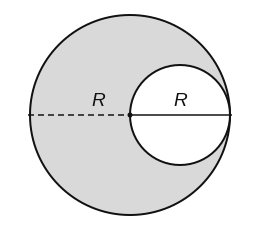
A uniform circular disc of radius ' R ' and mass ' M ' is rotating about an axis perpendicular to its plane and passing through its centre. A small circular part of radius R/2 is removed from the original disc as shown in the figure. Find the moment of inertia of the remaining part of the original disc about the axis as given above.
त्रिज्या ' R ' तथा द्रव्यमान ' M ' की एक समरूप वृत्ताकार चकती अपने तल के लम्बवत तथा केन्द्र से होकर जाने वाली अक्ष के परितः घूर्णन कर रही है। चित्र में दर्शाए अनुसार मूल चकती से त्रिज्या R/2 का एक छोटा वृत्ताकार भाग निकाल दिया जाता है। उपर्युक्त अक्ष के परितः मूल चकती के शेष भाग का जड़त्व आघूर्ण ज्ञात कीजिए।
  1. A732MR2
  2. B932MR2
  3. C1732MR2
  4. D1332MR2
Show answer

Concept: Iremaining=Ifull disc−Iremoved part, with the parallel-axis theorem for the removed piece.

  1. Mass of removed part (area ∝ radius2): m=M(R/2R)2=M4; its centre is at distance R2 from the axis.
  2. Iremoved=12⋅M4(R2)2+M4(R2)2=MR232+MR216=3MR232.
  3. Iremaining=12MR2−332MR2=16−332MR2=1332MR2.

Short trick: For a hole of radius R/2 tangent to centre and rim, the hole's I is always 332MR2 — just subtract from 1632MR2.

Answer: (D) 1332MR2

अवधारणा: Iशेष=Iपूर्ण चकती−Iनिकाला गया भाग, निकाले गए भाग के लिए समान्तर अक्ष प्रमेय (parallel-axis theorem) का प्रयोग करें।

  1. निकाले गए भाग का द्रव्यमान (क्षेत्रफल ∝ त्रिज्या2): m=M(R/2R)2=M4; इसका केन्द्र अक्ष से R2 दूरी पर है।
  2. Iनिकाला=12⋅M4(R2)2+M4(R2)2=MR232+MR216=3MR232।
  3. Iशेष=12MR2−332MR2=16−332MR2=1332MR2।

शॉर्ट ट्रिक: केन्द्र और परिधि को स्पर्श करने वाले R/2 त्रिज्या के छिद्र का I सदैव 332MR2 होता है — बस 1632MR2 में से घटाइए।

उत्तर: (D) 1332MR2

JEE Main 2025 (January) – Paper 1 (B.E./B.Tech)PhysicsRotational Motion – moment of inertiaJEE Main 2025 (January) – Paper 1 (B.E./B.Tech) 2025 · 22 Jan Shift 1 →
Q2279.
An amount of ice of mass 10−3 kg and temperature −10∘C is transformed to vapour of temperature 110∘C by applying heat. The total amount of work required for this conversion is, (Take, specific heat of ice =2100 J kg−1K−1, specific heat of water =4180 J kg−1K−1, specific heat of steam =1920 J kg−1K−1, Latent heat of ice =3.35×10⁵ J kg−1 and Latent heat of steam =2.25×10⁶ J kg−1)
10−3 kg द्रव्यमान तथा −10∘C ताप की बर्फ को ऊष्मा देकर 110∘C ताप की वाष्प में बदला जाता है। इस रूपान्तरण के लिए आवश्यक कुल कार्य है (बर्फ की विशिष्ट ऊष्मा =2100 J kg−1K−1, जल की विशिष्ट ऊष्मा =4180 J kg−1K−1, वाष्प की विशिष्ट ऊष्मा =1920 J kg−1K−1, बर्फ की गुप्त ऊष्मा =3.35×10⁵ J kg−1 तथा वाष्प की गुप्त ऊष्मा =2.25×10⁶ J kg−1 लीजिए)
  1. A3043 J
  2. B3024 J
  3. C3003 J
  4. D3022 J
Show answer

Concept: Add the heats of the five stages: warm the ice, melt it, warm the water, boil it, warm the steam. Q=m[ciceΔT1+Lf+cwΔT2+Lv+csteamΔT3].

  1. Ice −10∘C→0∘C: 2100×10=21000 J/kg.
  2. Melting: 3.35×105=335000 J/kg.
  3. Water 0→100∘C: 4180×100=418000 J/kg.
  4. Boiling: 2.25×106=2250000 J/kg.
  5. Steam 100→110∘C: 1920×10=19200 J/kg.
  6. Total =3.0432×10⁶ J/kg; for m=10−3 kg, Q=3043.2≈3043 J.

Short trick: The two latent heats alone give 2585 J; adding 418+21+19.2 lands you at 3043 without a calculator.

Answer: (A) 3043 J

अवधारणा: पाँच चरणों की ऊष्माएँ जोड़िए: बर्फ को गर्म करना, पिघलाना, जल को गर्म करना, उबालना, वाष्प को गर्म करना। Q=m[ciceΔT1+Lf+cwΔT2+Lv+csteamΔT3]।

  1. बर्फ −10∘C→0∘C: 2100×10=21000 J/kg।
  2. गलन: 3.35×105=335000 J/kg।
  3. जल 0→100∘C: 4180×100=418000 J/kg।
  4. क्वथन: 2.25×106=2250000 J/kg।
  5. वाष्प 100→110∘C: 1920×10=19200 J/kg।
  6. कुल =3.0432×10⁶ J/kg; m=10−3 kg के लिए, Q=3043.2≈3043 J।

शॉर्ट ट्रिक: केवल दोनों गुप्त ऊष्माएँ 2585 J देती हैं; 418+21+19.2 जोड़ने पर बिना कैलकुलेटर 3043 मिल जाता है।

उत्तर: (A) 3043 J

JEE Main 2025 (January) – Paper 1 (B.E./B.Tech)PhysicsThermal Properties – calorimetryJEE Main 2025 (January) – Paper 1 (B.E./B.Tech) 2025 · 22 Jan Shift 1 →
Q2280.
An electron in the ground state of the hydrogen atom has the orbital radius of 5.3×10⁻¹¹ m while that for the electron in third excited state is 8.48×10⁻¹⁰ m. The ratio of the de Broglie wavelengths of electron in the excited state to that in the ground state is
हाइड्रोजन परमाणु की निम्नतम अवस्था (ground state) में इलेक्ट्रॉन की कक्षीय त्रिज्या 5.3×10⁻¹¹ m है, जबकि तृतीय उत्तेजित अवस्था में इलेक्ट्रॉन के लिए यह 8.48×10⁻¹⁰ m है। उत्तेजित अवस्था में इलेक्ट्रॉन की डी-ब्रॉग्ली (de Broglie) तरंगदैर्ध्य का निम्नतम अवस्था की तरंगदैर्ध्य से अनुपात है
  1. A3
  2. B16
  3. C9
  4. D4
Show answer

Concept: Bohr's quantisation 2πr=nλ gives λ=2πrn.

  1. Third excited state means n=4; ground state n=1.
  2. λ4λ1=2πr4/42πr1/1=r44r1=8.48×10−104×5.3×10−11=164=4.

Short trick: r∝n2 so λ=2πrn∝n: ratio =n2n1=41=4, no radii needed.

Answer: (D) 4

अवधारणा: बोर की क्वांटीकरण शर्त 2πr=nλ से λ=2πrn।

  1. तृतीय उत्तेजित अवस्था का अर्थ है n=4; निम्नतम अवस्था में n=1।
  2. λ4λ1=2πr4/42πr1/1=r44r1=8.48×10−104×5.3×10−11=164=4।

शॉर्ट ट्रिक: r∝n2 अतः λ=2πrn∝n: अनुपात =n2n1=41=4, त्रिज्याओं की आवश्यकता ही नहीं।

उत्तर: (D) 4

JEE Main 2025 (January) – Paper 1 (B.E./B.Tech)PhysicsAtoms – de Broglie wavelengthJEE Main 2025 (January) – Paper 1 (B.E./B.Tech) 2025 · 22 Jan Shift 1 →