Question bank

Q&A: practice questions with answers

Search questions on any topic. Filter by exam category, exam, subject and topic, try the question, then open the answer and explanation.

Courses – airGurukul

53,050 questions in the question bank.

Q2661.
In the spectrum of hydrogen, the ratio of the longest wavelength in the Lyman series to the longest wavelength in the Balmer series is:
हाइड्रोजन के स्पेक्ट्रम में, लाइमन श्रेणी की सबसे लंबी तरंगदैर्ध्य तथा बामर श्रेणी की सबसे लंबी तरंगदैर्ध्य का अनुपात है:
  1. A527
  2. B49
  3. C94
  4. D275
Show answer

Concept: 1λ=R(1n12−1n22); the longest wavelength of a series comes from the smallest energy gap (next level down).
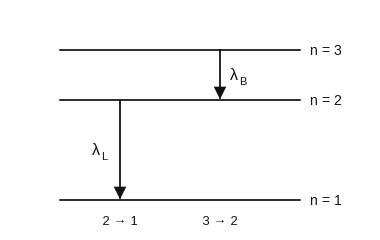
  1. Lyman longest: 2 → 1: 1λL=R(1−14)=3R4.
  2. Balmer longest: 3 → 2: 1λB=R(14−19)=5R36.
  3. λLλB=5R/363R/4=536×43=527.

Short trick: Lyman lines are UV (short), Balmer lines visible (long) – so the ratio must be less than 1: only (A) and (B) survive; a one-line calculation gives (A).

Answer: (A) 527

अवधारणा: 1λ=R(1n12−1n22); किसी श्रेणी की सबसे लंबी तरंगदैर्ध्य सबसे छोटे ऊर्जा-अंतर (ठीक अगले स्तर से संक्रमण) से मिलती है।

  1. लाइमन की सबसे लंबी: 2 → 1: 1λL=R(1−14)=3R4।
  2. बामर की सबसे लंबी: 3 → 2: 1λB=R(14−19)=5R36।
  3. λLλB=5R/363R/4=536×43=527।

शॉर्ट ट्रिक: लाइमन रेखाएँ पराबैंगनी (छोटी λ), बामर दृश्य (लंबी λ) – अतः अनुपात 1 से कम होगा: केवल (A) व (B) बचते हैं; गणना से (A)।

उत्तर: (A) 527
NEET UGPhysicsAtoms – hydrogen spectrum (Lyman & Balmer series)NEET UG 2015 · 25 Jul Shift 1 →
Q2662.
The energy of the em waves is of the order of 15 keV. To which part of the spectrum does it belong?
विद्युत-चुंबकीय तरंगों की ऊर्जा 15 keV की कोटि की है। यह स्पेक्ट्रम के किस भाग से संबंधित है?
  1. Aγ-raysγ-किरणें
  2. BX-raysX-किरणें
  3. CInfra-red raysअवरक्त (infra-red) किरणें
  4. DUltraviolet raysपराबैंगनी (ultraviolet) किरणें
Show answer

Concept: λ=hcE; with hc≈12400 eV Å, λ(Å) = 12400 / E(eV).

  1. λ=1240015000 Å≈0.83 Å ≈8.3×10⁻¹¹ m.
  2. X-rays span roughly 1 nm to 10−3 nm (energies ~100 eV to ~100 keV) → 0.83 Å lies in the X-ray band.
  3. γ-rays are mostly > 100 keV (nuclear origin); UV is only ~3–100 eV; infra-red is below ~1.7 eV.

Short trick: Remember the ladder: visible ≈ 2–3 eV, UV ≈ 10 eV, X-ray ≈ keV, γ-ray ≈ MeV. "keV → X-ray".

Answer: (B) X-rays

अवधारणा: λ=hcE; hc≈12400 eV Å लेने पर λ(Å) = 12400 / E(eV)।

  1. λ=1240015000 Å≈0.83 Å ≈8.3×10⁻¹¹ m।
  2. X-किरणों का परिसर लगभग 1 nm से 10−3 nm (ऊर्जा ~100 eV से ~100 keV) है → 0.83 Å, X-किरण क्षेत्र में है।
  3. γ-किरणें प्रायः > 100 keV (नाभिकीय उद्गम); पराबैंगनी केवल ~3–100 eV; अवरक्त ~1.7 eV से कम।

शॉर्ट ट्रिक: सीढ़ी याद रखें: दृश्य ≈ 2–3 eV, UV ≈ 10 eV, X-किरण ≈ keV, γ-किरण ≈ MeV। "keV → X-किरण"।

उत्तर: (B) X-किरणें

NEET UGPhysicsElectromagnetic waves – EM spectrumNEET UG 2015 · 25 Jul Shift 1 →
Q2663.
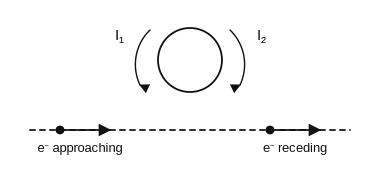
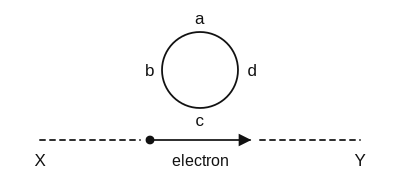
An electron moves on a straight line path XY as shown. The abcd is a coil adjacent to the path of electron. What will be the direction of current, if any, induced in the coil?
एक इलेक्ट्रॉन दर्शाए अनुसार सरल रेखीय पथ XY पर गति करता है। abcd इलेक्ट्रॉन के पथ के निकट स्थित एक कुंडली है। कुंडली में प्रेरित धारा (यदि कोई हो) की दिशा क्या होगी?
  1. ANo current inducedकोई धारा प्रेरित नहीं होगी
  2. Babcd
  3. Cadcb
  4. DThe current will reverse its direction as the electron goes past the coilजैसे ही इलेक्ट्रॉन कुंडली के आगे निकलेगा, धारा की दिशा उलट जाएगी
Show answer

Concept: A moving electron is a current; its magnetic field through the coil changes as it approaches and recedes. Lenz's law: induced current opposes the change in flux.

  1. Electron moving X → Y = conventional current Y → X below the coil; its field through the coil is into the page.
  2. Approaching: flux (into page) increases → induced current makes field out of page → anticlockwise (I1).
  3. Receding: flux decreases → induced current tries to keep it → clockwise (I2).
  4. So the current exists (A wrong) and is not one fixed sense (B, C wrong) – it reverses (D).

Short trick: Flux rises then falls ⇒ emf = −dΦ/dt changes sign ⇒ current always reverses when a charge/magnet passes by.

Answer: (D) The current reverses its direction as the electron goes past the coil

अवधारणा: गतिमान इलेक्ट्रॉन एक धारा है; पास आने व दूर जाने पर कुंडली से होकर इसका चुंबकीय फ्लक्स बदलता है। लेंज़ का नियम: प्रेरित धारा फ्लक्स-परिवर्तन का विरोध करती है।

  1. इलेक्ट्रॉन X → Y = कुंडली के नीचे परंपरागत धारा Y → X; इसका क्षेत्र कुंडली में पृष्ठ के अंदर की ओर है।
  2. पास आते समय: फ्लक्स (अंदर की ओर) बढ़ता है → प्रेरित धारा बाहर की ओर क्षेत्र बनाती है → वामावर्त (I1)।
  3. दूर जाते समय: फ्लक्स घटता है → प्रेरित धारा उसे बनाए रखने का प्रयास करती है → दक्षिणावर्त (I2)।
  4. अतः धारा प्रेरित होती है (A गलत) और एक ही दिशा में नहीं रहती (B, C गलत) – दिशा उलटती है (D)।

शॉर्ट ट्रिक: फ्लक्स पहले बढ़ता फिर घटता है ⇒ emf = −dΦ/dt का चिह्न बदलता है ⇒ आवेश/चुंबक के पास से गुजरने पर धारा सदैव उलटती है।

उत्तर: (D) इलेक्ट्रॉन के कुंडली से आगे निकलने पर धारा की दिशा उलट जाती है

NEET UGPhysicsElectromagnetic induction – Lenz's lawNEET UG 2015 · 25 Jul Shift 1 →
Q2664.
The cylindrical tube of a spray pump has radius R, one end of which has n fine holes, each of radius r. If the speed of the liquid in the tube is V, the speed of the ejection of the liquid through the holes is :
एक स्प्रे पंप की बेलनाकार नली की त्रिज्या R है, जिसके एक सिरे पर n महीन छिद्र हैं, प्रत्येक की त्रिज्या r है। यदि नली में द्रव की चाल V है, तो छिद्रों से द्रव के बाहर निकलने की चाल है:
  1. AV2Rnr
  2. BVR2n2r2
  3. CVR2nr2
  4. DVR2n3r2
Show answer

Concept: Equation of continuity: volume flow rate in = volume flow rate out, A1v1=A2v2.

  1. Inflow: πR2V.
  2. Outflow through n holes: nπr2v.
  3. πR2V=nπr2v⇒v=VR2nr2.

Short trick: Dimension check: answer must have dimension of V, so R² must be over r² – kills (A); n appears only once (total area n·πr²) – kills (B) and (D).

Answer: (C) VR2nr2

अवधारणा: सांतत्य समीकरण: अंदर आने वाली आयतन प्रवाह दर = बाहर जाने वाली आयतन प्रवाह दर, A1v1=A2v2।

  1. अंतर्प्रवाह: πR2V।
  2. n छिद्रों से बहिर्प्रवाह: nπr2v।
  3. πR2V=nπr2v⇒v=VR2nr2।

शॉर्ट ट्रिक: विमीय जाँच: उत्तर की विमा V जैसी होनी चाहिए, अतः R² के नीचे r² होगा – (A) बाहर; n केवल एक बार आता है (कुल क्षेत्रफल n·πr²) – (B) व (D) बाहर।

उत्तर: (C) VR2nr2

NEET UGPhysicsFluid mechanics – equation of continuityNEET UG 2015 · 25 Jul Shift 1 →
Q2665.
The Young’s modulus of steel is twice that of brass. Two wires of same length and of same area of cross section, one of steel and another of brass are suspended from the same roof. If we want the lower ends of the wires to be at the same level, then the weights added to the steel and brass wires must be in the ratio of:
स्टील का यंग प्रत्यास्थता गुणांक पीतल का दोगुना है। समान लंबाई तथा समान अनुप्रस्थ-काट क्षेत्रफल के दो तार, एक स्टील का तथा दूसरा पीतल का, एक ही छत से लटकाए गए हैं। यदि हम चाहते हैं कि तारों के निचले सिरे समान स्तर पर रहें, तो स्टील तथा पीतल के तारों में जोड़े गए भारों का अनुपात होना चाहिए:
  1. A1 : 1
  2. B1 : 2
  3. C2 : 1
  4. D4 : 2
Show answer

Concept: Y=W/AΔℓ/ℓ⇒Δℓ=WℓAY.

  1. Same level ⇒ equal extensions: WsℓAYs=WbℓAYb.
  2. WsWb=YsYb=2 ⇒ 2 : 1.
  3. Note: (D) 4 : 2 is numerically the same ratio but the expected simplest form is (C).

Short trick: Equal stretch ⇒ W ∝ Y (stiffer wire needs more load).

Answer: (C) 2 : 1

अवधारणा: Y=W/AΔℓ/ℓ⇒Δℓ=WℓAY।

  1. समान स्तर ⇒ समान विस्तार: WsℓAYs=WbℓAYb।
  2. WsWb=YsYb=2 ⇒ 2 : 1।
  3. ध्यान दें: (D) 4 : 2 संख्यात्मक रूप से वही अनुपात है, परंतु अपेक्षित सरलतम रूप (C) है।

शॉर्ट ट्रिक: समान खिंचाव ⇒ W ∝ Y (कठोर तार को अधिक भार चाहिए)।

उत्तर: (C) 2 : 1

NEET UGPhysicsMechanical properties of solids – Young's modulusNEET UG 2015 · 25 Jul Shift 1 →
Q2666.
A potentiometer wire of length L and a resistance r are connected in series with a battery of e.m.f. E0 and a resistance r1. An unknown e.m.f. E is balanced at a length l of the potentiometer wire. The e.m.f. E will be given by:
लंबाई L तथा प्रतिरोध r का एक विभवमापी तार, विद्युत वाहक बल E0 की बैटरी तथा प्रतिरोध r1 के साथ श्रेणीक्रम में जुड़ा है। एक अज्ञात विद्युत वाहक बल E, विभवमापी तार की लंबाई l पर संतुलित होता है। विद्युत वाहक बल E होगा:
  1. ALE0r(r+r1)l
  2. BLE0rlr1
  3. CE0r(r+r1)⋅lL
  4. DE0lL
Show answer

Concept: E = k l, where k = potential gradient = (p.d. across wire)/L.

  1. Current in primary: I=E0r+r1 (battery internal resistance neglected).
  2. P.d. across wire: Ir=E0rr+r1.
  3. k=E0r(r+r1)L ⇒ E=kl=E0r(r+r1)⋅lL.

Short trick: E must increase with l (balancing length) – (A) and (B) have l in the denominator; (D) ignores r1.

Answer: (C) E0r(r+r1)⋅lL

अवधारणा: E = k l, जहाँ k = विभव प्रवणता = (तार के सिरों पर विभवांतर)/L।

  1. प्राथमिक परिपथ में धारा: I=E0r+r1 (बैटरी का आंतरिक प्रतिरोध नगण्य)।
  2. तार के सिरों पर विभवांतर: Ir=E0rr+r1।
  3. k=E0r(r+r1)L ⇒ E=kl=E0r(r+r1)⋅lL।

शॉर्ट ट्रिक: E, संतुलन लंबाई l के साथ बढ़ना चाहिए – (A) व (B) में l हर में है; (D) में r1 की उपेक्षा है।

उत्तर: (C) E0r(r+r1)⋅lL

NEET UGPhysicsCurrent electricity – potentiometerNEET UG 2015 · 25 Jul Shift 1 →
Q2667.
A particle is executing a simple harmonic motion. Its maximum acceleration is α and maximum velocity is β. Then, its time period of vibration will be:
एक कण सरल आवर्त गति कर रहा है। इसका अधिकतम त्वरण α तथा अधिकतम वेग β है। तब, इसका कंपन आवर्तकाल होगा:
  1. A2πβα
  2. Bβ2α2
  3. Cαβ
  4. Dβ2α
Show answer

Concept: In SHM: vmax=Aω, amax=Aω2.

  1. amaxvmax=ω=αβ.
  2. T=2πω=2πβα.

Short trick: Only (A) has dimension of time ([v]/[a] = s) and the 2π of a period.

Answer: (A) 2πβα

अवधारणा: सरल आवर्त गति में: vmax=Aω, amax=Aω2।

  1. amaxvmax=ω=αβ।
  2. T=2πω=2πβα।

शॉर्ट ट्रिक: केवल (A) की विमा समय की है ([v]/[a] = s) और उसमें आवर्तकाल का 2π है।

उत्तर: (A) 2πβα

NEET UGPhysicsOscillations – SHM maximum velocity and accelerationNEET UG 2015 · 25 Jul Shift 1 →
Q2668.
If vectors A→=cos⁡ωti^+sin⁡ωtj^ and B→=cos⁡ωt2i^+sin⁡ωt2j^ are functions of times, then the value of t at which they are orthogonal to each other is:
यदि सदिश A→=cos⁡ωti^+sin⁡ωtj^ तथा B→=cos⁡ωt2i^+sin⁡ωt2j^ समय के फलन हैं, तो t का वह मान जिस पर वे परस्पर लंबवत होंगे, है:
  1. At=0
  2. Bt=π4ω
  3. Ct=π2ω
  4. Dt=πω
Show answer

Concept: Two vectors are orthogonal when A→⋅B→=0.

  1. A→⋅B→=cos⁡ωtcos⁡ωt2+sin⁡ωtsin⁡ωt2=cos⁡(ωt−ωt2)=cos⁡ωt2.
  2. cos⁡ωt2=0⇒ωt2=π2⇒t=πω.

Short trick: Both are unit vectors at angles ωt and ωt/2; the angle between them is ωt/2 – set it to 90°.

Answer: (D) t=πω

अवधारणा: दो सदिश लंबवत होते हैं जब A→⋅B→=0।

  1. A→⋅B→=cos⁡ωtcos⁡ωt2+sin⁡ωtsin⁡ωt2=cos⁡(ωt−ωt2)=cos⁡ωt2।
  2. cos⁡ωt2=0⇒ωt2=π2⇒t=πω।

शॉर्ट ट्रिक: दोनों एकांक सदिश हैं जो ωt तथा ωt/2 कोण पर हैं; उनके बीच का कोण ωt/2 है – इसे 90° रखें।

उत्तर: (D) t=πω

NEET UGPhysicsVectors – dot product and orthogonalityNEET UG 2015 · 25 Jul Shift 1 →
Q2669.
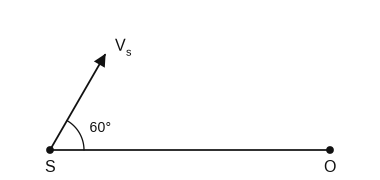
A source of sound S emitting waves of frequency 100 Hz and an observer O are located at some distance from each other. The source is moving with a speed of 19.4 m s−1 at an angle of 60° with the source observer line as shown in the figure. The observer is at rest. The apparent frequency observed by the observer (velocity of sound in air 330 m s−1), is:
100 Hz आवृत्ति की तरंगें उत्सर्जित करने वाला एक ध्वनि स्रोत S तथा एक प्रेक्षक O एक-दूसरे से कुछ दूरी पर स्थित हैं। स्रोत, चित्र में दर्शाए अनुसार स्रोत-प्रेक्षक रेखा से 60° के कोण पर 19.4 m s−1 की चाल से गतिमान है। प्रेक्षक विरामावस्था में है। प्रेक्षक द्वारा प्रेक्षित आभासी आवृत्ति (वायु में ध्वनि का वेग 330 m s−1) है:
  1. A97 Hz
  2. B100 Hz
  3. C103 Hz
  4. D106 Hz
Show answer

Concept: Doppler effect uses only the velocity component along the source–observer line: f′=fvv−vscos⁡θ (source approaching).

  1. Component towards O: vscos⁡60∘=19.4×12=9.7 m s−1.
  2. f′=100×330330−9.7=100×330320.3≈103 Hz.

Short trick: Source has a component towards O ⇒ f' > 100 Hz (kills A, B); small speed ⇒ f' ≈ f(1 + vscosθ/v) = 100(1 + 9.7/330) ≈ 103 Hz.

Answer: (C) 103 Hz

अवधारणा: डॉप्लर प्रभाव में केवल स्रोत–प्रेक्षक रेखा के अनुदिश वेग-घटक लिया जाता है: f′=fvv−vscos⁡θ (स्रोत पास आ रहा)।

  1. O की ओर घटक: vscos⁡60∘=19.4×12=9.7 m s−1।
  2. f′=100×330330−9.7=100×330320.3≈103 Hz।

शॉर्ट ट्रिक: स्रोत का O की ओर घटक है ⇒ f' > 100 Hz ((A), (B) बाहर); कम चाल ⇒ f' ≈ f(1 + vscosθ/v) = 100(1 + 9.7/330) ≈ 103 Hz।

उत्तर: (C) 103 Hz

NEET UGPhysicsWaves – Doppler effect (source moving at an angle)NEET UG 2015 · 25 Jul Shift 1 →
Q2670.
An automobile moves on a road with a speed of 54 km h−1. The radius of its wheels is 0.45 m and the moment of inertia of the wheel about its axis of rotation is 3 kg m2. If the vehicle is brought to rest in 15 s, the magnitude of average torque transmitted by its brakes to the wheel is:
एक ऑटोमोबाइल सड़क पर 54 km h−1 की चाल से चल रहा है। इसके पहियों की त्रिज्या 0.45 m है तथा घूर्णन अक्ष के परितः पहिए का जड़त्व आघूर्ण 3 kg m2 है। यदि वाहन को 15 s में विराम में लाया जाता है, तो इसके ब्रेकों द्वारा पहिए को स्थानांतरित औसत बल-आघूर्ण का परिमाण है:
  1. A2.86 kg m2 s−2
  2. B6.66 kg m2 s−2
  3. C8.58 kg m2 s−2
  4. D10.86 kg m2 s−2
Show answer

Concept: Rolling: ω = v/R; average torque τ = Iα = IΔω/Δt.

  1. v = 54 km h−1 = 15 m s−1 ⇒ ω0=150.45=1003 rad s−1.
  2. α=ω0t=100/315=209 rad s−2.
  3. τ=Iα=3×209=6.66 N m (= kg m2 s−2).

Short trick: τ = I v /(R t) = 3 × 15 /(0.45 × 15) = 3/0.45 = 6.67 – the 15s cancel!

Answer: (B) 6.66 kg m2 s−2

अवधारणा: लोटनिक गति: ω = v/R; औसत बल-आघूर्ण τ = Iα = IΔω/Δt।

  1. v = 54 km h−1 = 15 m s−1 ⇒ ω0=150.45=1003 rad s−1।
  2. α=ω0t=100/315=209 rad s−2।
  3. τ=Iα=3×209=6.66 N m (= kg m2 s−2)।

शॉर्ट ट्रिक: τ = I v /(R t) = 3 × 15 /(0.45 × 15) = 3/0.45 = 6.67 – दोनों 15 कट जाते हैं!

उत्तर: (B) 6.66 kg m2 s−2

NEET UGPhysicsRotational motion – torque and angular retardationNEET UG 2015 · 25 Jul Shift 1 →
Q2671.
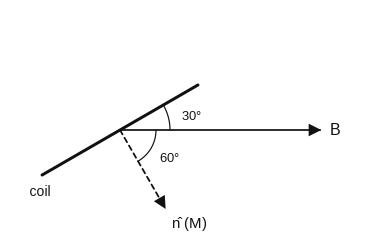
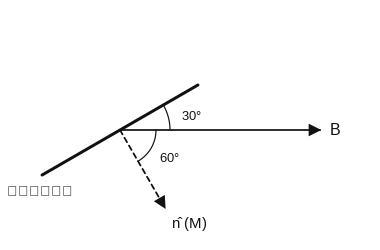
A rectangular coil of length 0.12 m and width 0.1 m having 50 turns of wire is suspended vertically in a uniform magnetic field of strength 0.2 Weber/m2. The coil carries a current of 2 A. If the plane of the coil is inclined at an angle of 30° with the direction of the field, the torque required to keep coil in stable equilibrium will be:
लंबाई 0.12 m तथा चौड़ाई 0.1 m की तार के 50 फेरों वाली एक आयताकार कुंडली 0.2 Weber/m2 तीव्रता के एकसमान चुंबकीय क्षेत्र में ऊर्ध्वाधर लटकाई गई है। कुंडली में 2 A की धारा प्रवाहित हो रही है। यदि कुंडली का तल क्षेत्र की दिशा से 30° के कोण पर झुका है, तो कुंडली को स्थायी संतुलन में रखने के लिए आवश्यक बल-आघूर्ण होगा:
  1. A0.12 Nm
  2. B0.15 Nm
  3. C0.20 Nm
  4. D0.24 Nm
Show answer

Concept: τ=NIABsin⁡θ, where θ is the angle between the area vector (normal, M→) and B→.

  1. Plane makes 30° with B→ ⇒ normal makes θ = 90° − 30° = 60°.
  2. τ=50×2×(0.12×0.1)×0.2×sin⁡60∘=0.24×0.866=0.208≈0.20 N m.
  3. The applied torque must balance this magnetic torque.

Short trick: Plane angle given ⇒ use cos of it: τ = NIAB cos30°. Max torque NIAB = 0.24 (option D) is for plane parallel to B – a trap.

Answer: (C) 0.20 Nm

अवधारणा: τ=NIABsin⁡θ, जहाँ θ क्षेत्रफल सदिश (अभिलंब, M→) तथा B→ के बीच का कोण है।

  1. तल B→ से 30° बनाता है ⇒ अभिलंब θ = 90° − 30° = 60° बनाता है।
  2. τ=50×2×(0.12×0.1)×0.2×sin⁡60∘=0.24×0.866=0.208≈0.20 N m।
  3. लगाया गया बल-आघूर्ण इस चुंबकीय बल-आघूर्ण को संतुलित करना चाहिए।

शॉर्ट ट्रिक: तल का कोण दिया हो ⇒ उसका cos लें: τ = NIAB cos30°। अधिकतम बल-आघूर्ण NIAB = 0.24 (विकल्प D) तल के B के समांतर होने पर है – जाल।

उत्तर: (C) 0.20 Nm

NEET UGPhysicsMoving charges and magnetism – torque on a current loopNEET UG 2015 · 25 Jul Shift 1 →
Q2672.
A parallel plate air capacitor has capacity ‘C’, distance of separation between plates is ‘d’ and potential difference ‘V’ is applied between the plates. Force of attraction between the plates of the parallel plate air capacitor is:
एक समांतर प्लेट वायु संधारित्र की धारिता ‘C’ है, प्लेटों के बीच पृथक्करण दूरी ‘d’ है तथा प्लेटों के बीच विभवांतर ‘V’ लगाया गया है। समांतर प्लेट वायु संधारित्र की प्लेटों के बीच आकर्षण बल है:
  1. AC2V22d2
  2. BC2V22d
  3. CCV22d
  4. DCV2d
Show answer

Concept: Each plate feels the field of the other plate only: F=qEother=q⋅σ2ε0=q22ε0A.

  1. q=CV and ε0A=Cd.
  2. F=C2V22Cd=CV22d.
  3. Check: energy U=q22C=q2x2ε0A ⇒ F=dUdx=q22ε0A – same.

Short trick: F = U/d = (½CV²)/d. Dimension check: CV² is energy, energy/length is force → only (C), (D); the ½ picks (C).

Answer: (C) CV22d

अवधारणा: प्रत्येक प्लेट केवल दूसरी प्लेट का क्षेत्र अनुभव करती है: F=qEother=q⋅σ2ε0=q22ε0A।

  1. q=CV तथा ε0A=Cd।
  2. F=C2V22Cd=CV22d।
  3. जाँच: ऊर्जा U=q22C=q2x2ε0A ⇒ F=dUdx=q22ε0A – वही।

शॉर्ट ट्रिक: F = U/d = (½CV²)/d। विमीय जाँच: CV² ऊर्जा है, ऊर्जा/लंबाई = बल → केवल (C), (D); ½ के कारण (C)।

उत्तर: (C) CV22d

NEET UGPhysicsElectrostatics – force between capacitor platesNEET UG 2015 · 25 Jul Shift 1 →
Q2673.
Two vessels separately contain two ideal gases A and B at the same temperature, the pressure of A being twice that of B. Under such conditions, the density of A is found to be 1.5 times the density of B. The ratio of molecular weight of A and B is:
दो पात्रों में अलग-अलग दो आदर्श गैसें A तथा B समान ताप पर भरी हैं, A का दाब B के दाब का दोगुना है। इन परिस्थितियों में A का घनत्व B के घनत्व का 1.5 गुना पाया जाता है। A तथा B के अणुभारों का अनुपात है:
  1. A12
  2. B23
  3. C34
  4. D2
Show answer

Concept: PV=mMRT⇒P=ρRTM⇒M=ρRTP.

  1. Same T: MAMB=ρAρB⋅PBPA.
  2. =1.5×12=34.

Short trick: M ∝ ρ/P at fixed T: (1.5)/(2) = 0.75.

Answer: (C) 34

अवधारणा: PV=mMRT⇒P=ρRTM⇒M=ρRTP।

  1. समान T: MAMB=ρAρB⋅PBPA।
  2. =1.5×12=34।

शॉर्ट ट्रिक: नियत T पर M ∝ ρ/P: (1.5)/(2) = 0.75।

उत्तर: (C) 34

NEET UGPhysicsKinetic theory – ideal gas equation with densityNEET UG 2015 · 25 Jul Shift 1 →
Q2674.
A satellite S is moving in an elliptical orbit around the earth. The mass of the satellite is very small compared to the mass of the earth. Then,
एक उपग्रह S पृथ्वी के परितः दीर्घवृत्तीय कक्षा में गति कर रहा है। उपग्रह का द्रव्यमान पृथ्वी के द्रव्यमान की तुलना में बहुत कम है। तब,
  1. AThe acceleration of S is always directed towards the centre of the earthS का त्वरण सदैव पृथ्वी के केंद्र की ओर निर्दिष्ट होता है
  2. BThe angular momentum of S about the centre of the earth changes in direction, but its magnitude remains constantपृथ्वी के केंद्र के परितः S के कोणीय संवेग की दिशा बदलती है, परंतु उसका परिमाण नियत रहता है
  3. CThe total mechanical energy of S varies periodically with timeS की कुल यांत्रिक ऊर्जा समय के साथ आवर्ती रूप से बदलती है
  4. DThe linear momentum of S remains constant in magnitudeS के रैखिक संवेग का परिमाण नियत रहता है
Show answer

Concept: The only force on S is earth's gravity, a central force directed towards the earth's centre.

  1. (A) a = F/m, and F is always towards the centre ⇒ correct.
  2. (B) Central force ⇒ torque about centre = 0 ⇒ angular momentum constant in magnitude AND direction ⇒ wrong.
  3. (C) Gravity is conservative ⇒ total mechanical energy is constant ⇒ wrong.
  4. (D) Speed is greatest at perigee and least at apogee ⇒ |p| changes ⇒ wrong.

Short trick: Central force ⇒ L conserved (fully), E conserved, but speed changes (Kepler's 2nd law).

Answer: (A) The acceleration of S is always directed towards the centre of the earth

अवधारणा: S पर एकमात्र बल पृथ्वी का गुरुत्व है, जो पृथ्वी के केंद्र की ओर निर्दिष्ट केंद्रीय बल है।

  1. (A) a = F/m, तथा F सदैव केंद्र की ओर ⇒ सही।
  2. (B) केंद्रीय बल ⇒ केंद्र के परितः बल-आघूर्ण = 0 ⇒ कोणीय संवेग का परिमाण तथा दिशा दोनों नियत ⇒ गलत।
  3. (C) गुरुत्व संरक्षी बल है ⇒ कुल यांत्रिक ऊर्जा नियत ⇒ गलत।
  4. (D) चाल उपभू पर अधिकतम तथा अपभू पर न्यूनतम ⇒ |p| बदलता है ⇒ गलत।

शॉर्ट ट्रिक: केंद्रीय बल ⇒ L (पूर्णतः) संरक्षित, E संरक्षित, परंतु चाल बदलती है (केप्लर का द्वितीय नियम)।

उत्तर: (A) S का त्वरण सदैव पृथ्वी के केंद्र की ओर निर्दिष्ट होता है

NEET UGPhysicsGravitation – satellite in elliptical orbitNEET UG 2015 · 25 Jul Shift 1 →
Q2675.
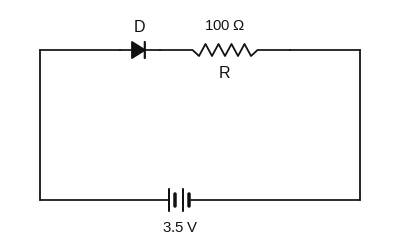
In the given figure, a diode D is connected to an external resistance R = 100 Ω and an e.m.f. of 3.5 V. If the barrier potential developed across the diode is 0.5 V, the current in the circuit will be:
दिए गए चित्र में, एक डायोड D बाह्य प्रतिरोध R = 100 Ω तथा 3.5 V के विद्युत वाहक बल से जुड़ा है। यदि डायोड के सिरों पर उत्पन्न रोधिका विभव 0.5 V है, तो परिपथ में धारा होगी:
  1. A35 mA
  2. B30 mA
  3. C40 mA
  4. D20 mA
Show answer

Concept: A forward-biased diode drops (approximately) its barrier potential; the rest of the emf appears across R.

  1. From the figure, the positive (long-plate) terminal drives current into the anode of D ⇒ forward biased.
  2. I=E−VBR=3.5−0.5100=0.03 A = 30 mA.

Short trick: (A) 35 mA is the trap that ignores the 0.5 V barrier.

Answer: (B) 30 mA

अवधारणा: अग्र-अभिनत डायोड पर (लगभग) उसका रोधिका विभव गिरता है; शेष विद्युत वाहक बल R पर आता है।

  1. चित्र से, धनात्मक (लंबी प्लेट) टर्मिनल D के एनोड में धारा भेजता है ⇒ अग्र-अभिनत।
  2. I=E−VBR=3.5−0.5100=0.03 A = 30 mA।

शॉर्ट ट्रिक: (A) 35 mA वह जाल है जिसमें 0.5 V रोधिका की उपेक्षा की गई है।

उत्तर: (B) 30 mA

NEET UGPhysicsSemiconductors – forward-biased diode with barrier potentialNEET UG 2015 · 25 Jul Shift 1 →
Q2676.
A remote-sensing satellite of earth revolves in a circular orbit at a height of 0.25×10⁶ m above the surface of earth. If earth’s radius is 6.38×10⁶ m and g = 9.8 m s−2, then the orbital speed of the satellite is:
पृथ्वी का एक सुदूर-संवेदी (remote-sensing) उपग्रह पृथ्वी की सतह से 0.25×10⁶ m की ऊँचाई पर वृत्तीय कक्षा में परिक्रमा करता है। यदि पृथ्वी की त्रिज्या 6.38×10⁶ m तथा g = 9.8 m s−2 है, तो उपग्रह की कक्षीय चाल है:
  1. A6.67 km s−1
  2. B7.76 km s−1
  3. C8.56 km s−1
  4. D9.13 km s−1
Show answer

Concept: v0=GMR+h=gR2R+h (using GM = gR²).

  1. R + h = 6.38 × 10⁶ + 0.25 × 106 = 6.63 × 10⁶ m.
  2. v0=9.8×(6.38×106)26.63×106=6.02×10⁷≈7.76×10³ m s−1.

Short trick: Near-surface orbit speed ≈ 7.9 km/s; a slightly higher orbit must be a little slower → 7.76.

Answer: (B) 7.76 km s−1

अवधारणा: v0=GMR+h=gR2R+h (GM = gR² प्रयोग करके)।

  1. R + h = 6.38 × 10⁶ + 0.25 × 106 = 6.63 × 10⁶ m।
  2. v0=9.8×(6.38×106)26.63×106=6.02×10⁷≈7.76×10³ m s−1।

शॉर्ट ट्रिक: सतह के निकट कक्षीय चाल ≈ 7.9 km/s; थोड़ी ऊँची कक्षा में चाल थोड़ी कम → 7.76।

उत्तर: (B) 7.76 km s−1

NEET UGPhysicsGravitation – orbital speed of a satelliteNEET UG 2015 · 25 Jul Shift 1 →
Q2677.
The position vector of a particle R→ as a function of time is given by:
R→=4sin⁡(2πt)i^+4cos⁡(2πt)j^
Where R is in meters, t is in seconds and i^ and j^ denote unit vectors along x- and y-directions, respectively. Which one of the following statements is wrong for the motion of particle?
किसी कण का स्थिति सदिश R→ समय के फलन के रूप में दिया गया है:
R→=4sin⁡(2πt)i^+4cos⁡(2πt)j^
जहाँ R मीटर में, t सेकंड में है तथा i^ और j^ क्रमशः x- तथा y-दिशाओं के अनुदिश एकांक सदिश हैं। कण की गति के लिए निम्नलिखित में से कौन-सा कथन गलत है?
  1. APath of the particle is a circle of radius 4 meterकण का पथ 4 मीटर त्रिज्या का एक वृत्त है
  2. BAcceleration vector is along −R→त्वरण सदिश −R→ के अनुदिश है
  3. CMagnitude of acceleration vector is v2R, where v is the velocity of particleत्वरण सदिश का परिमाण v2R है, जहाँ v कण का वेग है
  4. DMagnitude of the velocity of particle is 8 meter/secondकण के वेग का परिमाण 8 मीटर/सेकंड है
Show answer

Concept: x = 4 sin2πt, y = 4 cos2πt ⇒ x² + y² = 16: uniform circular motion with R = 4 m, ω = 2π rad s−1.

  1. (A) radius 4 m – true.
  2. a→=d2R→dt2=−ω2R→ ⇒ along −R→ – (B) true; magnitude ω²R = v²/R – (C) true.
  3. Speed v = ωR = 2π × 4 = 8π ≈ 25.1 m s−1, not 8 m s−1 ⇒ (D) is the wrong statement.

Short trick: v = ωR: the "2π" inside the sine never disappears – 8 m/s forgets it.

Answer: (D) Magnitude of the velocity of particle is 8 meter/second

अवधारणा: x = 4 sin2πt, y = 4 cos2πt ⇒ x² + y² = 16: R = 4 m तथा ω = 2π rad s−1 वाली एकसमान वृत्तीय गति।

  1. (A) त्रिज्या 4 m – सत्य।
  2. a→=d2R→dt2=−ω2R→ ⇒ −R→ के अनुदिश – (B) सत्य; परिमाण ω²R = v²/R – (C) सत्य।
  3. चाल v = ωR = 2π × 4 = 8π ≈ 25.1 m s−1, 8 m s−1 नहीं ⇒ (D) गलत कथन है।

शॉर्ट ट्रिक: v = ωR: sine के अंदर का "2π" कभी गायब नहीं होता – 8 m/s में यह भुला दिया गया है।

उत्तर: (D) कण के वेग का परिमाण 8 मीटर/सेकंड है

NEET UGPhysicsMotion in a plane – uniform circular motionNEET UG 2015 · 25 Jul Shift 1 →
Q2678.
A string is stretched between fixed points separated by 75.0 cm. It is observed to have resonant frequencies of 420 Hz and 315 Hz. There are no other resonant frequencies between these two. The lowest resonant frequency for this string is:
एक डोरी 75.0 cm की दूरी पर स्थित दो स्थिर बिंदुओं के बीच तनी हुई है। इसकी अनुनादी आवृत्तियाँ 420 Hz तथा 315 Hz प्रेक्षित की जाती हैं। इन दोनों के बीच कोई अन्य अनुनादी आवृत्ति नहीं है। इस डोरी की न्यूनतम अनुनादी आवृत्ति है:
  1. A105 Hz
  2. B155 Hz
  3. C205 Hz
  4. D10.5 Hz
Show answer

Concept: For a string fixed at both ends, resonant frequencies are fn=nv2L=nf1 (all integer multiples of the fundamental).

  1. Consecutive resonances differ by f1: f1=420−315=105 Hz.
  2. Check: 315 = 3 × 10⁵ and 420 = 4 × 10⁵ ✓.
  3. The lowest resonant frequency is the fundamental = 105 Hz.

Short trick: Lowest frequency = difference of two consecutive resonances (for a closed pipe it would be half the difference).

Answer: (A) 105 Hz

अवधारणा: दोनों सिरों पर बंधी डोरी के लिए अनुनादी आवृत्तियाँ fn=nv2L=nf1 हैं (मूल आवृत्ति के सभी पूर्णांक गुणज)।

  1. क्रमागत अनुनादों का अंतर f1 होता है: f1=420−315=105 Hz।
  2. जाँच: 315 = 3 × 10⁵ तथा 420 = 4 × 10⁵ ✓।
  3. न्यूनतम अनुनादी आवृत्ति मूल आवृत्ति = 105 Hz है।

शॉर्ट ट्रिक: न्यूनतम आवृत्ति = दो क्रमागत अनुनादों का अंतर (एक सिरे पर बंद नली में यह अंतर का आधा होता)।

उत्तर: (A) 105 Hz

NEET UGPhysicsWaves – stationary waves on a stringNEET UG 2015 · 25 Jul Shift 1 →
Q2679.
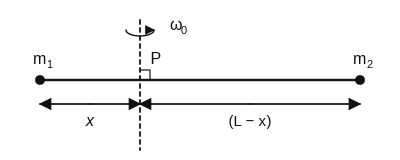
Point masses m1 and m2 are placed at the opposite ends of rigid rod of length L, and negligible mass. The rod is to be set rotating about an axis perpendicular to it. The position of point P on this rod through which the axis should pass so that the work required to set the rod rotating with angular velocity ω0 is minimum, is given by:
बिंदु द्रव्यमान m1 तथा m2, लंबाई L तथा नगण्य द्रव्यमान की एक दृढ़ छड़ के विपरीत सिरों पर रखे हैं। छड़ को उसके लंबवत एक अक्ष के परितः घुमाना है। छड़ पर बिंदु P की वह स्थिति, जिससे होकर अक्ष गुज़रनी चाहिए ताकि छड़ को कोणीय वेग ω0 से घुमाने के लिए आवश्यक कार्य न्यूनतम हो, दी जाती है:
  1. Ax=m2Lm1+m2
  2. Bx=m1Lm1+m2
  3. Cx=m1m2L
  4. Dx=m2m1L
Show answer

Concept: Work = rotational KE = 12Iω02; for fixed ω0 it is least when I is least, i.e. axis through the centre of mass.

  1. I(x)=m1x2+m2(L−x)2.
  2. dIdx=2m1x−2m2(L−x)=0⇒m1x=m2(L−x).
  3. x=m2Lm1+m2 (the centre of mass, measured from m1).

Short trick: Distance from m1 carries the OTHER mass on top: x = m2L/(m1+m2). Options (C), (D) fail the dimension/limit check (x can exceed L).

Answer: (A) x=m2Lm1+m2

अवधारणा: कार्य = घूर्णी गतिज ऊर्जा = 12Iω02; नियत ω0 के लिए यह तब न्यूनतम है जब I न्यूनतम हो, अर्थात अक्ष द्रव्यमान केंद्र से गुज़रे।

  1. I(x)=m1x2+m2(L−x)2।
  2. dIdx=2m1x−2m2(L−x)=0⇒m1x=m2(L−x)।
  3. x=m2Lm1+m2 (m1 से मापा गया द्रव्यमान केंद्र)।

शॉर्ट ट्रिक: m1 से दूरी के अंश में दूसरा द्रव्यमान आता है: x = m2L/(m1+m2)। (C), (D) सीमा-जाँच में विफल (x, L से अधिक हो सकता है)।

उत्तर: (A) x=m2Lm1+m2

NEET UGPhysicsRotational motion – moment of inertia minimum about centre of massNEET UG 2015 · 25 Jul Shift 1 →
Q2680.
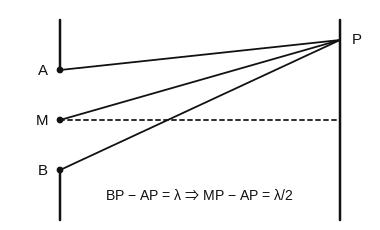
At the first minimum adjacent to the central maximum of a single-slit diffraction pattern, the phase difference between the Huygen’s wavelet from the edge of the slit and the wavelet from the midpoint of the slit is:
एकल-झिरी विवर्तन पैटर्न में केंद्रीय उच्चिष्ठ के निकटवर्ती प्रथम निम्निष्ठ पर, झिरी के किनारे से आने वाली हाइगेंस तरंगिका तथा झिरी के मध्य बिंदु से आने वाली तरंगिका के बीच कलांतर है:
  1. Aπ8 radianπ8 रेडियन
  2. Bπ4 radianπ4 रेडियन
  3. Cπ2 radianπ2 रेडियन
  4. Dπ radianπ रेडियन
Show answer

Concept: First minimum: asin⁡θ=λ – path difference between the two edges is λ; split the slit into two halves.

  1. Edge A to midpoint M is half the slit ⇒ path difference = λ/2.
  2. Phase difference =2πλ×λ2=π.
  3. So every wavelet of the upper half cancels its partner in the lower half – that is why it is a minimum.

Short trick: Half-slit pairing: edge ↔ midpoint must be out of phase (π) for darkness.

Answer: (D) π radian

अवधारणा: प्रथम निम्निष्ठ: asin⁡θ=λ – दोनों किनारों के बीच पथांतर λ है; झिरी को दो अर्धों में बाँटें।

  1. किनारे A से मध्य बिंदु M तक झिरी का आधा भाग ⇒ पथांतर = λ/2।
  2. कलांतर =2πλ×λ2=π।
  3. अतः ऊपरी अर्ध की प्रत्येक तरंगिका, निचले अर्ध की अपनी जोड़ीदार तरंगिका को निरस्त कर देती है – इसीलिए निम्निष्ठ बनता है।

शॉर्ट ट्रिक: अर्ध-झिरी युग्मन: अँधेरे के लिए किनारा ↔ मध्य बिंदु विपरीत कला (π) में होने चाहिए।

उत्तर: (D) π रेडियन

NEET UGPhysicsWave optics – single slit diffractionNEET UG 2015 · 25 Jul Shift 1 →