Question bank

Q&A: practice questions with answers

Search questions on any topic. Filter by exam category, exam, subject and topic, try the question, then open the answer and explanation.

Courses – airGurukul

53,050 questions in the question bank.

Q2681.
A force F→=αi^+3j^+6k^ is acting at a point r→=2i^−6j^−12k^. The value of α for which angular momentum about origin is conserved is:
एक बल F→=αi^+3j^+6k^ बिंदु r→=2i^−6j^−12k^ पर कार्य कर रहा है। α का वह मान जिसके लिए मूल बिंदु के परितः कोणीय संवेग संरक्षित रहता है, है:
  1. A1
  2. B−1
  3. C2
  4. DZeroशून्य
Show answer

Concept: Angular momentum is conserved when torque τ→=r→×F→=0, i.e. F→∥r→.

  1. Components must be proportional: α2=3−6=6−12=−12.
  2. α=−1.
  3. Check: F→=−i^+3j^+6k^=−12r→ ⇒ cross product zero ✓.

Short trick: j and k parts already say F = −½ r, so α = −½ × 2 = −1.

Answer: (B) −1

अवधारणा: कोणीय संवेग तब संरक्षित रहता है जब बल-आघूर्ण τ→=r→×F→=0, अर्थात F→∥r→।

  1. घटक समानुपाती होने चाहिए: α2=3−6=6−12=−12।
  2. α=−1।
  3. जाँच: F→=−i^+3j^+6k^=−12r→ ⇒ सदिश गुणनफल शून्य ✓।

शॉर्ट ट्रिक: j व k भाग पहले ही बताते हैं कि F = −½ r, अतः α = −½ × 2 = −1।

उत्तर: (B) −1
NEET UGPhysicsRotational motion – conservation of angular momentum (torque = 0)NEET UG 2015 · 25 Jul Shift 1 →
Q2682.
Two particles A and B move with constant velocities v→1 and v→2. At the initial moment their position vectors are r→1 and r→2 respectively. The condition for particles A and B for their collision is:
दो कण A तथा B नियत वेगों v→1 तथा v→2 से गति करते हैं। प्रारंभिक क्षण पर उनके स्थिति सदिश क्रमशः r→1 तथा r→2 हैं। कणों A तथा B की टक्कर के लिए शर्त है:
  1. Ar→1×v→1=r→2×v→2
  2. Br→1−r→2|r→1−r→2|=v→2−v→1|v→2−v→1|
  3. Cr→1⋅v→1=r→2⋅v→2
  4. Dr→1−r→2=v→1−v→2
Show answer

Concept: Collision at time t: r→1+v→1t=r→2+v→2t.

  1. r→1−r→2=(v→2−v→1)t with t > 0.
  2. So r→1−r→2 and v→2−v→1 point the same way: their unit vectors are equal – (B).
  3. (A), (C) are not the condition; (D) equates a position to a velocity (wrong dimensions, wrong sign).

Short trick: In B's frame, A must move straight at B: relative velocity of B w.r.t. A must point from B to A … i.e. unit vectors equal.

Answer: (B) r→1−r→2|r→1−r→2|=v→2−v→1|v→2−v→1|

अवधारणा: समय t पर टक्कर: r→1+v→1t=r→2+v→2t।

  1. r→1−r→2=(v→2−v→1)t, जहाँ t > 0।
  2. अतः r→1−r→2 तथा v→2−v→1 एक ही दिशा में हैं: उनके एकांक सदिश बराबर हैं – (B)।
  3. (A), (C) शर्त नहीं हैं; (D) स्थिति को वेग के बराबर रखता है (गलत विमा, गलत चिह्न)।

शॉर्ट ट्रिक: B के निर्देश-तंत्र में A को सीधे B की ओर आना चाहिए: A के सापेक्ष B का आपेक्षिक वेग B से A की ओर निर्दिष्ट होना चाहिए … अर्थात दोनों एकांक सदिश बराबर।

उत्तर: (B) r→1−r→2|r→1−r→2|=v→2−v→1|v→2−v→1|

NEET UGPhysicsMotion in a plane – relative velocity and collision conditionNEET UG 2015 · 25 Jul Shift 1 →
Q2683.
A nucleus of uranium decays at rest into nuclei of thorium and helium. Then:
विरामावस्था में यूरेनियम का एक नाभिक थोरियम तथा हीलियम के नाभिकों में क्षयित होता है। तब:
  1. AThe helium nucleus has less kinetic energy than the thorium nucleusहीलियम नाभिक की गतिज ऊर्जा थोरियम नाभिक से कम है
  2. BThe helium nucleus has more kinetic energy than the thorium nucleusहीलियम नाभिक की गतिज ऊर्जा थोरियम नाभिक से अधिक है
  3. CThe helium nucleus has less momentum than the thorium nucleusहीलियम नाभिक का संवेग थोरियम नाभिक से कम है
  4. DThe helium nucleus has more momentum than the thorium nucleusहीलियम नाभिक का संवेग थोरियम नाभिक से अधिक है
Show answer

Concept: Momentum conservation (initially at rest): pHe=pTh in magnitude; K=p22m.

  1. Equal momenta ⇒ (C) and (D) are wrong.
  2. KHeKTh=mThmHe=2344≫1 ⇒ helium has far more KE – (B); (A) wrong.

Short trick: Equal p, so the lighter fragment runs away with the energy (≈ 98% of Q goes to the α-particle).

Answer: (B) The helium nucleus has more kinetic energy than the thorium nucleus

अवधारणा: संवेग संरक्षण (प्रारंभ में विराम): परिमाण में pHe=pTh; K=p22m।

  1. समान संवेग ⇒ (C) व (D) गलत।
  2. KHeKTh=mThmHe=2344≫1 ⇒ हीलियम की गतिज ऊर्जा कहीं अधिक – (B); (A) गलत।

शॉर्ट ट्रिक: p समान है, अतः हल्का खंड ऊर्जा ले जाता है (Q का ≈ 98% α-कण को मिलता है)।

उत्तर: (B) हीलियम नाभिक की गतिज ऊर्जा थोरियम नाभिक से अधिक है

NEET UGPhysicsNuclei – alpha decay, momentum and kinetic energy sharingNEET UG 2015 · 25 Jul Shift 1 →
Q2684.
Two metal wires of identical dimensions are connected in series. If σ1 and σ2 are the conductivities of the metal wires respectively, the effective conductivity of the combination is:
समान विमाओं वाले धातु के दो तार श्रेणीक्रम में जुड़े हैं। यदि σ1 तथा σ2 क्रमशः धातु के तारों की चालकताएँ हैं, तो संयोजन की प्रभावी चालकता है:
  1. Aσ1σ2σ1+σ2
  2. B2σ1σ2σ1+σ2
  3. Cσ1+σ22σ1σ2
  4. Dσ1+σ2σ1σ2
Show answer

Concept: R=ℓσA; in series resistances add; the combination has length 2ℓ and area A.

  1. Req=ℓσ1A+ℓσ2A=ℓA⋅σ1+σ2σ1σ2.
  2. Also Req=2ℓσeqA.
  3. 2σeq=σ1+σ2σ1σ2⇒σeq=2σ1σ2σ1+σ2.

Short trick: Limit check σ1 = σ2 = σ ⇒ σeq must be σ: only (B) gives σ (A gives σ/2; C, D have wrong dimensions).

Answer: (B) 2σ1σ2σ1+σ2

अवधारणा: R=ℓσA; श्रेणी में प्रतिरोध जुड़ते हैं; संयोजन की लंबाई 2ℓ तथा क्षेत्रफल A है।

  1. Req=ℓσ1A+ℓσ2A=ℓA⋅σ1+σ2σ1σ2।
  2. साथ ही Req=2ℓσeqA।
  3. 2σeq=σ1+σ2σ1σ2⇒σeq=2σ1σ2σ1+σ2।

शॉर्ट ट्रिक: सीमा-जाँच σ1 = σ2 = σ ⇒ σeq = σ होना चाहिए: केवल (B) σ देता है ((A) σ/2 देता है; (C), (D) की विमा गलत)।

उत्तर: (B) 2σ1σ2σ1+σ2

NEET UGPhysicsCurrent electricity – effective conductivity of series combinationNEET UG 2015 · 25 Jul Shift 1 →
Q2685.
Light of wavelength 500 nm is incident on a metal with work function 2.28 eV. The de Broglie wavelength of the emitted electron is:
500 nm तरंगदैर्ध्य का प्रकाश 2.28 eV कार्य-फलन वाली एक धातु पर आपतित होता है। उत्सर्जित इलेक्ट्रॉन की दे ब्रॉग्ली तरंगदैर्ध्य है:
  1. A≤2.8×10⁻¹² m
  2. B<2.8×10⁻¹⁰ m
  3. C<2.8×10⁻⁹ m
  4. D≥2.8×10⁻⁹ m
Show answer

Concept: Einstein: Kmax=hcλ−ϕ; de Broglie λe=h2mK – the fastest electrons have the shortest λe.

  1. Photon energy =1240500=2.48 eV ⇒ Kmax=2.48−2.28=0.20 eV.
  2. λmin=h2mKmax=6.6×10−342×9.1×10−31×0.2×1.6×10−19≈2.75×10⁻⁹ m, i.e. ≈ 2.8 × 10⁻⁹ m (2 significant figures).
  3. Electrons come out with K ≤ Kmax, so λe ≥ λmin ⇒ λ ≥ 2.8 × 10⁻⁹ m.

Short trick: For electrons λ(nm) ≈ 1.23/√K(eV) = 1.23/√0.2 ≈ 2.75 nm; and since K can be less than Kmax, the inequality must be "≥".

Answer: (D) ≥2.8×10⁻⁹ m

अवधारणा: आइंस्टाइन: Kmax=hcλ−ϕ; दे ब्रॉग्ली λe=h2mK – सबसे तेज़ इलेक्ट्रॉनों की λe सबसे छोटी होती है।

  1. फोटॉन ऊर्जा =1240500=2.48 eV ⇒ Kmax=2.48−2.28=0.20 eV।
  2. λmin=h2mKmax=6.6×10−342×9.1×10−31×0.2×1.6×10−19≈2.75×10⁻⁹ m, अर्थात ≈ 2.8 × 10⁻⁹ m (2 सार्थक अंकों तक)।
  3. इलेक्ट्रॉन K ≤ Kmax के साथ निकलते हैं, अतः λe ≥ λmin ⇒ λ ≥ 2.8 × 10⁻⁹ m।

शॉर्ट ट्रिक: इलेक्ट्रॉन के लिए λ(nm) ≈ 1.23/√K(eV) = 1.23/√0.2 ≈ 2.75 nm; और K, Kmax से कम हो सकती है, अतः असमिका "≥" होगी।

उत्तर: (D) ≥2.8×10⁻⁹ m

NEET UGPhysicsDual nature – photoelectric effect and de Broglie wavelengthNEET UG 2015 · 25 Jul Shift 1 →
Q2686.
4.0 g of a gas occupies 22.4 liters at NTP. The specific heat capacity of the gas at constant volume is 5.0 J K−1 mol−1. If the speed of sound in this gas at NTP is 952 m s−1, then the heat capacity at constant pressure is
(Take gas constant R = 8.3 J K−1 mol−1)
4.0 g गैस NTP पर 22.4 लीटर आयतन घेरती है। नियत आयतन पर गैस की विशिष्ट ऊष्मा धारिता 5.0 J K−1 mol−1 है। यदि NTP पर इस गैस में ध्वनि की चाल 952 m s−1 है, तो नियत दाब पर ऊष्मा धारिता है
(गैस नियतांक R = 8.3 J K−1 mol−1 लें)
  1. A8.5 J K−1 mol−1
  2. B8.0 J K−1 mol−1
  3. C7.5 J K−1 mol−1
  4. D7.0 J K−1 mol−1
Show answer

Concept: Laplace: v=γRTM gives γ; then Cp=γCv.

  1. 22.4 L at NTP = 1 mol ⇒ M = 4 g mol−1 = 4 × 10⁻³ kg mol−1.
  2. γ=v2MRT=9522×4×10−38.3×273=36252266≈1.6.
  3. Cp=γCv=1.6×5.0=8.0 J K−1 mol−1.

Short trick: Use the speed data, not Cv + R (= 13.3, not in options) – the data are meant to be used through γ: Cp = γCv.

Answer: (B) 8.0 J K−1 mol−1

अवधारणा: लाप्लास: v=γRTM से γ मिलता है; फिर Cp=γCv।

  1. NTP पर 22.4 L = 1 mol ⇒ M = 4 g mol−1 = 4 × 10⁻³ kg mol−1।
  2. γ=v2MRT=9522×4×10−38.3×273=36252266≈1.6।
  3. Cp=γCv=1.6×5.0=8.0 J K−1 mol−1।

शॉर्ट ट्रिक: चाल के आँकड़े का प्रयोग करें, Cv + R का नहीं (= 13.3, विकल्पों में नहीं) – आँकड़ों का प्रयोग γ के माध्यम से करना है: Cp = γCv।

उत्तर: (B) 8.0 J K−1 mol−1

NEET UGPhysicsThermodynamics/Kinetic theory – speed of sound and C<sub>p</sub>NEET UG 2015 · 25 Jul Shift 1 →
Q2687.
A series R-C circuit is connected to an alternating voltage source. Consider two situations:
(a) When capacitor is air filled.
(b) When capacitor is mica filled.
Current through resistor is i and voltage across capacitor is V then:
एक श्रेणी R-C परिपथ एक प्रत्यावर्ती वोल्टता स्रोत से जुड़ा है। दो स्थितियों पर विचार कीजिए:
(a) जब संधारित्र में वायु भरी है।
(b) जब संधारित्र में अभ्रक (mica) भरा है।
प्रतिरोधक से धारा i तथा संधारित्र के सिरों पर वोल्टता V है, तब:
  1. AVa=Vb
  2. BVa<Vb
  3. CVa>Vb
  4. Dia>ib
Show answer

Concept: XC=1ωC; i=V0R2+XC2, VC=iXC=V0(RωC)2+1.

  1. Mica (K > 1) increases C ⇒ Cb > Ca ⇒ XC decreases.
  2. Impedance decreases ⇒ ib > ia ⇒ (D) wrong.
  3. VC=V0(RωC)2+1 decreases as C increases ⇒ Va > Vb – (C); (A), (B) wrong.

Short trick: Bigger C = smaller "resistance" XC ⇒ capacitor takes a smaller share of the voltage (potential-divider logic).

Answer: (C) Va>Vb

अवधारणा: XC=1ωC; i=V0R2+XC2, VC=iXC=V0(RωC)2+1।

  1. अभ्रक (K > 1) C बढ़ाता है ⇒ Cb > Ca ⇒ XC घटता है।
  2. प्रतिबाधा घटती है ⇒ ib > ia ⇒ (D) गलत।
  3. VC=V0(RωC)2+1, C बढ़ने पर घटता है ⇒ Va > Vb – (C); (A), (B) गलत।

शॉर्ट ट्रिक: बड़ा C = छोटा "प्रतिरोध" XC ⇒ संधारित्र को वोल्टता का छोटा हिस्सा मिलता है (विभव-विभाजक तर्क)।

उत्तर: (C) Va>Vb

NEET UGPhysicsAlternating current – series RC circuit with dielectricNEET UG 2015 · 25 Jul Shift 1 →
Q2688.
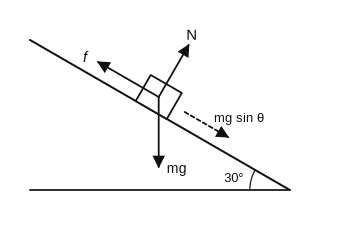
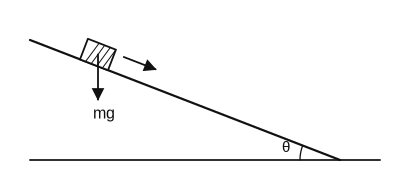
A plank with a box on it at one end is gradually raised about the other end. As the angle of inclination with the horizontal reaches 30°, the box starts to slip and slides 4.0 m down the plank in 4.0 s. The coefficients of static and kinetic friction between the box and the plank will be, respectively:
एक तख्ते के एक सिरे पर एक बक्सा रखा है और तख्ते को दूसरे सिरे के परितः धीरे-धीरे ऊपर उठाया जाता है। जैसे ही क्षैतिज से झुकाव कोण 30° होता है, बक्सा फिसलना शुरू कर देता है तथा 4.0 s में तख्ते पर 4.0 m नीचे खिसक जाता है। बक्से तथा तख्ते के बीच स्थैतिक तथा गतिज घर्षण गुणांक क्रमशः होंगे:
  1. A0.4 and 0.30.4 तथा 0.3
  2. B0.6 and 0.60.6 तथा 0.6
  3. C0.6 and 0.50.6 तथा 0.5
  4. D0.5 and 0.60.5 तथा 0.6
Show answer

Concept: Slipping just begins at the angle of repose: μs = tan θ. While sliding: a = g(sin θ − μk cos θ).

  1. μs=tan⁡30∘=13=0.577≈0.6.
  2. From rest: s=12at2⇒4=12a(16)⇒a=0.5 m s−2.
  3. μk=gsin⁡30∘−agcos⁡30∘=5−0.58.66≈0.52≈0.5 (g = 10 m s−2).

Short trick: μk must be less than μs – instantly removes (B) and (D); tan 30° ≈ 0.58 removes (A).

Answer: (C) 0.6 and 0.5

अवधारणा: फिसलना विश्राम कोण पर ठीक शुरू होता है: μs = tan θ। फिसलते समय: a = g(sin θ − μk cos θ)।

  1. μs=tan⁡30∘=13=0.577≈0.6।
  2. विराम से: s=12at2⇒4=12a(16)⇒a=0.5 m s−2।
  3. μk=gsin⁡30∘−agcos⁡30∘=5−0.58.66≈0.52≈0.5 (g = 10 m s−2)।

शॉर्ट ट्रिक: μk, μs से कम होना चाहिए – (B) व (D) तुरंत बाहर; tan 30° ≈ 0.58 से (A) बाहर।

उत्तर: (C) 0.6 तथा 0.5

NEET UGPhysicsLaws of motion – static and kinetic friction on inclineNEET UG 2015 · 25 Jul Shift 1 →
Q2689.
Two stones of masses m and 2 m are whirled in horizontal circles, the heavier one in a radius r2 and the lighter one in radius r. The tangential speed of lighter stone is n times that of the value of heavier stone when they experience same centripetal forces. The value of n is:
द्रव्यमान m तथा 2 m के दो पत्थरों को क्षैतिज वृत्तों में घुमाया जाता है, भारी पत्थर को r2 त्रिज्या में तथा हल्के पत्थर को r त्रिज्या में। जब वे समान अभिकेंद्र बलों का अनुभव करते हैं, तब हल्के पत्थर की स्पर्शरेखीय चाल भारी पत्थर की चाल की n गुनी है। n का मान है:
  1. A1
  2. B2
  3. C3
  4. D4
Show answer

Concept: Centripetal force F=mv2r.

  1. Lighter: F=mv12r; heavier: F=2mv22r/2=4mv22r.
  2. Equal forces ⇒ v12=4v22⇒v1=2v2 ⇒ n = 2.

Short trick: m/r for the heavy stone is 2m/(r/2) = 4 × (m/r) ⇒ v² ratio 4 ⇒ v ratio 2.

Answer: (B) 2

अवधारणा: अभिकेंद्र बल F=mv2r।

  1. हल्का: F=mv12r; भारी: F=2mv22r/2=4mv22r।
  2. बल समान ⇒ v12=4v22⇒v1=2v2 ⇒ n = 2।

शॉर्ट ट्रिक: भारी पत्थर के लिए m/r = 2m/(r/2) = 4 × (m/r) ⇒ v² का अनुपात 4 ⇒ v का अनुपात 2।

उत्तर: (B) 2

NEET UGPhysicsCircular motion – centripetal forceNEET UG 2015 · 25 Jul Shift 1 →
Q2690.
The coefficient of performance of a refrigerator is 5. If the temperature inside freezer is −20°C, the temperature of the surroundings to which it rejects heat is:
एक प्रशीतित्र (refrigerator) का कार्य-निष्पादन गुणांक 5 है। यदि फ्रीज़र के अंदर का ताप −20°C है, तो परिवेश का ताप, जिसमें यह ऊष्मा त्यागता है, है:
  1. A21°C
  2. B31°C
  3. C41°C
  4. D11°C
Show answer

Concept: For an ideal (Carnot) refrigerator: β=TCTH−TC (temperatures in kelvin).

  1. TC = −20 + 273 = 253 K.
  2. 5=253TH−253⇒TH−253=50.6⇒TH=303.6 K.
  3. TH ≈ 303.6 − 273 = 30.6°C ≈ 31°C.

Short trick: TH = TC(1 + 1/β) = 253 × 1.2 = 303.6 K – one multiplication.

Answer: (B) 31°C

अवधारणा: आदर्श (कार्नो) प्रशीतित्र के लिए: β=TCTH−TC (ताप केल्विन में)।

  1. TC = −20 + 273 = 253 K।
  2. 5=253TH−253⇒TH−253=50.6⇒TH=303.6 K।
  3. TH ≈ 303.6 − 273 = 30.6°C ≈ 31°C।

शॉर्ट ट्रिक: TH = TC(1 + 1/β) = 253 × 1.2 = 303.6 K – केवल एक गुणा।

उत्तर: (B) 31°C

NEET UGPhysicsThermodynamics – refrigerator coefficient of performanceNEET UG 2015 · 25 Jul Shift 1 →
Q2691.
An ideal gas is compressed to half its initial volume by means of several processes. Which of the process results in the maximum work done on the gas?
एक आदर्श गैस को कई प्रक्रमों द्वारा उसके प्रारंभिक आयतन के आधे तक संपीडित किया जाता है। निम्नलिखित में से कौन-सा प्रक्रम गैस पर अधिकतम कार्य किए जाने का परिणाम देता है?
  1. AIsothermalसमतापी
  2. BAdiabaticरुद्धोष्म
  3. CIsobaricसमदाबी
  4. DIsochoricसमआयतनिक
Show answer

Concept: Work done on the gas = area under the P–V curve between V and V/2.

  1. Isochoric: volume cannot change ⇒ the compression is impossible / W = 0 – (D) wrong.
  2. Isobaric: P stays at P0 ⇒ smallest area.
  3. Isothermal: P rises as 1/V; adiabatic: P rises as 1/Vγ (steeper, γ > 1) ⇒ adiabatic curve lies highest ⇒ largest area.
  4. Order: Wadiabatic > Wisothermal > Wisobaric.

Short trick: For compression the steepest curve (adiabatic) encloses the most area; for expansion it is the reverse (isobaric most).

Answer: (B) Adiabatic

अवधारणा: गैस पर किया गया कार्य = V तथा V/2 के बीच P–V वक्र के नीचे का क्षेत्रफल।

  1. समआयतनिक: आयतन बदल ही नहीं सकता ⇒ संपीडन असंभव / W = 0 – (D) गलत।
  2. समदाबी: P, P0 पर रहता है ⇒ सबसे कम क्षेत्रफल।
  3. समतापी: P, 1/V के अनुसार बढ़ता है; रुद्धोष्म: P, 1/Vγ के अनुसार (अधिक तीव्र, γ > 1) ⇒ रुद्धोष्म वक्र सबसे ऊपर ⇒ सबसे अधिक क्षेत्रफल।
  4. क्रम: Wरुद्धोष्म > Wसमतापी > Wसमदाबी।

शॉर्ट ट्रिक: संपीडन में सबसे तीव्र वक्र (रुद्धोष्म) सबसे अधिक क्षेत्रफल घेरता है; प्रसार में इसका उलटा (समदाबी अधिकतम)।

उत्तर: (B) रुद्धोष्म

NEET UGPhysicsThermodynamics – work done in compression processesNEET UG 2015 · 25 Jul Shift 1 →
Q2692.
A ball is thrown vertically downwards from a height of 20 m with an initial velocity v0. It collides with the ground, loses 50 percent of its energy in collision and rebounds to the same height. The initial velocity v0 is: (Take g = 10 m s−2)
एक गेंद 20 m की ऊँचाई से प्रारंभिक वेग v0 के साथ ऊर्ध्वाधरतः नीचे की ओर फेंकी जाती है। यह भूमि से टकराती है, टक्कर में अपनी 50 प्रतिशत ऊर्जा खो देती है तथा उसी ऊँचाई तक वापस उछलती है। प्रारंभिक वेग v0 है: (g = 10 m s−2 लें)
  1. A10 m s−1
  2. B14 m s−1
  3. C20 m s−1
  4. D28 m s−1
Show answer

Concept: Energy conservation before and after the impact; half the KE at the ground is lost.

  1. After impact it rises 20 m ⇒ KE just after = mgh = m × 10 × 20 = 200m J.
  2. This is 50% of KE just before ⇒ KE before = 400m J.
  3. KE before = ½mv0² + mgh ⇒ 400m = ½mv0² + 200m ⇒ v0² = 400 ⇒ v0 = 20 m s−1.

Short trick: Lost energy (50%) = gained energy above 20 m ⇒ ½mv0² = mgh ⇒ v0 = √(2gh) = 20 m/s.

Answer: (C) 20 m s−1

अवधारणा: टक्कर से पहले व बाद ऊर्जा संरक्षण; भूमि पर गतिज ऊर्जा का आधा भाग नष्ट हो जाता है।

  1. टक्कर के बाद यह 20 m ऊपर जाती है ⇒ ठीक बाद गतिज ऊर्जा = mgh = m × 10 × 20 = 200m J।
  2. यह ठीक पहले की गतिज ऊर्जा का 50% है ⇒ पहले की गतिज ऊर्जा = 400m J।
  3. पहले की गतिज ऊर्जा = ½mv0² + mgh ⇒ 400m = ½mv0² + 200m ⇒ v0² = 400 ⇒ v0 = 20 m s−1।

शॉर्ट ट्रिक: नष्ट ऊर्जा (50%) = 20 m से ऊपर अतिरिक्त ऊर्जा ⇒ ½mv0² = mgh ⇒ v0 = √(2gh) = 20 m/s।

उत्तर: (C) 20 m s−1

NEET UGPhysicsWork, energy and power – energy loss in collisionNEET UG 2015 · 25 Jul Shift 1 →
Q2693.
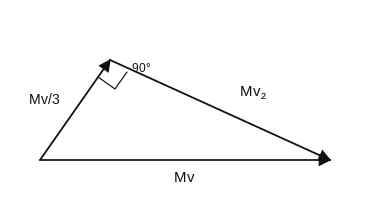
On a frictionless surface, a block of mass M moving at speed v collides elastically with another block of same mass M which is initially at rest. After collision the first block moves at an angle θ to its initial direction and has a speed v3. The second block’s speed after the collision is:
एक घर्षणरहित पृष्ठ पर, चाल v से गतिमान द्रव्यमान M का एक गुटका, प्रारंभ में विरामावस्था में स्थित समान द्रव्यमान M के दूसरे गुटके से प्रत्यास्थ टक्कर करता है। टक्कर के पश्चात पहला गुटका अपनी प्रारंभिक दिशा से θ कोण पर v3 चाल से गति करता है। टक्कर के पश्चात दूसरे गुटके की चाल है:
  1. A32v
  2. B223v
  3. C34v
  4. D32v
Show answer

Concept: Elastic collision of equal masses (one at rest): momentum and KE conservation ⇒ the two final velocities are perpendicular, so v2=v12+v22.

  1. KE: 12Mv2=12M(v3)2+12Mv22.
  2. v22=v2−v29=8v29⇒v2=223v.

Short trick: Equal masses + elastic = right-angled triangle of velocities; Pythagoras finishes it. (D) > v is impossible.

Answer: (B) 223v

अवधारणा: समान द्रव्यमानों की प्रत्यास्थ टक्कर (एक विराम में): संवेग व गतिज ऊर्जा संरक्षण ⇒ दोनों अंतिम वेग परस्पर लंबवत, अतः v2=v12+v22।

  1. गतिज ऊर्जा: 12Mv2=12M(v3)2+12Mv22।
  2. v22=v2−v29=8v29⇒v2=223v।

शॉर्ट ट्रिक: समान द्रव्यमान + प्रत्यास्थ = वेगों का समकोण त्रिभुज; पाइथागोरस से उत्तर। (D) > v असंभव है।

उत्तर: (B) 223v

NEET UGPhysicsWork, energy and power – 2D elastic collision of equal massesNEET UG 2015 · 25 Jul Shift 1 →
Q2694.
If potential (in volts) in a region is expressed as V(x,y,z)=6xy−y+2yz, the electric field (in N/C) at point (1, 1, 0) is:
यदि किसी क्षेत्र में विभव (वोल्ट में) V(x,y,z)=6xy−y+2yz द्वारा व्यक्त किया जाता है, तो बिंदु (1, 1, 0) पर विद्युत क्षेत्र (N/C में) है:
  1. A−(6i^+9j^+k^)
  2. B−(3i^+5j^+3k^)
  3. C−(6i^+5j^+2k^)
  4. D−(2i^+3j^+k^)
Show answer

Concept: E→=−(∂V∂xi^+∂V∂yj^+∂V∂zk^).

  1. ∂V∂x=6y, ∂V∂y=6x−1+2z, ∂V∂z=2y.
  2. At (1, 1, 0): 6, 5, 2.
  3. E→=−(6i^+5j^+2k^) N/C.

Short trick: Only (C) has the k-component equal to 2y = 2 at y = 1.

Answer: (C) −(6i^+5j^+2k^)

अवधारणा: E→=−(∂V∂xi^+∂V∂yj^+∂V∂zk^)।

  1. ∂V∂x=6y, ∂V∂y=6x−1+2z, ∂V∂z=2y।
  2. (1, 1, 0) पर: 6, 5, 2।
  3. E→=−(6i^+5j^+2k^) N/C।

शॉर्ट ट्रिक: केवल (C) में k-घटक 2y = 2 (y = 1 पर) है।

उत्तर: (C) −(6i^+5j^+2k^)

NEET UGPhysicsElectrostatic potential – field from potential (gradient)NEET UG 2015 · 25 Jul Shift 1 →
Q2695.
Two slits in Young’s experiment have widths in the ratio 1 : 25. The ratio of intensity at the maxima and minima in the interference pattern, ImaxImin is:
यंग के प्रयोग में दो झिरियों की चौड़ाइयों का अनुपात 1 : 25 है। व्यतिकरण पैटर्न में उच्चिष्ठ तथा निम्निष्ठ पर तीव्रताओं का अनुपात, ImaxImin है:
  1. A49
  2. B94
  3. C12149
  4. D49121
Show answer

Concept: Intensity ∝ slit width; amplitude ∝ √I; ImaxImin=(a1+a2a1−a2)2.

  1. I1 : I2 = 1 : 25 ⇒ a1 : a2 = 1 : 5.
  2. ImaxImin=(5+15−1)2=(32)2=94.

Short trick: Imax/Imin is always > 1 – (A), (D) out at once; (C) 121/49 comes from wrongly using 11:7.

Answer: (B) 94

अवधारणा: तीव्रता ∝ झिरी की चौड़ाई; आयाम ∝ √I; ImaxImin=(a1+a2a1−a2)2।

  1. I1 : I2 = 1 : 25 ⇒ a1 : a2 = 1 : 5।
  2. ImaxImin=(5+15−1)2=(32)2=94।

शॉर्ट ट्रिक: Imax/Imin सदैव > 1 – (A), (D) तुरंत बाहर; (C) 121/49 गलती से 11:7 लेने पर आता है।

उत्तर: (B) 94

NEET UGPhysicsWave optics – YDSE intensity ratio from slit widthsNEET UG 2015 · 25 Jul Shift 1 →
Q2696.
The heart of a man pumps 5 litres of blood through the arteries per minute at a pressure of 150 mm of mercury. If the density of mercury be 13.6×10³ kg/m3 and g = 10 m/s2 then the power of heart in watt is:
एक व्यक्ति का हृदय पारे के 150 mm दाब पर प्रति मिनट 5 लीटर रक्त धमनियों से पंप करता है। यदि पारे का घनत्व 13.6×10³ kg/m3 तथा g = 10 m/s2 हो, तो हृदय की शक्ति वाट में है:
  1. A1.50
  2. B1.70
  3. C2.35
  4. D3.0
Show answer

Concept: Power of a pump = pressure × volume flow rate, P = p (dV/dt).

  1. p = ρgh = 13.6 × 103 × 10 × 0.150 = 2.04 × 10⁴ Pa.
  2. dV/dt = 5 L min−1 = 5×10−360 m3 s−1.
  3. Power = 2.04×104×5×10−360=10260=1.70 W.

Short trick: pV per minute: 20400 × 0.005 = 102 J per minute ⇒ 102/60 = 1.7 W.

Answer: (B) 1.70

अवधारणा: पंप की शक्ति = दाब × आयतन प्रवाह दर, P = p (dV/dt)।

  1. p = ρgh = 13.6 × 103 × 10 × 0.150 = 2.04 × 10⁴ Pa।
  2. dV/dt = 5 L min−1 = 5×10−360 m3 s−1।
  3. शक्ति = 2.04×104×5×10−360=10260=1.70 W।

शॉर्ट ट्रिक: प्रति मिनट pV: 20400 × 0.005 = 102 J प्रति मिनट ⇒ 102/60 = 1.7 W।

उत्तर: (B) 1.70

NEET UGPhysicsFluid mechanics – power of the heart (pressure × flow rate)NEET UG 2015 · 25 Jul Shift 1 →
Q2697.
A proton and an alpha particle both enter a region of uniform magnetic field B, moving at right angles to the field B. If the radius of circular orbits for both the particles is equal and the kinetic energy acquired by proton is 1 MeV, the energy acquired by the alpha particle will be:
एक प्रोटॉन तथा एक ऐल्फा कण दोनों, एकसमान चुंबकीय क्षेत्र B वाले क्षेत्र में क्षेत्र B के लंबवत गति करते हुए प्रवेश करते हैं। यदि दोनों कणों की वृत्तीय कक्षाओं की त्रिज्या समान है तथा प्रोटॉन द्वारा अर्जित गतिज ऊर्जा 1 MeV है, तो ऐल्फा कण द्वारा अर्जित ऊर्जा होगी:
  1. A1 MeV
  2. B4 MeV
  3. C0.5 MeV
  4. D1.5 MeV
Show answer

Concept: r=mvqB=2mKqB⇒K=q2B2r22m, so for same r and B, K∝q2m.

  1. Proton: q = e, m = mp; alpha: q = 2e, m = 4mp.
  2. KαKp=(2e)2/4mpe2/mp=1.
  3. Kα = 1 MeV.

Short trick: q²/m: proton 1/1, alpha 4/4 – identical, so same energy.

Answer: (A) 1 MeV

अवधारणा: r=mvqB=2mKqB⇒K=q2B2r22m, अतः समान r व B के लिए K∝q2m।

  1. प्रोटॉन: q = e, m = mp; ऐल्फा: q = 2e, m = 4mp।
  2. KαKp=(2e)2/4mpe2/mp=1।
  3. Kα = 1 MeV।

शॉर्ट ट्रिक: q²/m: प्रोटॉन 1/1, ऐल्फा 4/4 – समान, अतः समान ऊर्जा।

उत्तर: (A) 1 MeV

NEET UGPhysicsMoving charges – circular motion in magnetic fieldNEET UG 2015 · 25 Jul Shift 1 →
Q2698.
The input signal given to a CE amplifier having a voltage gain of 150 is Vi=2cos⁡(15t+π3). The corresponding output signal will be:
150 वोल्टता लब्धि वाले एक CE प्रवर्धक को दिया गया निवेशी संकेत Vi=2cos⁡(15t+π3) है। संगत निर्गत संकेत होगा:
  1. A300cos⁡(15t+4π3)
  2. B300cos⁡(15t+π3)
  3. C75cos⁡(15t+2π3)
  4. D2cos⁡(15t+5π6)
Show answer

Concept: A CE amplifier multiplies the amplitude by the voltage gain and shifts the phase by π (180°).

  1. Amplitude: 150 × 2 = 300 V ⇒ (C), (D) wrong.
  2. Phase: π3+π=4π3 ⇒ Vo=300cos⁡(15t+4π3); (B) misses the phase reversal.

Short trick: CE = "Changes Everything": amplitude × gain and phase + π; frequency (15) never changes.

Answer: (A) 300cos⁡(15t+4π3)

अवधारणा: CE प्रवर्धक आयाम को वोल्टता लब्धि से गुणा करता है तथा कला में π (180°) का परिवर्तन करता है।

  1. आयाम: 150 × 2 = 300 V ⇒ (C), (D) गलत।
  2. कला: π3+π=4π3 ⇒ Vo=300cos⁡(15t+4π3); (B) में कला उत्क्रमण छूट गया है।

शॉर्ट ट्रिक: CE: आयाम × लब्धि तथा कला + π; आवृत्ति (15) कभी नहीं बदलती।

उत्तर: (A) 300cos⁡(15t+4π3)

NEET UGPhysicsSemiconductors – CE amplifier phase reversalNEET UG 2015 · 25 Jul Shift 1 →
Q2699.
If dimensions of critical velocity vc of a liquid flowing through a tube are expressed as [ηxρyrz], where η, ρ and r are the coefficient of viscosity of liquid, density of liquid and radius of the tube respectively, then the values of x, y and z are given by:
यदि किसी नली से बहते द्रव के क्रांतिक वेग vc की विमाएँ [ηxρyrz] के रूप में व्यक्त की जाती हैं, जहाँ η, ρ तथा r क्रमशः द्रव का श्यानता गुणांक, द्रव का घनत्व तथा नली की त्रिज्या हैं, तो x, y तथा z के मान हैं:
  1. A1, 1, 1
  2. B1, −1, −1
  3. C−1, −1, 1
  4. D−1, −1, −1
Show answer

Concept: Equate dimensions: [η] = M L−1 T−1, [ρ] = M L−3, [r] = L, [v] = L T−1.

  1. [M0LT−1]=[ML−1T−1]x[ML−3]y[L]z.
  2. T: −x = −1 ⇒ x = 1. M: x + y = 0 ⇒ y = −1.
  3. L: −x − 3y + z = 1 ⇒ −1 + 3 + z = 1 ⇒ z = −1.
  4. Indeed vc=Reηρr (Reynolds number is dimensionless).

Short trick: Reynolds number Re = ρvr/η is dimensionless ⇒ v ∝ η ρ−1 r−1 directly.

Answer: (B) 1, −1, −1

अवधारणा: विमाओं की तुलना करें: [η] = M L−1 T−1, [ρ] = M L−3, [r] = L, [v] = L T−1।

  1. [M0LT−1]=[ML−1T−1]x[ML−3]y[L]z।
  2. T: −x = −1 ⇒ x = 1। M: x + y = 0 ⇒ y = −1।
  3. L: −x − 3y + z = 1 ⇒ −1 + 3 + z = 1 ⇒ z = −1।
  4. वास्तव में vc=Reηρr (रेनॉल्ड्स संख्या विमाहीन है)।

शॉर्ट ट्रिक: रेनॉल्ड्स संख्या Re = ρvr/η विमाहीन है ⇒ सीधे v ∝ η ρ−1 r−1।

उत्तर: (B) 1, −1, −1

NEET UGPhysicsUnits and measurements – dimensional analysis (critical velocity)NEET UG 2015 · 25 Jul Shift 1 →
Q2700.
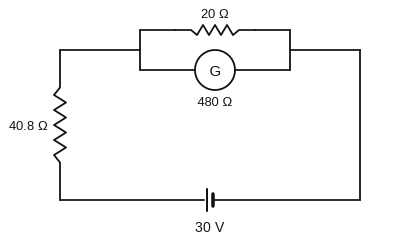
A circuit contains an ammeter, a battery of 30 V and a resistance 40.8 ohm all connected in series. If the ammeter has coil of resistance 480 ohm and a shunt of 20 ohm, the reading in the ammeter will be:
एक परिपथ में एक ऐमीटर, 30 V की एक बैटरी तथा 40.8 ओम का एक प्रतिरोध, सभी श्रेणीक्रम में जुड़े हैं। यदि ऐमीटर की कुंडली का प्रतिरोध 480 ओम तथा शंट 20 ओम का है, तो ऐमीटर का पाठ्यांक होगा:
  1. A1 A
  2. B0.5 A
  3. C0.25 A
  4. D2 A
Show answer

Concept: An ammeter = galvanometer coil with a shunt in parallel; it reads the total current through it.

  1. RA=480×20480+20=19.2 Ω.
  2. I=3040.8+19.2=3060=0.5 A.

Short trick: 40.8 + 19.2 = 60 – the numbers are chosen to give a round total.

Answer: (B) 0.5 A

अवधारणा: ऐमीटर = गैल्वेनोमीटर कुंडली जिसके समांतर शंट जुड़ा है; यह अपने से होकर जाने वाली कुल धारा पढ़ता है।

  1. RA=480×20480+20=19.2 Ω।
  2. I=3040.8+19.2=3060=0.5 A।

शॉर्ट ट्रिक: 40.8 + 19.2 = 60 – संख्याएँ पूर्ण योग देने के लिए चुनी गई हैं।

उत्तर: (B) 0.5 A

NEET UGPhysicsCurrent electricity – ammeter with shunt in a circuitNEET UG 2015 · 25 Jul Shift 1 →