Q2721.
Thermodynamic processes are indicated in the following diagram.
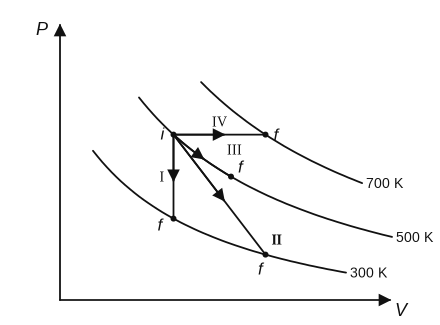
Match the following
Match the following
| Column-1 | Column-2 |
|---|---|
| P. Process I | a. Adiabatic |
| Q. Process II | b. Isobaric |
| R. Process III | c. Isochoric |
| S. Process IV | d. Isothermal |
निम्नलिखित आरेख में ऊष्मागतिक प्रक्रम दर्शाए गए हैं।
निम्नलिखित का मिलान कीजिए
निम्नलिखित का मिलान कीजिए
| स्तम्भ-1 | स्तम्भ-2 |
|---|---|
| P. प्रक्रम I | a. रुद्धोष्म (Adiabatic) |
| Q. प्रक्रम II | b. समदाबी (Isobaric) |
| R. प्रक्रम III | c. समआयतनी (Isochoric) |
| S. प्रक्रम IV | d. समतापी (Isothermal) |
- AP → a, Q → c, R → d, S → b
- BP → c, Q → a, R → d, S → b
- CP → c, Q → d, R → b, S → a
- DP → d, Q → b, R → a, S → c
Show answer
Concept: On a P–V diagram: vertical line = constant V, horizontal line = constant P, along an isotherm = constant T, steeper than an isotherm while crossing to a lower isotherm = adiabatic.
- I: vertical (V constant) → isochoric (c).
- II: steeper than the isotherm, from 500 K to 300 K → adiabatic expansion (a).
- III: stays on the 500 K curve → isothermal (d).
- IV: horizontal (P constant) → isobaric (b).
- P → c, Q → a, R → d, S → b.
Short trick: Only one option starts with P → c and also has Q → a.
Answer: (B) P → c, Q → a, R → d, S → b
अवधारणा: P–V आरेख पर: ऊर्ध्वाधर रेखा = नियत V, क्षैतिज रेखा = नियत P, समतापी वक्र के अनुदिश = नियत T, समतापी से अधिक ढलवाँ तथा निम्न ताप वक्र तक जाने वाला = रुद्धोष्म।
- I: ऊर्ध्वाधर (V नियत) → समआयतनी (c)।
- II: समतापी से अधिक ढलवाँ, 500 K से 300 K तक → रुद्धोष्म प्रसार (a)।
- III: 500 K वक्र पर ही रहता है → समतापी (d)।
- IV: क्षैतिज (P नियत) → समदाबी (b)।
- P → c, Q → a, R → d, S → b।
शॉर्ट ट्रिक: केवल एक विकल्प P → c से शुरू होकर Q → a भी रखता है।
उत्तर: (B) P → c, Q → a, R → d, S → b