Question bank

Q&A: practice questions with answers

Search questions on any topic. Filter by exam category, exam, subject and topic, try the question, then open the answer and explanation.

Courses – airGurukul

53,050 questions in the question bank.

Q2741.
Two blocks A and B of masses 3m and m respectively are connected by a massless and inextensible string. The whole system is suspended by a massless spring as shown in figure. The magnitudes of acceleration of A and B immediately after the string is cut, are respectively
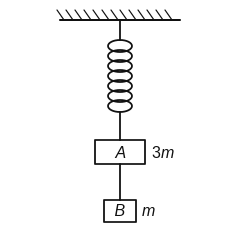
द्रव्यमान क्रमशः 3m तथा m के दो गुटके A तथा B एक द्रव्यमानरहित तथा अवितान्य डोरी से जुड़े हैं। पूरा निकाय चित्रानुसार एक द्रव्यमानरहित स्प्रिंग से लटकाया गया है। डोरी काटने के ठीक बाद A तथा B के त्वरणों के परिमाण क्रमशः हैं
  1. Ag,g3
  2. Bg3,g
  3. Cg, g
  4. Dg3,g3
Show answer

Concept: A spring cannot change its extension instantly, so its force stays the same just after the cut; the string tension drops to zero at once.
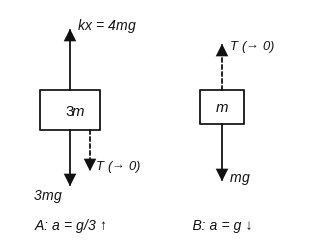
  1. Before the cut (equilibrium of whole system): kx=(3m+m)g=4mg.
  2. After the cut, A: kx−3mg=3maA⇒aA=4mg−3mg3m=g3 (upward).
  3. B: only gravity acts → aB=g (downward, free fall).

Short trick: Spring force = "memory" of the old load (4mg); A feels the extra mg upward → g/3; B just falls freely.

Answer: (B) g3,g

अवधारणा: स्प्रिंग अपना विस्तार तुरन्त नहीं बदल सकती, अतः काटने के ठीक बाद उसका बल वही रहता है; डोरी का तनाव तुरन्त शून्य हो जाता है।

  1. काटने से पहले (पूरे निकाय का साम्य): kx=(3m+m)g=4mg।
  2. काटने के बाद, A: kx−3mg=3maA⇒aA=4mg−3mg3m=g3 (ऊपर की ओर)।
  3. B: केवल गुरुत्व कार्य करता है → aB=g (नीचे की ओर, मुक्त पतन)।

शॉर्ट ट्रिक: स्प्रिंग बल = पुराने भार (4mg) की "स्मृति"; A पर अतिरिक्त mg ऊपर → g/3; B मुक्त रूप से गिरता है।

उत्तर: (B) g3,g
NEET UGPhysicsLaws of motion – spring force just after cutting stringNEET UG 2017 · 7 May Shift 1 →
Q2742.
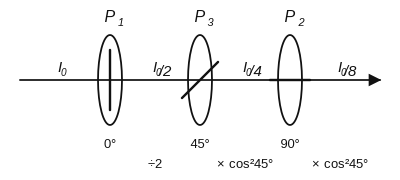
Two Polaroids P1 and P2 are placed with their axis perpendicular to each other. Unpolarised light I0 is incident on P1. A third polaroid P3 is kept in between P1 and P2 such that its axis makes an angle 45° with that of P1. The intensity of transmitted light through P2 is
दो पोलेरॉइड P1 तथा P2 इस प्रकार रखे हैं कि उनके अक्ष परस्पर लम्बवत् हैं। P1 पर अध्रुवित प्रकाश I0 आपतित है। एक तीसरा पोलेरॉइड P3, P1 तथा P2 के बीच इस प्रकार रखा है कि इसका अक्ष P1 के अक्ष से 45° का कोण बनाता है। P2 से पारगमित प्रकाश की तीव्रता है
  1. AI02
  2. BI04
  3. CI08
  4. DI016
Show answer

Concept: First polaroid halves unpolarised light; after that Malus' law I=I′cos2⁡θ applies at each polaroid.

  1. After P1: I02
  2. After P3 (45° to P1): I02cos2⁡45∘=I04
  3. After P2 (45° to P3): I04cos2⁡45∘=I08

Short trick: ½ × ½ × ½ = ⅛. (Without P₃ the crossed pair would give zero.)

Answer: (C) I08

अवधारणा: पहला पोलेरॉइड अध्रुवित प्रकाश को आधा कर देता है; उसके बाद प्रत्येक पोलेरॉइड पर मैलस का नियम I=I′cos2⁡θ लगता है।

  1. P1 के बाद: I02
  2. P3 के बाद (P1 से 45°): I02cos2⁡45∘=I04
  3. P2 के बाद (P3 से 45°): I04cos2⁡45∘=I08

शॉर्ट ट्रिक: ½ × ½ × ½ = ⅛। (P₃ के बिना क्रॉस युग्म शून्य देता।)

उत्तर: (C) I08

NEET UGPhysicsWave optics – polarisation, Malus' lawNEET UG 2017 · 7 May Shift 1 →
Q2743.
A long solenoid of diameter 0.1 m has 2 × 10⁴ turns per meter. At the centre of the solenoid, a coil of 100 turns and radius 0.01 m is placed with its axis coinciding with the solenoid axis. The current in the solenoid reduces at a constant rate to 0 A from 4 A in 0.05 s. If the resistance of the coil is 10π2 Ω, the total charge flowing through the coil during this time is
0.1 m व्यास की एक लम्बी परिनालिका में प्रति मीटर 2 × 10⁴ फेरे हैं। परिनालिका के केन्द्र पर 100 फेरों तथा 0.01 m त्रिज्या की एक कुण्डली इस प्रकार रखी है कि उसका अक्ष परिनालिका के अक्ष के संपाती है। परिनालिका में धारा 0.05 s में 4 A से नियत दर से घटकर 0 A हो जाती है। यदि कुण्डली का प्रतिरोध 10π2 Ω है, तो इस समय में कुण्डली से प्रवाहित कुल आवेश है
  1. A32π μC
  2. B16 μC
  3. C32 μC
  4. D16π μC
Show answer

Concept: Induced charge depends only on the total flux change: Q=NΔϕR (time 0.05 s is not needed).

  1. Field inside solenoid: B=μ0nI; flux through one turn of the small coil: ϕ=μ0nIπr2.
  2. Δϕ=4π×10−7×2×104×4×π(0.01)2=3.2π2×10⁻⁶ Wb
  3. Q=NΔϕR=100×3.2π2×10−610π2=32×10−6 C =32 μC

Short trick: The π² in R is there to cancel π (from μ₀) × π (from area) → answer has no π: only 16 μC or 32 μC can survive.

Answer: (C) 32 μC

अवधारणा: प्रेरित आवेश केवल कुल फ्लक्स परिवर्तन पर निर्भर करता है: Q=NΔϕR (समय 0.05 s की आवश्यकता नहीं)।

  1. परिनालिका के भीतर क्षेत्र: B=μ0nI; छोटी कुण्डली के एक फेरे से फ्लक्स: ϕ=μ0nIπr2।
  2. Δϕ=4π×10−7×2×104×4×π(0.01)2=3.2π2×10⁻⁶ Wb
  3. Q=NΔϕR=100×3.2π2×10−610π2=32×10−6 C =32 μC

शॉर्ट ट्रिक: R में π², π (μ₀ से) × π (क्षेत्रफल से) को काटने के लिए है → उत्तर में π नहीं: केवल 16 μC या 32 μC बच सकते हैं।

उत्तर: (C) 32 μC

NEET UGPhysicsElectromagnetic induction – charge flow due to flux changeNEET UG 2017 · 7 May Shift 1 →
Q2744.
Two discs of same moment of inertia rotating about their regular axis passing through centre and perpendicular to the plane of disc with angular velocities ω1 and ω2. They are brought into contact face to face coinciding the axis of rotation. The expression for loss of energy during this process is
समान जड़त्व आघूर्ण वाली दो डिस्क, केन्द्र से गुजरने वाले तथा डिस्क के तल के लम्बवत् अपने नियमित अक्ष के परितः कोणीय वेगों ω1 तथा ω2 से घूर्णन कर रही हैं। इन्हें घूर्णन अक्ष संपाती रखते हुए आमने-सामने संपर्क में लाया जाता है। इस प्रक्रम में ऊर्जा ह्रास का व्यंजक है
  1. A12I(ω1+ω2)2
  2. B14I(ω1−ω2)2
  3. CI(ω1−ω2)2
  4. DI8(ω1−ω2)2
Show answer

Concept: No external torque → angular momentum conserved; the discs end with a common ω (like a perfectly inelastic collision).

  1. Iω1+Iω2=2Iω⇒ω=ω1+ω22
  2. Ki=12I(ω12+ω22), Kf=12(2I)ω2=I4(ω1+ω2)2
  3. ΔK=Ki−Kf=I4(ω1−ω2)2

Short trick: Loss = ½ · (I₁I₂/(I₁+I₂)) · (ω₁ – ω₂)²; with I₁ = I₂ = I, reduced inertia = I/2 → ¼ I(ω₁ – ω₂)². Loss must vanish when ω₁ = ω₂, which rules out (A).

Answer: (B) 14I(ω1−ω2)2

अवधारणा: कोई बाह्य बल-आघूर्ण नहीं → कोणीय संवेग संरक्षित; डिस्कें अंत में एक उभयनिष्ठ ω से घूमती हैं (पूर्णतः अप्रत्यास्थ संघट्ट की तरह)।

  1. Iω1+Iω2=2Iω⇒ω=ω1+ω22
  2. Ki=12I(ω12+ω22), Kf=12(2I)ω2=I4(ω1+ω2)2
  3. ΔK=Ki−Kf=I4(ω1−ω2)2

शॉर्ट ट्रिक: ह्रास = ½ · (I₁I₂/(I₁+I₂)) · (ω₁ – ω₂)²; I₁ = I₂ = I पर समानीत जड़त्व = I/2 → ¼ I(ω₁ – ω₂)²। ω₁ = ω₂ होने पर ह्रास शून्य होना चाहिए, इससे (A) बाहर।

उत्तर: (B) 14I(ω1−ω2)2

NEET UGPhysicsRotational motion – energy loss when discs coupleNEET UG 2017 · 7 May Shift 1 →
Q2745.
Preeti reached the metro station and found that the escalator was not working. She walked up the stationary escalator in time t1. On other days, if she remains stationary on the moving escalator, then the escalator takes her up in time t2. The time taken by her to walk up on the moving escalator will be
प्रीति मेट्रो स्टेशन पहुँची तथा उसने पाया कि एस्केलेटर कार्य नहीं कर रहा था। वह स्थिर एस्केलेटर पर समय t1 में चलकर ऊपर पहुँची। अन्य दिनों में, यदि वह गतिमान एस्केलेटर पर स्थिर खड़ी रहती है, तो एस्केलेटर उसे समय t2 में ऊपर ले जाता है। गतिमान एस्केलेटर पर चलकर ऊपर जाने में उसके द्वारा लिया गया समय होगा
  1. At1+t22
  2. Bt1t2t2−t1
  3. Ct1t2t2+t1
  4. Dt1−t2
Show answer

Concept: Velocities add: v=vwalk+vesc, with vwalk=dt1, vesc=dt2.

  1. dt=dt1+dt2
  2. 1t=1t1+1t2⇒t=t1t2t1+t2

Short trick: Like resistors in parallel: t must be less than both t₁ and t₂ – only (C) always is.

Answer: (C) t1t2t2+t1

अवधारणा: वेग जुड़ते हैं: v=vwalk+vesc, जहाँ vwalk=dt1, vesc=dt2।

  1. dt=dt1+dt2
  2. 1t=1t1+1t2⇒t=t1t2t1+t2

शॉर्ट ट्रिक: समांतर प्रतिरोधों की तरह: t, t₁ तथा t₂ दोनों से कम होना चाहिए – केवल (C) सदैव ऐसा है।

उत्तर: (C) t1t2t2+t1

NEET UGPhysicsMotion in a straight line – relative velocity (escalator)NEET UG 2017 · 7 May Shift 1 →
Q2746.
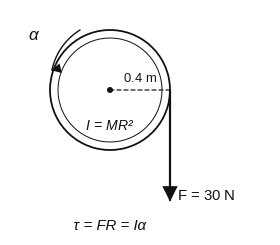
A rope is wound around a hollow cylinder of mass 3 kg and radius 40 cm. What is the angular acceleration of the cylinder if the rope is pulled with a force of 30 N?
3 kg द्रव्यमान तथा 40 cm त्रिज्या के एक खोखले बेलन पर एक रस्सी लिपटी है। यदि रस्सी को 30 N बल से खींचा जाए, तो बेलन का कोणीय त्वरण क्या है?
  1. A25 m/s2
  2. B0.25 rad/s2
  3. C25 rad/s2
  4. D5 m/s2
Show answer

Concept: τ=Iα with τ=FR and, for a hollow cylinder about its axis, I=MR2.

  1. τ=30×0.4=12 N m
  2. I=3×(0.4)2=0.48 kg m²
  3. α=120.48=25 rad/s²

Short trick: α = F/(MR) = 30/(3 × 0.4) = 25; and angular acceleration must be in rad/s² – (A), (D) have wrong units.

Answer: (C) 25 rad/s2

अवधारणा: τ=Iα जहाँ τ=FR तथा खोखले बेलन के लिए उसके अक्ष के परितः I=MR2।

  1. τ=30×0.4=12 N m
  2. I=3×(0.4)2=0.48 kg m²
  3. α=120.48=25 rad/s²

शॉर्ट ट्रिक: α = F/(MR) = 30/(3 × 0.4) = 25; तथा कोणीय त्वरण rad/s² में होना चाहिए – (A), (D) के मात्रक गलत हैं।

उत्तर: (C) 25 rad/s2

NEET UGPhysicsRotational motion – torque on a hollow cylinderNEET UG 2017 · 7 May Shift 1 →
Q2747.
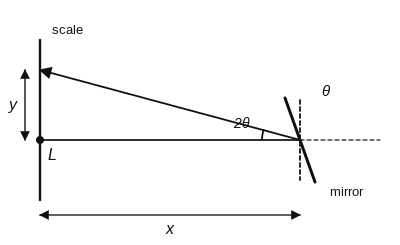
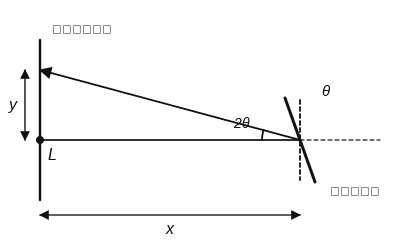
A beam of light from a source L is incident normally on a plane mirror fixed at a certain distance x from the source. The beam is reflected back as a spot on a scale placed just above the source L. When the mirror is rotated through a small angle θ, the spot of the light is found to move through a distance y on the scale. The angle θ is given by
एक स्रोत L से प्रकाश का एक पुंज, स्रोत से एक निश्चित दूरी x पर स्थिर एक समतल दर्पण पर अभिलम्बवत् आपतित होता है। पुंज परावर्तित होकर स्रोत L के ठीक ऊपर रखे एक पैमाने पर एक धब्बे (spot) के रूप में लौटता है। जब दर्पण को एक छोटे कोण θ से घुमाया जाता है, तो प्रकाश का धब्बा पैमाने पर दूरी y से विस्थापित होता पाया जाता है। कोण θ दिया जाता है
  1. Ay2x
  2. Byx
  3. Cx2y
  4. Dxy
Show answer

Concept: Rotating a mirror by θ (fixed incident ray) rotates the reflected ray by 2θ.

  1. Reflected ray turns by 2θ and travels distance x back to the scale.
  2. Small angle: 2θ≈yx
  3. θ=y2x

Short trick: Mirror θ → ray 2θ; spot shift y = x·2θ.

Answer: (A) y2x

अवधारणा: आपतित किरण स्थिर रहते हुए दर्पण को θ घुमाने पर परावर्तित किरण 2θ घूम जाती है।

  1. परावर्तित किरण 2θ घूमती है तथा पैमाने तक x दूरी तय करती है।
  2. छोटे कोण के लिए: 2θ≈yx
  3. θ=y2x

शॉर्ट ट्रिक: दर्पण θ → किरण 2θ; धब्बे का विस्थापन y = x·2θ।

उत्तर: (A) y2x

NEET UGPhysicsRay optics – rotation of plane mirrorNEET UG 2017 · 7 May Shift 1 →
Q2748.
The two nearest harmonics of a tube closed at one end and open at other end are 220 Hz and 260 Hz. What is the fundamental frequency of the system?
एक सिरे पर बंद तथा दूसरे सिरे पर खुली एक नली के दो निकटतम संनादी 220 Hz तथा 260 Hz हैं। निकाय की मूल आवृत्ति क्या है?
  1. A10 Hz
  2. B20 Hz
  3. C30 Hz
  4. D40 Hz
Show answer

Concept: A closed pipe has only odd harmonics f0,3f0,5f0,…; neighbouring ones differ by 2f0.

  1. 260−220=40=2f0⇒f0=20 Hz
  2. Check: 220 = 11 × 20 and 260 = 13 × 20 – consecutive odd multiples ✓

Short trick: Closed pipe: f₀ = (difference of successive harmonics)/2. 40 Hz (D) would be the open-pipe answer.

Answer: (B) 20 Hz

अवधारणा: बंद पाइप में केवल विषम संनादी f0,3f0,5f0,… होते हैं; निकटवर्ती संनादियों में 2f0 का अंतर होता है।

  1. 260−220=40=2f0⇒f0=20 Hz
  2. जाँच: 220 = 11 × 20 तथा 260 = 13 × 20 – क्रमागत विषम गुणज ✓

शॉर्ट ट्रिक: बंद पाइप: f₀ = (क्रमागत संनादियों का अंतर)/2। 40 Hz (D) खुले पाइप का उत्तर होता।

उत्तर: (B) 20 Hz

NEET UGPhysicsWaves – closed organ pipe harmonicsNEET UG 2017 · 7 May Shift 1 →
Q2749.
A thin prism having refracting angle 10° is made of glass of refractive index 1.42. This prism is combined with another thin prism of glass of refractive index 1.7. This combination produces dispersion without deviation. The refracting angle of second prism should be
10° अपवर्तक कोण वाला एक पतला प्रिज़्म 1.42 अपवर्तनांक वाले काँच से बना है। इस प्रिज़्म को 1.7 अपवर्तनांक वाले काँच के एक अन्य पतले प्रिज़्म के साथ संयोजित किया जाता है। यह संयोजन विचलन रहित वर्ण-विक्षेपण उत्पन्न करता है। दूसरे प्रिज़्म का अपवर्तक कोण होना चाहिए
  1. A4°
  2. B6°
  3. C8°
  4. D10°
Show answer

Concept: Thin prism deviation δ=(μ−1)A; no net deviation → the two deviations are equal and opposite.

  1. (μ1−1)A1=(μ2−1)A2
  2. (1.42−1)×10∘=(1.7−1)A2⇒4.2=0.7A2
  3. A2=6∘

Short trick: Higher-μ prism needs a smaller angle: 10° × 0.42/0.70 = 6°.

Answer: (B) 6°

अवधारणा: पतले प्रिज़्म का विचलन δ=(μ−1)A; कुल विचलन शून्य → दोनों विचलन बराबर तथा विपरीत।

  1. (μ1−1)A1=(μ2−1)A2
  2. (1.42−1)×10∘=(1.7−1)A2⇒4.2=0.7A2
  3. A2=6∘

शॉर्ट ट्रिक: अधिक μ वाले प्रिज़्म को छोटा कोण चाहिए: 10° × 0.42/0.70 = 6°।

उत्तर: (B) 6°

NEET UGPhysicsRay optics – dispersion without deviationNEET UG 2017 · 7 May Shift 1 →
Q2750.
The resistance of a wire is 'R' ohm. If it is melted and stretched to 'n' times its original length, its new resistance will be
एक तार का प्रतिरोध 'R' ओम है। यदि इसे पिघलाकर इसकी मूल लम्बाई के 'n' गुना तक खींचा जाए, तो इसका नया प्रतिरोध होगा
  1. AnR
  2. BRn
  3. Cn2R
  4. DRn2
Show answer

Concept: Volume is constant on recasting: Al = constant, so R=ρlA=ρl2V∝l2.

  1. Length becomes nl, area becomes A/n.
  2. R′=ρ(nl)A/n=n2ρlA=n2R

Short trick: Stretch n times → R × n² (length ×n and area ÷n).

Answer: (C) n2R

अवधारणा: पुनः ढालने पर आयतन नियत रहता है: Al = नियत, अतः R=ρlA=ρl2V∝l2।

  1. लम्बाई nl हो जाती है, क्षेत्रफल A/n।
  2. R′=ρ(nl)A/n=n2ρlA=n2R

शॉर्ट ट्रिक: n गुना खींचने पर → R × n² (लम्बाई ×n तथा क्षेत्रफल ÷n)।

उत्तर: (C) n2R

NEET UGPhysicsCurrent electricity – resistance on stretchingNEET UG 2017 · 7 May Shift 1 →
Q2751.
With respect to the conformers of ethane, which of the following statements is true?
एथेन के संरूपणों (conformers) के संबंध में, निम्नलिखित में से कौन-सा कथन सत्य है?
  1. ABond angle remains same but bond length changesआबंध कोण समान रहता है परन्तु आबंध लम्बाई बदलती है
  2. BBond angle changes but bond length remains sameआबंध कोण बदलता है परन्तु आबंध लम्बाई समान रहती है
  3. CBoth bond angle and bond length changeआबंध कोण तथा आबंध लम्बाई दोनों बदलते हैं
  4. DBoth bond angles and bond length remains sameआबंध कोण तथा आबंध लम्बाई दोनों समान रहते हैं
Show answer

Concept: Conformers arise only by rotation about the C–C σ bond; rotation changes only the dihedral (torsional) angle.

  1. Rotation about C–C does not stretch or bend any bond, so all C–H and C–C bond lengths stay the same.
  2. All H–C–H and H–C–C bond angles (≈109.5°) also stay the same.
  3. Only the dihedral angle (0° eclipsed → 60° staggered) and the torsional energy change.
  4. Hence (A), (B), (C) are wrong; (D) is true.

Short trick: Conformers = same bonds, same angles, only a different "twist" (dihedral angle).

Answer: (D)

अवधारणा: संरूपण केवल C–C σ आबंध के चारों ओर घूर्णन से बनते हैं; घूर्णन से केवल द्विफलकी (dihedral/मरोड़) कोण बदलता है।

  1. C–C के चारों ओर घूर्णन से कोई आबंध खिंचता या मुड़ता नहीं, अतः सभी C–H तथा C–C आबंध लम्बाइयाँ समान रहती हैं।
  2. सभी H–C–H तथा H–C–C आबंध कोण (≈109.5°) भी समान रहते हैं।
  3. केवल द्विफलकी कोण (0° ग्रसित → 60° सांतरित) तथा मरोड़ी ऊर्जा बदलती है।
  4. अतः (A), (B), (C) गलत हैं; (D) सत्य है।

शॉर्ट ट्रिक: संरूपण = वही आबंध, वही कोण, केवल अलग "घुमाव" (द्विफलकी कोण)।

उत्तर: (D)

NEET UGChemistryOrganic chemistry – conformations of ethaneNEET UG 2017 · 7 May Shift 1 →
Q2752.
Which of the following pairs of compounds is isoelectronic and isostructural?
निम्नलिखित में से यौगिकों का कौन-सा युग्म समइलेक्ट्रॉनिक (isoelectronic) तथा समसंरचनात्मक (isostructural) है?
  1. ABeCl2, XeF2
  2. BTeI2, XeF2
  3. CIBr2–, XeF2
  4. DIF3, XeF2
Show answer

Concept: Count valence electrons and apply VSEPR: same electron count + same shape = isoelectronic and isostructural.

  1. XeF2: 8 + 2×7 = 22 valence e–; Xe has 2 bp + 3 lp (sp3d) → linear.
  2. IBr2–: 7 + 2×7 + 1 = 22 valence e–; I has 2 bp + 3 lp → linear. Matches XeF2.
  3. (A) BeCl2: 2 + 14 = 16 e– (linear but not isoelectronic).
  4. (B) TeI2: 6 + 14 = 20 e–, 2 bp + 2 lp → bent.
  5. (D) IF3: 7 + 21 = 28 e–, T-shaped.

Short trick: Trihalide-type ions XY2– of halogens (I3–, IBr2–, ICl2–) are all linear, exactly like XeF2.

Answer: (C)

अवधारणा: संयोजकता इलेक्ट्रॉन गिनिए और VSEPR लगाइए: समान इलेक्ट्रॉन संख्या + समान आकृति = समइलेक्ट्रॉनिक तथा समसंरचनात्मक।

  1. XeF2: 8 + 2×7 = 22 संयोजकता e–; Xe पर 2 bp + 3 lp (sp3d) → रैखिक।
  2. IBr2–: 7 + 2×7 + 1 = 22 संयोजकता e–; I पर 2 bp + 3 lp → रैखिक। XeF2 से मेल खाता है।
  3. (A) BeCl2: 2 + 14 = 16 e– (रैखिक, परन्तु समइलेक्ट्रॉनिक नहीं)।
  4. (B) TeI2: 6 + 14 = 20 e–, 2 bp + 2 lp → कोणीय (bent)।
  5. (D) IF3: 7 + 21 = 28 e–, T-आकृति।

शॉर्ट ट्रिक: हैलोजनों के XY2– प्रकार के आयन (I3–, IBr2–, ICl2–) सभी XeF2 की भाँति रैखिक होते हैं।

उत्तर: (C)

NEET UGChemistryChemical bonding – VSEPR, isoelectronic & isostructural speciesNEET UG 2017 · 7 May Shift 1 →
Q2753.
HgCl2 and I2 both when dissolved in water containing I– ions the pair of species formed is
HgCl2 तथा I2 दोनों को I– आयन युक्त जल में घोलने पर बनने वाली स्पीशीज़ का युग्म है
  1. AHgI2, I3–
  2. BHgI2, I–
  3. CHgI42–, I3–
  4. DHg2I2, I–
Show answer

Concept: Excess I– converts Hg2+ into the soluble tetraiodomercurate(II) complex and I2 into the triiodide ion.

  1. HgCl2 + 2I– → HgI2↓ (red) + 2Cl–
  2. HgI2 + 2I– → [HgI4]2– (soluble; very large formation constant)
  3. I2 + I– ⇌ I3– (this is why I2 dissolves in KI solution)
  4. So the species present are HgI42– and I3–. HgI2 does not survive in excess I–; Hg2I2 needs Hg(I), which is absent.

Short trick: Same chemistry as Nessler's reagent K2[HgI4]: red HgI2 dissolves in excess KI; and I2 + KI → KI3.

Answer: (C)

अवधारणा: आधिक्य I–, Hg2+ को विलेय टेट्राआयोडोमर्क्यूरेट(II) संकुल में तथा I2 को ट्राइआयोडाइड आयन में बदल देता है।

  1. HgCl2 + 2I– → HgI2↓ (लाल) + 2Cl–
  2. HgI2 + 2I– → [HgI4]2– (विलेय; विरचन स्थिरांक बहुत अधिक)
  3. I2 + I– ⇌ I3– (इसी कारण I2, KI विलयन में घुल जाता है)
  4. अतः उपस्थित स्पीशीज़ HgI42– तथा I3– हैं। आधिक्य I– में HgI2 नहीं बचता; Hg2I2 के लिए Hg(I) चाहिए, जो अनुपस्थित है।

शॉर्ट ट्रिक: नेसलर अभिकर्मक K2[HgI4] वाला ही रसायन: लाल HgI2 आधिक्य KI में घुल जाता है; तथा I2 + KI → KI3।

उत्तर: (C)

NEET UGChemistryp-block / d-block – complex formation with iodideNEET UG 2017 · 7 May Shift 1 →
Q2754.
Mixture of chloroxylenol and terpineol acts as
क्लोरोज़ाइलेनॉल तथा टर्पिनिऑल का मिश्रण किस रूप में कार्य करता है?
  1. AAnalgesicपीड़ाहारी (Analgesic)
  2. BAntisepticपूतिरोधी (Antiseptic)
  3. CAntipyreticज्वरनाशी (Antipyretic)
  4. DAntibioticप्रतिजैविक (Antibiotic)
Show answer

Concept: NCERT: Dettol, a common antiseptic, is a mixture of chloroxylenol and terpineol.

  1. Chloroxylenol + terpineol = Dettol, applied on wounds/skin → antiseptic.
  2. (A) Analgesics (aspirin, morphine) relieve pain.
  3. (C) Antipyretics (paracetamol) lower fever.
  4. (D) Antibiotics (penicillin) are produced by microbes and kill/inhibit bacteria inside the body.

Short trick: "Dettol = Chloroxylenol + Terpineol" – Dettol is applied on living tissue (wounds) → antiseptic; disinfectants are for floors/drains, antibiotics act inside the body.

Answer: (B)

अवधारणा: NCERT: डेटॉल, एक सामान्य पूतिरोधी, क्लोरोज़ाइलेनॉल तथा टर्पिनिऑल का मिश्रण है।

  1. क्लोरोज़ाइलेनॉल + टर्पिनिऑल = डेटॉल, घाव/त्वचा पर लगाया जाता है → पूतिरोधी।
  2. (A) पीड़ाहारी (ऐस्पिरिन, मॉर्फीन) दर्द दूर करते हैं।
  3. (C) ज्वरनाशी (पैरासिटामॉल) बुखार कम करते हैं।
  4. (D) प्रतिजैविक (पेनिसिलिन) सूक्ष्मजीवों से बनते हैं और शरीर के अंदर जीवाणुओं को नष्ट/निरुद्ध करते हैं।

शॉर्ट ट्रिक: "डेटॉल = क्लोरोज़ाइलेनॉल + टर्पिनिऑल" – डेटॉल जीवित ऊतकों (घावों) पर लगाया जाता है → पूतिरोधी; विसंक्रामी फर्श/नालियों के लिए होते हैं, प्रतिजैविक शरीर के अंदर कार्य करते हैं।

उत्तर: (B)

NEET UGChemistryChemistry in everyday life – antisepticsNEET UG 2017 · 7 May Shift 1 →
Q2755.
Which is the incorrect statement?
कौन-सा कथन गलत है?
  1. AFeO0.98 has non stoichiometric metal deficiency defectFeO0.98 में अरससमीकरणमितीय (non-stoichiometric) धातु न्यूनता दोष होता है
  2. BDensity decreases in case of crystals with Schottky's defectशॉट्की दोष वाले क्रिस्टलों में घनत्व घटता है
  3. CNaCl(s) is insulator, silicon is semiconductor, silver is conductor, quartz is piezo electric crystalNaCl(s) विद्युतरोधी है, सिलिकॉन अर्धचालक है, सिल्वर चालक है, क्वार्ट्ज़ दाब-विद्युत (piezo electric) क्रिस्टल है
  4. DFrenkel defect is favoured in those ionic compounds in which sizes of cation and anions are almost equalफ्रेंकेल दोष उन आयनिक यौगिकों में अनुकूल होता है जिनमें धनायन तथा ऋणायन के आकार लगभग समान होते हैं
Show answer

Concept: Frenkel defect needs a small cation that can slip into interstitial sites (large size difference between cation and anion). Non-stoichiometric ferrous oxide (wüstite) is iron-deficient, FexO with x < 1 (about Fe0.93–0.96O).

  1. (D) is incorrect: Frenkel defect is favoured when the cation is much smaller than the anion (ZnS, AgCl, AgBr); ions of almost equal size favour the Schottky defect (NaCl, KCl, CsCl).
  2. (A) refers to non-stoichiometric ferrous oxide, which has less iron than the ideal 1 : 1 ratio (some Fe2+ missing, charge balanced by Fe3+) – a metal deficiency defect, so it is taken as a correct statement.
  3. (B) correct: in a Schottky defect equal numbers of cations and anions leave the lattice → mass per unit volume, i.e. density, decreases.
  4. (C) correct: NaCl is an insulator, Si a semiconductor, Ag a conductor and quartz a piezoelectric crystal.

Short trick: Schottky = "Same size, Subtract ions" (density ↓); Frenkel = "Far-different size, Fits into voids" (density same). Any statement pairing Frenkel with "equal size" is wrong.

Answer: (D) Frenkel defect is favoured in those ionic compounds in which sizes of cation and anions are almost equal

अवधारणा: फ्रेंकेल दोष के लिए छोटा धनायन चाहिए जो अंतराकाशी स्थलों में खिसक सके (धनायन तथा ऋणायन के आकार में बड़ा अंतर)। अरससमीकरणमितीय फेरस ऑक्साइड (वुस्टाइट) में आयरन कम होता है, FexO जहाँ x < 1 (लगभग Fe0.93–0.96O)।

  1. (D) गलत है: फ्रेंकेल दोष तब अनुकूल होता है जब धनायन, ऋणायन से बहुत छोटा हो (ZnS, AgCl, AgBr); लगभग समान आकार वाले आयन शॉट्की दोष के अनुकूल होते हैं (NaCl, KCl, CsCl)।
  2. (A) अरससमीकरणमितीय फेरस ऑक्साइड की बात करता है, जिसमें आदर्श 1 : 1 अनुपात से कम आयरन होता है (कुछ Fe2+ अनुपस्थित, आवेश Fe3+ द्वारा संतुलित) – यह धातु न्यूनता दोष है, अतः इसे सही कथन माना जाता है।
  3. (B) सही: शॉट्की दोष में समान संख्या में धनायन तथा ऋणायन जालक से हट जाते हैं → प्रति इकाई आयतन द्रव्यमान अर्थात् घनत्व घटता है।
  4. (C) सही: NaCl विद्युतरोधी, Si अर्धचालक, Ag चालक तथा क्वार्ट्ज़ दाब-विद्युत (piezoelectric) क्रिस्टल है।

शॉर्ट ट्रिक: शॉट्की = "समान आकार, आयन घटे" (घनत्व ↓); फ्रेंकेल = "आकार में बड़ा अंतर, आयन रिक्ति में खिसके" (घनत्व समान)। जो कथन फ्रेंकेल को "समान आकार" से जोड़े, वह गलत है।

उत्तर: (D) फ्रेंकेल दोष उन आयनिक यौगिकों में अनुकूल होता है जिनमें धनायन तथा ऋणायन के आकार लगभग समान होते हैं

NEET UGChemistrySolid state – point defectsNEET UG 2017 · 7 May Shift 1 →
Q2756.
Concentration of the Ag+ ions in a saturated solution of Ag2C2O4 is 2.2 × 10⁻⁴ mol L–1. Solubility product of Ag2C2O4 is
Ag2C2O4 के संतृप्त विलयन में Ag+ आयनों की सांद्रता 2.2 × 10⁻⁴ mol L–1 है। Ag2C2O4 का विलेयता गुणनफल है
  1. A2.42 × 10–8
  2. B2.66 × 10–12
  3. C4.5 × 10–11
  4. D5.3 × 10–12
Show answer

Concept: Ag2C2O4(s) ⇌ 2Ag+ + C2O42–; Ksp = [Ag+]2[C2O42–].

  1. [Ag+] = 2s = 2.2 × 10⁻⁴ M ⇒ [C2O42–] = s = 1.1 × 10⁻⁴ M
  2. Ksp = (2.2 × 10⁻⁴)2 × (1.1 × 10–4) = 4.84 × 10–8 × 1.1 × 10–4
  3. Ksp = 5.324 × 10⁻¹² ≈ 5.3 × 10⁻¹²

Short trick: Ksp = 4s3 with s = 1.1 × 10⁻⁴: 4 × 1.331 × 10–12 = 5.32 × 10⁻¹².

Answer: (D)

अवधारणा: Ag2C2O4(s) ⇌ 2Ag+ + C2O42–; Ksp = [Ag+]2[C2O42–]।

  1. [Ag+] = 2s = 2.2 × 10⁻⁴ M ⇒ [C2O42–] = s = 1.1 × 10⁻⁴ M
  2. Ksp = (2.2 × 10⁻⁴)2 × (1.1 × 10–4) = 4.84 × 10–8 × 1.1 × 10–4
  3. Ksp = 5.324 × 10⁻¹² ≈ 5.3 × 10⁻¹²

शॉर्ट ट्रिक: Ksp = 4s3, s = 1.1 × 10⁻⁴: 4 × 1.331 × 10–12 = 5.32 × 10⁻¹²।

उत्तर: (D)

NEET UGChemistryIonic equilibrium – solubility productNEET UG 2017 · 7 May Shift 1 →
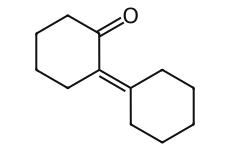
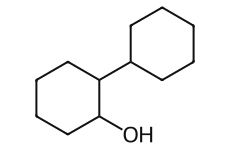
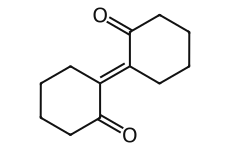
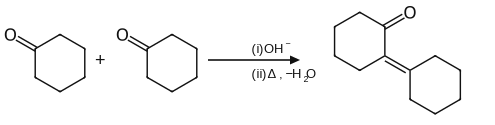
Q2757.
Of the following, which is the product formed when cyclohexanone undergoes aldol condensation followed by heating?
निम्नलिखित में से, साइक्लोहेक्सेनॉन के ऐल्डोल संघनन के पश्चात् गर्म करने पर बनने वाला उत्पाद कौन-सा है?
  1. A
  2. B
  3. C
  4. D
Show answer

Concept: Aldol: the α-carbanion of one ketone adds to the C=O of another → β-hydroxy ketone; on heating it loses H2O → α,β-unsaturated ketone.

  1. OH– removes an α-H of cyclohexanone → enolate.
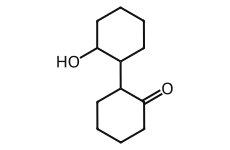
  2. Enolate attacks C=O of a second cyclohexanone → 2-(1-hydroxycyclohexyl)cyclohexanone (aldol, OH on the ring carbon that was the C=O).
  3. Heating removes H2O between that OH and the α-H → C=C conjugated with C=O: 2-cyclohexylidenecyclohexanone = (B).
  4. (A)/(C): still contain OH (not dehydrated) and (C) has lost the C=O; (D) has two C=O groups – impossible, one C=O is consumed in aldol.

Short trick: Aldol condensation of 2 RCOR′ → one C=O remains + new C=C at the α,β-position (−H2O). Look for exactly one C=O conjugated with a C=C.

Answer: (B)

अवधारणा: ऐल्डोल: एक कीटोन का α-कार्बऋणायन दूसरे के C=O पर जुड़ता है → β-हाइड्रॉक्सी कीटोन; गर्म करने पर H2O निकलता है → α,β-असंतृप्त कीटोन।

  1. OH– साइक्लोहेक्सेनॉन का एक α-H हटाता है → ईनोलेट।
  2. ईनोलेट दूसरे साइक्लोहेक्सेनॉन के C=O पर आक्रमण करता है → 2-(1-हाइड्रॉक्सीसाइक्लोहेक्सिल)साइक्लोहेक्सेनॉन (ऐल्डोल; OH उस वलय-कार्बन पर जो पहले C=O था)।
  3. गर्म करने पर उस OH तथा α-H के बीच से H2O निकलता है → C=O के साथ संयुग्मित C=C: 2-साइक्लोहेक्सिलिडीनसाइक्लोहेक्सेनॉन = (B)।
  4. (A)/(C): अभी भी OH है (निर्जलीकरण नहीं हुआ) तथा (C) में C=O ही नहीं है; (D) में दो C=O हैं – असंभव, ऐल्डोल में एक C=O उपयोग हो जाता है।

शॉर्ट ट्रिक: 2 RCOR′ का ऐल्डोल संघनन → एक C=O बचता है + α,β-स्थिति पर नया C=C (−H2O)। ठीक एक C=O जो C=C से संयुग्मित हो, ढूँढिए।

उत्तर: (B)

NEET UGChemistryAldehydes & ketones – aldol condensationNEET UG 2017 · 7 May Shift 1 →
Q2758.
The species, having bond angles of 120° is
120° आबंध कोण वाली स्पीशीज़ है
  1. APH3
  2. BClF3
  3. CNCl3
  4. DBCl3
Show answer

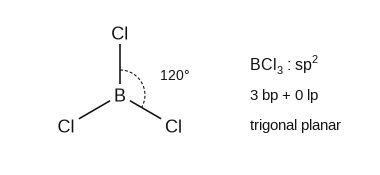
Concept: 120° angles occur in trigonal planar AX3 molecules (sp2, no lone pair).

  1. BCl3: B has 3 bond pairs, 0 lone pair → sp2, trigonal planar, Cl–B–Cl = 120°.
  2. (A) PH3: 3 bp + 1 lp, almost pure p-orbitals → ≈ 93.5°.
  3. (B) ClF3: 3 bp + 2 lp → T-shaped, ≈ 87.5°.
  4. (C) NCl3: 3 bp + 1 lp → pyramidal, ≈ 107°.

Short trick: AX3 with no lone pair on the central atom (BF3, BCl3, SO3, CO32–) → 120°.

Answer: (D)

अवधारणा: 120° कोण त्रिकोणीय समतलीय AX3 अणुओं (sp2, कोई एकाकी युग्म नहीं) में होते हैं।

  1. BCl3: B पर 3 आबंधी युग्म, 0 एकाकी युग्म → sp2, त्रिकोणीय समतलीय, Cl–B–Cl = 120°।
  2. (A) PH3: 3 bp + 1 lp, लगभग शुद्ध p-कक्षक → ≈ 93.5°।
  3. (B) ClF3: 3 bp + 2 lp → T-आकृति, ≈ 87.5°।
  4. (C) NCl3: 3 bp + 1 lp → पिरामिडी, ≈ 107°।

शॉर्ट ट्रिक: केन्द्रीय परमाणु पर कोई एकाकी युग्म न हो ऐसे AX3 (BF3, BCl3, SO3, CO32–) → 120°।

उत्तर: (D)

NEET UGChemistryChemical bonding – VSEPR bond anglesNEET UG 2017 · 7 May Shift 1 →
Q2759.
If molality of the dilute solution is doubled, the value of molal depression constant (Kf) will be
यदि तनु विलयन की मोललता दोगुनी कर दी जाए, तो मोलल अवनमन स्थिरांक (Kf) का मान होगा
  1. ADoubledदोगुना
  2. BHalvedआधा
  3. CTripledतिगुना
  4. DUnchangedअपरिवर्तित
Show answer

Concept: ΔTf = Kf m. Kf = RTf2Msolvent/(1000 ΔfusH) depends only on the solvent.

  1. Doubling m doubles ΔTf, not Kf.
  2. Kf is a property of the solvent (e.g. 1.86 K kg mol–1 for water), independent of the solute and its molality.
  3. So Kf remains unchanged; (A), (B), (C) wrongly treat a constant as a variable.

Short trick: Kf, Kb = "solvent's fingerprint" – change only if the solvent changes.

Answer: (D)

अवधारणा: ΔTf = Kf m। Kf = RTf2Mविलायक/(1000 ΔfusH) केवल विलायक पर निर्भर करता है।

  1. m दोगुना करने पर ΔTf दोगुना होता है, Kf नहीं।
  2. Kf विलायक का गुण है (जैसे जल के लिए 1.86 K kg mol–1), विलेय तथा उसकी मोललता से स्वतंत्र।
  3. अतः Kf अपरिवर्तित रहता है; (A), (B), (C) एक स्थिरांक को चर मान लेते हैं।

शॉर्ट ट्रिक: Kf, Kb = "विलायक की पहचान" – केवल विलायक बदलने पर बदलते हैं।

उत्तर: (D)

NEET UGChemistrySolutions – depression in freezing point (K<sub>f</sub>)NEET UG 2017 · 7 May Shift 1 →
Q2760.
Which one is the most acidic compound?
कौन-सा यौगिक सर्वाधिक अम्लीय है?
  1. A
  2. B
  3. C
  4. D
Show answer

Concept: Electron-withdrawing groups (–NO2: –I, –R) at o/p positions stabilise the phenoxide ion and increase acidity; electron-donating groups (–CH3) decrease it.

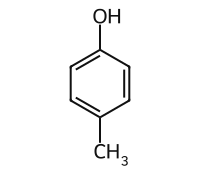
  1. p-Cresol (A): CH3 (+I, hyperconjugation) destabilises phenoxide → least acidic (pKa ≈ 10.2).
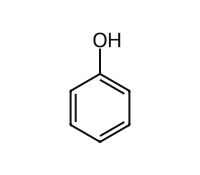
  2. Phenol (B): pKa ≈ 10.0.
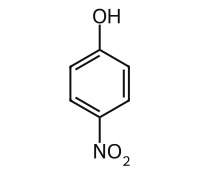
  3. p-Nitrophenol (C): one NO2 → pKa ≈ 7.1.
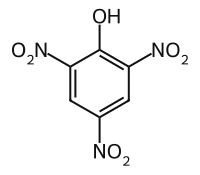
  4. 2,4,6-Trinitrophenol, picric acid (D): three NO2 at o, o, p → pKa ≈ 0.4, strongest acid.

Short trick: More NO2 groups at ortho/para = more acidic; picric acid is even more acidic than acetic acid.

Answer: (D)

अवधारणा: o/p स्थितियों पर इलेक्ट्रॉन-आकर्षी समूह (–NO2: –I, –R) फ़ीनॉक्साइड आयन को स्थायी करके अम्लता बढ़ाते हैं; इलेक्ट्रॉन-दाता समूह (–CH3) उसे घटाते हैं।

  1. p-क्रिसॉल (A): CH3 (+I, अतिसंयुग्मन) फ़ीनॉक्साइड को अस्थायी करता है → सबसे कम अम्लीय (pKa ≈ 10.2)।
  2. फ़ीनॉल (B): pKa ≈ 10.0।
  3. p-नाइट्रोफ़ीनॉल (C): एक NO2 → pKa ≈ 7.1।
  4. 2,4,6-ट्राइनाइट्रोफ़ीनॉल, पिक्रिक अम्ल (D): o, o, p पर तीन NO2 → pKa ≈ 0.4, सबसे प्रबल अम्ल।

शॉर्ट ट्रिक: ऑर्थो/पैरा पर जितने अधिक NO2, उतना अधिक अम्लीय; पिक्रिक अम्ल तो ऐसीटिक अम्ल से भी अधिक अम्लीय है।

उत्तर: (D)

NEET UGChemistryAlcohols, phenols – acidity of phenolsNEET UG 2017 · 7 May Shift 1 →