Question bank

Q&A: practice questions with answers

Search questions on any topic. Filter by exam category, exam, subject and topic, try the question, then open the answer and explanation.

Courses – airGurukul

53,050 questions in the question bank.

Q3141.
Given van der Waals constant for NH3, H2, O2 and CO2 are respectively 4.17, 0.244, 1.36 and 3.59, which one of the following gases is most easily liquefied?
NH3, H2, O2 और CO2 के वान्डरवाल्स स्थिरांक क्रमशः 4.17, 0.244, 1.36 और 3.59 दिए गए हैं, निम्नलिखित में से कौन-सी गैस सबसे आसानी से द्रवित होगी?
  1. AO2
  2. BH2
  3. CNH3
  4. DCO2
Show answer

Concept: van der Waals constant a measures intermolecular attraction; larger a ⇒ stronger attraction ⇒ higher critical temperature (Tc = 8a/27Rb) ⇒ easier liquefaction.

  1. a values: NH3 4.17 > CO2 3.59 > O2 1.36 > H2 0.244.
  2. Largest a ⇒ NH3 (also H-bonded) is most easily liquefied; H2 is the hardest.

Short trick: Liquefaction ease ∝ a (∝ Tc). Pick the biggest a.

Answer: (C)

अवधारणा: वान्डरवाल्स स्थिरांक a अंतराअणुक आकर्षण का माप है; अधिक a ⇒ प्रबल आकर्षण ⇒ उच्च क्रांतिक ताप (Tc = 8a/27Rb) ⇒ आसान द्रवण।

  1. a के मान: NH3 4.17 > CO2 3.59 > O2 1.36 > H2 0.244।
  2. सबसे अधिक a ⇒ NH3 (H-आबंधित भी) सबसे आसानी से द्रवित होती है; H2 सबसे कठिन।

शॉर्ट ट्रिक: द्रवण की सरलता ∝ a (∝ Tc)। सबसे बड़ा a चुनें।

उत्तर: (C)
NEET UGChemistryStates of matter – van der Waals constant aNEET UG 2018 · 6 May Shift 1 →
Q3142.
The solubility of BaSO4 in water is 2.42 × 10⁻³ gL–1 at 298 K. The value of its solubility product (Ksp) will be
(Given molar mass of BaSO4 = 233 g mol–1)
298 K पर जल में BaSO4 की विलेयता 2.42 × 10⁻³ gL–1 है। इसके विलेयता गुणनफल (Ksp) का मान होगा
(दिया है BaSO4 का मोलर द्रव्यमान = 233 g mol–1)
  1. A1.08 × 10–14 mol2L–2
  2. B1.08 × 10–12 mol2L–2
  3. C1.08 × 10–10 mol2L–2
  4. D1.08 × 10–8 mol2L–2
Show answer

Concept: For an AB-type salt, BaSO4(s) ⇌ Ba2+ + SO42–; Ksp = s2 (s in mol L–1).

  1. s = (2.42 × 10⁻³ g L–1) / (233 g mol–1) = 1.04 × 10⁻⁵ mol L–1
  2. Ksp = s2 = (1.04 × 10⁻⁵)2 = 1.08 × 10⁻¹⁰ mol2 L–2

Short trick: s ≈ 10–5 ⇒ Ksp ≈ 10–10; the mantissa 1.08 is common to all options, so only the power matters.

Answer: (C) 1.08 × 10⁻¹⁰ mol2 L–2

अवधारणा: AB प्रकार के लवण के लिए, BaSO4(s) ⇌ Ba2+ + SO42–; Ksp = s2 (s, mol L–1 में)।

  1. s = (2.42 × 10⁻³ g L–1) / (233 g mol–1) = 1.04 × 10⁻⁵ mol L–1
  2. Ksp = s2 = (1.04 × 10⁻⁵)2 = 1.08 × 10⁻¹⁰ mol2 L–2

शॉर्ट ट्रिक: s ≈ 10–5 ⇒ Ksp ≈ 10–10; 1.08 सभी विकल्पों में समान है, अतः केवल घातांक देखें।

उत्तर: (C) 1.08 × 10⁻¹⁰ mol2 L–2

NEET UGChemistryIonic equilibrium – solubility productNEET UG 2018 · 6 May Shift 1 →
Q3143.
In which case is number of molecules of water maximum?
किस स्थिति में जल के अणुओं की संख्या अधिकतम है?
  1. A0.00224 L of water vapours at 1 atm and 273 K1 atm और 273 K पर 0.00224 L जलवाष्प
  2. B0.18 g of water0.18 g जल
  3. C18 mL of water18 mL जल
  4. D10–3 mol of water10–3 mol जल
Show answer

Concept: Number of molecules = moles × NA; compare moles.

  1. (A) At STP 22.4 L = 1 mol ⇒ 0.00224/22.4 = 10–4 mol.
  2. (B) 0.18/18 = 10–2 mol.
  3. (C) 18 mL water (density 1 g mL–1) = 18 g = 1 mol ⇒ NA molecules (maximum).
  4. (D) 10–3 mol.

Short trick: Liquid water is ~1000 times denser than vapour – 18 mL of liquid is a full mole.

Answer: (C)

अवधारणा: अणुओं की संख्या = मोल × NA; मोलों की तुलना करें।

  1. (A) STP पर 22.4 L = 1 mol ⇒ 0.00224/22.4 = 10–4 mol।
  2. (B) 0.18/18 = 10–2 mol।
  3. (C) 18 mL जल (घनत्व 1 g mL–1) = 18 g = 1 mol ⇒ NA अणु (अधिकतम)।
  4. (D) 10–3 mol।

शॉर्ट ट्रिक: द्रव जल, वाष्प से लगभग 1000 गुना सघन है – 18 mL द्रव पूरा एक मोल है।

उत्तर: (C)

NEET UGChemistrySome basic concepts – mole conceptNEET UG 2018 · 6 May Shift 1 →
Q3144.
The correct difference between first and second order reactions is that
प्रथम और द्वितीय कोटि की अभिक्रियाओं के बीच सही अंतर यह है कि
  1. AA first-order reaction can catalyzed; a second-order reaction cannot be catalyzedप्रथम कोटि की अभिक्रिया उत्प्रेरित हो सकती है; द्वितीय कोटि की अभिक्रिया उत्प्रेरित नहीं हो सकती
  2. BThe half-life of a first-order reaction does not depend on [A]0; the half-life of a second-order reaction does depend on [A]0प्रथम कोटि की अभिक्रिया का अर्धायु काल [A]0 पर निर्भर नहीं करता; द्वितीय कोटि की अभिक्रिया का अर्धायु काल [A]0 पर निर्भर करता है
  3. CThe rate of a first-order reaction does not depend on reactant concentrations; the rate of a second-order reaction does depend on reactant concentrationsप्रथम कोटि की अभिक्रिया का वेग अभिकारक सांद्रताओं पर निर्भर नहीं करता; द्वितीय कोटि की अभिक्रिया का वेग अभिकारक सांद्रताओं पर निर्भर करता है
  4. DThe rate of a first-order reaction does depend on reactant concentrations; the rate of a second-order reaction does not depend on reactant concentrationsप्रथम कोटि की अभिक्रिया का वेग अभिकारक सांद्रताओं पर निर्भर करता है; द्वितीय कोटि की अभिक्रिया का वेग अभिकारक सांद्रताओं पर निर्भर नहीं करता
Show answer

Concept: Half-life: first order t1/2=0.693k (independent of [A]0); second order t1/2=1k[A]0 (depends on [A]0).

  1. (B) is exactly this difference ✔.
  2. (A) – reactions of any order can be catalysed ✘.
  3. (C), (D) – rates of both first-order (r = k[A]) and second-order (r = k[A]2) reactions depend on concentration ✘; only zero-order rate is concentration-independent.

Short trick: General rule: t1/2 ∝ [A]01−n ⇒ n = 1 gives no dependence; n = 2 gives t1/2 ∝ 1/[A]0.

Answer: (B)

अवधारणा: अर्धायु: प्रथम कोटि t1/2=0.693k ([A]0 से स्वतंत्र); द्वितीय कोटि t1/2=1k[A]0 ([A]0 पर निर्भर)।

  1. (B) ठीक यही अंतर है ✔।
  2. (A) – किसी भी कोटि की अभिक्रिया उत्प्रेरित हो सकती है ✘।
  3. (C), (D) – प्रथम कोटि (r = k[A]) और द्वितीय कोटि (r = k[A]2) दोनों के वेग सांद्रता पर निर्भर करते हैं ✘; केवल शून्य कोटि का वेग सांद्रता से स्वतंत्र होता है।

शॉर्ट ट्रिक: सामान्य नियम: t1/2 ∝ [A]01−n ⇒ n = 1 पर कोई निर्भरता नहीं; n = 2 पर t1/2 ∝ 1/[A]0।

उत्तर: (B)

NEET UGChemistryChemical kinetics – first vs second orderNEET UG 2018 · 6 May Shift 1 →
Q3145.
Among CaH2, BeH2, BaH2, the order of ionic character is
CaH2, BeH2, BaH2 में आयनिक गुण का क्रम है
  1. ABeH2 < BaH2 < CaH2
  2. BCaH2 < BeH2 < BaH2
  3. CBeH2 < CaH2 < BaH2
  4. DBaH2 < BeH2 < CaH2
Show answer

Concept: Down group 2, the cation gets larger and more electropositive (less polarising, Fajans rule) ⇒ hydrides become more ionic.

  1. BeH2: tiny Be2+, covalent polymeric hydride – least ionic.
  2. CaH2 is ionic (saline); BaH2, with the largest, most electropositive Ba, is the most ionic.
  3. Order: BeH2 < CaH2 < BaH2.

Short trick: Same anion, bigger cation ⇒ more ionic. Follow the group order Be → Ca → Ba.

Answer: (C)

अवधारणा: वर्ग 2 में नीचे जाने पर धनायन बड़ा और अधिक विद्युत-धनात्मक (कम ध्रुवणकारी, फ़ायान्स नियम) होता है ⇒ हाइड्राइड अधिक आयनिक होते जाते हैं।

  1. BeH2: अत्यंत छोटा Be2+, सहसंयोजी बहुलकी हाइड्राइड – न्यूनतम आयनिक।
  2. CaH2 आयनिक (लवणीय) है; BaH2 सबसे बड़े, सबसे विद्युत-धनात्मक Ba के कारण सर्वाधिक आयनिक है।
  3. क्रम: BeH2 < CaH2 < BaH2।

शॉर्ट ट्रिक: ऋणायन समान, धनायन बड़ा ⇒ अधिक आयनिक। वर्ग का क्रम Be → Ca → Ba अपनाएँ।

उत्तर: (C)

NEET UGChemistrys-Block – ionic character of hydridesNEET UG 2018 · 6 May Shift 1 →
Q3146.
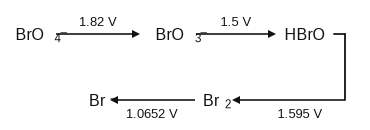
Consider the change in oxidation state of Bromine corresponding to different emf values as shown in the diagram below :

Then the species undergoing disproportionation is
नीचे दिए गए आरेख में विभिन्न emf मानों के संगत ब्रोमीन की ऑक्सीकरण अवस्था में परिवर्तन पर विचार कीजिए :

तब असमानुपातन (disproportionation) करने वाली स्पीशीज़ है
  1. ABr2
  2. BBrO4–
  3. CBrO3–
  4. DHBrO
Show answer

Concept: In a Latimer diagram a species disproportionates if E° on its right (its reduction) is greater than E° on its left (reduction of the species above it), i.e. E°cell = E°right − E°left > 0.

  1. HBrO: right E°(HBrO/Br2) = 1.595 V; left E°(BrO3–/HBrO) = 1.5 V.
  2. For 5HBrO → 2Br2 + BrO3– (+ H+, H2O): E°cell = 1.595 − 1.5 = +0.095 V > 0 ⇒ ΔG° < 0 ⇒ spontaneous ✔.
  3. Br2: E°(Br2/Br–) = 1.0652 V < E°(HBrO/Br2) = 1.595 V ⇒ E°cell = −0.53 V ⇒ no disproportionation.
  4. BrO3–: right 1.5 V < left 1.82 V ⇒ E°cell = −0.32 V ✘. BrO4– is the highest state – it cannot be oxidised further ✘.

Short trick: Scan the diagram: whenever "E° to the right > E° to the left", the middle species is unstable. Only HBrO (1.595 > 1.5) fits.

Answer: (D)

अवधारणा: लैटिमर आरेख में कोई स्पीशीज़ तब असमानुपातित होती है जब उसके दाईं ओर का E° (उसका अपचयन) उसके बाईं ओर के E° (ऊपर वाली स्पीशीज़ का अपचयन) से अधिक हो, अर्थात् E°cell = E°दायाँ − E°बायाँ > 0।

  1. HBrO: दायाँ E°(HBrO/Br2) = 1.595 V; बायाँ E°(BrO3–/HBrO) = 1.5 V।
  2. 5HBrO → 2Br2 + BrO3– (+ H+, H2O) के लिए: E°cell = 1.595 − 1.5 = +0.095 V > 0 ⇒ ΔG° < 0 ⇒ स्वतः प्रवर्तित ✔।
  3. Br2: E°(Br2/Br–) = 1.0652 V < E°(HBrO/Br2) = 1.595 V ⇒ E°cell = −0.53 V ⇒ असमानुपातन नहीं।
  4. BrO3–: दायाँ 1.5 V < बायाँ 1.82 V ⇒ E°cell = −0.32 V ✘। BrO4– उच्चतम अवस्था है – इसका आगे ऑक्सीकरण संभव नहीं ✘।

शॉर्ट ट्रिक: आरेख में देखें: जहाँ "दाईं ओर का E° > बाईं ओर का E°" हो, बीच की स्पीशीज़ अस्थायी है। केवल HBrO (1.595 > 1.5) पर यह लागू होता है।

उत्तर: (D)

NEET UGChemistryElectrochemistry – Latimer diagram and disproportionationNEET UG 2018 · 6 May Shift 1 →
Q3147.
For the redox reaction
MnO4– + C2O42– + H+ → Mn2+ + CO2 + H2O
The correct coefficients of the reactants for the balanced equation are
अपचयोपचय अभिक्रिया
MnO4– + C2O42– + H+ → Mn2+ + CO2 + H2O
के संतुलित समीकरण में अभिकारकों के सही गुणांक हैं
  1. AMnO4– : 2, C2O42– : 16, H+ : 5
  2. BMnO4– : 2, C2O42– : 5, H+ : 16
  3. CMnO4– : 16, C2O42– : 5, H+ : 2
  4. DMnO4– : 5, C2O42– : 16, H+ : 2
Show answer

Concept: Electrons lost = electrons gained; balance O with H2O and H with H+.

  1. Mn: +7 → +2, gains 5 e– per MnO4–.
  2. C: +3 → +4; C2O42– → 2CO2 loses 2 e–.
  3. LCM 10 ⇒ 2MnO4– + 5C2O42–.
  4. O: 8 on Mn side become 8H2O ⇒ need 16H+: 2MnO4– + 5C2O42– + 16H+ → 2Mn2+ + 10CO2 + 8H2O.
  5. Charge check: −2 −10 +16 = +4 = 2 × (+2) ✔.

Short trick: Permanganate–oxalate in acid is always 2 : 5 : 16 – memorise it.

Answer: (B)

अवधारणा: खोए इलेक्ट्रॉन = प्राप्त इलेक्ट्रॉन; O को H2O से और H को H+ से संतुलित करें।

  1. Mn: +7 → +2, प्रति MnO4– 5 e– ग्रहण।
  2. C: +3 → +4; C2O42– → 2CO2 में 2 e– त्याग।
  3. LCM 10 ⇒ 2MnO4– + 5C2O42–।
  4. O: Mn ओर के 8 O, 8H2O बनाते हैं ⇒ 16H+ चाहिए: 2MnO4– + 5C2O42– + 16H+ → 2Mn2+ + 10CO2 + 8H2O।
  5. आवेश जाँच: −2 −10 +16 = +4 = 2 × (+2) ✔।

शॉर्ट ट्रिक: अम्लीय माध्यम में परमैंगनेट–ऑक्सैलेट सदैव 2 : 5 : 16 – इसे याद रखें।

उत्तर: (B)

NEET UGChemistryRedox reactions – balancing by ion-electron methodNEET UG 2018 · 6 May Shift 1 →
Q3148.
Which one of the following conditions will favour maximum formation of the product in the reaction,
A2(g) + B2(g) ⇌ X2(g)   ΔrH = –X kJ?
अभिक्रिया
A2(g) + B2(g) ⇌ X2(g)   ΔrH = –X kJ
में उत्पाद के अधिकतम निर्माण के लिए निम्नलिखित में से कौन-सी परिस्थिति अनुकूल होगी?
  1. AHigh temperature and high pressureउच्च ताप और उच्च दाब
  2. BLow temperature and low pressureनिम्न ताप और निम्न दाब
  3. CLow temperature and high pressureनिम्न ताप और उच्च दाब
  4. DHigh temperature and low pressureउच्च ताप और निम्न दाब
Show answer

Concept: Le Chatelier: the equilibrium shifts to oppose the change imposed.

  1. Δng = 1 − 2 = −1 (fewer gas moles on product side) ⇒ high pressure favours the forward reaction.
  2. ΔH negative (exothermic) ⇒ low temperature favours the forward reaction.
  3. Hence low temperature and high pressure.

Short trick: Exothermic + volume-decreasing (like Haber process) ⇒ "low T, high P".

Answer: (C)

अवधारणा: ला-शातालिए: साम्य उस दिशा में खिसकता है जो लगाए गए परिवर्तन का विरोध करे।

  1. Δng = 1 − 2 = −1 (उत्पाद पक्ष में गैस के कम मोल) ⇒ उच्च दाब अग्र अभिक्रिया के अनुकूल।
  2. ΔH ऋणात्मक (ऊष्माक्षेपी) ⇒ निम्न ताप अग्र अभिक्रिया के अनुकूल।
  3. अतः निम्न ताप और उच्च दाब।

शॉर्ट ट्रिक: ऊष्माक्षेपी + आयतन घटाने वाली अभिक्रिया (हाबर प्रक्रम जैसी) ⇒ "निम्न T, उच्च P"।

उत्तर: (C)

NEET UGChemistryChemical equilibrium – Le Chatelier principleNEET UG 2018 · 6 May Shift 1 →
Q3149.
When initial concentration of the reactant is doubled, the half-life period of a zero order reaction
जब अभिकारक की प्रारंभिक सांद्रता दोगुनी की जाती है, तो शून्य कोटि की अभिक्रिया का अर्धायु काल
  1. AIs tripledतीन गुना हो जाता है
  2. BIs doubledदोगुना हो जाता है
  3. CIs halvedआधा हो जाता है
  4. DRemains unchangedअपरिवर्तित रहता है
Show answer

Concept: Zero order: [A] = [A]0 − kt ⇒ t1/2=[A]02k, directly proportional to [A]0.

  1. [A]0 → 2[A]0 ⇒ t1/2 → 2 t1/2.

Short trick: t1/2 ∝ [A]01−n; n = 0 ⇒ t1/2 ∝ [A]0.

Answer: (B)

अवधारणा: शून्य कोटि: [A] = [A]0 − kt ⇒ t1/2=[A]02k, जो [A]0 के समानुपाती है।

  1. [A]0 → 2[A]0 ⇒ t1/2 → 2 t1/2।

शॉर्ट ट्रिक: t1/2 ∝ [A]01−n; n = 0 ⇒ t1/2 ∝ [A]0।

उत्तर: (B)

NEET UGChemistryChemical kinetics – zero-order half-lifeNEET UG 2018 · 6 May Shift 1 →
Q3150.
The bond dissociation energies of X2, Y2 and XY are in the ratio of 1 : 0.5 : 1. ΔH for the formation of XY is –200 kJ mol–1. The bond dissociation energy of X2 will be
X2, Y2 और XY की आबंध वियोजन ऊर्जाएँ 1 : 0.5 : 1 के अनुपात में हैं। XY के निर्माण के लिए ΔH, –200 kJ mol–1 है। X2 की आबंध वियोजन ऊर्जा होगी
  1. A800 kJ mol–1
  2. B100 kJ mol–1
  3. C200 kJ mol–1
  4. D400 kJ mol–1
Show answer

Concept: ΔrH = Σ BE(bonds broken) − Σ BE(bonds formed).

  1. Formation of 1 mol XY: ½X2(g) + ½Y2(g) → XY(g).
  2. Let BE(X2) = a ⇒ BE(Y2) = 0.5a, BE(XY) = a.
  3. ΔH = ½a + ½(0.5a) − a = −a/4 = −200 ⇒ a = 800 kJ mol–1.

Short trick: Do not forget the ½ coefficients – using whole moles would wrongly give 400.

Answer: (A) 800 kJ mol–1

अवधारणा: ΔrH = Σ आबंध ऊर्जा (टूटे आबंध) − Σ आबंध ऊर्जा (बने आबंध)।

  1. 1 mol XY का निर्माण: ½X2(g) + ½Y2(g) → XY(g)।
  2. माना BE(X2) = a ⇒ BE(Y2) = 0.5a, BE(XY) = a।
  3. ΔH = ½a + ½(0.5a) − a = −a/4 = −200 ⇒ a = 800 kJ mol–1।

शॉर्ट ट्रिक: ½ गुणांक न भूलें – पूरे मोल लेने पर गलत उत्तर 400 आएगा।

उत्तर: (A) 800 kJ mol–1

NEET UGChemistryThermodynamics – bond enthalpyNEET UG 2018 · 6 May Shift 1 →
Q3151.
The correction factor ‘a’ to the ideal gas equation corresponds to
आदर्श गैस समीकरण में संशोधन गुणक ‘a’ संबंधित है
  1. AElectric field present between the gas moleculesगैस अणुओं के बीच उपस्थित विद्युत क्षेत्र से
  2. BVolume of the gas moleculesगैस अणुओं के आयतन से
  3. CDensity of the gas moleculesगैस अणुओं के घनत्व से
  4. DForces of attraction between the gas moleculesगैस अणुओं के बीच आकर्षण बलों से
Show answer

Concept: van der Waals equation: (P+an2V2)(V−nb)=nRT.

  1. The term an2/V2 corrects pressure for intermolecular attraction (molecules hit the wall with less force) ⇒ a ↔ attractive forces ✔.
  2. b corrects for the finite volume of molecules (B) ✘.
  3. (A), (C) are not represented by a ✘.

Short trick: "a" = attraction, "b" = bulk (volume).

Answer: (D)

अवधारणा: वान्डरवाल्स समीकरण: (P+an2V2)(V−nb)=nRT।

  1. पद an2/V2 अंतराअणुक आकर्षण के लिए दाब का संशोधन है (अणु दीवार से कम बल से टकराते हैं) ⇒ a ↔ आकर्षण बल ✔।
  2. b अणुओं के परिमित आयतन का संशोधन है (B) ✘।
  3. (A), (C) को a व्यक्त नहीं करता ✘।

शॉर्ट ट्रिक: "a" = attraction (आकर्षण), "b" = bulk (आयतन)।

उत्तर: (D)

NEET UGChemistryStates of matter – van der Waals equationNEET UG 2018 · 6 May Shift 1 →
Q3152.
Consider the following species :
CN+, CN–, NO and CN
Which one of these will have the highest bond order?
निम्नलिखित स्पीशीज़ पर विचार कीजिए :
CN+, CN–, NO और CN
इनमें से किसकी आबंध कोटि सर्वाधिक होगी?
  1. ACN+
  2. BCN–
  3. CNO
  4. DCN
Show answer

Concept: Bond order = (Nb − Na)/2. For 14 electrons (N2-like) the B.O. is maximum = 3; removing or adding electrons around 14 lowers it.

  1. CN–: 6 + 7 + 1 = 14 e– (isoelectronic with N2) ⇒ B.O. = (10 − 4)/2 = 3.
  2. CN: 13 e– ⇒ B.O. = (9 − 4)/2 = 2.5.
  3. CN+: 12 e– ⇒ B.O. = (8 − 4)/2 = 2.
  4. NO: 15 e– (one in π*) ⇒ B.O. = (10 − 5)/2 = 2.5.

Short trick: 14 electrons = triple bond (N2, CO, CN–, NO+, C22–) – highest B.O. among second-period diatomics.

Answer: (B)

अवधारणा: आबंध कोटि = (Nb − Na)/2। 14 इलेक्ट्रॉनों (N2 जैसे) पर आबंध कोटि अधिकतम = 3 होती है; 14 से कम या अधिक इलेक्ट्रॉन होने पर यह घटती है।

  1. CN–: 6 + 7 + 1 = 14 e– (N2 का समइलेक्ट्रॉनी) ⇒ आबंध कोटि = (10 − 4)/2 = 3।
  2. CN: 13 e– ⇒ आबंध कोटि = (9 − 4)/2 = 2.5।
  3. CN+: 12 e– ⇒ आबंध कोटि = (8 − 4)/2 = 2।
  4. NO: 15 e– (एक π* में) ⇒ आबंध कोटि = (10 − 5)/2 = 2.5।

शॉर्ट ट्रिक: 14 इलेक्ट्रॉन = त्रि-आबंध (N2, CO, CN–, NO+, C22–) – द्वितीय आवर्त के द्विपरमाणुकों में सर्वाधिक आबंध कोटि।

उत्तर: (B)

NEET UGChemistryChemical bonding – MOT bond orderNEET UG 2018 · 6 May Shift 1 →
Q3153.
Magnesium reacts with an element (X) to form an ionic compound. If the ground state electronic configuration of (X) is 1s2 2s2 2p3, the simplest formula for this compound is
मैग्नीशियम एक तत्व (X) से अभिक्रिया करके आयनिक यौगिक बनाता है। यदि (X) का मूल अवस्था इलेक्ट्रॉनिक विन्यास 1s2 2s2 2p3 है, तो इस यौगिक का सरलतम सूत्र है
  1. AMg2X
  2. BMgX2
  3. CMg2X3
  4. DMg3X2
Show answer

Concept: Ions combine in the ratio that makes total charge zero (criss-cross of valencies).

  1. X = 1s22s22p3 = nitrogen; it gains 3 e– ⇒ X3– (N3–).
  2. Mg loses 2 e– ⇒ Mg2+.
  3. Charge balance: 3(+2) + 2(−3) = 0 ⇒ Mg3X2 (magnesium nitride, Mg3N2).

Short trick: Burning Mg in air gives MgO and Mg3N2 – the formula is worth remembering directly.

Answer: (D)

अवधारणा: आयन उस अनुपात में संयोग करते हैं जिससे कुल आवेश शून्य हो (संयोजकताओं का आड़ा-गुणन)।

  1. X = 1s22s22p3 = नाइट्रोजन; यह 3 e– ग्रहण करता है ⇒ X3– (N3–)।
  2. Mg, 2 e– त्यागता है ⇒ Mg2+।
  3. आवेश संतुलन: 3(+2) + 2(−3) = 0 ⇒ Mg3X2 (मैग्नीशियम नाइट्राइड, Mg3N2)।

शॉर्ट ट्रिक: वायु में Mg जलाने पर MgO और Mg3N2 बनते हैं – यह सूत्र सीधे याद रखने योग्य है।

उत्तर: (D)

NEET UGChemistryChemical bonding – ionic compound formulaNEET UG 2018 · 6 May Shift 1 →
Q3154.
Iron exhibits bcc structure at room temperature. Above 900°C, it transforms to fcc structure. The ratio of density of iron at room temperature to that at 900°C (assuming molar mass and atomic radii of iron remains constant with temperature) is
कमरे के ताप पर आयरन bcc संरचना दर्शाता है। 900°C से ऊपर यह fcc संरचना में परिवर्तित हो जाता है। कमरे के ताप पर आयरन के घनत्व का 900°C पर घनत्व से अनुपात है (मान लीजिए कि आयरन का मोलर द्रव्यमान और परमाणु त्रिज्या ताप के साथ स्थिर रहते हैं)
  1. A3342
  2. B4332
  3. C32
  4. D12
Show answer

Concept: Density d=ZMNAa3; bcc: Z = 2, a=4r3; fcc: Z = 4, a=22r.

  1. dbccdfcc=ZbccZfcc(afccabcc)3=24(22r⋅34r)3
  2. =12(62)3=12⋅668=368≈0.919
  3. 3342=368 ✔ (less than 1, as bcc, 68 % packing, is less dense than fcc, 74 % packing).

Short trick: Same r ⇒ density ratio = packing-fraction ratio = 0.68/0.74 ≈ 0.92; only (A) ≈ 0.92 (B ≈ 1.63, C ≈ 1.22, D = 0.5).

Answer: (A)

अवधारणा: घनत्व d=ZMNAa3; bcc: Z = 2, a=4r3; fcc: Z = 4, a=22r।

  1. dbccdfcc=ZbccZfcc(afccabcc)3=24(22r⋅34r)3
  2. =12(62)3=12⋅668=368≈0.919
  3. 3342=368 ✔ (1 से कम, क्योंकि bcc (68 % संकुलन) fcc (74 % संकुलन) से कम सघन है)।

शॉर्ट ट्रिक: r समान ⇒ घनत्व अनुपात = संकुलन-अंश अनुपात = 0.68/0.74 ≈ 0.92; केवल (A) ≈ 0.92 (B ≈ 1.63, C ≈ 1.22, D = 0.5)।

उत्तर: (A)

NEET UGChemistrySolid state – density of bcc and fccNEET UG 2018 · 6 May Shift 1 →
Q3155.
Which one is a wrong statement?
कौन-सा कथन गलत है?
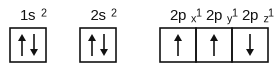
  1. AThe electronic configuration of N atom is
    N परमाणु का इलेक्ट्रॉनिक विन्यास है
  2. BAn orbital is designated by three quantum numbers while an electron in an atom is designated by four quantum numbersएक कक्षक को तीन क्वांटम संख्याओं द्वारा निर्दिष्ट किया जाता है जबकि परमाणु में एक इलेक्ट्रॉन को चार क्वांटम संख्याओं द्वारा
  3. CTotal orbital angular momentum of electron in 's' orbital is equal to zero's' कक्षक में इलेक्ट्रॉन का कुल कक्षीय कोणीय संवेग शून्य होता है
  4. DThe value of m for dz2 is zerodz2 के लिए m का मान शून्य है
Show answer

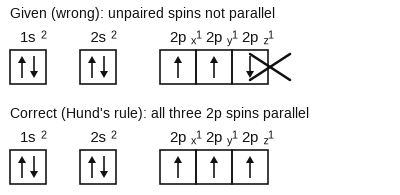
Concept: Hund's rule: in degenerate orbitals electrons first occupy singly with parallel spins before pairing.

  1. (A) shows 2px1↑ 2py1↑ 2pz1↓ – the three unpaired spins are not parallel ⇒ violates Hund's rule ⇒ wrong statement ✔.
  2. (B) n, l, m fix an orbital; the spin s adds the fourth for an electron – true.
  3. (C) For s, l = 0 ⇒ orbital angular momentum l(l+1)h2π=0 – true.
  4. (D) dz2 corresponds to m = 0 – true.

Short trick: For p3, all three arrows must point the same way (↑↑↑ or ↓↓↓) – any mix is wrong.

Answer: (A)

अवधारणा: हुंड नियम: समभ्रंश (degenerate) कक्षकों में युग्मन से पहले इलेक्ट्रॉन एक-एक करके समान्तर प्रचक्रण के साथ भरते हैं।

  1. (A) में 2px1↑ 2py1↑ 2pz1↓ दिखाया है – तीनों अयुग्मित प्रचक्रण समान्तर नहीं हैं ⇒ हुंड नियम का उल्लंघन ⇒ गलत कथन ✔।
  2. (B) n, l, m से कक्षक निर्धारित होता है; इलेक्ट्रॉन के लिए चौथी प्रचक्रण संख्या s जुड़ती है – सत्य।
  3. (C) s के लिए l = 0 ⇒ कक्षीय कोणीय संवेग l(l+1)h2π=0 – सत्य।
  4. (D) dz2 के लिए m = 0 – सत्य।

शॉर्ट ट्रिक: p3 में तीनों तीर एक ही दिशा में होने चाहिए (↑↑↑ या ↓↓↓) – कोई भी मिश्रण गलत है।

उत्तर: (A)

NEET UGChemistryStructure of atom – quantum numbers and Hund's ruleNEET UG 2018 · 6 May Shift 1 →
Q3156.
Oxygen is not produced during photosynthesis by
निम्नलिखित में से किसके द्वारा प्रकाश-संश्लेषण के दौरान ऑक्सीजन उत्पन्न नहीं होती?
  1. ACycas
  2. BNostoc
  3. CGreen sulphur bacteriaहरे सल्फर जीवाणु
  4. DChara
Show answer

Concept: O2 in photosynthesis comes from splitting of water. Organisms that do not use H2O as the electron (hydrogen) donor do not release O2 (anoxygenic photosynthesis).

  1. Green sulphur bacteria use H2S as the hydrogen donor: CO2 + 2H2S → [CH2O] + H2O + 2S – sulphur, not oxygen, is released.
  2. (A) Cycas – gymnosperm, splits water → releases O2.
  3. (B) Nostoc – cyanobacterium with PS II, oxygenic.
  4. (D) Chara – green alga, oxygenic.

Short trick: Van Niel: purple & green sulphur bacteria give out S, not O2. Cyanobacteria are the only oxygen-releasing prokaryotes.

Answer: (C) Green sulphur bacteria

अवधारणा: प्रकाश-संश्लेषण में O2 जल के विघटन से आती है। जो जीव H2O को इलेक्ट्रॉन (हाइड्रोजन) दाता के रूप में प्रयोग नहीं करते, वे O2 नहीं छोड़ते (अनॉक्सीजनी प्रकाश-संश्लेषण)।

  1. हरे सल्फर जीवाणु हाइड्रोजन दाता के रूप में H2S का प्रयोग करते हैं: CO2 + 2H2S → [CH2O] + H2O + 2S – ऑक्सीजन नहीं, सल्फर मुक्त होता है।
  2. (A) Cycas – अनावृतबीजी, जल का विघटन करता है → O2 मुक्त करता है।
  3. (B) Nostoc – PS II युक्त सायनोबैक्टीरिया, ऑक्सीजनी।
  4. (D) Chara – हरा शैवाल, ऑक्सीजनी।

शॉर्ट ट्रिक: वान नील: बैंगनी व हरे सल्फर जीवाणु O2 नहीं, S छोड़ते हैं। सायनोबैक्टीरिया ही ऑक्सीजन छोड़ने वाले प्रोकैरियोट हैं।

उत्तर: (C) हरे सल्फर जीवाणु

NEET UGBiologyPhotosynthesis – anoxygenic photosynthesisNEET UG 2018 · 6 May Shift 1 →
Q3157.
Double fertilization is
द्विनिषेचन है
  1. AFusion of two male gametes with one eggएक अंड के साथ दो नर युग्मकों का संलयन
  2. BFusion of one male gamete with two polar nucleiदो ध्रुवीय केंद्रकों के साथ एक नर युग्मक का संलयन
  3. CFusion of two male gametes of a pollen tube with two different eggsएक पराग नलिका के दो नर युग्मकों का दो भिन्न अंडों के साथ संलयन
  4. DSyngamy and triple fusionयुग्मक संलयन (syngamy) और त्रिक संलयन
Show answer

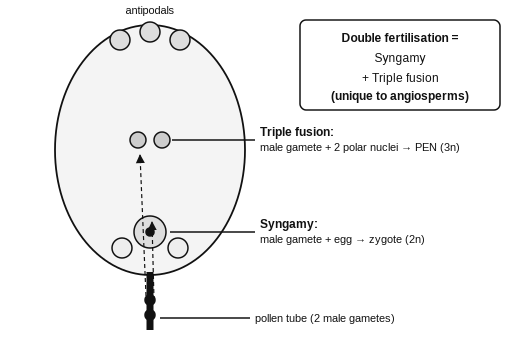
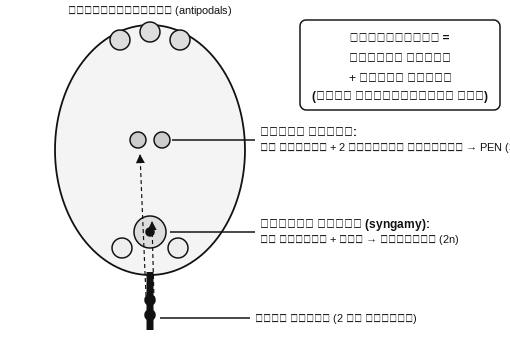
Concept: In angiosperms the two male gametes released into the synergid perform two fusions in the same embryo sac – this is double fertilisation.

  1. Male gamete 1 + egg → zygote (2n) = syngamy.
  2. Male gamete 2 + two polar nuclei (central cell) → primary endosperm nucleus (3n) = triple fusion.
  3. (A) only one male gamete fuses with an egg – polyspermy is not normal. (B) is only triple fusion – half the event. (C) there is only one egg per embryo sac.

Short trick: Double = 2 fusions: Syngamy (2n) + Triple fusion (3n).

Answer: (D) Syngamy and triple fusion

अवधारणा: आवृतबीजियों में सहायक कोशिका में मुक्त हुए दोनों नर युग्मक एक ही भ्रूणकोष में दो संलयन करते हैं – यही द्विनिषेचन है।

  1. नर युग्मक 1 + अंड → युग्मनज (2n) = युग्मक संलयन।
  2. नर युग्मक 2 + दो ध्रुवीय केंद्रक (केंद्रीय कोशिका) → प्राथमिक भ्रूणपोष केंद्रक (3n) = त्रिक संलयन।
  3. (A) अंड से केवल एक नर युग्मक संलयित होता है। (B) केवल त्रिक संलयन है – घटना का आधा भाग। (C) एक भ्रूणकोष में केवल एक अंड होता है।

शॉर्ट ट्रिक: द्वि = 2 संलयन: युग्मक संलयन (2n) + त्रिक संलयन (3n)।

उत्तर: (D) युग्मक संलयन और त्रिक संलयन

NEET UGBiologySexual reproduction in flowering plants – double fertilisationNEET UG 2018 · 6 May Shift 1 →
Q3158.
Which one of the following plants shows a very close relationship with a species of moth, where none of the two can complete its life cycle without the other?
निम्नलिखित में से कौन-सा पादप शलभ (moth) की एक जाति के साथ बहुत घनिष्ठ संबंध दर्शाता है, जहाँ दोनों में से कोई भी दूसरे के बिना अपना जीवन-चक्र पूरा नहीं कर सकता?
  1. ABananaकेला
  2. BYucca
  3. CHydrilla
  4. DViola
Show answer

Concept: Obligate mutualism – NCERT: “plant Yucca cannot complete its life cycle without a species of moth (Pronuba) and vice versa”.

  1. The moth pollinates the Yucca flower and lays its eggs in the ovary; larvae feed on some developing seeds.
  2. (A) Banana – parthenocarpic fruits, bat/bird pollination, no obligate moth.
  3. (C) Hydrilla – water-pollinated.
  4. (D) Viola – cleistogamous + chasmogamous flowers, self-pollination.

Short trick: Yucca–moth = “Y can't live without the other”.

Answer: (B) Yucca

अवधारणा: अविकल्पी सहोपकारिता – NCERT: “Yucca पादप शलभ (Pronuba) की एक जाति के बिना अपना जीवन-चक्र पूरा नहीं कर सकता और न ही शलभ पादप के बिना”।

  1. शलभ Yucca के पुष्प का परागण करता है और अंडाशय में अंडे देता है; लार्वा कुछ विकसित होते बीजों को खाते हैं।
  2. (A) केला – अनिषेकफलन, चमगादड़/पक्षी परागण; कोई अविकल्पी शलभ नहीं।
  3. (C) Hydrilla – जल-परागित।
  4. (D) Viola – अनुन्मील्य + उन्मील्य पुष्प, स्व-परागण।

शॉर्ट ट्रिक: Yucca–शलभ = “एक के बिना दूसरा नहीं”।

उत्तर: (B) Yucca

NEET UGBiologyOrganisms and populations – mutualism (plant–pollinator)NEET UG 2018 · 6 May Shift 1 →
Q3159.
Pollen grains can be stored for several years in liquid nitrogen having a temperature of
परागकणों को कई वर्षों तक द्रव नाइट्रोजन में संग्रहित किया जा सकता है, जिसका तापमान होता है
  1. A–196°C
  2. B–80°C
  3. C–120°C
  4. D–160°C
Show answer

Concept: Cryopreservation: liquid nitrogen boils at –196 °C (77 K); pollen stored in it remains viable for years and is used in pollen banks for crop breeding.

  1. Normal boiling point of N2 = 77 K = 77 – 273 = –196 °C.
  2. –80 °C is a deep-freezer / dry-ice range; –120 °C and –160 °C are not the temperature of liquid N2.

Short trick: 77 K → –196 °C; remember “196 = liquid N2”.

Answer: (A) –196°C

अवधारणा: निम्नताप परिरक्षण (cryopreservation): द्रव नाइट्रोजन –196 °C (77 K) पर उबलती है; इसमें रखे परागकण वर्षों तक जीवनक्षम रहते हैं और फसल प्रजनन हेतु पराग बैंकों में प्रयुक्त होते हैं।

  1. N2 का सामान्य क्वथनांक = 77 K = 77 – 273 = –196 °C।
  2. –80 °C डीप-फ्रीज़र / शुष्क बर्फ का परास है; –120 °C व –160 °C द्रव N2 का तापमान नहीं है।

शॉर्ट ट्रिक: 77 K → –196 °C; याद रखें “196 = द्रव N2”।

उत्तर: (A) –196°C

NEET UGBiologySexual reproduction in flowering plants – pollen storageNEET UG 2018 · 6 May Shift 1 →
Q3160.
Which of the following elements is responsible for maintaining turgor in cells?
निम्नलिखित में से कौन-सा तत्व कोशिकाओं में स्फीति (turgor) बनाए रखने के लिए उत्तरदायी है?
  1. APotassiumपोटैशियम
  2. BSodiumसोडियम
  3. CMagnesiumमैग्नीशियम
  4. DCalciumकैल्शियम
Show answer

Concept: NCERT: potassium helps to maintain an anion–cation balance in cells and is involved in protein synthesis, opening and closing of stomata, activation of enzymes and maintenance of the turgidity of cells.

  1. K+ is the chief osmoticum of plant cells; K+ influx into guard cells makes them turgid and opens stomata.
  2. (B) Sodium – needed in C4/CAM plants for PEP regeneration, water balance; not the turgor element in NCERT.
  3. (C) Magnesium – chlorophyll, ribosome structure, enzyme activator.
  4. (D) Calcium – middle lamella (calcium pectate), spindle formation.

Short trick: K keeps cells “Kool & turgid” – stomatal opening = K+ pump.

Answer: (A) Potassium

अवधारणा: NCERT: पोटैशियम कोशिकाओं में ऋणायन–धनायन संतुलन बनाए रखता है तथा प्रोटीन संश्लेषण, रंध्रों के खुलने-बंद होने, एंजाइमों के सक्रियण और कोशिकाओं की स्फीति बनाए रखने में भाग लेता है।

  1. K+ पादप कोशिकाओं का मुख्य परासरण सक्रिय आयन है; द्वार कोशिकाओं में K+ के प्रवेश से वे स्फीत होकर रंध्र खोलती हैं।
  2. (B) सोडियम – C4/CAM पादपों में PEP पुनर्जनन, जल संतुलन हेतु; NCERT में स्फीति वाला तत्व नहीं।
  3. (C) मैग्नीशियम – पर्णहरित, राइबोसोम संरचना, एंजाइम सक्रियक।
  4. (D) कैल्शियम – मध्य पटलिका (कैल्शियम पेक्टेट), तर्कु निर्माण।

शॉर्ट ट्रिक: K = स्फीति; रंध्र खुलना = K+ पंप।

उत्तर: (A) पोटैशियम

NEET UGBiologyMineral nutrition – role of potassiumNEET UG 2018 · 6 May Shift 1 →