Question bank

Q&A: practice questions with answers

Search questions on any topic. Filter by exam category, exam, subject and topic, try the question, then open the answer and explanation.

Courses – airGurukul

53,050 questions in the question bank.

Q3101.
The moment of the force, F→=4i^+5j^−6k^ at (2, 0, –3), about the point (2, –2, –2), is given by
बिंदु (2, 0, –3) पर लगे बल F→=4i^+5j^−6k^ का, बिंदु (2, –2, –2) के परितः आघूर्ण है
  1. A−7i^−8j^−4k^
  2. B−4i^−j^−8k^
  3. C−8i^−4j^−7k^
  4. D−7i^−4j^−8k^
Show answer

Concept: τ→=(r→−r→0)×F→, where r→0 is the point about which the moment is taken.

  1. r→−r→0=(2−2)i^+(0+2)j^+(−3+2)k^=2j^−k^
  2. τx=(2)(−6)−(−1)(5)=−12+5=−7
  3. τy=(−1)(4)−(0)(−6)=−4
  4. τz=(0)(5)−(2)(4)=−8
  5. τ→=−7i^−4j^−8k^

Short trick: τ→⊥F→: check τ→⋅F→=0. (D): −28−20+48=0 ✓; (A): −28−40+24≠0.

Answer: (D) −7i^−4j^−8k^

अवधारणा: τ→=(r→−r→0)×F→, जहाँ r→0 वह बिंदु है जिसके परितः आघूर्ण लिया जाता है।

  1. r→−r→0=(2−2)i^+(0+2)j^+(−3+2)k^=2j^−k^
  2. τx=(2)(−6)−(−1)(5)=−12+5=−7
  3. τy=(−1)(4)−(0)(−6)=−4
  4. τz=(0)(5)−(2)(4)=−8
  5. τ→=−7i^−4j^−8k^

शॉर्ट ट्रिक: τ→⊥F→: τ→⋅F→=0 जाँचें। (D): −28−20+48=0 ✓; (A): −28−40+24≠0।

उत्तर: (D) −7i^−4j^−8k^

NEET UGPhysicsRotational motion – torque (vector product)NEET UG 2018 · 6 May Shift 1 →
Q3102.
A student measured the diameter of a small steel ball using a screw gauge of least count 0.001 cm. The main scale reading is 5 mm and zero of circular scale division coincides with 25 divisions above the reference level. If screw gauge has a zero error of –0.004 cm, the correct diameter of the ball is
एक छात्र ने 0.001 cm अल्पतमांक वाले स्क्रू गेज से एक छोटी स्टील की गेंद का व्यास मापा। मुख्य पैमाने का पाठ्यांक 5 mm है तथा वृत्तीय पैमाने का शून्य, संदर्भ रेखा से 25 भाग ऊपर संपाती होता है। यदि स्क्रू गेज में –0.004 cm की शून्यांक त्रुटि है, तो गेंद का सही व्यास है
  1. A0.053 cm
  2. B0.525 cm
  3. C0.521 cm
  4. D0.529 cm
Show answer

Concept: Reading = MSR + (CSR × LC); correct value = reading – (zero error).

  1. Reading =0.5+25×0.001=0.525 cm
  2. Correct =0.525−(−0.004)=0.529 cm

Short trick: Negative zero error ⇒ add its magnitude. 0.525 is the uncorrected trap; 0.521 is the wrong-sign trap.

Answer: (D) 0.529 cm

अवधारणा: पाठ्यांक = MSR + (CSR × अल्पतमांक); सही मान = पाठ्यांक – (शून्यांक त्रुटि)।

  1. पाठ्यांक =0.5+25×0.001=0.525 cm
  2. सही =0.525−(−0.004)=0.529 cm

शॉर्ट ट्रिक: ऋणात्मक शून्यांक त्रुटि ⇒ उसका परिमाण जोड़ें। 0.525 बिना संशोधन का जाल है; 0.521 गलत चिह्न का जाल है।

उत्तर: (D) 0.529 cm

NEET UGPhysicsUnits and measurement – screw gauge with zero errorNEET UG 2018 · 6 May Shift 1 →
Q3103.
A solid sphere is rotating freely about its symmetry axis in free space. The radius of the sphere is increased keeping its mass same. Which of the following physical quantities would remain constant for the sphere?
एक ठोस गोला मुक्त आकाश में अपने सममिति अक्ष के परितः स्वतंत्र रूप से घूर्णन कर रहा है। गोले का द्रव्यमान समान रखते हुए उसकी त्रिज्या बढ़ा दी जाती है। गोले के लिए निम्नलिखित में से कौन-सी भौतिक राशि नियत रहेगी?
  1. ARotational kinetic energyघूर्णी गतिज ऊर्जा
  2. BMoment of inertiaजड़त्व आघूर्ण
  3. CAngular velocityकोणीय वेग
  4. DAngular momentumकोणीय संवेग
Show answer

Concept: In free space there is no external torque, so dLdt=τext=0 ⇒ L = constant.

  1. I=25MR2 increases as R increases – (B) changes.
  2. L=Iω constant ⇒ ω decreases – (C) changes.
  3. K=L22I decreases as I increases – (A) changes.
  4. Only angular momentum stays constant.

Short trick: Ice-skater rule: change shape, L is conserved; I and ω trade off, KE changes.

Answer: (D) Angular momentum

अवधारणा: मुक्त आकाश में कोई बाह्य बल-आघूर्ण नहीं है, अतः dLdt=τext=0 ⇒ L नियत।

  1. I=25MR2, R बढ़ने पर बढ़ता है – (B) बदलता है।
  2. L=Iω नियत ⇒ ω घटता है – (C) बदलता है।
  3. K=L22I, I बढ़ने पर घटती है – (A) बदलती है।
  4. केवल कोणीय संवेग नियत रहता है।

शॉर्ट ट्रिक: आइस-स्केटर नियम: आकार बदलें, L संरक्षित; I और ω एक-दूसरे की भरपाई करते हैं, गतिज ऊर्जा बदलती है।

उत्तर: (D) कोणीय संवेग

NEET UGPhysicsRotational motion – conservation of angular momentumNEET UG 2018 · 6 May Shift 1 →
Q3104.
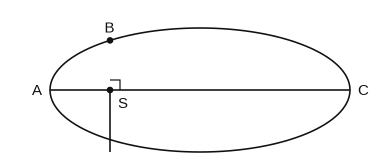
The kinetic energies of a planet in an elliptical orbit about the Sun, at positions A, B and C are KA, KB and KC, respectively. AC is the major axis and SB is perpendicular to AC at the position of the Sun S as shown in the figure. Then
सूर्य के परितः दीर्घवृत्तीय कक्षा में एक ग्रह की स्थितियों A, B तथा C पर गतिज ऊर्जाएँ क्रमशः KA, KB तथा KC हैं। AC दीर्घ अक्ष है तथा SB, सूर्य की स्थिति S पर AC के लंबवत है, जैसा चित्र में दर्शाया गया है। तब
  1. AKB<KA<KC
  2. BKA>KB>KC
  3. CKA<KB<KC
  4. DKB>KA>KC
Show answer

Concept: Angular momentum about the Sun is conserved (mvr = constant at A, C; and generally L constant), so speed is greatest where the planet is closest to the Sun.

  1. S is nearer A than C, so A is the perihelion (nearest) and C the aphelion (farthest).
  2. Distances: SA < SB < SC ⇒ speeds vA>vB>vC (energy conservation: lower PE ⇒ higher KE).
  3. KA>KB>KC

Short trick: Closer to the Sun ⇒ faster ⇒ more KE (total energy fixed, PE more negative near the Sun).

Answer: (B) KA>KB>KC

अवधारणा: सूर्य के परितः कोणीय संवेग संरक्षित है (mvr = नियत, A, C पर; और सामान्यतः L नियत), अतः ग्रह की चाल वहाँ अधिकतम है जहाँ वह सूर्य के सबसे निकट हो।

  1. S, C की तुलना में A के अधिक निकट है, अतः A उपसौर (perihelion) तथा C अपसौर (aphelion) है।
  2. दूरियाँ: SA < SB < SC ⇒ चालें vA>vB>vC (ऊर्जा संरक्षण: कम स्थितिज ऊर्जा ⇒ अधिक गतिज ऊर्जा)।
  3. KA>KB>KC

शॉर्ट ट्रिक: सूर्य के निकट ⇒ तेज ⇒ अधिक गतिज ऊर्जा (कुल ऊर्जा नियत, सूर्य के पास स्थितिज ऊर्जा अधिक ऋणात्मक)।

उत्तर: (B) KA>KB>KC

NEET UGPhysicsGravitation – Kepler's second law (kinetic energy in orbit)NEET UG 2018 · 6 May Shift 1 →
Q3105.
If the mass of the Sun were ten times smaller and the universal gravitational constant were ten times larger in magnitude, which of the following is not correct?
यदि सूर्य का द्रव्यमान दस गुना कम तथा सार्वत्रिक गुरुत्वाकर्षण नियतांक परिमाण में दस गुना अधिक हो, तो निम्नलिखित में से कौन-सा सही नहीं है?
  1. ATime period of a simple pendulum on the Earth would decreaseपृथ्वी पर सरल लोलक का आवर्तकाल घट जाएगा
  2. BWalking on the ground would become more difficultधरती पर चलना अधिक कठिन हो जाएगा
  3. CRaindrops will fall fasterवर्षा की बूँदें तेजी से गिरेंगी
  4. D'g' on the Earth will not changeपृथ्वी पर 'g' नहीं बदलेगा
Show answer

Concept: g=GMERE2 depends on the Earth's mass, not the Sun's. If G becomes 10G, g on Earth becomes 10g.

  1. (A) T=2πlg decreases – correct.
  2. (B) Weight increases tenfold, so walking is harder – correct.
  3. (C) Terminal velocity ∝g (and acceleration is larger), so raindrops fall faster – correct.
  4. (D) g does change (×10) – this statement is not correct.

Short trick: The Sun's mass is a red herring – only G enters g at the Earth's surface.

Answer: (D) 'g' on the Earth will not change

अवधारणा: g=GMERE2 पृथ्वी के द्रव्यमान पर निर्भर करता है, सूर्य के नहीं। यदि G, 10G हो जाए, तो पृथ्वी पर g भी 10g हो जाएगा।

  1. (A) T=2πlg घटेगा – सही।
  2. (B) भार दस गुना बढ़ेगा, अतः चलना कठिन – सही।
  3. (C) सीमांत वेग ∝g (और त्वरण भी अधिक), अतः बूँदें तेजी से गिरेंगी – सही।
  4. (D) g बदलता है (×10) – यह कथन सही नहीं है।

शॉर्ट ट्रिक: सूर्य का द्रव्यमान केवल भ्रमित करने के लिए है – पृथ्वी की सतह पर g में केवल G आता है।

उत्तर: (D) पृथ्वी पर 'g' नहीं बदलेगा

NEET UGPhysicsGravitation – dependence of g on GNEET UG 2018 · 6 May Shift 1 →
Q3106.
A solid sphere is in rolling motion. In rolling motion a body possesses translational kinetic energy (Kt) as well as rotational kinetic energy (Kr) simultaneously. The ratio Kt : (Kt + Kr) for the sphere is
एक ठोस गोला लोटनी गति में है। लोटनी गति में पिंड के पास एक साथ स्थानांतरीय गतिज ऊर्जा (Kt) तथा घूर्णी गतिज ऊर्जा (Kr) दोनों होती हैं। गोले के लिए अनुपात Kt : (Kt + Kr) है
  1. A10 : 7
  2. B5 : 7
  3. C7 : 10
  4. D2 : 5
Show answer

Concept: Rolling without slipping: v=ωr, Kt=12mv2, Kr=12Iω2 with I=25mr2.

  1. Kr=12⋅25mr2⋅v2r2=15mv2
  2. Kt+Kr=12mv2+15mv2=710mv2
  3. KtKt+Kr=1/27/10=57

Short trick: With k2r2=25: Kt:Kr:K=1:25:75=5:2:7.

Answer: (B) 5 : 7

अवधारणा: बिना फिसले लोटन: v=ωr, Kt=12mv2, Kr=12Iω2 जहाँ I=25mr2।

  1. Kr=12⋅25mr2⋅v2r2=15mv2
  2. Kt+Kr=12mv2+15mv2=710mv2
  3. KtKt+Kr=1/27/10=57

शॉर्ट ट्रिक: k2r2=25 से: Kt:Kr:K=1:25:75=5:2:7।

उत्तर: (B) 5 : 7

NEET UGPhysicsRotational motion – rolling kinetic energyNEET UG 2018 · 6 May Shift 1 →
Q3107.
A small sphere of radius 'r' falls from rest in a viscous liquid. As a result, heat is produced due to viscous force. The rate of production of heat when the sphere attains its terminal velocity, is proportional to
त्रिज्या 'r' का एक छोटा गोला विराम से एक श्यान द्रव में गिरता है। परिणामस्वरूप श्यान बल के कारण ऊष्मा उत्पन्न होती है। जब गोला अपना सीमांत वेग प्राप्त कर लेता है, तब ऊष्मा उत्पादन की दर अनुक्रमानुपाती है
  1. Ar5
  2. Br2
  3. Cr3
  4. Dr4
Show answer

Concept: Rate of heat = power of viscous force =FvT=6πηrvT⋅vT. Terminal velocity vT=2r2(ρ−σ)g9η∝r2.

  1. P=6πηrvT2
  2. P∝r⋅(r2)2=r5

Short trick: At terminal velocity, power = (net weight) × vT ∝r3×r2=r5.

Answer: (A) r5

अवधारणा: ऊष्मा की दर = श्यान बल की शक्ति =FvT=6πηrvT⋅vT। सीमांत वेग vT=2r2(ρ−σ)g9η∝r2।

  1. P=6πηrvT2
  2. P∝r⋅(r2)2=r5

शॉर्ट ट्रिक: सीमांत वेग पर शक्ति = (कुल प्रभावी भार) × vT ∝r3×r2=r5।

उत्तर: (A) r5

NEET UGPhysicsFluids – viscosity and terminal velocityNEET UG 2018 · 6 May Shift 1 →
Q3108.
The power radiated by a black body is P and it radiates maximum energy at wavelength, λ0. If the temperature of the black body is now changed so that it radiates maximum energy at wavelength 34λ0, the power radiated by it becomes nP. The value of n is
एक कृष्णिका द्वारा विकिरित शक्ति P है और यह तरंगदैर्ध्य λ0 पर अधिकतम ऊर्जा विकिरित करती है। यदि अब कृष्णिका का ताप इस प्रकार बदला जाए कि यह तरंगदैर्ध्य 34λ0 पर अधिकतम ऊर्जा विकिरित करे, तो इसके द्वारा विकिरित शक्ति nP हो जाती है। n का मान है
  1. A25681
  2. B43
  3. C34
  4. D81256
Show answer

Concept: Wien: λmT = constant; Stefan: P∝T4.

  1. λ0T=34λ0T′ ⇒ T′=43T
  2. n=P′P=(T′T)4=(43)4=25681

Short trick: P∝1λm4 directly: (43)4; λ falls ⇒ T rises ⇒ n > 1, so only (A) or (B).

Answer: (A) 25681

अवधारणा: वीन: λmT = नियत; स्टीफ़न: P∝T4।

  1. λ0T=34λ0T′ ⇒ T′=43T
  2. n=P′P=(T′T)4=(43)4=25681

शॉर्ट ट्रिक: सीधे P∝1λm4: (43)4; λ घटी ⇒ T बढ़ा ⇒ n > 1, अतः केवल (A) या (B)।

उत्तर: (A) 25681

NEET UGPhysicsThermal radiation – Wien's law and Stefan's lawNEET UG 2018 · 6 May Shift 1 →
Q3109.
Two wires are made of the same material and have the same volume. The first wire has cross-sectional area A and the second wire has cross-sectional area 3A. If the length of the first wire is increased by Δl on applying a force F, how much force is needed to stretch the second wire by the same amount?
दो तार एक ही पदार्थ के बने हैं तथा उनका आयतन समान है। पहले तार का अनुप्रस्थ-काट क्षेत्रफल A तथा दूसरे तार का अनुप्रस्थ-काट क्षेत्रफल 3A है। यदि बल F लगाने पर पहले तार की लंबाई Δl बढ़ जाती है, तो दूसरे तार को उतना ही खींचने के लिए कितने बल की आवश्यकता होगी?
  1. A4 F
  2. B6 F
  3. C9 F
  4. DF
Show answer

Concept: Δl=FLAY. Same volume ⇒ A1L1=A2L2, so the wire of area 3A has length L3.

  1. Wire 1: Δl=F⋅LAY
  2. Wire 2: Δl=F′⋅(L/3)3A⋅Y=F′L9AY
  3. Equal extensions ⇒ F′=9F

Short trick: For the same volume, Δl∝FA2; area ×3 ⇒ force ×9.

Answer: (C) 9 F

अवधारणा: Δl=FLAY। समान आयतन ⇒ A1L1=A2L2, अतः 3A क्षेत्रफल वाले तार की लंबाई L3 है।

  1. तार 1: Δl=F⋅LAY
  2. तार 2: Δl=F′⋅(L/3)3A⋅Y=F′L9AY
  3. समान प्रसार ⇒ F′=9F

शॉर्ट ट्रिक: समान आयतन के लिए Δl∝FA2; क्षेत्रफल ×3 ⇒ बल ×9।

उत्तर: (C) 9 F

NEET UGPhysicsElasticity – Young's modulus, wires of same volumeNEET UG 2018 · 6 May Shift 1 →
Q3110.
A sample of 0.1 g of water at 100°C and normal pressure (1.013×10⁵ N m−2) requires 54 cal of heat energy to convert to steam at 100°C. If the volume of the steam produced is 167.1 cc, the change in internal energy of the sample, is
100°C तथा सामान्य दाब (1.013×10⁵ N m−2) पर 0.1 g जल के एक नमूने को 100°C पर भाप में बदलने के लिए 54 cal ऊष्मा ऊर्जा की आवश्यकता होती है। यदि उत्पन्न भाप का आयतन 167.1 cc है, तो नमूने की आंतरिक ऊर्जा में परिवर्तन है
  1. A42.2 J
  2. B208.7 J
  3. C104.3 J
  4. D84.5 J
Show answer

Concept: First law: ΔQ=ΔU+PΔV.

  1. ΔQ=54×4.18=225.7 J
  2. PΔV=1.013×105×(167.1−0.1)×10−6≈16.9 J (volume of 0.1 g of water ≈ 0.1 cc is negligible)
  3. ΔU=225.7−16.9≈208.8 J ≈ 208.7 J

Short trick: Most of the latent heat goes into internal energy; ΔU must be a bit less than 226 J – only 208.7 J fits.

Answer: (B) 208.7 J

अवधारणा: प्रथम नियम: ΔQ=ΔU+PΔV।

  1. ΔQ=54×4.18=225.7 J
  2. PΔV=1.013×105×(167.1−0.1)×10−6≈16.9 J (0.1 g जल का आयतन ≈ 0.1 cc, नगण्य)
  3. ΔU=225.7−16.9≈208.8 J ≈ 208.7 J

शॉर्ट ट्रिक: गुप्त ऊष्मा का अधिकांश भाग आंतरिक ऊर्जा में जाता है; ΔU, 226 J से थोड़ा कम होना चाहिए – केवल 208.7 J उपयुक्त है।

उत्तर: (B) 208.7 J

NEET UGPhysicsThermodynamics – first law, change in internal energyNEET UG 2018 · 6 May Shift 1 →
Q3111.
The correct order of N-compounds in its decreasing order of oxidation states is
N-यौगिकों का उनकी ऑक्सीकरण अवस्थाओं के घटते क्रम में सही क्रम है
  1. AHNO3, NH4Cl, NO, N2
  2. BHNO3, NO, NH4Cl, N2
  3. CHNO3, NO, N2, NH4Cl
  4. DNH4Cl, N2, NO, HNO3
Show answer

Concept: Oxidation number of N is found from the sum rule (H = +1, O = −2, Cl = −1; sum = charge of the species).

  1. HNO3: (+1) + x + 3(−2) = 0 ⇒ x = +5
  2. NO: x + (−2) = 0 ⇒ x = +2
  3. N2: element ⇒ 0
  4. NH4Cl contains NH4+: x + 4(+1) = +1 ⇒ x = −3
  5. Decreasing order: +5 > +2 > 0 > −3 ⇒ HNO3, NO, N2, NH4Cl

Short trick: N ranges from −3 (NH3/NH4+) to +5 (HNO3). The only option that starts with HNO3 and ends with NH4Cl is (C).

Answer: (C)

अवधारणा: N की ऑक्सीकरण संख्या योग-नियम से निकालते हैं (H = +1, O = −2, Cl = −1; योग = स्पीशीज़ का आवेश)।

  1. HNO3: (+1) + x + 3(−2) = 0 ⇒ x = +5
  2. NO: x + (−2) = 0 ⇒ x = +2
  3. N2: तत्व ⇒ 0
  4. NH4Cl में NH4+ है: x + 4(+1) = +1 ⇒ x = −3
  5. घटता क्रम: +5 > +2 > 0 > −3 ⇒ HNO3, NO, N2, NH4Cl

शॉर्ट ट्रिक: N की ऑक्सीकरण संख्या −3 (NH3/NH4+) से +5 (HNO3) तक होती है। केवल (C) ही HNO3 से शुरू होकर NH4Cl पर समाप्त होता है।

उत्तर: (C)

NEET UGChemistryRedox reactions – oxidation numberNEET UG 2018 · 6 May Shift 1 →
Q3112.
Which one of the following elements is unable to form MF63– ion?
निम्नलिखित में से कौन-सा तत्व MF63– आयन बनाने में असमर्थ है?
  1. AB
  2. BAl
  3. CGa
  4. DIn
Show answer

Concept: To have 6 ligands (covalency 6) the central atom needs d-orbitals in its valence shell (sp3d2).

  1. B (2nd period) has only 2s and 2p orbitals ⇒ maximum covalency 4 (e.g. [BF4]–); [BF6]3– is impossible.
  2. Al, Ga, In have vacant d-orbitals ⇒ can expand covalency to 6, e.g. [AlF6]3– (cryolite, Na3AlF6).

Short trick: Second-period elements (B, C, N, O, F) can never exceed covalency 4 – no d-orbitals.

Answer: (A)

अवधारणा: 6 लिगन्ड (सहसंयोजकता 6) के लिए केंद्रीय परमाणु के संयोजकता कोश में d-कक्षक (sp3d2) होने चाहिए।

  1. B (द्वितीय आवर्त) में केवल 2s और 2p कक्षक हैं ⇒ अधिकतम सहसंयोजकता 4 (जैसे [BF4]–); [BF6]3– संभव नहीं।
  2. Al, Ga, In में रिक्त d-कक्षक हैं ⇒ सहसंयोजकता 6 तक बढ़ा सकते हैं, जैसे [AlF6]3– (क्रायोलाइट, Na3AlF6)।

शॉर्ट ट्रिक: द्वितीय आवर्त के तत्व (B, C, N, O, F) कभी 4 से अधिक सहसंयोजकता नहीं दिखाते – इनमें d-कक्षक नहीं होते।

उत्तर: (A)

NEET UGChemistryp-Block (Group 13) – covalency of boronNEET UG 2018 · 6 May Shift 1 →
Q3113.
Considering Ellingham diagram, which of the following metals can be used to reduce alumina?
एलिंघम आरेख के आधार पर, निम्नलिखित में से कौन-सी धातु ऐलुमिना के अपचयन के लिए प्रयुक्त की जा सकती है?
  1. AMg
  2. BZn
  3. CFe
  4. DCu
Show answer

Concept: In an Ellingham diagram, a metal whose oxide line (ΔfG° of oxide) lies below another can reduce that other oxide.

  1. The MgO line lies below the Al2O3 line (up to about 1773 K) ⇒ Mg + Al2O3 → MgO + Al has negative ΔG°.
  2. ZnO, FeO and Cu2O lines lie far above Al2O3 at all temperatures ⇒ Zn, Fe, Cu cannot reduce alumina.

Short trick: Only a metal more reactive than Al (higher in the activity series: Mg, Ca, Na…) can reduce Al2O3.

Answer: (A)

अवधारणा: एलिंघम आरेख में जिस धातु के ऑक्साइड की रेखा (ऑक्साइड का ΔfG°) दूसरी रेखा से नीचे हो, वह धातु उस दूसरे ऑक्साइड का अपचयन कर सकती है।

  1. MgO की रेखा Al2O3 की रेखा से नीचे है (लगभग 1773 K तक) ⇒ Mg + Al2O3 → MgO + Al के लिए ΔG° ऋणात्मक है।
  2. ZnO, FeO और Cu2O की रेखाएँ सभी तापों पर Al2O3 से बहुत ऊपर हैं ⇒ Zn, Fe, Cu ऐलुमिना का अपचयन नहीं कर सकते।

शॉर्ट ट्रिक: केवल Al से अधिक क्रियाशील धातु (सक्रियता श्रेणी में ऊपर: Mg, Ca, Na…) ही Al2O3 का अपचयन कर सकती है।

उत्तर: (A)

NEET UGChemistryMetallurgy – Ellingham diagramNEET UG 2018 · 6 May Shift 1 →
Q3114.
The correct order of atomic radii in group 13 elements is
वर्ग 13 के तत्वों में परमाणु त्रिज्याओं का सही क्रम है
  1. AB < Ga < Al < Tl < In
  2. BB < Al < Ga < In < Tl
  3. CB < Al < In < Ga < Tl
  4. DB < Ga < Al < In < Tl
Show answer

Concept: Atomic radius normally increases down a group, but Ga is an exception: the ten 3d electrons shield the nucleus poorly, so Ga is smaller than Al.

  1. Atomic radii (pm): B 85, Ga 135, Al 143, In 167, Tl 170.
  2. Order: B < Ga < Al < In < Tl.
  3. (A) puts Tl before In – wrong; (B) and (C) put Al before Ga – they ignore the d-block contraction.

Short trick: Remember "Ga < Al" (poor 3d shielding) and "In < Tl" (only slightly, due to 4f lanthanoid contraction) – only (D) has both.

Answer: (D)

अवधारणा: सामान्यतः वर्ग में नीचे जाने पर परमाणु त्रिज्या बढ़ती है, परंतु Ga अपवाद है: दस 3d इलेक्ट्रॉन नाभिक का परिरक्षण (shielding) कम कर पाते हैं, इसलिए Ga, Al से छोटा है।

  1. परमाणु त्रिज्या (pm): B 85, Ga 135, Al 143, In 167, Tl 170।
  2. क्रम: B < Ga < Al < In < Tl।
  3. (A) में Tl को In से पहले रखा है – गलत; (B) और (C) में Al को Ga से पहले रखा है – d-ब्लॉक संकुचन की उपेक्षा।

शॉर्ट ट्रिक: "Ga < Al" (3d का कम परिरक्षण) और "In < Tl" (4f लैन्थेनॉयड संकुचन के कारण केवल थोड़ा अंतर) याद रखें – दोनों बातें केवल (D) में हैं।

उत्तर: (D)

NEET UGChemistryp-Block (Group 13) – atomic radiiNEET UG 2018 · 6 May Shift 1 →
Q3115.
Which of the following statements is not true for halogens?
हैलोजेनों के लिए निम्नलिखित में से कौन-सा कथन सत्य नहीं है?
  1. AAll but fluorine show positive oxidation statesफ्लुओरीन को छोड़कर सभी धनात्मक ऑक्सीकरण अवस्थाएँ दर्शाते हैं
  2. BAll are oxidizing agentsसभी ऑक्सीकारक हैं
  3. CAll form monobasic oxyacidsसभी एकक्षारकी (monobasic) ऑक्सोअम्ल बनाते हैं
  4. DChlorine has the highest electron-gain enthalpyक्लोरीन की इलेक्ट्रॉन-लब्धि एन्थैल्पी सर्वाधिक है
Show answer

Concept: Group 17 facts (NCERT): F is the most electronegative element; the other halogens show +1, +3, +5, +7; all are oxidising agents; Cl has the most negative electron gain enthalpy; halogen oxoacids are monobasic.

  1. (B) All halogens are oxidising agents (F2 strongest, I2 weakest) – true.
  2. (C) All their oxoacids – HOX, HXO2, HXO3, HXO4 – have only one ionisable O–H hydrogen ⇒ monobasic – true.
  3. (D) Cl has the most negative electron gain enthalpy (≈ −349 kJ mol–1); F is less negative because its small 2p shell causes strong electron–electron repulsion – true.
  4. (A) is the statement to be marked: it claims that 'all but fluorine' show positive oxidation states, singling out F. Fluorine also forms an oxoacid, HOF (hypofluorous acid), the analogue of HOCl, HOBr, HOI – so the statement does not hold as a clean 'all except F' rule in the way it is framed. (Strictly, F carries −1 even in HOF, which is why this statement is the weakest of the four.)

Short trick: (B), (C), (D) are standard NCERT lines that are always true – eliminate them; the 'except fluorine' statement is the one to pick.

Answer: (A)

अवधारणा: वर्ग 17 के तथ्य (NCERT): F सबसे अधिक विद्युत-ऋणात्मक तत्व है; अन्य हैलोजेन +1, +3, +5, +7 दर्शाते हैं; सभी ऑक्सीकारक हैं; Cl की इलेक्ट्रॉन-लब्धि एन्थैल्पी सबसे अधिक ऋणात्मक है; हैलोजेनों के ऑक्सोअम्ल एकक्षारकी हैं।

  1. (B) सभी हैलोजेन ऑक्सीकारक हैं (F2 सबसे प्रबल, I2 सबसे दुर्बल) – सत्य।
  2. (C) इनके सभी ऑक्सोअम्ल – HOX, HXO2, HXO3, HXO4 – में केवल एक आयननीय O–H हाइड्रोजन है ⇒ एकक्षारकी – सत्य।
  3. (D) Cl की इलेक्ट्रॉन-लब्धि एन्थैल्पी सबसे अधिक ऋणात्मक है (≈ −349 kJ mol–1); F की कम ऋणात्मक है क्योंकि उसके छोटे 2p कोश में इलेक्ट्रॉन–इलेक्ट्रॉन प्रतिकर्षण अधिक होता है – सत्य।
  4. (A) ही चिह्नित किया जाने वाला कथन है: यह 'फ्लुओरीन को छोड़कर सभी' कहकर F को अलग करता है। फ्लुओरीन भी HOCl, HOBr, HOI की तरह एक ऑक्सोअम्ल HOF (हाइपोफ्लुओरस अम्ल) बनाता है – अतः जिस रूप में कथन दिया गया है, वह 'F को छोड़कर सभी' का साफ़ नियम नहीं बनता। (वस्तुतः HOF में भी F की ऑक्सीकरण संख्या −1 ही है, इसी कारण चारों में यह सबसे कमज़ोर कथन है।)

शॉर्ट ट्रिक: (B), (C), (D) NCERT की मानक पंक्तियाँ हैं जो सदैव सत्य हैं – इन्हें हटा दें; 'फ्लुओरीन को छोड़कर' वाला कथन ही चुनें।

उत्तर: (A)

NEET UGChemistryp-Block (Group 17) – properties of halogensNEET UG 2018 · 6 May Shift 1 →
Q3116.
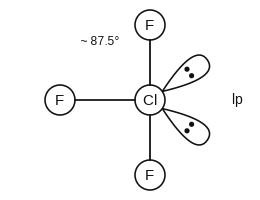
In the structure of ClF3, the number of lone pair of electrons on central atom ‘Cl’ is
ClF3 की संरचना में केंद्रीय परमाणु ‘Cl’ पर एकाकी इलेक्ट्रॉन युग्मों की संख्या है
  1. AFourचार
  2. BTwoदो
  3. COneएक
  4. DThreeतीन
Show answer

Concept: Lone pairs on the central atom = (valence electrons − electrons used in bonds) / 2.

  1. Cl has 7 valence electrons; 3 are used to form 3 Cl–F bonds.
  2. Lone pairs = (7 − 3)/2 = 2.
  3. Total electron pairs = 3 bp + 2 lp = 5 ⇒ sp3d, trigonal bipyramidal arrangement; both lone pairs occupy equatorial positions ⇒ T-shaped molecule.

Short trick: Steric number = ½(V + M) = ½(7 + 3) = 5 ⇒ 5 − 3 bonds = 2 lone pairs.

Answer: (B)

अवधारणा: केंद्रीय परमाणु पर एकाकी युग्म = (संयोजकता इलेक्ट्रॉन − आबंधों में प्रयुक्त इलेक्ट्रॉन) / 2।

  1. Cl के 7 संयोजकता इलेक्ट्रॉन हैं; 3 इलेक्ट्रॉन तीन Cl–F आबंध बनाने में प्रयुक्त होते हैं।
  2. एकाकी युग्म = (7 − 3)/2 = 2।
  3. कुल इलेक्ट्रॉन युग्म = 3 आबंधी + 2 एकाकी = 5 ⇒ sp3d, त्रिकोणीय द्विपिरैमिडी व्यवस्था; दोनों एकाकी युग्म विषुवतीय (equatorial) स्थानों पर ⇒ T-आकार का अणु।

शॉर्ट ट्रिक: स्टेरिक संख्या = ½(V + M) = ½(7 + 3) = 5 ⇒ 5 − 3 आबंध = 2 एकाकी युग्म।

उत्तर: (B)

NEET UGChemistryChemical bonding – VSEPR (ClF<sub>3</sub>)NEET UG 2018 · 6 May Shift 1 →
Q3117.
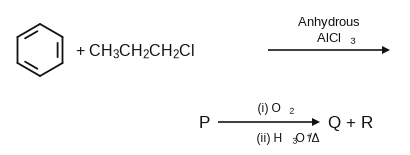
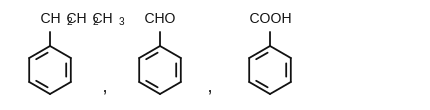
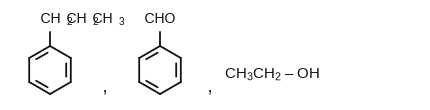
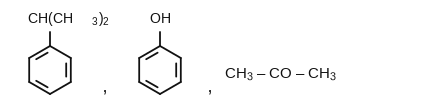
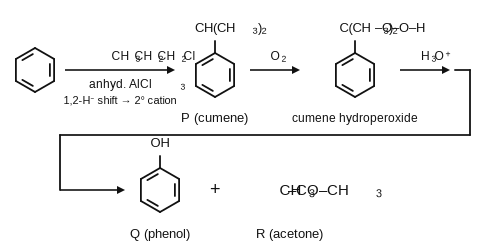
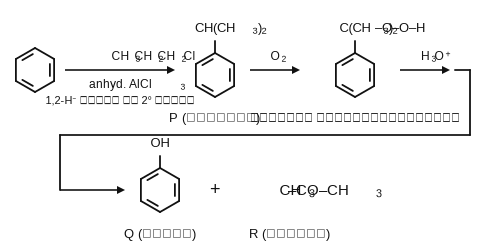
Identify the major products P, Q and R in the following sequence of reactions:

P      Q      R
निम्नलिखित अभिक्रिया-अनुक्रम में मुख्य उत्पाद P, Q और R को पहचानिए:

P      Q      R
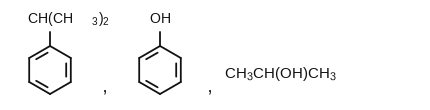
  1. A
  2. B
  3. C
  4. D
Show answer

Concept: Friedel–Crafts alkylation goes through a carbocation, which rearranges to the more stable one; cumene is then converted to phenol + acetone (cumene process).

  1. CH3CH2CH2Cl + AlCl3 → 1° propyl cation, which undergoes a 1,2-hydride shift to the more stable 2° isopropyl cation (CH3)2CH+.
  2. Benzene + (CH3)2CH+ → cumene, C6H5CH(CH3)2 = P (not n-propylbenzene).
  3. P + O2 → cumene hydroperoxide; with H3O+ it rearranges to phenol (Q) + acetone, CH3COCH3 (R).
  4. (B), (C) take P as n-propylbenzene (no rearrangement) – wrong; (A) gives R as isopropyl alcohol instead of acetone – wrong.

Short trick: n-Propyl/isobutyl halides in Friedel–Crafts never give straight-chain products – the cation rearranges. Cumene + O2/H+ = phenol + acetone.

Answer: (D)

अवधारणा: फ्रीडेल-क्राफ्ट्स ऐल्किलन कार्बधनायन द्वारा होता है, जो अधिक स्थायी कार्बधनायन में पुनर्विन्यासित हो जाता है; फिर क्यूमीन से फीनॉल + ऐसीटोन बनते हैं (क्यूमीन प्रक्रम)।

  1. CH3CH2CH2Cl + AlCl3 → 1° प्रोपिल धनायन, जो 1,2-हाइड्राइड शिफ्ट द्वारा अधिक स्थायी 2° आइसोप्रोपिल धनायन (CH3)2CH+ बन जाता है।
  2. बेन्ज़ीन + (CH3)2CH+ → क्यूमीन, C6H5CH(CH3)2 = P (n-प्रोपिलबेन्ज़ीन नहीं)।
  3. P + O2 → क्यूमीन हाइड्रोपरॉक्साइड; H3O+ के साथ यह पुनर्विन्यासित होकर फीनॉल (Q) + ऐसीटोन, CH3COCH3 (R) देता है।
  4. (B), (C) में P को n-प्रोपिलबेन्ज़ीन लिया है (पुनर्विन्यास नहीं) – गलत; (A) में R को ऐसीटोन के स्थान पर आइसोप्रोपिल ऐल्कोहॉल लिया है – गलत।

शॉर्ट ट्रिक: फ्रीडेल-क्राफ्ट्स में n-प्रोपिल/आइसोब्यूटिल हैलाइड कभी सीधी श्रृंखला वाला उत्पाद नहीं देते – धनायन पुनर्विन्यासित होता है। क्यूमीन + O2/H+ = फीनॉल + ऐसीटोन।

उत्तर: (D)

NEET UGChemistryPhenols – cumene process (Friedel–Crafts alkylation)NEET UG 2018 · 6 May Shift 1 →
Q3118.
Which of the following compounds can form a zwitterion?
निम्नलिखित में से कौन-सा यौगिक ज़्विटर आयन (zwitterion) बना सकता है?
  1. ABenzoic acidबेन्ज़ोइक अम्ल
  2. BAcetanilideऐसीटैनिलाइड
  3. CAnilineऐनिलीन
  4. DGlycineग्लाइसीन
Show answer

Concept: A zwitterion (dipolar ion) forms only when one molecule has both an acidic group (–COOH) and a basic group (–NH2): the acid proton moves to the amine.

  1. Glycine: H2N–CH2–COOH ⇌ H3N+–CH2–COO– (zwitterion).
  2. Benzoic acid – only acidic –COOH, no basic group.
  3. Acetanilide – amide N is non-basic (lone pair in resonance with C=O); no –COOH.
  4. Aniline – only basic –NH2, no acidic group.

Short trick: Zwitterion = amino acid. Look for –NH2 and –COOH in the same molecule.

Answer: (D)

अवधारणा: ज़्विटर आयन (द्विध्रुवीय आयन) तभी बनता है जब एक ही अणु में अम्लीय समूह (–COOH) और क्षारीय समूह (–NH2) दोनों हों: अम्ल का प्रोटॉन ऐमीन पर चला जाता है।

  1. ग्लाइसीन: H2N–CH2–COOH ⇌ H3N+–CH2–COO– (ज़्विटर आयन)।
  2. बेन्ज़ोइक अम्ल – केवल अम्लीय –COOH, कोई क्षारीय समूह नहीं।
  3. ऐसीटैनिलाइड – ऐमाइड का N अक्षारीय है (एकाकी युग्म C=O के साथ अनुनाद में); –COOH नहीं।
  4. ऐनिलीन – केवल क्षारीय –NH2, कोई अम्लीय समूह नहीं।

शॉर्ट ट्रिक: ज़्विटर आयन = ऐमीनो अम्ल। एक ही अणु में –NH2 और –COOH खोजें।

उत्तर: (D)

NEET UGChemistryBiomolecules – amino acids (zwitterion)NEET UG 2018 · 6 May Shift 1 →
Q3119.
Regarding cross-linked or network polymers, which of the following statements is incorrect?
तिर्यकबंधित (cross-linked) या जालक्रम बहुलकों के संबंध में निम्नलिखित में से कौन-सा कथन गलत है?
  1. AExamples are bakelite and melamine.बैकेलाइट और मेलामीन इसके उदाहरण हैं।
  2. BThey are formed from bi- and tri-functional monomers.ये द्वि- और त्रि-क्रियात्मक एकलकों से बनते हैं।
  3. CThey contain covalent bonds between various linear polymer chains.इनमें विभिन्न रैखिक बहुलक श्रृंखलाओं के बीच सहसंयोजी आबंध होते हैं।
  4. DThey contain strong covalents bonds in their polymer chains.इनकी बहुलक श्रृंखलाओं में प्रबल सहसंयोजी आबंध होते हैं।
Show answer

Concept: NCERT: "Cross-linked or network polymers are usually formed from bi-functional and tri-functional monomers and contain strong covalent bonds between various linear polymer chains, e.g. bakelite, melamine."

  1. (A), (B), (C) are exactly the NCERT description – correct statements.
  2. (D) speaks of covalent bonds within the chains – that is true of every polymer and is not what defines a network polymer; the characteristic feature is the covalent cross-links between chains. Hence (D) is the incorrect description.

Short trick: Network polymer = "bonds BETWEEN chains" (cross-links). Any option that talks only about bonds IN the chain misses the point.

Answer: (D)

अवधारणा: NCERT: "तिर्यकबंधित या जालक्रम बहुलक सामान्यतः द्वि-क्रियात्मक और त्रि-क्रियात्मक एकलकों से बनते हैं और इनमें विभिन्न रैखिक बहुलक श्रृंखलाओं के बीच प्रबल सहसंयोजी आबंध होते हैं, जैसे बैकेलाइट, मेलामीन।"

  1. (A), (B), (C) ठीक NCERT का वर्णन हैं – सही कथन।
  2. (D) श्रृंखलाओं के भीतर सहसंयोजी आबंधों की बात करता है – यह हर बहुलक में होता है और जालक्रम बहुलक की पहचान नहीं है; इनकी विशेषता श्रृंखलाओं के बीच सहसंयोजी तिर्यक-बंध हैं। अतः (D) गलत वर्णन है।

शॉर्ट ट्रिक: जालक्रम बहुलक = "श्रृंखलाओं के बीच आबंध" (तिर्यक-बंध)। जो विकल्प केवल श्रृंखला के भीतर के आबंध की बात करे, वह मूल बात छोड़ देता है।

उत्तर: (D)

NEET UGChemistryPolymers – cross-linked (network) polymersNEET UG 2018 · 6 May Shift 1 →
Q3120.
Nitration of aniline in strong acidic medium also gives m-nitroaniline because
प्रबल अम्लीय माध्यम में ऐनिलीन के नाइट्रोकरण से m-नाइट्रोऐनिलीन भी बनता है, क्योंकि
  1. AIn absence of substituents nitro group always goes to m-position.प्रतिस्थापियों की अनुपस्थिति में नाइट्रो समूह सदैव m-स्थिति पर जाता है।
  2. BIn electrophilic substitution reactions amino group is meta directive.इलेक्ट्रॉनरागी प्रतिस्थापन अभिक्रियाओं में ऐमीनो समूह मेटा-निर्देशक है।
  3. CInspite of substituents nitro group always goes to only m-position.प्रतिस्थापियों के होते हुए भी नाइट्रो समूह सदैव केवल m-स्थिति पर जाता है।
  4. DIn acidic (strong) medium aniline is present as anilinium ion.प्रबल अम्लीय माध्यम में ऐनिलीन, ऐनिलीनियम आयन के रूप में उपस्थित रहता है।
Show answer

Concept: –NH2 is o/p-directing, but in conc. HNO3/H2SO4 aniline is protonated to anilinium ion C6H5NH3+, whose –NH3+ group is electron-withdrawing and meta-directing.

  1. Product mixture: p-nitroaniline ≈ 51 %, m-nitroaniline ≈ 47 %, o-nitroaniline ≈ 2 %.
  2. (A) and (C) are false generalisations – orientation depends on the substituent present.
  3. (B) is false – free –NH2 is a strongly activating o/p director.

Short trick: Large meta yield from aniline = protonation (–NH3+). That is why –NH2 is protected by acetylation before nitration.

Answer: (D)

अवधारणा: –NH2 ऑर्थो/पैरा-निर्देशक है, परंतु सांद्र HNO3/H2SO4 में ऐनिलीन प्रोटॉनित होकर ऐनिलीनियम आयन C6H5NH3+ बन जाता है, जिसका –NH3+ समूह इलेक्ट्रॉन-आकर्षी और मेटा-निर्देशक है।

  1. उत्पाद मिश्रण: p-नाइट्रोऐनिलीन ≈ 51 %, m-नाइट्रोऐनिलीन ≈ 47 %, o-नाइट्रोऐनिलीन ≈ 2 %।
  2. (A) और (C) गलत सामान्यीकरण हैं – स्थिति उपस्थित प्रतिस्थापी पर निर्भर करती है।
  3. (B) गलत है – मुक्त –NH2 प्रबल सक्रियक और ऑर्थो/पैरा-निर्देशक है।

शॉर्ट ट्रिक: ऐनिलीन से अधिक मेटा उत्पाद = प्रोटॉनन (–NH3+)। इसी कारण नाइट्रोकरण से पहले –NH2 को ऐसीटिलन द्वारा सुरक्षित किया जाता है।

उत्तर: (D)

NEET UGChemistryAmines – nitration of anilineNEET UG 2018 · 6 May Shift 1 →