Question bank

Q&A: practice questions with answers

Search questions on any topic. Filter by exam category, exam, subject and topic, try the question, then open the answer and explanation.

Courses – airGurukul

53,050 questions in the question bank.

Q3961.
In the seeds of cereals, the outer covering of endosperm separates the embryo by a protein-rich layer called :
अनाजों के बीजों में भ्रूणपोष का बाहरी आवरण भ्रूण को एक प्रोटीन-समृद्ध परत द्वारा अलग करता है, जिसे कहते हैं :
  1. AIntegumentअध्यावरण
  2. BAleurone layerएल्यूरोन परत
  3. CColeoptileप्रांकुरचोल (Coleoptile)
  4. DColeorhizaमूलांकुरचोल (Coleorhiza)
Show answer

Concept: NCERT (Morphology – monocot seed): in cereals the outer covering of the endosperm separates the embryo by a proteinous layer called the aleurone layer.

  1. Aleurone cells secrete α-amylase (GA-induced) during germination to digest starch.
  2. Integument becomes the seed coat; coleoptile sheaths the plumule; coleorhiza sheaths the radicle.

Short trick: "Aleurone = Albumin (protein) layer".

Answer: (B) Aleurone layer

अवधारणा: NCERT (आकारिकी – एकबीजपत्री बीज): अनाजों में भ्रूणपोष का बाहरी आवरण भ्रूण को एक प्रोटीनयुक्त परत द्वारा अलग करता है जिसे एल्यूरोन परत कहते हैं।

  1. अंकुरण के समय एल्यूरोन कोशिकाएँ (GA-प्रेरित) α-एमाइलेज़ स्रावित करके स्टार्च पचाती हैं।
  2. अध्यावरण बीजावरण बनता है; प्रांकुरचोल प्रांकुर को और मूलांकुरचोल मूलांकुर को ढकता है।

शॉर्ट ट्रिक: "Aleurone = Albumin (प्रोटीन) परत"।

उत्तर: (B) एल्यूरोन परत
NEET UGBiologySexual reproduction in flowering plants – seed (aleurone layer)NEET UG 2025 · 4 May Shift 1 →
Q3962.
Match List I with List II:
List IList II
A. Chlorophyll aI. Yellow-green
B. Chlorophyll bII. Yellow
C. XanthophyllsIII. Blue-green
D. CarotenoidsIV. Yellow to Yellow-orange
Choose the option with all correct matches.
सूची I का सूची II से मिलान कीजिए :
सूची Iसूची II
A. क्लोरोफिल aI. पीला-हरा
B. क्लोरोफिल bII. पीला
C. ज़ैन्थोफिलIII. नीला-हरा
D. कैरोटिनॉइडIV. पीले से पीला-नारंगी
सभी सही मिलान वाला विकल्प चुनिए।
  1. AA-I, B-II, C-IV, D-III
  2. BA-I, B-IV, C-III, D-II
  3. CA-III, B-IV, C-II, D-I
  4. DA-III, B-I, C-II, D-IV
Show answer

Concept: NCERT paper chromatography of leaf pigments: chlorophyll a – bright/blue-green; chlorophyll b – yellow-green; xanthophylls – yellow; carotenoids – yellow to yellow-orange.

  1. A → III, B → I, C → II, D → IV.
  2. (A), (B) give chl a yellow-green (wrong); (C) gives chl b yellow-orange (wrong).

Short trick: Bands top to bottom: carotene (orange), xanthophyll (yellow), chl a (blue-green), chl b (yellow-green) – "a = aqua (blue-green)".

Answer: (D) A-III, B-I, C-II, D-IV

अवधारणा: NCERT – पत्ती वर्णकों का पेपर क्रोमैटोग्राफ़ी: क्लोरोफिल a – चमकीला/नीला-हरा; क्लोरोफिल b – पीला-हरा; ज़ैन्थोफिल – पीला; कैरोटिनॉइड – पीले से पीला-नारंगी।

  1. A → III, B → I, C → II, D → IV।
  2. (A), (B) में क्लोरोफिल a पीला-हरा (गलत); (C) में क्लोरोफिल b पीला-नारंगी (गलत)।

शॉर्ट ट्रिक: ऊपर से नीचे बैंड: कैरोटीन (नारंगी), ज़ैन्थोफिल (पीला), क्लोरोफिल a (नीला-हरा), क्लोरोफिल b (पीला-हरा) – "a = aqua (नीला-हरा)"।

उत्तर: (D) A-III, B-I, C-II, D-IV

NEET UGBiologyPhotosynthesis – pigmentsNEET UG 2025 · 4 May Shift 1 →
Q3963.
Who proposed that the genetic code for amino acids should be made up of three nucleotides?
किसने प्रस्तावित किया कि अमीनो अम्लों के लिए आनुवंशिक कूट तीन न्यूक्लियोटाइडों का बना होना चाहिए?
  1. AJacque Monodजैक मोनो (Jacque Monod)
  2. BFranklin Stahlफ्रैंकलिन स्टाल (Franklin Stahl)
  3. CGeorge Gamowजॉर्ज गैमो (George Gamow)
  4. DFrancis Crickफ्रांसिस क्रिक (Francis Crick)
Show answer

Concept: NCERT: physicist George Gamow argued that 4 bases must code for 20 amino acids, so the code should be a triplet (43 = 64 combinations ≥ 20).

  1. 41 = 4 and 42 = 16 are fewer than 20; 43 = 64 is enough.
  2. Monod – lac operon (with Jacob); Stahl – semi-conservative replication (with Meselson); Crick – DNA double helix, central dogma, wobble hypothesis.

Short trick: "Gamow → Game of 3".

Answer: (C) George Gamow

अवधारणा: NCERT: भौतिकविद् जॉर्ज गैमो ने तर्क दिया कि 4 क्षारकों को 20 अमीनो अम्लों का कूट बनाना है, अतः कूट त्रिक होना चाहिए (43 = 64 संयोजन ≥ 20)।

  1. 41 = 4 और 42 = 16, 20 से कम हैं; 43 = 64 पर्याप्त है।
  2. मोनो – lac ओपेरॉन (जैकब के साथ); स्टाल – अर्धसंरक्षी प्रतिकृतियन (मेसेल्सन के साथ); क्रिक – DNA द्विकुंडली, केंद्रीय सिद्धांत, वॉबल परिकल्पना।

शॉर्ट ट्रिक: "Gamow → 3 का खेल"।

उत्तर: (C) जॉर्ज गैमो

NEET UGBiologyMolecular basis of inheritance – genetic codeNEET UG 2025 · 4 May Shift 1 →
Q3964.
Histones are enriched with -
हिस्टोन किससे समृद्ध होते हैं -
  1. APhenylalanine & Leucineफेनिलऐलानिन एवं ल्यूसीन
  2. BPhenylalanine & Arginineफेनिलऐलानिन एवं आर्जिनिन
  3. CLysine & Arginineलाइसिन एवं आर्जिनिन
  4. DLeucine & Lysineल्यूसीन एवं लाइसिन
Show answer

Concept: NCERT: histones are rich in the basic amino acid residues lysine and arginine, which carry positive charges in their side chains – so histones are positively charged.

  1. Positive histones bind the negatively charged phosphate backbone of DNA → nucleosome (≈200 bp DNA around a histone octamer).
  2. Phenylalanine and leucine are neutral, non-polar – they cannot give the basic character.

Short trick: "Basic histones love acidic DNA – K and R (Lys, Arg)".

Answer: (C) Lysine & Arginine

अवधारणा: NCERT: हिस्टोन क्षारकीय अमीनो अम्ल अवशेषों लाइसिन और आर्जिनिन से समृद्ध होते हैं, जिनकी पार्श्व शृंखलाओं पर धनावेश होता है – अतः हिस्टोन धनावेशित होते हैं।

  1. धनावेशित हिस्टोन DNA की ऋणावेशित फॉस्फेट रीढ़ से बंधते हैं → न्यूक्लियोसोम (हिस्टोन अष्टक के चारों ओर ≈200 bp DNA)।
  2. फेनिलऐलानिन और ल्यूसीन उदासीन, अध्रुवीय हैं – ये क्षारकीय गुण नहीं दे सकते।

शॉर्ट ट्रिक: "क्षारकीय हिस्टोन, अम्लीय DNA से जुड़ते हैं – K और R (Lys, Arg)"।

उत्तर: (C) लाइसिन एवं आर्जिनिन

NEET UGBiologyMolecular basis of inheritance – histonesNEET UG 2025 · 4 May Shift 1 →
Q3965.
Which of the following enzyme(s) are NOT essential for gene cloning?
A. Restriction enzymes
B. DNA ligase
C. DNA mutase
D. DNA recombinase
E. DNA polymerase
Choose the correct answer from the options given below :
निम्नलिखित में से कौन-सा/से एंजाइम जीन क्लोनिंग के लिए आवश्यक नहीं है/हैं?
A. प्रतिबंधन एंजाइम
B. DNA लाइगेज़
C. DNA म्यूटेज़
D. DNA रिकॉम्बिनेज़
E. DNA पॉलीमरेज़
नीचे दिए गए विकल्पों में से सही उत्तर चुनिए :
  1. AD and E onlyकेवल D और E
  2. BB and C onlyकेवल B और C
  3. CC and D onlyकेवल C और D
  4. DA and B onlyकेवल A और B
Show answer

Concept: Gene cloning needs: restriction endonuclease (molecular scissors), DNA ligase (molecular glue), DNA polymerase (PCR amplification), plus vector and host.

  1. A, B, E are essential → every option with A, B or E is wrong.
  2. "DNA mutase" is not a cloning tool, and "DNA recombinase" is not required for standard rDNA cloning → C and D are not essential.

Short trick: Scissors + glue + copier (RE, ligase, polymerase) – anything else is extra.

Answer: (C) C and D only

अवधारणा: जीन क्लोनिंग में आवश्यक: प्रतिबंधन एंडोन्यूक्लिएज़ (आण्विक कैंची), DNA लाइगेज़ (आण्विक गोंद), DNA पॉलीमरेज़ (PCR प्रवर्धन), साथ में वाहक और परपोषी।

  1. A, B, E आवश्यक हैं → A, B या E वाला हर विकल्प गलत।
  2. "DNA म्यूटेज़" क्लोनिंग उपकरण नहीं है, और "DNA रिकॉम्बिनेज़" सामान्य rDNA क्लोनिंग में आवश्यक नहीं → C और D आवश्यक नहीं।

शॉर्ट ट्रिक: कैंची + गोंद + कॉपियर (RE, लाइगेज़, पॉलीमरेज़) – बाकी सब अतिरिक्त।

उत्तर: (C) केवल C और D

NEET UGBiologyBiotechnology – tools of recombinant DNA technologyNEET UG 2025 · 4 May Shift 1 →
Q3966.
A specialised membranous structure in a prokaryotic cell which helps in cell wall formation, DNA replication and respiration is :
प्रोकैरियोटी कोशिका में एक विशिष्ट झिल्लीमय संरचना जो कोशिका भित्ति निर्माण, DNA प्रतिकृतियन और श्वसन में सहायता करती है, है :
  1. ACristaeक्रिस्टी
  2. BEndoplasmic Reticulumअंतःप्रद्रव्यी जालिका
  3. CMesosomeमीसोसोम
  4. DChromatophoresवर्णकीलवक (Chromatophores)
Show answer

Concept: NCERT: the mesosome is formed by extensions of the plasma membrane into the cell (vesicles, tubules, lamellae); it helps in cell wall formation, DNA replication and distribution to daughter cells, respiration, secretion and increasing membrane surface area.

  1. Cristae and ER are eukaryotic structures (prokaryotes lack membrane-bound organelles).
  2. Chromatophores are pigment-containing membranous extensions of photosynthetic bacteria – for photosynthesis, not wall formation/replication.

Short trick: "Meso-some = multi-purpose membrane of bacteria (wall + DNA + respiration)".

Answer: (C) Mesosome

अवधारणा: NCERT: मीसोसोम प्लाज़्मा झिल्ली के कोशिका के भीतर विस्तार (पुटिकाएँ, नलिकाएँ, पटलिकाएँ) से बनता है; यह कोशिका भित्ति निर्माण, DNA प्रतिकृतियन व संतति कोशिकाओं में वितरण, श्वसन, स्रावण तथा झिल्ली सतह क्षेत्र बढ़ाने में सहायक है।

  1. क्रिस्टी और ER यूकैरियोटी संरचनाएँ हैं (प्रोकैरियोट में झिल्लीबद्ध कोशिकांग नहीं होते)।
  2. वर्णकीलवक प्रकाश-संश्लेषी जीवाणुओं में वर्णकयुक्त झिल्लीमय विस्तार हैं – प्रकाश-संश्लेषण हेतु, भित्ति निर्माण/प्रतिकृतियन हेतु नहीं।

शॉर्ट ट्रिक: "मीसोसोम = जीवाणु की बहुउद्देशीय झिल्ली (भित्ति + DNA + श्वसन)"।

उत्तर: (C) मीसोसोम

NEET UGBiologyCell – prokaryotic cell (mesosome)NEET UG 2025 · 4 May Shift 1 →
Q3967.
Which factor is important for termination of transcription?
अनुलेखन की समाप्ति के लिए कौन-सा कारक महत्वपूर्ण है?
  1. Aρ (rho)ρ (रो)
  2. Bγ (gamma)γ (गामा)
  3. Cα (alpha)α (अल्फा)
  4. Dσ (sigma)σ (सिग्मा)
Show answer

Concept: NCERT: in bacteria the RNA polymerase associates transiently with the initiation factor σ (sigma) to start and with the termination factor ρ (rho) to stop transcription.

  1. ρ factor → termination ✔.
  2. σ factor → initiation (promoter recognition), not termination.
  3. α (and β, β′, ω) are core-enzyme sub-units; γ is not a transcription factor of this kind.

Short trick: "Sigma Starts, Rho Removes".

Answer: (A) ρ (rho)

अवधारणा: NCERT: जीवाणुओं में RNA पॉलीमरेज़ अनुलेखन आरंभ करने हेतु प्रारंभन कारक σ (सिग्मा) से और समाप्ति हेतु समापन कारक ρ (रो) से अस्थायी रूप से जुड़ता है।

  1. ρ कारक → समाप्ति ✔।
  2. σ कारक → प्रारंभन (प्रोमोटर की पहचान), समाप्ति नहीं।
  3. α (तथा β, β′, ω) मूल एंजाइम की उप-इकाइयाँ हैं; γ इस प्रकार का अनुलेखन कारक नहीं है।

शॉर्ट ट्रिक: "Sigma Starts, Rho Removes" (सिग्मा शुरू, रो समाप्त)।

उत्तर: (A) ρ (रो)

NEET UGBiologyMolecular basis of inheritance – transcriptionNEET UG 2025 · 4 May Shift 1 →
Q3968.
Which of the following statement is correct about location of the male frog copulatory pad ?
नर मेंढक के मैथुन पैड (copulatory pad) की स्थिति के बारे में निम्नलिखित में से कौन-सा कथन सही है?
  1. ASecond digit of fore limbअग्रपाद का दूसरा अंक (अंगुली)
  2. BFirst digit of the fore limbअग्रपाद का पहला अंक (अंगुली)
  3. CFirst and Second digit of fore limbअग्रपाद का पहला और दूसरा अंक
  4. DFirst digit of hind limbपश्चपाद का पहला अंक
Show answer

Concept: NCERT: male frogs are distinguished by sound-producing vocal sacs and a copulatory pad on the first digit of the fore limbs, absent in females.

  1. The pad helps the male grip the female during amplexus.
  2. It is not on the 2nd digit, nor on both, nor on the hind limb.

Short trick: Male frog: "vocal sac + first-finger pad" (fore limb has 4 digits; the 1st one gets the pad).

Answer: (B) First digit of the fore limb

अवधारणा: NCERT: नर मेंढक में ध्वनि उत्पन्न करने वाले स्वर कोष तथा अग्रपाद के पहले अंक पर मैथुन पैड होता है, जो मादा में नहीं होता।

  1. यह पैड आलिंगन (amplexus) के समय नर को मादा को पकड़ने में सहायता करता है।
  2. यह दूसरे अंक पर, दोनों पर या पश्चपाद पर नहीं होता।

शॉर्ट ट्रिक: नर मेंढक: "स्वर कोष + पहली अंगुली का पैड" (अग्रपाद में 4 अंक; पहले पर पैड)।

उत्तर: (B) अग्रपाद का पहला अंक

NEET UGBiologyStructural organisation in animals – frogNEET UG 2025 · 4 May Shift 1 →
Q3969.
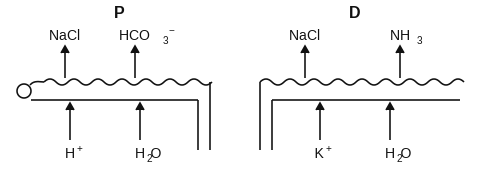
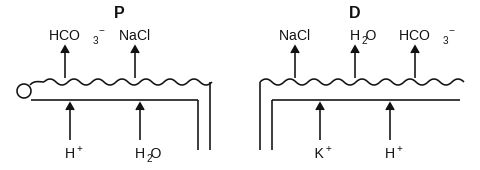
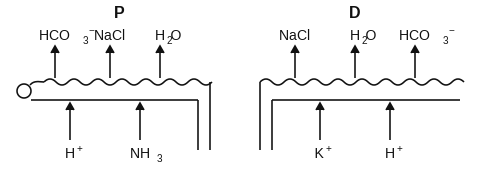
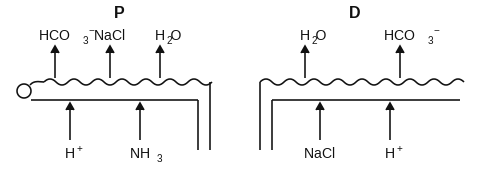
Which of the following diagrams is correct with regard to the proximal (P) and distal (D) tubule of the Nephron.
वृक्काणु (नेफ्रॉन) की समीपस्थ (P) और दूरस्थ (D) नलिका के संदर्भ में निम्नलिखित में से कौन-सा आरेख सही है?
  1. A
  2. B
  3. C
  4. D
Show answer

Concept: NCERT Fig. "Reabsorption and secretion of major substances at different parts of the nephron": arrows going out of the tubule = reabsorption, arrows coming into the lumen = secretion.

  1. PCT: reabsorbs nearly all nutrients, 70–80% electrolytes and water – HCO3–, NaCl, H2O (and K+, nutrients); secretes H+ and NH3 into the filtrate.
  2. DCT: conditional reabsorption of Na+ (NaCl) and water, reabsorption of HCO3–; selective secretion of H+ and K+ (and NH3) → pH and K+ balance.
  3. Diagram (d): P – HCO3–, NaCl, H2O out; H+, NH3 in. D – NaCl, H2O, HCO3– out; K+, H+ in ✔.
  4. (a) shows NaCl being secreted in DCT ✘; (b) shows H2O secreted and NH3 reabsorbed ✘; (c) shows H2O secreted in PCT ✘ (water is never secreted).

Short trick: Water is only ever reabsorbed; H+/K+/NH3 are the secreted trio – any diagram showing H2O or NaCl going in is wrong.

Answer: (D) Diagram (d)

अवधारणा: NCERT चित्र "वृक्काणु के विभिन्न भागों में प्रमुख पदार्थों का पुनरावशोषण और स्रावण": नलिका से बाहर जाने वाले तीर = पुनरावशोषण, अवकाशिका (lumen) में आने वाले तीर = स्रावण।

  1. PCT: लगभग सभी पोषक, 70–80% विद्युत-अपघट्य और जल का पुनरावशोषण – HCO3–, NaCl, H2O (तथा K+, पोषक); H+ और NH3 का निस्यंद में स्रावण।
  2. DCT: Na+ (NaCl) और जल का सशर्त पुनरावशोषण, HCO3– का पुनरावशोषण; H+ और K+ (तथा NH3) का चयनात्मक स्रावण → pH और K+ संतुलन।
  3. आरेख (d): P – HCO3–, NaCl, H2O बाहर; H+, NH3 भीतर। D – NaCl, H2O, HCO3– बाहर; K+, H+ भीतर ✔।
  4. (a) में DCT में NaCl का स्रावण ✘; (b) में H2O का स्रावण और NH3 का पुनरावशोषण ✘; (c) में PCT में H2O का स्रावण ✘ (जल का कभी स्रावण नहीं होता)।

शॉर्ट ट्रिक: जल का केवल पुनरावशोषण होता है; H+/K+/NH3 स्रावित तिकड़ी हैं – जिस आरेख में H2O या NaCl भीतर जाता दिखे वह गलत।

उत्तर: (D) आरेख (d)

NEET UGBiologyExcretory products – tubular reabsorption and secretionNEET UG 2025 · 4 May Shift 1 →
Q3970.
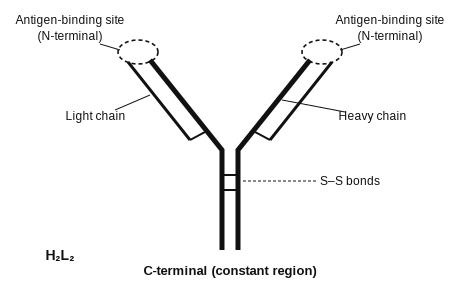
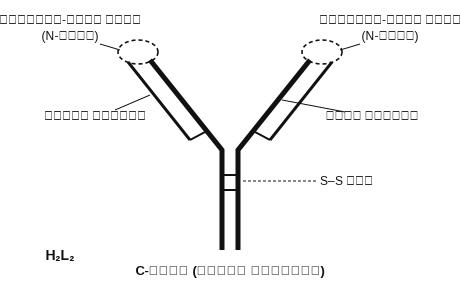
Identify the statement that is NOT correct.
वह कथन पहचानिए जो सही नहीं है।
  1. AAntigen binding site is located at C-terminal region of antibody molecules.प्रतिजन बंधन स्थल प्रतिरक्षी अणुओं के C-सिरे वाले क्षेत्र पर स्थित होता है।
  2. BConstant region of heavy and light chains are located at C-terminus of antibody molecules.भारी और हल्की शृंखलाओं का स्थिर क्षेत्र प्रतिरक्षी अणुओं के C-सिरे पर स्थित होता है।
  3. CEach antibody has two light and two heavy chains.प्रत्येक प्रतिरक्षी में दो हल्की और दो भारी शृंखलाएँ होती हैं।
  4. DThe heavy and light chains are held together by disulfide bonds.भारी और हल्की शृंखलाएँ डाइसल्फ़ाइड बंधों द्वारा जुड़ी रहती हैं।
Show answer

Concept: Antibody = Y-shaped H2L2 molecule; the variable regions at the tips of the arms are the N-terminal ends and form the antigen-binding sites; the constant regions form the C-terminal stem.

  1. (A) wrong – antigen binding site is at the N-terminal (variable) region, not C-terminal. ✔ (the NOT-correct statement)
  2. (B) correct – constant regions of H and L chains lie towards the C-terminus.
  3. (C) correct – 2 heavy + 2 light polypeptide chains (H2L2).
  4. (D) correct – H–L and H–H chains are joined by disulphide (S–S) bonds.

Short trick: "Arms catch antigen at the N-ose; the C-onstant stem is the tail".

Answer: (A) Antigen binding site is located at C-terminal region

अवधारणा: प्रतिरक्षी = Y-आकार का H2L2 अणु; भुजाओं के सिरों पर परिवर्ती क्षेत्र N-सिरे होते हैं और प्रतिजन-बंधन स्थल बनाते हैं; स्थिर क्षेत्र C-सिरे वाला तना बनाते हैं।

  1. (A) गलत – प्रतिजन बंधन स्थल N-सिरे (परिवर्ती) क्षेत्र पर होता है, C-सिरे पर नहीं। ✔ (असत्य कथन)
  2. (B) सही – H और L शृंखलाओं के स्थिर क्षेत्र C-सिरे की ओर होते हैं।
  3. (C) सही – 2 भारी + 2 हल्की पॉलीपेप्टाइड शृंखलाएँ (H2L2)।
  4. (D) सही – H–L और H–H शृंखलाएँ डाइसल्फ़ाइड (S–S) बंधों से जुड़ी होती हैं।

शॉर्ट ट्रिक: "भुजाएँ N-सिरे पर प्रतिजन पकड़ती हैं; C-स्थिर तना पूँछ है"।

उत्तर: (A) प्रतिजन बंधन स्थल C-सिरे पर होता है

NEET UGBiologyHuman health and disease – antibody structureNEET UG 2025 · 4 May Shift 1 →
Q3971.
Match List I with List II :
List IList II
A. ScutellumI. Persistent nucellus
B. Non-albuminous seedII. Cotyledon of Monocot seed
C. EpiblastIII. Groundnut
D. PerispermIV. Rudimentary cotyledon
Choose the option with all correct matches
सूची I का सूची II से मिलान कीजिए :
सूची Iसूची II
A. स्कूटेलमI. स्थायी बीजांडकाय (nucellus)
B. अभ्रूणपोषी बीजII. एकबीजपत्री बीज का बीजपत्र
C. एपिब्लास्टIII. मूँगफली
D. परिभ्रूणपोष (Perisperm)IV. अल्पविकसित बीजपत्र
सभी सही मिलान वाला विकल्प चुनिए
  1. AA-IV, B-III, C-I, D-II
  2. BA-II, B-IV, C-III, D-I
  3. CA-II, B-III, C-IV, D-I
  4. DA-IV, B-III, C-II, D-I
Show answer

Concept: NCERT: monocot (grass) embryo has one shield-shaped cotyledon, the scutellum; non-albuminous seeds have no residual endosperm; residual persistent nucellus = perisperm.

  1. A – Scutellum = cotyledon of monocot seed → II.
  2. B – Non-albuminous (exalbuminous) seed: endosperm fully used up, e.g. pea, groundnut → III.
  3. C – Epiblast = rudimentary second cotyledon in some grasses → IV.
  4. D – Perisperm = persistent nucellus (black pepper, beet) → I.

Short trick: "Peri-sperm = nucellus around"; scutellum = "shield" cotyledon; epiblast = "extra tiny" cotyledon.

Answer: (C) A-II, B-III, C-IV, D-I

अवधारणा: NCERT: एकबीजपत्री (घास) भ्रूण में एक ढाल-आकार का बीजपत्र – स्कूटेलम होता है; अभ्रूणपोषी बीजों में भ्रूणपोष शेष नहीं रहता; शेष स्थायी बीजांडकाय = परिभ्रूणपोष।

  1. A – स्कूटेलम = एकबीजपत्री बीज का बीजपत्र → II।
  2. B – अभ्रूणपोषी बीज: भ्रूणपोष पूरा उपयोग हो जाता है, जैसे मटर, मूँगफली → III।
  3. C – एपिब्लास्ट = कुछ घासों में अल्पविकसित दूसरा बीजपत्र → IV।
  4. D – परिभ्रूणपोष = स्थायी बीजांडकाय (काली मिर्च, चुकंदर) → I।

शॉर्ट ट्रिक: "परि-भ्रूणपोष = चारों ओर का बीजांडकाय"; स्कूटेलम = "ढाल" बीजपत्र; एपिब्लास्ट = "अतिरिक्त छोटा" बीजपत्र।

उत्तर: (C) A-II, B-III, C-IV, D-I

NEET UGBiologySexual reproduction in flowering plants – seed structureNEET UG 2025 · 4 May Shift 1 →
Q3972.
Find the statement that is NOT correct with regard to the structure of monocot stem.
एकबीजपत्री तने की संरचना के संदर्भ में वह कथन ज्ञात कीजिए जो सही नहीं है।
  1. AVascular bundles are conjoint and closedसंवहन बंडल संयुक्त और बंद होते हैं
  2. BPhloem parenchyma is absent.फ्लोएम मृदूतक अनुपस्थित होता है।
  3. CHypodermis is parenchymatous.अधस्त्वचा मृदूतकी होती है।
  4. DVascular bundles are scatteredसंवहन बंडल बिखरे होते हैं
Show answer

Concept: NCERT: monocot stem has a sclerenchymatous hypodermis, many scattered vascular bundles each surrounded by a sclerenchymatous bundle sheath, conjoint and closed bundles, water-containing cavities, and no phloem parenchyma.

  1. (A), (B), (D) are NCERT features → correct.
  2. (C) is wrong: hypodermis is sclerenchymatous (collenchymatous in dicot stem), not parenchymatous.

Short trick: Hypodermis: dicot stem = collenchyma, monocot stem = sclerenchyma (strength for a stem without secondary growth).

Answer: (C) Hypodermis is parenchymatous.

अवधारणा: NCERT: एकबीजपत्री तने में दृढ़ोतकी अधस्त्वचा, अनेक बिखरे संवहन बंडल (प्रत्येक दृढ़ोतकी बंडल आच्छद से घिरा), संयुक्त और बंद बंडल, जल-युक्त गुहाएँ होती हैं तथा फ्लोएम मृदूतक नहीं होता।

  1. (A), (B), (D) NCERT के लक्षण हैं → सही।
  2. (C) गलत है: अधस्त्वचा दृढ़ोतकी होती है (द्विबीजपत्री तने में स्थूलकोणोतकी), मृदूतकी नहीं।

शॉर्ट ट्रिक: अधस्त्वचा: द्विबीजपत्री तना = स्थूलकोणोतक, एकबीजपत्री तना = दृढ़ोतक (द्वितीयक वृद्धि रहित तने को मज़बूती)।

उत्तर: (C) अधस्त्वचा मृदूतकी होती है।

NEET UGBiologyAnatomy of flowering plants – monocot stemNEET UG 2025 · 4 May Shift 1 →
Q3973.
Twins are born to a family that lives next door to you. The twins are a boy and a girl. Which of the following must be true?
आपके पड़ोस में रहने वाले एक परिवार में जुड़वाँ बच्चे पैदा हुए हैं। जुड़वाँ बच्चों में एक लड़का और एक लड़की है। निम्नलिखित में से क्या अवश्य सत्य होगा?
  1. AThey were conceived through in vitro fertilization.उनका गर्भाधान पात्रे निषेचन (IVF) द्वारा हुआ था।
  2. BThey have 75% identical genetic content.उनमें 75% समान आनुवंशिक सामग्री है।
  3. CThey are monozygotic twins.वे एकयुग्मजी (monozygotic) जुड़वाँ हैं।
  4. DThey are fraternal twins.वे भ्रातृ (fraternal) जुड़वाँ हैं।
Show answer

Concept: Monozygotic twins arise from one zygote → same genotype → always same sex. Dizygotic (fraternal) twins arise from two eggs fertilised by two sperms → can be of different sex.

  1. Boy + girl → XY and XX → two different zygotes → fraternal ✔.
  2. Monozygotic impossible (would be same sex).
  3. Fraternal twins share ~50% genes like ordinary siblings, not 75%.
  4. Fraternal twins occur naturally; IVF is not required.

Short trick: Different sex twins = always dizygotic.

Answer: (D) They are fraternal twins.

अवधारणा: एकयुग्मजी जुड़वाँ एक युग्मनज से बनते हैं → समान जीनप्ररूप → सदैव समान लिंग। द्वियुग्मजी (भ्रातृ) जुड़वाँ दो शुक्राणुओं द्वारा निषेचित दो अंडों से बनते हैं → भिन्न लिंग हो सकते हैं।

  1. लड़का + लड़की → XY और XX → दो भिन्न युग्मनज → भ्रातृ ✔।
  2. एकयुग्मजी असंभव (समान लिंग होते)।
  3. भ्रातृ जुड़वाँ सामान्य भाई-बहनों की तरह ~50% जीन साझा करते हैं, 75% नहीं।
  4. भ्रातृ जुड़वाँ प्राकृतिक रूप से होते हैं; IVF आवश्यक नहीं।

शॉर्ट ट्रिक: भिन्न लिंग के जुड़वाँ = सदैव द्वियुग्मजी।

उत्तर: (D) वे भ्रातृ जुड़वाँ हैं।

NEET UGBiologyHuman reproduction – twinsNEET UG 2025 · 4 May Shift 1 →
Q3974.
Sweet potato and potato represent a certain type of evolution. Select the correct combination of terms to explain the evolution.
शकरकंद और आलू एक विशेष प्रकार के विकास को दर्शाते हैं। इस विकास की व्याख्या हेतु पदों का सही संयोजन चुनिए।
  1. AHomology, convergentसमजातता, अभिसारी
  2. BAnalogy, divergentसमरूपता, अपसारी
  3. CAnalogy, convergentसमरूपता (Analogy), अभिसारी (convergent)
  4. DHomology, divergentसमजातता, अपसारी
Show answer

Concept: NCERT (Evolution): sweet potato (root modification) and potato (stem modification) are analogous – different origin, same function (food storage) – the result of convergent evolution.

  1. Homology (same origin, different function – e.g. thorn of Bougainvillea and tendril of Cucurbita) indicates divergent evolution – not the case here.
  2. Analogy always pairs with convergent evolution, so (B) is internally wrong.

Short trick: Analogy ↔ Convergent; Homology ↔ Divergent ("A-C, H-D").

Answer: (C) Analogy, convergent

अवधारणा: NCERT (विकास): शकरकंद (जड़ रूपांतरण) और आलू (तना रूपांतरण) समरूप हैं – भिन्न उत्पत्ति, समान कार्य (भोजन संग्रह) – यह अभिसारी विकास का परिणाम है।

  1. समजातता (समान उत्पत्ति, भिन्न कार्य – जैसे बोगनविलिया का काँटा और कुकुरबिटा का प्रतान) अपसारी विकास दर्शाती है – यहाँ लागू नहीं।
  2. समरूपता सदैव अभिसारी विकास के साथ जुड़ती है, अतः (B) स्वयं में गलत है।

शॉर्ट ट्रिक: समरूपता ↔ अभिसारी; समजातता ↔ अपसारी ("A-C, H-D")।

उत्तर: (C) समरूपता, अभिसारी

NEET UGBiologyEvolution – analogous organsNEET UG 2025 · 4 May Shift 1 →
Q3975.
Which one of the following phytohormones promotes nutrient mobilization which helps in the delay of leaf senescence in plants?
निम्नलिखित में से कौन-सा पादप हॉर्मोन पोषक-तत्त्व संचलन (nutrient mobilization) को बढ़ावा देता है जो पादपों में पत्तियों की जीर्णता (senescence) को विलंबित करने में सहायक है?
  1. AGibberellinजिबरेलिन
  2. BCytokininसाइटोकाइनिन
  3. CEthyleneएथिलीन
  4. DAbscisic acidएब्सिसिक अम्ल
Show answer

Concept: NCERT: cytokinins help to produce new leaves, chloroplasts, lateral shoot growth and adventitious shoots, overcome apical dominance and promote nutrient mobilisation which helps in the delay of leaf senescence.

  1. Gibberellins – stem elongation, bolting, malting; they do delay senescence of fruits but the "nutrient mobilisation" line belongs to cytokinin.
  2. Ethylene and ABA promote senescence and abscission – the opposite.

Short trick: "Cytokinin keeps leaves young" (Richmond–Lang effect).

Answer: (B) Cytokinin

अवधारणा: NCERT: साइटोकाइनिन नई पत्तियाँ, हरितलवक, पार्श्व प्ररोह वृद्धि व अपस्थानिक प्ररोह बनाने में सहायक हैं, शीर्ष प्रभाविता हटाते हैं और पोषक-तत्त्व संचलन को बढ़ावा देते हैं जो पत्ती की जीर्णता को विलंबित करता है।

  1. जिबरेलिन – तने का दीर्घीकरण, बोल्टिंग, माल्टिंग; ये फलों की जीर्णता विलंबित करते हैं पर "पोषक संचलन" वाली पंक्ति साइटोकाइनिन की है।
  2. एथिलीन और ABA जीर्णता और विलगन को बढ़ाते हैं – विपरीत प्रभाव।

शॉर्ट ट्रिक: "साइटोकाइनिन पत्तियों को जवान रखता है" (रिचमंड–लैंग प्रभाव)।

उत्तर: (B) साइटोकाइनिन

NEET UGBiologyPlant growth and development – cytokininsNEET UG 2025 · 4 May Shift 1 →
Q3976.
Why can't insulin be given orally to diabetic patients?
मधुमेह रोगियों को इंसुलिन मुख द्वारा (orally) क्यों नहीं दी जा सकती?
  1. ABecause of structural variationसंरचनात्मक भिन्नता के कारण
  2. BIts bioavailability will be increasedइसकी जैवउपलब्धता बढ़ जाएगी
  3. CHuman body will elicit strong immune responseमानव शरीर प्रबल प्रतिरक्षा अनुक्रिया करेगा
  4. DIt will be digested in Gastro-Intestinal (GI) tractयह जठरांत्र (GI) पथ में पच जाएगी
Show answer

Concept: Insulin is a polypeptide hormone (chains A and B joined by disulphide bridges); proteins taken by mouth are hydrolysed by pepsin, trypsin and peptidases.

  1. Oral insulin would be broken into amino acids in the GI tract → no hormone reaches blood → it is injected.
  2. Bioavailability would decrease, not increase; human insulin does not trigger a strong immune response; "structural variation" is not the reason.

Short trick: Any protein drug by mouth = food for proteases.

Answer: (D) It will be digested in Gastro-Intestinal (GI) tract

अवधारणा: इंसुलिन एक पॉलीपेप्टाइड हॉर्मोन है (शृंखलाएँ A और B डाइसल्फ़ाइड सेतुओं से जुड़ी); मुख से ली गई प्रोटीनें पेप्सिन, ट्रिप्सिन और पेप्टाइडेज़ द्वारा जल-अपघटित हो जाती हैं।

  1. मुख से ली गई इंसुलिन GI पथ में अमीनो अम्लों में टूट जाएगी → रुधिर में हॉर्मोन नहीं पहुँचेगा → इसलिए इंजेक्शन दिया जाता है।
  2. जैवउपलब्धता घटेगी, बढ़ेगी नहीं; मानव इंसुलिन प्रबल प्रतिरक्षा अनुक्रिया नहीं करती; "संरचनात्मक भिन्नता" कारण नहीं है।

शॉर्ट ट्रिक: मुख से दी गई कोई भी प्रोटीन औषधि = प्रोटीएज़ का भोजन।

उत्तर: (D) यह जठरांत्र (GI) पथ में पच जाएगी

NEET UGBiologyBiotechnology applications – insulinNEET UG 2025 · 4 May Shift 1 →
Q3977.
Name the class of enzyme that usually catalyze the following reaction:
S−G+S#→S+S#−G
Where, G → a group other than hydrogen
S → a substrate
S# → another substrate
निम्नलिखित अभिक्रिया को सामान्यतः उत्प्रेरित करने वाले एंजाइम के वर्ग का नाम बताइए :
S−G+S#→S+S#−G
जहाँ, G → हाइड्रोजन के अतिरिक्त कोई समूह
S → एक क्रियाधार
S# → दूसरा क्रियाधार
  1. ATransferaseट्रांसफ़रेज़
  2. BLigaseलाइगेज़
  3. CHydrolaseहाइड्रोलेज़
  4. DLyaseलायेज़
Show answer

Concept: NCERT enzyme classes: transferases catalyse transfer of a group G (other than hydrogen) between a pair of substrates S and S′: S–G + S′ → S + S′–G.

  1. Group G moves from S to S# → transferase ✔.
  2. Ligases join two compounds (C–O, C–S, C–N, P–O bonds) using ATP.
  3. Hydrolases break ester, ether, peptide, C–C bonds by adding water.
  4. Lyases remove groups by means other than hydrolysis, leaving double bonds.

Short trick: "Group shifts partner" → Transferase.

Answer: (A) Transferase

अवधारणा: NCERT एंजाइम वर्ग: ट्रांसफ़रेज़ हाइड्रोजन के अतिरिक्त किसी समूह G का क्रियाधारों के युग्म S और S′ के बीच स्थानांतरण उत्प्रेरित करते हैं: S–G + S′ → S + S′–G।

  1. समूह G, S से S# पर जाता है → ट्रांसफ़रेज़ ✔।
  2. लाइगेज़ ATP से दो यौगिकों को जोड़ते हैं (C–O, C–S, C–N, P–O बंध)।
  3. हाइड्रोलेज़ जल जोड़कर एस्टर, ईथर, पेप्टाइड, C–C बंध तोड़ते हैं।
  4. लायेज़ जल-अपघटन के अलावा अन्य विधियों से समूह हटाते हैं, जिससे द्विबंध बनते हैं।

शॉर्ट ट्रिक: "समूह साथी बदलता है" → ट्रांसफ़रेज़।

उत्तर: (A) ट्रांसफ़रेज़

NEET UGBiologyBiomolecules – enzyme classificationNEET UG 2025 · 4 May Shift 1 →
Q3978.
Given below are two statements :
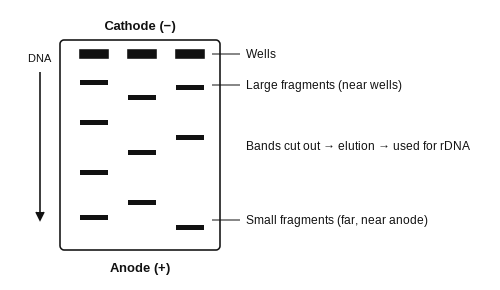
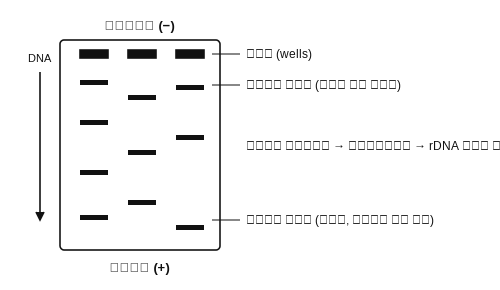
Statement I : The DNA fragments extracted from gel electrophoresis can be used in construction of recombinant DNA.
Statement II : Smaller size DNA fragments are observed near anode while larger fragments are found near the wells in an agarose gel.
In the light of the above statements, choose the most appropriate answer from the options given below :
नीचे दो कथन दिए गए हैं :
कथन I : जेल वैद्युतकणसंचलन से निकाले गए DNA खंडों का उपयोग पुनर्योगज DNA के निर्माण में किया जा सकता है।
कथन II : एगारोज़ जेल में छोटे आकार के DNA खंड एनोड के पास तथा बड़े खंड कूपों (wells) के पास दिखाई देते हैं।
उपर्युक्त कथनों के आलोक में, नीचे दिए गए विकल्पों में से सबसे उपयुक्त उत्तर चुनिए :
  1. AStatement I is correct but statement II is incorrectकथन I सही है परन्तु कथन II गलत है
  2. BStatement I is incorrect but statement II is correctकथन I गलत है परन्तु कथन II सही है
  3. CBoth statement I and statement II are correctकथन I और कथन II दोनों सही हैं
  4. DBoth statement I and statement II are incorrectकथन I और कथन II दोनों गलत हैं
Show answer

Concept: NCERT: negatively charged DNA moves towards the anode through agarose; separation is by size due to the sieving effect – the smaller the fragment, the farther it moves.

  1. Separated bands are cut out and extracted (elution); purified fragments are joined to cloning vectors → Statement I correct.
  2. Small fragments travel far → near anode; large fragments move least → near the wells (cathode end) → Statement II correct.

Short trick: DNA "runs to red" (anode +); small runners go farthest.

Answer: (C) Both statement I and statement II are correct

अवधारणा: NCERT: ऋणावेशित DNA एगारोज़ में से एनोड की ओर चलता है; छलनी प्रभाव के कारण पृथक्करण आकार के अनुसार होता है – खंड जितना छोटा, उतना दूर जाता है।

  1. पृथक बैंडों को काटकर निकाला जाता है (इल्यूशन); शुद्ध खंडों को क्लोनिंग वाहकों से जोड़ा जाता है → कथन I सही।
  2. छोटे खंड दूर जाते हैं → एनोड के पास; बड़े खंड सबसे कम चलते हैं → कूपों (कैथोड सिरे) के पास → कथन II सही।

शॉर्ट ट्रिक: DNA "धनात्मक (एनोड +) की ओर दौड़ता है"; छोटे धावक सबसे दूर जाते हैं।

उत्तर: (C) कथन I और कथन II दोनों सही हैं

NEET UGBiologyBiotechnology – gel electrophoresisNEET UG 2025 · 4 May Shift 1 →
Q3979.
The correct sequence of events in the life cycle of bryophytes is
A. Fusion of antherozoid with egg.
B. Attachment of gametophyte to substratum.
C. Reduction division, to produce haploid spores.
D. Formation of sporophyte.
E. Release of antherozoids into water.
Choose the correct answer from the options given below :
ब्रायोफ़ाइटों के जीवन चक्र में घटनाओं का सही क्रम है
A. पुमणु का अंड से संलयन।
B. युग्मकोद्भिद् का आधार (substratum) से जुड़ना।
C. अगुणित बीजाणु बनाने हेतु न्यूनीकरण विभाजन।
D. बीजाणुद्भिद् का निर्माण।
E. पुमणुओं का जल में मुक्त होना।
नीचे दिए गए विकल्पों में से सही उत्तर चुनिए :
  1. AB, E, A, D, C
  2. BD, E, A, B, C
  3. CD, E, A, C, B
  4. DB, E, A, C, D
Show answer

Concept: Bryophytes: the dominant plant body is the haploid gametophyte attached to the substratum by rhizoids; the sporophyte develops on it after fertilisation and produces spores by meiosis.

  1. B – gametophyte attached by rhizoids.
  2. E – biflagellate antherozoids released into water.
  3. A – antherozoid fuses with the egg in the archegonium → zygote.
  4. D – zygote does not undergo meiosis immediately; it forms a multicellular sporophyte.
  5. C – some sporophyte cells undergo reduction division → haploid spores. Sequence B, E, A, D, C.

Short trick: Sporophyte must be formed (D) before meiosis in it (C) → only (A) has D before C after A.

Answer: (A) B, E, A, D, C

अवधारणा: ब्रायोफ़ाइट: प्रभावी पादप शरीर अगुणित युग्मकोद्भिद् है जो मूलाभासों द्वारा आधार से जुड़ा रहता है; निषेचन के बाद उस पर बीजाणुद्भिद् विकसित होता है जो अर्धसूत्री विभाजन से बीजाणु बनाता है।

  1. B – युग्मकोद्भिद् मूलाभासों द्वारा जुड़ा।
  2. E – द्विकशाभिकी पुमणु जल में मुक्त।
  3. A – स्त्रीधानी में पुमणु का अंड से संलयन → युग्मनज।
  4. D – युग्मनज तुरंत अर्धसूत्री विभाजन नहीं करता; बहुकोशिकीय बीजाणुद्भिद् बनाता है।
  5. C – बीजाणुद्भिद् की कुछ कोशिकाएँ न्यूनीकरण विभाजन करती हैं → अगुणित बीजाणु। क्रम B, E, A, D, C।

शॉर्ट ट्रिक: बीजाणुद्भिद् (D) पहले बने तभी उसमें अर्धसूत्री (C) होगा → केवल (A) में A के बाद D फिर C है।

उत्तर: (A) B, E, A, D, C

NEET UGBiologyPlant kingdom – bryophyte life cycleNEET UG 2025 · 4 May Shift 1 →
Q3980.
Genes R and Y follow independent assortment. If RRYY produce round yellow seeds and rryy produce wrinkled green seeds, what will be the phenotypic ratio of the F2 generation?
जीन R और Y स्वतंत्र अपव्यूहन का पालन करते हैं। यदि RRYY गोल पीले बीज और rryy झुर्रीदार हरे बीज उत्पन्न करते हैं, तो F2 पीढ़ी का लक्षणप्ररूपी अनुपात क्या होगा?
  1. APhenotypic ratio - 9 : 3 : 3 : 1लक्षणप्ररूपी अनुपात - 9 : 3 : 3 : 1
  2. BPhenotypic ratio - 9 : 7लक्षणप्ररूपी अनुपात - 9 : 7
  3. CPhenotypic ratio - 1 : 2 : 1लक्षणप्ररूपी अनुपात - 1 : 2 : 1
  4. DPhenotypic ratio - 3 : 1लक्षणप्ररूपी अनुपात - 3 : 1
Show answer

Concept: Mendel’s dihybrid cross with complete dominance and independent assortment gives F2 phenotypes 9 : 3 : 3 : 1.

  1. P: RRYY × rryy → F1 RrYy (round yellow).
  2. F1 × F1: each gene gives 3 : 1; independent → (3 : 1)(3 : 1) = 9 : 3 : 3 : 1.
  3. 9 round yellow : 3 round green : 3 wrinkled yellow : 1 wrinkled green.
  4. 9 : 7 is complementary gene interaction; 1 : 2 : 1 and 3 : 1 are monohybrid ratios.

Short trick: (3 + 1)2 expands to 9 : 3 : 3 : 1.

Answer: (A) 9 : 3 : 3 : 1

अवधारणा: पूर्ण प्रभाविता और स्वतंत्र अपव्यूहन वाले मेंडल के द्विसंकर संकरण में F2 लक्षणप्ररूप 9 : 3 : 3 : 1 होते हैं।

  1. P: RRYY × rryy → F1 RrYy (गोल पीले)।
  2. F1 × F1: प्रत्येक जीन 3 : 1 देता है; स्वतंत्र → (3 : 1)(3 : 1) = 9 : 3 : 3 : 1।
  3. 9 गोल पीले : 3 गोल हरे : 3 झुर्रीदार पीले : 1 झुर्रीदार हरा।
  4. 9 : 7 पूरक जीन पारस्परिक क्रिया है; 1 : 2 : 1 और 3 : 1 एकसंकर अनुपात हैं।

शॉर्ट ट्रिक: (3 + 1)2 का विस्तार 9 : 3 : 3 : 1।

उत्तर: (A) 9 : 3 : 3 : 1

NEET UGBiologyPrinciples of inheritance – dihybrid crossNEET UG 2025 · 4 May Shift 1 →