NEET UG 2025 · Shift 1

NEET UG 4 May 2025 Shift 1 – Question Paper

180 questions · 720 marks · 180 minutes · +4 for a correct answer, −1 for a wrong one. Free PDF with answer key.

Library – airGurukul

Paper pattern

SectionQuestionsMarks
Physics45180
Chemistry45180
Biology90360

Sample questions from this paper

Q1.
A parallel plate capacitor made of circular plates is being charged such that the surface charge density on its plates is increasing at a constant rate with time. The magnetic field arising due to displacement current is:
वृत्ताकार प्लेटों से बने एक समांतर प्लेट संधारित्र को इस प्रकार आवेशित किया जा रहा है कि उसकी प्लेटों पर पृष्ठ आवेश घनत्व समय के साथ नियत दर से बढ़ रहा है। विस्थापन धारा (displacement current) के कारण उत्पन्न चुंबकीय क्षेत्र है:
  1. ANon-zero everywhere with maximum at the imaginary cylindrical surface connecting peripheries of the platesसर्वत्र शून्येतर, तथा प्लेटों की परिधियों को जोड़ने वाले काल्पनिक बेलनाकार पृष्ठ पर अधिकतम
  2. BZero between the plates and non-zero outsideप्लेटों के बीच शून्य और बाहर शून्येतर
  3. CZero at all placesसभी स्थानों पर शून्य
  4. DConstant between the plates and zero outside the platesप्लेटों के बीच नियत और प्लेटों के बाहर शून्य
Show answer

Concept: Ampere–Maxwell law: ∮B→⋅dl→=μ0ε0dΦEdt in the gap. Constant dσ/dt gives a constant displacement current density Jd=ε0dEdt=dσdt.

  1. Inside the gap (r<R): B⋅2πr=μ0Jdπr2⇒B=μ0Jdr2, which grows linearly with r.
  2. Outside (r>R): whole displacement current Id=JdπR2 is enclosed, so B=μ0Id2πr, which falls as 1/r.
  3. Hence B rises up to r=R and then decreases: it is maximum on the cylindrical surface through the plate edges and non-zero inside and outside.
  4. B is wrong (field exists between plates), C is wrong (Id≠0), D is wrong (field is neither constant inside nor zero outside).

Short trick: Same as the field of a long straight current-carrying wire of radius R: ∝ r inside, ∝ 1/r outside, peak at the surface.

Answer: (A) Non-zero everywhere, maximum at the cylindrical surface through the plate peripheries

अवधारणा: एम्पियर–मैक्सवेल नियम: प्लेटों के बीच ∮B→⋅dl→=μ0ε0dΦEdt। नियत dσ/dt से विस्थापन धारा घनत्व Jd=ε0dEdt=dσdt नियत रहता है।

  1. प्लेटों के बीच (r<R): B⋅2πr=μ0Jdπr2⇒B=μ0Jdr2, अर्थात r के साथ रैखिक रूप से बढ़ता है।
  2. बाहर (r>R): पूरी विस्थापन धारा Id=JdπR2 परिबद्ध है, अतः B=μ0Id2πr, जो 1/r के अनुसार घटता है।
  3. अतः B, r=R तक बढ़ता है फिर घटता है: प्लेटों के किनारों से गुजरने वाले बेलनाकार पृष्ठ पर अधिकतम तथा अंदर-बाहर दोनों जगह शून्येतर।
  4. B गलत (प्लेटों के बीच क्षेत्र है), C गलत (Id≠0), D गलत (अंदर नियत नहीं और बाहर शून्य नहीं)।

शॉर्ट ट्रिक: R त्रिज्या के लंबे धारावाही तार जैसा: अंदर ∝ r, बाहर ∝ 1/r, सतह पर अधिकतम।

उत्तर: (A) सर्वत्र शून्येतर, प्लेटों की परिधि वाले बेलनाकार पृष्ठ पर अधिकतम
NEET UGPhysicsEM waves – displacement current
Q46.
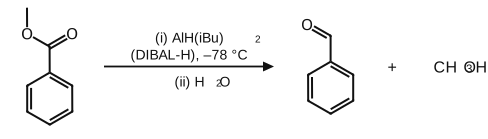
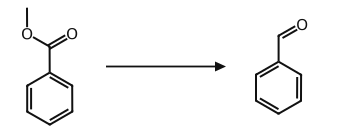
Identify the suitable reagent for the following conversion.
निम्नलिखित रूपांतरण के लिए उपयुक्त अभिकर्मक पहचानिए।
  1. A(i) NaBH4, (ii) H+/H2O
  2. BH2/Pd-BaSO4
  3. C(i) LiAlH4, (ii) H+/H2O
  4. D(i) AlH(iBu)2 (ii) H2O
Show answer

Concept: DIBAL-H [AlH(iBu)2] is a bulky, mild hydride that reduces esters (and nitriles) only up to the aldehyde stage at low temperature.

  1. Methyl benzoate C6H5COOCH3 must lose –OCH3 and stop at C6H5CHO.
  2. DIBAL-H gives a stable tetrahedral Al-intermediate at –78 °C; water then releases benzaldehyde + CH3OH.
  3. NaBH4 barely reduces esters; LiAlH4 over-reduces to benzyl alcohol; H2/Pd-BaSO4 (Rosenmund) works on acid chlorides, not esters.

Short trick: Ester/nitrile → aldehyde = DIBAL-H; acid chloride → aldehyde = Rosenmund; anything → alcohol = LiAlH4.

Answer: (D) (i) AlH(iBu)2 (ii) H2O

अवधारणा: DIBAL-H [AlH(iBu)2] एक भारी (bulky), मृदु हाइड्राइड है जो कम ताप पर एस्टर (और नाइट्राइल) को केवल ऐल्डिहाइड अवस्था तक अपचयित करता है।

  1. मेथिल बेन्ज़ोएट C6H5COOCH3 से –OCH3 हटकर अभिक्रिया C6H5CHO पर रुकनी चाहिए।
  2. –78 °C पर DIBAL-H एक स्थायी चतुष्फलकीय Al-मध्यवर्ती बनाता है; फिर जल मिलाने पर बेन्ज़ैल्डिहाइड + CH3OH मुक्त होते हैं।
  3. NaBH4 एस्टर को लगभग अपचयित नहीं करता; LiAlH4 बेन्ज़िल ऐल्कोहॉल तक अपचयित कर देता है; H2/Pd-BaSO4 (रोज़ेनमुंड) अम्ल क्लोराइड पर काम करता है, एस्टर पर नहीं।

शॉर्ट ट्रिक: एस्टर/नाइट्राइल → ऐल्डिहाइड = DIBAL-H; अम्ल क्लोराइड → ऐल्डिहाइड = रोज़ेनमुंड; ऐल्कोहॉल तक = LiAlH4।

उत्तर: (D) (i) AlH(iBu)2 (ii) H2O

NEET UGChemistryAldehydes – reduction of esters (DIBAL-H)
Q91.

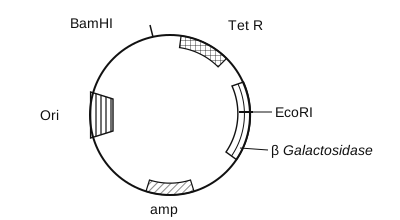
In the above represented plasmid an alien piece of DNA is inserted at EcoRI site. Which of the following strategies will be chosen to select the recombinant colonies?

ऊपर दर्शाए गए प्लाज्मिड में एक विजातीय (alien) DNA खंड को EcoRI स्थल पर निवेशित किया गया है। पुनर्योगज (recombinant) कॉलोनियों के चयन के लिए निम्नलिखित में से कौन-सी युक्ति अपनाई जाएगी?
  1. AWhite color colonies will be selectedसफ़ेद रंग की कॉलोनियों का चयन किया जाएगा
  2. BBlue color colonies grown on ampicillinएम्पिसिलिन पर उगी नीले रंग की कॉलोनियाँ
  3. CUsing ampicillin & tetracyclin containing medium plate.एम्पिसिलिन व टेट्रासाइक्लिन युक्त माध्यम प्लेट का उपयोग करके
  4. DBlue color colonies will be selected.नीले रंग की कॉलोनियों का चयन किया जाएगा।
Show answer

Concept: The EcoRI site lies inside the lacZ gene coding for β-galactosidase. Insert DNA here → insertional inactivation of the enzyme.

  1. Non-recombinant plasmid: β-galactosidase is active → acts on the chromogenic substrate (X-gal) → blue colonies.
  2. Recombinant plasmid: lacZ is interrupted → no active enzyme → no colour → white colonies. So white colonies are picked.
  3. (B), (D): blue colonies are non-recombinants – wrong.
  4. (C): the insert does not touch ampR or tetR, so recombinants and non-recombinants both grow on ampicillin + tetracycline – no selection possible.

Short trick: “Insert kills the colour” – recombinant = white; blue = “blank” plasmid.

Answer: (A) White color colonies will be selected

अवधारणा: EcoRI स्थल β-गैलेक्टोसाइडेज़ बनाने वाले lacZ जीन के भीतर है। यहाँ DNA निवेशित करने पर एंजाइम का निवेशी निष्क्रियण (insertional inactivation) हो जाता है।

  1. अपुनर्योगज प्लाज्मिड: β-गैलेक्टोसाइडेज़ सक्रिय → वर्णजनक (chromogenic) क्रियाधार (X-gal) पर क्रिया → नीली कॉलोनियाँ।
  2. पुनर्योगज प्लाज्मिड: lacZ बाधित → सक्रिय एंजाइम नहीं → कोई रंग नहीं → सफ़ेद कॉलोनियाँ। अतः सफ़ेद कॉलोनियाँ चुनी जाती हैं।
  3. (B), (D): नीली कॉलोनियाँ अपुनर्योगज होती हैं – गलत।
  4. (C): निवेश ampR या tetR को प्रभावित नहीं करता, इसलिए पुनर्योगज और अपुनर्योगज दोनों एम्पिसिलिन + टेट्रासाइक्लिन पर उगेंगे – चयन सम्भव नहीं।

शॉर्ट ट्रिक: “निवेश रंग मिटा देता है” – पुनर्योगज = सफ़ेद; नीला = “खाली” प्लाज्मिड।

उत्तर: (A) सफ़ेद रंग की कॉलोनियों का चयन किया जाएगा

NEET UGBiologyBiotechnology – selection of recombinants (blue-white screening)

See all 180 solutions

More NEET UG papers