Question bank

Q&A: practice questions with answers

Search questions on any topic. Filter by exam category, exam, subject and topic, try the question, then open the answer and explanation.

Courses – airGurukul

53,050 questions in the question bank.

Q4201.
A metallic bar of Young’s modulus, 0.5×10¹¹ N m−2 and coefficient of linear thermal expansion 10−5 ∘C−1, length 1 m and area of cross-section 10−3 m2 is heated from 0 °C to 100 °C without expansion or bending. The compressive force developed in it is:
यंग गुणांक 0.5×10¹¹ N m−2, रैखिक तापीय प्रसार गुणांक 10−5 ∘C−1, लंबाई 1 m तथा अनुप्रस्थ काट क्षेत्रफल 10−3 m2 वाली एक धात्विक छड़ को बिना प्रसार या मुड़ने दिए 0 °C से 100 °C तक गर्म किया जाता है। इसमें उत्पन्न संपीडक बल है:
  1. A50×103 N
  2. B100×103 N
  3. C2×103 N
  4. D5×103 N
Show answer

Concept: If thermal expansion is prevented, the bar is compressed by the strain it would have had: strain = αΔT, so F=YAαΔT (independent of length).

  1. F=0.5×1011×10−3×10−5×100
  2. =0.5×105=5×10⁴ N
  3. =50×103 N

Short trick: Thermal force = Y A α ΔT; the length (1 m) is a distractor.

Answer: (A) 50×103 N

अवधारणा: यदि तापीय प्रसार रोका जाए तो छड़ उतनी ही विकृति से संपीडित होती है जितना वह फैलती: विकृति = αΔT, अतः F=YAαΔT (लंबाई से स्वतंत्र)।

  1. F=0.5×1011×10−3×10−5×100
  2. =0.5×105=5×10⁴ N
  3. =50×103 N

शॉर्ट ट्रिक: तापीय बल = Y A α ΔT; लंबाई (1 m) केवल भ्रमित करने हेतु है।

उत्तर: (A) 50×103 N

NEET UGPhysicsThermal properties – thermal stressNEET UG 2024 · 5 May Shift 1 →
Q4202.
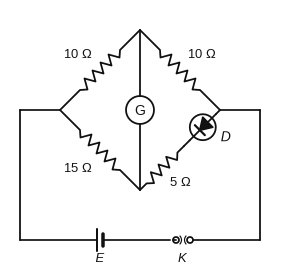
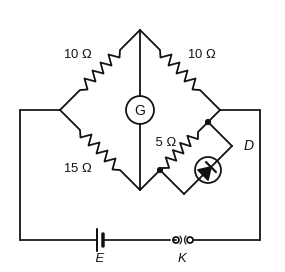
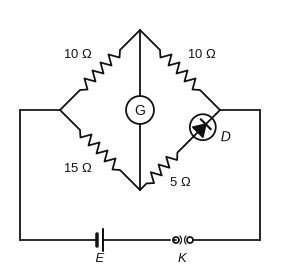
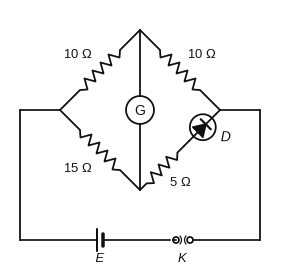
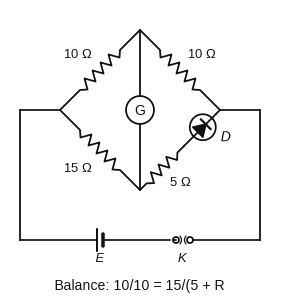
Choose the correct circuit which can achieve the bridge balance.
वह सही परिपथ चुनिए जिसमें सेतु संतुलन प्राप्त किया जा सकता है।
  1. A
  2. B
  3. C
  4. D
Show answer

Concept: Bridge balance needs PQ=RS with current in every arm. A forward-biased diode conducts and adds its own (dynamic) resistance RD; a reverse-biased diode blocks the arm; a forward diode in parallel shorts the resistor.

  1. Arms: 10 Ω, 10 Ω (upper), 15 Ω and (5 Ω + diode) (lower). Balance: 1010=155+RD⇒RD=10 Ω – possible only if the diode conducts in series with 5 Ω.
  2. Circuits (A) and (C): the diode is reverse biased (in (A) it is reversed; in (C) the cell is reversed) → that arm is open → no balance.
  3. Circuit (B): the diode is in parallel with 5 Ω and forward biased → it bypasses the 5 Ω → no balance.
  4. Circuit (D): diode in series with 5 Ω, forward biased by the cell → arm resistance 5 + RD can satisfy the balance condition.

Short trick: Look at only two things: is the diode in SERIES with 5 Ω, and is its arrow pointing along the current from the cell’s + terminal? Both “yes” only in (D).

Answer: (D) Circuit (D)

अवधारणा: सेतु संतुलन हेतु PQ=RS तथा प्रत्येक भुजा में धारा आवश्यक है। अग्र बायसित डायोड चालन करता है और अपना (गतिक) प्रतिरोध RD जोड़ता है; पश्च बायसित डायोड भुजा को रोक देता है; समांतर में अग्र डायोड प्रतिरोधक को लघुपथित कर देता है।

  1. भुजाएँ: 10 Ω, 10 Ω (ऊपरी), 15 Ω तथा (5 Ω + डायोड) (निचली)। संतुलन: 1010=155+RD⇒RD=10 Ω – यह तभी संभव है जब डायोड 5 Ω के साथ श्रेणी में चालन करे।
  2. परिपथ (A) और (C): डायोड पश्च बायसित है ((A) में डायोड उलटा है; (C) में सेल उलटा है) → वह भुजा खुली → संतुलन नहीं।
  3. परिपथ (B): डायोड 5 Ω के समांतर तथा अग्र बायसित है → 5 Ω को बायपास करता है → संतुलन नहीं।
  4. परिपथ (D): डायोड 5 Ω के साथ श्रेणी में, सेल द्वारा अग्र बायसित → भुजा प्रतिरोध 5 + RD संतुलन शर्त पूरी कर सकता है।

शॉर्ट ट्रिक: केवल दो बातें देखें: क्या डायोड 5 Ω के साथ श्रेणी में है, और क्या उसका तीर सेल के + टर्मिनल से चलने वाली धारा की दिशा में है? दोनों “हाँ” केवल (D) में।

उत्तर: (D) परिपथ (D)

NEET UGPhysicsSemiconductor diode in a Wheatstone bridgeNEET UG 2024 · 5 May Shift 1 →
Q4203.
A small telescope has an objective of focal length 140 cm and an eye piece of focal length 5.0 cm. The magnifying power of telescope for viewing a distant object is:
एक छोटे दूरदर्शक के अभिदृश्यक की फोकस दूरी 140 cm तथा नेत्रिका की फोकस दूरी 5.0 cm है। दूरस्थ वस्तु को देखने के लिए दूरदर्शक की आवर्धन क्षमता है:
  1. A28
  2. B17
  3. C32
  4. D34
Show answer

Concept: Telescope in normal adjustment (final image at infinity): m=fofe.

  1. m=1405=28

Short trick: Distant object + nothing said about near point → use normal adjustment fo/fe. (For image at D: fofe(1+feD)=33.6, not offered.)

Answer: (A) 28

अवधारणा: सामान्य समायोजन में दूरदर्शक (अंतिम प्रतिबिंब अनंत पर): m=fofe।

  1. m=1405=28

शॉर्ट ट्रिक: दूरस्थ वस्तु और निकट बिंदु का उल्लेख नहीं → सामान्य समायोजन fo/fe। (प्रतिबिंब D पर हो तो fofe(1+feD)=33.6, जो विकल्प में नहीं है।)

उत्तर: (A) 28

NEET UGPhysicsRay optics – astronomical telescopeNEET UG 2024 · 5 May Shift 1 →
Q4204.
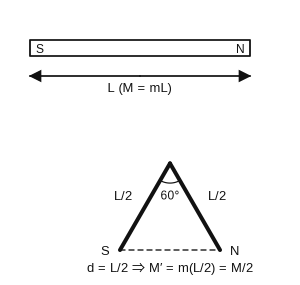
An iron bar of length L has magnetic moment M. It is bent at the middle of its length such that the two arms make angle 60° with each other. The magnetic moment of this new magnet is:
L लंबाई की एक लोहे की छड़ का चुंबकीय आघूर्ण M है। इसे इसकी लंबाई के मध्य से इस प्रकार मोड़ा जाता है कि दोनों भुजाएँ परस्पर 60° का कोण बनाती हैं। इस नए चुंबक का चुंबकीय आघूर्ण है:
  1. AM2
  2. B2M
  3. CM3
  4. DM
Show answer

Concept: Magnetic moment = pole strength × straight-line distance between the poles; bending does not change pole strength m.

  1. Initially M=mL.
  2. After bending, the poles and the bend form a triangle with two sides L/2 and included angle 60° → equilateral → pole separation = L/2.
  3. M′=m⋅L2=M2.

Short trick: 60° bend at the middle → equilateral triangle → distance halves → M/2. (90° bend would give M/√2.)

Answer: (A) M2

अवधारणा: चुंबकीय आघूर्ण = ध्रुव प्राबल्य × ध्रुवों के बीच सीधी दूरी; मोड़ने से ध्रुव प्राबल्य m नहीं बदलता।

  1. प्रारंभ में M=mL।
  2. मोड़ने के बाद दोनों ध्रुव व मोड़ बिंदु एक त्रिभुज बनाते हैं जिसकी दो भुजाएँ L/2 तथा अंतर्गत कोण 60° → समबाहु → ध्रुवों की दूरी = L/2।
  3. M′=m⋅L2=M2।

शॉर्ट ट्रिक: मध्य से 60° मोड़ → समबाहु त्रिभुज → दूरी आधी → M/2। (90° मोड़ पर M/√2 आता।)

उत्तर: (A) M2

NEET UGPhysicsMagnetism – magnetic moment of a bent magnetNEET UG 2024 · 5 May Shift 1 →
Q4205.
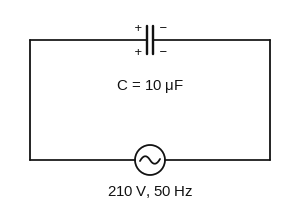
A 10 μF capacitor is connected to a 210 V, 50 Hz source as shown in figure. The peak current in the circuit is nearly (π = 3.14):
एक 10 μF संधारित्र को चित्रानुसार 210 V, 50 Hz स्रोत से जोड़ा गया है। परिपथ में शिखर धारा लगभग है (π = 3.14):
  1. A0.93 A
  2. B1.20 A
  3. C0.35 A
  4. D0.58 A
Show answer

Concept: Capacitive reactance XC=12πfC; 210 V is the rms value, so I0=2VrmsXC.

  1. XC=12×3.14×50×10×10−6=1000π≈318.5 Ω
  2. Irms=210318.5≈0.66 A
  3. I0=2×0.66≈0.93 A

Short trick: Mains-type voltage (210 V) is rms; “peak” → multiply by √2. 0.66 A (rms) is not offered, 0.93 A is.

Answer: (A) 0.93 A

अवधारणा: धारितीय प्रतिघात XC=12πfC; 210 V वर्ग-माध्य-मूल (rms) मान है, अतः I0=2VrmsXC।

  1. XC=12×3.14×50×10×10−6=1000π≈318.5 Ω
  2. Irms=210318.5≈0.66 A
  3. I0=2×0.66≈0.93 A

शॉर्ट ट्रिक: मेन्स जैसी वोल्टता (210 V) rms होती है; “शिखर” → √2 से गुणा करें। 0.66 A (rms) विकल्प में नहीं, 0.93 A है।

उत्तर: (A) 0.93 A

NEET UGPhysicsAlternating current – capacitive circuitNEET UG 2024 · 5 May Shift 1 →
Q4206.
Two heaters A and B have power rating of 1 kW and 2 kW, respectively. Those two are first connected in series and then in parallel to a fixed power source. The ratio of power outputs for these two cases is:
दो हीटरों A और B की शक्ति रेटिंग क्रमशः 1 kW और 2 kW है। इन्हें पहले श्रेणी में और फिर समांतर में एक नियत शक्ति स्रोत से जोड़ा जाता है। इन दोनों स्थितियों में शक्ति निर्गतों का अनुपात है:
  1. A2 : 9
  2. B1 : 2
  3. C2 : 3
  4. D1 : 1
Show answer

Concept: At fixed voltage, R=V2P; series: 1Ps=1P1+1P2; parallel: Pp=P1+P2.

  1. Series: Ps=P1P2P1+P2=1×23=23 kW.
  2. Parallel: Pp=1+2=3 kW.
  3. PsPp=2/33=29

Short trick: Powers combine like capacitors: series → product/sum, parallel → sum.

Answer: (A) 2 : 9

अवधारणा: नियत वोल्टता पर R=V2P; श्रेणी: 1Ps=1P1+1P2; समांतर: Pp=P1+P2।

  1. श्रेणी: Ps=P1P2P1+P2=1×23=23 kW।
  2. समांतर: Pp=1+2=3 kW।
  3. PsPp=2/33=29

शॉर्ट ट्रिक: शक्तियाँ संधारित्रों की तरह जुड़ती हैं: श्रेणी → गुणनफल/योग, समांतर → योग।

उत्तर: (A) 2 : 9

NEET UGPhysicsCurrent electricity – power in series and parallelNEET UG 2024 · 5 May Shift 1 →
Q4207.
If the mass of the bob in a simple pendulum is increased to thrice its original mass and its length is made half its original length, then the new time period of oscillation is x2 times its original time period. Then the value of x is:
यदि किसी सरल लोलक के गोलक का द्रव्यमान उसके मूल द्रव्यमान का तीन गुना कर दिया जाए और उसकी लंबाई मूल लंबाई की आधी कर दी जाए, तो दोलन का नया आवर्तकाल मूल आवर्तकाल का x2 गुना हो जाता है। तब x का मान है:
  1. A2
  2. B23
  3. C4
  4. D3
Show answer

Concept: T=2πLg – independent of the mass of the bob.

  1. T′T=L/2L=12
  2. x2=12⇒x=22=2

Short trick: Ignore the mass completely (it is a distractor); only L matters.

Answer: (A) 2

अवधारणा: T=2πLg – गोलक के द्रव्यमान से स्वतंत्र।

  1. T′T=L/2L=12
  2. x2=12⇒x=22=2

शॉर्ट ट्रिक: द्रव्यमान को पूरी तरह अनदेखा करें (भ्रामक है); केवल L मायने रखती है।

उत्तर: (A) 2

NEET UGPhysicsOscillations – simple pendulum time periodNEET UG 2024 · 5 May Shift 1 →
Q4208.
The property which is not of an electromagnetic wave travelling in free space is that:
मुक्त आकाश में गतिमान वैद्युतचुंबकीय तरंग का वह गुण जो सही नहीं है:
  1. AThe energy density in electric field is equal to energy density in magnetic fieldविद्युत क्षेत्र में ऊर्जा घनत्व, चुंबकीय क्षेत्र में ऊर्जा घनत्व के बराबर होता है
  2. BThey travel with a speed equal to 1μ0ϵ0ये 1μ0ϵ0 के बराबर चाल से चलती हैं
  3. CThey originate from charges moving with uniform speedये एकसमान चाल से गतिमान आवेशों से उत्पन्न होती हैं
  4. DThey are transverse in nature.ये अनुप्रस्थ प्रकृति की होती हैं।
Show answer

Concept: EM waves are produced by accelerated (oscillating) charges; a charge moving with uniform velocity produces only steady E and B fields, no radiation.

  1. (A) uE=12ϵ0E2=uB=B22μ0 (since E = cB) → true.
  2. (B) c=1μ0ϵ0 → true.
  3. (D) E and B are perpendicular to the direction of propagation → true.
  4. (C) uniform speed → no EM wave → this is NOT a property.

Short trick: Charge at rest → only E; uniform motion → E + steady B; acceleration → EM wave.

Answer: (C) They originate from charges moving with uniform speed

अवधारणा: वैद्युतचुंबकीय तरंगें त्वरित (दोलित) आवेशों से उत्पन्न होती हैं; एकसमान वेग से गतिमान आवेश केवल स्थायी E और B क्षेत्र बनाता है, कोई विकिरण नहीं।

  1. (A) uE=12ϵ0E2=uB=B22μ0 (क्योंकि E = cB) → सत्य।
  2. (B) c=1μ0ϵ0 → सत्य।
  3. (D) E और B संचरण दिशा के लंबवत हैं → सत्य।
  4. (C) एकसमान चाल → कोई EM तरंग नहीं → यह गुण नहीं है।

शॉर्ट ट्रिक: विरामस्थ आवेश → केवल E; एकसमान गति → E + स्थायी B; त्वरण → EM तरंग।

उत्तर: (C) ये एकसमान चाल से गतिमान आवेशों से उत्पन्न होती हैं

NEET UGPhysicsElectromagnetic waves – propertiesNEET UG 2024 · 5 May Shift 1 →
Q4209.
A sheet is placed on a horizontal surface in front of a strong magnetic pole. A force is needed to:
A. hold the sheet there if it is magnetic
B. hold the sheet there if it is non-magnetic.
C. move the sheet away from the pole with uniform velocity if it is conducting.
D. move the sheet away from the pole with uniform velocity if it is both, non-conducting and non-polar
Choose the correct statement(s) from the options given below
एक प्रबल चुंबकीय ध्रुव के सामने एक चादर (sheet) क्षैतिज सतह पर रखी है। बल की आवश्यकता होती है:
A. चादर को वहाँ रोके रखने के लिए यदि वह चुंबकीय है
B. चादर को वहाँ रोके रखने के लिए यदि वह अचुंबकीय है।
C. चादर को ध्रुव से एकसमान वेग से दूर ले जाने के लिए यदि वह चालक है।
D. चादर को ध्रुव से एकसमान वेग से दूर ले जाने के लिए यदि वह अचालक और अध्रुवीय दोनों है
नीचे दिए गए विकल्पों में से सही कथन चुनिए
  1. AA and C onlyकेवल A और C
  2. BA, C and D onlyकेवल A, C और D
  3. CC onlyकेवल C
  4. DB and D onlyकेवल B और D
Show answer

Concept: A magnetic (ferromagnetic) material is attracted by a pole; a moving conductor in a non-uniform field carries eddy currents that oppose the motion (Lenz); a non-magnetic, non-conducting, non-polar sheet feels no such force.

  1. A: magnetic sheet is pulled towards the pole → a force is needed to hold it → true.
  2. B: non-magnetic sheet is not attracted → no holding force needed → false.
  3. C: as a conducting sheet moves away, the flux through it changes → eddy currents → magnetic drag opposing the motion → a force is needed for uniform velocity → true.
  4. D: non-conducting and non-polar → no eddy currents, no attraction → no force needed → false.

Short trick: “Magnetic → attraction; Conducting + moving → eddy drag; neither → nothing.”

Answer: (A) A and C only

अवधारणा: चुंबकीय (लौहचुंबकीय) पदार्थ ध्रुव द्वारा आकर्षित होता है; असमान क्षेत्र में गतिमान चालक में भँवर धाराएँ (eddy currents) बनती हैं जो गति का विरोध करती हैं (लेंज़); अचुंबकीय, अचालक, अध्रुवीय चादर पर ऐसा कोई बल नहीं लगता।

  1. A: चुंबकीय चादर ध्रुव की ओर खिंचती है → रोके रखने हेतु बल चाहिए → सत्य।
  2. B: अचुंबकीय चादर आकर्षित नहीं होती → रोकने हेतु बल नहीं चाहिए → असत्य।
  3. C: चालक चादर के दूर जाने पर उससे गुजरने वाला फ्लक्स बदलता है → भँवर धाराएँ → गति-विरोधी चुंबकीय कर्षण → एकसमान वेग हेतु बल चाहिए → सत्य।
  4. D: अचालक और अध्रुवीय → न भँवर धाराएँ, न आकर्षण → बल नहीं चाहिए → असत्य।

शॉर्ट ट्रिक: “चुंबकीय → आकर्षण; चालक + गतिमान → भँवर कर्षण; दोनों नहीं → कुछ नहीं।”

उत्तर: (A) केवल A और C

NEET UGPhysicsElectromagnetic induction – magnetic attraction and eddy currentsNEET UG 2024 · 5 May Shift 1 →
Q4210.
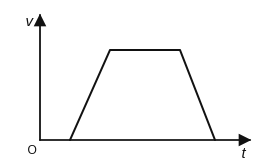
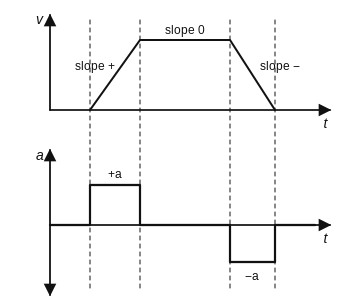
The velocity (v) – time (t) plot of the motion of a body is shown below:

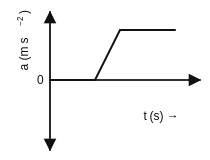
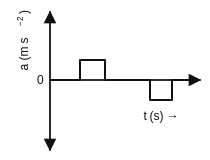
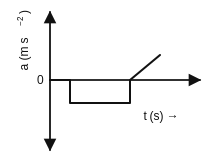
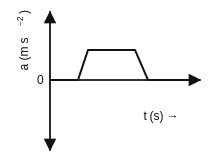
The acceleration (a) – time (t) graph that best suits this motion is:
किसी वस्तु की गति का वेग (v) – समय (t) आलेख नीचे दर्शाया गया है:

इस गति के लिए सबसे उपयुक्त त्वरण (a) – समय (t) ग्राफ़ है:
  1. A
  2. B
  3. C
  4. D
Show answer

Concept: a=dvdt = slope of the v–t graph; a straight-line segment has constant slope.

  1. Rising straight line → constant positive a (a positive rectangle).
  2. Horizontal part → slope 0 → a = 0.
  3. Falling straight line → constant negative a (a negative rectangle).
  4. Only (B) shows: positive block, zero, negative block. (A), (D) have no negative part; (C) starts negative.

Short trick: For v–t made of straight lines, the a–t graph is always a set of flat steps (rectangles), never sloping lines.

Answer: (B) Graph (B)

अवधारणा: a=dvdt = v–t ग्राफ़ की ढाल; सरल रेखा खंड की ढाल नियत होती है।

  1. ऊपर उठती सरल रेखा → नियत धनात्मक a (धनात्मक आयत)।
  2. क्षैतिज भाग → ढाल 0 → a = 0।
  3. नीचे गिरती सरल रेखा → नियत ऋणात्मक a (ऋणात्मक आयत)।
  4. केवल (B) में: धनात्मक खंड, शून्य, ऋणात्मक खंड। (A), (D) में ऋणात्मक भाग नहीं; (C) ऋणात्मक से शुरू होता है।

शॉर्ट ट्रिक: सरल रेखाओं से बने v–t के लिए a–t ग्राफ़ सदैव समतल सीढ़ियों (आयतों) का होता है, कभी ढलवाँ रेखाएँ नहीं।

उत्तर: (B) ग्राफ़ (B)

NEET UGPhysicsMotion in a straight line – v–t to a–t graphNEET UG 2024 · 5 May Shift 1 →
Q4211.
A parallel plate capacitor is charged by connecting it to a battery through a resistor. If I is the current in the circuit, then in the gap between the plates:
एक समांतर पट्टिका संधारित्र को एक प्रतिरोधक के माध्यम से बैटरी से जोड़कर आवेशित किया जाता है। यदि परिपथ में धारा I है, तो पट्टिकाओं के बीच के रिक्त स्थान में:
  1. ADisplacement current of magnitude equal to I flows in the same direction as I.I के बराबर परिमाण की विस्थापन धारा I की ही दिशा में बहती है।
  2. BDisplacement current of magnitude equal to I flows in a direction opposite to that of I.I के बराबर परिमाण की विस्थापन धारा I की विपरीत दिशा में बहती है।
  3. CDisplacement current of magnitude greater than I flows but can be in any direction.I से अधिक परिमाण की विस्थापन धारा बहती है परंतु वह किसी भी दिशा में हो सकती है।
  4. DThere is no current.कोई धारा नहीं बहती।
Show answer

Concept: Displacement current Id=ϵ0dϕEdt makes current continuous: in the gap Id equals the conduction current I in the wires.

  1. q=ϵ0EA⇒I=dqdt=ϵ0AdEdt=ϵ0dϕEdt=Id.
  2. While charging, E (and ϕE) grows in the direction of I → Id is in the same direction as I.
  3. So magnitude equal, direction same → (A); (B), (C), (D) wrong.

Short trick: Kirchhoff-style continuity: whatever enters the capacitor gap as I continues as Id, same size, same way.

Answer: (A) Displacement current equal to I, in the same direction

अवधारणा: विस्थापन धारा Id=ϵ0dϕEdt धारा को सतत बनाती है: रिक्त स्थान में Id तारों की चालन धारा I के बराबर होती है।

  1. q=ϵ0EA⇒I=dqdt=ϵ0AdEdt=ϵ0dϕEdt=Id।
  2. आवेशन के समय E (और ϕE) I की दिशा में बढ़ता है → Id की दिशा I के समान है।
  3. अतः परिमाण बराबर, दिशा समान → (A); (B), (C), (D) गलत।

शॉर्ट ट्रिक: किरखॉफ़ जैसी सततता: संधारित्र के रिक्त स्थान में जो I के रूप में आता है वही Id के रूप में आगे बढ़ता है, समान परिमाण, समान दिशा।

उत्तर: (A) I के बराबर विस्थापन धारा, समान दिशा में

NEET UGPhysicsElectromagnetic waves – displacement currentNEET UG 2024 · 5 May Shift 1 →
Q4212.
A force defined by F=αt2+βt acts on a particle at a given time t. The factor which is dimensionless, if α and β are constants, is:
किसी दिए गए समय t पर एक कण पर F=αt2+βt द्वारा परिभाषित बल कार्य करता है। यदि α और β नियतांक हैं, तो विमाहीन गुणक है:
  1. Aαtβ
  2. Bαβt
  3. Cαβt
  4. Dβtα
Show answer

Concept: Only like quantities can be added: each term has the dimension of force.

  1. [α][T2]=[F] and [β][T]=[F].
  2. Dividing: [α]T2[β]T=1⇒[αtβ]=1 → dimensionless.
  3. (B) αβt, (C) αβt, (D) βtα have dimensions → wrong.

Short trick: Ratio of two terms of the same sum is always dimensionless: αt2βt=αtβ.

Answer: (A) αtβ

अवधारणा: केवल समान विमा वाली राशियाँ जोड़ी जा सकती हैं: प्रत्येक पद की विमा बल की है।

  1. [α][T2]=[F] तथा [β][T]=[F]।
  2. भाग देने पर: [α]T2[β]T=1⇒[αtβ]=1 → विमाहीन।
  3. (B) αβt, (C) αβt, (D) βtα की विमाएँ हैं → गलत।

शॉर्ट ट्रिक: एक ही योग के दो पदों का अनुपात सदैव विमाहीन होता है: αt2βt=αtβ।

उत्तर: (A) αtβ

NEET UGPhysicsUnits and dimensions – dimensional analysisNEET UG 2024 · 5 May Shift 1 →
Q4213.
If the plates of a parallel plate capacitor connected to a battery are moved close to each other, then
A. The charge stored in it, increases.
B. The energy stored in it decreases.
C. Its capacitance increases.
D. The ratio of charge to its potential remains the same.
E. The product of charge and voltage increases.
Choose the most appropriate answer from the options given below:
यदि बैटरी से जुड़े एक समांतर पट्टिका संधारित्र की पट्टिकाओं को एक-दूसरे के पास लाया जाए, तो
A. इसमें संचित आवेश बढ़ता है।
B. इसमें संचित ऊर्जा घटती है।
C. इसकी धारिता बढ़ती है।
D. आवेश और विभव का अनुपात समान रहता है।
E. आवेश और वोल्टता का गुणनफल बढ़ता है।
नीचे दिए गए विकल्पों में से सबसे उपयुक्त उत्तर चुनिए:
  1. AA, C and E onlyकेवल A, C और E
  2. BB, D and E onlyकेवल B, D और E
  3. CA, B and C onlyकेवल A, B और C
  4. DA, B and E onlyकेवल A, B और E
Show answer

Concept: With the battery connected V stays constant; C=ϵ0Ad increases as d decreases.

  1. C: d ↓ → C ↑ → true.
  2. A: Q = CV ↑ → true.
  3. B: U=12CV2 ↑ → “decreases” is false.
  4. D: Q/V = C, which increases → false.
  5. E: QV = CV² ↑ → true.

Short trick: Battery connected → V fixed → everything with C in it (Q, U, QV) increases.

Answer: (A) A, C and E only

अवधारणा: बैटरी जुड़ी रहने पर V नियत रहता है; d घटने पर C=ϵ0Ad बढ़ती है।

  1. C: d ↓ → C ↑ → सत्य।
  2. A: Q = CV ↑ → सत्य।
  3. B: U=12CV2 ↑ → “घटती है” असत्य।
  4. D: Q/V = C, जो बढ़ती है → असत्य।
  5. E: QV = CV² ↑ → सत्य।

शॉर्ट ट्रिक: बैटरी जुड़ी → V नियत → जिसमें C है वह सब (Q, U, QV) बढ़ता है।

उत्तर: (A) केवल A, C और E

NEET UGPhysicsCapacitance – plates moved closer with battery connectedNEET UG 2024 · 5 May Shift 1 →
Q4214.
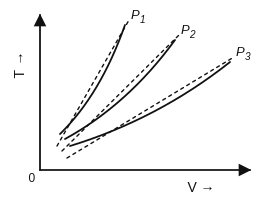
The following graph represents the T-V curves of an ideal gas (where T is the temperature and V the volume) at three pressures P1, P2 and P3 compared with those of Charles’s law represented as dotted lines.

Then the correct relation is:
निम्नलिखित ग्राफ़ एक आदर्श गैस के तीन दाबों P1, P2 और P3 पर T-V वक्रों (जहाँ T ताप तथा V आयतन है) को दर्शाता है, जिनकी तुलना बिंदुकित रेखाओं द्वारा दर्शाए गए चार्ल्स नियम के वक्रों से की गई है।

तब सही संबंध है:
  1. AP1>P3>P2
  2. BP2>P1>P3
  3. CP1>P2>P3
  4. DP3>P2>P1
Show answer

Concept: At constant pressure PV=nRT⇒T=(PnR)V: the slope of a T–V line is proportional to P.

  1. Steepest curve is P1, then P2, then P3.
  2. Larger slope → larger pressure → P1>P2>P3.

Short trick: On T–V (T on y-axis) steeper = higher P; on V–T (V on y-axis) steeper = lower P. Check the axes first!

Answer: (C) P1>P2>P3

अवधारणा: नियत दाब पर PV=nRT⇒T=(PnR)V: T–V रेखा की ढाल P के समानुपाती है।

  1. सबसे तीव्र वक्र P1, फिर P2, फिर P3।
  2. अधिक ढाल → अधिक दाब → P1>P2>P3।

शॉर्ट ट्रिक: T–V (y-अक्ष पर T) में तीव्र = अधिक P; V–T (y-अक्ष पर V) में तीव्र = कम P। पहले अक्ष जाँचें!

उत्तर: (C) P1>P2>P3

NEET UGPhysicsKinetic theory – ideal gas T–V graph (Charles’s law)NEET UG 2024 · 5 May Shift 1 →
Q4215.
The minimum energy required to launch a satellite of mass m from the surface of earth of mass M and radius R in a circular orbit at an altitude of 2R from the surface of the earth is:
द्रव्यमान M और त्रिज्या R वाली पृथ्वी की सतह से m द्रव्यमान के एक उपग्रह को पृथ्वी की सतह से 2R ऊँचाई पर वृत्ताकार कक्षा में प्रक्षेपित करने के लिए आवश्यक न्यूनतम ऊर्जा है:
  1. A2GmM3R
  2. BGmM2R
  3. CGmM3R
  4. D5GmM6R
Show answer

Concept: Energy needed = (total energy in orbit) − (energy at the surface). In a circular orbit of radius r: E=−GMm2r.

  1. Orbit radius r=R+2R=3R → Ef=−GMm6R.
  2. At the surface (at rest, ignoring earth’s rotation): Ei=−GMmR.
  3. W=Ef−Ei=−GMm6R+GMmR=5GMm6R

Short trick: Altitude h → r = R + h. Use Eorbit=−GMm2r (half of PE), not PE alone: 1−12×3=56.

Answer: (D) 5GmM6R

अवधारणा: आवश्यक ऊर्जा = (कक्षा में कुल ऊर्जा) − (सतह पर ऊर्जा)। त्रिज्या r की वृत्ताकार कक्षा में: E=−GMm2r।

  1. कक्षा की त्रिज्या r=R+2R=3R → Ef=−GMm6R।
  2. सतह पर (विराम में, पृथ्वी का घूर्णन नगण्य): Ei=−GMmR।
  3. W=Ef−Ei=−GMm6R+GMmR=5GMm6R

शॉर्ट ट्रिक: ऊँचाई h → r = R + h। केवल PE नहीं, Eorbit=−GMm2r (PE का आधा) लें: 1−12×3=56।

उत्तर: (D) 5GmM6R

NEET UGPhysicsGravitation – energy to put a satellite in orbitNEET UG 2024 · 5 May Shift 1 →
Q4216.
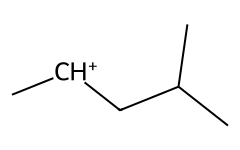
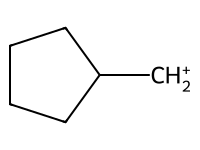
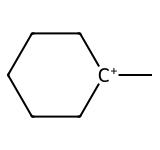
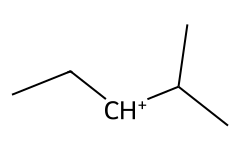
The most stable carbocation among the following
निम्नलिखित में से सबसे अधिक स्थायी कार्बधनायन (carbocation) है
  1. A
  2. B
  3. C
  4. D
Show answer

Concept: In the absence of conjugation, carbocation stability is decided by +I effect and hyperconjugation: 3° > 2° > 1°; more α-hydrogens → more hyperconjugative structures → more stable.

  1. (A) 4-methylpentan-2-yl cation: 2°, α-H = 3 (CH3) + 2 (CH2) = 5.
  2. (B) cyclopentylmethyl cation: 1°, α-H = 1 only – least stable.
  3. (C) 1-methylcyclohexyl cation: 3°, α-H = 3 (CH3) + 2 + 2 (two ring CH2) = 7.
  4. (D) 2-methylpentan-3-yl cation: 2°, α-H = 2 (CH2) + 1 (CH) = 3.
  5. The only tertiary cation, with the maximum α-H (7), is (C).

Short trick: Count α-H (H on carbons directly attached to C+). Highest count + highest degree wins: 3° with 7 α-H beats every 2° and 1° here.

Answer: (C)

अवधारणा: अनुनाद न होने पर कार्बधनायन का स्थायित्व +I प्रभाव और अतिसंयुग्मन (hyperconjugation) से तय होता है: 3° > 2° > 1°; जितने अधिक α-हाइड्रोजन, उतनी अधिक अतिसंयुग्मी संरचनाएँ → उतना अधिक स्थायी।

  1. (A) 4-मेथिलपेन्टेन-2-इल धनायन: 2°, α-H = 3 (CH3) + 2 (CH2) = 5।
  2. (B) साइक्लोपेन्टिलमेथिल धनायन: 1°, केवल 1 α-H – सबसे कम स्थायी।
  3. (C) 1-मेथिलसाइक्लोहेक्सिल धनायन: 3°, α-H = 3 (CH3) + 2 + 2 (वलय के दो CH2) = 7।
  4. (D) 2-मेथिलपेन्टेन-3-इल धनायन: 2°, α-H = 2 (CH2) + 1 (CH) = 3।
  5. एकमात्र तृतीयक धनायन, जिसमें अधिकतम α-H (7) हैं, (C) है।

शॉर्ट ट्रिक: α-H गिनिए (C+ से सीधे जुड़े कार्बनों पर H)। सबसे अधिक संख्या + सबसे उच्च कोटि वाला जीतता है: 7 α-H वाला 3° धनायन यहाँ सभी 2° और 1° से अधिक स्थायी है।

उत्तर: (C)

NEET UGChemistryOrganic chemistry – carbocation stability (hyperconjugation)NEET UG 2024 · 5 May Shift 1 →
Q4217.
For the reaction 2A ⇌ B + C, Kc = 4 × 10⁻³. At a given time, the composition of reaction mixture is : [A] = [B] = [C] = 2 × 10⁻³ M
Then, which of the following is correct?
अभिक्रिया 2A ⇌ B + C के लिए Kc = 4 × 10⁻³ है। किसी दिए गए समय पर अभिक्रिया मिश्रण का संघटन है : [A] = [B] = [C] = 2 × 10⁻³ M
तब, निम्नलिखित में से कौन-सा सही है?
  1. AReaction has a tendency to go in forward direction.अभिक्रिया में अग्र दिशा में जाने की प्रवृत्ति है।
  2. BReaction has a tendency to go in backward direction.अभिक्रिया में पश्च दिशा में जाने की प्रवृत्ति है।
  3. CReaction has gone to completion in forward direction.अभिक्रिया अग्र दिशा में पूर्ण हो चुकी है।
  4. DReaction is at equilibrium.अभिक्रिया साम्यावस्था में है।
Show answer

Concept: Compare the reaction quotient Qc with Kc: Q < K → forward; Q = K → equilibrium; Q > K → backward.

  1. Qc=[B][C][A]2=(2×10⁻³)(2×10⁻³)(2×10⁻³)2=1
  2. Kc = 4 × 10–3 = 0.004.
  3. Qc (1) > Kc (0.004): too much product is present, so the reaction shifts backward to form more A.
  4. It is not at equilibrium (Q ≠ K) and not complete (A is still present), so (A), (C), (D) are wrong.

Short trick: When all concentrations are equal, Q = (conc.)Δn = (2 × 10⁻³)0 = 1, since Δn = 2 − 2 = 0. Any K < 1 then means "backward".

Answer: (B)

अवधारणा: अभिक्रिया भागफल Qc की Kc से तुलना कीजिए: Q < K → अग्र दिशा; Q = K → साम्य; Q > K → पश्च दिशा।

  1. Qc=[B][C][A]2=(2×10⁻³)(2×10⁻³)(2×10⁻³)2=1
  2. Kc = 4 × 10–3 = 0.004।
  3. Qc (1) > Kc (0.004): उत्पाद आवश्यकता से अधिक है, अतः अभिक्रिया पश्च दिशा में जाकर अधिक A बनाएगी।
  4. यह साम्य में नहीं है (Q ≠ K) और पूर्ण भी नहीं हुई (A अभी भी उपस्थित है), अतः (A), (C), (D) गलत हैं।

शॉर्ट ट्रिक: सभी सांद्रताएँ बराबर हों तो Q = (सांद्रता)Δn = (2 × 10⁻³)0 = 1, क्योंकि Δn = 2 − 2 = 0। तब K < 1 का अर्थ है "पश्च दिशा"।

उत्तर: (B)

NEET UGChemistryChemical equilibrium – reaction quotient Q vs KNEET UG 2024 · 5 May Shift 1 →
Q4218.
‘Spin only’ magnetic moment is same for which of the following ions?
A. Ti3+, B. Cr2+
C. Mn2+, D. Fe2+
E. Sc3+
Choose the most appropriate answer from the options given below:
निम्नलिखित में से किन आयनों के लिए ‘केवल चक्रण’ (spin only) चुंबकीय आघूर्ण समान है?
A. Ti3+, B. Cr2+
C. Mn2+, D. Fe2+
E. Sc3+
नीचे दिए गए विकल्पों में से सबसे उपयुक्त उत्तर चुनिए:
  1. AA and E onlyकेवल A और E
  2. BB and C onlyकेवल B और C
  3. CA and D onlyकेवल A और D
  4. DB and D onlyकेवल B और D
Show answer

Concept: μs=n(n+2) BM depends only on the number of unpaired electrons n, so ions with equal n have equal μ.

  1. Ti3+: 3d1 → n = 1 → 1.73 BM
  2. Cr2+: 3d4 → n = 4 → 4.90 BM
  3. Mn2+: 3d5 → n = 5 → 5.92 BM
  4. Fe2+: 3d6 → n = 4 → 4.90 BM
  5. Sc3+: 3d0 → n = 0 → 0 BM
  6. Only Cr2+ and Fe2+ have the same n (4) → B and D.

Short trick: dn and d10−n (high spin) have the same unpaired electrons: d4 ↔ d6, d1 ↔ d9, d3 ↔ d7.

Answer: (D)

अवधारणा: μs=n(n+2) BM केवल अयुग्मित इलेक्ट्रॉनों की संख्या n पर निर्भर करता है, अतः समान n वाले आयनों का μ समान होता है।

  1. Ti3+: 3d1 → n = 1 → 1.73 BM
  2. Cr2+: 3d4 → n = 4 → 4.90 BM
  3. Mn2+: 3d5 → n = 5 → 5.92 BM
  4. Fe2+: 3d6 → n = 4 → 4.90 BM
  5. Sc3+: 3d0 → n = 0 → 0 BM
  6. केवल Cr2+ और Fe2+ में n समान (4) है → B और D।

शॉर्ट ट्रिक: dn और d10−n (उच्च चक्रण) में अयुग्मित इलेक्ट्रॉन समान होते हैं: d4 ↔ d6, d1 ↔ d9, d3 ↔ d7।

उत्तर: (D)

NEET UGChemistryd-block – spin-only magnetic momentNEET UG 2024 · 5 May Shift 1 →
Q4219.
The energy of an electron in the ground state (n = 1) for He+ ion is –x J, then that for an electron in n = 2 state for Be3+ ion in J is
He+ आयन की मूल अवस्था (n = 1) में इलेक्ट्रॉन की ऊर्जा –x J है, तो Be3+ आयन की n = 2 अवस्था में इलेक्ट्रॉन की ऊर्जा (J में) है
  1. A−x9
  2. B–4x
  3. C−49x
  4. D–x
Show answer

Concept: For a one-electron species, En=−13.6Z2n2 eV, i.e. E∝Z2n2.

  1. He+ (Z = 2, n = 1): Z2/n2 = 4/1 = 4 → E = –x J.
  2. Be3+ (Z = 4, n = 2): Z2/n2 = 16/4 = 4.
  3. Same ratio Z2/n2 → same energy: E = –x J.

Short trick: Z/n is 2 in both cases (2/1 = 4/2), so the energies are identical – no calculation needed.

Answer: (D) –x

अवधारणा: एक-इलेक्ट्रॉन स्पीशीज़ के लिए En=−13.6Z2n2 eV, अर्थात् E∝Z2n2।

  1. He+ (Z = 2, n = 1): Z2/n2 = 4/1 = 4 → E = –x J।
  2. Be3+ (Z = 4, n = 2): Z2/n2 = 16/4 = 4।
  3. Z2/n2 का अनुपात समान → ऊर्जा समान: E = –x J।

शॉर्ट ट्रिक: दोनों में Z/n = 2 है (2/1 = 4/2), अतः ऊर्जाएँ बराबर हैं – गणना की आवश्यकता नहीं।

उत्तर: (D) –x

NEET UGChemistryAtomic structure – Bohr energy of hydrogen-like ionsNEET UG 2024 · 5 May Shift 1 →
Q4220.
Which reaction is NOT a redox reaction ?
कौन-सी अभिक्रिया रेडॉक्स (अपचयोपचय) अभिक्रिया नहीं है?
  1. A2KClO3 + I2 → 2KIO3 + Cl2
  2. BH2 + Cl2 → 2HCl
  3. CBaCl2 + Na2SO4 → BaSO4 + 2NaCl
  4. DZn + CuSO4 → ZnSO4 + Cu
Show answer

Concept: A redox reaction needs a change in oxidation number of some element (one oxidised, one reduced).

  1. (A) Cl: +5 → 0 (reduced); I: 0 → +5 (oxidised) – redox.
  2. (B) H: 0 → +1, Cl: 0 → –1 – redox.
  3. (C) Ba +2, Cl –1, Na +1, S +6, O –2 on both sides – only exchange of ions (precipitation of BaSO4), no change – NOT redox.
  4. (D) Zn: 0 → +2, Cu: +2 → 0 – redox (displacement).

Short trick: Double-displacement (ion exchange / precipitation, neutralisation) reactions are never redox; any reaction with a free element on one side is redox.

Answer: (C)

अवधारणा: रेडॉक्स अभिक्रिया में किसी तत्व की ऑक्सीकरण संख्या में परिवर्तन होना आवश्यक है (एक ऑक्सीकृत, एक अपचयित)।

  1. (A) Cl: +5 → 0 (अपचयित); I: 0 → +5 (ऑक्सीकृत) – रेडॉक्स।
  2. (B) H: 0 → +1, Cl: 0 → –1 – रेडॉक्स।
  3. (C) दोनों ओर Ba +2, Cl –1, Na +1, S +6, O –2 – केवल आयनों का विनिमय (BaSO4 का अवक्षेपण), कोई परिवर्तन नहीं – रेडॉक्स नहीं।
  4. (D) Zn: 0 → +2, Cu: +2 → 0 – रेडॉक्स (विस्थापन)।

शॉर्ट ट्रिक: द्वि-विस्थापन (आयन विनिमय / अवक्षेपण, उदासीनीकरण) अभिक्रियाएँ कभी रेडॉक्स नहीं होतीं; जिस अभिक्रिया में किसी ओर मुक्त तत्व हो वह रेडॉक्स होती है।

उत्तर: (C)

NEET UGChemistryRedox reactions – identifying redoxNEET UG 2024 · 5 May Shift 1 →