Question bank

Q&A: practice questions with answers

Search questions on any topic. Filter by exam category, exam, subject and topic, try the question, then open the answer and explanation.

Courses – airGurukul

53,050 questions in the question bank.

Q4281.
Match List I with List II.
List-IList-II
A. NucleolusI. Site of formation of glycolipid
B. CentrioleII. Organisation like the cartwheel
C. LeucoplastsIII. Site for active ribosomal RNA synthesis
D. Golgi apparatusIV. For storing nutrients
Choose the correct answer from the options given below:
सूची-I का सूची-II से मिलान कीजिए।
सूची-Iसूची-II
A. केंद्रिका (Nucleolus)I. ग्लाइकोलिपिड निर्माण का स्थल
B. तारक केंद्र (Centriole)II. गाड़ी के पहिए (cartwheel) जैसा संगठन
C. अवर्णीलवक (Leucoplasts)III. सक्रिय राइबोसोमल RNA संश्लेषण का स्थल
D. गॉल्जी उपकरणIV. पोषक पदार्थों के संग्रह हेतु
नीचे दिए गए विकल्पों में से सही उत्तर चुनिए:
  1. AA-II, B-III, C-I, D-IV
  2. BA-III, B-IV, C-II, D-I
  3. CA-I, B-II, C-III, D-IV
  4. DA-III, B-II, C-IV, D-I
Show answer

Concept: Each organelle is matched to its NCERT function.

  1. A → III: the nucleolus is the site of active ribosomal RNA synthesis.
  2. B → II: a centriole has a cartwheel organisation of 9 peripheral triplet fibrils.
  3. C → IV: leucoplasts are colourless plastids that store nutrients (amyloplasts store starch, elaioplasts oil, aleuroplasts protein).
  4. D → I: the Golgi apparatus is the important site of formation of glycoproteins and glycolipids.

Short trick: Nucleolus goes with rRNA and Centriole with cartwheel. A-III with B-II is found only in option (D).

Answer: (D) A-III, B-II, C-IV, D-I

अवधारणा: प्रत्येक कोशिकांग को उसके NCERT कार्य से मिलाया गया है।

  1. A → III: केंद्रिका सक्रिय राइबोसोमल RNA संश्लेषण का स्थल है।
  2. B → II: तारक केंद्र में 9 परिधीय त्रिक तंतुकों का गाड़ी के पहिए जैसा संगठन होता है।
  3. C → IV: अवर्णीलवक रंगहीन लवक हैं जो पोषक पदार्थों का संग्रह करते हैं (मंडलवक में मंड, तेललवक में तेल, प्रोटीनलवक में प्रोटीन)।
  4. D → I: गॉल्जी उपकरण ग्लाइकोप्रोटीन और ग्लाइकोलिपिड निर्माण का महत्त्वपूर्ण स्थल है।

शॉर्ट ट्रिक: केंद्रिका को rRNA से और तारक केंद्र को गाड़ी के पहिए (cartwheel) जैसे संगठन से जोड़ें। A-III के साथ B-II केवल विकल्प (D) में है।

उत्तर: (D) A-III, B-II, C-IV, D-I
NEET UGBotanyCell: the unit of life – cell organellesNEET UG 2024 · 5 May Shift 1 →
Q4282.
What is the fate of a piece of DNA carrying only gene of interest which is transferred into an alien organism?
A. The piece of DNA would be able to multiply itself independently in the progeny cells of the organism.
B. It may get integrated into the genome of the recipient.
C. It may multiply and be inherited along with the host DNA.
D. The alien piece of DNA is not an integral part of chromosome.
E. It shows ability to replicate.
Choose the correct answer from the options given below:
केवल वांछित जीन वाले DNA के एक खंड को किसी विदेशी (alien) जीव में स्थानांतरित करने पर उसका क्या होता है?
A. DNA का यह खंड जीव की संतति कोशिकाओं में स्वतंत्र रूप से अपनी संख्या बढ़ा सकेगा।
B. यह ग्राही (recipient) के जीनोम में समाकलित (integrate) हो सकता है।
C. यह परपोषी DNA के साथ गुणित होकर वंशागत हो सकता है।
D. विदेशी DNA खंड गुणसूत्र का अभिन्न अंग नहीं होता।
E. यह प्रतिकृतिकरण की क्षमता दर्शाता है।
नीचे दिए गए विकल्पों में से सही उत्तर चुनिए:
  1. AD and E onlyकेवल D और E
  2. BB and C onlyकेवल B और C
  3. CA and E onlyकेवल A और E
  4. DA and B onlyकेवल A और B
Show answer

Concept: NCERT: a piece of DNA with only the gene of interest has no origin of replication (ori), so it cannot replicate on its own.

  1. Such DNA cannot multiply independently in the progeny cells, so A and E are false.
  2. It may get integrated into the recipient's genome (B true). It then multiplies and is inherited along with the host DNA (C true).
  3. D is false: the useful fate is integration, after which the alien DNA becomes part of the host chromosome (which is why it can then replicate).

Short trick: No ori means no independent replication. The DNA must "hitch-hike" on the host chromosome, which is what B and C describe.

Answer: (B) B and C only

अवधारणा: NCERT: केवल वांछित जीन वाले DNA खंड में प्रतिकृतिकरण उद्भव (ori) नहीं होता, इसलिए वह स्वयं प्रतिकृति नहीं बना सकता।

  1. ऐसा DNA संतति कोशिकाओं में स्वतंत्र रूप से गुणित नहीं हो सकता, अतः A और E असत्य हैं।
  2. यह ग्राही के जीनोम में समाकलित हो सकता है (B सत्य)। फिर यह परपोषी DNA के साथ गुणित होकर वंशागत होता है (C सत्य)।
  3. D असत्य है: समाकलन के बाद विदेशी DNA परपोषी गुणसूत्र का भाग बन जाता है (इसी कारण वह तब प्रतिकृति बना पाता है)।

शॉर्ट ट्रिक: ori नहीं तो स्वतंत्र प्रतिकृतिकरण भी नहीं। DNA को परपोषी गुणसूत्र के सहारे चलना पड़ता है, जो B और C बताते हैं।

उत्तर: (B) केवल B और C

NEET UGBotanyBiotechnology – principles (fate of alien DNA)NEET UG 2024 · 5 May Shift 1 →
Q4283.
Hind II always cuts DNA molecules at a particular point called recognition sequence and it consists of
Hind II सदैव DNA अणुओं को एक विशेष बिंदु पर काटता है जिसे पहचान अनुक्रम (recognition sequence) कहते हैं। इसमें होते हैं:
  1. A6 bp
  2. B4 bp
  3. C10 bp
  4. D8 bp
Show answer

Concept: Hind II was the first restriction endonuclease isolated. It always cuts DNA at a specific recognition sequence of six base pairs.

  1. NCERT: "…recognising a specific sequence of six base pairs. This specific base sequence is known as the recognition sequence for Hind II."
  2. So the recognition sequence consists of 6 bp.

Short trick: Hind II is the first enzyme and has a six-bp site, the same length as the classic EcoRI site GAATTC.

Answer: (A) 6 bp

अवधारणा: Hind II पहला पृथक किया गया प्रतिबंधन एंडोन्यूक्लिएज़ था। यह DNA को सदैव छह क्षारक युग्मों के एक विशिष्ट पहचान अनुक्रम पर काटता है।

  1. NCERT: "…छह क्षार युग्मों के विशिष्ट अनुक्रम को पहचानकर; इस विशिष्ट क्षार अनुक्रम को Hind II का पहचान अनुक्रम कहते हैं।"
  2. अतः पहचान अनुक्रम में 6 bp होते हैं।

शॉर्ट ट्रिक: Hind II पहला एंजाइम है और इसका स्थल छह bp का है, जितना प्रसिद्ध EcoRI स्थल GAATTC।

उत्तर: (A) 6 bp

NEET UGBotanyBiotechnology – restriction enzymesNEET UG 2024 · 5 May Shift 1 →
Q4284.
The cofactor of the enzyme carboxypeptidase is
कार्बोक्सीपेप्टिडेज़ एंजाइम का सहकारक (cofactor) है:
  1. ANiacinनियासिन
  2. BFlavinफ्लेविन
  3. CHaemहीम
  4. DZincजिंक
Show answer

Concept: Cofactors can be prosthetic groups, coenzymes or metal ions. Zinc is the NCERT example of a metal-ion cofactor for the proteolytic enzyme carboxypeptidase.

  1. Haem is the prosthetic group of peroxidase and catalase.
  2. NAD and NADP contain the vitamin niacin, and FAD contains flavin (riboflavin). These are coenzymes of dehydrogenases and other enzymes.
  3. Zn2+ is the cofactor of carboxypeptidase.

Short trick: Think "Zinc Cuts" for Carboxypeptidase, a protein-cutting enzyme.

Answer: (D) Zinc

अवधारणा: सहकारक प्रोस्थेटिक समूह, सहएंजाइम या धातु आयन हो सकते हैं। प्रोटीन-अपघटक एंजाइम कार्बोक्सीपेप्टिडेज़ के लिए धातु-आयन सहकारक का NCERT उदाहरण जिंक है।

  1. हीम, परऑक्सीडेज़ और कैटालेज़ का प्रोस्थेटिक समूह है।
  2. NAD और NADP में विटामिन नियासिन होता है, और FAD में फ्लेविन (राइबोफ्लेविन) होता है। ये डीहाइड्रोजिनेज़ आदि के सहएंजाइम हैं।
  3. Zn2+ कार्बोक्सीपेप्टिडेज़ का सहकारक है।

शॉर्ट ट्रिक: "Zinc Cuts" से Carboxypeptidase याद रखें, जो प्रोटीन काटने वाला एंजाइम है।

उत्तर: (D) जिंक

NEET UGBotanyBiomolecules – enzyme cofactorsNEET UG 2024 · 5 May Shift 1 →
Q4285.
Which of the following are required for the dark reaction of photosynthesis?
A. Light
B. Chlorophyll
C. CO2
D. ATP
E. NADPH
Choose the correct answer from the options given below:
प्रकाश-संश्लेषण की अदीप्त अभिक्रिया (dark reaction) के लिए निम्नलिखित में से कौन-से आवश्यक हैं?
A. प्रकाश
B. पर्णहरित (Chlorophyll)
C. CO2
D. ATP
E. NADPH
नीचे दिए गए विकल्पों में से सही उत्तर चुनिए:
  1. AB, C and D onlyकेवल B, C और D
  2. BC, D and E onlyकेवल C, D और E
  3. CD and E onlyकेवल D और E
  4. DA, B and C onlyकेवल A, B और C
Show answer

Concept: The biosynthetic (dark) phase does not depend directly on light. It needs the products of the light reaction, ATP and NADPH, besides CO2 and H2O.

  1. C, D and E are required: RuBisCO fixes CO2, and the reduction of PGA uses ATP and NADPH.
  2. A (light) and B (chlorophyll) are needed only in the light reaction, which happens in the thylakoids.

Short trick: The dark reaction is the "kitchen" in the stroma: it needs raw material (CO2) and fuel (ATP + NADPH), not sunlight or pigment.

Answer: (B) C, D and E only

अवधारणा: जैवसंश्लेषी (अदीप्त) प्रावस्था सीधे प्रकाश पर निर्भर नहीं होती। इसे CO2 और H2O के अतिरिक्त प्रकाश अभिक्रिया के उत्पादों ATP और NADPH की आवश्यकता होती है।

  1. C, D और E आवश्यक हैं: RuBisCO CO2 का स्थिरीकरण करता है, और PGA के अपचयन में ATP और NADPH लगते हैं।
  2. A (प्रकाश) और B (पर्णहरित) केवल प्रकाश अभिक्रिया में आवश्यक हैं, जो थाइलेकॉइड में होती है।

शॉर्ट ट्रिक: अदीप्त अभिक्रिया स्ट्रोमा की "रसोई" है: इसे कच्चा माल (CO2) और ईंधन (ATP + NADPH) चाहिए, सूर्य-प्रकाश या वर्णक नहीं।

उत्तर: (B) केवल C, D और E

NEET UGBotanyPhotosynthesis – dark reactionNEET UG 2024 · 5 May Shift 1 →
Q4286.
The type of conservation in which the threatened species are taken out from their natural habitat and placed in special setting where they can be protected and given special care is called
संरक्षण का वह प्रकार, जिसमें संकटग्रस्त जातियों को उनके प्राकृतिक आवास से बाहर निकालकर विशेष परिवेश में रखा जाता है जहाँ उनकी रक्षा और विशेष देखभाल की जा सके, कहलाता है:
  1. ABiodiversity conservationजैव विविधता संरक्षण
  2. BSemi-conservative methodअर्ध-संरक्षी विधि
  3. CSustainable developmentसतत (धारणीय) विकास
  4. Din-situ conservationस्वस्थाने (in-situ) संरक्षण
Show answer

Concept: Removing threatened species from their natural habitat and protecting them in special settings is ex situ (off-site) conservation, which is a method of biodiversity conservation.

  1. "Ex situ" is not given as an option. Of the four choices, only "Biodiversity conservation" covers this approach.
  2. (B) Semi-conservative is a term for DNA replication and has nothing to do with conservation of species.
  3. (C) Sustainable development is a general principle of resource use, not a type of conservation.
  4. (D) In situ means protection inside the natural habitat, which is the opposite of what the question describes.

Short trick: When the exact term (ex situ) is missing, eliminate the options that are clearly wrong and choose the broader category that contains it.

Answer: (A) Biodiversity conservation

अवधारणा: संकटग्रस्त जातियों को प्राकृतिक आवास से हटाकर विशेष परिवेश में सुरक्षित रखना बाह्यस्थाने (ex situ) संरक्षण है, जो जैव विविधता संरक्षण की एक विधि है।

  1. "Ex situ" विकल्पों में नहीं दिया गया है। चारों विकल्पों में से केवल "जैव विविधता संरक्षण" इस विधि को समाहित करता है।
  2. (B) अर्ध-संरक्षी शब्द DNA प्रतिकृतिकरण से संबंधित है, जातियों के संरक्षण से नहीं।
  3. (C) सतत विकास संसाधन-उपयोग का एक सामान्य सिद्धांत है, संरक्षण का प्रकार नहीं।
  4. (D) स्वस्थाने का अर्थ है प्राकृतिक आवास के अंदर रक्षा, जो प्रश्न में दिए विवरण का ठीक उल्टा है।

शॉर्ट ट्रिक: जब सटीक शब्द (ex situ) न हो, तो स्पष्ट रूप से गलत विकल्प हटाएँ और उस व्यापक श्रेणी को चुनें जिसमें वह शामिल है।

उत्तर: (A) जैव विविधता संरक्षण

NEET UGBotanyBiodiversity – conservationNEET UG 2024 · 5 May Shift 1 →
Q4287.
Match List I with List II.
List-IList-II
A. Two or more alternative forms of a geneI. Back cross
B. Cross of F1 progeny with homozygous recessive parentII. Ploidy
C. Cross of F1 progeny with any of the parentsIII. Allele
D. Number of chromosome sets in plantIV. Test cross
Choose the correct answer from the options given below:
सूची-I का सूची-II से मिलान कीजिए।
सूची-Iसूची-II
A. किसी जीन के दो या अधिक वैकल्पिक रूपI. प्रतीप संकरण (Back cross)
B. F1 संतति का समयुग्मजी अप्रभावी जनक से संकरणII. सूत्रगुणता (Ploidy)
C. F1 संतति का किसी भी जनक से संकरणIII. युग्मविकल्पी (Allele)
D. पादप में गुणसूत्र समुच्चयों की संख्याIV. परीक्षार्थ संकरण (Test cross)
नीचे दिए गए विकल्पों में से सही उत्तर चुनिए:
  1. AA-II, B-I, C-III, D-IV
  2. BA-III, B-IV, C-I, D-II
  3. CA-IV, B-III, C-II, D-I
  4. DA-I, B-II, C-III, D-IV
Show answer

Concept: These are standard Mendelian terms.

  1. A → III: an allele is an alternative form of the same gene.
  2. B → IV: a test cross is F1 × homozygous recessive parent and reveals the unknown genotype.
  3. C → I: a back cross is F1 × either parent. A test cross is a special back cross.
  4. D → II: ploidy is the number of chromosome sets (n, 2n, 3n…).

Short trick: Every test cross is a back cross, but a back cross is a test cross only when the parent used is recessive.

Answer: (B) A-III, B-IV, C-I, D-II

अवधारणा: ये मेंडल के मानक पद हैं।

  1. A → III: युग्मविकल्पी एक ही जीन का वैकल्पिक रूप है।
  2. B → IV: परीक्षार्थ संकरण F1 × समयुग्मजी अप्रभावी जनक होता है और अज्ञात जीनोटाइप बताता है।
  3. C → I: प्रतीप संकरण F1 × कोई भी जनक है। परीक्षार्थ संकरण एक विशेष प्रतीप संकरण है।
  4. D → II: सूत्रगुणता गुणसूत्र समुच्चयों की संख्या है (n, 2n, 3n…)।

शॉर्ट ट्रिक: हर परीक्षार्थ संकरण एक प्रतीप संकरण है, पर प्रतीप संकरण तभी परीक्षार्थ होता है जब प्रयुक्त जनक अप्रभावी हो।

उत्तर: (B) A-III, B-IV, C-I, D-II

NEET UGBotanyPrinciples of inheritance – genetic termsNEET UG 2024 · 5 May Shift 1 →
Q4288.
Formation of interfascicular cambium from fully developed parenchyma cells is an example for
पूर्ण विकसित मृदूतक (parenchyma) कोशिकाओं से अंतरापूलीय एधा (interfascicular cambium) का निर्माण किसका उदाहरण है?
  1. ARedifferentiationपुनर्विभेदन
  2. BDedifferentiationनिर्विभेदन (Dedifferentiation)
  3. CMaturationपरिपक्वन
  4. DDifferentiationविभेदन
Show answer

Concept: When differentiated living cells, which had lost the capacity to divide, regain that capacity, the process is called dedifferentiation.

  1. Parenchyma cells are permanent and do not divide. When they become interfascicular cambium they turn meristematic again, which is dedifferentiation.
  2. Redifferentiation is when the cells produced by such a meristem mature again into permanent cells, e.g. secondary xylem and phloem.
  3. Differentiation and maturation are the first change of meristematic cells into permanent ones.

Short trick: The prefix "De" means going back. A permanent cell going back to a dividing state is dedifferentiation. Cork cambium formation is another example.

Answer: (B) Dedifferentiation

अवधारणा: जब विभेदित जीवित कोशिकाएँ, जिन्होंने विभाजन क्षमता खो दी थी, उसे पुनः प्राप्त कर लेती हैं, तो इस प्रक्रिया को निर्विभेदन कहते हैं।

  1. मृदूतक कोशिकाएँ स्थायी होती हैं और विभाजित नहीं होतीं। अंतरापूलीय एधा बनने पर वे फिर विभज्योतकी हो जाती हैं, जो निर्विभेदन है।
  2. पुनर्विभेदन तब होता है जब ऐसे विभज्योतक से बनी कोशिकाएँ फिर स्थायी कोशिकाओं में परिपक्व होती हैं, जैसे द्वितीयक जाइलम और फ्लोएम।
  3. विभेदन और परिपक्वन विभज्योतकी कोशिकाओं का पहली बार स्थायी कोशिकाओं में बदलना है।

शॉर्ट ट्रिक: उपसर्ग "निर्/De" का अर्थ है पीछे लौटना। स्थायी कोशिका का फिर विभाजनशील बनना निर्विभेदन है। कॉर्क एधा का बनना भी इसका उदाहरण है।

उत्तर: (B) निर्विभेदन

NEET UGBotanyPlant growth – dedifferentiationNEET UG 2024 · 5 May Shift 1 →
Q4289.
Spindle fibres attach to kinetochores of chromosomes during
तर्कु तंतु (spindle fibres) गुणसूत्रों के काइनेटोकोर से किस अवस्था में जुड़ते हैं?
  1. AMetaphaseमध्यावस्था (Metaphase)
  2. BAnaphaseपश्चावस्था (Anaphase)
  3. CTelophaseअंत्यावस्था (Telophase)
  4. DProphaseपूर्वावस्था (Prophase)
Show answer

Concept: NCERT: the key feature of metaphase is the attachment of spindle fibres to the kinetochores of chromosomes.

  1. Kinetochores are small disc-shaped structures on the surface of the centromere and serve as sites of spindle attachment.
  2. In metaphase, chromosomes attached to the spindle are aligned at the metaphase plate.
  3. Prophase: the spindle only begins to form. Anaphase: the centromeres split and chromatids separate. Telophase: the nuclear envelope reforms.

Short trick: Think Metaphase = Middle line-up + attachMent.

Answer: (A) Metaphase

अवधारणा: NCERT: मध्यावस्था की मुख्य विशेषता गुणसूत्रों के काइनेटोकोर से तर्कु तंतुओं का जुड़ना है।

  1. काइनेटोकोर गुणसूत्रबिंदु (centromere) की सतह पर छोटी चक्रिका जैसी संरचनाएँ हैं जहाँ तर्कु तंतु जुड़ते हैं।
  2. मध्यावस्था में तर्कु से जुड़े गुणसूत्र मध्यावस्था पट्टिका पर पंक्तिबद्ध होते हैं।
  3. पूर्वावस्था: तर्कु बनना केवल शुरू होता है। पश्चावस्था: गुणसूत्रबिंदु विभक्त होते हैं और अर्धगुणसूत्र अलग होते हैं। अंत्यावस्था: केंद्रक आवरण फिर बनता है।

शॉर्ट ट्रिक: मध्यावस्था = मध्य में पंक्ति + जुड़ाव।

उत्तर: (A) मध्यावस्था

NEET UGBotanyCell cycle – mitosisNEET UG 2024 · 5 May Shift 1 →
Q4290.
In a plant, black seed color (BB/Bb) is dominant over white seed color (bb). In order to find out the genotype of the black seed plant, with which of the following genotype will you cross it?
एक पादप में काला बीज रंग (BB/Bb) सफ़ेद बीज रंग (bb) पर प्रभावी है। काले बीज वाले पादप का जीनोटाइप ज्ञात करने के लिए आप उसका संकरण किस जीनोटाइप से करेंगे?
  1. Abb
  2. BBb
  3. CBB/Bb
  4. DBB
Show answer

Concept: A test cross is a cross of a dominant-phenotype individual of unknown genotype with the homozygous recessive (bb) parent.

  1. If black is BB: BB × bb gives all Bb, so all seeds are black.
  2. If black is Bb: Bb × bb gives 1 Bb : 1 bb, so seeds are black : white = 1 : 1.
  3. The recessive parent shows its alleles directly in the progeny. Crossing with BB or Bb cannot clearly separate the two cases.

Short trick: For an unknown dominant, always cross with the recessive: all progeny dominant means homozygous, and a 1 : 1 ratio means heterozygous.

Answer: (A) bb

अवधारणा: परीक्षार्थ संकरण में अज्ञात जीनोटाइप वाले प्रभावी लक्षणप्ररूपी जीव का संकरण समयुग्मजी अप्रभावी (bb) जनक से किया जाता है।

  1. यदि काला BB है: BB × bb से सभी Bb मिलेंगे, अतः सभी बीज काले होंगे।
  2. यदि काला Bb है: Bb × bb से 1 Bb : 1 bb मिलेंगे, अतः काले : सफ़ेद = 1 : 1 होंगे।
  3. अप्रभावी जनक के युग्मविकल्पी संतति में सीधे दिखते हैं। BB या Bb से संकरण करने पर दोनों स्थितियों को स्पष्ट रूप से अलग नहीं किया जा सकता।

शॉर्ट ट्रिक: अज्ञात प्रभावी का संकरण हमेशा अप्रभावी से करें: सब प्रभावी आएँ तो समयुग्मजी, और 1 : 1 आए तो विषमयुग्मजी।

उत्तर: (A) bb

NEET UGBotanyPrinciples of inheritance – test crossNEET UG 2024 · 5 May Shift 1 →
Q4291.
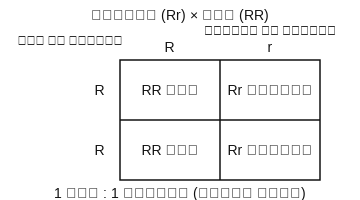
A pink flowered Snapdragon plant was crossed with a red flowered Snapdragon plant. What type of phenotype/s is/are expected in the progeny?
एक गुलाबी पुष्प वाले स्नैपड्रैगन (Snapdragon) पादप का संकरण लाल पुष्प वाले स्नैपड्रैगन पादप से कराया गया। संतति में किस प्रकार का/के लक्षणप्ररूप अपेक्षित है/हैं?
  1. ARed flowered as well as pink flowered plantsलाल पुष्प वाले तथा गुलाबी पुष्प वाले पादप
  2. BOnly pink flowered plantsकेवल गुलाबी पुष्प वाले पादप
  3. CRed, Pink as well as white flowered plantsलाल, गुलाबी तथा सफ़ेद पुष्प वाले पादप
  4. DOnly red flowered plantsकेवल लाल पुष्प वाले पादप
Show answer

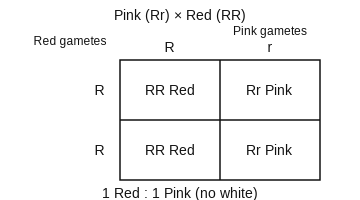
Concept: Flower colour in snapdragon (Antirrhinum) shows incomplete dominance: RR is red, Rr is pink and rr is white.

  1. Pink (Rr) × Red (RR).
  2. Gametes: R and r from the pink parent, R only from the red parent.
  3. Progeny: 1 RR (red) : 1 Rr (pink).
  4. No rr plant can form, so white is impossible. (B), (C) and (D) are therefore wrong.

Short trick: Under incomplete dominance, phenotype ratio = genotype ratio. Any cross with RR can never give white.

Answer: (A) Red flowered as well as pink flowered plants

अवधारणा: स्नैपड्रैगन (Antirrhinum) में पुष्प का रंग अपूर्ण प्रभाविता दर्शाता है: RR लाल, Rr गुलाबी और rr सफ़ेद।

  1. गुलाबी (Rr) × लाल (RR)।
  2. युग्मक: गुलाबी जनक से R और r, लाल जनक से केवल R।
  3. संतति: 1 RR (लाल) : 1 Rr (गुलाबी)।
  4. कोई rr पादप नहीं बन सकता, अतः सफ़ेद असंभव है। इसलिए (B), (C) और (D) गलत हैं।

शॉर्ट ट्रिक: अपूर्ण प्रभाविता में लक्षणप्ररूप अनुपात = जीनोटाइप अनुपात। RR वाले किसी भी संकरण से सफ़ेद कभी नहीं आ सकता।

उत्तर: (A) लाल तथा गुलाबी पुष्प वाले पादप

NEET UGBotanyPrinciples of inheritance – incomplete dominanceNEET UG 2024 · 5 May Shift 1 →
Q4292.
Inhibition of Succinic dehydrogenase enzyme by malonate is a classical example of
मैलोनेट द्वारा सक्सिनिक डीहाइड्रोजिनेज़ एंजाइम का संदमन किसका उत्कृष्ट उदाहरण है?
  1. AFeedback inhibitionपुनर्भरण संदमन (Feedback inhibition)
  2. BCompetitive inhibitionस्पर्धी संदमन (Competitive inhibition)
  3. CEnzyme activationएंजाइम सक्रियण
  4. DCofactor inhibitionसहकारक संदमन
Show answer

Concept: A competitive inhibitor closely resembles the substrate in structure and competes with it for the enzyme's active site.

  1. Malonate (–OOC–CH2–COO–) resembles succinate (–OOC–CH2–CH2–COO–).
  2. It binds to the active site of succinic dehydrogenase, so succinate cannot bind and enzyme action falls.
  3. Feedback inhibition is inhibition by an end product, usually at an allosteric site, so it is not this case. Malonate does not activate the enzyme or act on a cofactor.

Short trick: Look-alike molecules compete. Malonate is the "mal-succinate" that occupies the succinate site.

Answer: (B) Competitive inhibition

अवधारणा: स्पर्धी संदमक की संरचना क्रियाधार (substrate) से बहुत मिलती है और वह एंजाइम के सक्रिय स्थल के लिए क्रियाधार से स्पर्धा करता है।

  1. मैलोनेट (–OOC–CH2–COO–) सक्सिनेट (–OOC–CH2–CH2–COO–) जैसा दिखता है।
  2. यह सक्सिनिक डीहाइड्रोजिनेज़ के सक्रिय स्थल से जुड़ता है, अतः सक्सिनेट नहीं जुड़ पाता और एंजाइम क्रिया घट जाती है।
  3. पुनर्भरण संदमन अंतिम उत्पाद द्वारा होता है, प्रायः ऐलोस्टेरिक स्थल पर, इसलिए यह वह स्थिति नहीं है। मैलोनेट एंजाइम को सक्रिय नहीं करता और न ही सहकारक पर कार्य करता है।

शॉर्ट ट्रिक: एक जैसे दिखने वाले अणु स्पर्धा करते हैं। मैलोनेट वह "नकली सक्सिनेट" है जो सक्सिनेट का स्थान घेर लेता है।

उत्तर: (B) स्पर्धी संदमन

NEET UGBotanyBiomolecules – enzyme inhibitionNEET UG 2024 · 5 May Shift 1 →
Q4293.
Given below are two statements:
Statement I: Bt toxins are insect group specific and coded by a gene cryIAc.
Statement II: Bt toxin exists as inactive protoxin in B. thuringiensis. However, after ingestion by the insect the inactive protoxin gets converted into active form due to acidic pH of the insect gut.
In the light of the above statements, choose the correct answer from the options given below:
नीचे दो कथन दिए गए हैं:
कथन I: Bt विष कीट-समूह विशिष्ट होते हैं और जीन cryIAc द्वारा कोडित होते हैं।
कथन II: B. thuringiensis में Bt विष निष्क्रिय पूर्वविष (protoxin) के रूप में रहता है। परंतु कीट द्वारा निगले जाने के बाद, कीट की आहारनाल के अम्लीय pH के कारण निष्क्रिय पूर्वविष सक्रिय रूप में बदल जाता है।
उपर्युक्त कथनों के आलोक में, नीचे दिए गए विकल्पों में से सही उत्तर चुनिए:
  1. ABoth Statement I and Statement II are falseकथन I और कथन II दोनों असत्य हैं
  2. BStatement I is true but Statement II is falseकथन I सत्य है परन्तु कथन II असत्य है
  3. CStatement I is false but Statement II is trueकथन I असत्य है परन्तु कथन II सत्य है
  4. DBoth Statement I and Statement II are trueकथन I और कथन II दोनों सत्य हैं
Show answer

Concept: Bt toxin is a protoxin that is activated by the alkaline pH of the insect gut, which solubilises the crystals.

  1. Statement I – true. NCERT says most Bt toxins are insect-group specific, and the toxin is coded by genes such as cryIAc. cryIAc and cryIIAb control cotton bollworms.
  2. Statement II – false. The protoxin is activated by the alkaline pH of the gut, not an acidic pH. The active toxin binds to midgut epithelial cells, creates pores, and the cells swell, lyse and the insect dies.

Short trick: Remember "Alkaline Activates": two A's for Bt toxin.

Answer: (B) Statement I is true but Statement II is false

अवधारणा: Bt विष एक पूर्वविष है जो कीट की आहारनाल के क्षारीय pH से सक्रिय होता है; यही pH क्रिस्टलों को घोलता है।

  1. कथन I – सत्य। NCERT के अनुसार अधिकांश Bt विष कीट-समूह विशिष्ट होते हैं, और विष cryIAc जैसे जीनों द्वारा कोडित होता है। cryIAc और cryIIAb कपास के बॉलवर्म को नियंत्रित करते हैं।
  2. कथन II – असत्य। पूर्वविष आहारनाल के क्षारीय pH से सक्रिय होता है, अम्लीय से नहीं। सक्रिय विष मध्यांत्र की उपकला कोशिकाओं से जुड़कर छिद्र बनाता है, कोशिकाएँ फूलकर फट जाती हैं और कीट मर जाता है।

शॉर्ट ट्रिक: "Alkaline Activates" याद रखें: Bt विष के लिए दो A।

उत्तर: (B) कथन I सत्य है परन्तु कथन II असत्य है

NEET UGBotanyBiotechnology applications – Bt toxinNEET UG 2024 · 5 May Shift 1 →
Q4294.
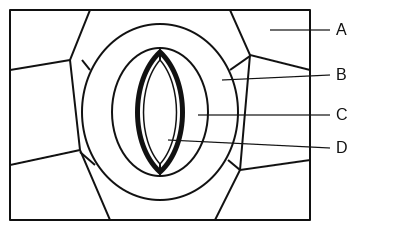
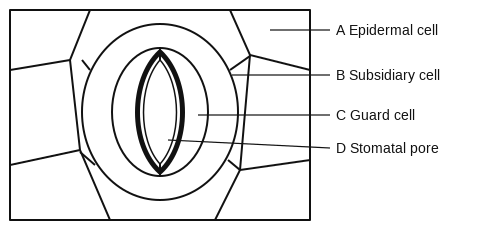
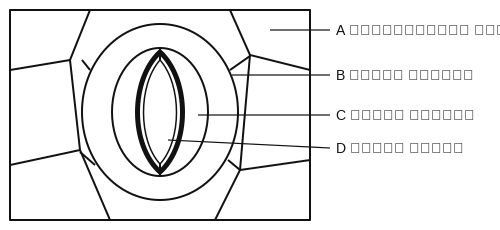
In the given figure, which component has thin outer walls and highly thickened inner walls?
दिए गए चित्र में किस घटक की बाहरी भित्ति पतली और भीतरी भित्ति अत्यधिक मोटी होती है?
  1. AD
  2. BA
  3. CB
  4. DC
Show answer

Concept: The guard cells of a stoma have thin outer walls (away from the pore) and highly thickened inner walls (towards the pore).

  1. A = epidermal cell, B = subsidiary cell, C = guard cell, D = stomatal aperture (pore).
  2. Only the guard cells have this uneven wall thickening. When they become turgid, the thin outer wall bulges outwards and the pore opens.
  3. C is the guard cell, which is option (D).

Short trick: The thick inner wall faces the pore, like a "lip" of the stomatal mouth. Mind the option order: C is option (D).

Answer: (D) C

अवधारणा: रंध्र की द्वार कोशिकाओं की बाहरी भित्ति (छिद्र से दूर) पतली और भीतरी भित्ति (छिद्र की ओर) अत्यधिक मोटी होती है।

  1. A = बाह्यत्वचीय कोशिका, B = सहायक कोशिका, C = द्वार कोशिका, D = रंध्र छिद्र।
  2. केवल द्वार कोशिकाओं में यह असमान भित्ति-स्थूलन होता है। स्फीत होने पर पतली बाहरी भित्ति बाहर की ओर फूलती है और छिद्र खुल जाता है।
  3. C द्वार कोशिका है, जो विकल्प (D) है।

शॉर्ट ट्रिक: मोटी भीतरी भित्ति छिद्र की ओर होती है, जैसे रंध्र-मुख का "होंठ"। विकल्प-क्रम पर ध्यान दें: C विकल्प (D) है।

उत्तर: (D) C

NEET UGBotanyAnatomy of flowering plants – stomatal apparatusNEET UG 2024 · 5 May Shift 1 →
Q4295.
Which one of the following can be explained on the basis of Mendel's law of Dominance?
A. Out of one pair of factors one is dominant and the other is recessive.
B. Alleles do not show any expression and both the characters appear as such in F2 generation.
C. Factors occur in pairs in normal diploid plants.
D. The discrete unit controlling a particular character is called factor.
E. The expression of only one of the parental characters is found in a monohybrid cross.
Choose the correct answer from the options given below:
मेंडल के प्रभाविता के नियम के आधार पर निम्नलिखित में से किसकी व्याख्या की जा सकती है?
A. कारकों के एक युग्म में से एक प्रभावी और दूसरा अप्रभावी होता है।
B. युग्मविकल्पी कोई अभिव्यक्ति नहीं दर्शाते और दोनों लक्षण F2 पीढ़ी में ज्यों-के-त्यों प्रकट होते हैं।
C. सामान्य द्विगुणित पादपों में कारक युग्मों में होते हैं।
D. किसी विशेष लक्षण को नियंत्रित करने वाली विविक्त इकाई को कारक कहते हैं।
E. एकसंकर संकरण में जनकों के केवल एक लक्षण की अभिव्यक्ति मिलती है।
नीचे दिए गए विकल्पों में से सही उत्तर चुनिए:
  1. AA, C, D and E onlyकेवल A, C, D और E
  2. BB, C, and D onlyकेवल B, C और D
  3. CA, B, C, D and EA, B, C, D और E
  4. DA, B and C onlyकेवल A, B और C
Show answer

Concept: NCERT states the law of dominance in three parts: (i) characters are controlled by discrete units called factors, (ii) factors occur in pairs, and (iii) in a dissimilar pair, one member dominates (dominant) over the other (recessive). The law explains why only one parental character is expressed in the F1 of a monohybrid cross.

  1. D matches part (i), C matches part (ii), and A matches part (iii).
  2. E is the observation the law explains: only one parental character appears in the F1.
  3. B is wrong. Alleles do express themselves, and the dominant one masks the recessive. B does not follow from dominance.

Short trick: B is the odd statement out. The only option without B is (A).

Answer: (A) A, C, D and E only

अवधारणा: NCERT प्रभाविता के नियम को तीन भागों में बताती है: (i) लक्षण विविक्त इकाइयों द्वारा नियंत्रित होते हैं जिन्हें कारक कहते हैं, (ii) कारक युग्मों में होते हैं, और (iii) असमान युग्म में एक सदस्य (प्रभावी) दूसरे (अप्रभावी) पर प्रभावी होता है। यह नियम बताता है कि एकसंकर संकरण की F1 में जनकों का केवल एक लक्षण क्यों प्रकट होता है।

  1. D भाग (i) से, C भाग (ii) से और A भाग (iii) से मेल खाता है।
  2. E वह प्रेक्षण है जिसकी व्याख्या यह नियम करता है: F1 में जनकों का केवल एक लक्षण दिखता है।
  3. B गलत है। युग्मविकल्पी अभिव्यक्त होते हैं, और प्रभावी अप्रभावी को छिपा देता है। B प्रभाविता से नहीं निकलता।

शॉर्ट ट्रिक: B अलग कथन है। B रहित एकमात्र विकल्प (A) है।

उत्तर: (A) केवल A, C, D और E

NEET UGBotanyPrinciples of inheritance – law of dominanceNEET UG 2024 · 5 May Shift 1 →
Q4296.
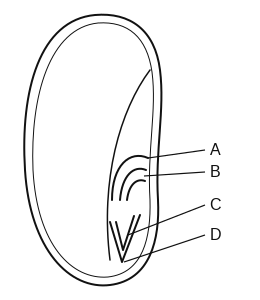
Identify the part of the seed from the given figure which is destined to form root when the seed germinates.
दिए गए चित्र में बीज के उस भाग को पहचानिए जो बीज के अंकुरण पर जड़ बनाता है।
  1. AB
  2. BC
  3. CD
  4. DA
Show answer

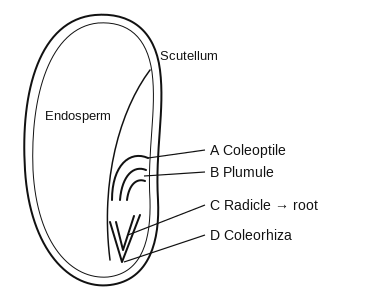
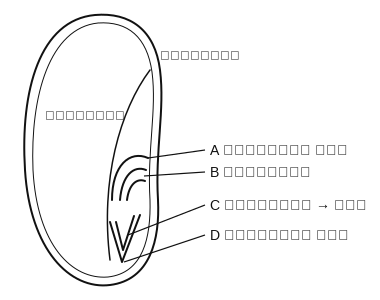
Concept: In a monocot seed (e.g. maize), the embryo axis has a plumule enclosed in the coleoptile at its upper end and a radicle enclosed in the coleorhiza at its lower end. The radicle forms the root.

  1. A = coleoptile (the outer sheath of the shoot tip) and B = plumule (the future shoot).
  2. C = radicle (the future root) and D = coleorhiza (the sheath around the radicle).
  3. The radicle, C, forms the root. C is option (B).

Short trick: Pair the words: rhiza = root sheath, so the radicle is inside it. ptile = shoot sheath, so the plumule is inside it. The inner of the lower pair (C) is the root.

Answer: (B) C

अवधारणा: एकबीजपत्री बीज (जैसे मक्का) में भ्रूणीय अक्ष के ऊपरी सिरे पर प्रांकुर चोल (coleoptile) में बंद प्रांकुर और निचले सिरे पर मूलांकुर चोल (coleorhiza) में बंद मूलांकुर होता है। मूलांकुर जड़ बनाता है।

  1. A = प्रांकुर चोल (प्ररोह-शीर्ष का बाहरी आवरण) और B = प्रांकुर (भावी प्ररोह)।
  2. C = मूलांकुर (भावी जड़) और D = मूलांकुर चोल (मूलांकुर का आवरण)।
  3. मूलांकुर C जड़ बनाता है। C विकल्प (B) है।

शॉर्ट ट्रिक: शब्दों का जोड़ा बनाएँ: rhiza = जड़ का आवरण, अतः मूलांकुर उसके अंदर; ptile = प्ररोह का आवरण, अतः प्रांकुर उसके अंदर। नीचे वाले जोड़े का भीतरी भाग (C) जड़ है।

उत्तर: (B) C

NEET UGBotanyMorphology of flowering plants – monocot seedNEET UG 2024 · 5 May Shift 1 →
Q4297.
Auxin is used by gardeners to prepare weed-free lawns. But no damage is caused to grass as auxin
माली खरपतवार-मुक्त लॉन तैयार करने के लिए ऑक्सिन का उपयोग करते हैं। परंतु घास को कोई हानि नहीं होती, क्योंकि ऑक्सिन
  1. Apromotes abscission of mature leaves onlyकेवल परिपक्व पत्तियों के विलगन (abscission) को बढ़ाता है
  2. Bdoes not affect mature monocotyledon plantsपरिपक्व एकबीजपत्री पादपों को प्रभावित नहीं करता
  3. Ccan help in cell division in grasses, to produce growthघासों में कोशिका विभाजन में सहायता कर वृद्धि उत्पन्न करता है
  4. Dpromotes apical dominanceशीर्ष प्रभाविता को बढ़ाता है
Show answer

Concept: NCERT: 2,4-D, a synthetic auxin, is widely used to kill dicotyledonous weeds and does not affect mature monocotyledonous plants. Gardeners use it to prepare weed-free lawns.

  1. Grass is a monocot, so it is unaffected. Broad-leaved (dicot) weeds are killed.
  2. (A) and (D) are real auxin effects, but neither explains why grass is spared. (C) is a cytokinin role and is not the reason.

Short trick: Remember 2,4-D as "Destroys Dicots".

Answer: (B) does not affect mature monocotyledon plants

अवधारणा: NCERT: संश्लेषित ऑक्सिन 2,4-D का व्यापक उपयोग द्विबीजपत्री खरपतवार नष्ट करने में होता है और यह परिपक्व एकबीजपत्री पादपों को प्रभावित नहीं करता। माली इसी से खरपतवार-मुक्त लॉन बनाते हैं।

  1. घास एकबीजपत्री है, इसलिए उस पर प्रभाव नहीं पड़ता। चौड़ी पत्ती वाले (द्विबीजपत्री) खरपतवार नष्ट हो जाते हैं।
  2. (A) और (D) ऑक्सिन के वास्तविक प्रभाव हैं, पर इनमें से कोई भी नहीं बताता कि घास क्यों बचती है। (C) साइटोकाइनिन का कार्य है और यह कारण नहीं है।

शॉर्ट ट्रिक: 2,4-D को "Destroys Dicots" (द्विबीजपत्री नष्ट करे) से याद रखें।

उत्तर: (B) परिपक्व एकबीजपत्री पादपों को प्रभावित नहीं करता

NEET UGBotanyPlant growth regulators – auxin as weedicideNEET UG 2024 · 5 May Shift 1 →
Q4298.
Given below are two statements:
Statement I: Chromosomes become gradually visible under light microscope during leptotene stage.
Statement II: The beginning of diplotene stage is recognized by dissolution of synaptonemal complex.
In the light of the above statements, choose the correct answer from the options given below:
नीचे दो कथन दिए गए हैं:
कथन I: लेप्टोटीन अवस्था में गुणसूत्र धीरे-धीरे प्रकाश सूक्ष्मदर्शी में दिखाई देने लगते हैं।
कथन II: डिप्लोटीन अवस्था का आरंभ सिनैप्टोनीमल सम्मिश्र (synaptonemal complex) के विघटन से पहचाना जाता है।
उपर्युक्त कथनों के आलोक में, नीचे दिए गए विकल्पों में से सही उत्तर चुनिए:
  1. ABoth Statement I and Statement II are falseकथन I और कथन II दोनों असत्य हैं
  2. BStatement I is true but Statement II is falseकथन I सत्य है परन्तु कथन II असत्य है
  3. CStatement I is false but Statement II is trueकथन I असत्य है परन्तु कथन II सत्य है
  4. DBoth Statement I and Statement II are trueकथन I और कथन II दोनों सत्य हैं
Show answer

Concept: The stages of prophase I are leptotene, zygotene, pachytene, diplotene and diakinesis.

  1. Statement I – true. In leptotene, chromosomes gradually become visible under the light microscope as compaction continues.
  2. Statement II – true. The start of diplotene is marked by dissolution of the synaptonemal complex. The homologues then begin to separate except at the chiasmata.

Short trick: The synaptonemal complex forms in Zygotene and dissolves in Diplotene. Think "Zip" in zygotene and "Divorce" in diplotene.

Answer: (D) Both Statement I and Statement II are true

अवधारणा: पूर्वावस्था I के चरण हैं: लेप्टोटीन, ज़ाइगोटीन, पैकीटीन, डिप्लोटीन और डायाकाइनेसिस।

  1. कथन I – सत्य। लेप्टोटीन में संघनन जारी रहने से गुणसूत्र धीरे-धीरे प्रकाश सूक्ष्मदर्शी में दिखने लगते हैं।
  2. कथन II – सत्य। डिप्लोटीन का आरंभ सिनैप्टोनीमल सम्मिश्र के विघटन से होता है। इसके बाद समजात गुणसूत्र काइऐज़्मा को छोड़कर अलग होने लगते हैं।

शॉर्ट ट्रिक: सिनैप्टोनीमल सम्मिश्र ज़ाइगोटीन में बनता है और डिप्लोटीन में घुलता है। ज़ाइगोटीन में "Zip" और डिप्लोटीन में "Divorce" सोचें।

उत्तर: (D) कथन I और कथन II दोनों सत्य हैं

NEET UGBotanyCell cycle – meiosis prophase INEET UG 2024 · 5 May Shift 1 →
Q4299.
The capacity to generate a whole plant from any cell of the plant is called
पादप की किसी भी कोशिका से पूर्ण पादप उत्पन्न करने की क्षमता कहलाती है:
  1. AMicropropagationसूक्ष्मप्रवर्धन (Micropropagation)
  2. BDifferentiationविभेदन
  3. CSomatic hybridizationकायिक संकरण
  4. DTotipotencyपूर्णशक्तता (Totipotency)
Show answer

Concept: NCERT: the capacity to generate a whole plant from any cell or explant is called totipotency.

  1. Totipotency is the basis of tissue culture.
  2. Micropropagation is the technique that uses tissue culture to raise many plants quickly. It applies totipotency but is not the capacity itself.
  3. Differentiation is the maturation of cells, and somatic hybridisation is protoplast fusion.

Short trick: Toti = total. A cell with total potential can form a whole plant.

Answer: (D) Totipotency

अवधारणा: NCERT: किसी भी कोशिका या कर्तोतक (explant) से पूर्ण पादप उत्पन्न करने की क्षमता को पूर्णशक्तता कहते हैं।

  1. पूर्णशक्तता ऊतक संवर्धन का आधार है।
  2. सूक्ष्मप्रवर्धन वह तकनीक है जिसमें ऊतक संवर्धन से शीघ्र अनेक पादप उगाए जाते हैं। यह पूर्णशक्तता का उपयोग है, स्वयं वह क्षमता नहीं।
  3. विभेदन कोशिकाओं का परिपक्व होना है, और कायिक संकरण जीवद्रव्यक (protoplast) संलयन है।

शॉर्ट ट्रिक: पूर्ण + शक्तता: पूर्ण क्षमता वाली एक कोशिका पूरा पादप बना सकती है।

उत्तर: (D) पूर्णशक्तता

NEET UGBotanyBiotechnology – plant tissue cultureNEET UG 2024 · 5 May Shift 1 →
Q4300.
Given below are two statements:
Statement I: Parenchyma is living but collenchyma is dead tissue.
Statement II: Gymnosperms lack xylem vessels but presence of xylem vessels is the characteristic of angiosperms.
In the light of the above statements, choose the correct answer from the options given below:
नीचे दो कथन दिए गए हैं:
कथन I: मृदूतक (Parenchyma) जीवित है परंतु स्थूलकोण ऊतक (collenchyma) मृत ऊतक है।
कथन II: अनावृतबीजियों में जाइलम वाहिकाएँ नहीं होतीं, परंतु जाइलम वाहिकाओं की उपस्थिति आवृतबीजियों का अभिलक्षण है।
उपर्युक्त कथनों के आलोक में, नीचे दिए गए विकल्पों में से सही उत्तर चुनिए:
  1. ABoth Statement I and Statement II are falseकथन I और कथन II दोनों असत्य हैं
  2. BStatement I is true but Statement II is falseकथन I सत्य है परन्तु कथन II असत्य है
  3. CStatement I is false but Statement II is trueकथन I असत्य है परन्तु कथन II सत्य है
  4. DBoth Statement I and Statement II are trueकथन I और कथन II दोनों सत्य हैं
Show answer

Concept: Parenchyma and collenchyma are both living simple permanent tissues. Sclerenchyma is the dead one. Vessels are a characteristic feature of angiosperms.

  1. Statement I – false. Collenchyma is living, with cellulose, hemicellulose and pectin thickening at the corners. Sclerenchyma is dead.
  2. Statement II – true. NCERT: "Gymnosperms lack vessels in their xylem." The presence of vessels is a characteristic feature of angiosperms.

Short trick: Of the three simple tissues, only Sclerenchyma is dead. Remember "S for Stone-dead".

Answer: (C) Statement I is false but Statement II is true

अवधारणा: मृदूतक और स्थूलकोण ऊतक दोनों जीवित सरल स्थायी ऊतक हैं। दृढ़ोतक (sclerenchyma) मृत होता है। वाहिकाएँ आवृतबीजियों का अभिलक्षण हैं।

  1. कथन I – असत्य। स्थूलकोण ऊतक जीवित होता है और उसके कोनों पर सेलुलोज़, हेमीसेलुलोज़ और पेक्टिन का स्थूलन होता है। दृढ़ोतक मृत होता है।
  2. कथन II – सत्य। NCERT: "अनावृतबीजियों के जाइलम में वाहिकाएँ नहीं होतीं।" वाहिकाओं की उपस्थिति आवृतबीजियों का अभिलक्षण है।

शॉर्ट ट्रिक: तीन सरल ऊतकों में से केवल दृढ़ोतक (Sclerenchyma) मृत है। "S for Stone-dead" याद रखें।

उत्तर: (C) कथन I असत्य है परन्तु कथन II सत्य है

NEET UGBotanyAnatomy of flowering plants – tissuesNEET UG 2024 · 5 May Shift 1 →