Question bank

Q&A: practice questions with answers

Search questions on any topic. Filter by exam category, exam, subject and topic, try the question, then open the answer and explanation.

Courses – airGurukul

53,050 questions in the question bank.

Q4381.
The dimensions [MLT-2A-2] belong to the:
विमाएँ [MLT-2A-2] किसकी हैं?
  1. AMagnetic fluxचुम्बकीय फ्लक्स
  2. BSelf inductanceस्वप्रेरकत्व
  3. CMagnetic permeabilityचुम्बकीय पारगम्यता (permeability)
  4. DElectric permittivityविद्युत विद्युतशीलता (permittivity)
Show answer

Concept: From F=μ0I1I2l2πd: [μ0]=[F][I2]=[MLT−2A−2].

  1. Magnetic flux: [ML2T−2A−1] – wrong.
  2. Self inductance: [ML2T−2A−2] – wrong (extra L).
  3. Permittivity ϵ0: [M−1L−3T4A2] – wrong.
  4. Permeability μ0: [MLT−2A−2] – matches.

Short trick: μ0 = force per (current)²; also μ0ϵ0=1/c2 cross-checks.

Answer: (C) Magnetic permeability

अवधारणा: F=μ0I1I2l2πd से: [μ0]=[F][I2]=[MLT−2A−2]।

  1. चुम्बकीय फ्लक्स: [ML2T−2A−1] – गलत।
  2. स्वप्रेरकत्व: [ML2T−2A−2] – गलत (एक L अतिरिक्त)।
  3. विद्युतशीलता ϵ0: [M−1L−3T4A2] – गलत।
  4. पारगम्यता μ0: [MLT−2A−2] – मेल खाता है।

शॉर्ट ट्रिक: μ0 = बल प्रति (धारा)²; साथ ही μ0ϵ0=1/c2 से जाँच करें।

उत्तर: (C) चुम्बकीय पारगम्यता
NEET UGPhysicsUnits and dimensions – magnetic permeabilityNEET UG 2022 · 17 Jul Shift 1 →
Q4382.
If the initial tension on a stretched string is doubled, then the ratio of the initial and final speeds of a transverse wave along the string is:
यदि किसी तनी हुई डोरी का प्रारंभिक तनाव दोगुना कर दिया जाए, तो डोरी के अनुदिश अनुप्रस्थ तरंग की प्रारंभिक तथा अंतिम चालों का अनुपात है:
  1. A1 : 1
  2. B2 : 1
  3. C1 : 2
  4. D1 : 2
Show answer

Concept: v=Tμ ⇒ v∝T for the same string.

  1. vivf=TiTf=T2T
  2. =12 ⇒ ratio 1 : 2

Short trick: Tension doubled ⇒ speed × √2; initial : final = 1 : √2.

Answer: (C) 1 : 2

अवधारणा: v=Tμ ⇒ उसी डोरी के लिए v∝T।

  1. vivf=TiTf=T2T
  2. =12 ⇒ अनुपात 1 : 2

शॉर्ट ट्रिक: तनाव दोगुना ⇒ चाल × √2; प्रारंभिक : अंतिम = 1 : √2।

उत्तर: (C) 1 : 2

NEET UGPhysicsWaves – speed of transverse wave on a stringNEET UG 2022 · 17 Jul Shift 1 →
Q4383.
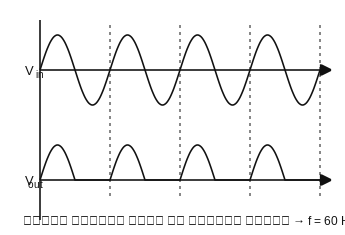
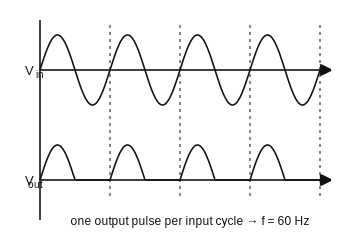
In half wave rectification, if the input frequency is 60 Hz, then the output frequency would be:
अर्ध-तरंग दिष्टकरण में यदि निवेशी आवृत्ति 60 Hz हो, तो निर्गत आवृत्ति होगी:
  1. AZeroशून्य
  2. B30 Hz
  3. C60 Hz
  4. D120 Hz
Show answer

Concept: A half-wave rectifier passes only one half of every input cycle, so it gives one output pulse per input cycle.

  1. Input: 60 cycles per second.
  2. Output: one positive pulse for each cycle ⇒ 60 pulses per second.
  3. Output (ripple) frequency = 60 Hz. A full-wave rectifier would give 2 × 60 = 120 Hz (option D trap).

Short trick: Half-wave: fout = fin; full-wave: fout = 2fin.

Answer: (C) 60 Hz

अवधारणा: अर्ध-तरंग दिष्टकारी प्रत्येक निवेशी चक्र का केवल एक अर्धभाग पारित करता है, अतः प्रत्येक निवेशी चक्र पर एक निर्गत स्पंद देता है।

  1. निवेश: 60 चक्र प्रति सेकंड।
  2. निर्गत: प्रत्येक चक्र के लिए एक धनात्मक स्पंद ⇒ 60 स्पंद प्रति सेकंड।
  3. निर्गत (ऊर्मिका) आवृत्ति = 60 Hz। पूर्ण-तरंग दिष्टकारी 2 × 60 = 120 Hz देगा (विकल्प D का भ्रम)।

शॉर्ट ट्रिक: अर्ध-तरंग: fout = fin; पूर्ण-तरंग: fout = 2fin।

उत्तर: (C) 60 Hz

NEET UGPhysicsSemiconductors – half-wave rectifierNEET UG 2022 · 17 Jul Shift 1 →
Q4384.
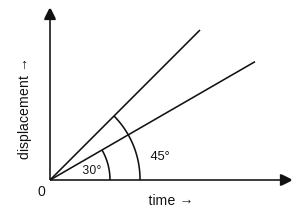
The displacement time graphs of two moving particles make angles of 30° and 45° with the x-axis as shown in the figure. The ratio of their respective velocity is
दो गतिमान कणों के विस्थापन-समय ग्राफ x-अक्ष से 30° तथा 45° के कोण बनाते हैं, जैसा चित्र में दर्शाया गया है। उनके संगत वेगों का अनुपात है
  1. A3 : 1
  2. B1 : 1
  3. C1 : 2
  4. D1 : 3
Show answer

Concept: Velocity = slope of the displacement-time graph = tan⁡θ.

  1. v1=tan⁡30∘=13, v2=tan⁡45∘=1
  2. v1:v2=13:1=1:3

Short trick: Steeper line = faster; 30° line is slower, so the ratio must be less than 1 – only (C) or (D); tan ratio gives (D).

Answer: (D) 1 : 3

अवधारणा: वेग = विस्थापन-समय ग्राफ की ढाल = tan⁡θ।

  1. v1=tan⁡30∘=13, v2=tan⁡45∘=1
  2. v1:v2=13:1=1:3

शॉर्ट ट्रिक: अधिक ढालू रेखा = अधिक तेज़; 30° वाली रेखा धीमी है, अतः अनुपात 1 से कम – केवल (C) या (D); tan का अनुपात (D) देता है।

उत्तर: (D) 1 : 3

NEET UGPhysicsKinematics – slope of displacement-time graphNEET UG 2022 · 17 Jul Shift 1 →
Q4385.
A square loop of side 1 m and resistance 1 Ω is placed in a magnetic field of 0.5 T. If the plane of loop is perpendicular to the direction of magnetic field, the magnetic flux through the loop is
1 m भुजा तथा 1 Ω प्रतिरोध का एक वर्गाकार लूप 0.5 T के चुम्बकीय क्षेत्र में रखा है। यदि लूप का तल चुम्बकीय क्षेत्र की दिशा के लंबवत हो, तो लूप से गुजरने वाला चुम्बकीय फ्लक्स है
  1. A2 weber2 वेबर
  2. B0.5 weber0.5 वेबर
  3. C1 weber1 वेबर
  4. DZero weberशून्य वेबर
Show answer

Concept: ϕ=BAcos⁡θ, θ = angle between B→ and the area vector (normal to the plane).

  1. Plane ⊥ field ⇒ normal ∥ field ⇒ θ = 0°.
  2. ϕ=0.5×12×cos⁡0∘=0.5 Wb
  3. Resistance 1 Ω is irrelevant to flux.

Short trick: “Plane perpendicular to B” = maximum flux BA; “plane parallel to B” = zero flux.

Answer: (B) 0.5 weber

अवधारणा: ϕ=BAcos⁡θ, θ = B→ तथा क्षेत्रफल सदिश (तल के अभिलंब) के बीच कोण।

  1. तल ⊥ क्षेत्र ⇒ अभिलंब ∥ क्षेत्र ⇒ θ = 0°।
  2. ϕ=0.5×12×cos⁡0∘=0.5 Wb
  3. 1 Ω प्रतिरोध फ्लक्स के लिए अप्रासंगिक है।

शॉर्ट ट्रिक: “तल B के लंबवत” = अधिकतम फ्लक्स BA; “तल B के समांतर” = शून्य फ्लक्स।

उत्तर: (B) 0.5 वेबर

NEET UGPhysicsEMI – magnetic fluxNEET UG 2022 · 17 Jul Shift 1 →
Q4386.
The energy that will be ideally radiated by a 100 kW transmitter in 1 hour is:
एक 100 kW प्रेषित्र (transmitter) द्वारा 1 घंटे में आदर्श रूप से विकिरित ऊर्जा होगी:
  1. A36 × 107 J
  2. B36 × 104 J
  3. C36 × 105 J
  4. D1 × 105 J
Show answer

Concept: Energy = Power × time (SI units).

  1. P = 100 kW = 105 W; t = 1 h = 3600 s
  2. E=105×3600=3.6×10⁸ J
  3. =36×107 J

Short trick: 1 kWh = 3.6 × 10⁶ J ⇒ 100 kWh = 3.6 × 10⁸ J.

Answer: (A) 36 × 107 J

अवधारणा: ऊर्जा = शक्ति × समय (SI मात्रकों में)।

  1. P = 100 kW = 105 W; t = 1 h = 3600 s
  2. E=105×3600=3.6×10⁸ J
  3. =36×107 J

शॉर्ट ट्रिक: 1 kWh = 3.6 × 10⁶ J ⇒ 100 kWh = 3.6 × 10⁸ J।

उत्तर: (A) 36 × 107 J

NEET UGPhysicsWork, energy and power – energy from powerNEET UG 2022 · 17 Jul Shift 1 →
Q4387.
A body of mass 60 g experiences a gravitational force of 3.0 N, when placed at a particular point. The magnitude of the gravitational field intensity at that point is :
60 g द्रव्यमान की एक वस्तु किसी विशेष बिंदु पर रखे जाने पर 3.0 N का गुरुत्वीय बल अनुभव करती है। उस बिंदु पर गुरुत्वीय क्षेत्र तीव्रता का परिमाण है:
  1. A0.05 N/kg
  2. B50 N/kg
  3. C20 N/kg
  4. D180 N/kg
Show answer

Concept: Gravitational field intensity = force per unit mass, Eg=Fm.

  1. m = 60 g = 0.06 kg
  2. Eg=3.00.06=50 N/kg

Short trick: Convert grams to kg first – using 60 directly gives the trap 0.05.

Answer: (B) 50 N/kg

अवधारणा: गुरुत्वीय क्षेत्र तीव्रता = प्रति एकांक द्रव्यमान बल, Eg=Fm।

  1. m = 60 g = 0.06 kg
  2. Eg=3.00.06=50 N/kg

शॉर्ट ट्रिक: पहले ग्राम को kg में बदलें – सीधे 60 लेने पर भ्रामक उत्तर 0.05 आता है।

उत्तर: (B) 50 N/kg

NEET UGPhysicsGravitation – gravitational field intensityNEET UG 2022 · 17 Jul Shift 1 →
Q4388.
Match List - I with List - II
List-I
(Electromagnetic Waves)
List-II
(Wavelength)
(a) AM radio waves(i) 10-10 m
(b) Microwaves(ii) 102 m
(c) Infrared radiations(iii) 10-2 m
(d) X-rays(iv) 10-4 m
Choose the correct answer from the options given below:
सूची - I का सूची - II से मिलान कीजिए
सूची-I
(विद्युतचुम्बकीय तरंगें)
सूची-II
(तरंगदैर्घ्य)
(a) AM रेडियो तरंगें(i) 10-10 m
(b) सूक्ष्म तरंगें (Microwaves)(ii) 102 m
(c) अवरक्त विकिरण (Infrared)(iii) 10-2 m
(d) X-किरणें(iv) 10-4 m
नीचे दिए गए विकल्पों में से सही उत्तर चुनिए:
  1. A(a) - (iv), (b) - (iii), (c) - (ii), (d) - (i)
  2. B(a) - (iii), (b) - (ii), (c) - (i), (d) - (iv)
  3. C(a) - (iii), (b) - (iv), (c) - (ii), (d) - (i)
  4. D(a) - (ii), (b) - (iii), (c) - (iv), (d) - (i)
Show answer

Concept: Order of wavelengths: radio > microwave > infrared > visible > UV > X-rays > γ-rays.

  1. AM radio waves: hundreds of metres → 102 m (ii).
  2. Microwaves: mm–cm range → 10−2 m (iii).
  3. Infrared: about 10−4 m (iv) (between microwave and visible).
  4. X-rays: about 10−10 m = 1 Å (i).

Short trick: “Raging Martians Invaded Venus Using X-ray Guns” – λ decreases left to right; just place the four values in descending order.

Answer: (D) (a) - (ii), (b) - (iii), (c) - (iv), (d) - (i)

अवधारणा: तरंगदैर्घ्य का क्रम: रेडियो > सूक्ष्म तरंग > अवरक्त > दृश्य > पराबैंगनी > X-किरणें > γ-किरणें।

  1. AM रेडियो तरंगें: सैकड़ों मीटर → 102 m (ii)।
  2. सूक्ष्म तरंगें: mm–cm परास → 10−2 m (iii)।
  3. अवरक्त: लगभग 10−4 m (iv) (सूक्ष्म तरंग और दृश्य के बीच)।
  4. X-किरणें: लगभग 10−10 m = 1 Å (i)।

शॉर्ट ट्रिक: “Raging Martians Invaded Venus Using X-ray Guns” – बाएँ से दाएँ λ घटती है; चारों मानों को अवरोही क्रम में रख दें।

उत्तर: (D) (a) - (ii), (b) - (iii), (c) - (iv), (d) - (i)

NEET UGPhysicsEM waves – electromagnetic spectrumNEET UG 2022 · 17 Jul Shift 1 →
Q4389.
A shell of mass m is at rest initially. It explodes into three fragments having mass in the ratio 2 : 2 : 1. If the fragments having equal mass fly off along mutually perpendicular directions with speed v, the speed of the third (lighter) fragment is
m द्रव्यमान का एक गोला प्रारंभ में विरामावस्था में है। यह 2 : 2 : 1 द्रव्यमान अनुपात वाले तीन टुकड़ों में फट जाता है। यदि समान द्रव्यमान वाले टुकड़े परस्पर लंबवत दिशाओं में v चाल से उड़ते हैं, तो तीसरे (हल्के) टुकड़े की चाल है
  1. Av
  2. B2v
  3. C22v
  4. D32v
Show answer

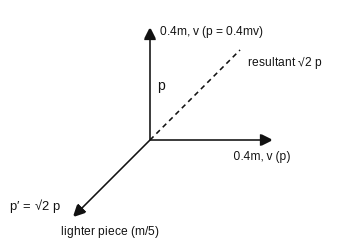
Concept: Initial momentum is zero, so the vector sum of the three fragment momenta is zero.

  1. Masses: 2m5,2m5,m5 i.e. 0.4m, 0.4m, 0.2m.
  2. Each equal piece: p = 0.4mv; they are perpendicular ⇒ resultant = 2×0.4mv.
  3. Lighter piece: 0.2mv′=2×0.4mv
  4. v′=22v

Short trick: Mass ratio heavy:light = 2:1 ⇒ speed of light piece = 2 × √2 v.

Answer: (C) 22v

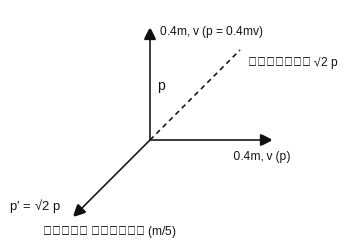
अवधारणा: प्रारंभिक संवेग शून्य है, अतः तीनों टुकड़ों के संवेगों का सदिश योग शून्य होगा।

  1. द्रव्यमान: 2m5,2m5,m5 अर्थात 0.4m, 0.4m, 0.2m।
  2. प्रत्येक समान टुकड़ा: p = 0.4mv; ये लंबवत हैं ⇒ परिणामी = 2×0.4mv।
  3. हल्का टुकड़ा: 0.2mv′=2×0.4mv
  4. v′=22v

शॉर्ट ट्रिक: भारी:हल्का द्रव्यमान = 2:1 ⇒ हल्के टुकड़े की चाल = 2 × √2 v।

उत्तर: (C) 22v

NEET UGPhysicsConservation of momentum – explosionNEET UG 2022 · 17 Jul Shift 1 →
Q4390.
A biconvex lens has radii of curvature, 20 cm each. If the refractive index of the material of the lens is 1.5, the power of the lens is:
एक उभयोत्तल लेंस की प्रत्येक वक्रता त्रिज्या 20 cm है। यदि लेंस के पदार्थ का अपवर्तनांक 1.5 है, तो लेंस की क्षमता है:
  1. A+2D
  2. B+20D
  3. C+5D
  4. DInfinityअनंत
Show answer

Concept: Lens maker’s formula 1f=(μ−1)(1R1−1R2); for biconvex R1=+20 cm, R2=−20 cm.

  1. 1f=0.5(120+120)=0.5×220=120 cm⁻¹
  2. f = 20 cm = 0.2 m
  3. P=1f(m)=10.2=+5 D

Short trick: Equi-biconvex lens with μ = 1.5 ⇒ f = R. So f = 20 cm, P = 100/20 = +5 D.

Answer: (C) +5D

अवधारणा: लेंस निर्माता सूत्र 1f=(μ−1)(1R1−1R2); उभयोत्तल के लिए R1=+20 cm, R2=−20 cm।

  1. 1f=0.5(120+120)=0.5×220=120 cm⁻¹
  2. f = 20 cm = 0.2 m
  3. P=1f(m)=10.2=+5 D

शॉर्ट ट्रिक: μ = 1.5 वाले सम-उभयोत्तल लेंस के लिए f = R। अतः f = 20 cm, P = 100/20 = +5 D।

उत्तर: (C) +5D

NEET UGPhysicsRay optics – lens maker’s formula and powerNEET UG 2022 · 17 Jul Shift 1 →
Q4391.
Given below are two statements
Statement I : Biot-Savart's law gives us the expression for the magnetic field strength of an infinitesimal current element (Idl) of a current carrying conductor only.
Statement II: Biot-Savart's law is analogous to Coulomb's inverse square law of charge q, with the former being related to the field produced by a scalar source, Idl while the latter being produced by a vector source, q.
In light of above statements choose the most appropriate answer from the options given below:
नीचे दो कथन दिए गए हैं
कथन I : बायो-सावर्ट नियम केवल किसी धारावाही चालक के अतिसूक्ष्म धारा अवयव (Idl) के चुम्बकीय क्षेत्र की तीव्रता का व्यंजक देता है।
कथन II : बायो-सावर्ट नियम आवेश q के कूलॉम के व्युत्क्रम वर्ग नियम के अनुरूप है, जिसमें पहला एक अदिश स्रोत Idl द्वारा उत्पन्न क्षेत्र से संबंधित है जबकि दूसरा एक सदिश स्रोत q द्वारा उत्पन्न होता है।
उपरोक्त कथनों के आलोक में नीचे दिए गए विकल्पों में से सबसे उपयुक्त उत्तर चुनिए:
  1. ABoth Statement I and Statement II are correctकथन I तथा कथन II दोनों सही हैं
  2. BBoth Statement I and Statement II are incorrectकथन I तथा कथन II दोनों गलत हैं
  3. CStatement I is correct and Statement II is incorrectकथन I सही है तथा कथन II गलत है
  4. DStatement I is incorrect and Statement II is correctकथन I गलत है तथा कथन II सही है
Show answer

Concept: Biot-Savart law: dB→=μ04πIdl→×r→r3 – the source Idl→ is a vector.

  1. Statement I: the law gives the field of a current element Idl – correct.
  2. Statement II: the analogy (inverse-square) is right, but the labels are swapped – Idl is a vector source and charge q is a scalar source. Hence incorrect.

Short trick: Charge has no direction (scalar); a current element has direction (vector) – that is why Biot-Savart has a cross product.

Answer: (C) Statement I is correct and Statement II is incorrect

अवधारणा: बायो-सावर्ट नियम: dB→=μ04πIdl→×r→r3 – स्रोत Idl→ एक सदिश है।

  1. कथन I: यह नियम धारा अवयव Idl का क्षेत्र देता है – सही।
  2. कथन II: व्युत्क्रम-वर्ग समानता सही है, परन्तु नाम उलटे हैं – Idl एक सदिश स्रोत है तथा आवेश q एक अदिश स्रोत है। अतः गलत।

शॉर्ट ट्रिक: आवेश की कोई दिशा नहीं (अदिश); धारा अवयव की दिशा होती है (सदिश) – इसीलिए बायो-सावर्ट में सदिश गुणनफल आता है।

उत्तर: (C) कथन I सही है तथा कथन II गलत है

NEET UGPhysicsMoving charges – Biot-Savart lawNEET UG 2022 · 17 Jul Shift 1 →
Q4392.
In the given nuclear reaction, the element X is:
1122Na→X+e++ν
दी गई नाभिकीय अभिक्रिया में तत्व X है:
1122Na→X+e++ν
  1. A1123Na
  2. B1023Ne
  3. C1022Ne
  4. D1222Mg
Show answer

Concept: In β⁺ decay a proton becomes a neutron: p→n+e++ν. Mass number A is unchanged, Z decreases by 1.

  1. A: 22 → 22 (positron and neutrino carry no nucleons).
  2. Z: 11 → 11 − 1 = 10 (charge conservation: 11 = Z + 1).
  3. Z = 10 is neon ⇒ X = 1022Ne.

Short trick: β⁺: A same, Z − 1. β⁻: A same, Z + 1.

Answer: (C) 1022Ne

अवधारणा: β⁺ क्षय में एक प्रोटॉन न्यूट्रॉन में बदलता है: p→n+e++ν। द्रव्यमान संख्या A अपरिवर्तित, Z में 1 की कमी।

  1. A: 22 → 22 (पॉज़िट्रॉन तथा न्यूट्रिनो में कोई न्यूक्लिऑन नहीं)।
  2. Z: 11 → 11 − 1 = 10 (आवेश संरक्षण: 11 = Z + 1)।
  3. Z = 10 नियॉन है ⇒ X = 1022Ne।

शॉर्ट ट्रिक: β⁺: A वही, Z − 1। β⁻: A वही, Z + 1।

उत्तर: (C) 1022Ne

NEET UGPhysicsNuclei – β⁺ decayNEET UG 2022 · 17 Jul Shift 1 →
Q4393.
Plane angle and solid angle have:
समतल कोण तथा घन कोण में होते हैं:
  1. AUnits but no dimensionsमात्रक परन्तु विमाएँ नहीं
  2. BDimensions but no unitsविमाएँ परन्तु मात्रक नहीं
  3. CNo units and no dimensionsन मात्रक न विमाएँ
  4. DBoth units and dimensionsमात्रक तथा विमाएँ दोनों
Show answer

Concept: Plane angle = arc/radius (radian, rad); solid angle = area/radius² (steradian, sr).

  1. Both are ratios of like quantities ⇒ dimensionless.
  2. Yet they have SI units: rad and sr.
  3. So: units but no dimensions.

Short trick: Every dimensionless quantity need not be unitless – rad and sr are the classic examples (also strain has neither).

Answer: (A) Units but no dimensions

अवधारणा: समतल कोण = चाप/त्रिज्या (रेडियन, rad); घन कोण = क्षेत्रफल/त्रिज्या² (स्टेरेडियन, sr)।

  1. दोनों समान राशियों के अनुपात हैं ⇒ विमाहीन।
  2. फिर भी इनके SI मात्रक हैं: rad तथा sr।
  3. अतः: मात्रक हैं परन्तु विमाएँ नहीं।

शॉर्ट ट्रिक: प्रत्येक विमाहीन राशि मात्रकहीन नहीं होती – rad तथा sr इसके प्रसिद्ध उदाहरण हैं (विकृति में दोनों नहीं होते)।

उत्तर: (A) मात्रक परन्तु विमाएँ नहीं

NEET UGPhysicsUnits and dimensions – supplementary quantitiesNEET UG 2022 · 17 Jul Shift 1 →
Q4394.
The angle between the electric lines of force and the equipotential surface is:
विद्युत बल रेखाओं तथा समविभव पृष्ठ के बीच कोण है:
  1. A0°
  2. B45°
  3. C90°
  4. D180°
Show answer

Concept: No work is done in moving a charge along an equipotential surface: dW=qE→⋅dl→=0.

  1. E→⋅dl→=0 for every dl→ on the surface with E→≠0.
  2. ⇒ E→ ⊥ surface: field lines cut equipotentials at 90°.

Short trick: Field lines point “downhill” in potential, straight across the contour – always perpendicular.

Answer: (C) 90°

अवधारणा: समविभव पृष्ठ के अनुदिश आवेश को ले जाने में कोई कार्य नहीं होता: dW=qE→⋅dl→=0।

  1. पृष्ठ पर प्रत्येक dl→ के लिए E→⋅dl→=0, जबकि E→≠0।
  2. ⇒ E→ ⊥ पृष्ठ: बल रेखाएँ समविभव पृष्ठों को 90° पर काटती हैं।

शॉर्ट ट्रिक: बल रेखाएँ विभव की “ढलान” की ओर, समोच्च रेखा के सीधे आर-पार चलती हैं – सदैव लंबवत।

उत्तर: (C) 90°

NEET UGPhysicsElectrostatics – equipotential surfacesNEET UG 2022 · 17 Jul Shift 1 →
Q4395.
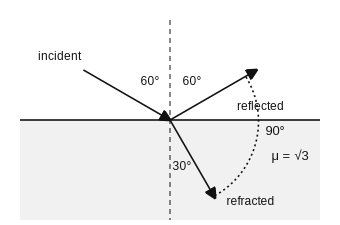
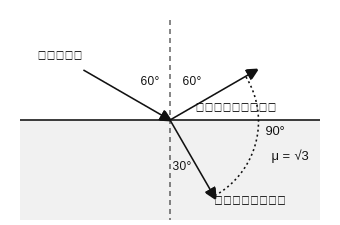
A light ray falls on a glass surface of refractive index 3, at an angle 60°. The angle between the refracted and reflected rays would be:
एक प्रकाश किरण 3 अपवर्तनांक वाले काँच के पृष्ठ पर 60° के कोण पर आपतित होती है। अपवर्तित तथा परावर्तित किरणों के बीच कोण होगा:
  1. A30°
  2. B60°
  3. C90°
  4. D120°
Show answer

Concept: Snell’s law sin⁡i=μsin⁡r; reflected ray makes angle i with the normal on the incident side.

  1. sin⁡r=sin⁡60∘3=3/23=12⇒r=30∘
  2. Reflected ray is 60° from the normal, i.e. 30° above the surface; refracted ray is 30° from the normal, i.e. 60° below the surface.
  3. Angle between them = 180° − (60° + 30°) = 90°.

Short trick: tan⁡60∘=3=μ ⇒ this is the Brewster angle, where reflected ⊥ refracted.

Answer: (C) 90°

अवधारणा: स्नेल का नियम sin⁡i=μsin⁡r; परावर्तित किरण आपतन वाली ओर अभिलंब से कोण i बनाती है।

  1. sin⁡r=sin⁡60∘3=3/23=12⇒r=30∘
  2. परावर्तित किरण अभिलंब से 60° अर्थात पृष्ठ से 30° ऊपर है; अपवर्तित किरण अभिलंब से 30° अर्थात पृष्ठ से 60° नीचे है।
  3. इनके बीच कोण = 180° − (60° + 30°) = 90°।

शॉर्ट ट्रिक: tan⁡60∘=3=μ ⇒ यह ब्रूस्टर कोण है, जहाँ परावर्तित ⊥ अपवर्तित।

उत्तर: (C) 90°

NEET UGPhysicsRay optics – reflection and refraction (Brewster condition)NEET UG 2022 · 17 Jul Shift 1 →
Q4396.
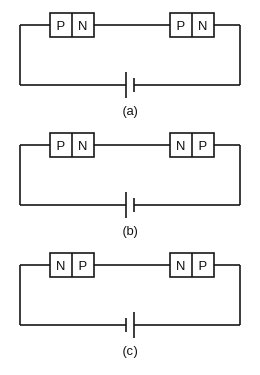
In the given circuits (a), (b) and (c), the potential drop across the two p-n junctions are equal in:
दिए गए परिपथों (a), (b) तथा (c) में दोनों p-n संधियों के सिरों पर विभवपात किसमें बराबर है?
  1. ACircuit (a) onlyकेवल परिपथ (a) में
  2. BCircuit (b) onlyकेवल परिपथ (b) में
  3. CCircuit (c) onlyकेवल परिपथ (c) में
  4. DBoth circuits (a) and (c)परिपथ (a) तथा (c) दोनों में
Show answer

Concept: Identical diodes in series carry the same current; if both are biased the same way (both forward or both reverse), they share the voltage equally.

  1. (a) P-N … P-N: both junctions face the same way ⇒ same bias ⇒ equal drops.
  2. (b) P-N … N-P: one forward, one reverse biased ⇒ the reverse-biased one takes almost the whole voltage ⇒ unequal.
  3. (c) N-P … N-P: both face the same way ⇒ same bias ⇒ equal drops.

Short trick: Just check whether the two diodes point the same way round the loop: same orientation ⇒ equal drops.

Answer: (D) Both circuits (a) and (c)

अवधारणा: श्रेणी में जुड़े समरूप डायोडों से समान धारा बहती है; यदि दोनों एक ही प्रकार से बायसित हों (दोनों अग्र या दोनों पश्च), तो वोल्टता बराबर बँटती है।

  1. (a) P-N … P-N: दोनों संधियाँ एक ही दिशा में ⇒ समान बायस ⇒ समान विभवपात।
  2. (b) P-N … N-P: एक अग्र, एक पश्च बायसित ⇒ पश्च बायसित संधि लगभग पूरी वोल्टता ले लेती है ⇒ असमान।
  3. (c) N-P … N-P: दोनों एक ही दिशा में ⇒ समान बायस ⇒ समान विभवपात।

शॉर्ट ट्रिक: केवल देखें कि लूप में दोनों डायोड एक ही दिशा में हैं या नहीं: समान दिशा ⇒ समान विभवपात।

उत्तर: (D) परिपथ (a) तथा (c) दोनों में

NEET UGPhysicsSemiconductors – biasing of p-n junctionsNEET UG 2022 · 17 Jul Shift 1 →
Q4397.
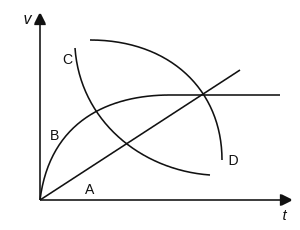
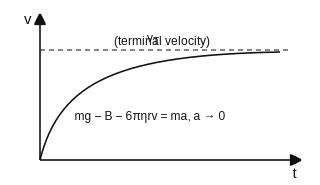
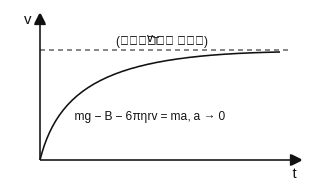
A spherical ball is dropped in a long column of a highly viscous liquid. The curve in the graph shown, which represents the speed of the ball (v) as a function of time (t) is:
एक गोलाकार गेंद को अत्यधिक श्यान द्रव के एक लंबे स्तंभ में गिराया जाता है। दर्शाए गए ग्राफ में वह वक्र, जो गेंद की चाल (v) को समय (t) के फलन के रूप में निरूपित करता है, है:
  1. AA
  2. BB
  3. CC
  4. DD
Show answer

Concept: Net force =mg−FB−6πηrv; the viscous drag grows with v until the net force becomes zero (terminal velocity).

  1. At t = 0, v = 0 and acceleration is maximum (steep start).
  2. As v rises, drag rises and acceleration falls ⇒ curve bends over.
  3. Finally v = constant vT ⇒ horizontal line. This is curve B.
  4. A (uniform increase) ignores drag; C and D show decreasing speed – wrong.

Short trick: v-t for terminal velocity looks like a charging capacitor: v=vT(1−e−t/τ).

Answer: (B) B

अवधारणा: कुल बल =mg−FB−6πηrv; श्यान कर्षण v के साथ बढ़ता है जब तक कुल बल शून्य न हो जाए (सीमांत वेग)।

  1. t = 0 पर v = 0 तथा त्वरण अधिकतम (ढालू प्रारंभ)।
  2. v बढ़ने पर कर्षण बढ़ता है और त्वरण घटता है ⇒ वक्र मुड़ने लगता है।
  3. अंत में v = नियत vT ⇒ क्षैतिज रेखा। यह वक्र B है।
  4. A (एकसमान वृद्धि) कर्षण की उपेक्षा करता है; C तथा D घटती चाल दर्शाते हैं – गलत।

शॉर्ट ट्रिक: सीमांत वेग का v-t ग्राफ आवेशित होते संधारित्र जैसा: v=vT(1−e−t/τ)।

उत्तर: (B) B

NEET UGPhysicsFluids – viscosity and terminal velocityNEET UG 2022 · 17 Jul Shift 1 →
Q4398.
Two resistors of resistances, 100 Ω and 200 Ω are connected in parallel in an electrical circuit. The ratio of thermal energy developed in 100 Ω to that in 200 Ω in a given time is
100 Ω तथा 200 Ω प्रतिरोध वाले दो प्रतिरोधक एक विद्युत परिपथ में समांतर क्रम में जुड़े हैं। दिए गए समय में 100 Ω में उत्पन्न ऊष्मीय ऊर्जा का 200 Ω में उत्पन्न ऊष्मीय ऊर्जा से अनुपात है
  1. A1 : 2
  2. B2 : 1
  3. C1 : 4
  4. D4 : 1
Show answer

Concept: In parallel the voltage V is common, so H=V2tR⇒H∝1R.

  1. H1H2=R2R1=200100
  2. =2:1

Short trick: Parallel ⇒ use V2/R (smaller R heats more); series ⇒ use I2R (larger R heats more).

Answer: (B) 2 : 1

अवधारणा: समांतर क्रम में वोल्टता V उभयनिष्ठ है, अतः H=V2tR⇒H∝1R।

  1. H1H2=R2R1=200100
  2. =2:1

शॉर्ट ट्रिक: समांतर ⇒ V2/R लें (छोटा R अधिक गर्म); श्रेणी ⇒ I2R लें (बड़ा R अधिक गर्म)।

उत्तर: (B) 2 : 1

NEET UGPhysicsCurrent electricity – Joule heating in parallelNEET UG 2022 · 17 Jul Shift 1 →
Q4399.
When two monochromatic light of frequency ν and ν/2 are incident on a photoelectric metal, their stopping potential becomes Vs/2 and Vs respectively. The threshold frequency for this metal is:
जब आवृत्ति ν तथा ν/2 के दो एकवर्णी प्रकाश किसी प्रकाश-विद्युत धातु पर आपतित होते हैं, तो उनके निरोधी विभव क्रमशः Vs/2 तथा Vs हो जाते हैं। इस धातु की देहली आवृत्ति है:
  1. A2ν
  2. B3ν
  3. C23ν
  4. D32ν
Show answer

Concept: Einstein’s photoelectric equation eVs=hν−hν0 applied to both lights, then eliminate Vs.

  1. Light of frequency ν: eVs2=hν−hν0 … (i)
  2. Light of frequency ν/2: eVs=hν2−hν0 … (ii)
  3. Multiply (i) by 2 and equate with (ii): 2hν−2hν0=hν2−hν0
  4. hν0=2hν−hν2=32hν⇒ν0=32ν
  5. Note: physically this is odd (a threshold above both frequencies, and the lower frequency having the larger stopping potential), but solving the given equations yields only 32ν, so (D) is the most appropriate choice; (A) 2ν, (B) 3ν, (C) 23ν do not satisfy both equations.

Short trick: Check options directly: put ν0=32ν ⇒ (i) gives eVs=−hν and (ii) gives eVs=−hν – consistent; no other option makes both equal.

Answer: (D) 32ν

अवधारणा: दोनों प्रकाशों पर आइंस्टीन का प्रकाश-विद्युत समीकरण eVs=hν−hν0 लगाइए, फिर Vs का विलोपन कीजिए।

  1. आवृत्ति ν वाला प्रकाश: eVs2=hν−hν0 … (i)
  2. आवृत्ति ν/2 वाला प्रकाश: eVs=hν2−hν0 … (ii)
  3. (i) को 2 से गुणा करके (ii) के बराबर रखें: 2hν−2hν0=hν2−hν0
  4. hν0=2hν−hν2=32hν⇒ν0=32ν
  5. ध्यान दें: भौतिक रूप से यह असामान्य है (देहली आवृत्ति दोनों आवृत्तियों से अधिक, तथा कम आवृत्ति का निरोधी विभव अधिक), परन्तु दिए गए समीकरणों को हल करने पर केवल 32ν प्राप्त होता है, अतः (D) सबसे उपयुक्त विकल्प है; (A) 2ν, (B) 3ν, (C) 23ν दोनों समीकरणों को संतुष्ट नहीं करते।

शॉर्ट ट्रिक: विकल्पों को सीधे जाँचें: ν0=32ν रखने पर (i) से eVs=−hν तथा (ii) से भी eVs=−hν – संगत; कोई अन्य विकल्प दोनों को बराबर नहीं करता।

उत्तर: (D) 32ν

NEET UGPhysicsDual nature – photoelectric equationNEET UG 2022 · 17 Jul Shift 1 →
Q4400.
If a soap bubble expands, the pressure inside the bubble:
यदि साबुन का एक बुलबुला फैलता है, तो बुलबुले के अंदर का दाब:
  1. Adecreasesघटता है
  2. Bincreasesबढ़ता है
  3. Cremains the sameसमान रहता है
  4. Dis equal to the atmospheric pressureवायुमंडलीय दाब के बराबर होता है
Show answer

Concept: Excess pressure inside a soap bubble (two surfaces): Pin−Pout=4SR.

  1. Pin=P0+4SR
  2. Bubble expands ⇒ R increases ⇒ 4SR decreases ⇒ Pin decreases (but stays above P0).
  3. So (B), (C) are wrong, and (D) is wrong because excess pressure never becomes zero for finite R.

Short trick: Smaller bubble = higher inside pressure (that is why a small bubble feeds a big one when connected).

Answer: (A) decreases

अवधारणा: साबुन के बुलबुले (दो पृष्ठ) के अंदर आधिक्य दाब: Pin−Pout=4SR।

  1. Pin=P0+4SR
  2. बुलबुला फैलता है ⇒ R बढ़ता है ⇒ 4SR घटता है ⇒ Pin घटता है (परन्तु P0 से अधिक रहता है)।
  3. अतः (B), (C) गलत हैं, तथा (D) गलत है क्योंकि सीमित R के लिए आधिक्य दाब कभी शून्य नहीं होता।

शॉर्ट ट्रिक: छोटा बुलबुला = अधिक आंतरिक दाब (इसी कारण जोड़ने पर छोटा बुलबुला बड़े को हवा देता है)।

उत्तर: (A) घटता है

NEET UGPhysicsMechanical properties of fluids – excess pressure in a bubbleNEET UG 2022 · 17 Jul Shift 1 →