Question bank

Q&A: practice questions with answers

Search questions on any topic. Filter by exam category, exam, subject and topic, try the question, then open the answer and explanation.

Courses – airGurukul

53,050 questions in the question bank.

Q941.
The energy released if hydrogen atoms are combined to form 24He is _______ MeV.
(Take binding energies per nucleon of 12H and 24He as 1.1 MeV and 7.2 MeV, respectively)
यदि हाइड्रोजन परमाणुओं को संयोजित करके 24He बनाया जाए, तो मुक्त ऊर्जा _______ MeV है।
(12H तथा 24He की प्रति न्यूक्लिऑन बंधन ऊर्जा क्रमशः 1.1 MeV तथा 7.2 MeV लीजिए)
  1. A6.1
  2. B24.4
  3. C26.6
  4. D5
Show answer

Concept: Energy released = (total binding energy of products) − (total binding energy of reactants). Reaction: 212H→24He.

  1. BE of He: 4×7.2=28.8 MeV.
  2. BE of two deuterons: 2×(2×1.1)=4.4 MeV.
  3. Q=28.8−4.4=24.4 MeV.

Short trick: 4×(7.2−1.1)=4×6.1=24.4 MeV (same 4 nucleons on both sides).

Answer: (B) 24.4

अवधारणा: मुक्त ऊर्जा = (उत्पादों की कुल बंधन ऊर्जा) − (अभिकारकों की कुल बंधन ऊर्जा)। अभिक्रिया: 212H→24He।

  1. He की बंधन ऊर्जा: 4×7.2=28.8 MeV।
  2. दो ड्यूट्रॉनों की बंधन ऊर्जा: 2×(2×1.1)=4.4 MeV।
  3. Q=28.8−4.4=24.4 MeV।

शॉर्ट ट्रिक: 4×(7.2−1.1)=4×6.1=24.4 MeV (दोनों ओर समान 4 न्यूक्लिऑन)।

उत्तर: (B) 24.4
JEE Main 2026 (April) – Paper 1 (B.E./B.Tech)PhysicsNuclei – binding energy and fusionJEE Main 2026 (April) – Paper 1 (B.E./B.Tech) 2026 · 6 Apr Shift 2 →
Q942.
Angle of minimum deviation is equal to the half of the angle of prism in an equilateral prism. The refractive index of the prism is _______.
एक समबाहु प्रिज़्म में न्यूनतम विचलन कोण, प्रिज़्म कोण के आधे के बराबर है। प्रिज़्म का अपवर्तनांक _______ है।
  1. A1.5
  2. B3
  3. C2
  4. D1.65
Show answer

Concept: μ=sin⁡A+δm2sin⁡A2.

  1. Equilateral prism: A=60∘, so δm=30∘.
  2. μ=sin⁡45∘sin⁡30∘=1/21/2=2.

Short trick: A+δm2=45∘, A2=30∘ → sin⁡45∘sin⁡30∘=2.

Answer: (C) 2

अवधारणा: μ=sin⁡A+δm2sin⁡A2।

  1. समबाहु प्रिज़्म: A=60∘, अतः δm=30∘।
  2. μ=sin⁡45∘sin⁡30∘=1/21/2=2।

शॉर्ट ट्रिक: A+δm2=45∘, A2=30∘ → sin⁡45∘sin⁡30∘=2।

उत्तर: (C) 2

JEE Main 2026 (April) – Paper 1 (B.E./B.Tech)PhysicsRay Optics – prism minimum deviationJEE Main 2026 (April) – Paper 1 (B.E./B.Tech) 2026 · 6 Apr Shift 2 →
Q943.
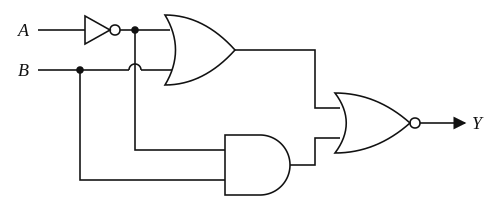
Refer to the logic circuit given below. For two inputs (A=1, B=1) and (A=0, B=1), output (Y) will be _______.
नीचे दिए गए लॉजिक परिपथ को देखिए। दो निवेशों (A=1, B=1) तथा (A=0, B=1) के लिए निर्गत (Y) _______ होगा।
  1. A1, 0 respectivelyक्रमशः 1, 0
  2. B0, 1 respectivelyक्रमशः 0, 1
  3. C0, 0 respectivelyक्रमशः 0, 0
  4. D1, 1 respectivelyक्रमशः 1, 1
Show answer

Concept: A is inverted to A¯. The OR gate gets A¯,B; the AND gate gets A¯,B; their outputs go to a NOR gate: Y=(A¯+B)+A¯B―=A¯+B―=AB¯.

  1. A=1,B=1: A¯=0; OR =1, AND =0; NOR(1,0)=0.
  2. A=0,B=1: A¯=1; OR =1, AND =1; NOR(1,1)=0.
  3. So Y=0,0 respectively.

Short trick: Y=AB¯; with B=1 in both cases, Y=0 both times.

Answer: (C) 0, 0 respectively

अवधारणा: A उत्क्रमित होकर A¯ बनता है। OR गेट को A¯,B तथा AND गेट को A¯,B मिलते हैं; इनके निर्गत NOR गेट में जाते हैं: Y=(A¯+B)+A¯B―=A¯+B―=AB¯।

  1. A=1,B=1: A¯=0; OR =1, AND =0; NOR(1,0)=0।
  2. A=0,B=1: A¯=1; OR =1, AND =1; NOR(1,1)=0।
  3. अतः Y क्रमशः 0,0 है।

शॉर्ट ट्रिक: Y=AB¯; दोनों स्थितियों में B=1 है, अतः दोनों बार Y=0।

उत्तर: (C) क्रमशः 0, 0

JEE Main 2026 (April) – Paper 1 (B.E./B.Tech)PhysicsSemiconductor Electronics – logic gatesJEE Main 2026 (April) – Paper 1 (B.E./B.Tech) 2026 · 6 Apr Shift 2 →
Q944.
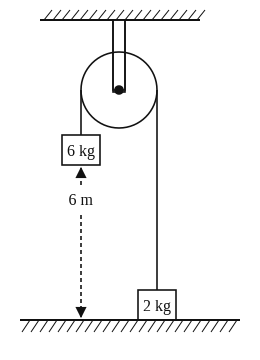
The velocity at which 6 kg mass (shown in figure) strikes the ground when it is released from a height of 6 m above the ground is _______ m/s. Assume pulley is massless and string is light and inextensible. (Take g=10 m/s2)
चित्र में दर्शाया 6 kg द्रव्यमान, भूमि से 6 m की ऊँचाई से छोड़े जाने पर जिस वेग से भूमि से टकराता है, वह _______ m/s है। मान लीजिए घिरनी द्रव्यमानरहित है तथा डोरी हल्की और अवितान्य है। (g=10 m/s2 लीजिए)
  1. A7.74
  2. B7.20
  3. C6.55
  4. D4.50
Show answer

Concept: Atwood machine: a=(m1−m2)gm1+m2, then v2=2as.

  1. a=(6−2)×106+2=5 m/s2.
  2. v=2×5×6=60≈7.75 m/s ≈ 7.74 m/s.

Short trick: Energy: (6−2)(10)(6)=12(8)v2 → v2=60.

Answer: (A) 7.74

अवधारणा: एटवुड मशीन: a=(m1−m2)gm1+m2, फिर v2=2as।

  1. a=(6−2)×106+2=5 m/s2।
  2. v=2×5×6=60≈7.75 m/s ≈ 7.74 m/s।

शॉर्ट ट्रिक: ऊर्जा से: (6−2)(10)(6)=12(8)v2 → v2=60।

उत्तर: (A) 7.74

JEE Main 2026 (April) – Paper 1 (B.E./B.Tech)PhysicsLaws of Motion – Atwood machineJEE Main 2026 (April) – Paper 1 (B.E./B.Tech) 2026 · 6 Apr Shift 2 →
Q945.
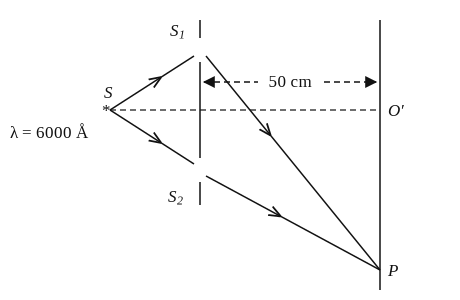
In a Young double slit experiment, the wavelength of incident light is 6000 Å, the separation between slits S1 and S2 is 5 cm and the distance between slits plane and screen is 50 cm, as shown in the figure below. If the resultant intensity at P is equal to the intensity due to individual slits, the path difference between interfering waves is _______ Å.
यंग के द्वि-झिरी प्रयोग में आपतित प्रकाश की तरंगदैर्ध्य 6000 Å, झिरियों S1 तथा S2 के बीच की दूरी 5 cm तथा झिरियों के तल और पर्दे के बीच की दूरी 50 cm है, जैसा कि नीचे चित्र में दर्शाया गया है। यदि P पर परिणामी तीव्रता, प्रत्येक झिरी के कारण तीव्रता के बराबर है, तो व्यतिकारी तरंगों के बीच पथांतर _______ Å है।
  1. A4000
  2. B3000
  3. C2000
  4. D1000
Show answer

Concept: I=4I0cos2⁡ϕ2 and path difference Δx=λ2πϕ.

  1. I=I0 → cos2⁡ϕ2=14 → cos⁡ϕ2=12 → least ϕ=2π3.
  2. Δx=λ2π×2π3=λ3=60003=2000 Å.
  3. (B) λ/2 gives I=0 and (D) λ/6 gives I=3I0. (ϕ=4π3, i.e. 2λ3=4000 Å, also gives I=I0, but the path difference asked for is the least one, λ3.)

Short trick: I=I0=14Imax ↔ ϕ=120∘ ↔ Δx=λ/3.

Answer: (C) 2000

अवधारणा: I=4I0cos2⁡ϕ2 तथा पथांतर Δx=λ2πϕ।

  1. I=I0 → cos2⁡ϕ2=14 → cos⁡ϕ2=12 → न्यूनतम ϕ=2π3।
  2. Δx=λ2π×2π3=λ3=60003=2000 Å।
  3. (B) λ/2 से I=0 तथा (D) λ/6 से I=3I0 मिलता है। (ϕ=4π3, अर्थात् 2λ3=4000 Å पर भी I=I0 होता है, परंतु यहाँ पूछा गया पथांतर न्यूनतम वाला, λ3, है।)

शॉर्ट ट्रिक: I=I0=14Imax ↔ ϕ=120∘ ↔ Δx=λ/3।

उत्तर: (C) 2000

JEE Main 2026 (April) – Paper 1 (B.E./B.Tech)PhysicsWave Optics – YDSE intensity and path differenceJEE Main 2026 (April) – Paper 1 (B.E./B.Tech) 2026 · 6 Apr Shift 2 →
Q946.
A block takes t time to slide down a plane inclined at 45∘ to the horizontal. If the surface is made smooth (frictionless), the block takes time t2 to slide down the plane. The coefficient of friction between the block and the inclined plane is (α100). The value of α is _______.
क्षैतिज से 45∘ पर आनत एक तल पर नीचे फिसलने में एक ब्लॉक t समय लेता है। यदि सतह को चिकना (घर्षणरहित) बना दिया जाए, तो ब्लॉक तल पर नीचे फिसलने में t2 समय लेता है। ब्लॉक तथा आनत तल के बीच घर्षण गुणांक (α100) है। α का मान _______ है।
Show answer

Concept: Same length L=12at2, so a∝1t2. Rough: a1=g(sin⁡θ−μcos⁡θ); smooth: a2=gsin⁡θ.

  1. a2a1=(tt/2)2=4.
  2. At 45∘, sin⁡θ=cos⁡θ: 11−μ=4 → μ=34=0.75.
  3. α100=0.75 → α=75.

Short trick: At 45∘: μ=1−1n2 where n = time ratio =2 → μ=34.

Answer: 75

अवधारणा: समान लंबाई L=12at2, अतः a∝1t2। खुरदरा: a1=g(sin⁡θ−μcos⁡θ); चिकना: a2=gsin⁡θ।

  1. a2a1=(tt/2)2=4।
  2. 45∘ पर sin⁡θ=cos⁡θ: 11−μ=4 → μ=34=0.75।
  3. α100=0.75 → α=75।

शॉर्ट ट्रिक: 45∘ पर: μ=1−1n2, जहाँ n = समय अनुपात =2 → μ=34।

उत्तर: 75

JEE Main 2026 (April) – Paper 1 (B.E./B.Tech)PhysicsLaws of Motion – friction on an inclined planeJEE Main 2026 (April) – Paper 1 (B.E./B.Tech) 2026 · 6 Apr Shift 2 →
Q947.
The de Broglie wavelength for an electron accelerated through the potential difference of V1 volt is λ1. When the potential difference is changed to V2 volt, the associated de Broglie wavelength is increased by 50%. If (V1/V2)=(9/α), then the value of α is _______.
V1 वोल्ट विभवांतर से त्वरित एक इलेक्ट्रॉन की दे ब्रॉग्ली तरंगदैर्ध्य λ1 है। जब विभवांतर को V2 वोल्ट कर दिया जाता है, तो संबद्ध दे ब्रॉग्ली तरंगदैर्ध्य 50% बढ़ जाती है। यदि (V1/V2)=(9/α) है, तो α का मान _______ है।
Show answer

Concept: λ=h2meV, so λ∝1V and V1V2=(λ2λ1)2.

  1. λ2=1.5λ1=32λ1.
  2. V1V2=(32)2=94.
  3. Comparing with 9α: α=4.

Short trick: λ up by factor 32 → V down by 94.

Answer: 4

अवधारणा: λ=h2meV, अतः λ∝1V तथा V1V2=(λ2λ1)2।

  1. λ2=1.5λ1=32λ1।
  2. V1V2=(32)2=94।
  3. 9α से तुलना करने पर: α=4।

शॉर्ट ट्रिक: λ में 32 गुना वृद्धि → V में 94 गुना कमी।

उत्तर: 4

JEE Main 2026 (April) – Paper 1 (B.E./B.Tech)PhysicsDual Nature – de Broglie wavelength of electronJEE Main 2026 (April) – Paper 1 (B.E./B.Tech) 2026 · 6 Apr Shift 2 →
Q948.
A moving coil of galvanometer when shunted with 2 Ω resistance gives a full scale deflection for a current of 500 mA. When a resistance of 470 Ω is connected in series it gives a full scale deflection for 10 V potential applied on it. The value of resistance of galvanometer coil is _______ Ω.
एक चल कुंडली गैल्वेनोमीटर, 2 Ω प्रतिरोध से शंटित किए जाने पर 500 mA धारा के लिए पूर्ण पैमाना विक्षेप देता है। जब इसके श्रेणी में 470 Ω का प्रतिरोध जोड़ा जाता है, तो यह इस पर आरोपित 10 V विभव के लिए पूर्ण पैमाना विक्षेप देता है। गैल्वेनोमीटर कुंडली का प्रतिरोध _______ Ω है।
Show answer

Concept: Shunt (parallel): IgG=(I−Ig)S. Series (voltmeter): V=Ig(G+R).

  1. Shunt: IgG=(0.5−Ig)×2 → Ig(G+2)=1 → Ig=1G+2.
  2. Series: 1G+2(G+470)=10 → G+470=10G+20.
  3. 9G=450 → G=50 Ω (and Ig=152 A).

Short trick: Equate Ig: 1G+2=10G+470 → G=50 Ω.

Answer: 50

अवधारणा: शंट (समांतर): IgG=(I−Ig)S। श्रेणी (वोल्टमीटर): V=Ig(G+R)।

  1. शंट: IgG=(0.5−Ig)×2 → Ig(G+2)=1 → Ig=1G+2।
  2. श्रेणी: 1G+2(G+470)=10 → G+470=10G+20।
  3. 9G=450 → G=50 Ω (तथा Ig=152 A)।

शॉर्ट ट्रिक: Ig बराबर रखें: 1G+2=10G+470 → G=50 Ω।

उत्तर: 50

JEE Main 2026 (April) – Paper 1 (B.E./B.Tech)PhysicsMoving Charges – galvanometer conversionJEE Main 2026 (April) – Paper 1 (B.E./B.Tech) 2026 · 6 Apr Shift 2 →
Q949.
Two cells of emfs 1 V and 2 V and internal resistance 2 Ω and 1 Ω, respectively connected in parallel, gave a current of 1 A through an external resistance. If the polarity of one cell is reversed, then value of current through the external resistance will be α5 A. The value of α is _______.
क्रमशः 1 V तथा 2 V विद्युत वाहक बल और 2 Ω तथा 1 Ω आंतरिक प्रतिरोध वाले दो सेल समांतर क्रम में जुड़कर एक बाह्य प्रतिरोध में 1 A धारा देते हैं। यदि एक सेल की ध्रुवता उलट दी जाए, तो बाह्य प्रतिरोध में धारा का मान α5 A होगा। α का मान _______ है।
Show answer

Concept: Parallel cells: Eeq=E1/r1+E2/r21/r1+1/r2, req=r1r2r1+r2, and I=Eeqreq+R.

  1. req=2×13=23 Ω; Eeq=0.5+21.5=53 V.
  2. 1=5/32/3+R → R=1 Ω.
  3. Reversing one cell: Eeq′=|−0.5+2|1.5=1 V (same magnitude whichever cell is reversed).
  4. I′=12/3+1=35 A → α=3.

Short trick: Eeq=req∑Er: 23(2.5)=53, reversed 23(1.5)=1; R=1 → I=35.

Answer: 3

अवधारणा: समांतर सेल: Eeq=E1/r1+E2/r21/r1+1/r2, req=r1r2r1+r2 तथा I=Eeqreq+R।

  1. req=2×13=23 Ω; Eeq=0.5+21.5=53 V।
  2. 1=5/32/3+R → R=1 Ω।
  3. एक सेल उलटने पर: Eeq′=|−0.5+2|1.5=1 V (किसी भी सेल को उलटें, परिमाण समान)।
  4. I′=12/3+1=35 A → α=3।

शॉर्ट ट्रिक: Eeq=req∑Er: 23(2.5)=53, उलटने पर 23(1.5)=1; R=1 → I=35।

उत्तर: 3

JEE Main 2026 (April) – Paper 1 (B.E./B.Tech)PhysicsCurrent Electricity – cells in parallelJEE Main 2026 (April) – Paper 1 (B.E./B.Tech) 2026 · 6 Apr Shift 2 →
Q950.
A concave mirror of focal length 10 cm forms an image which is double the size of object when the object is placed at two different positions. The distance between the two positions of the object is _______ cm.
10 cm फोकस दूरी का एक अवतल दर्पण, वस्तु को दो भिन्न स्थितियों पर रखने पर वस्तु के आकार का दोगुना प्रतिबिंब बनाता है। वस्तु की दोनों स्थितियों के बीच की दूरी _______ cm है।
Show answer

Concept: For a mirror m=ff−u (sign convention, f=−10 cm). Size double means m=−2 (real) or m=+2 (virtual).

  1. m=−2: −2=−10−10−u → u=−15 cm.
  2. m=+2: 2=−10−10−u → u=−5 cm.
  3. Distance between positions =15−5=10 cm.

Short trick: |u|=|f|(1±1|m|) → separation =2|f||m|=202=10 cm.

Answer: 10

अवधारणा: दर्पण के लिए m=ff−u (चिह्न परिपाटी, f=−10 cm)। दोगुना आकार अर्थात् m=−2 (वास्तविक) या m=+2 (आभासी)।

  1. m=−2: −2=−10−10−u → u=−15 cm।
  2. m=+2: 2=−10−10−u → u=−5 cm।
  3. स्थितियों के बीच दूरी =15−5=10 cm।

शॉर्ट ट्रिक: |u|=|f|(1±1|m|) → अंतर =2|f||m|=202=10 cm।

उत्तर: 10

JEE Main 2026 (April) – Paper 1 (B.E./B.Tech)PhysicsRay Optics – concave mirror magnificationJEE Main 2026 (April) – Paper 1 (B.E./B.Tech) 2026 · 6 Apr Shift 2 →
Q951.

Which of the following contain the same number of atoms ?

(Given : Molar mass in g mol−1 of H, He, O and S are 1, 4, 16 and 32 respectively)

A. 2 g of O2 gas
B. 4 g of SO2 gas
C. 1400 mL of O2 at STP
D. 0.05 L of He at STP
E. 0.0625 mol of H2 gas

Choose the correct answer from the options given below :

निम्नलिखित में से किनमें परमाणुओं की संख्या समान है ?

(दिया है : H, He, O तथा S के मोलर द्रव्यमान g mol−1 में क्रमशः 1, 4, 16 तथा 32 हैं)

A. 2 g O2 गैस
B. 4 g SO2 गैस
C. STP पर 1400 mL O2
D. STP पर 0.05 L He
E. 0.0625 mol H2 गैस

नीचे दिए गए विकल्पों में से सही उत्तर चुनिए :

  1. AA and B onlyकेवल A और B
  2. BB and C onlyकेवल B और C
  3. CC and D onlyकेवल C और D
  4. DA, C and E onlyकेवल A, C और E
Show answer

Concept: Moles of atoms = moles of molecules × atomicity; at STP 1 mol gas = 22.4 L.

  1. A: 2 g O2 = 2/32 = 0.0625 mol → atoms = 0.0625 × 2 = 0.125 mol.
  2. B: 4 g SO2 = 4/64 = 0.0625 mol → atoms = 0.0625 × 3 = 0.1875 mol.
  3. C: 1.4 L O2 = 1.4/22.4 = 0.0625 mol → atoms = 0.125 mol.
  4. D: 0.05 L He = 0.05/22.4 = 0.00223 mol atoms (monoatomic).
  5. E: 0.0625 mol H2 → atoms = 0.125 mol.
  6. A, C and E each contain 0.125 mol (= 0.125 NA) atoms; B and D differ, so (A), (B), (C) are wrong.

Short trick: A, C, E are all 0.0625 mol of a diatomic gas → same atoms.

Answer: (D) A, C and E only

अवधारणा: परमाणुओं के मोल = अणुओं के मोल × परमाणुकता; STP पर 1 mol गैस = 22.4 L।

  1. A: 2 g O2 = 2/32 = 0.0625 mol → परमाणु = 0.0625 × 2 = 0.125 mol।
  2. B: 4 g SO2 = 4/64 = 0.0625 mol → परमाणु = 0.0625 × 3 = 0.1875 mol।
  3. C: 1.4 L O2 = 1.4/22.4 = 0.0625 mol → परमाणु = 0.125 mol।
  4. D: 0.05 L He = 0.05/22.4 = 0.00223 mol परमाणु (एकपरमाणुक)।
  5. E: 0.0625 mol H2 → परमाणु = 0.125 mol।
  6. A, C तथा E प्रत्येक में 0.125 mol (= 0.125 NA) परमाणु हैं; B और D भिन्न हैं, अतः (A), (B), (C) गलत हैं।

शॉर्ट ट्रिक: A, C, E तीनों किसी द्विपरमाणुक गैस के 0.0625 mol हैं → परमाणु समान।

उत्तर: (D) केवल A, C और E

JEE Main 2026 (April) – Paper 1 (B.E./B.Tech)ChemistryMole Concept – number of atomsJEE Main 2026 (April) – Paper 1 (B.E./B.Tech) 2026 · 6 Apr Shift 2 →
Q952.

The Bohr radius of a hydrogen like species is 70.53 pm. The species and the stationary state (n) are respectively

(Given : Hydrogen atom Bohr radius is 52.9 pm)

किसी हाइड्रोजन सदृश स्पीशीज़ की बोर त्रिज्या 70.53 pm है। स्पीशीज़ तथा स्थिर अवस्था (n) क्रमशः हैं

(दिया है : हाइड्रोजन परमाणु की बोर त्रिज्या 52.9 pm है)

  1. ALi2+, 3
  2. BHe+, 3
  3. CHe+, 2
  4. DLi2+, 2
Show answer

Concept: For a hydrogen-like species rn=52.9n2Z pm.

  1. n2Z=70.5352.9=1.333=43.
  2. n = 2, Z = 3 → Li2+ in n = 2.
  3. Check others: Li2+, n = 3 → 158.7 pm; He+, n = 3 → 238.05 pm; He+, n = 2 → 105.8 pm – none equals 70.53 pm.

Short trick: 70.53/52.9 = 4/3 → n² = 4, Z = 3.

Answer: (D) Li2+, 2

अवधारणा: हाइड्रोजन सदृश स्पीशीज़ के लिए rn=52.9n2Z pm।

  1. n2Z=70.5352.9=1.333=43।
  2. n = 2, Z = 3 → Li2+, n = 2 में।
  3. अन्य की जाँच: Li2+, n = 3 → 158.7 pm; He+, n = 3 → 238.05 pm; He+, n = 2 → 105.8 pm – कोई भी 70.53 pm नहीं।

शॉर्ट ट्रिक: 70.53/52.9 = 4/3 → n² = 4, Z = 3।

उत्तर: (D) Li2+, 2

JEE Main 2026 (April) – Paper 1 (B.E./B.Tech)ChemistryAtomic Structure – Bohr radiusJEE Main 2026 (April) – Paper 1 (B.E./B.Tech) 2026 · 6 Apr Shift 2 →
Q953.

Given below are two statements :

Statement I : The number of compounds among SO2, SO3, SF4, SF6 and H2S in which sulphur does not obey the Octet rule is 3.

Statement II : Among [H2O, ClF3, SF4], [NH3, BrF5, SF4], [BrF5, ClF3, XeF4] and [XeF4, ClF3, H2O], the number of sets in which all the molecules have one lone pair of electrons on the central atom is 1.

In the light of the above statements, choose the correct answer from the options given below :

नीचे दो कथन दिए गए हैं :

कथन I : SO2, SO3, SF4, SF6 तथा H2S में से उन यौगिकों की संख्या जिनमें सल्फर अष्टक नियम का पालन नहीं करता, 3 है।

कथन II : [H2O, ClF3, SF4], [NH3, BrF5, SF4], [BrF5, ClF3, XeF4] तथा [XeF4, ClF3, H2O] में से उन समुच्चयों की संख्या जिनमें सभी अणुओं के केंद्रीय परमाणु पर एक एकाकी इलेक्ट्रॉन युग्म है, 1 है।

उपर्युक्त कथनों के आलोक में, नीचे दिए गए विकल्पों में से सही उत्तर चुनिए :

  1. ABoth Statement I and Statement II are trueकथन I और कथन II दोनों सत्य हैं
  2. BBoth Statement I and Statement II are falseकथन I और कथन II दोनों असत्य हैं
  3. CStatement I is true but Statement II is falseकथन I सत्य है परंतु कथन II असत्य है
  4. DStatement I is false but Statement II is trueकथन I असत्य है परंतु कथन II सत्य है
Show answer

Concept: Count electrons around S in the Lewis structures; count lone pairs on the central atom by VSEPR.

  1. Statement I: SO2 (O=S=O, 10 e− around S), SO3 (12 e−), SF4 (10 e−), SF6 (12 e−) all have an expanded octet; only H2S (8 e−) obeys the octet. Number = 4, not 3 → Statement I is false.
  2. Lone pairs on central atom: H2O 2, ClF3 2, SF4 1, NH3 1, BrF5 1, XeF4 2.
  3. Only [NH3, BrF5, SF4] has one lone pair on every central atom (the set [XeF4, ClF3, H2O] has two lone pairs on each). Number of sets = 1 → Statement II is true.
  4. Hence (A), (B), (C) are wrong.

Short trick: Every S–O/S–F compound of S(IV) and S(VI) is hypervalent; only H2S keeps an octet.

Answer: (D) Statement I is false but Statement II is true

अवधारणा: लूइस संरचना में S के चारों ओर इलेक्ट्रॉन गिनिए; VSEPR से केंद्रीय परमाणु पर एकाकी युग्म गिनिए।

  1. कथन I: SO2 (O=S=O, S के चारों ओर 10 e−), SO3 (12 e−), SF4 (10 e−), SF6 (12 e−) सभी में अष्टक का विस्तार है; केवल H2S (8 e−) अष्टक का पालन करता है। संख्या = 4, 3 नहीं → कथन I असत्य है।
  2. केंद्रीय परमाणु पर एकाकी युग्म: H2O 2, ClF3 2, SF4 1, NH3 1, BrF5 1, XeF4 2।
  3. केवल [NH3, BrF5, SF4] में प्रत्येक केंद्रीय परमाणु पर एक एकाकी युग्म है ([XeF4, ClF3, H2O] में प्रत्येक पर दो हैं)। समुच्चयों की संख्या = 1 → कथन II सत्य है।
  4. अतः (A), (B), (C) गलत हैं।

शॉर्ट ट्रिक: S(IV) और S(VI) के सभी S–O/S–F यौगिक अतिसंयोजी (hypervalent) हैं; केवल H2S अष्टक रखता है।

उत्तर: (D) कथन I असत्य है परंतु कथन II सत्य है

JEE Main 2026 (April) – Paper 1 (B.E./B.Tech)ChemistryChemical Bonding – octet rule and lone pairs (VSEPR)JEE Main 2026 (April) – Paper 1 (B.E./B.Tech) 2026 · 6 Apr Shift 2 →
Q954.

Match List - I with List - II.

Given V1 and V2 are initial and final volumes respectively.

List - I
(Isothermal process)
List - II
(Expression)
A.Reversible expansionI.q=0
B.Free expansionII.q=nRTln⁡V2V1
C.Irreversible CompressionIII.w=−pext(V1−V2)
D.Cyclic reversibleIV.qrevT=0

Choose the correct answer from the options given below :

सूची - I का सूची - II से मिलान कीजिए।

दिया है V1 तथा V2 क्रमशः प्रारंभिक तथा अंतिम आयतन हैं।

सूची - I
(समतापी प्रक्रम)
सूची - II
(व्यंजक)
A.उत्क्रमणीय प्रसारI.q=0
B.मुक्त प्रसारII.q=nRTln⁡V2V1
C.अनुत्क्रमणीय संपीडनIII.w=−pext(V1−V2)
D.चक्रीय उत्क्रमणीयIV.qrevT=0

नीचे दिए गए विकल्पों में से सही उत्तर चुनिए :

  1. AA-II, B-III, C-I, D-IV
  2. BA-II, B-I, C-IV, D-III
  3. CA-II, B-I, C-III, D-IV
  4. DA-I, B-II, C-III, D-IV
Show answer

Concept: For an ideal gas at constant T, ΔU = 0, so q = −w.

  1. A. Reversible isothermal expansion: w=−nRTln⁡V2V1, so q=nRTln⁡V2V1 → II.
  2. B. Free expansion (pext = 0): w = 0 and ΔU = 0, so q = 0 → I.
  3. C. Irreversible compression against constant external pressure: work is given by the pextΔV expression (magnitude pext|V1 − V2|) → III.
  4. D. Cyclic reversible process: entropy is a state function, so the sum of qrev/T over the cycle is zero → IV.
  5. A-II, B-I, C-III, D-IV; (A) and (B) wrongly match free expansion/irreversible compression, (D) gives q = 0 to reversible expansion.

Short trick: Free expansion → q = w = 0 locks B-I; only (B) and (C) have B-I, and C must take the pext expression.

Answer: (C) A-II, B-I, C-III, D-IV

अवधारणा: स्थिर T पर आदर्श गैस के लिए ΔU = 0, अतः q = −w।

  1. A. उत्क्रमणीय समतापी प्रसार: w=−nRTln⁡V2V1, अतः q=nRTln⁡V2V1 → II।
  2. B. मुक्त प्रसार (pext = 0): w = 0 तथा ΔU = 0, अतः q = 0 → I।
  3. C. स्थिर बाह्य दाब के विरुद्ध अनुत्क्रमणीय संपीडन: कार्य pextΔV व्यंजक से (परिमाण pext|V1 − V2|) → III।
  4. D. चक्रीय उत्क्रमणीय प्रक्रम: एन्ट्रॉपी अवस्था फलन है, अतः पूरे चक्र में qrev/T का योग शून्य → IV।
  5. A-II, B-I, C-III, D-IV; (A) और (B) मुक्त प्रसार/अनुत्क्रमणीय संपीडन का गलत मिलान करते हैं, (D) उत्क्रमणीय प्रसार को q = 0 देता है।

शॉर्ट ट्रिक: मुक्त प्रसार → q = w = 0 से B-I तय; केवल (B) और (C) में B-I है, और C को pext व्यंजक ही मिलेगा।

उत्तर: (C) A-II, B-I, C-III, D-IV

JEE Main 2026 (April) – Paper 1 (B.E./B.Tech)ChemistryThermodynamics – isothermal processesJEE Main 2026 (April) – Paper 1 (B.E./B.Tech) 2026 · 6 Apr Shift 2 →
Q955.

Given below are two statements :

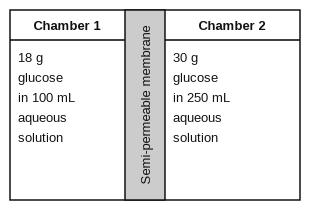
Statement I : H2O molecules move from the chamber 1 to chamber 2.

Statement II : The osmotic pressure of a solution prepared by dissolving 50 mg of potassium sulphate (molar mass = 174 g/mol) in 2 L of water (at 27 °C) is 0.0107 bar. (Given: R = 0.083 dm3 bar K−1 mol−1 and assume complete dissociation of electrolyte)

In the light of the above statements, choose the correct answer from the options given below :

नीचे दो कथन दिए गए हैं :

कथन I : H2O अणु कक्ष 1 (chamber 1) से कक्ष 2 (chamber 2) की ओर गति करते हैं।

कथन II : 50 mg पोटैशियम सल्फेट (मोलर द्रव्यमान = 174 g/mol) को 2 L जल में (27 °C पर) घोलकर बनाए गए विलयन का परासरण दाब 0.0107 bar है। (दिया है: R = 0.083 dm3 bar K−1 mol−1 तथा विद्युत-अपघट्य का पूर्ण वियोजन मानिए)

उपर्युक्त कथनों के आलोक में, नीचे दिए गए विकल्पों में से सही उत्तर चुनिए :

  1. ABoth Statement I and Statement II are trueकथन I और कथन II दोनों सत्य हैं
  2. BBoth Statement I and Statement II are falseकथन I और कथन II दोनों असत्य हैं
  3. CStatement I is true but Statement II is falseकथन I सत्य है परंतु कथन II असत्य है
  4. DStatement I is false but Statement II is trueकथन I असत्य है परंतु कथन II सत्य है
Show answer

Concept: In osmosis solvent flows from the lower-concentration (lower π) side to the higher-concentration side; π = iCRT.

  1. Chamber 1: 18/1800.100=1.0 M; Chamber 2: 30/1800.250=0.667 M.
  2. Water moves from chamber 2 (dilute) to chamber 1 (concentrated) → Statement I is false.
  3. K2SO4: n = 0.050174=2.874×10⁻⁴ mol; C = 2.874×10−42=1.437×10⁻⁴ M; i = 3.
  4. π = 3 × 1.437 × 10−4 × 0.083 × 300 = 0.0107 bar → Statement II is true.

Short trick: 18/100 > 30/250 (g per mL), so chamber 1 is stronger; water goes into it.

Answer: (D) Statement I is false but Statement II is true

अवधारणा: परासरण में विलायक कम सांद्रता (कम π) वाली ओर से अधिक सांद्रता वाली ओर बहता है; π = iCRT।

  1. कक्ष 1: 18/1800.100=1.0 M; कक्ष 2: 30/1800.250=0.667 M।
  2. जल कक्ष 2 (तनु) से कक्ष 1 (सांद्र) की ओर जाता है → कथन I असत्य है।
  3. K2SO4: n = 0.050174=2.874×10⁻⁴ mol; C = 2.874×10−42=1.437×10⁻⁴ M; i = 3।
  4. π = 3 × 1.437 × 10−4 × 0.083 × 300 = 0.0107 bar → कथन II सत्य है।

शॉर्ट ट्रिक: 18/100 > 30/250 (g प्रति mL), अतः कक्ष 1 अधिक सांद्र है; जल उसी में जाता है।

उत्तर: (D) कथन I असत्य है परंतु कथन II सत्य है

JEE Main 2026 (April) – Paper 1 (B.E./B.Tech)ChemistrySolutions – osmosis and osmotic pressureJEE Main 2026 (April) – Paper 1 (B.E./B.Tech) 2026 · 6 Apr Shift 2 →
Q956.

Given is a concentrated solution of a weak electrolyte AxBy of concentration ‘c’ and dissociation constant ‘K’. The degree of dissociation is given by :

सांद्रता ‘c’ तथा वियोजन स्थिरांक ‘K’ वाले एक दुर्बल विद्युत-अपघट्य AxBy का सांद्र विलयन दिया गया है। वियोजन की मात्रा (degree of dissociation) है :

  1. A[K×cx+y−1xxyy]x+y
  2. B(Kcx+y−1xxyy)1x+y
  3. C(cx+y−1xxyyK)x+y
  4. D(cx+y−1xxyyK)1x+y
Show answer

Concept: For a weak electrolyte α ≪ 1, so 1 − α ≈ 1.

  1. AxBy ⇌ xAy+ + yBx−; at equilibrium: c(1 − α), xcα, ycα.
  2. K=(xcα)x(ycα)yc(1−α)≈xxyycx+y−1αx+y.
  3. α=(Kcx+y−1xxyy)1x+y.
  4. (A) and (C) have the wrong power (x + y instead of 1/(x + y)); (D) is the reciprocal of the correct ratio.

Short trick: Check with x = y = 1: α = √(K/c) – only (B) gives this.

Answer: (B) (Kcx+y−1xxyy)1x+y

अवधारणा: दुर्बल विद्युत-अपघट्य के लिए α ≪ 1, अतः 1 − α ≈ 1।

  1. AxBy ⇌ xAy+ + yBx−; साम्य पर: c(1 − α), xcα, ycα।
  2. K=(xcα)x(ycα)yc(1−α)≈xxyycx+y−1αx+y।
  3. α=(Kcx+y−1xxyy)1x+y।
  4. (A) और (C) में घात गलत है (1/(x + y) के स्थान पर x + y); (D) सही अनुपात का व्युत्क्रम है।

शॉर्ट ट्रिक: x = y = 1 रखकर जाँचिए: α = √(K/c) – केवल (B) यह देता है।

उत्तर: (B) (Kcx+y−1xxyy)1x+y

JEE Main 2026 (April) – Paper 1 (B.E./B.Tech)ChemistryIonic Equilibrium – Ostwald dilution lawJEE Main 2026 (April) – Paper 1 (B.E./B.Tech) 2026 · 6 Apr Shift 2 →
Q957.

For a general redox reaction

Anode   Red1→Ox1n1++n1e−

Cathode   Ox2+n2e−→Red2n2−

Which of the following statement is incorrect ?

एक सामान्य रेडॉक्स अभिक्रिया के लिए

ऐनोड   Red1→Ox1n1++n1e−

कैथोड   Ox2+n2e−→Red2n2−

निम्नलिखित में से कौन-सा कथन गलत है ?

  1. AThe overall reaction can be written as n2Red1+n1Ox2⇌n2Ox1n1++n1Red2n2−समग्र अभिक्रिया को n2Red1+n1Ox2⇌n2Ox1n1++n1Red2n2− के रूप में लिखा जा सकता है
  2. BThe electrons do not appear in the overall reaction because electrons produced at the anode are consumed at the cathode.समग्र अभिक्रिया में इलेक्ट्रॉन प्रकट नहीं होते क्योंकि ऐनोड पर उत्पन्न इलेक्ट्रॉन कैथोड पर उपभुक्त हो जाते हैं।
  3. C
    Here n is the number of electrons transferred in redox reaction.

    यहाँ n रेडॉक्स अभिक्रिया में स्थानांतरित इलेक्ट्रॉनों की संख्या है।
  4. DIf the reaction is carried out reversibly, the electrical work done is equal to the ratio of charge and potential difference through which charge is moved.यदि अभिक्रिया उत्क्रमणीय रूप से की जाए, तो किया गया विद्युत कार्य, आवेश तथा उस विभवांतर (जिससे होकर आवेश गति करता है) के अनुपात के बराबर होता है।
Show answer

Concept: Electrical work = charge × potential difference (W = QE = nFE); Nernst: E=E∘−2.303RTnFlog⁡Q.

  1. (A) Multiplying anode reaction by n2 and cathode by n1 cancels n1n2 electrons → the overall equation is correct.
  2. (B) Electrons released at the anode are taken up at the cathode, so they cancel – correct.
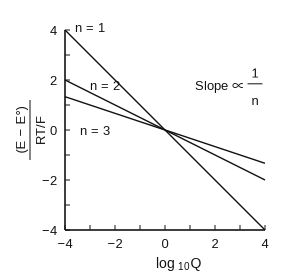
  3. (C) E−E∘RT/F=−2.303nlog⁡Q: straight lines through the origin with negative slope whose magnitude ∝ 1/n – correct.
  4. (D) Work is the product of charge and potential difference, not their ratio → incorrect.

Short trick: Joule = coulomb × volt, never coulomb/volt.

Answer: (D) The electrical work is not the ratio of charge and potential difference

अवधारणा: विद्युत कार्य = आवेश × विभवांतर (W = QE = nFE); नेर्न्स्ट: E=E∘−2.303RTnFlog⁡Q।

  1. (A) ऐनोड अभिक्रिया को n2 से तथा कैथोड को n1 से गुणा करने पर n1n2 इलेक्ट्रॉन कट जाते हैं → समग्र समीकरण सही है।
  2. (B) ऐनोड पर मुक्त इलेक्ट्रॉन कैथोड पर ग्रहण हो जाते हैं, अतः कट जाते हैं – सही।
  3. (C) E−E∘RT/F=−2.303nlog⁡Q: मूलबिंदु से जाने वाली सीधी रेखाएँ जिनकी ऋणात्मक ढाल का परिमाण ∝ 1/n – सही।
  4. (D) कार्य, आवेश और विभवांतर का गुणनफल है, अनुपात नहीं → गलत।

शॉर्ट ट्रिक: जूल = कूलॉम × वोल्ट, कभी कूलॉम/वोल्ट नहीं।

उत्तर: (D) विद्युत कार्य आवेश और विभवांतर का अनुपात नहीं है

JEE Main 2026 (April) – Paper 1 (B.E./B.Tech)ChemistryElectrochemistry – redox cell and Nernst equationJEE Main 2026 (April) – Paper 1 (B.E./B.Tech) 2026 · 6 Apr Shift 2 →
Q958.

In a period, the first ionisation enthalpy of the element at extreme left and the negative electron gain enthalpy of the extreme right element, except noble gases, are respectively.

किसी आवर्त में, बिल्कुल बाईं ओर के तत्व की प्रथम आयनन एन्थैल्पी तथा उत्कृष्ट गैसों को छोड़कर बिल्कुल दाईं ओर के तत्व की ऋणात्मक इलेक्ट्रॉन लब्धि एन्थैल्पी क्रमशः होती हैं।

  1. Alowest and lowestन्यूनतम और न्यूनतम
  2. Bhighest and lowestउच्चतम और न्यूनतम
  3. Clowest and highestन्यूनतम और उच्चतम
  4. Dhighest and highestउच्चतम और उच्चतम
Show answer

Concept: Across a period Zeff increases and size decreases.

  1. The extreme-left element (alkali metal, ns1) loses its electron most easily → lowest first ionisation enthalpy.
  2. The extreme-right element other than the noble gas (halogen, ns2np5) needs one electron to reach a noble-gas configuration → highest negative electron gain enthalpy.
  3. So lowest and highest; (A), (B), (D) contradict one or both trends.

Short trick: Alkali metals lose, halogens gain – most easily of all.

Answer: (C) lowest and highest

अवधारणा: आवर्त में बाएँ से दाएँ Zeff बढ़ता है और आकार घटता है।

  1. बिल्कुल बाईं ओर का तत्व (क्षार धातु, ns1) अपना इलेक्ट्रॉन सबसे आसानी से खोता है → न्यूनतम प्रथम आयनन एन्थैल्पी।
  2. उत्कृष्ट गैस के अतिरिक्त बिल्कुल दाईं ओर का तत्व (हैलोजन, ns2np5) एक इलेक्ट्रॉन लेकर उत्कृष्ट गैस विन्यास पाता है → उच्चतम ऋणात्मक इलेक्ट्रॉन लब्धि एन्थैल्पी।
  3. अतः न्यूनतम और उच्चतम; (A), (B), (D) एक या दोनों प्रवृत्तियों के विपरीत हैं।

शॉर्ट ट्रिक: क्षार धातुएँ खोती हैं, हैलोजन ग्रहण करते हैं – सबसे आसानी से।

उत्तर: (C) न्यूनतम और उच्चतम

JEE Main 2026 (April) – Paper 1 (B.E./B.Tech)ChemistryPeriodic Properties – ionisation and electron gain enthalpyJEE Main 2026 (April) – Paper 1 (B.E./B.Tech) 2026 · 6 Apr Shift 2 →
Q959.

Given below are two statements :

Statement I : F2O < H2O < Cl2O is the correct trend in terms of bond angle.

Statement II : SiF4, SnF4 and PbF4 are ionic in nature.

In the light of the above statements, choose the correct answer from the options given below :

नीचे दो कथन दिए गए हैं :

कथन I : आबंध कोण के संदर्भ में F2O < H2O < Cl2O सही क्रम है।

कथन II : SiF4, SnF4 तथा PbF4 प्रकृति में आयनिक हैं।

उपर्युक्त कथनों के आलोक में, नीचे दिए गए विकल्पों में से सही उत्तर चुनिए :

  1. ABoth Statement I and Statement II are trueकथन I और कथन II दोनों सत्य हैं
  2. BBoth Statement I and Statement II are falseकथन I और कथन II दोनों असत्य हैं
  3. CStatement I is true but Statement II is falseकथन I सत्य है परंतु कथन II असत्य है
  4. DStatement I is false but Statement II is trueकथन I असत्य है परंतु कथन II सत्य है
Show answer

Concept: Bond angle at O depends on the electronegativity and size of the attached atoms; ionic character of MF4 rises down group 14.

  1. F2O ≈ 103° (bond pairs pulled towards F), H2O ≈ 104.5°, Cl2O ≈ 111° (large Cl atoms repel; bond pairs closer to O) → F2O < H2O < Cl2O: Statement I is true.
  2. SnF4 and PbF4 are ionic, but SiF4 is a covalent, volatile tetrahedral gas → Statement II is false.
  3. Hence (A), (B), (D) are wrong.

Short trick: SiF4 is a gas – no ionic solid is a gas.

Answer: (C) Statement I is true but Statement II is false

अवधारणा: O पर आबंध कोण संलग्न परमाणुओं की विद्युत-ऋणात्मकता तथा आकार पर निर्भर है; वर्ग 14 में नीचे जाने पर MF4 का आयनिक लक्षण बढ़ता है।

  1. F2O ≈ 103° (आबंध युग्म F की ओर खिंचते हैं), H2O ≈ 104.5°, Cl2O ≈ 111° (बड़े Cl परमाणुओं का प्रतिकर्षण; आबंध युग्म O के निकट) → F2O < H2O < Cl2O: कथन I सत्य है।
  2. SnF4 तथा PbF4 आयनिक हैं, परंतु SiF4 एक सहसंयोजक, वाष्पशील चतुष्फलकीय गैस है → कथन II असत्य है।
  3. अतः (A), (B), (D) गलत हैं।

शॉर्ट ट्रिक: SiF4 गैस है – कोई आयनिक ठोस गैस नहीं होता।

उत्तर: (C) कथन I सत्य है परंतु कथन II असत्य है

JEE Main 2026 (April) – Paper 1 (B.E./B.Tech)ChemistryChemical Bonding – bond angle; p-Block – tetrafluoridesJEE Main 2026 (April) – Paper 1 (B.E./B.Tech) 2026 · 6 Apr Shift 2 →
Q960.

The correct order of first (ΔiH1) and second (ΔiH2) ionisation enthalpy values of Cr and Mn are :

A. ΔiH1 : Cr > Mn
B. ΔiH2 : Cr > Mn
C. ΔiH1 : Mn > Cr
D. ΔiH2 : Mn > Cr

Choose the correct answer from the options given below :

Cr तथा Mn की प्रथम (ΔiH1) एवं द्वितीय (ΔiH2) आयनन एन्थैल्पी मानों का सही क्रम है :

A. ΔiH1 : Cr > Mn
B. ΔiH2 : Cr > Mn
C. ΔiH1 : Mn > Cr
D. ΔiH2 : Mn > Cr

नीचे दिए गए विकल्पों में से सही उत्तर चुनिए :

  1. AA and B onlyकेवल A और B
  2. BB and C onlyकेवल B और C
  3. CA and D onlyकेवल A और D
  4. DC and D onlyकेवल C और D
Show answer

Concept: Stability of half-filled d5 and filled 4s2 configurations.

  1. ΔiH1: Cr (3d54s1) loses the single 4s electron easily, 653 kJ mol−1; Mn (3d54s2) removes a paired 4s electron from a stable 4s2, 717 kJ mol−1 → Mn > Cr (C true, A false).
  2. ΔiH2: Cr+ is 3d5 (stable half-filled), 1592 kJ mol−1; Mn+ (3d54s1) loses 4s1 to become 3d5, 1509 kJ mol−1 → Cr > Mn (B true, D false).
  3. B and C are correct; (A), (C), (D) each contain a false statement.

Short trick: Whoever has to break d5 pays more – Cr on the 2nd IE.

Answer: (B) B and C only

अवधारणा: अर्धपूरित d5 तथा पूरित 4s2 विन्यासों का स्थायित्व।

  1. ΔiH1: Cr (3d54s1) अपना एकल 4s इलेक्ट्रॉन आसानी से खोता है, 653 kJ mol−1; Mn (3d54s2) में स्थायी 4s2 से युग्मित इलेक्ट्रॉन हटाना पड़ता है, 717 kJ mol−1 → Mn > Cr (C सत्य, A असत्य)।
  2. ΔiH2: Cr+ 3d5 (स्थायी अर्धपूरित) है, 1592 kJ mol−1; Mn+ (3d54s1) 4s1 खोकर 3d5 बनता है, 1509 kJ mol−1 → Cr > Mn (B सत्य, D असत्य)।
  3. B और C सही हैं; (A), (C), (D) प्रत्येक में एक असत्य कथन है।

शॉर्ट ट्रिक: जिसे d5 तोड़ना पड़े वह अधिक ऊर्जा देता है – द्वितीय IE में Cr।

उत्तर: (B) केवल B और C

JEE Main 2026 (April) – Paper 1 (B.E./B.Tech)Chemistryd-Block – ionisation enthalpies of Cr and MnJEE Main 2026 (April) – Paper 1 (B.E./B.Tech) 2026 · 6 Apr Shift 2 →