Question bank

Q&A: practice questions with answers

Search questions on any topic. Filter by exam category, exam, subject and topic, try the question, then open the answer and explanation.

Courses – airGurukul

53,050 questions in the question bank.

Q1141.
The area of the region R={(x,y):xy≤27,1≤y≤x2} is equal to:
क्षेत्र R={(x,y):xy≤27,1≤y≤x2} का क्षेत्रफल बराबर है:
  1. A78loge⁡3−523
  2. B54loge⁡3−523
  3. C54loge⁡3−263
  4. D54loge⁡3+263
Show answer

Concept: Take the bounded part in the first quadrant (x>0): between y=1 and the lower of y=x2 and y=27x. (For x≤−1 the condition xy≤27 holds automatically, so only the x>0 part gives a finite area – that is the intended region.)

  1. x2=1⇒x=1; x2=27x⇒x=3; 27x=1⇒x=27.
  2. Area =∫13(x2−1)dx+∫327(27x−1)dx.
  3. =(263−2)+(27ln⁡9−24)=203−24+54ln⁡3.
  4. =54loge⁡3−523.

Short trick: Integrate along y instead: ∫19(27y−y)dy=27ln⁡9−23(27−1)=54ln⁡3−523.

Answer: (B) 54loge⁡3−523

अवधारणा: प्रथम चतुर्थांश (x>0) का परिबद्ध भाग लीजिए: y=1 तथा y=x2 और y=27x में से नीचे वाले वक्र के बीच। (x≤−1 के लिए xy≤27 स्वतः सत्य है, अतः केवल x>0 वाला भाग ही परिमित क्षेत्रफल देता है – यही अभीष्ट क्षेत्र है।)

  1. x2=1⇒x=1; x2=27x⇒x=3; 27x=1⇒x=27।
  2. क्षेत्रफल =∫13(x2−1)dx+∫327(27x−1)dx।
  3. =(263−2)+(27ln⁡9−24)=203−24+54ln⁡3।
  4. =54loge⁡3−523।

शॉर्ट ट्रिक: y के सापेक्ष समाकलन कीजिए: ∫19(27y−y)dy=27ln⁡9−23(27−1)=54ln⁡3−523।

उत्तर: (B) 54loge⁡3−523

JEE Main 2026 (April) – Paper 1 (B.E./B.Tech)MathematicsArea under curvesJEE Main 2026 (April) – Paper 1 (B.E./B.Tech) 2026 · 5 Apr Shift 1 →
Q1142.
The product of all possible values of α, for which limx→0(1−cos⁡(αx)cos⁡((α+1)x)cos⁡((α+2)x)sin2⁡((α+1)x))=2, is:
α के उन सभी संभव मानों का गुणनफल, जिनके लिए limx→0(1−cos⁡(αx)cos⁡((α+1)x)cos⁡((α+2)x)sin2⁡((α+1)x))=2 है, है:
  1. A−2
  2. B1
  3. C−1
  4. D54
Show answer

Concept: Near 0, cos⁡(px)≈1−p2x22, so 1−cos⁡(ax)cos⁡(bx)cos⁡(cx)≈(a2+b2+c2)x22; and sin2⁡(kx)≈k2x2.

  1. Limit =α2+(α+1)2+(α+2)22(α+1)2=2 (needs α≠−1).
  2. 3α2+6α+5=4α2+8α+4⇒α2+2α−1=0.
  3. Roots −1±2 (both ≠−1, valid); product =−1.

Short trick: Put t=α+1: (t−1)2+t2+(t+1)22t2=3t2+22t2=2⇒t2=2, so α=−1±2.

Answer: (C) −1

अवधारणा: 0 के निकट cos⁡(px)≈1−p2x22, अतः 1−cos⁡(ax)cos⁡(bx)cos⁡(cx)≈(a2+b2+c2)x22; तथा sin2⁡(kx)≈k2x2।

  1. सीमा =α2+(α+1)2+(α+2)22(α+1)2=2 (α≠−1 आवश्यक)।
  2. 3α2+6α+5=4α2+8α+4⇒α2+2α−1=0।
  3. मूल −1±2 (दोनों ≠−1, मान्य); गुणनफल =−1।

शॉर्ट ट्रिक: t=α+1 रखें: (t−1)2+t2+(t+1)22t2=3t2+22t2=2⇒t2=2, अतः α=−1±2।

उत्तर: (C) −1

JEE Main 2026 (April) – Paper 1 (B.E./B.Tech)MathematicsLimits – standard expansionsJEE Main 2026 (April) – Paper 1 (B.E./B.Tech) 2026 · 5 Apr Shift 1 →
Q1143.
The value of the integral ∫0∞loge⁡(x)x2+4dx is:
समाकल ∫0∞loge⁡(x)x2+4dx का मान है:
  1. Aπloge⁡(2)2
  2. Bπloge⁡(2)4
  3. C1+πloge⁡(2)
  4. D2+πloge⁡(2)
Show answer

Concept: ∫0∞ln⁡t1+t2dt=0 (substitute t→1t: it equals its own negative).

  1. Put x=2t, dx=2dt: I=∫0∞ln⁡2+ln⁡t4(t2+1)⋅2dt=12∫0∞ln⁡2+ln⁡t1+t2dt.
  2. =12[ln⁡2⋅π2+0].
  3. I=πln⁡24.

Short trick: ∫0∞ln⁡xx2+a2dx=πln⁡a2a; with a=2: πln⁡24.

Answer: (B) πloge⁡(2)4

अवधारणा: ∫0∞ln⁡t1+t2dt=0 (t→1t रखने पर यह स्वयं का ऋणात्मक हो जाता है)।

  1. x=2t, dx=2dt रखें: I=∫0∞ln⁡2+ln⁡t4(t2+1)⋅2dt=12∫0∞ln⁡2+ln⁡t1+t2dt।
  2. =12[ln⁡2⋅π2+0]।
  3. I=πln⁡24।

शॉर्ट ट्रिक: ∫0∞ln⁡xx2+a2dx=πln⁡a2a; a=2 पर: πln⁡24।

उत्तर: (B) πloge⁡(2)4

JEE Main 2026 (April) – Paper 1 (B.E./B.Tech)MathematicsDefinite integrals – improper integralJEE Main 2026 (April) – Paper 1 (B.E./B.Tech) 2026 · 5 Apr Shift 1 →
Q1144.
Let f:R→R be a differentiable function such that f(x+y3)=f(x)+f(y)3 for all x,y∈R, and f′(0)=3. Then the minimum value of the function g(x)=3+exf(x), is:
माना f:R→R एक अवकलनीय फलन है जिसके लिए सभी x,y∈R हेतु f(x+y3)=f(x)+f(y)3 तथा f′(0)=3 है। तब फलन g(x)=3+exf(x) का न्यूनतम मान है:
  1. A3(e+1e)
  2. B3(e−1e)
  3. C3−ee
  4. D3e
Show answer

Concept: Reduce the equation to Cauchy's f(x+y)=f(x)+f(y), so f(x)=f′(0)x.

  1. x=y=0: f(0)=2f(0)3⇒f(0)=0.
  2. y=0: f(x3)=f(x)3, hence f(x+y3)=f(x+y)3, giving f(x+y)=f(x)+f(y).
  3. Differentiable additive ⇒f(x)=3x, so g(x)=3+3xex.
  4. g′(x)=3ex(1+x)=0⇒x=−1 (minimum, g′ changes −→+); g(−1)=3−3e=3(e−1e).

Short trick: min(xex)=−1e at x=−1 is a standard fact.

Answer: (B) 3(e−1e)

अवधारणा: समीकरण को कॉशी समीकरण f(x+y)=f(x)+f(y) में बदलिए, जिससे f(x)=f′(0)x।

  1. x=y=0: f(0)=2f(0)3⇒f(0)=0।
  2. y=0: f(x3)=f(x)3, अतः f(x+y3)=f(x+y)3, जिससे f(x+y)=f(x)+f(y)।
  3. अवकलनीय योज्य फलन ⇒f(x)=3x, अतः g(x)=3+3xex।
  4. g′(x)=3ex(1+x)=0⇒x=−1 (न्यूनतम, g′ का चिह्न −→+); g(−1)=3−3e=3(e−1e)।

शॉर्ट ट्रिक: x=−1 पर min(xex)=−1e एक मानक तथ्य है।

उत्तर: (B) 3(e−1e)

JEE Main 2026 (April) – Paper 1 (B.E./B.Tech)MathematicsFunctional equations – minimum valueJEE Main 2026 (April) – Paper 1 (B.E./B.Tech) 2026 · 5 Apr Shift 1 →
Q1145.
The value of the integral ∫π6π3(4−cosec2xcos4⁡x)dx is:
समाकल ∫π6π3(4−cosec2xcos4⁡x)dx का मान है:
  1. A113
  2. B163
  3. C3233
  4. D6433
Show answer

Concept: Put t=tan⁡x, dt=sec2⁡xdx; then sec2⁡x=1+t2 and cosec2x=1+t2t2.

  1. 4−cosec2xcos4⁡xdx=(4−1+t2t2)(1+t2)dt=(3t2−1)(1+t2)t2dt.
  2. =(3t2+2−1t2)dt, antiderivative t3+2t+1t.
  3. At t=3: 33+23+13=163. At t=13: 133+23+3=1633.
  4. Value =163−1633=3233.

Short trick: F(t)=t3+2t+1t satisfies F(3)=3F(13), so the answer is 23F(3).

Answer: (C) 3233

अवधारणा: t=tan⁡x, dt=sec2⁡xdx रखें; तब sec2⁡x=1+t2 तथा cosec2x=1+t2t2।

  1. 4−cosec2xcos4⁡xdx=(4−1+t2t2)(1+t2)dt=(3t2−1)(1+t2)t2dt।
  2. =(3t2+2−1t2)dt, प्रतिअवकलज t3+2t+1t।
  3. t=3 पर: 33+23+13=163। t=13 पर: 133+23+3=1633।
  4. मान =163−1633=3233।

शॉर्ट ट्रिक: F(t)=t3+2t+1t के लिए F(3)=3F(13), अतः उत्तर 23F(3)।

उत्तर: (C) 3233

JEE Main 2026 (April) – Paper 1 (B.E./B.Tech)MathematicsDefinite integrals – substitutionJEE Main 2026 (April) – Paper 1 (B.E./B.Tech) 2026 · 5 Apr Shift 1 →
Q1146.
Let A={1,2,3,4,5,6}. The number of one-one functions f:A→A such that f(1)≥3, f(3)≤4 and f(2)+f(3)=5, is _____.
माना A={1,2,3,4,5,6} है। ऐसे एकैकी फलनों f:A→A की संख्या, जिनके लिए f(1)≥3, f(3)≤4 तथा f(2)+f(3)=5 है, _____ है।
Show answer

Concept: Fix (f(2),f(3)), then choose f(1), then arrange the remaining 3 images in 3! ways.

  1. f(2)+f(3)=5, f(3)≤4: (f(2),f(3))∈{(4,1),(3,2),(2,3),(1,4)}.
  2. (4,1): f(1)∈{3,5,6} – 3 ways; (3,2): f(1)∈{4,5,6} – 3; (2,3): f(1)∈{4,5,6} – 3; (1,4): f(1)∈{3,5,6} – 3.
  3. Each case: f(4),f(5),f(6) fill the remaining 3 values in 3!=6 ways.
  4. Total =4×3×6=72.

Short trick: In every case exactly one of {3,4,5,6} is used by f(2) or f(3), leaving 3 choices for f(1): 4⋅3⋅3!=72.

Answer: 72

अवधारणा: (f(2),f(3)) निश्चित कीजिए, फिर f(1) चुनिए, फिर शेष 3 प्रतिबिंबों को 3! प्रकार से व्यवस्थित कीजिए।

  1. f(2)+f(3)=5, f(3)≤4: (f(2),f(3))∈{(4,1),(3,2),(2,3),(1,4)}।
  2. (4,1): f(1)∈{3,5,6} – 3 प्रकार; (3,2): f(1)∈{4,5,6} – 3; (2,3): f(1)∈{4,5,6} – 3; (1,4): f(1)∈{3,5,6} – 3।
  3. प्रत्येक स्थिति में f(4),f(5),f(6) शेष 3 मानों को 3!=6 प्रकार से भरते हैं।
  4. कुल =4×3×6=72।

शॉर्ट ट्रिक: प्रत्येक स्थिति में {3,4,5,6} में से ठीक एक मान f(2) या f(3) लेता है, अतः f(1) के 3 विकल्प: 4⋅3⋅3!=72।

उत्तर: 72

JEE Main 2026 (April) – Paper 1 (B.E./B.Tech)MathematicsFunctions – counting one-one functionsJEE Main 2026 (April) – Paper 1 (B.E./B.Tech) 2026 · 5 Apr Shift 1 →
Q1147.
Two players A and B play a series of games of badminton. The player, who wins 5 games first, wins the series. Assuming that no game ends in a draw, the number of ways, in which player A wins the series is _____.
दो खिलाड़ी A और B बैडमिंटन के खेलों की एक श्रृंखला खेलते हैं। जो खिलाड़ी पहले 5 खेल जीतता है, वह श्रृंखला जीतता है। यह मानते हुए कि कोई भी खेल बराबरी (draw) पर समाप्त नहीं होता, खिलाड़ी A के श्रृंखला जीतने के तरीकों की संख्या _____ है।
Show answer

Concept: If A wins with B winning k games (0≤k≤4), the series has 5+k games, the last won by A; the k losses are placed among the first 4+k games.

  1. Ways =∑k=04(4+kk)=(40)+(51)+(62)+(73)+(84).
  2. =1+5+15+35+70=126.

Short trick: Hockey-stick identity: ∑k=04(4+k4)=(95)=126.

Answer: 126

अवधारणा: यदि A जीतता है और B, k खेल (0≤k≤4) जीतता है, तो श्रृंखला में 5+k खेल होंगे, अंतिम A जीतेगा; B की k जीतें पहले 4+k खेलों में रखी जाती हैं।

  1. तरीके =∑k=04(4+kk)=(40)+(51)+(62)+(73)+(84)।
  2. =1+5+15+35+70=126।

शॉर्ट ट्रिक: हॉकी-स्टिक सर्वसमिका: ∑k=04(4+k4)=(95)=126।

उत्तर: 126

JEE Main 2026 (April) – Paper 1 (B.E./B.Tech)MathematicsPermutations and combinations – series of gamesJEE Main 2026 (April) – Paper 1 (B.E./B.Tech) 2026 · 5 Apr Shift 1 →
Q1148.
If the sum of the coefficients of x7 and x14 in the expansion of (1x3−x4)n, x≠0, is zero, then the value of n is _____.
यदि (1x3−x4)n, x≠0, के प्रसार में x7 तथा x14 के गुणांकों का योग शून्य है, तो n का मान _____ है।
Show answer

Concept: Tr+1=(nr)(x−3)n−r(−x4)r=(−1)r(nr)x7r−3n.

  1. x7: 7r1−3n=7; x14: 7r2−3n=14, so r2=r1+1 and 3n is a multiple of 7, i.e. n=7m, r1=3m+1.
  2. Coefficients (−1)r1(nr1) and (−1)r1+1(nr1+1) have opposite signs, so the sum is zero iff (nr1)=(nr1+1).
  3. ⇒r1+(r1+1)=n⇒2(3m+1)+1=7m⇒m=3, n=21.
  4. Check: r1=10, r2=11, (2110)=(2111)=352716 ✓.

Short trick: Consecutive terms with equal binomial coefficients are the two middle terms of an odd power: r1=n−12 with 7r1−3n=7 gives n=21.

Answer: 21

अवधारणा: Tr+1=(nr)(x−3)n−r(−x4)r=(−1)r(nr)x7r−3n।

  1. x7: 7r1−3n=7; x14: 7r2−3n=14, अतः r2=r1+1 तथा 3n, 7 का गुणज है, अर्थात् n=7m, r1=3m+1।
  2. गुणांक (−1)r1(nr1) तथा (−1)r1+1(nr1+1) विपरीत चिह्न के हैं, अतः योग शून्य तभी जब (nr1)=(nr1+1)।
  3. ⇒r1+(r1+1)=n⇒2(3m+1)+1=7m⇒m=3, n=21।
  4. जाँच: r1=10, r2=11, (2110)=(2111)=352716 ✓।

शॉर्ट ट्रिक: समान द्विपद गुणांक वाले क्रमागत पद विषम घात के दो मध्य पद होते हैं: r1=n−12 तथा 7r1−3n=7 से n=21।

उत्तर: 21

JEE Main 2026 (April) – Paper 1 (B.E./B.Tech)MathematicsBinomial theorem – general termJEE Main 2026 (April) – Paper 1 (B.E./B.Tech) 2026 · 5 Apr Shift 1 →
Q1149.
If π4+∑p=111tan−1⁡(2p−11+22p−1)=α, then tan⁡α is equal to _____.
यदि π4+∑p=111tan−1⁡(2p−11+22p−1)=α है, तो tan⁡α बराबर है _____।
Show answer

Concept: Write each term as tan−1⁡u−tan−1⁡v=tan−1⁡u−v1+uv (uv>0).

  1. 2p−1=2p−2p−1 and 22p−1=2p⋅2p−1, so the term =tan−1⁡2p−tan−1⁡2p−1.
  2. Sum over p=1 to 11 telescopes: tan−1⁡211−tan−1⁡1=tan−1⁡2048−π4.
  3. α=π4+tan−1⁡2048−π4=tan−1⁡2048, so tan⁡α=2048.

Short trick: Numerator = difference, denominator =1+ product of 2p and 2p−1 – the classic telescoping tan−1 form.

Answer: 2048

अवधारणा: प्रत्येक पद को tan−1⁡u−tan−1⁡v=tan−1⁡u−v1+uv (uv>0) के रूप में लिखिए।

  1. 2p−1=2p−2p−1 तथा 22p−1=2p⋅2p−1, अतः पद =tan−1⁡2p−tan−1⁡2p−1।
  2. p=1 से 11 तक योग दूरदर्शी है: tan−1⁡211−tan−1⁡1=tan−1⁡2048−π4।
  3. α=π4+tan−1⁡2048−π4=tan−1⁡2048, अतः tan⁡α=2048।

शॉर्ट ट्रिक: अंश = अंतर, हर =1+ (2p और 2p−1 का गुणनफल) – दूरदर्शी tan−1 का मानक रूप।

उत्तर: 2048

JEE Main 2026 (April) – Paper 1 (B.E./B.Tech)MathematicsInverse trigonometric functions – telescoping sumJEE Main 2026 (April) – Paper 1 (B.E./B.Tech) 2026 · 5 Apr Shift 1 →
Q1150.
Let y=y(x) be the solution of the differential equation xsin⁡(yx)dy=(ysin⁡(yx)−x)dx, y(1)=π2 and let α=cos⁡(y(e12)e12). Then the number of integral value of p, for which the equation x2+y2−2px+2py+α+2=0 represents a circle of radius r≤6, is _____.
माना y=y(x) अवकल समीकरण xsin⁡(yx)dy=(ysin⁡(yx)−x)dx, y(1)=π2 का हल है तथा माना α=cos⁡(y(e12)e12) है। तब p के उन पूर्णांक मानों की संख्या, जिनके लिए समीकरण x2+y2−2px+2py+α+2=0 त्रिज्या r≤6 वाले वृत्त को निरूपित करता है, _____ है।
Show answer

Concept: Homogeneous DE – put y=vx; then a circle needs radius2=g2+f2−c>0.

  1. dydx=yx−1sin⁡(y/x). With y=vx: v+xdvdx=v−1sin⁡v⇒sin⁡vdv=−dxx.
  2. cos⁡v=ln⁡x+C; at x=1, v=π2: 0=0+C⇒C=0. So cos⁡yx=ln⁡x.
  3. Formally α=cos⁡y(e12)e12=ln⁡e12=12. But a cosine can never exceed 1: cos⁡yx=ln⁡x holds only for e−1≤x≤e, so y(e12) does not exist and α is not defined.
  4. Circle x2+y2−2px+2py+14=0: r2=p2+p2−14=2p2−14.
  5. 0<2p2−14≤36⇒7<p2≤25⇒p∈{±3,±4,±5}.
  6. Taking the formal value α=12, the number of integral values would be 6 – but the data are inconsistent.

Short trick: Always check the range: cos⁡(y/x)=ln⁡x forces |ln⁡x|≤1, so x=e12 is outside the domain of the solution.

Answer: Bonus – y(e12) does not exist since cos⁡yx=ln⁡x=12>1 is impossible; full marks to all (formal working with α=12 gives 6).

अवधारणा: समघात अवकल समीकरण – y=vx रखिए; वृत्त के लिए त्रिज्या2=g2+f2−c>0 आवश्यक है।

  1. dydx=yx−1sin⁡(y/x)। y=vx से: v+xdvdx=v−1sin⁡v⇒sin⁡vdv=−dxx।
  2. cos⁡v=ln⁡x+C; x=1 पर v=π2: 0=0+C⇒C=0। अतः cos⁡yx=ln⁡x।
  3. औपचारिक रूप से α=cos⁡y(e12)e12=ln⁡e12=12। परंतु कोज्या (cosine) का मान कभी 1 से अधिक नहीं हो सकता: cos⁡yx=ln⁡x केवल e−1≤x≤e के लिए सत्य है, अतः y(e12) का अस्तित्व नहीं है और α परिभाषित नहीं है।
  4. वृत्त x2+y2−2px+2py+14=0: r2=p2+p2−14=2p2−14।
  5. 0<2p2−14≤36⇒7<p2≤25⇒p∈{±3,±4,±5}।
  6. औपचारिक मान α=12 लेने पर पूर्णांक मानों की संख्या 6 होगी – परंतु दिए गए आँकड़े असंगत हैं।

शॉर्ट ट्रिक: सदैव परिसर जाँचिए: cos⁡(y/x)=ln⁡x से |ln⁡x|≤1 आवश्यक है, अतः x=e12 हल के प्रांत से बाहर है।

उत्तर: बोनस – y(e12) का अस्तित्व नहीं है क्योंकि cos⁡yx=ln⁡x=12>1 असंभव है; सभी को पूरे अंक (औपचारिक रूप से α=12 लेने पर 6 आता है)।

JEE Main 2026 (April) – Paper 1 (B.E./B.Tech)MathematicsDifferential equations – homogeneous; circleJEE Main 2026 (April) – Paper 1 (B.E./B.Tech) 2026 · 5 Apr Shift 1 →
Q1151.
In a Vernier calipers, when both jaws touch each other, zero of the Vernier scale is shifted to the right of zero of the main scale and 7th Vernier division coincides with a main scale reading. If the value of 1 main scale division is 1 mm and there are 10 Vernier scale divisions, then the Vernier caliper has
एक वर्नियर कैलिपर्स में, जब दोनों जबड़े एक-दूसरे को स्पर्श करते हैं, तो वर्नियर पैमाने का शून्य मुख्य पैमाने के शून्य से दाईं ओर विस्थापित है तथा वर्नियर का 7वाँ भाग मुख्य पैमाने के किसी पाठ्यांक के संपाती है। यदि मुख्य पैमाने के 1 भाग का मान 1 mm है तथा वर्नियर पैमाने पर 10 भाग हैं, तो वर्नियर कैलिपर्स में है
  1. A0.07 cm negative zero error0.07 cm ऋणात्मक शून्यांक त्रुटि
  2. B0.7 cm negative zero error0.7 cm ऋणात्मक शून्यांक त्रुटि
  3. C0.07 cm positive zero error0.07 cm धनात्मक शून्यांक त्रुटि
  4. D0.7 cm positive zero error0.7 cm धनात्मक शून्यांक त्रुटि
Show answer

Concept: Least count LC = 1 MSD − 1 VSD = 1 MSD/N. If the Vernier zero lies to the right of the main-scale zero with jaws closed, the zero error is positive and equals (coinciding division) × LC.

  1. LC =1 mm10=0.1 mm.
  2. Vernier zero is to the right → positive zero error.
  3. Zero error =7×0.1=0.7 mm =0.07 cm.

Short trick: Right of zero → positive; magnitude = coinciding division × LC.

Answer: (C) 0.07 cm positive zero error

अवधारणा: अल्पतमांक LC = 1 MSD − 1 VSD = 1 MSD/N। जबड़े बंद होने पर यदि वर्नियर शून्य मुख्य पैमाने के शून्य के दाईं ओर हो तो शून्यांक त्रुटि धनात्मक होती है तथा उसका मान (संपाती भाग) × LC होता है।

  1. LC =1 mm10=0.1 mm।
  2. वर्नियर शून्य दाईं ओर है → धनात्मक शून्यांक त्रुटि।
  3. शून्यांक त्रुटि =7×0.1=0.7 mm =0.07 cm।

शॉर्ट ट्रिक: शून्य के दाईं ओर → धनात्मक; मान = संपाती भाग × LC।

उत्तर: (C) 0.07 cm धनात्मक शून्यांक त्रुटि

JEE Main 2026 (April) – Paper 1 (B.E./B.Tech)PhysicsUnits & Measurements – Vernier callipers zero errorJEE Main 2026 (April) – Paper 1 (B.E./B.Tech) 2026 · 5 Apr Shift 1 →
Q1152.
L, C and R represents physical quantities inductance, capacitance and resistance respectively. The dimensional formula ML2T−4A−2 corresponds to ________.
L, C तथा R क्रमशः भौतिक राशियों प्रेरकत्व, धारिता तथा प्रतिरोध को निरूपित करते हैं। विमीय सूत्र ML2T−4A−2 किसके संगत है? ________
  1. ARLC
  2. BRLC
  3. CCLR
  4. D1RLC
Show answer

Concept: [R]=ML2T−3A−2 and LC is a time (since ω=1/LC), so [LC]=T. Also L/C has the dimension of resistance.

  1. (A) RLC=ML2T−3A−2T=ML2T−4A−2 ✔
  2. (B) RLC=ML2T−5A−2 ✘
  3. (C) [C]=M−1L−2T4A2, [LR]=[R2T]=M2L4T−5A−4 → CLR=M−2L−4T6.5A4 ✘
  4. (D) 1RLC=RR = dimensionless ✘

Short trick: Resistance ÷ time = ML2T−4A−2, and LC is time.

Answer: (A) RLC

अवधारणा: [R]=ML2T−3A−2 तथा LC समय है (क्योंकि ω=1/LC), अतः [LC]=T। साथ ही L/C की विमा प्रतिरोध की विमा है।

  1. (A) RLC=ML2T−3A−2T=ML2T−4A−2 ✔
  2. (B) RLC=ML2T−5A−2 ✘
  3. (C) [C]=M−1L−2T4A2, [LR]=[R2T]=M2L4T−5A−4 → CLR=M−2L−4T6.5A4 ✘
  4. (D) 1RLC=RR = विमाहीन ✘

शॉर्ट ट्रिक: प्रतिरोध ÷ समय = ML2T−4A−2, तथा LC समय है।

उत्तर: (A) RLC

JEE Main 2026 (April) – Paper 1 (B.E./B.Tech)PhysicsUnits & Dimensions – electrical quantitiesJEE Main 2026 (April) – Paper 1 (B.E./B.Tech) 2026 · 5 Apr Shift 1 →
Q1153.
When one moves from a point 16 km below the earth's surface to a point 16 km above the earth's surface. The change in g is approximately α %. The value of α is _____.
(Take radius of the earth = 6400 km.)
जब कोई पृथ्वी की सतह से 16 km नीचे स्थित बिंदु से पृथ्वी की सतह से 16 km ऊपर स्थित बिंदु तक जाता है, तो g में परिवर्तन लगभग α % है। α का मान _____ है।
(पृथ्वी की त्रिज्या = 6400 km लीजिए।)
  1. A0.12
  2. B0.25
  3. C0.50
  4. D0.75
Show answer

Concept: Depth d: gd=g(1−d/R). Height h≪R: gh≈g(1−2h/R).

  1. d/R=16/6400=0.0025 → gd=g(1−0.0025).
  2. 2h/R=0.005 → gh=g(1−0.005).
  3. Change =gd−gh=0.0025g → 0.25% of g.

Short trick: Change ≈(2h−d)/R×100=16/6400×100=0.25%.

Answer: (B) 0.25

अवधारणा: गहराई d पर: gd=g(1−d/R)। ऊँचाई h≪R पर: gh≈g(1−2h/R)।

  1. d/R=16/6400=0.0025 → gd=g(1−0.0025)।
  2. 2h/R=0.005 → gh=g(1−0.005)।
  3. परिवर्तन =gd−gh=0.0025g → g का 0.25%।

शॉर्ट ट्रिक: परिवर्तन ≈(2h−d)/R×100=16/6400×100=0.25%।

उत्तर: (B) 0.25

JEE Main 2026 (April) – Paper 1 (B.E./B.Tech)PhysicsGravitation – variation of g with height and depthJEE Main 2026 (April) – Paper 1 (B.E./B.Tech) 2026 · 5 Apr Shift 1 →
Q1154.
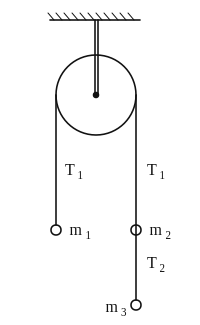
Three masses m1=4 kg, m2=4 kg and m3=6 kg are suspended from a fixed smooth frictionless pully as shown in the figure below. The value of T1/T2 is ______
(take g=10 m/s2)
तीन द्रव्यमान m1=4 kg, m2=4 kg तथा m3=6 kg एक स्थिर चिकनी घर्षणरहित घिरनी से नीचे चित्र में दर्शाए अनुसार लटकाए गए हैं। T1/T2 का मान ______ है
(g=10 m/s2 लीजिए)
  1. A5/3
  2. B2/3
  3. C3/5
  4. D2/5
Show answer

Concept: Treat m2+m3 (10 kg) on one side against m1 (4 kg) on the other; all move with the same acceleration.

  1. a=(10−4)g14=6014=307 m/s2 (right side goes down).
  2. m1 goes up: T1=m1(g+a)=4(10+307)=4007 N.
  3. m3 goes down: T2=m3(g−a)=6(10−307)=2407 N.
  4. T1/T2=400/240=5/3.

Short trick: T1=2m1(m2+m3)gM, T2=2m1m3gM → T1/T2=m2+m3m3=106=53.

Answer: (A) 5/3

अवधारणा: एक ओर m2+m3 (10 kg) तथा दूसरी ओर m1 (4 kg) मानिए; सभी समान त्वरण से गति करते हैं।

  1. a=(10−4)g14=6014=307 m/s2 (दाईं ओर का भाग नीचे जाता है)।
  2. m1 ऊपर जाता है: T1=m1(g+a)=4(10+307)=4007 N।
  3. m3 नीचे जाता है: T2=m3(g−a)=6(10−307)=2407 N।
  4. T1/T2=400/240=5/3।

शॉर्ट ट्रिक: T1=2m1(m2+m3)gM, T2=2m1m3gM → T1/T2=m2+m3m3=106=53।

उत्तर: (A) 5/3

JEE Main 2026 (April) – Paper 1 (B.E./B.Tech)PhysicsLaws of Motion – pulley system (Atwood machine)JEE Main 2026 (April) – Paper 1 (B.E./B.Tech) 2026 · 5 Apr Shift 1 →
Q1155.
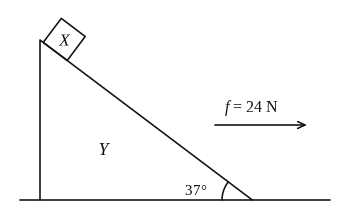
A wedge Y with mass of 10 kg and all frictionless surfaces and the inclined surface making 37° with horizontal. A block X with mass 2 kg is placed at the highest point of the wedge as shown in figure is at rest. At t=0 wedge (Y) is pulled toward right with constant force (f) of 24 N. Taking the block X at rest at t=0, the time taken by it to slide down 8.8 m on the slope, while Y is on the move, is_____ s.
(take tan⁡(37°)=3/4 and g=10 m/s2)
10 kg द्रव्यमान का एक वेज Y है जिसकी सभी सतहें घर्षणरहित हैं तथा आनत सतह क्षैतिज से 37° का कोण बनाती है। 2 kg द्रव्यमान का एक गुटका X चित्र में दर्शाए अनुसार वेज के उच्चतम बिंदु पर विरामावस्था में रखा है। t=0 पर वेज (Y) को 24 N के नियत बल (f) से दाईं ओर खींचा जाता है। t=0 पर गुटके X को विरामावस्था में मानते हुए, Y के गतिमान रहते हुए गुटके द्वारा ढलान पर 8.8 m नीचे फिसलने में लिया गया समय _____ s है।
(tan⁡(37°)=3/4 तथा g=10 m/s2 लीजिए)
  1. A2
  2. B4
  3. C2
  4. D22
Show answer

Concept: In the wedge frame the block feels a pseudo force mA to the left; along the incline (which descends to the right) arel=gsin⁡θ−Acos⁡θ, where A is the wedge's acceleration.

  1. Usual approach (block and wedge pushed together by f): A=fM+m=2412=2 m/s2.
  2. arel=10×0.6−2×0.8=6−1.6=4.4 m/s2.
  3. 8.8=12(4.4)t2 → t2=4 → t=2 s.
  4. Exact check: the wedge alone obeys MA=f−Nsin⁡θ with N=mgcos⁡θ+mAsin⁡θ → 10A=24−0.6(16+1.2A) → A=9067≈1.34 m/s2, arel=33067≈4.93 m/s2, t=2×8.84.93≈1.89 s ≈ 2 s.
  5. Either way the time is about 2 s; (B) 4 s, (C) 2 ≈ 1.41 s and (D) 22 ≈ 2.83 s are far off.

Short trick: arel=gsin⁡θ−fM+mcos⁡θ=4.4 m/s2; t=2s/arel=17.6/4.4=2 s.

Answer: (A) 2

अवधारणा: वेज के निर्देश तंत्र में गुटके पर बाईं ओर छद्म बल mA लगता है; आनत तल के अनुदिश (जो दाईं ओर नीचे जाता है) arel=gsin⁡θ−Acos⁡θ, जहाँ A वेज का त्वरण है।

  1. सामान्य विधि (बल f से गुटका व वेज साथ धकेले जाते हैं): A=fM+m=2412=2 m/s2।
  2. arel=10×0.6−2×0.8=6−1.6=4.4 m/s2।
  3. 8.8=12(4.4)t2 → t2=4 → t=2 s।
  4. यथार्थ जाँच: केवल वेज के लिए MA=f−Nsin⁡θ, जहाँ N=mgcos⁡θ+mAsin⁡θ → 10A=24−0.6(16+1.2A) → A=9067≈1.34 m/s2, arel=33067≈4.93 m/s2, t=2×8.84.93≈1.89 s ≈ 2 s।
  5. दोनों प्रकार से समय लगभग 2 s है; (B) 4 s, (C) 2 ≈ 1.41 s तथा (D) 22 ≈ 2.83 s बहुत दूर हैं।

शॉर्ट ट्रिक: arel=gsin⁡θ−fM+mcos⁡θ=4.4 m/s2; t=2s/arel=17.6/4.4=2 s।

उत्तर: (A) 2

JEE Main 2026 (April) – Paper 1 (B.E./B.Tech)PhysicsLaws of Motion – block on a moving wedgeJEE Main 2026 (April) – Paper 1 (B.E./B.Tech) 2026 · 5 Apr Shift 1 →
Q1156.
The Young's modulus of steel wire of radius r and length L is Y.
If the radius r and length L of the wire are doubled then the value of Y
त्रिज्या r तथा लंबाई L वाले स्टील के तार का यंग गुणांक Y है।
यदि तार की त्रिज्या r तथा लंबाई L दोगुनी कर दी जाएँ, तो Y का मान
  1. Aincreases by two timesदो गुना बढ़ जाता है
  2. Breduces by halfआधा हो जाता है
  3. Cremains unchangedअपरिवर्तित रहता है
  4. Dbecomes one fourthएक-चौथाई हो जाता है
Show answer

Concept: Young's modulus Y=stressstrain is a property of the material only; it does not depend on the dimensions of the wire.

  1. Changing r or L changes the extension for a given load (ΔL=FLπr2Y), not Y.
  2. The wire is still steel → Y remains unchanged. (A), (B), (D) wrongly treat Y as dimension-dependent.

Short trick: Elastic moduli depend only on material (and temperature).

Answer: (C) remains unchanged

अवधारणा: यंग गुणांक Y=प्रतिबलविकृति केवल पदार्थ का गुण है; यह तार की विमाओं पर निर्भर नहीं करता।

  1. r या L बदलने से दिए गए भार के लिए प्रसार बदलता है (ΔL=FLπr2Y), Y नहीं।
  2. तार अब भी स्टील का है → Y अपरिवर्तित रहता है। (A), (B), (D) गलती से Y को विमाओं पर निर्भर मानते हैं।

शॉर्ट ट्रिक: प्रत्यास्थता गुणांक केवल पदार्थ (तथा ताप) पर निर्भर करते हैं।

उत्तर: (C) अपरिवर्तित रहता है

JEE Main 2026 (April) – Paper 1 (B.E./B.Tech)PhysicsMechanical Properties of Solids – Young's modulusJEE Main 2026 (April) – Paper 1 (B.E./B.Tech) 2026 · 5 Apr Shift 1 →
Q1157.
Given below are two statements: one is labelled as Assertion A and the other is labelled as Reason R
Statement I: Change in internal energy of a system containing n mole of ideal gas can be written as ΔU=nCv(Tf−Ti)=nRγ−1(Tf−Ti), where γ=CpCv, Ti = initial temperature, Tf = final temperature.
Statement II: Relation between degree of freedom f and γ (=Cp/Cv) is (γ=1+2f)
Choose the correct answer from the options given below
नीचे दो कथन दिए गए हैं: एक को अभिकथन A तथा दूसरे को कारण R से चिह्नित किया गया है
कथन I: आदर्श गैस के n मोल वाले निकाय की आंतरिक ऊर्जा में परिवर्तन को ΔU=nCv(Tf−Ti)=nRγ−1(Tf−Ti) के रूप में लिखा जा सकता है, जहाँ γ=CpCv, Ti = प्रारंभिक ताप, Tf = अंतिम ताप।
कथन II: स्वातंत्र्य कोटि f तथा γ (=Cp/Cv) के बीच संबंध (γ=1+2f) है
नीचे दिए गए विकल्पों में से सही उत्तर चुनिए
  1. ABoth A and R are true and R is the correct explanation of AA तथा R दोनों सत्य हैं तथा R, A की सही व्याख्या है
  2. BBoth A and R are true but R is NOT the correct explanation of AA तथा R दोनों सत्य हैं परंतु R, A की सही व्याख्या नहीं है
  3. CA is true but R is falseA सत्य है परंतु R असत्य है
  4. DA is false but R is trueA असत्य है परंतु R सत्य है
Show answer

Concept: For an ideal gas U depends only on T, so ΔU=nCvΔT for any process; Mayer's relation Cp−Cv=R with γ=Cp/Cv gives Cv=Rγ−1.

  1. Statement I (A): Cv=Rγ−1 follows directly from Cp−Cv=R → A is true.
  2. Statement II (R): with equipartition Cv=f2R, Cp=(f2+1)R → γ=1+2f → R is true.
  3. A is derived from Mayer's relation and holds for every ideal gas regardless of how f is counted; it does not need the degrees-of-freedom relation, so R is not the explanation of A. Hence (A) is wrong, and (C), (D) are wrong since both statements are true.

Short trick: Cv=R/(γ−1) is just Mayer's relation – no degrees of freedom needed.

Answer: (B) Both A and R are true but R is NOT the correct explanation of A

अवधारणा: आदर्श गैस के लिए U केवल T पर निर्भर करती है, अतः किसी भी प्रक्रम में ΔU=nCvΔT; मेयर संबंध Cp−Cv=R तथा γ=Cp/Cv से Cv=Rγ−1 प्राप्त होता है।

  1. कथन I (A): Cv=Rγ−1 सीधे Cp−Cv=R से प्राप्त होता है → A सत्य है।
  2. कथन II (R): ऊर्जा के समविभाजन से Cv=f2R, Cp=(f2+1)R → γ=1+2f → R सत्य है।
  3. A मेयर संबंध से व्युत्पन्न है तथा प्रत्येक आदर्श गैस के लिए मान्य है, चाहे f कैसे भी गिना जाए; इसके लिए स्वातंत्र्य कोटि संबंध आवश्यक नहीं, अतः R, A की व्याख्या नहीं है। इसलिए (A) गलत है, तथा (C), (D) गलत हैं क्योंकि दोनों कथन सत्य हैं।

शॉर्ट ट्रिक: Cv=R/(γ−1) केवल मेयर संबंध है – स्वातंत्र्य कोटि की आवश्यकता नहीं।

उत्तर: (B) A तथा R दोनों सत्य हैं परंतु R, A की सही व्याख्या नहीं है

JEE Main 2026 (April) – Paper 1 (B.E./B.Tech)PhysicsKinetic Theory – internal energy and degrees of freedomJEE Main 2026 (April) – Paper 1 (B.E./B.Tech) 2026 · 5 Apr Shift 1 →
Q1158.
Consider the following statements:
A. Zeroth law of thermodynamics gives concept of temperature
B. First law of thermodynamics gives concept of internal energy
C. In isothermal expansion of ideal gas, ΔQ≠ΔW
D. Product of intensive and extensive variables is extensive
E. The ratio of any extensive variable to mass will be an extensive variable
Choose the correct combination of statements from the options given below:
निम्नलिखित कथनों पर विचार कीजिए:
A. ऊष्मागतिकी का शून्यांकी नियम ताप की अवधारणा देता है
B. ऊष्मागतिकी का प्रथम नियम आंतरिक ऊर्जा की अवधारणा देता है
C. आदर्श गैस के समतापीय प्रसार में, ΔQ≠ΔW
D. गहन (intensive) तथा विस्तीर्ण (extensive) चरों का गुणनफल विस्तीर्ण होता है
E. किसी भी विस्तीर्ण चर का द्रव्यमान से अनुपात एक विस्तीर्ण चर होगा
नीचे दिए गए विकल्पों में से कथनों का सही संयोजन चुनिए:
  1. AC, D and E Onlyकेवल C, D तथा E
  2. BA, B and C Onlyकेवल A, B तथा C
  3. CA, B and D Onlyकेवल A, B तथा D
  4. DB, C and D Onlyकेवल B, C तथा D
Show answer

Concept: Zeroth law → thermal equilibrium → temperature; first law → internal energy as a state function. Intensive × extensive scales with system size; extensive ÷ mass is a specific (intensive) quantity.

  1. A: true.
  2. B: true.
  3. C: isothermal ideal gas → ΔU=0 → ΔQ=ΔW; so C is false.
  4. D: e.g. P×V, density × volume = mass → extensive; true.
  5. E: e.g. volume/mass = specific volume, which is intensive; false.
  6. Correct set: A, B, D. (A), (B), (D) each contain the false statement C or E.

Short trick: Isothermal ideal gas: Q=W; "per unit mass" always makes a quantity intensive.

Answer: (C) A, B and D Only

अवधारणा: शून्यांकी नियम → तापीय साम्य → ताप; प्रथम नियम → अवस्था फलन के रूप में आंतरिक ऊर्जा। गहन × विस्तीर्ण निकाय के आकार के अनुपात में बदलता है; विस्तीर्ण ÷ द्रव्यमान एक विशिष्ट (गहन) राशि है।

  1. A: सत्य।
  2. B: सत्य।
  3. C: आदर्श गैस का समतापीय प्रक्रम → ΔU=0 → ΔQ=ΔW; अतः C असत्य है।
  4. D: उदाहरण P×V, घनत्व × आयतन = द्रव्यमान → विस्तीर्ण; सत्य।
  5. E: उदाहरण आयतन/द्रव्यमान = विशिष्ट आयतन, जो गहन है; असत्य।
  6. सही समुच्चय: A, B, D। (A), (B), (D) प्रत्येक में असत्य कथन C या E सम्मिलित है।

शॉर्ट ट्रिक: समतापीय आदर्श गैस: Q=W; "प्रति इकाई द्रव्यमान" किसी राशि को सदैव गहन बना देता है।

उत्तर: (C) केवल A, B तथा D

JEE Main 2026 (April) – Paper 1 (B.E./B.Tech)PhysicsThermodynamics – laws and state variablesJEE Main 2026 (April) – Paper 1 (B.E./B.Tech) 2026 · 5 Apr Shift 1 →
Q1159.
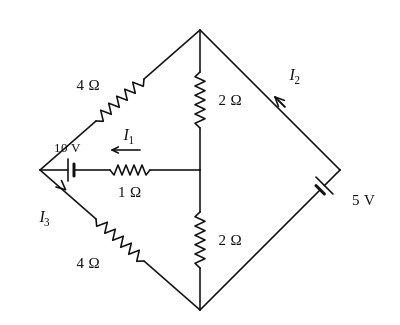
Refer to the figure given below. The values of I1, I2 and I3 are ________.
नीचे दिए गए चित्र को देखिए। I1, I2 तथा I3 के मान ________ हैं।
  1. AI1=2.5 A, I2=1.875 A, I3=1.875 A
  2. BI1=1.875 A, I2=2.5 A, I3=1.875 A
  3. CI1=1.875 A, I2=1.875 A, I3=2.5 A
  4. DI1=2.5 A, I2=2.5 A, I3=1.875 A
Show answer

Concept: Use superposition: keep one source at a time (the other replaced by a short circuit) and add the branch currents. Label the left node P, top node T, bottom node B, middle node M.

  1. Only 10 V: T and B are shorted. Between P and T/B: 4∥4=2 Ω; between M and T/B: 2∥2=1 Ω. Loop current =101+2+1=2.5 A through the 1 Ω (towards P), splitting 1.25 A into each 4 Ω; no net current through the 5 V branch.
  2. Only 5 V: P–T 4 Ω, P–B 4 Ω, M–T 2 Ω, M–B 2 Ω form a balanced bridge (4/4 = 2/2), so P and M are at the same potential → zero current in the 1 Ω. Battery current =58+54=0.625+1.25=1.875 A; each 4 Ω carries 0.625 A (T → P → B).
  3. Superpose: I1=2.5+0=2.5 A; I2=0+1.875=1.875 A; lower 4 Ω: I3=1.25+0.625=1.875 A (both downward from P to B).
  4. Check with node potentials (VB=0): VT=5 V, VP=7.5 V, VM=0 → I3=7.5/4=1.875 A ✔.

Short trick: The 5 V source sees a balanced Wheatstone bridge, so it never affects I1; the 10 V source sees T and B shorted.

Answer: (A) I1=2.5 A, I2=1.875 A, I3=1.875 A

अवधारणा: अध्यारोपण का प्रयोग कीजिए: एक समय पर एक ही स्रोत रखिए (दूसरे को लघुपथित करके) तथा शाखा धाराएँ जोड़िए। बाएँ नोड को P, ऊपरी को T, निचले को B तथा मध्य नोड को M कहिए।

  1. केवल 10 V: T तथा B लघुपथित। P तथा T/B के बीच: 4∥4=2 Ω; M तथा T/B के बीच: 2∥2=1 Ω। पाश धारा =101+2+1=2.5 A, 1 Ω में (P की ओर), प्रत्येक 4 Ω में 1.25 A; 5 V शाखा में कोई नेट धारा नहीं।
  2. केवल 5 V: P–T 4 Ω, P–B 4 Ω, M–T 2 Ω, M–B 2 Ω एक संतुलित सेतु बनाते हैं (4/4 = 2/2), अतः P तथा M समान विभव पर → 1 Ω में धारा शून्य। बैटरी धारा =58+54=0.625+1.25=1.875 A; प्रत्येक 4 Ω में 0.625 A (T → P → B)।
  3. अध्यारोपण: I1=2.5+0=2.5 A; I2=0+1.875=1.875 A; निचला 4 Ω: I3=1.25+0.625=1.875 A (दोनों P से B की ओर)।
  4. नोड विभवों से जाँच (VB=0): VT=5 V, VP=7.5 V, VM=0 → I3=7.5/4=1.875 A ✔।

शॉर्ट ट्रिक: 5 V स्रोत के लिए परिपथ संतुलित व्हीटस्टोन सेतु है, अतः वह I1 को प्रभावित नहीं करता; 10 V स्रोत के लिए T तथा B लघुपथित हैं।

उत्तर: (A) I1=2.5 A, I2=1.875 A, I3=1.875 A

JEE Main 2026 (April) – Paper 1 (B.E./B.Tech)PhysicsCurrent Electricity – Kirchhoff's laws / superpositionJEE Main 2026 (April) – Paper 1 (B.E./B.Tech) 2026 · 5 Apr Shift 1 →
Q1160.
An electron of mass m is moving in an electric field E→=−2E0i^ (E0 = constant >0), with an initial velocity V→=v0i^ (v0 = constant >0). If λ0=h4mv0, its de Broglie wavelength at time t is ______.
(e = charge of electron)
द्रव्यमान m का एक इलेक्ट्रॉन विद्युत क्षेत्र E→=−2E0i^ (E0 = नियतांक >0) में प्रारंभिक वेग V→=v0i^ (v0 = नियतांक >0) से गति कर रहा है। यदि λ0=h4mv0, तो समय t पर इसकी दे-ब्रॉग्ली तरंगदैर्ध्य ______ है।
(e = इलेक्ट्रॉन का आवेश)
  1. A4λ0[1−E0et2mv0]
  2. B4λ0[1+E0et2mv0]
  3. C4λ0[1+2E0etmv0]
  4. D4λ0[1−2E0etmv0]
Show answer

Concept: Force on electron F→=−eE→=+2eE0i^, i.e. along v→0, so the electron speeds up; λ=hmv.

  1. a=2eE0m → v=v0+2eE0tm=v0(1+2E0etmv0).
  2. λ=hmv=hmv0⋅11+2E0etmv0.
  3. Since hmv0=4λ0: λ=4λ01+2E0etmv0.
  4. (A), (B) use half the force; (D) has the wrong sign (electron would decelerate only if E→ were along +i^).

Short trick: Field opposite to velocity → electron accelerates → λ decreases → "+" in denominator with force 2eE0.

Answer: (C) 4λ0[1+2E0etmv0]

अवधारणा: इलेक्ट्रॉन पर बल F→=−eE→=+2eE0i^, अर्थात् v→0 की दिशा में, अतः इलेक्ट्रॉन की चाल बढ़ती है; λ=hmv।

  1. a=2eE0m → v=v0+2eE0tm=v0(1+2E0etmv0)।
  2. λ=hmv=hmv0⋅11+2E0etmv0।
  3. चूँकि hmv0=4λ0: λ=4λ01+2E0etmv0।
  4. (A), (B) आधे बल का प्रयोग करते हैं; (D) में चिह्न गलत है (इलेक्ट्रॉन का मंदन तभी होता जब E→, +i^ की दिशा में होता)।

शॉर्ट ट्रिक: क्षेत्र वेग के विपरीत → इलेक्ट्रॉन त्वरित → λ घटती है → हर में "+" तथा बल 2eE0।

उत्तर: (C) 4λ0[1+2E0etmv0]

JEE Main 2026 (April) – Paper 1 (B.E./B.Tech)PhysicsDual Nature – de Broglie wavelength of accelerated electronJEE Main 2026 (April) – Paper 1 (B.E./B.Tech) 2026 · 5 Apr Shift 1 →