Question bank

Q&A: practice questions with answers

Search questions on any topic. Filter by exam category, exam, subject and topic, try the question, then open the answer and explanation.

Courses – airGurukul

53,050 questions in the question bank.

Q1161.
In the hydrogen atom, the electron makes a transition from the higher orbit (i) to a lower orbit (f). The ratio of the radius of the orbits in given by ri:rf=16:4. The wavelength of photon emitted due to this transition is ______nm.
(Given Rydberg constant = 1.0973×10⁷ /m)
हाइड्रोजन परमाणु में इलेक्ट्रॉन उच्च कक्षा (i) से निम्न कक्षा (f) में संक्रमण करता है। कक्षाओं की त्रिज्याओं का अनुपात ri:rf=16:4 दिया गया है। इस संक्रमण के कारण उत्सर्जित फोटॉन की तरंगदैर्ध्य ______nm है।
(रिडबर्ग नियतांक = 1.0973×10⁷ /m दिया है)
  1. A121
  2. B242
  3. C486
  4. D974
Show answer

Concept: Bohr radius rn∝n2, so ri:rf=16:4=42:22 → ni=4, nf=2 (Balmer Hβ line). 1λ=R(1nf2−1ni2).

  1. 1λ=R(14−116)=3R16.
  2. λ=163×1.0973×107=4.86×10⁻⁷ m ≈486 nm.
  3. (A) 121 nm would be 2 → 1 (Lyman α); the radii 16 : 4 correspond to n2 = 16 and 4, i.e. 4 → 2.

Short trick: r∝n2: read 16 : 4 directly as n2 → 4 → 2 → Hβ = 486 nm.

Answer: (C) 486

अवधारणा: बोर त्रिज्या rn∝n2, अतः ri:rf=16:4=42:22 → ni=4, nf=2 (बामर Hβ रेखा)। 1λ=R(1nf2−1ni2)।

  1. 1λ=R(14−116)=3R16।
  2. λ=163×1.0973×107=4.86×10⁻⁷ m ≈486 nm।
  3. (A) 121 nm, 2 → 1 (लाइमन α) संक्रमण का होता; त्रिज्याएँ 16 : 4, n2 = 16 तथा 4 के संगत हैं, अर्थात् 4 → 2।

शॉर्ट ट्रिक: r∝n2: 16 : 4 को सीधे n2 पढ़िए → 4 → 2 → Hβ = 486 nm।

उत्तर: (C) 486
JEE Main 2026 (April) – Paper 1 (B.E./B.Tech)PhysicsAtoms – Bohr model, hydrogen spectrumJEE Main 2026 (April) – Paper 1 (B.E./B.Tech) 2026 · 5 Apr Shift 1 →
Q1162.
A displacement current of 4.0 A can be set up in the space between two parallel plates of 6 μF capacitor. The rate of change of potential difference across the plates of the capacitor is nearly α×106 V/s. The value of α is _______.
6 μF संधारित्र की दो समांतर प्लेटों के बीच के स्थान में 4.0 A की विस्थापन धारा स्थापित की जा सकती है। संधारित्र की प्लेटों के बीच विभवांतर में परिवर्तन की दर लगभग α×106 V/s है। α का मान _______ है।
  1. A0.58
  2. B0.67
  3. C0.82
  4. D0.75
Show answer

Concept: Id=ε0dΦEdt=CdVdt.

  1. dVdt=IdC=4.06×10⁻⁶.
  2. =0.667×10⁶ V/s → α≈0.67.

Short trick: dV/dt=I/C=4/6 MV/s.

Answer: (B) 0.67

अवधारणा: Id=ε0dΦEdt=CdVdt।

  1. dVdt=IdC=4.06×10⁻⁶।
  2. =0.667×10⁶ V/s → α≈0.67।

शॉर्ट ट्रिक: dV/dt=I/C=4/6 MV/s।

उत्तर: (B) 0.67

JEE Main 2026 (April) – Paper 1 (B.E./B.Tech)PhysicsElectromagnetic Waves – displacement currentJEE Main 2026 (April) – Paper 1 (B.E./B.Tech) 2026 · 5 Apr Shift 1 →
Q1163.
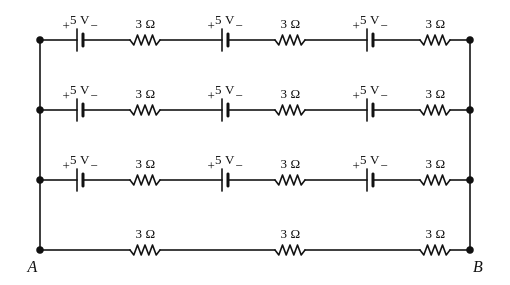
Refer to the figure given below, current between terminals A and B is __________ A.
नीचे दिए गए चित्र को देखिए, टर्मिनलों A तथा B के बीच धारा __________ A है।
  1. A12.5
  2. B1.25
  3. C7.5
  4. D5
Show answer

Concept: Each of the top three rows is a source of emf 3×5=15 V (all cells aligned, + towards A) with internal resistance 3×3=9 Ω. Identical sources in parallel: same emf, resistance divided by their number. The bottom row (9 Ω, no cell) is the external load between A and B.

  1. Three identical (15 V, 9 Ω) branches in parallel → Eeq=15 V, req=9/3=3 Ω.
  2. Load: bottom row =3+3+3=9 Ω.
  3. I=Eeqreq+R=153+9=1.25 A.

Short trick: Millman: VAB=3×15/93/9+1/9=11.25 V → I=11.25/9=1.25 A.

Answer: (B) 1.25

अवधारणा: ऊपर की तीनों पंक्तियों में से प्रत्येक 3×5=15 V विद्युत वाहक बल (सभी सेल एक ही दिशा में, + सिरा A की ओर) तथा 3×3=9 Ω आंतरिक प्रतिरोध का स्रोत है। समान स्रोत समांतर में: विद्युत वाहक बल वही, प्रतिरोध उनकी संख्या से विभाजित। सबसे नीचे की पंक्ति (9 Ω, कोई सेल नहीं) A तथा B के बीच बाह्य भार है।

  1. तीन समान (15 V, 9 Ω) शाखाएँ समांतर में → Eeq=15 V, req=9/3=3 Ω।
  2. भार: नीचे की पंक्ति =3+3+3=9 Ω।
  3. I=Eeqreq+R=153+9=1.25 A।

शॉर्ट ट्रिक: मिलमैन: VAB=3×15/93/9+1/9=11.25 V → I=11.25/9=1.25 A।

उत्तर: (B) 1.25

JEE Main 2026 (April) – Paper 1 (B.E./B.Tech)PhysicsCurrent Electricity – cells in parallelJEE Main 2026 (April) – Paper 1 (B.E./B.Tech) 2026 · 5 Apr Shift 1 →
Q1164.
In Young's double slit experiment, the fringe width of the interference pattern produced on the screen is 2.4 μm. If the experiment is carried out in another medium having refractive index 1.2, the fringe width will be ____ μm.
यंग के द्विझिरी प्रयोग में, पर्दे पर उत्पन्न व्यतिकरण प्रतिरूप की फ्रिंज चौड़ाई 2.4 μm है। यदि प्रयोग अपवर्तनांक 1.2 वाले किसी अन्य माध्यम में किया जाए, तो फ्रिंज चौड़ाई ____ μm होगी।
  1. A1.2
  2. B2
  3. C2.4
  4. D2.88
Show answer

Concept: β=λDd and in a medium λ′=λ/μ, so β′=β/μ.

  1. β′=2.41.2=2 μm.

Short trick: Fringe width shrinks by the factor μ.

Answer: (B) 2

अवधारणा: β=λDd तथा माध्यम में λ′=λ/μ, अतः β′=β/μ।

  1. β′=2.41.2=2 μm।

शॉर्ट ट्रिक: फ्रिंज चौड़ाई μ गुना कम हो जाती है।

उत्तर: (B) 2

JEE Main 2026 (April) – Paper 1 (B.E./B.Tech)PhysicsWave Optics – YDSE in a mediumJEE Main 2026 (April) – Paper 1 (B.E./B.Tech) 2026 · 5 Apr Shift 1 →
Q1165.
A ray of light passing through an equilateral prism is having velocity 2.12×10⁸ m/s in the prism material, then the minimum angle of deviation is ________ degrees.
एक समबाहु प्रिज्म से गुजरने वाली प्रकाश किरण का प्रिज्म के पदार्थ में वेग 2.12×10⁸ m/s है, तो न्यूनतम विचलन कोण ________ डिग्री है।
  1. A45
  2. B30
  3. C28
  4. D58
Show answer

Concept: μ=c/v and μ=sin⁡(A+δm2)sin⁡(A/2) with A=60°.

  1. μ=3×1082.12×108=1.415≈2.
  2. sin⁡(60°+δm2)=2sin⁡30°=12 → 60°+δm2=45°.
  3. δm=30°.

Short trick: μ=2 with A=60° always gives δm=30°.

Answer: (B) 30

अवधारणा: μ=c/v तथा μ=sin⁡(A+δm2)sin⁡(A/2), जहाँ A=60°।

  1. μ=3×1082.12×108=1.415≈2।
  2. sin⁡(60°+δm2)=2sin⁡30°=12 → 60°+δm2=45°।
  3. δm=30°।

शॉर्ट ट्रिक: A=60° के साथ μ=2 सदैव δm=30° देता है।

उत्तर: (B) 30

JEE Main 2026 (April) – Paper 1 (B.E./B.Tech)PhysicsRay Optics – prism minimum deviationJEE Main 2026 (April) – Paper 1 (B.E./B.Tech) 2026 · 5 Apr Shift 1 →
Q1166.
Light source having wavelength 331 nm is used to generate photo-electrons whose stopping potential is 0.2 V. The work function of the used metal in the experiment is α×10−19 J. The value of α is _____.
(h=6.62×10⁻³⁴ J s, e=1.6×10⁻¹⁹ C and c=3×10⁸ m/s)
331 nm तरंगदैर्ध्य वाले प्रकाश स्रोत का प्रयोग प्रकाश-इलेक्ट्रॉन उत्पन्न करने के लिए किया जाता है, जिनका निरोधी विभव 0.2 V है। प्रयोग में प्रयुक्त धातु का कार्य फलन α×10−19 J है। α का मान _____ है।
(h=6.62×10⁻³⁴ J s, e=1.6×10⁻¹⁹ C तथा c=3×10⁸ m/s)
  1. A3.68
  2. B4.68
  3. C5.68
  4. D2.68
Show answer

Concept: Einstein's equation: hcλ=ϕ+eV0.

  1. hcλ=6.62×10−34×3×108331×10−9=6.00×10⁻¹⁹ J.
  2. eV0=1.6×10−19×0.2=0.32×10⁻¹⁹ J.
  3. ϕ=6.00−0.32=5.68×10⁻¹⁹ J → α=5.68.

Short trick: 6.62×3/331=0.06 exactly, so photon energy is 6×10⁻¹⁹ J.

Answer: (C) 5.68

अवधारणा: आइंस्टीन का समीकरण: hcλ=ϕ+eV0।

  1. hcλ=6.62×10−34×3×108331×10−9=6.00×10⁻¹⁹ J।
  2. eV0=1.6×10−19×0.2=0.32×10⁻¹⁹ J।
  3. ϕ=6.00−0.32=5.68×10⁻¹⁹ J → α=5.68।

शॉर्ट ट्रिक: 6.62×3/331=0.06 यथार्थ, अतः फोटॉन ऊर्जा 6×10⁻¹⁹ J।

उत्तर: (C) 5.68

JEE Main 2026 (April) – Paper 1 (B.E./B.Tech)PhysicsDual Nature – photoelectric effectJEE Main 2026 (April) – Paper 1 (B.E./B.Tech) 2026 · 5 Apr Shift 1 →
Q1167.
A compound microscope is designed with two symmetric biconvex lenses. The objective lens is cut vertically, creating two identical plano-convex lenses. One of them is used in place of original objective lens. To retain same magnification keeping the object distance unchanged, the tube length has to be
एक संयुक्त सूक्ष्मदर्शी दो सममित उभयोत्तल लेंसों से बनाया गया है। अभिदृश्यक लेंस को ऊर्ध्वाधरतः काटकर दो सर्वसम समतल-उत्तल लेंस बनाए जाते हैं। इनमें से एक को मूल अभिदृश्यक लेंस के स्थान पर प्रयुक्त किया जाता है। वस्तु दूरी अपरिवर्तित रखते हुए समान आवर्धन बनाए रखने के लिए नलिका की लंबाई को
  1. Aincreased two timesदो गुना बढ़ाना होगा
  2. Bincreased 32 times32 गुना बढ़ाना होगा
  3. Cdecreased two timesदो गुना घटाना होगा
  4. Ddecreased 32 times32 गुना घटाना होगा
Show answer

Concept: Symmetric biconvex lens: 1f=(μ−1)2R; each plano-convex half: 1f′=(μ−1)1R → f′=2f. Magnifying power m≈Lfo⋅Dfe.

  1. Objective focal length doubles: fo′=2fo; eyepiece unchanged.
  2. For the same m, L′fo′=Lfo → L′=2L.
  3. So the tube length must be increased two times; (B), (C), (D) do not keep L/fo constant.

Short trick: Cutting a symmetric biconvex lens into two plano-convex halves doubles f; m∝L/fo → double L.

Answer: (A) increased two times

अवधारणा: सममित उभयोत्तल लेंस: 1f=(μ−1)2R; प्रत्येक समतल-उत्तल अर्धभाग: 1f′=(μ−1)1R → f′=2f। आवर्धन क्षमता m≈Lfo⋅Dfe।

  1. अभिदृश्यक की फोकस दूरी दोगुनी: fo′=2fo; नेत्रिका अपरिवर्तित।
  2. समान m के लिए L′fo′=Lfo → L′=2L।
  3. अतः नलिका की लंबाई दो गुना बढ़ानी होगी; (B), (C), (D) L/fo को नियत नहीं रखते।

शॉर्ट ट्रिक: सममित उभयोत्तल लेंस को दो समतल-उत्तल भागों में काटने पर f दोगुनी; m∝L/fo → L दोगुनी।

उत्तर: (A) दो गुना बढ़ाना होगा

JEE Main 2026 (April) – Paper 1 (B.E./B.Tech)PhysicsRay Optics – compound microscopeJEE Main 2026 (April) – Paper 1 (B.E./B.Tech) 2026 · 5 Apr Shift 1 →
Q1168.
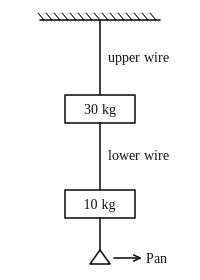
Two wires as shown in the figure below, made of steel and have breaking stress of 12×108 N/m2. Area of cross-section of upper wire is 0.008 cm2 and of lower wire is 0.004 cm2. The maximum mass that can be added to pan without breaking any wire is ______ kg.
(take g=10 m/s2)
नीचे चित्र में दर्शाए अनुसार दो तार स्टील के बने हैं तथा उनका भंजन प्रतिबल 12×108 N/m2 है। ऊपरी तार के अनुप्रस्थ काट का क्षेत्रफल 0.008 cm2 तथा निचले तार का 0.004 cm2 है। किसी भी तार के टूटे बिना पलड़े (pan) में जोड़ा जा सकने वाला अधिकतम द्रव्यमान ______ kg है।
(g=10 m/s2 लीजिए)
  1. A56
  2. B38
  3. C96
  4. D5.6
Show answer

Concept: Maximum tension a wire can bear = breaking stress × area. Upper wire holds 30 kg + 10 kg + M; lower wire holds 10 kg + M (pan mass neglected).

  1. Upper: Tmax=12×108×0.008×10−4=960 N → (40+M)10≤960 → M≤56 kg.
  2. Lower: Tmax=12×108×0.004×10−4=480 N → (10+M)10≤480 → M≤38 kg.
  3. Both must hold → Mmax=38 kg. (A) 56 kg would break the lower wire.

Short trick: Check each wire separately; the smaller limit wins.

Answer: (B) 38

अवधारणा: कोई तार अधिकतम जितना तनाव सह सकता है = भंजन प्रतिबल × क्षेत्रफल। ऊपरी तार 30 kg + 10 kg + M को धारण करता है; निचला तार 10 kg + M को (पलड़े का द्रव्यमान नगण्य)।

  1. ऊपरी: Tmax=12×108×0.008×10−4=960 N → (40+M)10≤960 → M≤56 kg।
  2. निचला: Tmax=12×108×0.004×10−4=480 N → (10+M)10≤480 → M≤38 kg।
  3. दोनों शर्तें आवश्यक → Mmax=38 kg। (A) 56 kg पर निचला तार टूट जाएगा।

शॉर्ट ट्रिक: प्रत्येक तार अलग से जाँचिए; छोटी सीमा ही मान्य।

उत्तर: (B) 38

JEE Main 2026 (April) – Paper 1 (B.E./B.Tech)PhysicsMechanical Properties of Solids – breaking stressJEE Main 2026 (April) – Paper 1 (B.E./B.Tech) 2026 · 5 Apr Shift 1 →
Q1169.
An a.c. source of angular frequency ω is connected across a resistor R and a capacitor C in series. The current is observed as I. Now the frequency of the source is changed to ω/4, (keeping the voltage unchanged) the current is found to be I/3. The ratio of resistance to reactance at frequency ω is
कोणीय आवृत्ति ω का एक प्रत्यावर्ती स्रोत श्रेणीक्रम में जुड़े प्रतिरोधक R तथा संधारित्र C के सिरों पर जोड़ा जाता है। धारा I प्रेक्षित होती है। अब स्रोत की आवृत्ति ω/4 कर दी जाती है (वोल्टता अपरिवर्तित रखते हुए), तो धारा I/3 पाई जाती है। आवृत्ति ω पर प्रतिरोध तथा प्रतिघात का अनुपात है
  1. A67
  2. B35
  3. C78
  4. D34
Show answer

Concept: I=VR2+X2 with X=1ωC; at ω/4 the reactance becomes 4X.

  1. II/3=R2+16X2R2+X2=3.
  2. R2+16X2=9R2+9X2 → 7X2=8R2.
  3. RX=78.

Short trick: Impedance ratio 3 → R2(9−1)=X2(16−9).

Answer: (C) 78

अवधारणा: I=VR2+X2, जहाँ X=1ωC; ω/4 पर प्रतिघात 4X हो जाता है।

  1. II/3=R2+16X2R2+X2=3।
  2. R2+16X2=9R2+9X2 → 7X2=8R2।
  3. RX=78।

शॉर्ट ट्रिक: प्रतिबाधा अनुपात 3 → R2(9−1)=X2(16−9)।

उत्तर: (C) 78

JEE Main 2026 (April) – Paper 1 (B.E./B.Tech)PhysicsAlternating Current – series RC circuitJEE Main 2026 (April) – Paper 1 (B.E./B.Tech) 2026 · 5 Apr Shift 1 →
Q1170.
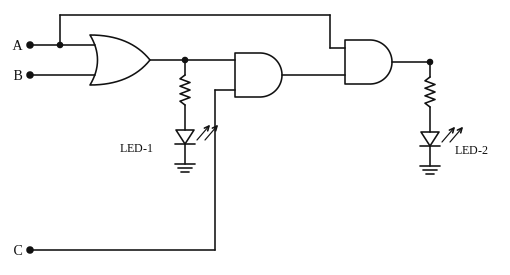
For the given logic circuit, which of the following inputs combination will make both LED−1 and LED−2 to glow?
दिए गए लॉजिक परिपथ के लिए, निम्नलिखित में से कौन-सा निवेश संयोजन LED−1 तथा LED−2 दोनों को दीप्त करेगा?
  1. AA = 0, B = 1, C = 1
  2. BA = 1, B = 0, C = 0
  3. CA = 1, B = 0, C = 1
  4. DA = 1, B = 1, C = 0
Show answer

Concept: An LED connected from a gate output to ground glows when that output is 1.

  1. OR output Y1=A+B drives LED−1.
  2. Middle AND: Y2=(A+B)⋅C.
  3. Last AND: Y=A⋅(A+B)⋅C=A⋅C drives LED−2.
  4. Both glow ⇔ A+B=1 and AC=1 ⇔ A=1, C=1 (any B). Only (C) has A=1, C=1; (A) has A=0, (B) and (D) have C=0.

Short trick: A(A+B)=A → LED−2 =AC.

Answer: (C) A = 1, B = 0, C = 1

अवधारणा: गेट के निर्गत से भूसंपर्क तक जुड़ा LED तब दीप्त होता है जब वह निर्गत 1 हो।

  1. OR निर्गत Y1=A+B, LED−1 को चलाता है।
  2. मध्य AND: Y2=(A+B)⋅C।
  3. अंतिम AND: Y=A⋅(A+B)⋅C=A⋅C, LED−2 को चलाता है।
  4. दोनों दीप्त ⇔ A+B=1 तथा AC=1 ⇔ A=1, C=1 (कोई भी B)। केवल (C) में A=1, C=1 है; (A) में A=0, (B) तथा (D) में C=0 है।

शॉर्ट ट्रिक: A(A+B)=A → LED−2 =AC।

उत्तर: (C) A = 1, B = 0, C = 1

JEE Main 2026 (April) – Paper 1 (B.E./B.Tech)PhysicsSemiconductors – logic gatesJEE Main 2026 (April) – Paper 1 (B.E./B.Tech) 2026 · 5 Apr Shift 1 →
Q1171.
A cube has side length 5 cm and modulus of rigidity 105 N/m2. The displacement produced by a force of 10 N in the upper face of cube is _____ mm.
एक घन की भुजा की लंबाई 5 cm तथा दृढ़ता गुणांक 105 N/m2 है। घन के ऊपरी फलक पर 10 N के बल द्वारा उत्पन्न विस्थापन _____ mm है।
Show answer

Concept: Shear modulus η=F/AΔx/L → Δx=FLηA.

  1. A=(0.05)2=2.5×10⁻³ m2, L=0.05 m.
  2. Δx=10×0.05105×2.5×10−3=0.5250=2×10⁻³ m.
  3. Δx=2 mm.

Short trick: For a cube Δx=Fηa=10105×0.05 m.

Answer: 2

अवधारणा: दृढ़ता गुणांक η=F/AΔx/L → Δx=FLηA।

  1. A=(0.05)2=2.5×10⁻³ m2, L=0.05 m।
  2. Δx=10×0.05105×2.5×10−3=0.5250=2×10⁻³ m।
  3. Δx=2 mm।

शॉर्ट ट्रिक: घन के लिए Δx=Fηa=10105×0.05 m।

उत्तर: 2

JEE Main 2026 (April) – Paper 1 (B.E./B.Tech)PhysicsMechanical Properties of Solids – shear modulusJEE Main 2026 (April) – Paper 1 (B.E./B.Tech) 2026 · 5 Apr Shift 1 →
Q1172.
From 18 m height above the ground a ball is dropped from rest. The height above the ground at which the magnitude of velocity equal to the magnitude of acceleration (in the same set of units) due to gravity is ____ m.
(Take g=10 m/s2 and neglect the air resistance)
भूमि से 18 m ऊँचाई से एक गेंद को विरामावस्था से गिराया जाता है। भूमि से वह ऊँचाई, जिस पर वेग का परिमाण गुरुत्वीय त्वरण के परिमाण (समान मात्रक पद्धति में) के बराबर हो, ____ m है।
(g=10 m/s2 लीजिए तथा वायु प्रतिरोध की उपेक्षा कीजिए)
Show answer

Concept: Free fall from rest: v2=2gs, where s is the distance fallen.

  1. Required v=10 m/s.
  2. s=v22g=10020=5 m.
  3. Height above ground =18−5=13 m.

Short trick: v=g ⇒ fallen s=g/2=5 m.

Answer: 13

अवधारणा: विराम से मुक्त पतन: v2=2gs, जहाँ s गिरी हुई दूरी है।

  1. आवश्यक v=10 m/s।
  2. s=v22g=10020=5 m।
  3. भूमि से ऊँचाई =18−5=13 m।

शॉर्ट ट्रिक: v=g ⇒ गिरी दूरी s=g/2=5 m।

उत्तर: 13

JEE Main 2026 (April) – Paper 1 (B.E./B.Tech)PhysicsKinematics – free fallJEE Main 2026 (April) – Paper 1 (B.E./B.Tech) 2026 · 5 Apr Shift 1 →
Q1173.
A transverse wave on a string is described by y=3sin⁡(36t+0.018x+π/4). where x, y are in cm and t in seconds. The least distance between the two successive crests in the wave is ____ cm. (Nearest integer)
(π=3.14)
एक डोरी पर अनुप्रस्थ तरंग y=3sin⁡(36t+0.018x+π/4) द्वारा वर्णित है, जहाँ x, y cm में तथा t सेकंड में हैं। तरंग में दो क्रमागत शीर्षों (crests) के बीच न्यूनतम दूरी ____ cm है। (निकटतम पूर्णांक)
(π=3.14)
Show answer

Concept: Distance between successive crests = wavelength λ=2πk.

  1. k=0.018 cm−1.
  2. λ=2×3.140.018=6.280.018=348.9 cm.
  3. Nearest integer: 349 cm.

Short trick: λ=6.28/0.018≈349 cm.

Answer: 349

अवधारणा: क्रमागत शीर्षों के बीच दूरी = तरंगदैर्ध्य λ=2πk।

  1. k=0.018 cm−1।
  2. λ=2×3.140.018=6.280.018=348.9 cm।
  3. निकटतम पूर्णांक: 349 cm।

शॉर्ट ट्रिक: λ=6.28/0.018≈349 cm।

उत्तर: 349

JEE Main 2026 (April) – Paper 1 (B.E./B.Tech)PhysicsWaves – wave equation, wavelengthJEE Main 2026 (April) – Paper 1 (B.E./B.Tech) 2026 · 5 Apr Shift 1 →
Q1174.
The charged particle moving in a uniform magnetic field of (3i^+2j^) T has an acceleration (4i^−x2j^) m/s2. The value of x is
(3i^+2j^) T के एकसमान चुम्बकीय क्षेत्र में गतिमान आवेशित कण का त्वरण (4i^−x2j^) m/s2 है। x का मान है
Show answer

Concept: Magnetic force q(v→×B→) is always perpendicular to B→, so a→⋅B→=0.

  1. (4i^−x2j^)⋅(3i^+2j^)=12−x=0.
  2. x=12.

Short trick: Dot product of acceleration with B is zero.

Answer: 12

अवधारणा: चुम्बकीय बल q(v→×B→) सदैव B→ के लंबवत होता है, अतः a→⋅B→=0।

  1. (4i^−x2j^)⋅(3i^+2j^)=12−x=0।
  2. x=12।

शॉर्ट ट्रिक: त्वरण तथा B का अदिश गुणनफल शून्य होता है।

उत्तर: 12

JEE Main 2026 (April) – Paper 1 (B.E./B.Tech)PhysicsMoving Charges – magnetic force perpendicular to fieldJEE Main 2026 (April) – Paper 1 (B.E./B.Tech) 2026 · 5 Apr Shift 1 →
Q1175.
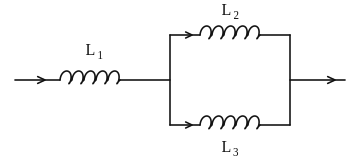
In the given circuit below inductance values of L1, L2 and L3 are same. The magnetic energy stored in the entire circuit is (Ut) and that stored in the L2 inductor is (Ul). Ut/Ul is _______.
(Ignore the mutual inductance if any)
नीचे दिए गए परिपथ में L1, L2 तथा L3 के प्रेरकत्व के मान समान हैं। संपूर्ण परिपथ में संचित चुम्बकीय ऊर्जा (Ut) है तथा L2 प्रेरक में संचित ऊर्जा (Ul) है। Ut/Ul का मान _______ है।
(अन्योन्य प्रेरकत्व, यदि कोई हो, की उपेक्षा कीजिए)
Show answer

Concept: Energy in an inductor U=12LI2. Current I flows through L1 and divides equally (I/2 each) between the identical parallel inductors L2, L3.

  1. UL1=12LI2; UL2=UL3=12L(I2)2=LI28.
  2. Ut=LI22+2×LI28=3LI24.
  3. UtUl=3/41/8=6.

Short trick: Energies in ratio 4:1:1 → total/one parallel coil =6/1.

Answer: 6

अवधारणा: प्रेरक में ऊर्जा U=12LI2। धारा I, L1 से प्रवाहित होकर समान समांतर प्रेरकों L2, L3 में बराबर (I/2 प्रत्येक) बँट जाती है।

  1. UL1=12LI2; UL2=UL3=12L(I2)2=LI28।
  2. Ut=LI22+2×LI28=3LI24।
  3. UtUl=3/41/8=6।

शॉर्ट ट्रिक: ऊर्जाओं का अनुपात 4:1:1 → कुल/एक समांतर कुंडली =6/1।

उत्तर: 6

JEE Main 2026 (April) – Paper 1 (B.E./B.Tech)PhysicsElectromagnetic Induction – energy stored in inductorsJEE Main 2026 (April) – Paper 1 (B.E./B.Tech) 2026 · 5 Apr Shift 1 →
Q1176.

How many grams of residue is obtained by heating 2.76 g of silver carbonate?
(Given : Molar mass of C, O and Ag are 12, 16 and 108 g mol−1 respectively)

2.76 g सिल्वर कार्बोनेट को गर्म करने पर कितने ग्राम अवशेष प्राप्त होता है?
(दिया है : C, O तथा Ag के मोलर द्रव्यमान क्रमशः 12, 16 तथा 108 g mol−1 हैं)

  1. A1.08 g
  2. B2.16 g
  3. C3.24 g
  4. D4.32 g
Show answer

Concept: On strong heating silver carbonate decomposes completely to metallic silver: 2Ag2CO3 → 4Ag + 2CO2 + O2. The residue is Ag.

  1. Molar mass of Ag2CO3 = 2(108) + 12 + 3(16) = 276 g mol−1.
  2. Moles of Ag2CO3 = 2.76/276 = 0.01 mol.
  3. Each mole gives 2 mol Ag → 0.02 mol Ag = 0.02 × 108 = 2.16 g.

Short trick: All the silver stays behind: mass of Ag = 2.76 × (216/276) = 2.16 g.

Answer: (B) 2.16 g

अवधारणा: तीव्र गर्म करने पर सिल्वर कार्बोनेट पूर्णतः धात्विक सिल्वर में अपघटित हो जाता है: 2Ag2CO3 → 4Ag + 2CO2 + O2। अवशेष Ag है।

  1. Ag2CO3 का मोलर द्रव्यमान = 2(108) + 12 + 3(16) = 276 g mol−1।
  2. Ag2CO3 के मोल = 2.76/276 = 0.01 mol।
  3. प्रत्येक मोल से 2 mol Ag → 0.02 mol Ag = 0.02 × 108 = 2.16 g।

शॉर्ट ट्रिक: सारा सिल्वर बचा रहता है: Ag का द्रव्यमान = 2.76 × (216/276) = 2.16 g।

उत्तर: (B) 2.16 g

JEE Main 2026 (April) – Paper 1 (B.E./B.Tech)ChemistrySome Basic Concepts – stoichiometryJEE Main 2026 (April) – Paper 1 (B.E./B.Tech) 2026 · 5 Apr Shift 1 →
Q1177.

Arrange the following atomic orbitals of multi electron atoms in order of increasing energy.

  1. n=3,l=2,m=+1
  2. n=4,l=0,m=0
  3. n=6,l=1,m=0
  4. n=5,l=1,m=+1
  5. n=2,l=1,m=+1

Choose the correct answer from the options given below:

बहु-इलेक्ट्रॉन परमाणुओं के निम्नलिखित परमाणु कक्षकों को ऊर्जा के बढ़ते क्रम में व्यवस्थित कीजिए।

  1. n=3,l=2,m=+1
  2. n=4,l=0,m=0
  3. n=6,l=1,m=0
  4. n=5,l=1,m=+1
  5. n=2,l=1,m=+1

नीचे दिए गए विकल्पों में से सही उत्तर चुनिए:

  1. AC < D < B < A < E
  2. BB < A < E < C < D
  3. CE < C < D < B < A
  4. DE < B < A < D < C
Show answer

Concept: In multi-electron atoms orbital energy follows the (n + l) rule; for equal (n + l), the orbital with lower n has lower energy. The value of m does not affect the energy.

  1. A: 3d → n + l = 5
  2. B: 4s → n + l = 4
  3. C: 6p → n + l = 7
  4. D: 5p → n + l = 6
  5. E: 2p → n + l = 3
  6. Increasing order: E (3) < B (4) < A (5) < D (6) < C (7). (A), (B) and (C) do not follow increasing (n + l).

Short trick: Just write n + l: 5, 4, 7, 6, 3 and sort.

Answer: (D) E < B < A < D < C

अवधारणा: बहु-इलेक्ट्रॉन परमाणुओं में कक्षक ऊर्जा (n + l) नियम का पालन करती है; समान (n + l) होने पर कम n वाले कक्षक की ऊर्जा कम होती है। m का मान ऊर्जा को प्रभावित नहीं करता।

  1. A: 3d → n + l = 5
  2. B: 4s → n + l = 4
  3. C: 6p → n + l = 7
  4. D: 5p → n + l = 6
  5. E: 2p → n + l = 3
  6. बढ़ता क्रम: E (3) < B (4) < A (5) < D (6) < C (7)। (A), (B) तथा (C) बढ़ते (n + l) क्रम का पालन नहीं करते।

शॉर्ट ट्रिक: केवल n + l लिखिए: 5, 4, 7, 6, 3 और क्रम में लगाइए।

उत्तर: (D) E < B < A < D < C

JEE Main 2026 (April) – Paper 1 (B.E./B.Tech)ChemistryAtomic Structure – (n + l) ruleJEE Main 2026 (April) – Paper 1 (B.E./B.Tech) 2026 · 5 Apr Shift 1 →
Q1178.

Identify the correct statements from the following :

  1. Heisenberg uncertainty principle is applicable to electrons.
  2. The size of 2px orbital is less than the size of 3px orbital.
  3. The energy of 2s orbital of H atom is equal to the energy of 2s orbital of Li.
  4. The electronic configuration of Cr is [Ar] 3d5 4s1

Choose the correct answer from the options given below:

निम्नलिखित में से सही कथनों को पहचानिए :

  1. हाइज़ेनबर्ग अनिश्चितता सिद्धांत (uncertainty principle) इलेक्ट्रॉनों पर लागू होता है।
  2. 2px कक्षक का आकार 3px कक्षक के आकार से कम होता है।
  3. H परमाणु के 2s कक्षक की ऊर्जा, Li के 2s कक्षक की ऊर्जा के बराबर होती है।
  4. Cr का इलेक्ट्रॉनिक विन्यास [Ar] 3d5 4s1 है।

नीचे दिए गए विकल्पों में से सही उत्तर चुनिए:

  1. AA, B and C Onlyकेवल A, B और C
  2. BA, B and D Onlyकेवल A, B और D
  3. CB, C and D Onlyकेवल B, C और D
  4. DA, C and D Onlyकेवल A, C और D
Show answer

Concept: Energy of an orbital depends on the effective nuclear charge it experiences; orbital size grows with n.

  1. A – true: the uncertainty principle is significant for microscopic particles like electrons.
  2. B – true: size increases with n, so 2px is smaller than 3px.
  3. C – false: energy depends on nuclear charge; Li (Z = 3) attracts its 2s electron more strongly, so its 2s energy is lower (more negative) than that of H (Z = 1).
  4. D – true: Cr (Z = 24) has the half-filled stable configuration [Ar] 3d5 4s1.
  5. Correct: A, B, D. Options (A), (C), (D) all contain the false statement C.

Answer: (B) A, B and D Only

अवधारणा: किसी कक्षक की ऊर्जा उस पर लगने वाले प्रभावी नाभिकीय आवेश पर निर्भर करती है; कक्षक का आकार n के साथ बढ़ता है।

  1. A – सत्य: अनिश्चितता सिद्धांत इलेक्ट्रॉन जैसे सूक्ष्म कणों के लिए महत्वपूर्ण है।
  2. B – सत्य: आकार n के साथ बढ़ता है, अतः 2px, 3px से छोटा है।
  3. C – असत्य: ऊर्जा नाभिकीय आवेश पर निर्भर करती है; Li (Z = 3) अपने 2s इलेक्ट्रॉन को अधिक प्रबलता से आकर्षित करता है, अतः इसकी 2s ऊर्जा H (Z = 1) की तुलना में कम (अधिक ऋणात्मक) होती है।
  4. D – सत्य: Cr (Z = 24) का अर्धपूरित स्थायी विन्यास [Ar] 3d5 4s1 है।
  5. सही: A, B, D। विकल्प (A), (C), (D) सभी में असत्य कथन C शामिल है।

उत्तर: (B) केवल A, B और D

JEE Main 2026 (April) – Paper 1 (B.E./B.Tech)ChemistryAtomic Structure – quantum mechanical modelJEE Main 2026 (April) – Paper 1 (B.E./B.Tech) 2026 · 5 Apr Shift 1 →
Q1179.

What is the mole fraction of water in 10% by weight (w/w) of aqueous urea solution?
[Given: Molar mass of H, O, C and N are 1, 16, 12 and 14 g mol−1 respectively.]

यूरिया के 10% भार द्वारा (w/w) जलीय विलयन में जल का मोल अंश क्या है?
[दिया है: H, O, C तथा N के मोलर द्रव्यमान क्रमशः 1, 16, 12 तथा 14 g mol−1 हैं।]

  1. A0.825
  2. B0.032
  3. C0.867
  4. D0.967
Show answer

Concept: Mole fraction of water = nwater/(nwater + nurea).

  1. Take 100 g solution: urea = 10 g, water = 90 g.
  2. Urea NH2CONH2: M = 60 g mol−1 → n = 10/60 = 0.1667 mol.
  3. Water: n = 90/18 = 5 mol.
  4. xwater=55+0.1667=0.9677≈0.967

Short trick: Water is in large excess, so xwater must be close to 1 – only (D) fits.

Answer: (D) 0.967

अवधारणा: जल का मोल अंश = nजल/(nजल + nयूरिया)।

  1. 100 g विलयन लीजिए: यूरिया = 10 g, जल = 90 g।
  2. यूरिया NH2CONH2: M = 60 g mol−1 → n = 10/60 = 0.1667 mol।
  3. जल: n = 90/18 = 5 mol।
  4. xwater=55+0.1667=0.9677≈0.967

शॉर्ट ट्रिक: जल अत्यधिक मात्रा में है, अतः xजल 1 के निकट होना चाहिए – केवल (D) उपयुक्त है।

उत्तर: (D) 0.967

JEE Main 2026 (April) – Paper 1 (B.E./B.Tech)ChemistrySolutions – mole fractionJEE Main 2026 (April) – Paper 1 (B.E./B.Tech) 2026 · 5 Apr Shift 1 →
Q1180.

M3A2 is a sparingly soluble salt of molar mass y g mol−1 and solubility x g L−1.
The ratio of the molar concentration of the anion (A3−) to the solubility product of the salt is

M3A2 एक अल्प विलेय लवण है जिसका मोलर द्रव्यमान y g mol−1 तथा विलेयता x g L−1 है।
ऋणायन (A3−) की मोलर सांद्रता तथा लवण के विलेयता गुणनफल का अनुपात है

  1. A154⋅y4x4
  2. By5108x4
  3. C108⋅x5y5
  4. D1108y4x4
Show answer

Concept: For M3A2 ⇌ 3M2+ + 2A3−, with molar solubility s: Ksp = (3s)3(2s)2 = 108s5.

  1. Molar solubility s=xy mol L−1.
  2. [A3−] = 2s.
  3. [A3−]Ksp=2s108s5=154s4=154⋅y4x4

Short trick: Ratio ∝ s−4 = (y/x)4 with coefficient 2/108 = 1/54.

Answer: (A) 154⋅y4x4

अवधारणा: M3A2 ⇌ 3M2+ + 2A3− के लिए, मोलर विलेयता s होने पर: Ksp = (3s)3(2s)2 = 108s5।

  1. मोलर विलेयता s=xy mol L−1।
  2. [A3−] = 2s।
  3. [A3−]Ksp=2s108s5=154s4=154⋅y4x4

शॉर्ट ट्रिक: अनुपात ∝ s−4 = (y/x)4, गुणांक 2/108 = 1/54।

उत्तर: (A) 154⋅y4x4

JEE Main 2026 (April) – Paper 1 (B.E./B.Tech)ChemistryIonic Equilibrium – solubility productJEE Main 2026 (April) – Paper 1 (B.E./B.Tech) 2026 · 5 Apr Shift 1 →