Question bank

Q&A: practice questions with answers

Search questions on any topic. Filter by exam category, exam, subject and topic, try the question, then open the answer and explanation.

Courses – airGurukul

53,050 questions in the question bank.

Q1241.
A spherical interface lens of radius R separates two media of refractive indices 1 and 1.4 respectively as shown in the figure below. A point source is placed at a distance of 4R in front of spherical interface. The magnitude of the magnification of point source image is ________.
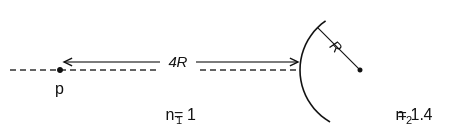
त्रिज्या R का एक गोलीय अन्तरापृष्ठ (लेंस) क्रमशः 1 तथा 1.4 अपवर्तनांक वाले दो माध्यमों को पृथक करता है, जैसा कि नीचे चित्र में दर्शाया गया है। एक बिन्दु स्रोत गोलीय अन्तरापृष्ठ के सामने 4R दूरी पर रखा है। बिन्दु स्रोत के प्रतिबिम्ब के आवर्धन का परिमाण ________ है।
  1. A1.66
  2. B2.33
  3. C2.66
  4. D1.33
Show answer

Concept: n2v−n1u=n2−n1R and m=n1vn2u. The surface is convex towards the source (centre in the 1.4 medium), so R=+R, u=−4R.

  1. 1.4v+14R=0.4R⇒1.4v=0.15R.
  2. v=1.4R0.15=28R3≈9.33R (real image).
  3. m=1×28R/31.4×(−4R)=−53, so |m|=1.66.

Short trick: |m|=n1vn2|u|=9.335.6=1.67.

Answer: (A) 1.66

अवधारणा: n2v−n1u=n2−n1R तथा m=n1vn2u। पृष्ठ स्रोत की ओर उत्तल है (केन्द्र 1.4 माध्यम में), अतः R=+R, u=−4R।

  1. 1.4v+14R=0.4R⇒1.4v=0.15R।
  2. v=1.4R0.15=28R3≈9.33R (वास्तविक प्रतिबिम्ब)।
  3. m=1×28R/31.4×(−4R)=−53, अतः |m|=1.66।

शॉर्ट ट्रिक: |m|=n1vn2|u|=9.335.6=1.67।

उत्तर: (A) 1.66

JEE Main 2026 (April) – Paper 1 (B.E./B.Tech)PhysicsRay Optics – refraction at spherical surfaceJEE Main 2026 (April) – Paper 1 (B.E./B.Tech) 2026 · 6 Apr Shift 1 →
Q1242.
A small cube of side 1 mm is placed at the centre of a circular loop of radius 10 cm carrying a current of 2 A. The magnetic energy stored inside the cube is α×10−14 J. The value of α is _______.
(μ0=4π×10−7 Tm/A, π=3.14)
1 mm भुजा का एक छोटा घन 2 A धारावाही 10 cm त्रिज्या के वृत्ताकार लूप के केन्द्र पर रखा है। घन के अन्दर संचित चुम्बकीय ऊर्जा α×10−14 J है। α का मान _______ है।
(μ0=4π×10−7 Tm/A, π=3.14)
  1. A6.28
  2. B6.28×10−6
  3. C628
  4. D6.28×10−4
Show answer

Concept: Field at the centre of a loop B=μ0I2r; energy density u=B22μ0; energy =u× volume (field nearly uniform over the tiny cube).

  1. B=4π×10−7×22×0.1=4π×10−6 T.
  2. u=(4π×10−6)22×4π×10−7=2π×10−5=6.28×10⁻⁵ J/m3.
  3. U=6.28×10−5×(10−3)3=6.28×10⁻¹⁴ J ⇒α=6.28.

Short trick: u=μ0I28r2=4π×10−7×48×0.01=2π×10−5.

Answer: (A) 6.28

अवधारणा: लूप के केन्द्र पर क्षेत्र B=μ0I2r; ऊर्जा घनत्व u=B22μ0; ऊर्जा =u× आयतन (छोटे घन में क्षेत्र लगभग एकसमान)।

  1. B=4π×10−7×22×0.1=4π×10−6 T।
  2. u=(4π×10−6)22×4π×10−7=2π×10−5=6.28×10⁻⁵ J/m3।
  3. U=6.28×10−5×(10−3)3=6.28×10⁻¹⁴ J ⇒α=6.28।

शॉर्ट ट्रिक: u=μ0I28r2=4π×10−7×48×0.01=2π×10−5।

उत्तर: (A) 6.28

JEE Main 2026 (April) – Paper 1 (B.E./B.Tech)PhysicsMagnetism – magnetic energy densityJEE Main 2026 (April) – Paper 1 (B.E./B.Tech) 2026 · 6 Apr Shift 1 →
Q1243.
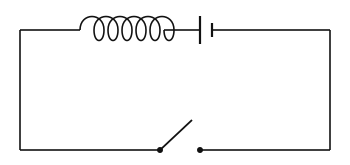
An inductor of inductance 10 mH having resistance of 100 Ω is connected to battery of E.M.F. 1.0 V through a switch as shown in the figure below. After switch is closed, the ratio of instantaneous voltages across the inductor when the current passing through it is 2 mA and 4 mA is _________.
100 Ω प्रतिरोध वाला 10 mH प्रेरकत्व का एक प्रेरक, नीचे चित्र में दर्शाए अनुसार, एक स्विच के माध्यम से 1.0 V वि.वा.बल (E.M.F.) की बैटरी से जुड़ा है। स्विच बंद करने के पश्चात्, जब प्रेरक से प्रवाहित धारा 2 mA तथा 4 mA हो, तब प्रेरक के सिरों पर तात्क्षणिक वोल्टताओं का अनुपात _________ है।
  1. A4/3
  2. B3/4
  3. C5/3
  4. D3/5
Show answer

Concept: Kirchhoff's loop law: E=iR+Ldidt, so the induced voltage across the inductance is VL=E−iR.

  1. At i=2 mA: VL=1−2×10−3×100=0.8 V.
  2. At i=4 mA: VL=1−4×10−3×100=0.6 V.
  3. Ratio =0.80.6=43.

Short trick: E−i1RE−i2R=1−0.21−0.4=43; (B) is the inverse.

Answer: (A) 4/3

अवधारणा: किरचॉफ का पाश नियम: E=iR+Ldidt, अतः प्रेरकत्व के सिरों पर प्रेरित वोल्टता VL=E−iR।

  1. i=2 mA पर: VL=1−2×10−3×100=0.8 V।
  2. i=4 mA पर: VL=1−4×10−3×100=0.6 V।
  3. अनुपात =0.80.6=43।

शॉर्ट ट्रिक: E−i1RE−i2R=1−0.21−0.4=43; (B) इसका व्युत्क्रम है।

उत्तर: (A) 4/3

JEE Main 2026 (April) – Paper 1 (B.E./B.Tech)PhysicsElectromagnetic Induction – LR circuit growthJEE Main 2026 (April) – Paper 1 (B.E./B.Tech) 2026 · 6 Apr Shift 1 →
Q1244.
The ratio of momentum of the photons of the 1st and 2nd line of Balmer series of Hydrogen atoms is α/β. The possible values of α and β are:-
हाइड्रोजन परमाणुओं की बामर श्रेणी की 1ली तथा 2री रेखा के फोटॉनों के संवेगों का अनुपात α/β है। α तथा β के सम्भावित मान हैं:-
  1. A27 and 2027 तथा 20
  2. B3 and 163 तथा 16
  3. C5 and 365 तथा 36
  4. D20 and 2720 तथा 27
Show answer

Concept: p=hλ and 1λ=RH(122−1n2), so p∝(14−1n2).

  1. 1st line (3→2): 14−19=536.
  2. 2nd line (4→2): 14−116=316.
  3. p1p2=5/363/16=80108=2027, so α=20, β=27.

Short trick: The first line has the least energy, so the ratio must be less than 1 — (A) is inverted; (B) and (C) are the individual factors, not the ratio.

Answer: (D) 20 and 27

अवधारणा: p=hλ तथा 1λ=RH(122−1n2), अतः p∝(14−1n2)।

  1. पहली रेखा (3→2): 14−19=536।
  2. दूसरी रेखा (4→2): 14−116=316।
  3. p1p2=5/363/16=80108=2027, अतः α=20, β=27।

शॉर्ट ट्रिक: पहली रेखा की ऊर्जा सबसे कम है, अतः अनुपात 1 से कम होना चाहिए — (A) उल्टा है; (B) व (C) अलग-अलग गुणक हैं, अनुपात नहीं।

उत्तर: (D) 20 तथा 27

JEE Main 2026 (April) – Paper 1 (B.E./B.Tech)PhysicsAtoms – Balmer series photon momentumJEE Main 2026 (April) – Paper 1 (B.E./B.Tech) 2026 · 6 Apr Shift 1 →
Q1245.
A LCR series circuit driven with Erms=90 V at frequency fd=30 Hz has resistance R=80 Ω, an inductance with inductive reactance XL=20.0 Ω and capacitance with capacitive reactance XC=80.0 Ω. The power factor of the circuit is______.
Erms=90 V तथा आवृत्ति fd=30 Hz से चालित एक श्रेणी LCR परिपथ में प्रतिरोध R=80 Ω, प्रेरकीय प्रतिघात XL=20.0 Ω वाला एक प्रेरकत्व तथा धारितीय प्रतिघात XC=80.0 Ω वाली एक धारिता है। परिपथ का शक्ति गुणांक ______ है।
  1. A0.8
  2. B0.64
  3. C0.9
  4. D0.5
Show answer

Concept: cos⁡ϕ=RZ with Z=R2+(XC−XL)2.

  1. XC−XL=80−20=60 Ω.
  2. Z=802+602=100 Ω.
  3. cos⁡ϕ=80100=0.8.

Short trick: 60-80-100 is a 3-4-5 triangle: cos⁡ϕ=4/5. Erms and fd are not needed.

Answer: (A) 0.8

अवधारणा: cos⁡ϕ=RZ, जहाँ Z=R2+(XC−XL)2।

  1. XC−XL=80−20=60 Ω।
  2. Z=802+602=100 Ω।
  3. cos⁡ϕ=80100=0.8।

शॉर्ट ट्रिक: 60-80-100 एक 3-4-5 त्रिभुज है: cos⁡ϕ=4/5। Erms तथा fd की आवश्यकता नहीं है।

उत्तर: (A) 0.8

JEE Main 2026 (April) – Paper 1 (B.E./B.Tech)PhysicsAlternating Current – power factorJEE Main 2026 (April) – Paper 1 (B.E./B.Tech) 2026 · 6 Apr Shift 1 →
Q1246.
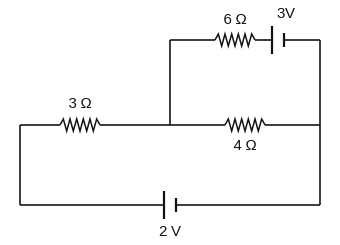
Refer to the circuit diagram given below. The heat generated across the 6 Ω resistance in 100 second is α100 J. The value of α is ________. (Nearest integer)
नीचे दिए गए परिपथ आरेख को देखिए। 100 सेकण्ड में 6 Ω प्रतिरोध में उत्पन्न ऊष्मा α100 J है। α का मान ________ है। (निकटतम पूर्णांक)
Show answer

Concept: Node analysis. Call the right-hand junction Y (VY=0), the left corner L and the junction between 3 Ω and 4 Ω X. The longer plate of each cell is its positive terminal: the 2 V cell gives VL=+2 V; in the top branch the 3 V cell has its positive plate towards X.

  1. Current from X to Y through the top branch: i6=VX−3−06.
  2. KCL at X: 2−VX3=VX4+VX−36. Multiply by 12: 8−4VX=3VX+2VX−6⇒VX=149 V.
  3. i6=14/9−36=−1354 A, i.e. 1354 A flowing from Y to X.
  4. Heat H=i2Rt=(1354)2×6×100=1014002916=34.774 J.
  5. α100=34.774⇒α=3477.4≈3477.

Short trick: Replace the top branch and 4 Ω by a Thevenin source: E′=3/61/6+1/4=1.2 V, r′=2.4 Ω; then solve one loop for VX and the 6 Ω current follows.

Answer: 3477

अवधारणा: नोड विश्लेषण। दायीं संधि को Y (VY=0), बाएँ कोने को L तथा 3 Ω व 4 Ω के बीच की संधि को X कहिए। प्रत्येक सेल की लम्बी प्लेट धन टर्मिनल है: 2 V सेल से VL=+2 V; ऊपरी शाखा में 3 V सेल की धन प्लेट X की ओर है।

  1. ऊपरी शाखा में X से Y की ओर धारा: i6=VX−3−06।
  2. X पर KCL: 2−VX3=VX4+VX−36। 12 से गुणा करने पर: 8−4VX=3VX+2VX−6⇒VX=149 V।
  3. i6=14/9−36=−1354 A, अर्थात् 1354 A धारा Y से X की ओर।
  4. ऊष्मा H=i2Rt=(1354)2×6×100=1014002916=34.774 J।
  5. α100=34.774⇒α=3477.4≈3477।

शॉर्ट ट्रिक: ऊपरी शाखा तथा 4 Ω को थेवेनिन स्रोत से बदलिए: E′=3/61/6+1/4=1.2 V, r′=2.4 Ω; फिर एक पाश से VX ज्ञात कर 6 Ω की धारा निकालिए।

उत्तर: 3477

JEE Main 2026 (April) – Paper 1 (B.E./B.Tech)PhysicsCurrent Electricity – Kirchhoff's laws & Joule heatingJEE Main 2026 (April) – Paper 1 (B.E./B.Tech) 2026 · 6 Apr Shift 1 →
Q1247.
An unpolarized light of intensity I0 passes through polarizer and then through a certain optically active solution and finally it goes to analyser. If the angle between analyser and polariser is 0∘ and intensity of light emerged from analyser is 38I0, the angle of rotation of the light by the solution with respect to analyser is ______ degrees.
I0 तीव्रता का एक अध्रुवित प्रकाश ध्रुवक (polarizer) से, फिर एक प्रकाशिक सक्रिय विलयन से गुजरता है तथा अन्त में विश्लेषक (analyser) पर जाता है। यदि विश्लेषक तथा ध्रुवक के बीच कोण 0∘ है तथा विश्लेषक से निर्गत प्रकाश की तीव्रता 38I0 है, तो विश्लेषक के सापेक्ष विलयन द्वारा प्रकाश का घूर्णन कोण ______ डिग्री है।
Show answer

Concept: The polariser passes I02; the solution rotates the plane by θ, so by Malus' law the analyser (parallel to the polariser) passes I02cos2⁡θ.

  1. I02cos2⁡θ=38I0.
  2. cos2⁡θ=34⇒cos⁡θ=32.
  3. θ=30∘.

Short trick: 3/81/2=34=cos2⁡30∘.

Answer: 30

अवधारणा: ध्रुवक I02 तीव्रता पारित करता है; विलयन ध्रुवण तल को θ से घुमाता है, अतः मैलस नियम से विश्लेषक (ध्रुवक के समान्तर) I02cos2⁡θ पारित करता है।

  1. I02cos2⁡θ=38I0।
  2. cos2⁡θ=34⇒cos⁡θ=32।
  3. θ=30∘।

शॉर्ट ट्रिक: 3/81/2=34=cos2⁡30∘।

उत्तर: 30

JEE Main 2026 (April) – Paper 1 (B.E./B.Tech)PhysicsWave Optics – polarisation & optical activityJEE Main 2026 (April) – Paper 1 (B.E./B.Tech) 2026 · 6 Apr Shift 1 →
Q1248.
The energy released when 717.13 kg of 37Li is converted into 24He by proton bombardment is α×1032 eV. The value of α is ____. (Nearest integer)
(Mass of 37Li=7.0183 u, mass of 24He=4.004 u, mass of proton =1.008 u and 1 u=931 MeV/c2 and Avogadro number =6.0×10²³)
जब 717.13 kg 37Li को प्रोटॉन बमबारी द्वारा 24He में परिवर्तित किया जाता है, तब मुक्त ऊर्जा α×1032 eV है। α का मान ____ है। (निकटतम पूर्णांक)
(37Li का द्रव्यमान =7.0183 u, 24He का द्रव्यमान =4.004 u, प्रोटॉन का द्रव्यमान =1.008 u तथा 1 u=931 MeV/c2 और आवोगाद्रो संख्या =6.0×10²³)
Show answer

Concept: Reaction 37Li+11H→224He. Energy per reaction Q=Δm×931 MeV; multiply by the number of Li nuclei.

  1. Δm=(7.0183+1.008)−2×4.004=0.0183 u.
  2. Q=0.0183×931=17.04 MeV =1.704×10⁷ eV per reaction.
  3. Moles of Li =7000/17.13 g7 g/mol=100017.13=58.38; nuclei N=58.38×6.0×1023=3.503×1025.
  4. E=3.503×1025×1.704×107=5.97×1032 eV (using 7.0183 g/mol gives 5.95×1032).
  5. α≈6.

Short trick: 17.13≈Q in MeV, so E≈1000Q×6×1023×Q×106=6×1032 eV.

Answer: 6

अवधारणा: अभिक्रिया 37Li+11H→224He। प्रति अभिक्रिया ऊर्जा Q=Δm×931 MeV; इसे Li नाभिकों की संख्या से गुणा कीजिए।

  1. Δm=(7.0183+1.008)−2×4.004=0.0183 u।
  2. Q=0.0183×931=17.04 MeV =1.704×10⁷ eV प्रति अभिक्रिया।
  3. Li के मोल =7000/17.13 g7 g/mol=100017.13=58.38; नाभिक N=58.38×6.0×1023=3.503×1025।
  4. E=3.503×1025×1.704×107=5.97×1032 eV (7.0183 g/mol लेने पर 5.95×1032)।
  5. α≈6।

शॉर्ट ट्रिक: 17.13≈ MeV में Q, अतः E≈1000Q×6×1023×Q×106=6×1032 eV।

उत्तर: 6

JEE Main 2026 (April) – Paper 1 (B.E./B.Tech)PhysicsNuclei – Q-value & energy releasedJEE Main 2026 (April) – Paper 1 (B.E./B.Tech) 2026 · 6 Apr Shift 1 →
Q1249.
A three coulomb charge moves from the point (0,−2,−5) to the point (5,1,2) in an electric field expressed as E→=2xi^+3y2j^+4k^ N/C. The work done in moving the charge is ______J.
तीन कूलॉम का एक आवेश E→=2xi^+3y2j^+4k^ N/C द्वारा व्यक्त विद्युत क्षेत्र में बिन्दु (0,−2,−5) से बिन्दु (5,1,2) तक गति करता है। आवेश को गति कराने में किया गया कार्य ______J है।
Show answer

Concept: Work done by the field W=q∫E→⋅dr→. The field is conservative (E→=∇(x2+y3+4z)), so the path does not matter.

  1. ∫E→⋅dr→=[x2]05+[y3]−21+[4z]−52.
  2. =(25−0)+(1−(−8))+(8−(−20))=25+9+28=62 V.
  3. W=3×62=186 J.

Short trick: Treat f=x2+y3+4z as a potential function: W=q[f(B)−f(A)]=3[(25+1+8)−(0−8−20)]=3×62.

Answer: 186

अवधारणा: क्षेत्र द्वारा किया गया कार्य W=q∫E→⋅dr→। क्षेत्र संरक्षी है (E→=∇(x2+y3+4z)), अतः पथ का कोई प्रभाव नहीं।

  1. ∫E→⋅dr→=[x2]05+[y3]−21+[4z]−52।
  2. =(25−0)+(1−(−8))+(8−(−20))=25+9+28=62 V।
  3. W=3×62=186 J।

शॉर्ट ट्रिक: f=x2+y3+4z को विभव-फलन मानिए: W=q[f(B)−f(A)]=3[(25+1+8)−(0−8−20)]=3×62।

उत्तर: 186

JEE Main 2026 (April) – Paper 1 (B.E./B.Tech)PhysicsElectrostatics – work done by electric fieldJEE Main 2026 (April) – Paper 1 (B.E./B.Tech) 2026 · 6 Apr Shift 1 →
Q1250.
A certain gas is isothermally compressed to (13)rd of its initial volume (V0=3 litre) by applying required pressure. If the bulk modulus of the gas is 3×10⁵ N/m2, the magnitude of work done on the gas is _____J.
किसी गैस को आवश्यक दाब लगाकर समतापीय रूप से उसके प्रारम्भिक आयतन (V0=3 लीटर) के (13) भाग तक संपीडित किया जाता है। यदि गैस का आयतन प्रत्यास्थता गुणांक (bulk modulus) 3×10⁵ N/m2 है, तो गैस पर किए गए कार्य का परिमाण _____J है।
Show answer

Concept: For an isothermal process PV= const, so the isothermal bulk modulus B=−VdPdV=P. Hence the initial pressure is P0=3×10⁵ Pa. Work on the gas =P0V0ln⁡V0Vf.

  1. P0V0=3×105×3×10−3=900 J.
  2. Won=900ln⁡3=900×1.0986=988.75 J.
  3. Nearest integer: 989 J.

Short trick: Isothermal B=P, so |W|=BV0ln⁡3=900×1.0986≈989 J.

Answer: 989

अवधारणा: समतापीय प्रक्रम में PV= नियत, अतः समतापीय आयतन प्रत्यास्थता गुणांक B=−VdPdV=P। अतः प्रारम्भिक दाब P0=3×10⁵ Pa। गैस पर कार्य =P0V0ln⁡V0Vf।

  1. P0V0=3×105×3×10−3=900 J।
  2. Won=900ln⁡3=900×1.0986=988.75 J।
  3. निकटतम पूर्णांक: 989 J।

शॉर्ट ट्रिक: समतापीय B=P, अतः |W|=BV0ln⁡3=900×1.0986≈989 J।

उत्तर: 989

JEE Main 2026 (April) – Paper 1 (B.E./B.Tech)PhysicsThermodynamics – isothermal work & bulk modulusJEE Main 2026 (April) – Paper 1 (B.E./B.Tech) 2026 · 6 Apr Shift 1 →
Q1251.

An oxide of iron contains 69.9% iron, its empirical formula, is:

(Given : Molar mass of Fe and O are 56 and 16 g mol−1 respectively.)

आयरन के एक ऑक्साइड में 69.9% आयरन है, इसका मूलानुपाती सूत्र (empirical formula) है:

(दिया है : Fe तथा O के मोलर द्रव्यमान क्रमशः 56 तथा 16 g mol−1 हैं।)

  1. AFeO
  2. BFe2O3
  3. CFe3O4
  4. DFeO3
Show answer

Concept: Convert mass % to moles and take the simplest whole-number ratio.

  1. In 100 g: Fe = 69.9 g, O = 30.1 g.
  2. mol Fe = 69.956=1.248; mol O = 30.116=1.881.
  3. Ratio O : Fe = 1.8811.248=1.51≈1.5, so Fe : O = 2 : 3 → Fe2O3.
  4. Check: %Fe in Fe2O3 = 112160×100=70%; FeO gives 77.8%, Fe3O4 72.4%, FeO3 53.8%.

Short trick: Remember %Fe: FeO 78, Fe3O4 72, Fe2O3 70.

Answer: (B) Fe2O3

अवधारणा: द्रव्यमान % को मोल में बदलकर सरलतम पूर्णांक अनुपात लीजिए।

  1. 100 g में: Fe = 69.9 g, O = 30.1 g।
  2. Fe के मोल = 69.956=1.248; O के मोल = 30.116=1.881।
  3. अनुपात O : Fe = 1.8811.248=1.51≈1.5, अतः Fe : O = 2 : 3 → Fe2O3।
  4. जाँच: Fe2O3 में %Fe = 112160×100=70%; FeO में 77.8%, Fe3O4 में 72.4%, FeO3 में 53.8%।

शॉर्ट ट्रिक: %Fe याद रखें: FeO 78, Fe3O4 72, Fe2O3 70।

उत्तर: (B) Fe2O3

JEE Main 2026 (April) – Paper 1 (B.E./B.Tech)ChemistryMole Concept – empirical formulaJEE Main 2026 (April) – Paper 1 (B.E./B.Tech) 2026 · 6 Apr Shift 1 →
Q1252.

If shortest wavelength of hydrogen atom in Lyman series is x, then longest wavelength in Balmer series of He+ is:

यदि हाइड्रोजन परमाणु की लाइमन श्रेणी (Lyman series) में लघुतम तरंगदैर्ध्य x है, तो He+ की बामर श्रेणी (Balmer series) में दीर्घतम तरंगदैर्ध्य है:

  1. A9x5
  2. B36x5
  3. Cx4
  4. D5x9
Show answer

Concept: 1λ=RZ2(1n12−1n22).

  1. Shortest Lyman line of H: n1=1, n2=∞ → 1x=R.
  2. Longest Balmer line of He+ (Z = 2): n1=2, n2=3 → 1λ=4R(14−19)=5R9.
  3. λ=95R=9x5.

Short trick: Balmer longest for H is 36/(5R); dividing by Z2 = 4 gives 9/(5R).

Answer: (A) 9x5

अवधारणा: 1λ=RZ2(1n12−1n22)।

  1. H की लाइमन श्रेणी की लघुतम रेखा: n1=1, n2=∞ → 1x=R।
  2. He+ (Z = 2) की बामर श्रेणी की दीर्घतम रेखा: n1=2, n2=3 → 1λ=4R(14−19)=5R9।
  3. λ=95R=9x5।

शॉर्ट ट्रिक: H के लिए बामर दीर्घतम 36/(5R) है; Z2 = 4 से भाग देने पर 9/(5R)।

उत्तर: (A) 9x5

JEE Main 2026 (April) – Paper 1 (B.E./B.Tech)ChemistryAtomic Structure – hydrogen spectrumJEE Main 2026 (April) – Paper 1 (B.E./B.Tech) 2026 · 6 Apr Shift 1 →
Q1253.

Match the LIST-I with LIST-II

List-I
Orbital
List-II
Radial nodes and nodal plane
A.2sI.1 Radial node + two nodal planes
B.3sII.1 Radial node + one nodal plane
C.3pIII.2 Radial nodes + No nodal plane
D.4dIV.1 Radial node + No nodal plane

Choose the correct answer from the options given below:

सूची-I का सूची-II से मिलान कीजिए

सूची-I
कक्षक
सूची-II
त्रिज्य नोड (radial node) तथा नोडल तल
A.2sI.1 त्रिज्य नोड + दो नोडल तल
B.3sII.1 त्रिज्य नोड + एक नोडल तल
C.3pIII.2 त्रिज्य नोड + कोई नोडल तल नहीं
D.4dIV.1 त्रिज्य नोड + कोई नोडल तल नहीं

नीचे दिए गए विकल्पों में से सही उत्तर चुनिए:

  1. AA-IV, B-I, C-III, D-II
  2. BA-IV, B-II, C-III, D-I
  3. CA-III, B-I, C-IV, D-II
  4. DA-IV, B-III, C-II, D-I
Show answer

Concept: Radial nodes = n − l − 1; nodal planes (angular nodes) = l.

  1. 2s: 2 − 0 − 1 = 1 radial, 0 planes → IV.
  2. 3s: 3 − 0 − 1 = 2 radial, 0 planes → III.
  3. 3p: 3 − 1 − 1 = 1 radial, 1 plane → II.
  4. 4d: 4 − 2 − 1 = 1 radial, 2 planes → I.
  5. (A), (B) and (C) wrongly pair 3s or 3p (e.g. B-I gives 3s two planes, impossible for l = 0).

Short trick: s-orbitals never have nodal planes, so B must be III and A must be IV – only (D) fits.

Answer: (D) A-IV, B-III, C-II, D-I

अवधारणा: त्रिज्य नोड = n − l − 1; नोडल तल (कोणीय नोड) = l।

  1. 2s: 2 − 0 − 1 = 1 त्रिज्य, 0 तल → IV।
  2. 3s: 3 − 0 − 1 = 2 त्रिज्य, 0 तल → III।
  3. 3p: 3 − 1 − 1 = 1 त्रिज्य, 1 तल → II।
  4. 4d: 4 − 2 − 1 = 1 त्रिज्य, 2 तल → I।
  5. (A), (B) तथा (C) में 3s या 3p का गलत मिलान है (जैसे B-I में 3s के दो तल, जो l = 0 के लिए असंभव है)।

शॉर्ट ट्रिक: s-कक्षकों में कभी नोडल तल नहीं होता, अतः B = III तथा A = IV – केवल (D) उपयुक्त है।

उत्तर: (D) A-IV, B-III, C-II, D-I

JEE Main 2026 (April) – Paper 1 (B.E./B.Tech)ChemistryAtomic Structure – nodes of orbitalsJEE Main 2026 (April) – Paper 1 (B.E./B.Tech) 2026 · 6 Apr Shift 1 →
Q1254.

The pairs among

A = [SO32−, CO32−], B = [O22−, F2], C = [CN−, CO], D = [NH3, H3O+] and E = [MnO42−, CrO42−] that do not have similar Lewis dot structure are

युग्मों

A = [SO32−, CO32−], B = [O22−, F2], C = [CN−, CO], D = [NH3, H3O+] तथा E = [MnO42−, CrO42−] में से वे युग्म जिनकी लुईस बिंदु संरचना (Lewis dot structure) समान नहीं है, हैं

  1. AA, B and EA, B तथा E
  2. BA and EA तथा E
  3. CB, C and DB, C तथा D
  4. DC and DC तथा D
Show answer

Concept: Isoelectronic species with the same number of atoms have similar Lewis structures; differing electron count or lone pairs give different structures.

  1. A: SO32− (26 valence e−) has a lone pair on S (pyramidal); CO32− (24 e−) has none (planar) → different.
  2. B: O22− and F2 both 14 valence e−, single bond with three lone pairs on each atom → similar.
  3. C: CN− and CO both 10 e−, triple bond with one lone pair on each atom → similar.
  4. D: NH3 and H3O+ both 8 e−, three bond pairs + one lone pair → similar.
  5. E: MnO42− has one extra (unpaired, Mn d1) electron compared to CrO42− (Cr d0) → different.
  6. Hence A and E; options with B, C or D are wrong.

Short trick: Count valence electrons – equal counts (B, C, D) mean similar Lewis structures.

Answer: (B) A and E

अवधारणा: समान परमाणुओं की संख्या वाली समइलेक्ट्रॉनिक (isoelectronic) स्पीशीज़ की लुईस संरचनाएँ समान होती हैं; इलेक्ट्रॉन संख्या या एकाकी युग्मों में अंतर होने पर संरचना भिन्न होती है।

  1. A: SO32− (26 संयोजी e−) में S पर एक एकाकी युग्म है (पिरैमिडी); CO32− (24 e−) में नहीं (समतलीय) → भिन्न।
  2. B: O22− तथा F2 दोनों में 14 संयोजी e−, एकल आबंध तथा प्रत्येक परमाणु पर तीन एकाकी युग्म → समान।
  3. C: CN− तथा CO दोनों में 10 e−, त्रिआबंध तथा प्रत्येक परमाणु पर एक एकाकी युग्म → समान।
  4. D: NH3 तथा H3O+ दोनों में 8 e−, तीन आबंधी युग्म + एक एकाकी युग्म → समान।
  5. E: MnO42− में CrO42− (Cr d0) की तुलना में एक अतिरिक्त (अयुग्मित, Mn d1) इलेक्ट्रॉन है → भिन्न।
  6. अतः A तथा E; B, C या D वाले विकल्प गलत हैं।

शॉर्ट ट्रिक: संयोजी इलेक्ट्रॉन गिनिए – बराबर संख्या (B, C, D) का अर्थ समान लुईस संरचना।

उत्तर: (B) A तथा E

JEE Main 2026 (April) – Paper 1 (B.E./B.Tech)ChemistryChemical Bonding – Lewis structuresJEE Main 2026 (April) – Paper 1 (B.E./B.Tech) 2026 · 6 Apr Shift 1 →
Q1255.

Arrange the following isothermal processes in order of the magnitude of the work (p − V) involved between states 1 and 2.

A. Expansion in single stage wA
B. Expansion in multi stages wB
C. Compression in single stage wC
D. Compression in multi stages wD

Choose the correct option.

अवस्थाओं 1 तथा 2 के बीच निहित कार्य (p − V) के परिमाण के क्रम में निम्नलिखित समतापीय प्रक्रमों को व्यवस्थित कीजिए।

A. एकल चरण में प्रसार wA
B. बहु-चरणों में प्रसार wB
C. एकल चरण में संपीडन wC
D. बहु-चरणों में संपीडन wD

सही विकल्प चुनिए।

  1. A|wB| > |wA| > |wC| > |wD|
  2. B|wC| > |wD| > |wA| > |wB|
  3. C|wC| > |wD| > |wB| > |wA|
  4. D|wB| > |wA| > |wD| > |wC|
Show answer

Concept: On a p–V diagram the work is the area under the external-pressure path. The reversible area lies between the expansion and compression areas: |wexp| ≤ |wrev| ≤ |wcomp|.

  1. Single-stage compression is done against the final (highest) pressure → largest area → |wC| is maximum.
  2. Multi-stage compression approaches the reversible path from above → |wD| < |wC| but still > |wrev|.
  3. Multi-stage expansion approaches the reversible path from below → |wB| < |wrev|.
  4. Single-stage expansion against the final (lowest) pressure → smallest area → |wA| is minimum.
  5. Order: |wC| > |wD| > |wB| > |wA|. (A), (D) put expansion above compression; (B) puts single-stage expansion above multi-stage expansion – wrong.

Short trick: Compression always costs more than expansion gives; more stages push both towards the reversible value.

Answer: (C) |wC| > |wD| > |wB| > |wA|

अवधारणा: p–V आरेख पर कार्य बाह्य दाब पथ के नीचे का क्षेत्रफल है। उत्क्रमणीय क्षेत्रफल प्रसार तथा संपीडन क्षेत्रफलों के बीच होता है: |wप्रसार| ≤ |wउत्क्र.| ≤ |wसंपीडन|।

  1. एकल चरण संपीडन अंतिम (उच्चतम) दाब के विरुद्ध होता है → सबसे बड़ा क्षेत्रफल → |wC| अधिकतम।
  2. बहु-चरण संपीडन ऊपर से उत्क्रमणीय पथ के निकट पहुँचता है → |wD| < |wC| परन्तु फिर भी > |wउत्क्र.|।
  3. बहु-चरण प्रसार नीचे से उत्क्रमणीय पथ के निकट पहुँचता है → |wB| < |wउत्क्र.|।
  4. एकल चरण प्रसार अंतिम (न्यूनतम) दाब के विरुद्ध → सबसे छोटा क्षेत्रफल → |wA| न्यूनतम।
  5. क्रम: |wC| > |wD| > |wB| > |wA|। (A), (D) में प्रसार को संपीडन से अधिक रखा गया है; (B) में एकल चरण प्रसार को बहु-चरण प्रसार से अधिक रखा गया है – गलत।

शॉर्ट ट्रिक: संपीडन में लगने वाला कार्य हमेशा प्रसार से प्राप्त कार्य से अधिक होता है; अधिक चरण दोनों को उत्क्रमणीय मान की ओर ले जाते हैं।

उत्तर: (C) |wC| > |wD| > |wB| > |wA|

JEE Main 2026 (April) – Paper 1 (B.E./B.Tech)ChemistryThermodynamics – p–V work in isothermal processesJEE Main 2026 (April) – Paper 1 (B.E./B.Tech) 2026 · 6 Apr Shift 1 →
Q1256.

When 0.25 moles of a non-volatile, non-ionizable solute was dissolved in 1 mole of a solvent the vapor pressure of solution was x % of vapor pressure of pure solvent. What is x %?

जब एक अवाष्पशील, अनआयनीकरणीय विलेय के 0.25 मोल को एक विलायक के 1 मोल में घोला गया, तो विलयन का वाष्प दाब शुद्ध विलायक के वाष्प दाब का x % था। x % क्या है?

  1. A50%
  2. B60%
  3. C70%
  4. D80%
Show answer

Concept: For a non-volatile solute, Raoult's law: ps = xsolvent · p°.

  1. xsolvent = 11+0.25=11.25=0.8.
  2. ps = 0.8 p° → 80% of the pure-solvent vapour pressure.

Short trick: ps/p° = nsolvent/(nsolvent + nsolute) = 1/1.25.

Answer: (D) 80%

अवधारणा: अवाष्पशील विलेय के लिए राउल्ट का नियम: ps = xविलायक · p°।

  1. xविलायक = 11+0.25=11.25=0.8।
  2. ps = 0.8 p° → शुद्ध विलायक के वाष्प दाब का 80%।

शॉर्ट ट्रिक: ps/p° = nविलायक/(nविलायक + nविलेय) = 1/1.25।

उत्तर: (D) 80%

JEE Main 2026 (April) – Paper 1 (B.E./B.Tech)ChemistrySolutions – Raoult's lawJEE Main 2026 (April) – Paper 1 (B.E./B.Tech) 2026 · 6 Apr Shift 1 →
Q1257.

One mole each of He and A(g) are taken in a 10 L closed flask and heated to 400 K to establish the following equilibrium.

A(g) ⇌ B (g)

Kc for this reaction at 400 K is 4.0. The partial pressures (in atm) of He and B(g) are respectively (at equilibrium)

(Assume He, A(g) and B(g) behave as ideal gases)

(Given : R = 0.082 L atm K−1 mol−1)

He तथा A(g) प्रत्येक का एक मोल 10 L के बंद फ्लास्क में लिया जाता है तथा निम्नलिखित साम्य स्थापित करने के लिए 400 K तक गर्म किया जाता है।

A(g) ⇌ B (g)

400 K पर इस अभिक्रिया के लिए Kc 4.0 है। (साम्य पर) He तथा B(g) के आंशिक दाब (atm में) क्रमशः हैं

(मान लीजिए He, A(g) तथा B(g) आदर्श गैसों की भाँति व्यवहार करती हैं)

(दिया है : R = 0.082 L atm K−1 mol−1)

  1. A3.28, 2.624
  2. B2.624, 3.28
  3. C3.28, 0.656
  4. D0.656, 6.56
Show answer

Concept: He is inert; it does not take part but has its own partial pressure p = nRT/V. For A ⇌ B (Δn = 0), Kc = nB/nA.

  1. Let y mol A convert: y1−y=4 → y = 0.8 mol B, 0.2 mol A left.
  2. pHe = 1×0.082×40010=3.28 atm.
  3. pB = 0.8×0.082×40010=2.624 atm.

Short trick: RT/V = 3.28 atm per mole; multiply by 1 (He) and 0.8 (B).

Answer: (A) 3.28, 2.624

अवधारणा: He अक्रिय है; यह अभिक्रिया में भाग नहीं लेती परन्तु इसका अपना आंशिक दाब p = nRT/V होता है। A ⇌ B (Δn = 0) के लिए Kc = nB/nA।

  1. माना y मोल A परिवर्तित होता है: y1−y=4 → y = 0.8 मोल B, 0.2 मोल A शेष।
  2. pHe = 1×0.082×40010=3.28 atm।
  3. pB = 0.8×0.082×40010=2.624 atm।

शॉर्ट ट्रिक: RT/V = 3.28 atm प्रति मोल; इसे 1 (He) तथा 0.8 (B) से गुणा कीजिए।

उत्तर: (A) 3.28, 2.624

JEE Main 2026 (April) – Paper 1 (B.E./B.Tech)ChemistryChemical Equilibrium – partial pressuresJEE Main 2026 (April) – Paper 1 (B.E./B.Tech) 2026 · 6 Apr Shift 1 →
Q1258.

Consider the following data.

ElectrolyteΛ°m (S cm2 mol−1)
BaCl2x1
H2SO4x2
HClx3

BaSO4 is sparingly soluble in water. If the conductivity of the saturated BaSO4 solution is x S cm−1 then the solubility product of BaSO4 can be given as

(Here Λm = Λ°m)

निम्नलिखित आँकड़ों पर विचार कीजिए।

वैद्युतअपघट्यΛ°m (S cm2 mol−1)
BaCl2x1
H2SO4x2
HClx3

BaSO4 जल में अल्प विलेय है। यदि संतृप्त BaSO4 विलयन की चालकता x S cm−1 है, तो BaSO4 का विलेयता गुणनफल दिया जा सकता है

(यहाँ Λm = Λ°m)

  1. A106x2α2(x1+x2−2x3)2
  2. Bx2(x1+x2−2x3)2
  3. Cα2(x1+x2−2x3)2106x2
  4. Dx2(x1+x2+2x3)2
Show answer

Concept: Kohlrausch's law gives Λ°m(BaSO4); solubility s (mol L−1) = 1000κΛm; Ksp = s2.

  1. Λ°m(BaSO4) = Λ°(BaCl2) + Λ°(H2SO4) − 2Λ°(HCl) = x1 + x2 − 2x3.
  2. s = 1000xx1+x2−2x3 mol L−1.
  3. Ksp = s2 = 106x2(x1+x2−2x3)2.
  4. The degree of dissociation α = Λm/Λ°m = 1 here, so this equals 106x2α2(x1+x2−2x3)2 → (A). (B) misses the factor 106 (cm3 → L), (C) is the reciprocal, (D) has the wrong sign of 2x3.

Short trick: Ksp = (1000κ/Λ°)2 – look for 106κ2 in the numerator.

Answer: (A) 106x2α2(x1+x2−2x3)2

अवधारणा: कोलराउश नियम से Λ°m(BaSO4) प्राप्त होता है; विलेयता s (mol L−1) = 1000κΛm; Ksp = s2।

  1. Λ°m(BaSO4) = Λ°(BaCl2) + Λ°(H2SO4) − 2Λ°(HCl) = x1 + x2 − 2x3।
  2. s = 1000xx1+x2−2x3 mol L−1।
  3. Ksp = s2 = 106x2(x1+x2−2x3)2।
  4. यहाँ वियोजन की मात्रा α = Λm/Λ°m = 1 है, अतः यह 106x2α2(x1+x2−2x3)2 के बराबर है → (A)। (B) में 106 गुणांक (cm3 → L) छूटा है, (C) व्युत्क्रम है, (D) में 2x3 का चिह्न गलत है।

शॉर्ट ट्रिक: Ksp = (1000κ/Λ°)2 – अंश में 106κ2 देखिए।

उत्तर: (A) 106x2α2(x1+x2−2x3)2

JEE Main 2026 (April) – Paper 1 (B.E./B.Tech)ChemistryElectrochemistry – Kohlrausch law and K<sub>sp</sub>JEE Main 2026 (April) – Paper 1 (B.E./B.Tech) 2026 · 6 Apr Shift 1 →
Q1259.

Given below are two statements:

Statement I: Aluminium is more electropositive than thallium as the standard electrode potential value of E°Al3+/Al is negative and E°Tl3+/Tl is positive.

Statement II: The sum of first three ionization enthalpies of boron is very high when compared to that of aluminium. Due to this reason boron forms covalent compounds only and aluminium forms Al3+ ion.

In the light of the above statements, choose the correct answer from the options given below

नीचे दो कथन दिए गए हैं:

कथन I: ऐलुमिनियम, थैलियम की तुलना में अधिक विद्युतधनी है क्योंकि E°Al3+/Al का मानक इलेक्ट्रोड विभव मान ऋणात्मक है तथा E°Tl3+/Tl धनात्मक है।

कथन II: बोरॉन की प्रथम तीन आयनन एन्थैल्पियों का योग ऐलुमिनियम की तुलना में बहुत अधिक है। इस कारण बोरॉन केवल सहसंयोजी यौगिक बनाता है तथा ऐलुमिनियम Al3+ आयन बनाता है।

उपरोक्त कथनों के आलोक में, नीचे दिए गए विकल्पों में से सही उत्तर चुनिए

  1. ABoth Statement I and Statement II are trueकथन I और कथन II दोनों सत्य हैं
  2. BBoth Statement I and Statement II are falseकथन I और कथन II दोनों असत्य हैं
  3. CStatement I is true but Statement II is falseकथन I सत्य है परन्तु कथन II असत्य है
  4. DStatement I is false but Statement II is trueकथन I असत्य है परन्तु कथन II सत्य है
Show answer

Concept: Group-13 trends: E° values and ionisation enthalpies.

  1. Statement I: E°(Al3+/Al) = −1.66 V while E°(Tl3+/Tl) = +1.26 V. Al is readily oxidised to Al3+ (electropositive), whereas Tl3+ is a strong oxidant (inert-pair effect) → true.
  2. Statement II: ΣIE1–3 of B (≈ 6887 kJ mol−1) is far higher than that of Al (≈ 5137 kJ mol−1); hence B cannot form B3+ and forms only covalent compounds, while Al forms Al3+ → true.
  3. So (B), (C), (D) are wrong.

Short trick: Negative E° = good reducing metal = electropositive; Tl3+ is unstable due to the inert-pair effect.

Answer: (A) Both Statement I and Statement II are true

अवधारणा: वर्ग-13 की प्रवृत्तियाँ: E° मान तथा आयनन एन्थैल्पी।

  1. कथन I: E°(Al3+/Al) = −1.66 V जबकि E°(Tl3+/Tl) = +1.26 V। Al सरलता से Al3+ में ऑक्सीकृत होता है (विद्युतधनी), जबकि Tl3+ एक प्रबल ऑक्सीकारक है (अक्रिय युग्म प्रभाव) → सत्य।
  2. कथन II: B की ΣIE1–3 (≈ 6887 kJ mol−1) Al (≈ 5137 kJ mol−1) से बहुत अधिक है; अतः B, B3+ नहीं बना पाता तथा केवल सहसंयोजी यौगिक बनाता है, जबकि Al, Al3+ बनाता है → सत्य।
  3. अतः (B), (C), (D) गलत हैं।

शॉर्ट ट्रिक: ऋणात्मक E° = अच्छा अपचायक धातु = विद्युतधनी; अक्रिय युग्म प्रभाव के कारण Tl3+ अस्थायी है।

उत्तर: (A) कथन I और कथन II दोनों सत्य हैं

JEE Main 2026 (April) – Paper 1 (B.E./B.Tech)Chemistryp-Block Elements – Group 13JEE Main 2026 (April) – Paper 1 (B.E./B.Tech) 2026 · 6 Apr Shift 1 →
Q1260.

The correct statements among the following are.

A. Basic vanadium oxide is used in the manufacture of H2SO4.
B. The spin-only magnetic moment value of the transition metal halide employed in Ziegler-Natta polymerization is 2.84 BM.
C. The p-block metal compound employed in Ziegler-Natta polymerization has the metal in +3 oxidation state.
D. The number of electrons present in the outer most 'd' orbital of metal halide employed in Wacker process is 8.

Choose the correct answer from the options given below:

निम्नलिखित में से सही कथन हैं।

A. क्षारकीय वैनेडियम ऑक्साइड का उपयोग H2SO4 के निर्माण में किया जाता है।
B. ज़ीग्लर-नाटा बहुलकन (Ziegler-Natta polymerization) में प्रयुक्त संक्रमण धातु हैलाइड का प्रचक्रण-मात्र (spin-only) चुंबकीय आघूर्ण मान 2.84 BM है।
C. ज़ीग्लर-नाटा बहुलकन में प्रयुक्त p-ब्लॉक धातु यौगिक में धातु +3 ऑक्सीकरण अवस्था में है।
D. वाकर प्रक्रम (Wacker process) में प्रयुक्त धातु हैलाइड के सबसे बाहरी 'd' कक्षक में उपस्थित इलेक्ट्रॉनों की संख्या 8 है।

नीचे दिए गए विकल्पों में से सही उत्तर चुनिए:

  1. AA and B Onlyकेवल A तथा B
  2. BA, C and D Onlyकेवल A, C तथा D
  3. CC and D Onlyकेवल C तथा D
  4. DB, C and D Onlyकेवल B, C तथा D
Show answer

Concept: Catalysts – Contact process (V2O5), Ziegler–Natta (TiCl4 + Al(C2H5)3), Wacker process (PdCl2).

  1. A: The oxide used in the contact process is V2O5, which is amphoteric (not basic) → false.
  2. B: TiCl4 has Ti4+ (3d0), μ = 0 BM (2.84 BM would need 2 unpaired electrons) → false.
  3. C: Al(C2H5)3 – Al is in +3 state → true.
  4. D: PdCl2 – Pd2+ is 4d8 → 8 d-electrons → true.
  5. Correct: C and D only; (A), (B), (D) each include A or B, which are false.

Short trick: Ti4+ = d0 (diamagnetic), Pd2+ = d8.

Answer: (C) C and D Only

अवधारणा: उत्प्रेरक – संपर्क प्रक्रम (V2O5), ज़ीग्लर–नाटा (TiCl4 + Al(C2H5)3), वाकर प्रक्रम (PdCl2)।

  1. A: संपर्क प्रक्रम में प्रयुक्त ऑक्साइड V2O5 है, जो उभयधर्मी (amphoteric) है (क्षारकीय नहीं) → असत्य।
  2. B: TiCl4 में Ti4+ (3d0) है, μ = 0 BM (2.84 BM के लिए 2 अयुग्मित इलेक्ट्रॉन चाहिए) → असत्य।
  3. C: Al(C2H5)3 – Al, +3 अवस्था में है → सत्य।
  4. D: PdCl2 – Pd2+ 4d8 है → 8 d-इलेक्ट्रॉन → सत्य।
  5. सही: केवल C तथा D; (A), (B), (D) प्रत्येक में A या B शामिल है, जो असत्य हैं।

शॉर्ट ट्रिक: Ti4+ = d0 (प्रतिचुंबकीय), Pd2+ = d8।

उत्तर: (C) केवल C तथा D

JEE Main 2026 (April) – Paper 1 (B.E./B.Tech)Chemistryd-Block Elements – industrial catalystsJEE Main 2026 (April) – Paper 1 (B.E./B.Tech) 2026 · 6 Apr Shift 1 →