Question bank

Q&A: practice questions with answers

Search questions on any topic. Filter by exam category, exam, subject and topic, try the question, then open the answer and explanation.

Courses – airGurukul

53,050 questions in the question bank.

Q1301.
In a screw gauge when the circular scale is given five complete rotations it moves linearly by 2.5 mm. If the circular scale has 100 divisions, the least count of screw gauge is _________ mm.
किसी पेंचमापी (screw gauge) में जब वृत्ताकार पैमाने को पाँच पूर्ण घूर्णन दिए जाते हैं, तो वह रेखीय रूप से 2.5 mm चल जाता है। यदि वृत्ताकार पैमाने पर 100 भाग हों, तो पेंचमापी का अल्पतमांक _________ mm है।
  1. A1×10−2
  2. B1×10−3
  3. C5×10−2
  4. D5×10−3
Show answer

Concept: Pitch = linear distance moved in one rotation; least count = pitchnumber of circular scale divisions.

  1. Pitch =2.55=0.5 mm per rotation.
  2. Least count =0.5100=0.005 mm =5×10⁻³ mm.

Short trick: LC =2.55×100 mm in one shot.

Answer: (D) 5×10⁻³ mm

अवधारणा: चूड़ी अंतराल (pitch) = एक घूर्णन में चली रेखीय दूरी; अल्पतमांक = पिचवृत्ताकार पैमाने के भागों की संख्या।

  1. पिच =2.55=0.5 mm प्रति घूर्णन।
  2. अल्पतमांक =0.5100=0.005 mm =5×10⁻³ mm।

शॉर्ट ट्रिक: एक ही चरण में LC =2.55×100 mm।

उत्तर: (D) 5×10⁻³ mm

JEE Main 2026 (April) – Paper 1 (B.E./B.Tech)PhysicsUnits & Measurements – least count of screw gaugeJEE Main 2026 (April) – Paper 1 (B.E./B.Tech) 2026 · 4 Apr Shift 1 →
Q1302.
The increase in the pressure required to decrease the volume (ΔV) of water is 6.3×10⁷ N/m2. The percentage decrease in the volume is _______. (Bulk modulus of water =2.1×10⁹ N/m2.)
जल के आयतन में कमी (ΔV) करने के लिए आवश्यक दाब में वृद्धि 6.3×10⁷ N/m2 है। आयतन में प्रतिशत कमी _______ है। (जल का आयतन प्रत्यास्थता गुणांक (bulk modulus) =2.1×10⁹ N/m2)
  1. A2 %
  2. B3 %
  3. C6 %
  4. D4 %
Show answer

Concept: Bulk modulus B=ΔPΔV/V, so the fractional decrease in volume is ΔVV=ΔPB.

  1. ΔVV=6.3×1072.1×109=3×10⁻².
  2. Percentage decrease =0.03×100=3%.

Short trick: 6.32.1=3 and 107−9=10−2 → directly 3%.

Answer: (B) 3 %

अवधारणा: आयतन प्रत्यास्थता गुणांक B=ΔPΔV/V, अतः आयतन में भिन्नात्मक कमी ΔVV=ΔPB।

  1. ΔVV=6.3×1072.1×109=3×10⁻²।
  2. प्रतिशत कमी =0.03×100=3%।

शॉर्ट ट्रिक: 6.32.1=3 तथा 107−9=10−2 → सीधे 3%।

उत्तर: (B) 3 %

JEE Main 2026 (April) – Paper 1 (B.E./B.Tech)PhysicsMechanical Properties of Solids – bulk modulusJEE Main 2026 (April) – Paper 1 (B.E./B.Tech) 2026 · 4 Apr Shift 1 →
Q1303.
The time taken by a block of mass m to slide down from the highest point to the lowest point on a rough inclined plane is 50 % more compared to the time taken by the same block on identical inclined smooth plane. Both inclined planes are at 45° with the horizontal. The coefficient of kinetic friction between the rough inclined surface and block is _______.
किसी खुरदरे आनत तल पर द्रव्यमान m के एक गुटके को उच्चतम बिंदु से निम्नतम बिंदु तक फिसलने में लगा समय, उसी गुटके द्वारा समरूप चिकने आनत तल पर लगे समय से 50 % अधिक है। दोनों आनत तल क्षैतिज से 45° पर हैं। खुरदरे आनत पृष्ठ तथा गुटके के बीच गतिज घर्षण गुणांक _______ है।
  1. A3/4
  2. B2/3
  3. C5/9
  4. D4/9
Show answer

Concept: For the same length L from rest, L=12at2, so t∝1a. Smooth: as=gsin⁡θ; rough: ar=g(sin⁡θ−μcos⁡θ).

  1. tr=1.5ts⇒asar=(trts)2=94.
  2. At θ=45∘, sin⁡θ=cos⁡θ, so asar=11−μ=94.
  3. 1−μ=49⇒μ=59.

Short trick: For 45∘, μ=1−(tstr)2=1−49=59.

Answer: (C) 5/9

अवधारणा: विराम से समान लंबाई L के लिए L=12at2, अतः t∝1a। चिकना तल: as=gsin⁡θ; खुरदरा तल: ar=g(sin⁡θ−μcos⁡θ)।

  1. tr=1.5ts⇒asar=(trts)2=94।
  2. θ=45∘ पर sin⁡θ=cos⁡θ, अतः asar=11−μ=94।
  3. 1−μ=49⇒μ=59।

शॉर्ट ट्रिक: 45∘ के लिए μ=1−(tstr)2=1−49=59।

उत्तर: (C) 5/9

JEE Main 2026 (April) – Paper 1 (B.E./B.Tech)PhysicsLaws of Motion – friction on an inclineJEE Main 2026 (April) – Paper 1 (B.E./B.Tech) 2026 · 4 Apr Shift 1 →
Q1304.
Two nuclei of mass number 3 combine with another nucleus of mass number 4 to yield a nucleus of mass number 10. If the binding energy per nucleon for the mass numbers 3, 4 and 10 are 5.6 MeV, 7.4 MeV and 6.1 MeV, respectively, then in the process, ΔMc2 = ______ MeV.
द्रव्यमान संख्या 3 के दो नाभिक, द्रव्यमान संख्या 4 के एक अन्य नाभिक से संयोग कर द्रव्यमान संख्या 10 का एक नाभिक बनाते हैं। यदि द्रव्यमान संख्या 3, 4 तथा 10 के लिए प्रति न्यूक्लिऑन बंधन ऊर्जा क्रमशः 5.6 MeV, 7.4 MeV तथा 6.1 MeV है, तो इस प्रक्रिया में ΔMc2 = ______ MeV।
  1. A6.9
  2. B7.9
  3. C2.2
  4. D4.3
Show answer

Concept: Energy balance of a nuclear reaction: ΔMc2 equals the difference between the total binding energies of the final and initial nuclei, BE = (BE per nucleon) × (mass number).

  1. Initial BE =2(3×5.6)+4×7.4=33.6+29.6=63.2 MeV.
  2. Final BE =10×6.1=61.0 MeV.
  3. |ΔM|c2=63.2−61.0=2.2 MeV (the product is less tightly bound, so this much energy is absorbed).

Answer: (C) 2.2

अवधारणा: नाभिकीय अभिक्रिया का ऊर्जा संतुलन: ΔMc2 अंतिम तथा प्रारंभिक नाभिकों की कुल बंधन ऊर्जाओं के अंतर के बराबर होता है, BE = (प्रति न्यूक्लिऑन बंधन ऊर्जा) × (द्रव्यमान संख्या)।

  1. प्रारंभिक BE =2(3×5.6)+4×7.4=33.6+29.6=63.2 MeV।
  2. अंतिम BE =10×6.1=61.0 MeV।
  3. |ΔM|c2=63.2−61.0=2.2 MeV (उत्पाद नाभिक कम दृढ़ता से बंधा है, अतः इतनी ऊर्जा अवशोषित होती है)।

उत्तर: (C) 2.2

JEE Main 2026 (April) – Paper 1 (B.E./B.Tech)PhysicsNuclei – binding energy and mass defectJEE Main 2026 (April) – Paper 1 (B.E./B.Tech) 2026 · 4 Apr Shift 1 →
Q1305.
A solid sphere of mass M and radius R is divided into two unequal parts. The smaller part having mass M/8 is converted into a sphere of radius r and the larger part is converted into a circular disc of thickness t and radius 2R. If I1 is moment of inertia of a sphere having radius r about an axis through its centre and I2 is the moment of inertia of a disc about its diameter, the ratio of their moment of inertia I2/I1 = _____.
द्रव्यमान M तथा त्रिज्या R के एक ठोस गोले को दो असमान भागों में बाँटा जाता है। M/8 द्रव्यमान वाले छोटे भाग को त्रिज्या r के गोले में तथा बड़े भाग को मोटाई t और त्रिज्या 2R की वृत्ताकार चकती (disc) में बदल दिया जाता है। यदि I1 त्रिज्या r वाले गोले का उसके केंद्र से गुजरने वाली अक्ष के परितः जड़त्व आघूर्ण है तथा I2 चकती का उसके व्यास के परितः जड़त्व आघूर्ण है, तो उनके जड़त्व आघूर्णों का अनुपात I2/I1 = _____।
  1. A35
  2. B70
  3. C140
  4. D210
Show answer

Concept: Same material → same density, so M/8M=r3R3⇒r=R2. Sphere: I=25mr2; disc about diameter: I=14ma2.

  1. I1=25⋅M8⋅(R2)2=MR280.
  2. I2=14⋅7M8⋅(2R)2=7MR28.
  3. I2I1=7/81/80=70.

Short trick: Once r=R/2 is spotted from the 18 mass, I2I1=78×80=70.

Answer: (B) 70

अवधारणा: एक ही पदार्थ → समान घनत्व, अतः M/8M=r3R3⇒r=R2। गोला: I=25mr2; व्यास के परितः चकती: I=14ma2।

  1. I1=25⋅M8⋅(R2)2=MR280।
  2. I2=14⋅7M8⋅(2R)2=7MR28।
  3. I2I1=7/81/80=70।

शॉर्ट ट्रिक: 18 द्रव्यमान से r=R/2 पहचानते ही I2I1=78×80=70।

उत्तर: (B) 70

JEE Main 2026 (April) – Paper 1 (B.E./B.Tech)PhysicsRotational Motion – moment of inertiaJEE Main 2026 (April) – Paper 1 (B.E./B.Tech) 2026 · 4 Apr Shift 1 →
Q1306.
The two projectiles are projected with the same initial velocities at the 15° and 30° with respect to the horizontal. The ratio of their ranges is 1:x. The value of x is
दो प्रक्षेप्यों को समान प्रारंभिक वेगों से क्षैतिज के सापेक्ष 15° तथा 30° पर प्रक्षेपित किया जाता है। उनके परासों का अनुपात 1:x है। x का मान है
  1. A2
  2. B3
  3. C23
  4. D12
Show answer

Concept: Range of a projectile R=u2sin⁡2θg; for the same speed, R∝sin⁡2θ.

  1. R15R30=sin⁡30∘sin⁡60∘=1/23/2=13.
  2. So the ratio is 1:3⇒x=3.

Short trick: Double the angles and compare sines: sin⁡30∘:sin⁡60∘=1:3.

Answer: (B) 3

अवधारणा: प्रक्षेप्य का परास R=u2sin⁡2θg; समान चाल के लिए R∝sin⁡2θ।

  1. R15R30=sin⁡30∘sin⁡60∘=1/23/2=13।
  2. अतः अनुपात 1:3⇒x=3।

शॉर्ट ट्रिक: कोणों को दोगुना कर sine की तुलना कीजिए: sin⁡30∘:sin⁡60∘=1:3।

उत्तर: (B) 3

JEE Main 2026 (April) – Paper 1 (B.E./B.Tech)PhysicsKinematics – range of a projectileJEE Main 2026 (April) – Paper 1 (B.E./B.Tech) 2026 · 4 Apr Shift 1 →
Q1307.
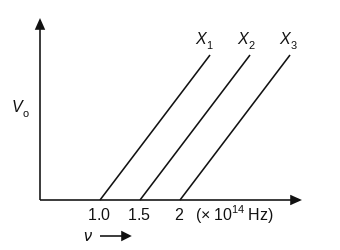
The graph shows variation of stopping potential V0 with the frequency ν of the incident radiation for three photosensitive metals X1, X2 and X3. Which metal will give out electrons with greater kinetic energy, for the same wavelength of incident radiation?
ग्राफ में तीन प्रकाश-सुग्राही धातुओं X1, X2 तथा X3 के लिए आपतित विकिरण की आवृत्ति ν के साथ निरोधी विभव V0 का परिवर्तन दर्शाया गया है। आपतित विकिरण की समान तरंगदैर्ध्य के लिए कौन-सी धातु अधिक गतिज ऊर्जा वाले इलेक्ट्रॉन उत्सर्जित करेगी?
  1. AX1
  2. BX2
  3. CX3
  4. DAll the metals will give out photo electrons with same kinetic energies.सभी धातुएँ समान गतिज ऊर्जा वाले प्रकाश-इलेक्ट्रॉन उत्सर्जित करेंगी।
Show answer

Concept: Einstein's equation: Kmax=hν−hν0. The intercept of each line on the ν-axis is the threshold frequency ν0 of that metal.

  1. From the graph, ν0 is 1.0, 1.5 and 2×10¹⁴ Hz for X1, X2 and X3 respectively.
  2. For the same incident wavelength, ν is the same for all three, so Kmax=h(ν−ν0) is largest for the metal with the smallest ν0.
  3. X1 has the lowest threshold frequency → maximum kinetic energy. Options (B) and (C) have higher ν0, and (D) is wrong because the work functions differ.

Answer: (A) X1

अवधारणा: आइंस्टीन समीकरण: Kmax=hν−hν0। प्रत्येक रेखा का ν-अक्ष पर अंतःखंड उस धातु की देहली आवृत्ति ν0 है।

  1. ग्राफ से X1, X2 तथा X3 के लिए ν0 क्रमशः 1.0, 1.5 तथा 2×10¹⁴ Hz है।
  2. समान आपतित तरंगदैर्ध्य के लिए तीनों पर ν समान है, अतः Kmax=h(ν−ν0) उस धातु के लिए अधिकतम होगी जिसकी ν0 न्यूनतम है।
  3. X1 की देहली आवृत्ति सबसे कम है → अधिकतम गतिज ऊर्जा। विकल्प (B) तथा (C) की ν0 अधिक है, और (D) गलत है क्योंकि कार्य-फलन भिन्न हैं।

उत्तर: (A) X1

JEE Main 2026 (April) – Paper 1 (B.E./B.Tech)PhysicsDual Nature of Radiation – photoelectric effectJEE Main 2026 (April) – Paper 1 (B.E./B.Tech) 2026 · 4 Apr Shift 1 →
Q1308.
A slit of width a is illuminated by light of wavelength λ. The linear separation between 1st and 3rd minima in the diffraction pattern produced on a screen placed at a distance D from the slit system is _________.
चौड़ाई a की एक झिरी को तरंगदैर्ध्य λ के प्रकाश से प्रदीप्त किया जाता है। झिरी निकाय से दूरी D पर रखे पर्दे पर बनने वाले विवर्तन प्रतिरूप में पहली (1st) तथा तीसरी (3rd) निम्निष्ठों के बीच रेखीय दूरी _________ है।
  1. ADλa
  2. B1.5Dλa
  3. C2Dλa
  4. D3Dλa
Show answer

Concept: In single-slit diffraction the nth minimum lies at yn=nλDa (small-angle approximation).

  1. y1=λDa, y3=3λDa (same side of the centre).
  2. Separation =y3−y1=2Dλa.

Short trick: Between the nth and mth minima (same side), the gap is (m−n)λDa → here 2Dλa.

Answer: (C) 2Dλa

अवधारणा: एकल झिरी विवर्तन में nवीं निम्निष्ठ yn=nλDa पर होती है (लघु-कोण सन्निकटन)।

  1. y1=λDa, y3=3λDa (केंद्र के एक ही ओर)।
  2. दूरी =y3−y1=2Dλa।

शॉर्ट ट्रिक: एक ही ओर की nवीं तथा mवीं निम्निष्ठों के बीच दूरी (m−n)λDa → यहाँ 2Dλa।

उत्तर: (C) 2Dλa

JEE Main 2026 (April) – Paper 1 (B.E./B.Tech)PhysicsWave Optics – single slit diffractionJEE Main 2026 (April) – Paper 1 (B.E./B.Tech) 2026 · 4 Apr Shift 1 →
Q1309.
A string A of length 0.314 m and Young's modulus 2×10¹⁰ N/m2 is connected to another string B of length and Young's modulus both twice of those of A. This series combination of strings is then suspended from a rigid support and its free end is fixed to a load of mass 0.8 kg. The net change in length of the combination is _________ mm.
(radius of both the strings is 0.2 mm and acceleration due to gravity =10 m/s2.)
(Mass of both strings is to be neglected as compared to the mass of load)
0.314 m लंबाई तथा 2×10¹⁰ N/m2 यंग गुणांक वाली एक डोरी A, एक अन्य डोरी B से जुड़ी है जिसकी लंबाई तथा यंग गुणांक दोनों A के दोगुने हैं। डोरियों के इस श्रेणी संयोजन को एक दृढ़ आधार से लटकाया जाता है तथा इसके मुक्त सिरे पर 0.8 kg द्रव्यमान का भार बाँधा जाता है। संयोजन की लंबाई में कुल परिवर्तन _________ mm है।
(दोनों डोरियों की त्रिज्या 0.2 mm तथा गुरुत्वीय त्वरण =10 m/s2)
(भार के द्रव्यमान की तुलना में दोनों डोरियों का द्रव्यमान नगण्य माना जाए)
  1. A3
  2. B2
  3. C1.9
  4. D1
Show answer

Concept: Elongation of a wire ΔL=FLAY; in series the same force F=mg acts in both strings and the elongations add.

  1. F=0.8×10=8 N; A=πr2=π(2×10⁻⁴)2=4π×10−8 m2.
  2. String A: ΔLA=8×0.3144π×10−8×2×1010. Using 0.314=0.1π: ΔLA=8×0.1π800π=10−3 m=1 mm.
  3. String B: L and Y both double, so ΔLB=F(2L)A(2Y)=ΔLA=1 mm.
  4. Net change =1+1=2 mm.

Short trick: Doubling L and Y together leaves ΔL unchanged → answer is simply 2ΔLA.

Answer: (B) 2

अवधारणा: तार का विस्तार ΔL=FLAY; श्रेणीक्रम में दोनों डोरियों में समान बल F=mg लगता है और विस्तार जुड़ते हैं।

  1. F=0.8×10=8 N; A=πr2=π(2×10⁻⁴)2=4π×10−8 m2।
  2. डोरी A: ΔLA=8×0.3144π×10−8×2×1010। 0.314=0.1π लेने पर: ΔLA=8×0.1π800π=10−3 m=1 mm।
  3. डोरी B: L तथा Y दोनों दोगुने, अतः ΔLB=F(2L)A(2Y)=ΔLA=1 mm।
  4. कुल परिवर्तन =1+1=2 mm।

शॉर्ट ट्रिक: L और Y दोनों एक साथ दोगुने करने से ΔL अपरिवर्तित रहता है → उत्तर सीधे 2ΔLA।

उत्तर: (B) 2

JEE Main 2026 (April) – Paper 1 (B.E./B.Tech)PhysicsMechanical Properties of Solids – elongation of wires in seriesJEE Main 2026 (April) – Paper 1 (B.E./B.Tech) 2026 · 4 Apr Shift 1 →
Q1310.
One gas of n1 mole of molecules at temperature T1, volume V1, and pressure P1, and another gas of n2 mole of molecules at temperature T2, volume V2, and pressure P2, are mixed resulting in pressure P and volume V of the mixture. The temperature of the mixture is __________.
n1 मोल अणुओं की एक गैस ताप T1, आयतन V1 तथा दाब P1 पर, और n2 मोल अणुओं की दूसरी गैस ताप T2, आयतन V2 तथा दाब P2 पर मिश्रित की जाती हैं, जिससे मिश्रण का दाब P तथा आयतन V हो जाता है। मिश्रण का ताप __________ है।
  1. A(T1+T2)/2
  2. BT1T2PV/(T2P1V1+T1P2V2)
  3. C(T2P1V1+T1P2V2)/(T1T2PV)
  4. D|T1−T2|/2
Show answer

Concept: Mixing conserves the number of moles: n=n1+n2. Apply PV=nRT to each gas and to the mixture.

  1. n1=P1V1RT1, n2=P2V2RT2, and for the mixture n1+n2=PVRT.
  2. PVT=P1V1T1+P2V2T2=T2P1V1+T1P2V2T1T2.
  3. T=T1T2PVT2P1V1+T1P2V2.
  4. (A) and (D) ignore the amounts of the two gases, and (C) has the dimensions of 1/temperature — all wrong.

Answer: (B) T1T2PV/(T2P1V1+T1P2V2)

अवधारणा: मिश्रण में मोलों की कुल संख्या संरक्षित रहती है: n=n1+n2। प्रत्येक गैस तथा मिश्रण पर PV=nRT लगाइए।

  1. n1=P1V1RT1, n2=P2V2RT2, तथा मिश्रण के लिए n1+n2=PVRT।
  2. PVT=P1V1T1+P2V2T2=T2P1V1+T1P2V2T1T2।
  3. T=T1T2PVT2P1V1+T1P2V2।
  4. (A) तथा (D) दोनों गैसों की मात्राओं की उपेक्षा करते हैं, और (C) की विमा 1/ताप है — सभी गलत।

उत्तर: (B) T1T2PV/(T2P1V1+T1P2V2)

JEE Main 2026 (April) – Paper 1 (B.E./B.Tech)PhysicsKinetic Theory – mixing of ideal gasesJEE Main 2026 (April) – Paper 1 (B.E./B.Tech) 2026 · 4 Apr Shift 1 →
Q1311.
An ideal gas undergoes a process maintaining relation between pressure (P) and volume (V) as P=P0(1+(V0V)2)−1, where P0 and V0 are constants. If two samples A and B (two moles each) with initial volumes V0 and 3V0 respectively undergo above mentioned process and attain same pressure, then the difference at the temperatures of these samples, TB−TA is __________.
(R = gas constant)
एक आदर्श गैस दाब (P) तथा आयतन (V) के बीच संबंध P=P0(1+(V0V)2)−1 बनाए रखते हुए एक प्रक्रम से गुजरती है, जहाँ P0 तथा V0 नियतांक हैं। यदि दो नमूने A तथा B (प्रत्येक में दो मोल) क्रमशः प्रारंभिक आयतन V0 तथा 3V0 के साथ उपर्युक्त प्रक्रम से गुजरते हुए समान दाब प्राप्त करते हैं, तो इन नमूनों के तापों का अंतर TB−TA __________ है।
(R = गैस नियतांक)
  1. A9P0V08R
  2. B11P0V010R
  3. C7P0V06R
  4. D13P0V011R
Show answer

Concept: On this process curve the temperature at any volume follows from the ideal-gas law: T=PVnR with P=P01+(V0/V)2 and n=2.

  1. Sample A (at V=V0): PA=P01+1=P02, so TA=PAV02R=P0V04R.
  2. Sample B (at V=3V0): PB=P01+19=9P010, so TB=PB(3V0)2R=27P0V020R.
  3. TB−TA=27P0V020R−5P0V020R=22P0V020R=11P0V010R.

Short trick: Write T(V)=P0VnR⋅V2V2+V02; plugging V0 and 3V0 gives 14 and 2720 at once.

Defect: on this single process curve P fixes V uniquely (P increases monotonically with V), so two samples that attain the same pressure have the same volume and hence the same temperature, giving TB−TA=0, which is not among the options. The options match only the temperature difference of the initial states (11P0V010R), which contradicts the wording.

Answer: Bonus – the printed condition (same final pressure) gives TB−TA=0, not any option; the question is ambiguous.

अवधारणा: इस प्रक्रम वक्र पर किसी आयतन पर ताप आदर्श गैस समीकरण से मिलता है: T=PVnR, जहाँ P=P01+(V0/V)2 तथा n=2।

  1. नमूना A (V=V0 पर): PA=P01+1=P02, अतः TA=PAV02R=P0V04R।
  2. नमूना B (V=3V0 पर): PB=P01+19=9P010, अतः TB=PB(3V0)2R=27P0V020R।
  3. TB−TA=27P0V020R−5P0V020R=22P0V020R=11P0V010R।

शॉर्ट ट्रिक: T(V)=P0VnR⋅V2V2+V02 लिखिए; V0 तथा 3V0 रखते ही 14 और 2720 मिल जाते हैं।

त्रुटि: इस एक ही प्रक्रम वक्र पर P से V अद्वितीय रूप से निर्धारित होता है (V बढ़ने पर P एकदिष्ट रूप से बढ़ता है), अतः समान दाब प्राप्त करने वाले दोनों नमूनों का आयतन समान होगा और इसलिए ताप भी समान होगा, जिससे TB−TA=0 आता है, जो किसी विकल्प में नहीं है। विकल्प केवल प्रारंभिक अवस्थाओं के तापांतर (11P0V010R) से मेल खाते हैं, जो प्रश्न के कथन के विपरीत है।

उत्तर: बोनस – दिए गए प्रतिबंध (समान अंतिम दाब) से TB−TA=0 आता है, कोई विकल्प नहीं; प्रश्न अस्पष्ट है।

JEE Main 2026 (April) – Paper 1 (B.E./B.Tech)PhysicsThermodynamics – process with given P–V relationJEE Main 2026 (April) – Paper 1 (B.E./B.Tech) 2026 · 4 Apr Shift 1 →
Q1312.
A voltmeter with internal resistance of x Ω can be used to measure upto 20 V. In order to increase its measuring range to 30 V, the required modification is to____________.
आंतरिक प्रतिरोध x Ω वाले एक वोल्टमीटर से 20 V तक मापा जा सकता है। इसकी मापन परास 30 V तक बढ़ाने के लिए आवश्यक परिवर्तन है____________।
  1. Aconnect resistor of x2 Ω, in series with voltmeter.वोल्टमीटर के श्रेणीक्रम में x2 Ω का प्रतिरोधक जोड़ना।
  2. Bconnect resistor of x2 Ω, in parallel to voltmeter.वोल्टमीटर के पार्श्वक्रम (समान्तर) में x2 Ω का प्रतिरोधक जोड़ना।
  3. Cconnect a resistor of x Ω in series with voltmeter.वोल्टमीटर के श्रेणीक्रम में x Ω का प्रतिरोधक जोड़ना।
  4. Dconnect resistor of 2x Ω in parallel to voltmeter.वोल्टमीटर के पार्श्वक्रम में 2x Ω का प्रतिरोधक जोड़ना।
Show answer

Concept: To extend a voltmeter's range a resistance is added in series so that the extra voltage drops across it while the full-scale current through the meter stays the same.

  1. Full-scale current I=20x A.
  2. The extra 30−20=10 V must drop across the series resistor R: R=1020/x=x2 Ω.
  3. A parallel resistor ((B), (D)) never increases a voltmeter's range, and x Ω in series ((C)) would make the range 40 V, not 30 V.

Short trick: R=x(VnewVold−1)=x(3020−1)=x2.

Answer: (A) connect resistor of x2 Ω in series with voltmeter

अवधारणा: वोल्टमीटर की परास बढ़ाने के लिए प्रतिरोध श्रेणीक्रम में जोड़ा जाता है, ताकि अतिरिक्त वोल्टता उस पर गिरे और मीटर से गुजरने वाली पूर्ण-स्केल धारा वही रहे।

  1. पूर्ण-स्केल धारा I=20x A।
  2. अतिरिक्त 30−20=10 V श्रेणी प्रतिरोधक R पर गिरनी चाहिए: R=1020/x=x2 Ω।
  3. पार्श्वक्रम प्रतिरोधक ((B), (D)) वोल्टमीटर की परास कभी नहीं बढ़ाता, और श्रेणीक्रम में x Ω ((C)) से परास 40 V हो जाती, 30 V नहीं।

शॉर्ट ट्रिक: R=x(VnewVold−1)=x(3020−1)=x2।

उत्तर: (A) वोल्टमीटर के श्रेणीक्रम में x2 Ω का प्रतिरोधक जोड़ना

JEE Main 2026 (April) – Paper 1 (B.E./B.Tech)PhysicsCurrent Electricity – extending the range of a voltmeterJEE Main 2026 (April) – Paper 1 (B.E./B.Tech) 2026 · 4 Apr Shift 1 →
Q1313.
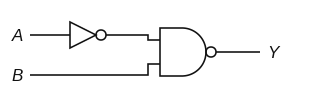
Two 4 bits binary numbers, A = 1101 and B = 1010 are given in the inputs of a logic circuit shown in figure below. The output (Y) will be :
दो 4-बिट द्विआधारी संख्याएँ, A = 1101 तथा B = 1010 नीचे चित्र में दर्शाए गए तर्क परिपथ (logic circuit) के निवेशों पर दी गई हैं। निर्गत (Y) होगा :
  1. AY = 1101
  2. BY = 0010
  3. CY = 0111
  4. DY = 1000
Show answer

Concept: A passes through a NOT gate; A¯ and B then feed a NAND gate: Y=A¯⋅B―=A+B¯ (De Morgan).

  1. A¯=1101―=0010.
  2. A¯⋅B=0010⋅1010=0010 (bitwise AND).
  3. Y=0010―=1101.

Short trick: Y=A+B¯=1101+0101=1101 — bitwise OR gives it instantly.

Answer: (A) Y = 1101

अवधारणा: A एक NOT गेट से गुजरता है; फिर A¯ तथा B एक NAND गेट में जाते हैं: Y=A¯⋅B―=A+B¯ (डी-मॉर्गन)।

  1. A¯=1101―=0010।
  2. A¯⋅B=0010⋅1010=0010 (बिटवार AND)।
  3. Y=0010―=1101।

शॉर्ट ट्रिक: Y=A+B¯=1101+0101=1101 — बिटवार OR से तुरन्त उत्तर।

उत्तर: (A) Y = 1101

JEE Main 2026 (April) – Paper 1 (B.E./B.Tech)PhysicsSemiconductors – logic gatesJEE Main 2026 (April) – Paper 1 (B.E./B.Tech) 2026 · 4 Apr Shift 1 →
Q1314.
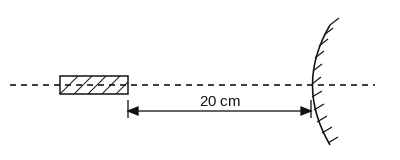
A rod of length 10 cm lies along the principle axis of a concave mirror of focal length 10 cm as shown in figure. The length of the image is _________ cm.
10 cm लंबाई की एक छड़, चित्र में दर्शाए अनुसार 10 cm फोकस दूरी के अवतल दर्पण के मुख्य अक्ष के अनुदिश रखी है। प्रतिबिम्ब की लंबाई _________ cm है।
  1. A2.5
  2. B5
  3. C7.5
  4. D7
Show answer

Concept: Image each end of the rod separately with the mirror formula 1v+1u=1f (sign convention: u, f negative for a concave mirror with a real object).

  1. Near end: u=−20 cm, f=−10 cm → 1v=−110+120=−120, v=−20 cm.
  2. Far end: u=−30 cm → 1v=−110+130=−115, v=−15 cm.
  3. Image length =|−20−(−15)|=5 cm.

Short trick: The end at 2f images onto itself (v=20 cm); only the far end moves in to 15 cm → 5 cm.

Answer: (B) 5

अवधारणा: दर्पण सूत्र 1v+1u=1f से छड़ के दोनों सिरों के प्रतिबिम्ब अलग-अलग बनाइए (चिह्न परिपाटी: वास्तविक वस्तु वाले अवतल दर्पण के लिए u, f ऋणात्मक)।

  1. निकट सिरा: u=−20 cm, f=−10 cm → 1v=−110+120=−120, v=−20 cm।
  2. दूरस्थ सिरा: u=−30 cm → 1v=−110+130=−115, v=−15 cm।
  3. प्रतिबिम्ब की लंबाई =|−20−(−15)|=5 cm।

शॉर्ट ट्रिक: 2f पर स्थित सिरे का प्रतिबिम्ब वहीं बनता है (v=20 cm); केवल दूर वाला सिरा 15 cm पर आता है → 5 cm।

उत्तर: (B) 5

JEE Main 2026 (April) – Paper 1 (B.E./B.Tech)PhysicsRay Optics – image of a rod in a concave mirrorJEE Main 2026 (April) – Paper 1 (B.E./B.Tech) 2026 · 4 Apr Shift 1 →
Q1315.
A parallel plate air capacitor is connected to a battery. The plates are pulled apart at uniform speed v. If x is the separation between the plates at any instant, then the time rate of change of electrostatic energy of the capacitor is proportional to xα, where α is _______.
एक समान्तर पट्टिका वायु संधारित्र एक बैटरी से जुड़ा है। पट्टिकाओं को एकसमान चाल v से एक-दूसरे से दूर खींचा जाता है। यदि किसी क्षण पट्टिकाओं के बीच दूरी x है, तो संधारित्र की स्थिरवैद्युत ऊर्जा में परिवर्तन की समय-दर xα के समानुपाती है, जहाँ α _______ है।
  1. A−2
  2. B1
  3. C−1
  4. D2
Show answer

Concept: With the battery connected, V stays constant, so U=12CV2=ε0AV22x.

  1. dUdt=dUdx⋅dxdt=−ε0AV22x2⋅v.
  2. v, A, V are constants, so |dUdt|∝x−2.
  3. Hence α=−2. (B) and (D) would need U to grow with x; (C) is the power law of U itself, not of its rate.

Short trick: U∝x−1 at constant V; differentiating w.r.t. time with x˙=v lowers the power by one → x−2.

Answer: (A) −2

अवधारणा: बैटरी जुड़ी रहने पर V नियत रहता है, अतः U=12CV2=ε0AV22x।

  1. dUdt=dUdx⋅dxdt=−ε0AV22x2⋅v।
  2. v, A, V नियत हैं, अतः |dUdt|∝x−2।
  3. अतः α=−2। (B) तथा (D) के लिए U को x के साथ बढ़ना होगा; (C) स्वयं U की घात है, उसकी दर की नहीं।

शॉर्ट ट्रिक: नियत V पर U∝x−1; x˙=v के साथ समय के सापेक्ष अवकलन से घात एक कम हो जाती है → x−2।

उत्तर: (A) −2

JEE Main 2026 (April) – Paper 1 (B.E./B.Tech)PhysicsElectrostatics – energy of a capacitor with changing separationJEE Main 2026 (April) – Paper 1 (B.E./B.Tech) 2026 · 4 Apr Shift 1 →
Q1316.
An insulated wire is wound so that it forms a flat coil with N=200 turns. The radius of the innermost turn is r1=3 cm, and of the outermost turn r2=6 cm. If 20 mA current flows in it then the magnetic moment will be α×10−2 A.m2. The value of α is_____.
एक विद्युतरोधी तार को इस प्रकार लपेटा जाता है कि वह N=200 फेरों वाली एक समतल कुंडली बना ले। सबसे भीतरी फेरे की त्रिज्या r1=3 cm तथा सबसे बाहरी फेरे की त्रिज्या r2=6 cm है। यदि इसमें 20 mA धारा प्रवाहित हो, तो चुम्बकीय आघूर्ण α×10−2 A.m2 होगा। α का मान_____है।
  1. A4.4
  2. B2.64
  3. C3.25
  4. D1.2
Show answer

Concept: Turns are spread uniformly from r1 to r2: number of turns in dr is dN=Nr2−r1dr, each contributing dM=Iπr2dN.

  1. M=NIπr2−r1∫r1r2r2dr=NIπ(r23−r13)3(r2−r1)=NIπ3(r12+r1r2+r22).
  2. r12+r1r2+r22=(9+18+36)×10−4=63×10−4 m2.
  3. M=200×0.02×π3×63×10−4=4π×21×10−4=2.64×10⁻² A m2.
  4. So α=2.64.

Short trick: Effective area = πr2―=π3(r12+r1r2+r22); then M=NI× that area.

Answer: (B) 2.64

अवधारणा: फेरे r1 से r2 तक एकसमान रूप से फैले हैं: dr में फेरों की संख्या dN=Nr2−r1dr, और प्रत्येक का योगदान dM=Iπr2dN।

  1. M=NIπr2−r1∫r1r2r2dr=NIπ(r23−r13)3(r2−r1)=NIπ3(r12+r1r2+r22)।
  2. r12+r1r2+r22=(9+18+36)×10−4=63×10−4 m2।
  3. M=200×0.02×π3×63×10−4=4π×21×10−4=2.64×10⁻² A m2।
  4. अतः α=2.64।

शॉर्ट ट्रिक: प्रभावी क्षेत्रफल =πr2―=π3(r12+r1r2+r22); फिर M=NI× यह क्षेत्रफल।

उत्तर: (B) 2.64

JEE Main 2026 (April) – Paper 1 (B.E./B.Tech)PhysicsMagnetism – magnetic moment of a flat spiral coilJEE Main 2026 (April) – Paper 1 (B.E./B.Tech) 2026 · 4 Apr Shift 1 →
Q1317.
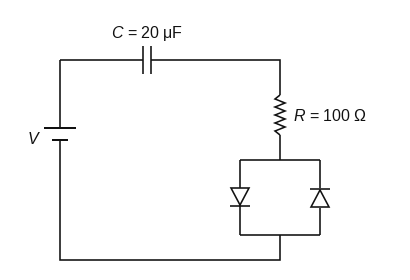
Consider a circuit consisting of a capacitor (20 μF), resistor (100 Ω) and two identical diodes as shown in figure. The resistance of diode under forward biasing condition is 10 Ω. The time constant of the circuit is α×10−3 s. The value of α is __________
चित्र में दर्शाए अनुसार एक संधारित्र (20 μF), एक प्रतिरोधक (100 Ω) तथा दो सर्वसम डायोडों से बने एक परिपथ पर विचार कीजिए। अग्र अभिनति (forward bias) की स्थिति में डायोड का प्रतिरोध 10 Ω है। परिपथ का समय-नियतांक α×10−3 s है। α का मान __________ है।
  1. A2.2
  2. B2.0
  3. C2.1
  4. D2.4
Show answer

Concept: The two diodes are connected in anti-parallel. Whichever way current flows, exactly one diode is forward biased (10 Ω) and the other is reverse biased (open). Time constant τ=ReqC.

  1. Req=100+10=110 Ω (resistor in series with the conducting diode).
  2. τ=110×20×10−6=2.2×10⁻³ s.
  3. So α=2.2. (B) ignores the diode resistance; (C) wrongly puts both diodes in parallel (5 Ω).

Answer: (A) 2.2

अवधारणा: दोनों डायोड प्रति-समान्तर (anti-parallel) जुड़े हैं। धारा किसी भी दिशा में बहे, ठीक एक डायोड अग्र अभिनत (10 Ω) तथा दूसरा पश्च अभिनत (खुला) रहता है। समय-नियतांक τ=ReqC।

  1. Req=100+10=110 Ω (प्रतिरोधक, चालक डायोड के साथ श्रेणीक्रम में)।
  2. τ=110×20×10−6=2.2×10⁻³ s।
  3. अतः α=2.2। (B) डायोड प्रतिरोध की उपेक्षा करता है; (C) दोनों डायोडों को गलती से समान्तर में (5 Ω) मान लेता है।

उत्तर: (A) 2.2

JEE Main 2026 (April) – Paper 1 (B.E./B.Tech)PhysicsSemiconductors – diodes in an RC circuitJEE Main 2026 (April) – Paper 1 (B.E./B.Tech) 2026 · 4 Apr Shift 1 →
Q1318.
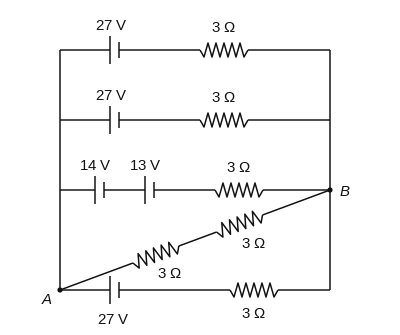
The voltage and the current between A and B points shown in the circuit are_____________.
परिपथ में दर्शाए गए बिंदुओं A तथा B के बीच वोल्टता तथा धारा_____________हैं।
  1. A24 V, 12 A
  2. B24 V, 4 A
  3. C18 V, 12 A
  4. D27 V, 4 A
Show answer

Concept: Between the two vertical rails (A side and B side) there are four identical source branches, each of emf 27 V (14 V + 13 V aiding in the third) with 3 Ω internal resistance, and the load AB = two 3 Ω in series = 6 Ω.

  1. Four identical branches in parallel: Eeq=27 V, req=34=0.75 Ω.
  2. Current through AB: I=276+0.75=276.75=4 A.
  3. Voltage across AB: V=IR=4×6=24 V.
  4. (A) and (C) give 12 A, which would need the load to be about 1.5 Ω; (D) ignores the drop across the internal resistance.

Short trick: VAB=ERR+r/4=27×66.75=24 V, I=24/6=4 A.

Answer: (B) 24 V, 4 A

अवधारणा: दोनों ऊर्ध्वाधर रेलों (A ओर तथा B ओर) के बीच चार सर्वसम स्रोत शाखाएँ हैं, प्रत्येक का विद्युत वाहक बल 27 V (तीसरी में 14 V + 13 V सहायक) तथा 3 Ω प्रतिरोध है; भार AB = श्रेणीक्रम में दो 3 Ω = 6 Ω।

  1. समान्तर क्रम में चार सर्वसम शाखाएँ: Eeq=27 V, req=34=0.75 Ω।
  2. AB से धारा: I=276+0.75=276.75=4 A।
  3. AB के सिरों पर वोल्टता: V=IR=4×6=24 V।
  4. (A) तथा (C) में 12 A है, जिसके लिए भार लगभग 1.5 Ω होना चाहिए; (D) आंतरिक प्रतिरोध पर विभव-पात की उपेक्षा करता है।

शॉर्ट ट्रिक: VAB=ERR+r/4=27×66.75=24 V, I=24/6=4 A।

उत्तर: (B) 24 V, 4 A

JEE Main 2026 (April) – Paper 1 (B.E./B.Tech)PhysicsCurrent Electricity – parallel combination of cellsJEE Main 2026 (April) – Paper 1 (B.E./B.Tech) 2026 · 4 Apr Shift 1 →
Q1319.
A telescope with objective diameter R is used to observe a distant star emitting light of wavelength 500 nm, at a resolution of 5×10⁻⁷ radian. The value of R is _________ cm.
अभिदृश्यक व्यास R वाले एक दूरदर्शी का उपयोग 500 nm तरंगदैर्ध्य का प्रकाश उत्सर्जित करने वाले एक दूरस्थ तारे को 5×10⁻⁷ रेडियन के विभेदन पर देखने के लिए किया जाता है। R का मान _________ cm है।
  1. A61
  2. B122
  3. C244
  4. D305
Show answer

Concept: Limit of resolution of a telescope (Rayleigh criterion): Δθ=1.22λD, where D is the objective diameter (here called R).

  1. R=1.22λΔθ=1.22×500×10−95×10−7.
  2. R=1.22 m =122 cm.
  3. (A) and (C) come from wrongly using the factor 0.61 or 2.44 in place of 1.22.

Answer: (B) 122

अवधारणा: दूरदर्शी की विभेदन सीमा (रैले कसौटी): Δθ=1.22λD, जहाँ D अभिदृश्यक का व्यास है (यहाँ R कहा गया है)।

  1. R=1.22λΔθ=1.22×500×10−95×10−7।
  2. R=1.22 m =122 cm।
  3. (A) तथा (C) 1.22 के स्थान पर गलती से 0.61 या 2.44 गुणांक लेने से आते हैं।

उत्तर: (B) 122

JEE Main 2026 (April) – Paper 1 (B.E./B.Tech)PhysicsWave Optics – resolving power of a telescopeJEE Main 2026 (April) – Paper 1 (B.E./B.Tech) 2026 · 4 Apr Shift 1 →
Q1320.
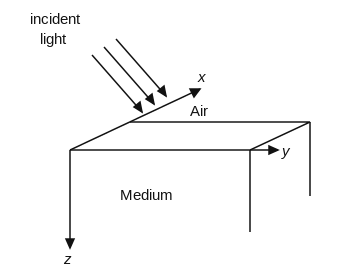
An unpolarized light is incident on the plane interface of air-dielectric medium shown in figure. If the incident angle is equal to Brewster angle, identify the expression representing reflected wave.
चित्र में दर्शाए गए वायु-परावैद्युत माध्यम के समतल अंतरापृष्ठ पर एक अध्रुवित प्रकाश आपतित होता है। यदि आपतन कोण ब्रूस्टर कोण के बराबर है, तो परावर्तित तरंग को निरूपित करने वाले व्यंजक की पहचान कीजिए।
  1. A(Exi^+Eyj^)sin⁡(kx−kz−ωt)
  2. B(Exi^+Ezk^)sin⁡(kx+ky−ωt)
  3. C(Exj^+Eyk^)sin⁡(ky+kz−ωt)
  4. D(Exi^+Eyj^+Ezk^)sin⁡(kx+ky−kz−ωt)
Show answer

Concept: The interface is the xy-plane and +z points into the medium. A reflected wave must travel back into the air (negative z-component of k→). At the Brewster angle the reflected light is plane polarised with E→ perpendicular to the plane of incidence, i.e. parallel to the interface — so E→ has no z-component.

  1. (B) sin⁡(kx+ky−ωt) travels along the surface (no z-component) — not a reflected wave.
  2. (C) sin⁡(ky+kz−ωt) travels along +z, into the medium — that is a transmitted wave.
  3. (D) travels back into air, but its E→ contains Ezk^, a component perpendicular to the interface, which is absent in Brewster reflection.
  4. (A) sin⁡(kx−kz−ωt) travels along i^−k^, i.e. back into the air, and its field (Exi^+Eyj^) lies parallel to the interface — the required reflected wave. (For incidence in the xz-plane the s-polarised field is along j^; the Eyj^ term is that field, and for a transverse wave the Ex term must be zero.)

Short trick: Reflected ⇒ −kz in the phase; Brewster ⇒ no k^ in E→. Only (A) satisfies both.

Answer: (A) (Exi^+Eyj^)sin⁡(kx−kz−ωt)

अवधारणा: अंतरापृष्ठ xy-तल है तथा +z माध्यम के भीतर की ओर है। परावर्तित तरंग को वापस वायु में जाना चाहिए (k→ का z-घटक ऋणात्मक)। ब्रूस्टर कोण पर परावर्तित प्रकाश समतल ध्रुवित होता है तथा E→ आपतन तल के लंबवत, अर्थात् अंतरापृष्ठ के समान्तर होता है — अतः E→ का कोई z-घटक नहीं होता।

  1. (B) sin⁡(kx+ky−ωt) पृष्ठ के अनुदिश चलती है (z-घटक नहीं) — परावर्तित तरंग नहीं।
  2. (C) sin⁡(ky+kz−ωt) +z दिशा में, अर्थात् माध्यम के भीतर चलती है — यह अपवर्तित (संचरित) तरंग है।
  3. (D) वायु में वापस जाती है, पर इसके E→ में Ezk^ है, जो अंतरापृष्ठ के लंबवत घटक है और ब्रूस्टर परावर्तन में अनुपस्थित होता है।
  4. (A) sin⁡(kx−kz−ωt) दिशा i^−k^ में, अर्थात् वापस वायु में चलती है, और इसका क्षेत्र (Exi^+Eyj^) अंतरापृष्ठ के समान्तर है — यही अभीष्ट परावर्तित तरंग है। (xz-तल में आपतन के लिए s-ध्रुवित क्षेत्र j^ के अनुदिश होता है; Eyj^ पद यही क्षेत्र है, तथा अनुप्रस्थ तरंग के लिए Ex पद शून्य होना चाहिए।)

शॉर्ट ट्रिक: परावर्तित ⇒ कला में −kz; ब्रूस्टर ⇒ E→ में k^ नहीं। केवल (A) दोनों शर्तें पूरी करता है।

उत्तर: (A) (Exi^+Eyj^)sin⁡(kx−kz−ωt)

JEE Main 2026 (April) – Paper 1 (B.E./B.Tech)PhysicsWave Optics – Brewster's law and polarisationJEE Main 2026 (April) – Paper 1 (B.E./B.Tech) 2026 · 4 Apr Shift 1 →