Question bank

Q&A: practice questions with answers

Search questions on any topic. Filter by exam category, exam, subject and topic, try the question, then open the answer and explanation.

Courses – airGurukul

53,050 questions in the question bank.

Q1341.
Amongst the following, the total number of compounds soluble in aqueous NaOH at room temperature is:
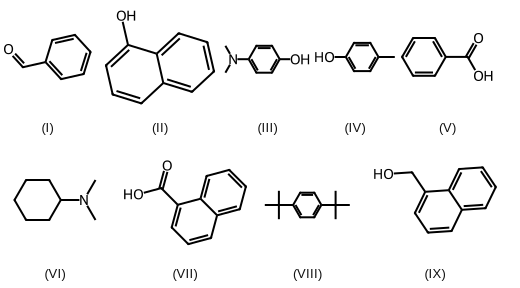
निम्नलिखित में से कमरे के ताप पर जलीय NaOH में विलेय यौगिकों की कुल संख्या है:
  1. A5
  2. B4
  3. C6
  4. D3
Show answer

Concept: NaOH dissolves compounds acidic enough to form salts: carboxylic acids (pKa ≈ 4–5) and phenols (pKa ≈ 10). Aldehydes, amines, hydrocarbons and alcohols (pKa ≈ 16) do not dissolve.

  1. Soluble: II (1-naphthol), III (4-dimethylaminophenol), IV (p-cresol) – phenols; V (benzoic acid), VII (1-naphthoic acid) – acids.
  2. Insoluble: I (benzaldehyde), VI (N,N-dimethylcyclohexylamine, basic), VIII (1,4-di-tert-butylbenzene), IX (1-naphthylmethanol – an alcohol, not a phenol).
  3. Total = 5.

Short trick: Count OH directly on a ring + all COOH: 3 + 2 = 5. CH2OH (IX) is a trap.

Answer: (A) 5

अवधारणा: NaOH उन यौगिकों को घोलता है जो लवण बनाने योग्य अम्लीय हों: कार्बोक्सिलिक अम्ल (pKa ≈ 4–5) तथा फ़ीनॉल (pKa ≈ 10)। ऐल्डिहाइड, ऐमीन, हाइड्रोकार्बन तथा ऐल्कोहॉल (pKa ≈ 16) नहीं घुलते।

  1. विलेय: II (1-नैफ़्थॉल), III (4-डाइमेथिलऐमीनोफ़ीनॉल), IV (p-क्रीसॉल) – फ़ीनॉल; V (बेन्ज़ोइक अम्ल), VII (1-नैफ़्थोइक अम्ल) – अम्ल।
  2. अविलेय: I (बेन्ज़ैल्डिहाइड), VI (N,N-डाइमेथिलसाइक्लोहेक्सिलऐमीन, क्षारीय), VIII (1,4-डाइ-tert-ब्यूटिलबेन्ज़ीन), IX (1-नैफ़्थिलमेथेनॉल – ऐल्कोहॉल, फ़ीनॉल नहीं)।
  3. कुल = 5।

शॉर्ट ट्रिक: वलय पर सीधे जुड़े OH + सभी COOH गिनें: 3 + 2 = 5। CH2OH (IX) एक जाल है।

उत्तर: (A) 5
JEE Main 2026 (April) – Paper 1 (B.E./B.Tech)ChemistryAcidity – solubility in aqueous NaOHJEE Main 2026 (April) – Paper 1 (B.E./B.Tech) 2026 · 4 Apr Shift 1 →
Q1342.
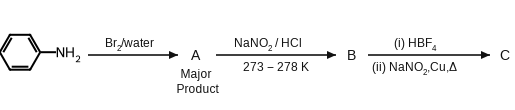
Product C of the following reaction sequence will be
निम्नलिखित अभिक्रिया अनुक्रम का उत्पाद C होगा
  1. A1-Bromo-4-nitrobenzene1-ब्रोमो-4-नाइट्रोबेन्ज़ीन
  2. B1, 3, 5-Tribromo-2-nitrobenzene1, 3, 5-ट्राइब्रोमो-2-नाइट्रोबेन्ज़ीन
  3. C4-Bromo-1-nitrobenzene4-ब्रोमो-1-नाइट्रोबेन्ज़ीन
  4. D1, 3, 5-Tribromobenzene1, 3, 5-ट्राइब्रोमोबेन्ज़ीन
Show answer

Concept: –NH2 is strongly activating; diazonium fluoroborate with NaNO2/Cu on heating replaces –N2+ by –NO2.

  1. Aniline + Br2/water → 2,4,6-tribromoaniline (A).
  2. NaNO2/HCl, 273–278 K → 2,4,6-tribromobenzenediazonium chloride (B).
  3. (i) HBF4 → ArN2+BF4−; (ii) NaNO2, Cu, Δ → Ar–NO2.
  4. C = 2,4,6-tribromonitrobenzene = 1,3,5-tribromo-2-nitrobenzene.
  5. (A)/(C) keep only one Br (bromine water gives tribromination); (D) is the product of H3PO2 reduction, not of NaNO2/Cu.

Short trick: Bromine water + aniline → always three Br; the N2+ spot becomes NO2.

Answer: (B) 1, 3, 5-Tribromo-2-nitrobenzene

अवधारणा: –NH2 प्रबल सक्रियक है; डाइऐज़ोनियम फ्लुओरोबोरेट को NaNO2/Cu के साथ गर्म करने पर –N2+ का स्थान –NO2 ले लेता है।

  1. ऐनिलीन + Br2/जल → 2,4,6-ट्राइब्रोमोऐनिलीन (A)।
  2. NaNO2/HCl, 273–278 K → 2,4,6-ट्राइब्रोमोबेन्ज़ीनडाइऐज़ोनियम क्लोराइड (B)।
  3. (i) HBF4 → ArN2+BF4−; (ii) NaNO2, Cu, Δ → Ar–NO2।
  4. C = 2,4,6-ट्राइब्रोमोनाइट्रोबेन्ज़ीन = 1,3,5-ट्राइब्रोमो-2-नाइट्रोबेन्ज़ीन।
  5. (A)/(C) में केवल एक Br है (ब्रोमीन जल त्रिब्रोमीनन करता है); (D) H3PO2 अपचयन का उत्पाद है, NaNO2/Cu का नहीं।

शॉर्ट ट्रिक: ब्रोमीन जल + ऐनिलीन → सदैव तीन Br; N2+ का स्थान NO2 लेता है।

उत्तर: (B) 1, 3, 5-ट्राइब्रोमो-2-नाइट्रोबेन्ज़ीन

JEE Main 2026 (April) – Paper 1 (B.E./B.Tech)ChemistryAmines – diazonium salt reactionsJEE Main 2026 (April) – Paper 1 (B.E./B.Tech) 2026 · 4 Apr Shift 1 →
Q1343.
Given below are two statements:
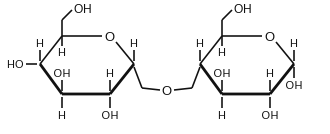
Statement I: The structure of Maltose is given below:

Maltose is a non-reducing sugar.
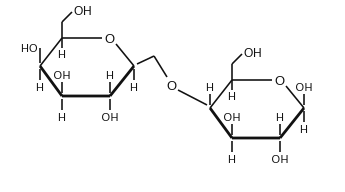
Statement II: The structure of Lactose is given below:

Lactose is a reducing sugar.
In the light of the above statements, choose the correct answer from the options given below
नीचे दो कथन दिए गए हैं:
कथन I: माल्टोस की संरचना नीचे दी गई है:

माल्टोस एक अनपचायी (non-reducing) शर्करा है।
कथन II: लैक्टोस की संरचना नीचे दी गई है:

लैक्टोस एक अपचायी (reducing) शर्करा है।
उपर्युक्त कथनों के आलोक में, नीचे दिए गए विकल्पों में से सही उत्तर चुनिए
  1. ABoth Statement I and Statement II are trueकथन I और कथन II दोनों सत्य हैं
  2. BBoth Statement I and Statement II are falseकथन I और कथन II दोनों असत्य हैं
  3. CStatement I is true but Statement II is falseकथन I सत्य है परन्तु कथन II असत्य है
  4. DStatement I is false but Statement II is trueकथन I असत्य है परन्तु कथन II सत्य है
Show answer

Concept: A disaccharide is reducing if one anomeric carbon (C1) is free (hemiacetal OH), so the ring can open to an aldehyde.

  1. Maltose = α-D-glucose C1 – O – C4 of a second glucose. The C1 of the second glucose carries a free OH → it is a reducing sugar. Statement I (non-reducing) is false.
  2. Lactose = β-D-galactose C1 – O – C4 of glucose; C1 of the glucose unit is free → reducing. Statement II is true.

Short trick: Among common disaccharides only sucrose (C1–C2 link) is non-reducing.

Answer: (D) Statement I is false but Statement II is true

अवधारणा: डाइसैकेराइड अपचायी होती है यदि एक ऐनोमरी कार्बन (C1) मुक्त हो (हेमीऐसीटल OH), जिससे वलय खुलकर ऐल्डिहाइड बन सके।

  1. माल्टोस = α-D-ग्लूकोस का C1 – O – दूसरे ग्लूकोस का C4। दूसरे ग्लूकोस के C1 पर मुक्त OH है → यह अपचायी शर्करा है। कथन I (अनपचायी) असत्य है।
  2. लैक्टोस = β-D-गैलेक्टोस का C1 – O – ग्लूकोस का C4; ग्लूकोस इकाई का C1 मुक्त है → अपचायी। कथन II सत्य है।

शॉर्ट ट्रिक: सामान्य डाइसैकेराइडों में केवल सुक्रोस (C1–C2 बंध) अनपचायी है।

उत्तर: (D) कथन I असत्य है परन्तु कथन II सत्य है

JEE Main 2026 (April) – Paper 1 (B.E./B.Tech)ChemistryBiomolecules – disaccharidesJEE Main 2026 (April) – Paper 1 (B.E./B.Tech) 2026 · 4 Apr Shift 1 →
Q1344.
Match the LIST-I with LIST-II
List-I
Name of amino acid
List-II
One letter symbol/type
A. ArginineI. D/Non-essential
B. Aspartic acidII. R/Essential
C. LysineIII. E/Non-essential
D. Glutamic acidIV. K/Essential
Choose the correct answer from the options given below:
सूची-I का सूची-II से मिलान कीजिए
सूची-I
ऐमीनो अम्ल का नाम
सूची-II
एक अक्षर प्रतीक/प्रकार
A. आर्जिनीनI. D/अनावश्यक
B. ऐस्पार्टिक अम्लII. R/आवश्यक
C. लाइसीनIII. E/अनावश्यक
D. ग्लूटैमिक अम्लIV. K/आवश्यक
नीचे दिए गए विकल्पों में से सही उत्तर चुनिए:
  1. AA-II, B-I, C-IV, D-III
  2. BA-IV, B-III, C-II, D-I
  3. CA-III, B-IV, C-I, D-II
  4. DA-II, B-IV, C-I, D-III
Show answer

Concept: One-letter codes and essential/non-essential classification (NCERT table).

  1. Arginine – R, essential → II
  2. Aspartic acid – D, non-essential → I
  3. Lysine – K, essential → IV
  4. Glutamic acid – E, non-essential → III
  5. (B), (C), (D) assign K or R to an acid – wrong.

Short trick: Acidic amino acids: AsparDic = D, GlutEmic = E; basic: aRginine = R, lysine = K.

Answer: (A) A-II, B-I, C-IV, D-III

अवधारणा: एक-अक्षर कोड तथा आवश्यक/अनावश्यक वर्गीकरण (NCERT सारणी)।

  1. आर्जिनीन – R, आवश्यक → II
  2. ऐस्पार्टिक अम्ल – D, अनावश्यक → I
  3. लाइसीन – K, आवश्यक → IV
  4. ग्लूटैमिक अम्ल – E, अनावश्यक → III
  5. (B), (C), (D) किसी अम्ल को K या R देते हैं – गलत।

शॉर्ट ट्रिक: अम्लीय ऐमीनो अम्ल: ऐस्पार्टिक = D, ग्लूटैमिक = E; क्षारीय: आर्जिनीन = R, लाइसीन = K।

उत्तर: (A) A-II, B-I, C-IV, D-III

JEE Main 2026 (April) – Paper 1 (B.E./B.Tech)ChemistryBiomolecules – amino acidsJEE Main 2026 (April) – Paper 1 (B.E./B.Tech) 2026 · 4 Apr Shift 1 →
Q1345.
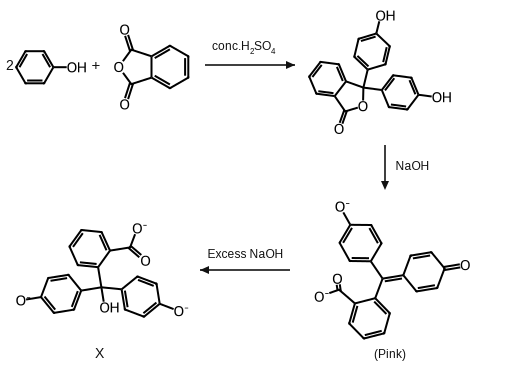
Identify the colour of compound 'X' in the sequence of the reaction.
अभिक्रिया के अनुक्रम में यौगिक 'X' का रंग पहचानिए।
  1. AVioletबैंगनी
  2. BGreenहरा
  3. CRedलाल
  4. DColourlessरंगहीन
Show answer

Concept: Colour of phenolphthalein comes from the extended conjugation of the quinonoid dianion; breaking that conjugation removes colour.

  1. Phenol + phthalic anhydride (conc. H2SO4) → phenolphthalein (colourless lactone).
  2. NaOH → quinonoid dianion with C=C conjugated across all rings → pink.
  3. Excess NaOH: OH− adds to the central carbon → sp3 carbinol trianion X; conjugation is broken → colourless.

Short trick: sp3 central carbon = no extended conjugation = no colour.

Answer: (D) Colourless

अवधारणा: फ़ीनॉल्फ़्थेलीन का रंग क्विनोनॉयड द्विऋणायन के विस्तारित संयुग्मन से आता है; संयुग्मन टूटने पर रंग चला जाता है।

  1. फ़ीनॉल + थैलिक ऐनहाइड्राइड (सांद्र H2SO4) → फ़ीनॉल्फ़्थेलीन (रंगहीन लैक्टोन)।
  2. NaOH → क्विनोनॉयड द्विऋणायन जिसमें C=C सभी वलयों में संयुग्मित है → गुलाबी।
  3. अधिक NaOH: OH− केन्द्रीय कार्बन पर जुड़ता है → sp3 कार्बिनॉल त्रिऋणायन X; संयुग्मन टूट जाता है → रंगहीन।

शॉर्ट ट्रिक: sp3 केन्द्रीय कार्बन = विस्तारित संयुग्मन नहीं = रंग नहीं।

उत्तर: (D) रंगहीन

JEE Main 2026 (April) – Paper 1 (B.E./B.Tech)ChemistryPhenols – phenolphthalein indicatorJEE Main 2026 (April) – Paper 1 (B.E./B.Tech) 2026 · 4 Apr Shift 1 →
Q1346.
According to Lewis theory, the total number of σ bond-pairs and lone pair of electrons around the central atom of XeO64− ion is _______.
लूइस सिद्धांत के अनुसार, XeO64− आयन के केन्द्रीय परमाणु के चारों ओर σ आबंध-युग्मों तथा एकाकी इलेक्ट्रॉन युग्मों की कुल संख्या _______ है।
Show answer

Concept: In perxenate XeO64−, Xe is in the +8 state: all 8 valence electrons are used in bonding.

  1. Oxidation state: x + 6(−2) = −4 → x = +8.
  2. Xe forms 6 σ bonds to O (two of them additionally π, the other four O carry the 4− charge).
  3. Lone pairs on Xe = (8 − 8)/2 = 0 (all 8 electrons used: 6 in σ, 2 in π).
  4. σ bond pairs + lone pairs = 6 + 0 = 6 (octahedral).

Short trick: Xe(+8) has no lone pair; steric number = number of O atoms = 6.

Answer: 6

अवधारणा: परज़ीनेट XeO64− में Xe +8 अवस्था में है: सभी 8 संयोजी इलेक्ट्रॉन आबंधन में प्रयुक्त होते हैं।

  1. ऑक्सीकरण अवस्था: x + 6(−2) = −4 → x = +8।
  2. Xe, O से 6 σ बंध बनाता है (इनमें से दो पर अतिरिक्त π, शेष चार O पर 4− आवेश)।
  3. Xe पर एकाकी युग्म = (8 − 8)/2 = 0 (सभी 8 इलेक्ट्रॉन प्रयुक्त: 6 σ में, 2 π में)।
  4. σ आबंध युग्म + एकाकी युग्म = 6 + 0 = 6 (अष्टफलकीय)।

शॉर्ट ट्रिक: Xe(+8) पर कोई एकाकी युग्म नहीं; स्टेरिक संख्या = O परमाणुओं की संख्या = 6।

उत्तर: 6

JEE Main 2026 (April) – Paper 1 (B.E./B.Tech)ChemistryChemical bonding – Lewis structure of XeO₆⁴⁻JEE Main 2026 (April) – Paper 1 (B.E./B.Tech) 2026 · 4 Apr Shift 1 →
Q1347.
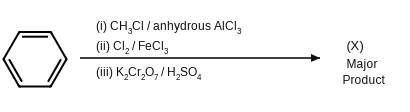
Consider the following sequence of reactions to give the major product (X)

P g of the major product (X) formed is reacted with NaHCO3 solution to liberate a gas which occupied 11.2 dm3 at STP.
P = _______ g.
(Given molar mass in g mol−1 H:1, C:12, O:16, Cl:35.5)
मुख्य उत्पाद (X) देने वाली अभिक्रियाओं के निम्नलिखित अनुक्रम पर विचार कीजिए

बने हुए मुख्य उत्पाद (X) के P g को NaHCO3 विलयन से अभिक्रिया कराने पर एक गैस मुक्त होती है जो STP पर 11.2 dm3 आयतन घेरती है।
P = _______ g।
(दिया है, मोलर द्रव्यमान g mol−1 में H:1, C:12, O:16, Cl:35.5)
Show answer

Concept: –CH3 is o/p-directing (para major); side-chain oxidation turns –CH3 into –COOH; each –COOH releases one CO2 with NaHCO3.

  1. Benzene + CH3Cl/AlCl3 → toluene.
  2. Cl2/FeCl3 → 4-chlorotoluene (major).
  3. K2Cr2O7/H2SO4 → 4-chlorobenzoic acid X, C7H5ClO2, M = 84 + 5 + 35.5 + 32 = 156.5 g mol−1.
  4. ArCOOH + NaHCO3 → ArCOONa + H2O + CO2; n(CO2) = 11.2/22.4 = 0.5 mol = n(X).
  5. P = 0.5 × 156.5 = 78.25 g; the integer answer is 78.

Short trick: 11.2 L = ½ mol → P = M/2 = 156.5/2 = 78.25 → 78.

Answer: 78

अवधारणा: –CH3 o/p-निर्देशी है (पैरा मुख्य); पार्श्व-शृंखला ऑक्सीकरण –CH3 को –COOH में बदलता है; प्रत्येक –COOH, NaHCO3 के साथ एक CO2 मुक्त करता है।

  1. बेन्ज़ीन + CH3Cl/AlCl3 → टॉलूईन।
  2. Cl2/FeCl3 → 4-क्लोरोटॉलूईन (मुख्य)।
  3. K2Cr2O7/H2SO4 → 4-क्लोरोबेन्ज़ोइक अम्ल X, C7H5ClO2, M = 84 + 5 + 35.5 + 32 = 156.5 g mol−1।
  4. ArCOOH + NaHCO3 → ArCOONa + H2O + CO2; n(CO2) = 11.2/22.4 = 0.5 mol = n(X)।
  5. P = 0.5 × 156.5 = 78.25 g; पूर्णांक उत्तर 78 है।

शॉर्ट ट्रिक: 11.2 L = ½ mol → P = M/2 = 156.5/2 = 78.25 → 78।

उत्तर: 78

JEE Main 2026 (April) – Paper 1 (B.E./B.Tech)ChemistryAromatic compounds – synthesis and stoichiometryJEE Main 2026 (April) – Paper 1 (B.E./B.Tech) 2026 · 4 Apr Shift 1 →
Q1348.
2.0 g of a bromo hydrocarbon (X) was subjected to Carius analysis, gave 3.36 g of AgBr. The percentage of carbon in the compound (X) is 26.7%. Total number of carbon atoms in the empirical formula for compound (X) is _______.
(Given molar mass in g mol−1 H:1, C:12, Br : 80, Ag : 108)
एक ब्रोमो हाइड्रोकार्बन (X) के 2.0 g का कैरिअस विश्लेषण करने पर 3.36 g AgBr प्राप्त हुआ। यौगिक (X) में कार्बन का प्रतिशत 26.7% है। यौगिक (X) के मूलानुपाती सूत्र में कार्बन परमाणुओं की कुल संख्या _______ है।
(दिया है, मोलर द्रव्यमान g mol−1 में H:1, C:12, Br : 80, Ag : 108)
Show answer

Concept: Carius: %Br = 80188×mAgBrm×100; H by difference; then mole ratio.

  1. %Br =80188×3.362.0×100=71.49%
  2. %H = 100 − 71.49 − 26.7 = 1.81%
  3. Moles per 100 g: C = 26.7/12 = 2.225; H = 1.81/1 = 1.81; Br = 71.49/80 = 0.894
  4. Divide by 0.894: C : H : Br = 2.49 : 2.03 : 1 → ×2 → 4.98 : 4.05 : 2 ≈ 5 : 4 : 2
  5. Empirical formula C5H4Br2 → 5 carbon atoms.

Short trick: C : Br ≈ 2.225 : 0.894 = 2.5 : 1 → double it → C5…Br2.

Answer: 5

अवधारणा: कैरिअस: %Br = 80188×mAgBrm×100; H अंतर से; फिर मोल अनुपात।

  1. %Br =80188×3.362.0×100=71.49%
  2. %H = 100 − 71.49 − 26.7 = 1.81%
  3. प्रति 100 g मोल: C = 26.7/12 = 2.225; H = 1.81/1 = 1.81; Br = 71.49/80 = 0.894
  4. 0.894 से भाग देने पर: C : H : Br = 2.49 : 2.03 : 1 → ×2 → 4.98 : 4.05 : 2 ≈ 5 : 4 : 2
  5. मूलानुपाती सूत्र C5H4Br2 → 5 कार्बन परमाणु।

शॉर्ट ट्रिक: C : Br ≈ 2.225 : 0.894 = 2.5 : 1 → दोगुना → C5…Br2।

उत्तर: 5

JEE Main 2026 (April) – Paper 1 (B.E./B.Tech)ChemistryOrganic analysis – Carius method and empirical formulaJEE Main 2026 (April) – Paper 1 (B.E./B.Tech) 2026 · 4 Apr Shift 1 →
Q1349.
The pH of a solution obtained by mixing 5 mL of 0.1 M NH4OH solution with 250 mL of 0.1 M NH4Cl solution is _______ × 10−2. (Nearest integer)
Given: pKb (NH4OH) = 4.74
log 2 = 0.30
log 3 = 0.48
log 5 = 0.70
5 mL 0.1 M NH4OH विलयन को 250 mL 0.1 M NH4Cl विलयन के साथ मिलाने पर प्राप्त विलयन का pH _______ × 10−2 है। (निकटतम पूर्णांक)
दिया है: pKb (NH4OH) = 4.74
log 2 = 0.30
log 3 = 0.48
log 5 = 0.70
Show answer

Concept: Basic buffer: pOH = pKb + log [salt][base] (ratio of millimoles, same total volume).

  1. NH4OH = 5 × 0.1 = 0.5 mmol; NH4Cl = 250 × 0.1 = 25 mmol
  2. Ratio = 25/0.5 = 50; log 50 = log 5 + 1 = 1.70
  3. pOH = 4.74 + 1.70 = 6.44
  4. pH = 14 − 6.44 = 7.56 = 756 × 10−2

Short trick: Salt is 50 × base → pOH rises by 1.70 above pKb.

Answer: 756

अवधारणा: क्षारीय बफ़र: pOH = pKb + log [लवण][क्षार] (मिलीमोल का अनुपात, कुल आयतन समान)।

  1. NH4OH = 5 × 0.1 = 0.5 mmol; NH4Cl = 250 × 0.1 = 25 mmol
  2. अनुपात = 25/0.5 = 50; log 50 = log 5 + 1 = 1.70
  3. pOH = 4.74 + 1.70 = 6.44
  4. pH = 14 − 6.44 = 7.56 = 756 × 10−2

शॉर्ट ट्रिक: लवण = 50 × क्षार → pOH, pKb से 1.70 अधिक।

उत्तर: 756

JEE Main 2026 (April) – Paper 1 (B.E./B.Tech)ChemistryIonic equilibrium – basic bufferJEE Main 2026 (April) – Paper 1 (B.E./B.Tech) 2026 · 4 Apr Shift 1 →
Q1350.
A non-volatile, non-electrolyte solid solute when dissolved in 40 g of a solvent, the vapour pressure of the solvent decreased from 760 mm Hg to 750 mm Hg. If the same solution boils at 320 K, then the number of moles of the solvent present in the solution is _______. (Nearest integer)
[Given: boiling point of the pure solvent = 319.5 K,
Kb of the solvent = 0.3 K kg mol−1]
एक अवाष्पशील, अविद्युत-अपघट्य ठोस विलेय को 40 g विलायक में घोलने पर विलायक का वाष्प दाब 760 mm Hg से घटकर 750 mm Hg हो जाता है। यदि यही विलयन 320 K पर उबलता है, तो विलयन में उपस्थित विलायक के मोलों की संख्या _______ है। (निकटतम पूर्णांक)
[दिया है: शुद्ध विलायक का क्वथनांक = 319.5 K,
विलायक का Kb = 0.3 K kg mol−1]
Show answer

Concept: Elevation of boiling point gives moles of solute; relative lowering of vapour pressure (Raoult's law) gives the mole fraction of solute.

  1. ΔTb = 320 − 319.5 = 0.5 K; m = 0.5/0.3 = 1.667 mol kg−1
  2. nsolute = 1.667 × 0.040 = 0.0667 mol
  3. p∘−pp∘=10760=n2n1+n2 → n1+n2=0.0667×76=5.067
  4. nsolvent = 5.067 − 0.067 = 5.0 mol

Short trick: n1 = n2 × (p/Δp) = 0.0667 × 750/10 = 5.

Answer: 5

अवधारणा: क्वथनांक उन्नयन से विलेय के मोल मिलते हैं; वाष्प दाब का आपेक्षिक अवनमन (राउल्ट नियम) विलेय का मोल अंश देता है।

  1. ΔTb = 320 − 319.5 = 0.5 K; m = 0.5/0.3 = 1.667 mol kg−1
  2. nविलेय = 1.667 × 0.040 = 0.0667 mol
  3. p∘−pp∘=10760=n2n1+n2 → n1+n2=0.0667×76=5.067
  4. nविलायक = 5.067 − 0.067 = 5.0 mol

शॉर्ट ट्रिक: n1 = n2 × (p/Δp) = 0.0667 × 750/10 = 5।

उत्तर: 5

JEE Main 2026 (April) – Paper 1 (B.E./B.Tech)ChemistrySolutions – colligative propertiesJEE Main 2026 (April) – Paper 1 (B.E./B.Tech) 2026 · 4 Apr Shift 1 →
Q1351.
Let α,β be the roots of the equation x2−x+p=0 and γ,δ be the roots the equation x2−4x+q=0; p,q∈Z. If α,β,γ,δ are in G.P., then |p+q| equals :
माना α,β समीकरण x2−x+p=0 के मूल हैं तथा γ,δ समीकरण x2−4x+q=0 के मूल हैं; p,q∈Z। यदि α,β,γ,δ गुणोत्तर श्रेढ़ी (G.P.) में हैं, तो |p+q| बराबर है :
  1. A16
  2. B32
  3. C34
  4. D38
Show answer

Concept: Write the four roots as α,αr,αr2,αr3 and use sum and product of roots of each quadratic.

  1. α+β=α(1+r)=1 and γ+δ=αr2(1+r)=4. Dividing, r2=4, so r=±2.
  2. r=2: α=13, p=αβ=α2r=29∉Z – rejected.
  3. r=−2: α(1−2)=1⇒α=−1. Roots: −1,2,−4,8.
  4. p=(−1)(2)=−2, q=(−4)(8)=−32, so |p+q|=|−34|=34.

Short trick: Ratio of the sums =r2=4; only r=−2 gives integer p: roots −1,2,−4,8.

Answer: (C) 34

अवधारणा: चारों मूलों को α,αr,αr2,αr3 लिखिए तथा प्रत्येक द्विघात के मूलों के योग व गुणनफल का प्रयोग कीजिए।

  1. α+β=α(1+r)=1 तथा γ+δ=αr2(1+r)=4। भाग देने पर r2=4, अतः r=±2।
  2. r=2: α=13, p=αβ=α2r=29∉Z – अस्वीकार्य।
  3. r=−2: α(1−2)=1⇒α=−1। मूल: −1,2,−4,8।
  4. p=(−1)(2)=−2, q=(−4)(8)=−32, अतः |p+q|=|−34|=34।

शॉर्ट ट्रिक: योगों का अनुपात =r2=4; केवल r=−2 से पूर्णांक p मिलता है: मूल −1,2,−4,8।

उत्तर: (C) 34

JEE Main 2026 (April) – Paper 1 (B.E./B.Tech)MathematicsQuadratic equations – roots in G.P.JEE Main 2026 (April) – Paper 1 (B.E./B.Tech) 2026 · 5 Apr Shift 2 →
Q1352.
Let z1,z2∈C be the distinct solutions of the equation z2+4z−(1+12i)=0. Then |z1|2+|z2|2 is equal to :
माना z1,z2∈C समीकरण z2+4z−(1+12i)=0 के भिन्न हल हैं। तब |z1|2+|z2|2 बराबर है :
  1. A18
  2. B22
  3. C29
  4. D34
Show answer

Concept: Complete the square and take the square root of a complex number.

  1. (z+2)2=4+1+12i=5+12i.
  2. 5+12i=±(3+2i) since (3+2i)2=9−4+12i=5+12i.
  3. z=−2±(3+2i): z1=1+2i, z2=−5−2i.
  4. |z1|2+|z2|2=(1+4)+(25+4)=34.

Short trick: |z1|2+|z2|2=|z1+z2|2+|z1−z2|22=16+|2(3+2i)|22=16+522=34.

Answer: (D) 34

अवधारणा: पूर्ण वर्ग बनाइए तथा सम्मिश्र संख्या का वर्गमूल ज्ञात कीजिए।

  1. (z+2)2=4+1+12i=5+12i।
  2. 5+12i=±(3+2i), क्योंकि (3+2i)2=9−4+12i=5+12i।
  3. z=−2±(3+2i): z1=1+2i, z2=−5−2i।
  4. |z1|2+|z2|2=(1+4)+(25+4)=34।

शॉर्ट ट्रिक: |z1|2+|z2|2=|z1+z2|2+|z1−z2|22=16+|2(3+2i)|22=16+522=34।

उत्तर: (D) 34

JEE Main 2026 (April) – Paper 1 (B.E./B.Tech)MathematicsComplex numbers – quadratic with complex coefficientsJEE Main 2026 (April) – Paper 1 (B.E./B.Tech) 2026 · 5 Apr Shift 2 →
Q1353.
If f:N→Z is defined by $f(n)=|n−1−5−2n23(2k+1)2k+1−3n33k(2k+1)3k(k+2)+1|,k∈N,and\sum\limits_{n=1}^{k} f(n)=98,thenk$ is equal to :
यदि f:N→Z इस प्रकार परिभाषित है कि $f(n)=|n−1−5−2n23(2k+1)2k+1−3n33k(2k+1)3k(k+2)+1|,k∈N,तथा\sum\limits_{n=1}^{k} f(n)=98,तोk$ बराबर है :
  1. A3
  2. B4
  3. C5
  4. D6
Show answer

Concept: Only the first column depends on n, so ∑f(n) is the same determinant with C1 replaced by the column of sums.

  1. ∑n=k(k+1)2, ∑2n2=k(k+1)(2k+1)3, ∑3n3=3k2(k+1)24.
  2. ∑f(n)=|k(k+1)2−1−5−k(k+1)(2k+1)33(2k+1)2k+1−3k2(k+1)243k(2k+1)3k(k+2)+1|.
  3. Taking k(k+1)12 out of C1 and expanding, the determinant simplifies to 7k(k+1)(2k+1)6.
  4. 7k(k+1)(2k+1)6=98⇒k(k+1)(2k+1)=84=3⋅4⋅7, so k=3.

Short trick: ∑f(n)=7∑n2; 7(1+4+9)=98 gives k=3 directly.

Answer: (A) 3

अवधारणा: केवल प्रथम स्तंभ n पर निर्भर है, अतः ∑f(n) वही सारणिक है जिसमें C1 को योगों के स्तंभ से बदल दिया गया हो।

  1. ∑n=k(k+1)2, ∑2n2=k(k+1)(2k+1)3, ∑3n3=3k2(k+1)24।
  2. ∑f(n)=|k(k+1)2−1−5−k(k+1)(2k+1)33(2k+1)2k+1−3k2(k+1)243k(2k+1)3k(k+2)+1|।
  3. C1 से k(k+1)12 बाहर निकालकर प्रसार करने पर सारणिक 7k(k+1)(2k+1)6 हो जाता है।
  4. 7k(k+1)(2k+1)6=98⇒k(k+1)(2k+1)=84=3⋅4⋅7, अतः k=3।

शॉर्ट ट्रिक: ∑f(n)=7∑n2; 7(1+4+9)=98 से सीधे k=3।

उत्तर: (A) 3

JEE Main 2026 (April) – Paper 1 (B.E./B.Tech)MathematicsDeterminants – summation of determinantJEE Main 2026 (April) – Paper 1 (B.E./B.Tech) 2026 · 5 Apr Shift 2 →
Q1354.
Let M be a 3×3 matrix such that $M(100)=(123), M(010)=(012) and M(001)=(−111).IfM\begin{pmatrix}x\\y\\z\end{pmatrix}=\begin{pmatrix}1\\7\\11\end{pmatrix},thenx+y+z$ equals :
माना M एक 3×3 आव्यूह है जिसके लिए $M(100)=(123), M(010)=(012) तथा M(001)=(−111).यदिM\begin{pmatrix}x\\y\\z\end{pmatrix}=\begin{pmatrix}1\\7\\11\end{pmatrix},तोx+y+z$ बराबर है :
  1. A4
  2. B5
  3. C7
  4. D11
Show answer

Concept: Me1,Me2,Me3 are the columns of M.

  1. M=(10−1211321).
  2. Equations: x−z=1, 2x+y+z=7, 3x+2y+z=11.
  3. Subtract the 2nd from the 3rd: x+y=4. With z=x−1: 2x+(4−x)+(x−1)=7⇒2x=4⇒x=2.
  4. y=2, z=1, so x+y+z=5.

Short trick: Check: 2(1,2,3)+2(0,1,2)+1(−1,1,1)=(1,7,11) ✓.

Answer: (B) 5

अवधारणा: Me1,Me2,Me3 ही आव्यूह M के स्तंभ हैं।

  1. M=(10−1211321)।
  2. समीकरण: x−z=1, 2x+y+z=7, 3x+2y+z=11।
  3. तीसरे में से दूसरा घटाने पर x+y=4। z=x−1 रखने पर: 2x+(4−x)+(x−1)=7⇒2x=4⇒x=2।
  4. y=2, z=1, अतः x+y+z=5।

शॉर्ट ट्रिक: जाँच: 2(1,2,3)+2(0,1,2)+1(−1,1,1)=(1,7,11) ✓।

उत्तर: (B) 5

JEE Main 2026 (April) – Paper 1 (B.E./B.Tech)MathematicsMatrices – matrix from column images, linear systemJEE Main 2026 (April) – Paper 1 (B.E./B.Tech) 2026 · 5 Apr Shift 2 →
Q1355.
If the sum of the first 10 terms of the series 11+14×4+21+24×4+31+34×4+41+44×4+… is mn, gcd(m,n)=1, then m+n is equal to :
यदि श्रेणी 11+14×4+21+24×4+31+34×4+41+44×4+… के प्रथम 10 पदों का योग mn है, gcd(m,n)=1, तो m+n बराबर है :
  1. A256
  2. B264
  3. C276
  4. D284
Show answer

Concept: 4r4+1=(2r2+2r+1)(2r2−2r+1) (Sophie Germain), and the difference of the factors is 4r.

  1. Tr=r4r4+1=14[12r2−2r+1−12r2+2r+1].
  2. Since 2(r+1)2−2(r+1)+1=2r2+2r+1, the sum telescopes.
  3. S10=14[1−12(100)+20+1]=14⋅220221=55221.
  4. gcd(55,221)=1 (221=13×17), so m+n=55+221=276.

Short trick: Sn=n(n+1)2(2n2+2n+1); n=10: 110442=55221.

Answer: (C) 276

अवधारणा: 4r4+1=(2r2+2r+1)(2r2−2r+1) (सोफी जर्मेन सर्वसमिका), तथा गुणनखंडों का अंतर 4r है।

  1. Tr=r4r4+1=14[12r2−2r+1−12r2+2r+1]।
  2. चूँकि 2(r+1)2−2(r+1)+1=2r2+2r+1, योग दूरदर्शी (टेलीस्कोपिक) है।
  3. S10=14[1−12(100)+20+1]=14⋅220221=55221।
  4. gcd(55,221)=1 (221=13×17), अतः m+n=55+221=276।

शॉर्ट ट्रिक: Sn=n(n+1)2(2n2+2n+1); n=10: 110442=55221।

उत्तर: (C) 276

JEE Main 2026 (April) – Paper 1 (B.E./B.Tech)MathematicsSequences and series – telescoping sumJEE Main 2026 (April) – Paper 1 (B.E./B.Tech) 2026 · 5 Apr Shift 2 →
Q1356.
Let A1,A2,A3,…,A39 be 39 arithmetic means between the numbers 59 and 159. Then the mean of A25,A28,A31 and A36 is equal to :
माना A1,A2,A3,…,A39 संख्याओं 59 तथा 159 के बीच 39 समांतर माध्य हैं। तब A25,A28,A31 तथा A36 का माध्य बराबर है :
  1. A129
  2. B136
  3. C131.50
  4. D134
Show answer

Concept: Inserting n A.M.s between a and b gives common difference d=b−an+1 and Ak=a+kd.

  1. d=159−5940=2.5, so Ak=59+2.5k.
  2. Mean of A25,A28,A31,A36 =59+2.5⋅25+28+31+364=59+2.5×30.
  3. =59+75=134.

Short trick: Mean of A.P. terms = term at the mean index: A30=59+30(2.5)=134.

Answer: (D) 134

अवधारणा: a तथा b के बीच n समांतर माध्य रखने पर सार्व अंतर d=b−an+1 तथा Ak=a+kd होता है।

  1. d=159−5940=2.5, अतः Ak=59+2.5k।
  2. A25,A28,A31,A36 का माध्य =59+2.5⋅25+28+31+364=59+2.5×30।
  3. =59+75=134।

शॉर्ट ट्रिक: समांतर श्रेढ़ी के पदों का माध्य = माध्य सूचकांक वाला पद: A30=59+30(2.5)=134।

उत्तर: (D) 134

JEE Main 2026 (April) – Paper 1 (B.E./B.Tech)MathematicsSequences and series – arithmetic meansJEE Main 2026 (April) – Paper 1 (B.E./B.Tech) 2026 · 5 Apr Shift 2 →
Q1357.
The coefficient of x2 in the expansion of (2x2+1x)10, x≠0, is :
(2x2+1x)10, x≠0, के प्रसार में x2 का गुणांक है :
  1. A3240
  2. B3360
  3. C3480
  4. D3600
Show answer

Concept: General term Tr+1=10Cr(2x2)10−r(1x)r.

  1. Tr+1=10Cr210−rx20−3r.
  2. 20−3r=2⇒r=6.
  3. Coefficient =10C6⋅24=210×16=3360.

Short trick: Power of x drops by 3 each step from 20: 20,17,…,2 at r=6.

Answer: (B) 3360

अवधारणा: व्यापक पद Tr+1=10Cr(2x2)10−r(1x)r।

  1. Tr+1=10Cr210−rx20−3r।
  2. 20−3r=2⇒r=6।
  3. गुणांक =10C6⋅24=210×16=3360।

शॉर्ट ट्रिक: x की घात 20 से प्रत्येक चरण में 3 घटती है: 20,17,…,2, अर्थात् r=6 पर।

उत्तर: (B) 3360

JEE Main 2026 (April) – Paper 1 (B.E./B.Tech)MathematicsBinomial theorem – coefficient of a termJEE Main 2026 (April) – Paper 1 (B.E./B.Tech) 2026 · 5 Apr Shift 2 →
Q1358.
The probabilities that players A and B of a team are selected for the captaincy for a tournament are 0.6 and 0.4, respectively. If A is selected the captain, the probability that the team wins the tournament is 0.8 and if B is selected the captain, the probability that the team wins the tournament is 0.7. Then the probability, that the team wins the tournament, is :
किसी टीम के खिलाड़ियों A तथा B के एक टूर्नामेंट के लिए कप्तान चुने जाने की प्रायिकताएँ क्रमशः 0.6 तथा 0.4 हैं। यदि A कप्तान चुना जाता है, तो टीम के टूर्नामेंट जीतने की प्रायिकता 0.8 है तथा यदि B कप्तान चुना जाता है, तो टीम के टूर्नामेंट जीतने की प्रायिकता 0.7 है। तब टीम के टूर्नामेंट जीतने की प्रायिकता है :
  1. A0.74
  2. B0.76
  3. C0.72
  4. D0.78
Show answer

Concept: Total probability: P(W)=P(A)P(W|A)+P(B)P(W|B).

  1. P(W)=0.6×0.8+0.4×0.7.
  2. =0.48+0.28=0.76.

Short trick: Weighted average of 0.8 and 0.7 with weights 6:4 → 0.7+0.6(0.1)=0.76.

Answer: (B) 0.76

अवधारणा: संपूर्ण प्रायिकता: P(W)=P(A)P(W|A)+P(B)P(W|B)।

  1. P(W)=0.6×0.8+0.4×0.7।
  2. =0.48+0.28=0.76।

शॉर्ट ट्रिक: 0.8 तथा 0.7 का 6:4 भार वाला भारित माध्य → 0.7+0.6(0.1)=0.76।

उत्तर: (B) 0.76

JEE Main 2026 (April) – Paper 1 (B.E./B.Tech)MathematicsProbability – total probability theoremJEE Main 2026 (April) – Paper 1 (B.E./B.Tech) 2026 · 5 Apr Shift 2 →
Q1359.
A box contains 5 blue, 6 yellow and 4 red balls. The number of ways, of drawing 8 balls containing at least two balls of each colour, is :
एक बक्से में 5 नीली, 6 पीली तथा 4 लाल गेंदें हैं। प्रत्येक रंग की कम से कम दो गेंदें रखते हुए 8 गेंदें निकालने के तरीकों की संख्या है :
  1. A4100
  2. B4140
  3. C4230
  4. D4290
Show answer

Concept: Balls are distinct; list all (blue, yellow, red) splits with each ≥2 and total 8, then multiply combinations.

  1. (2,2,4): 5C26C24C4=10⋅15⋅1=150.
  2. (2,3,3): 10⋅20⋅4=800; (2,4,2): 10⋅15⋅6=900.
  3. (3,2,3): 10⋅15⋅4=600; (3,3,2): 10⋅20⋅6=1200.
  4. (4,2,2): 5⋅15⋅6=450.
  5. Total =150+800+900+600+1200+450=4100.

Short trick: After fixing 2 of each colour, 2 extra balls are distributed: only 6 splits – list them quickly.

Answer: (A) 4100

अवधारणा: गेंदें भिन्न हैं; (नीली, पीली, लाल) के वे सभी विभाजन लिखिए जिनमें प्रत्येक ≥2 तथा कुल 8 हो, फिर संचयों का गुणा कीजिए।

  1. (2,2,4): 5C26C24C4=10⋅15⋅1=150।
  2. (2,3,3): 10⋅20⋅4=800; (2,4,2): 10⋅15⋅6=900।
  3. (3,2,3): 10⋅15⋅4=600; (3,3,2): 10⋅20⋅6=1200।
  4. (4,2,2): 5⋅15⋅6=450।
  5. कुल =150+800+900+600+1200+450=4100।

शॉर्ट ट्रिक: प्रत्येक रंग की 2 गेंदें निश्चित करने के बाद 2 अतिरिक्त गेंदें बाँटनी हैं: केवल 6 विभाजन – शीघ्रता से सूची बनाइए।

उत्तर: (A) 4100

JEE Main 2026 (April) – Paper 1 (B.E./B.Tech)MathematicsPermutations and combinations – selection with constraintsJEE Main 2026 (April) – Paper 1 (B.E./B.Tech) 2026 · 5 Apr Shift 2 →
Q1360.
A variable X takes values 0,0,2,6,12,20,…,n(n−1) with frequencies nC0,nC1,nC2,nC3,nC4,nC5,…,nCn, respectively. If the mean of this data is 60, then its median is :
एक चर X मान 0,0,2,6,12,20,…,n(n−1) क्रमशः बारंबारताओं nC0,nC1,nC2,nC3,nC4,nC5,…,nCn के साथ लेता है। यदि इन आँकड़ों का माध्य 60 है, तो इसकी माध्यिका है :
  1. A56
  2. B42
  3. C72
  4. D90
Show answer

Concept: The value with frequency nCr is r(r−1); use ∑r(r−1)nCr=n(n−1)2n−2.

  1. Mean =n(n−1)2n−22n=n(n−1)4=60⇒n(n−1)=240⇒n=16.
  2. Total frequency =216=65536; median = average of the 32768th and 32769th observations (values increase with r).
  3. Cumulative frequency up to r=7: ∑r=0716Cr=216−16C82=65536−128702=26333.
  4. Up to r=8: 26333+12870=39203≥32769. So both middle observations have r=8.
  5. Median =8×7=56.

Short trick: Binomial frequencies are symmetric about r=n2=8, so the median value is 8⋅7=56.

Answer: (A) 56

अवधारणा: बारंबारता nCr वाला मान r(r−1) है; ∑r(r−1)nCr=n(n−1)2n−2 का प्रयोग कीजिए।

  1. माध्य =n(n−1)2n−22n=n(n−1)4=60⇒n(n−1)=240⇒n=16।
  2. कुल बारंबारता =216=65536; माध्यिका = 32768वें तथा 32769वें प्रेक्षणों का औसत (मान r के साथ बढ़ते हैं)।
  3. r=7 तक संचयी बारंबारता: ∑r=0716Cr=216−16C82=65536−128702=26333।
  4. r=8 तक: 26333+12870=39203≥32769। अतः दोनों मध्य प्रेक्षणों के लिए r=8।
  5. माध्यिका =8×7=56।

शॉर्ट ट्रिक: द्विपद बारंबारताएँ r=n2=8 के सापेक्ष सममित हैं, अतः माध्यिका मान 8⋅7=56।

उत्तर: (A) 56

JEE Main 2026 (April) – Paper 1 (B.E./B.Tech)MathematicsStatistics – mean and median with binomial frequenciesJEE Main 2026 (April) – Paper 1 (B.E./B.Tech) 2026 · 5 Apr Shift 2 →