Question bank

Q&A: practice questions with answers

Search questions on any topic. Filter by exam category, exam, subject and topic, try the question, then open the answer and explanation.

Courses – airGurukul

53,050 questions in the question bank.

Q1821.
Let A and B be the two points of intersection of the line y+5=0 and the mirror image of the parabola y2=4x with respect to the line x+y+4=0. If d denotes the distance between A and B, and a denotes the area of △SAB, where S is the focus of the parabola y2=4x, then the value of (a+d) is
माना रेखा y+5=0 तथा, रेखा x+y+4=0 के सापेक्ष परवलय y2=4x के दर्पण प्रतिबिंब, के प्रतिच्छेदन बिंदु A तथा B हैं। यदि A तथा B के बीच की दूरी d है और △SAB का क्षेत्रफल a है, जहाँ S परवलय y2=4x की नाभि है, तो (a+d) का मान है
Show answer

Concept: Reflection in the line x+y+c=0 maps (x,y)↦(−y−c,−x−c); reflect the parabola, intersect with y=−5.

  1. For x+y+4=0: (x,y)↦(−y−4,−x−4). A point (X,Y) lies on the image iff its pre-image (−Y−4,−X−4) satisfies y2=4x: (−X−4)2=4(−Y−4).
  2. Image parabola: (X+4)2=−4(Y+4).
  3. Put Y=−5: (X+4)2=4⇒X=−2 or X=−6. So A(−2,−5), B(−6,−5) and d=4.
  4. Focus of y2=4x is S(1,0); its distance from the line y=−5 is 5.
  5. a=12⋅4⋅5=10, so a+d=10+4=14.

Short trick: For the mirror line x+y+c=0 the reflection is the swap-and-negate map (x,y)→(−y−c,−x−c) – no foot-of-perpendicular computation needed.

Answer: 14

अवधारणा: रेखा x+y+c=0 में परावर्तन (x,y)↦(−y−c,−x−c) देता है; परवलय का प्रतिबिंब लेकर y=−5 से प्रतिच्छेद कीजिए।

  1. x+y+4=0 के लिए: (x,y)↦(−y−4,−x−4)। बिंदु (X,Y) प्रतिबिंब पर होगा यदि उसका पूर्व-प्रतिबिंब (−Y−4,−X−4), y2=4x को संतुष्ट करे: (−X−4)2=4(−Y−4)।
  2. प्रतिबिंब परवलय: (X+4)2=−4(Y+4)।
  3. Y=−5 रखने पर: (X+4)2=4⇒X=−2 अथवा X=−6। अतः A(−2,−5), B(−6,−5) तथा d=4।
  4. y2=4x की नाभि S(1,0) है; रेखा y=−5 से इसकी दूरी 5 है।
  5. a=12⋅4⋅5=10, अतः a+d=10+4=14।

शॉर्ट ट्रिक: दर्पण रेखा x+y+c=0 के लिए परावर्तन सीधा अदल-बदल नियम (x,y)→(−y−c,−x−c) है – लंब-पाद निकालने की आवश्यकता नहीं।

उत्तर: 14
JEE Main 2025 (January) – Paper 1 (B.E./B.Tech)MathematicsParabola – reflection of a conicJEE Main 2025 (January) – Paper 1 (B.E./B.Tech) 2025 · 28 Jan Shift 2 →
Q1822.
The number of natural numbers, between 212 and 999, such that the sum of their digits is 15, is
212 तथा 999 के बीच की उन प्राकृत संख्याओं की संख्या, जिनके अंकों का योग 15 है, है
Show answer

Concept: Count all 3-digit numbers with digit sum 15 by stars and bars with digit caps, then remove those not exceeding 212.

  1. Digits a+b+c=15, 1≤a≤9, 0≤b,c≤9. Put a′=a−1: a′+b+c=14 with a′≤8, b,c≤9.
  2. Unrestricted solutions: (162)=120. Subtract a′≥9: (72)=21; b≥10: (62)=15; c≥10: 15 (no double violations). Total =120−21−15−15=69.
  3. Now remove numbers ≤212 with digit sum 15. With a=1: b+c=14, b,c≤9⇒b=5,…,9: 5 numbers (159, 168, 177, 186, 195).
  4. With a=2 and number ≤212: b∈{0,1} needs b+c=13, impossible with c≤9. The end points 212 and 999 themselves do not have digit sum 15.
  5. Required count =69−5=64.

Short trick: Cap violations for a digit ≥10 are easiest by substituting b=10+b′ and recounting – two symmetric cases here.

Answer: 64

अवधारणा: अंक-योग 15 वाली सभी 3-अंकीय संख्याएँ, अंक-सीमाओं सहित स्टार्स एंड बार्स (stars and bars) से गिनिए, फिर 212 तक की संख्याएँ घटाइए।

  1. अंक a+b+c=15, 1≤a≤9, 0≤b,c≤9। a′=a−1 रखने पर: a′+b+c=14, जहाँ a′≤8, b,c≤9।
  2. बिना प्रतिबंध हल: (162)=120। घटाइए a′≥9: (72)=21; b≥10: (62)=15; c≥10: 15 (दोहरा उल्लंघन संभव नहीं)। कुल =120−21−15−15=69।
  3. अब 212 तक की, अंक-योग 15 वाली संख्याएँ हटाइए। a=1 के लिए: b+c=14, b,c≤9⇒b=5,…,9: 5 संख्याएँ (159, 168, 177, 186, 195)।
  4. a=2 तथा संख्या ≤212 के लिए: b∈{0,1} में b+c=13 चाहिए, जो c≤9 के साथ असंभव है। स्वयं 212 तथा 999 का अंक-योग 15 नहीं है।
  5. अभीष्ट संख्या =69−5=64।

शॉर्ट ट्रिक: किसी अंक के ≥10 होने के उल्लंघन, b=10+b′ रखकर पुनः गिनने से सरलता से मिलते हैं – यहाँ दो सममित स्थितियाँ हैं।

उत्तर: 64

JEE Main 2025 (January) – Paper 1 (B.E./B.Tech)MathematicsCombinatorics – numbers with given digit sumJEE Main 2025 (January) – Paper 1 (B.E./B.Tech) 2025 · 28 Jan Shift 2 →
Q1823.
If y=y(x) is the solution of the differential equation, 4−x2dydx=((sin−1⁡(x2))2−y)sin−1⁡(x2), −2≤x≤2, y(2)=π2−84, then y2(0) is equal to
यदि अवकल समीकरण 4−x2dydx=((sin−1⁡(x2))2−y)sin−1⁡(x2), −2≤x≤2, y(2)=π2−84 का हल y=y(x) है, तो y2(0) बराबर है
Show answer

Concept: Substitute u=sin−1⁡(x2), since dudx=14−x2 turns the equation into a linear ODE in u.

  1. 4−x2dydx=dydu, so the equation becomes dydu+uy=u3.
  2. Integrating factor eu2/2: y=u2−2+Ce−u2/2 (check: y=u2−2 gives 2u+u(u2−2)=u3).
  3. At x=2, u=π2 and y=π2−84=π24−2=u2−2, forcing C=0.
  4. So y=(sin−1⁡x2)2−2; at x=0, y(0)=−2.
  5. y2(0)=4.

Short trick: Try the particular solution y=u2+A first – it fits with A=−2, and the initial condition kills the homogeneous part.

Answer: 4

अवधारणा: u=sin−1⁡(x2) रखिए, क्योंकि dudx=14−x2 से समीकरण u में रैखिक अवकल समीकरण बन जाता है।

  1. 4−x2dydx=dydu, अतः समीकरण बनता है: dydu+uy=u3।
  2. समाकलन गुणक eu2/2: y=u2−2+Ce−u2/2 (जाँच: y=u2−2 से 2u+u(u2−2)=u3)।
  3. x=2 पर u=π2 तथा y=π2−84=π24−2=u2−2, जिससे C=0।
  4. अतः y=(sin−1⁡x2)2−2; x=0 पर y(0)=−2।
  5. y2(0)=4।

शॉर्ट ट्रिक: पहले विशेष हल y=u2+A आज़माइए – A=−2 से यह ठीक बैठता है और प्रारंभिक प्रतिबंध समघात भाग को शून्य कर देता है।

उत्तर: 4

JEE Main 2025 (January) – Paper 1 (B.E./B.Tech)MathematicsDifferential equations – linear first orderJEE Main 2025 (January) – Paper 1 (B.E./B.Tech) 2025 · 28 Jan Shift 2 →
Q1824.
The interior angles of a polygon with n sides, are in an A.P. with common difference 6∘. If the largest interior angle of the polygon is 219∘, then n is equal to
n भुजाओं वाले एक बहुभुज के अंतःकोण, सार्व अंतर 6∘ वाली एक समांतर श्रेणी (A.P.) में हैं। यदि बहुभुज का सबसे बड़ा अंतःकोण 219∘ है, तो n बराबर है
Show answer

Concept: Sum of interior angles of an n-gon is (n−2)180∘; A.P. sum with largest term known.

  1. Largest angle: a+(n−1)6=219⇒a=225−6n.
  2. Sum: n2[2a+(n−1)6]=n2[2(225−6n)+6n−6]=n(222−3n).
  3. Equate: n(222−3n)=180(n−2)⇒222n−3n2=180n−360⇒n2−14n−120=0.
  4. (n−20)(n+6)=0⇒n=20 (rejecting n=−6).
  5. Check: smallest angle =225−120=105∘, mean =162∘=18×180∘20, consistent.

Short trick: Write the sum as n×(average of first and last)=n(a+219)2 and equate to (n−2)180 – one clean quadratic.

Answer: 20

अवधारणा: n-भुज के अंतःकोणों का योग (n−2)180∘ होता है; सबसे बड़ा पद ज्ञात होने पर A.P. का योग लगाइए।

  1. सबसे बड़ा कोण: a+(n−1)6=219⇒a=225−6n।
  2. योग: n2[2a+(n−1)6]=n2[2(225−6n)+6n−6]=n(222−3n)।
  3. बराबर रखने पर: n(222−3n)=180(n−2)⇒222n−3n2=180n−360⇒n2−14n−120=0।
  4. (n−20)(n+6)=0⇒n=20 (n=−6 अस्वीकार्य)।
  5. जाँच: सबसे छोटा कोण =225−120=105∘, माध्य =162∘=18×180∘20, संगत।

शॉर्ट ट्रिक: योग को n×(पहले व अंतिम पद का माध्य)=n(a+219)2 लिखकर (n−2)180 के बराबर रखिए – एक ही साफ द्विघात मिलता है।

उत्तर: 20

JEE Main 2025 (January) – Paper 1 (B.E./B.Tech)MathematicsArithmetic progression – interior angles of a polygonJEE Main 2025 (January) – Paper 1 (B.E./B.Tech) 2025 · 28 Jan Shift 2 →
Q1825.
Let f(x)=limn→∞∑r=0n(tan⁡(x/2r+1)+tan3⁡(x/2r+1)1−tan2⁡(x/2r+1)). Then limx→0ex−ef(x)(x−f(x)) is equal to
माना f(x)=limn→∞∑r=0n(tan⁡(x/2r+1)+tan3⁡(x/2r+1)1−tan2⁡(x/2r+1)) है। तब limx→0ex−ef(x)(x−f(x)) बराबर है
Show answer

Concept: tan⁡2θ−tan⁡θ=tan⁡θ(1+tan2⁡θ)1−tan2⁡θ makes the series telescope; then use limh→0eh−1h=1.

  1. With θ=x2r+1, each term equals tan⁡x2r−tan⁡x2r+1.
  2. ∑r=0n=tan⁡x−tan⁡x2n+1→tan⁡x as n→∞. Hence f(x)=tan⁡x.
  3. ex−ef(x)x−f(x)=ef(x)⋅ex−f(x)−1x−f(x).
  4. As x→0: f(x)=tan⁡x→0 and x−f(x)→0, so the limit =e0⋅1=1.

Short trick: ep−eqp−q→eL whenever p,q→L; here L=0, so the answer is 1 immediately.

Answer: 1

अवधारणा: tan⁡2θ−tan⁡θ=tan⁡θ(1+tan2⁡θ)1−tan2⁡θ से श्रेणी दूरबीनी बन जाती है; फिर limh→0eh−1h=1 का उपयोग कीजिए।

  1. θ=x2r+1 रखने पर प्रत्येक पद tan⁡x2r−tan⁡x2r+1 के बराबर है।
  2. ∑r=0n=tan⁡x−tan⁡x2n+1→tan⁡x जब n→∞। अतः f(x)=tan⁡x।
  3. ex−ef(x)x−f(x)=ef(x)⋅ex−f(x)−1x−f(x)।
  4. x→0 पर: f(x)=tan⁡x→0 तथा x−f(x)→0, अतः सीमा =e0⋅1=1।

शॉर्ट ट्रिक: जब भी p,q→L, तब ep−eqp−q→eL; यहाँ L=0, अतः उत्तर तुरंत 1।

उत्तर: 1

JEE Main 2025 (January) – Paper 1 (B.E./B.Tech)MathematicsLimits – telescoping trigonometric seriesJEE Main 2025 (January) – Paper 1 (B.E./B.Tech) 2025 · 28 Jan Shift 2 →
Q1826.

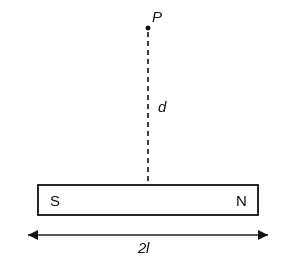
A bar magnet has total length 2l=20 units and the field point P is at a distance d=10 units from the centre of the magnet. If the relative uncertainty of length measurement is 1%, then uncertainty of the magnetic field at point P is :

एक छड़ चुम्बक की कुल लम्बाई 2l=20 मात्रक है तथा क्षेत्र बिंदु P चुम्बक के केंद्र से d=10 मात्रक की दूरी पर है। यदि लम्बाई मापन की आपेक्षिक अनिश्चितता 1% है, तो बिंदु P पर चुम्बकीय क्षेत्र की अनिश्चितता है :
  1. A4%
  2. B15%
  3. C5%
  4. D10%
Show answer

Concept: P lies on the equatorial (broad-side) line of the magnet, where B=μ04πm(2l)(d2+l2)3/2 (m = pole strength). Relative errors of each length factor add.

  1. B∝2l(d2+l2)3/2, so ΔBB=Δ(2l)2l+32Δ(d2+l2)d2+l2.
  2. Every length (l and d) has 1% uncertainty, so Δ(2l)2l=1% and Δ(d2)d2=Δ(l2)l2=2%, hence Δ(d2+l2)d2+l2=2%.
  3. ΔBB=1%+32(2%)=1%+3%=4%.

Short trick: For xp the error multiplies by p: here 1%+32×2%=4%.

Answer: (A) 4%

अवधारणा: बिंदु P चुम्बक की निरक्षीय (अनुप्रस्थ) रेखा पर है, जहाँ B=μ04πm(2l)(d2+l2)3/2 (m = ध्रुव प्राबल्य)। प्रत्येक लम्बाई गुणक की आपेक्षिक त्रुटियाँ जुड़ती हैं।

  1. B∝2l(d2+l2)3/2, अतः ΔBB=Δ(2l)2l+32Δ(d2+l2)d2+l2।
  2. प्रत्येक लम्बाई (l तथा d) में 1% अनिश्चितता है, अतः Δ(2l)2l=1% तथा Δ(d2)d2=Δ(l2)l2=2%, इसलिए Δ(d2+l2)d2+l2=2%।
  3. ΔBB=1%+32(2%)=1%+3%=4%।

शॉर्ट ट्रिक: xp के लिए त्रुटि p गुना हो जाती है: यहाँ 1%+32×2%=4%।

उत्तर: (A) 4%

JEE Main 2025 (January) – Paper 1 (B.E./B.Tech)PhysicsUnits & Measurements – error analysisJEE Main 2025 (January) – Paper 1 (B.E./B.Tech) 2025 · 28 Jan Shift 2 →
Q1827.
A concave mirror produces an image of an object such that the distance between the object and image is 20 cm. If the magnification of the image is '−3', then the magnitude of the radius of curvature of the mirror is :
एक अवतल दर्पण किसी वस्तु का प्रतिबिम्ब इस प्रकार बनाता है कि वस्तु और प्रतिबिम्ब के बीच की दूरी 20 cm है। यदि प्रतिबिम्ब का आवर्धन '−3' है, तो दर्पण की वक्रता त्रिज्या का परिमाण है :
  1. A30 cm
  2. B3.75 cm
  3. C15 cm
  4. D7.5 cm
Show answer

Concept: Mirror magnification m=−vu and mirror formula 1v+1u=1f, R=2f.

  1. m=−3⇒−vu=−3⇒v=3u. The image is real, on the same side as the object.
  2. Distance between object and image =|v−u|=|3u−u|=2|u|=20 cm⇒|u|=10 cm.
  3. With sign convention: u=−10 cm, v=−30 cm. So 1f=1−30+1−10=−430⇒f=−7.5 cm.
  4. |R|=2|f|=15 cm.

Short trick: |v−u|=2|u| for m=−3 gives u at once; then f=uvu+v.

Answer: (C) 15 cm

अवधारणा: दर्पण का आवर्धन m=−vu तथा दर्पण सूत्र 1v+1u=1f, R=2f।

  1. m=−3⇒−vu=−3⇒v=3u। प्रतिबिम्ब वास्तविक है, वस्तु की ओर ही बनता है।
  2. वस्तु और प्रतिबिम्ब के बीच दूरी =|v−u|=|3u−u|=2|u|=20 cm⇒|u|=10 cm।
  3. चिह्न परिपाटी से: u=−10 cm, v=−30 cm। अतः 1f=1−30+1−10=−430⇒f=−7.5 cm।
  4. |R|=2|f|=15 cm।

शॉर्ट ट्रिक: m=−3 के लिए |v−u|=2|u| से u तुरंत मिलता है; फिर f=uvu+v।

उत्तर: (C) 15 cm

JEE Main 2025 (January) – Paper 1 (B.E./B.Tech)PhysicsRay Optics – spherical mirrorsJEE Main 2025 (January) – Paper 1 (B.E./B.Tech) 2025 · 28 Jan Shift 2 →
Q1828.
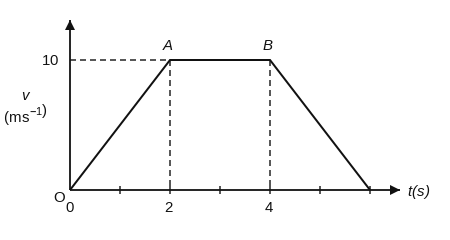
The velocity-time graph of an object moving along a straight line is shown in figure. What is the distance covered by the object between t=0 to t=4 s?
सरल रेखा में गतिमान किसी वस्तु का वेग-समय ग्राफ चित्र में दिखाया गया है। t=0 से t=4 s के बीच वस्तु द्वारा तय की गई दूरी क्या है?
  1. A30 m
  2. B11 m
  3. C10 m
  4. D13 m
Show answer

Concept: Distance = area under the velocity-time graph (velocity is non-negative here).

  1. From t=0 to t=2 s: velocity rises uniformly from 0 to 10 m/s. Area =12×2×10=10 m.
  2. From t=2 s to t=4 s: velocity is constant at 10 m/s. Area =10×2=20 m.
  3. Total distance =10+20=30 m.

Short trick: Triangle + rectangle: 12(2)(10)+(2)(10)=30 m.

Answer: (A) 30 m

अवधारणा: दूरी = वेग-समय ग्राफ के नीचे का क्षेत्रफल (यहाँ वेग ऋणात्मक नहीं है)।

  1. t=0 से t=2 s तक: वेग एकसमान रूप से 0 से 10 m/s तक बढ़ता है। क्षेत्रफल =12×2×10=10 m।
  2. t=2 s से t=4 s तक: वेग 10 m/s पर नियत है। क्षेत्रफल =10×2=20 m।
  3. कुल दूरी =10+20=30 m।

शॉर्ट ट्रिक: त्रिभुज + आयत: 12(2)(10)+(2)(10)=30 m।

उत्तर: (A) 30 m

JEE Main 2025 (January) – Paper 1 (B.E./B.Tech)PhysicsKinematics – velocity-time graphJEE Main 2025 (January) – Paper 1 (B.E./B.Tech) 2025 · 28 Jan Shift 2 →
Q1829.
A body of mass 4 kg is placed on a plane at a point P having coordinate (3,4) m. Under the action of force F→=(2i^+3j^) N, it moves to a new point Q having coordinates (6,10) m in 4 sec. The average power and instanteous power at the end of 4 sec are in the ratio of :
4 kg द्रव्यमान का एक पिंड किसी समतल पर निर्देशांक (3,4) m वाले बिंदु P पर रखा है। बल F→=(2i^+3j^) N के प्रभाव में यह 4 सेकंड में निर्देशांक (6,10) m वाले नये बिंदु Q पर पहुँच जाता है। 4 सेकंड के अंत पर औसत शक्ति तथा तात्क्षणिक शक्ति का अनुपात है :
  1. A13 : 6
  2. B4 : 3
  3. C1 : 2
  4. D6 : 13
Show answer

Concept: Average power =Wt=F→⋅s→t; instantaneous power =F→⋅v→. The body starts from rest, so v→=a→t.

  1. Displacement s→=(6−3)i^+(10−4)j^=(3i^+6j^) m.
  2. W=F→⋅s→=2(3)+3(6)=24 J ⇒Pavg=244=6 W.
  3. a→=F→m=(0.5i^+0.75j^) m/s2; at t=4 s, v→=a→t=(2i^+3j^) m/s.
  4. Pinst=F→⋅v→=2(2)+3(3)=13 W.
  5. Pavg:Pinst=6:13.

Short trick: Starting from rest under constant force, Pavg:Pinst=F→⋅s→/t:F→⋅a→t — compute the two dot products only.

Answer: (D) 6 : 13

अवधारणा: औसत शक्ति =Wt=F→⋅s→t; तात्क्षणिक शक्ति =F→⋅v→। पिंड विरामावस्था से चलता है, अतः v→=a→t।

  1. विस्थापन s→=(6−3)i^+(10−4)j^=(3i^+6j^) m।
  2. W=F→⋅s→=2(3)+3(6)=24 J ⇒Pavg=244=6 W।
  3. a→=F→m=(0.5i^+0.75j^) m/s2; t=4 s पर, v→=a→t=(2i^+3j^) m/s।
  4. Pinst=F→⋅v→=2(2)+3(3)=13 W।
  5. Pavg:Pinst=6:13।

शॉर्ट ट्रिक: विरामावस्था से नियत बल में Pavg:Pinst के लिए केवल दो अदिश गुणनफल F→⋅s→/t तथा F→⋅v→ निकालिए।

उत्तर: (D) 6 : 13

JEE Main 2025 (January) – Paper 1 (B.E./B.Tech)PhysicsWork, Energy & PowerJEE Main 2025 (January) – Paper 1 (B.E./B.Tech) 2025 · 28 Jan Shift 2 →
Q1830.
Match List - I with List - II.
List - IList - II
(A)Angular Impulse(I)[M0L2T−2]
(B)Latent Heat(II)[ML2T−3A−1]
(C)Electrical resistivity(III)[ML2T−1]
(D)Electromotive force(IV)[ML3T−3A−2]
सूची-I का सूची-II से मिलान कीजिए।
सूची-Iसूची-II
(A)कोणीय आवेग (Angular Impulse)(I)[M0L2T−2]
(B)गुप्त ऊष्मा (Latent Heat)(II)[ML2T−3A−1]
(C)वैद्युत प्रतिरोधकता (Electrical resistivity)(III)[ML2T−1]
(D)विद्युत वाहक बल (Electromotive force)(IV)[ML3T−3A−2]
  1. A(A)-(II), (B)-(I), (C)-(IV), (D)-(III)
  2. B(A)-(I), (B)-(III), (C)-(IV), (D)-(II)
  3. C(A)-(III), (B)-(I), (C)-(II), (D)-(IV)
  4. D(A)-(III), (B)-(I), (C)-(IV), (D)-(II)
Show answer

Concept: Work out each dimension from a defining formula.

  1. (A) Angular impulse = change in angular momentum =mvr: [ML2T−1] → (III).
  2. (B) Latent heat =Qm (J/kg): [M0L2T−2] → (I).
  3. (C) Resistivity ρ=RAL; with R=[ML2T−3A−2]: ρ=[ML3T−3A−2] → (IV).
  4. (D) EMF =Wq: [ML2T−3A−1] → (II).
  5. So A-III, B-I, C-IV, D-II. (A), (B) and (C) fail because each misplaces at least one pair — e.g. (A) gives angular impulse the EMF dimension, (B) gives it latent heat's, (C) swaps resistivity and EMF.

Short trick: Any quantity 'per unit charge' carries A−1 and resistance-type quantities carry A−2 — that fixes (C) and (D) instantly.

Answer: (D) (A)-(III), (B)-(I), (C)-(IV), (D)-(II)

अवधारणा: प्रत्येक राशि की विमा उसके परिभाषा-सूत्र से निकालिए।

  1. (A) कोणीय आवेग = कोणीय संवेग में परिवर्तन =mvr: [ML2T−1] → (III)।
  2. (B) गुप्त ऊष्मा =Qm (J/kg): [M0L2T−2] → (I)।
  3. (C) प्रतिरोधकता ρ=RAL; R=[ML2T−3A−2] लेने पर: ρ=[ML3T−3A−2] → (IV)।
  4. (D) विद्युत वाहक बल =Wq: [ML2T−3A−1] → (II)।
  5. अतः A-III, B-I, C-IV, D-II। विकल्प (A), (B) और (C) गलत हैं क्योंकि प्रत्येक में कम से कम एक जोड़ी गलत है — जैसे (A) कोणीय आवेग को EMF की विमा देता है, (B) उसे गुप्त ऊष्मा की, और (C) प्रतिरोधकता तथा EMF को आपस में बदल देता है।

शॉर्ट ट्रिक: 'प्रति एकांक आवेश' वाली राशि में A−1 तथा प्रतिरोध-प्रकार की राशि में A−2 आता है — इससे (C) और (D) तुरंत तय हो जाते हैं।

उत्तर: (D) (A)-(III), (B)-(I), (C)-(IV), (D)-(II)

JEE Main 2025 (January) – Paper 1 (B.E./B.Tech)PhysicsUnits & Measurements – dimensionsJEE Main 2025 (January) – Paper 1 (B.E./B.Tech) 2025 · 28 Jan Shift 2 →
Q1831.
A uniform magnetic field of 0.4 T acts perpendicular to a circular copper disc 20 cm in radius. The disc is having a uniform angular velocity of 10π rad s−1 about an axis through its centre and perpendicular to the disc. What is the potential difference developed between the axis of the disc and the rim? (π=3.14)
0.4 T का एकसमान चुम्बकीय क्षेत्र 20 cm त्रिज्या की वृत्ताकार ताँबे की चकती के लम्बवत कार्य करता है। चकती अपने केंद्र से गुजरने वाली तथा चकती के लम्बवत अक्ष के परितः 10π rad s−1 के एकसमान कोणीय वेग से घूम रही है। चकती की अक्ष और रिम (परिधि) के बीच उत्पन्न विभवान्तर क्या है? (π=3.14)
  1. A0.5024 V
  2. B0.0628 V
  3. C0.2512 V
  4. D0.1256 V
Show answer

Concept: For a disc rotating in a perpendicular field, the EMF between centre and rim is ε=12BωR2.

  1. B=0.4 T, ω=10π rad/s, R=0.2 m.
  2. ε=12×0.4×10π×(0.2)2=0.08π V.
  3. ε=0.08×3.14=0.2512 V.

Short trick: Average of rim speed field sweep: ε=12BωR2 — plug and multiply.

Answer: (C) 0.2512 V

अवधारणा: लम्बवत क्षेत्र में घूमती चकती के केंद्र और रिम के बीच विद्युत वाहक बल ε=12BωR2 होता है।

  1. B=0.4 T, ω=10π rad/s, R=0.2 m।
  2. ε=12×0.4×10π×(0.2)2=0.08π V।
  3. ε=0.08×3.14=0.2512 V।

शॉर्ट ट्रिक: सीधे ε=12BωR2 में मान रखकर गुणा कीजिए।

उत्तर: (C) 0.2512 V

JEE Main 2025 (January) – Paper 1 (B.E./B.Tech)PhysicsElectromagnetic Induction – rotating discJEE Main 2025 (January) – Paper 1 (B.E./B.Tech) 2025 · 28 Jan Shift 2 →
Q1832.

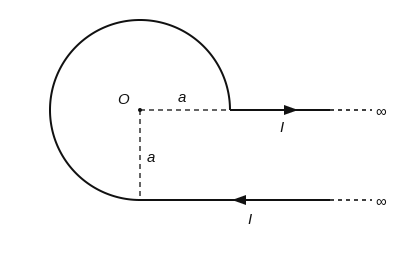
An infinite wire has a circular bend of radius a, and carrying a current I as shown in figure. The magnitude of magnetic field at the origin O of the arc is given by :

एक अनंत तार में a त्रिज्या का वृत्ताकार मोड़ है और इसमें चित्रानुसार धारा I प्रवाहित है। चाप के मूल बिंदु O पर चुम्बकीय क्षेत्र का परिमाण है :
  1. Aμ04πIa[π2+1]
  2. Bμ04πIa[3π2+2]
  3. Cμ02πIa[π2+2]
  4. Dμ04πIa[3π2+1]
Show answer

Concept: Arc of angle θ: B=μ0I4πaθ. Semi-infinite straight wire whose end lies at the foot of the perpendicular from the point: B=μ0I4πa. A wire along a line through the point gives zero field.

  1. The circular bend subtends 3π2 at O (a quarter is replaced by the two straight leads): B1=μ0I4πa⋅3π2, into the page.
  2. The lower straight wire runs from the point directly below O (distance a) to infinity: B2=μ0I4πa(sin⁡0∘+sin⁡90∘)=μ0I4πa, also into the page.
  3. The upper straight wire lies along a line passing through O, so it contributes zero.
  4. B=B1+B2=μ04πIa[3π2+1].

Short trick: Memorise: full loop →2π, each semi-infinite end-on wire →1, wire through the point →0 (all in units of μ0I/4πa).

Answer: (D) μ04πIa[3π2+1]

अवधारणा: θ कोण के चाप के लिए: B=μ0I4πaθ। ऐसा अर्ध-अनंत सीधा तार जिसका सिरा बिंदु से डाले गए लम्ब के पाद पर हो: B=μ0I4πa। बिंदु से होकर जाने वाली रेखा पर स्थित तार का क्षेत्र शून्य होता है।

  1. वृत्ताकार मोड़ O पर 3π2 कोण बनाता है (एक चौथाई भाग के स्थान पर दो सीधे तार हैं): B1=μ0I4πa⋅3π2, कागज के भीतर की ओर।
  2. नीचे वाला सीधा तार O के ठीक नीचे (a दूरी पर) स्थित बिंदु से अनंत तक जाता है: B2=μ0I4πa(sin⁡0∘+sin⁡90∘)=μ0I4πa, यह भी भीतर की ओर।
  3. ऊपर वाला सीधा तार O से गुजरने वाली रेखा पर है, अतः उसका योगदान शून्य है।
  4. B=B1+B2=μ04πIa[3π2+1]।

शॉर्ट ट्रिक: याद रखिए: पूर्ण लूप →2π, लम्ब-पाद पर सिरे वाला अर्ध-अनंत तार →1, बिंदु से गुजरता तार →0 (सभी μ0I/4πa के मात्रक में)।

उत्तर: (D) μ04πIa[3π2+1]

JEE Main 2025 (January) – Paper 1 (B.E./B.Tech)PhysicsMoving Charges & Magnetism – field of wire and arcJEE Main 2025 (January) – Paper 1 (B.E./B.Tech) 2025 · 28 Jan Shift 2 →
Q1833.
In a long glass tube, mixture of two liquids A and B with refractive indices 1.3 and 1.4 respectively, forms a convex refractive meniscus towards A. If an object placed at 13 cm from the vertex of the meniscus in A forms an image with a magnification of '−2' then the radius of curvature of meniscus is :
एक लम्बी काँच की नली में क्रमशः 1.3 तथा 1.4 अपवर्तनांक वाले दो द्रवों A और B का मिश्रण, A की ओर उत्तल अपवर्तक नवचंद्रक (मेनिस्कस) बनाता है। यदि द्रव A में नवचंद्रक के शीर्ष से 13 cm दूरी पर रखी वस्तु '−2' आवर्धन वाला प्रतिबिम्ब बनाती है, तो नवचंद्रक की वक्रता त्रिज्या है :
  1. A13 cm
  2. B43 cm
  3. C1 cm
  4. D23 cm
Show answer

Concept: Refraction at a single spherical surface: n2v−n1u=n2−n1R, with magnification m=n1vn2u. Light travels from A (n1=1.3) into B (n2=1.4).

  1. u=−13 cm. m=−2=1.3v1.4×(−13)⇒v=−2×1.4×(−13)1.3=+28 cm.
  2. 1.428−1.3−13=0.1R.
  3. 0.05+0.1=0.15=0.1R⇒R=0.10.15=23 cm.

Short trick: 1.313=0.1 and 1.428=0.05 — the arithmetic is designed to be clean.

Answer: (D) 23 cm

अवधारणा: एकल गोलीय पृष्ठ पर अपवर्तन: n2v−n1u=n2−n1R, तथा आवर्धन m=n1vn2u। प्रकाश A (n1=1.3) से B (n2=1.4) में जाता है।

  1. u=−13 cm। m=−2=1.3v1.4×(−13)⇒v=−2×1.4×(−13)1.3=+28 cm।
  2. 1.428−1.3−13=0.1R।
  3. 0.05+0.1=0.15=0.1R⇒R=0.10.15=23 cm।

शॉर्ट ट्रिक: 1.313=0.1 तथा 1.428=0.05 — गणना जान-बूझकर सरल रखी गई है।

उत्तर: (D) 23 cm

JEE Main 2025 (January) – Paper 1 (B.E./B.Tech)PhysicsRay Optics – refraction at spherical surfaceJEE Main 2025 (January) – Paper 1 (B.E./B.Tech) 2025 · 28 Jan Shift 2 →
Q1834.
A 400 g solid cube having an edge of length 10 cm floats in water. How much volume of the cube is outside the water? (Given : density of water =1000 kg m−3)
10 cm भुजा वाला 400 g का एक ठोस घन जल में तैरता है। घन का कितना आयतन जल के बाहर है? (दिया है : जल का घनत्व =1000 kg m−3)
  1. A1400 cm3
  2. B600 cm3
  3. C4000 cm3
  4. D400 cm3
Show answer

Concept: Floating equilibrium: weight = buoyant force, so the submerged volume satisfies Vsubρw=m.

  1. Total volume of cube =103=1000 cm3.
  2. Vsub=mρw=400 g1 g/cm3=400 cm3.
  3. Volume outside water =1000−400=600 cm3.

Short trick: In water (density 1 g/cm³), submerged volume in cm³ = mass in grams.

Answer: (B) 600 cm3

अवधारणा: प्लवन साम्य: भार = उत्प्लावन बल, अतः डूबा हुआ आयतन Vsubρw=m को संतुष्ट करता है।

  1. घन का कुल आयतन =103=1000 cm3।
  2. Vsub=mρw=400 g1 g/cm3=400 cm3।
  3. जल के बाहर आयतन =1000−400=600 cm3।

शॉर्ट ट्रिक: जल (घनत्व 1 g/cm³) में डूबा आयतन (cm³ में) = द्रव्यमान (ग्राम में)।

उत्तर: (B) 600 cm3

JEE Main 2025 (January) – Paper 1 (B.E./B.Tech)PhysicsFluid Mechanics – flotationJEE Main 2025 (January) – Paper 1 (B.E./B.Tech) 2025 · 28 Jan Shift 2 →
Q1835.
Given below are two statements. One is labelled as Assertion (A) and the other is labelled as Reason (R).
Assertion (A) : Knowing initial position x0 and initial momentum p0 is enough to determine the position and momentum at any time t for a simple harmonic motion with a given angular frequency ω.
Reason (R) : The amplitude and phase can be expressed in terms of x0 and p0.
In the light of the above statements, choose the correct answer from the options given below :
नीचे दो कथन दिए गए हैं। एक को अभिकथन (A) तथा दूसरे को कारण (R) कहा गया है।
अभिकथन (A) : दिए गए कोणीय आवृत्ति ω वाली सरल आवर्त गति के लिए प्रारंभिक स्थिति x0 तथा प्रारंभिक संवेग p0 का ज्ञान, किसी भी समय t पर स्थिति और संवेग ज्ञात करने के लिए पर्याप्त है।
कारण (R) : आयाम तथा कला को x0 तथा p0 के पदों में व्यक्त किया जा सकता है।
उपर्युक्त कथनों के आलोक में, नीचे दिए गए विकल्पों में से सही उत्तर चुनिए :
  1. A(A) is false but (R) is true(A) असत्य है परन्तु (R) सत्य है
  2. B(A) is true but (R) is false(A) सत्य है परन्तु (R) असत्य है
  3. CBoth (A) and (R) are true but (R) is NOT the correct explanation of (A)(A) और (R) दोनों सत्य हैं परन्तु (R), (A) की सही व्याख्या नहीं है
  4. DBoth (A) and (R) are true and (R) is the correct explanation of (A)(A) और (R) दोनों सत्य हैं तथा (R), (A) की सही व्याख्या है
Show answer

Concept: SHM is fully specified by amplitude A, phase ϕ and ω: x(t)=Asin⁡(ωt+ϕ).

  1. At t=0: x0=Asin⁡ϕ and p0=mωAcos⁡ϕ.
  2. These give A=x02+(p0mω)2 and tan⁡ϕ=mωx0p0 — so (R) is true.
  3. Once A and ϕ are known (with given ω), x(t) and p(t)=mωAcos⁡(ωt+ϕ) are known at every t — so (A) is true.
  4. (R) is exactly why (A) holds: the initial data fix the two unknown constants of the motion. Hence (A) and (B) are wrong since both statements are true, and (C) is wrong because (R) does explain (A).

Short trick: SHM has two arbitrary constants; two initial conditions determine them completely.

Answer: (D) Both (A) and (R) are true and (R) is the correct explanation of (A)

अवधारणा: सरल आवर्त गति आयाम A, कला ϕ तथा ω से पूर्णतः निर्धारित होती है: x(t)=Asin⁡(ωt+ϕ)।

  1. t=0 पर: x0=Asin⁡ϕ तथा p0=mωAcos⁡ϕ।
  2. इनसे A=x02+(p0mω)2 तथा tan⁡ϕ=mωx0p0 प्राप्त होते हैं — अतः (R) सत्य है।
  3. A और ϕ ज्ञात होने पर (दिए गए ω के साथ) प्रत्येक t पर x(t) तथा p(t)=mωAcos⁡(ωt+ϕ) ज्ञात हो जाते हैं — अतः (A) सत्य है।
  4. (R) ही (A) के सत्य होने का कारण है: प्रारंभिक मान गति के दोनों अज्ञात स्थिरांकों को निश्चित कर देते हैं। इसलिए (A) और (B) गलत हैं क्योंकि दोनों कथन सत्य हैं, और (C) गलत है क्योंकि (R), (A) की व्याख्या करता है।

शॉर्ट ट्रिक: सरल आवर्त गति में दो स्वेच्छ स्थिरांक होते हैं; दो प्रारंभिक शर्तें उन्हें पूर्णतः निर्धारित कर देती हैं।

उत्तर: (D) (A) और (R) दोनों सत्य हैं तथा (R), (A) की सही व्याख्या है

JEE Main 2025 (January) – Paper 1 (B.E./B.Tech)PhysicsOscillations – SHMJEE Main 2025 (January) – Paper 1 (B.E./B.Tech) 2025 · 28 Jan Shift 2 →
Q1836.
A uniform rod of mass 250 g having length 100 cm is balanced on a sharp edge at 40 cm mark. A mass of 400 g is suspended at 10 cm mark. To maintain the balance of the rod, the mass to be suspended at 90 cm mark, is
250 g द्रव्यमान तथा 100 cm लम्बाई की एक एकसमान छड़ 40 cm चिह्न पर एक तीक्ष्ण किनारे पर संतुलित है। 10 cm चिह्न पर 400 g का द्रव्यमान लटकाया गया है। छड़ का संतुलन बनाए रखने के लिए 90 cm चिह्न पर लटकाया जाने वाला द्रव्यमान है
  1. A190 g
  2. B200 g
  3. C300 g
  4. D290 g
Show answer

Concept: For rotational equilibrium about the edge, net torque = 0. The rod's weight acts at its centre (50 cm mark).

  1. Anticlockwise torque (about 40 cm): 400g×(40−10)=400g×30.
  2. Clockwise torques: rod's weight 250g×(50−40)=250g×10, and mg×(90−40)=mg×50.
  3. Balance: 400×30=250×10+50m⇒12000−2500=50m.
  4. m=950050=190 g.

Short trick: Work in gram-cm; g cancels throughout.

Answer: (A) 190 g

अवधारणा: किनारे के परितः घूर्णी साम्य के लिए कुल बल आघूर्ण = 0। छड़ का भार उसके केंद्र (50 cm चिह्न) पर कार्य करता है।

  1. वामावर्त बल आघूर्ण (40 cm के परितः): 400g×(40−10)=400g×30।
  2. दक्षिणावर्त बल आघूर्ण: छड़ का भार 250g×(50−40)=250g×10, तथा mg×(90−40)=mg×50।
  3. संतुलन: 400×30=250×10+50m⇒12000−2500=50m।
  4. m=950050=190 g।

शॉर्ट ट्रिक: ग्राम-सेमी में गणना कीजिए; g हर जगह निरस्त हो जाता है।

उत्तर: (A) 190 g

JEE Main 2025 (January) – Paper 1 (B.E./B.Tech)PhysicsRotational Motion – torque and equilibriumJEE Main 2025 (January) – Paper 1 (B.E./B.Tech) 2025 · 28 Jan Shift 2 →
Q1837.
Earth has mass 8 times and radius 2 times that of a planet. If the escape velocity from the earth is 11.2 km/s, the escape velocity in km/s from the planet will be :
पृथ्वी का द्रव्यमान किसी ग्रह के द्रव्यमान का 8 गुना तथा त्रिज्या 2 गुनी है। यदि पृथ्वी से पलायन वेग 11.2 km/s है, तो उस ग्रह से पलायन वेग km/s में होगा :
  1. A2.8
  2. B11.2
  3. C5.6
  4. D8.4
Show answer

Concept: Escape velocity ve=2GMR, so ve∝M/R.

  1. ve,earthve,planet=MEMP⋅RPRE=8×12=4=2.
  2. ve,planet=11.22=5.6 km/s.

Short trick: 8/2=2 — just halve 11.2.

Answer: (C) 5.6

अवधारणा: पलायन वेग ve=2GMR, अतः ve∝M/R।

  1. ve,पृथ्वीve,ग्रह=MEMP⋅RPRE=8×12=4=2।
  2. ve,ग्रह=11.22=5.6 km/s।

शॉर्ट ट्रिक: 8/2=2 — 11.2 का आधा कर दीजिए।

उत्तर: (C) 5.6

JEE Main 2025 (January) – Paper 1 (B.E./B.Tech)PhysicsGravitation – escape velocityJEE Main 2025 (January) – Paper 1 (B.E./B.Tech) 2025 · 28 Jan Shift 2 →
Q1838.
The magnetic field of an E.M. wave is given by B→=(32i^+12j^)30sin⁡[ω(t−zc)] (S.I. Units). The corresponding electric field in S.I. units is :
किसी विद्युत चुम्बकीय तरंग का चुम्बकीय क्षेत्र B→=(32i^+12j^)30sin⁡[ω(t−zc)] (S.I. मात्रक) है। संगत विद्युत क्षेत्र S.I. मात्रकों में है :
  1. AE→=(12i^−32j^)30csin⁡[ω(t−zc)]
  2. BE→=(34i^+14j^)30ccos⁡[ω(t−zc)]
  3. CE→=(12i^+32j^)30csin⁡[ω(t+zc)]
  4. DE→=(32i^−12j^)30csin⁡[ω(t+zc)]
Show answer

Concept: In an EM wave, |E→|=c|B→|, E→⊥B→, and E→×B→ points along propagation. Phase of E→ and B→ is the same.

  1. The wave moves along +z^ (phase t−z/c), so E^×B^=z^, i.e. E^=B^×z^.
  2. B^=32i^+12j^, so E^=(32i^+12j^)×z^=12i^−32j^ (check: E^×B^=(14+34)z^=z^ ✓).
  3. Magnitude =30c, same sine phase ω(t−z/c).
  4. So E→=(12i^−32j^)30csin⁡[ω(t−zc)]. (B) has wrong (non-unit) direction and cosine phase; (C) and (D) carry phase t+z/c of a wave moving along −z.

Short trick: Rotate B^ by 90∘ clockwise (for +z propagation) and multiply by c.

Answer: (A) E→=(12i^−32j^)30csin⁡[ω(t−zc)]

अवधारणा: विद्युत चुम्बकीय तरंग में |E→|=c|B→|, E→⊥B→, तथा E→×B→ संचरण की दिशा में होता है। E→ और B→ की कला समान रहती है।

  1. तरंग +z^ दिशा में चलती है (कला t−z/c), अतः E^×B^=z^, अर्थात E^=B^×z^।
  2. B^=32i^+12j^ से E^=12i^−32j^ (जाँच: E^×B^=(14+34)z^=z^ ✓)।
  3. परिमाण =30c, वही sine कला ω(t−z/c)।
  4. अतः E→=(12i^−32j^)30csin⁡[ω(t−zc)]। विकल्प (B) में दिशा गलत (एकांक सदिश नहीं) तथा cosine कला है; (C) और (D) में कला t+z/c है, जो −z दिशा में चलती तरंग की होती है।

शॉर्ट ट्रिक: +z संचरण के लिए B^ को 90∘ दक्षिणावर्त घुमाइए और c से गुणा कीजिए।

उत्तर: (A) E→=(12i^−32j^)30csin⁡[ω(t−zc)]

JEE Main 2025 (January) – Paper 1 (B.E./B.Tech)PhysicsElectromagnetic WavesJEE Main 2025 (January) – Paper 1 (B.E./B.Tech) 2025 · 28 Jan Shift 2 →
Q1839.
The kinetic energy of translation of the molecules in 50 g of CO2 gas at 17∘C is
17∘C पर 50 g CO2 गैस के अणुओं की स्थानान्तरीय गतिज ऊर्जा है
  1. A4205.5 J
  2. B4102.8 J
  3. C3582.7 J
  4. D3986.3 J
Show answer

Concept: Translational kinetic energy of n moles of any gas: KEtrans=32nRT (independent of the gas being polyatomic).

  1. n=5044 mol (molar mass of CO2 = 44 g/mol); T=17+273=290 K.
  2. KE=32×5044×8.3×290.
  3. =32×1.136×2407≈4102.8 J.

Short trick: Only the translational part counts: always 32nRT, never 52 or 62, whatever the molecule.

Answer: (B) 4102.8 J

अवधारणा: किसी भी गैस के n मोल की स्थानान्तरीय गतिज ऊर्जा: KEtrans=32nRT (गैस बहुपरमाणुक हो तब भी यही)।

  1. n=5044 mol (CO2 का मोलर द्रव्यमान = 44 g/mol); T=17+273=290 K।
  2. KE=32×5044×8.3×290।
  3. =32×1.136×2407≈4102.8 J।

शॉर्ट ट्रिक: केवल स्थानान्तरीय भाग लेना है: अणु चाहे जैसा हो, सदैव 32nRT, कभी 52 या 62 नहीं।

उत्तर: (B) 4102.8 J

JEE Main 2025 (January) – Paper 1 (B.E./B.Tech)PhysicsKinetic Theory of GasesJEE Main 2025 (January) – Paper 1 (B.E./B.Tech) 2025 · 28 Jan Shift 2 →
Q1840.
Which of the following phenomena can not be explained by wave theory of light?
निम्नलिखित में से कौन-सी परिघटना प्रकाश के तरंग सिद्धांत से स्पष्ट नहीं की जा सकती?
  1. ACompton effectकॉम्पटन प्रभाव (Compton effect)
  2. BRefraction of lightप्रकाश का अपवर्तन
  3. CReflection of lightप्रकाश का परावर्तन
  4. DDiffraction of lightप्रकाश का विवर्तन
Show answer

Concept: Wave theory explains propagation phenomena; particle (photon) nature is needed for energy-quantum phenomena.

  1. Reflection and refraction follow directly from wave fronts (Huygens' principle) — so (C) and (B) are explained by waves.
  2. Diffraction is a hallmark of waves — (D) is explained by wave theory.
  3. The Compton effect — the increase in wavelength of X-rays scattered by electrons — requires photons carrying momentum hλ colliding like particles; wave theory cannot account for the wavelength shift.

Short trick: Photoelectric and Compton effects = photon physics; interference, diffraction, polarisation = wave physics.

Answer: (A) Compton effect

अवधारणा: तरंग सिद्धांत संचरण संबंधी परिघटनाएँ समझाता है; ऊर्जा-क्वांटम वाली परिघटनाओं के लिए कण (फोटॉन) प्रकृति चाहिए।

  1. परावर्तन और अपवर्तन तरंगाग्रों (हाइगेन्स के सिद्धांत) से सीधे प्राप्त होते हैं — अतः (C) और (B) तरंगों से स्पष्ट हो जाते हैं।
  2. विवर्तन तरंगों की पहचान है — (D) तरंग सिद्धांत से स्पष्ट है।
  3. कॉम्पटन प्रभाव — इलेक्ट्रॉनों से प्रकीर्णित X-किरणों की तरंगदैर्घ्य में वृद्धि — के लिए संवेग hλ वाले फोटॉनों का कणों की तरह टकराना आवश्यक है; तरंग सिद्धांत इस तरंगदैर्घ्य परिवर्तन की व्याख्या नहीं कर सकता।

शॉर्ट ट्रिक: प्रकाश-विद्युत व कॉम्पटन प्रभाव = फोटॉन भौतिकी; व्यतिकरण, विवर्तन, ध्रुवण = तरंग भौतिकी।

उत्तर: (A) कॉम्पटन प्रभाव

JEE Main 2025 (January) – Paper 1 (B.E./B.Tech)PhysicsDual Nature of Radiation – wave vs photonJEE Main 2025 (January) – Paper 1 (B.E./B.Tech) 2025 · 28 Jan Shift 2 →