Question bank

Q&A: practice questions with answers

Search questions on any topic. Filter by exam category, exam, subject and topic, try the question, then open the answer and explanation.

Courses – airGurukul

53,050 questions in the question bank.

Q1841.
A balloon and its content having mass M is moving up with an acceleration 'a'. The mass that must be released from the content so that the balloon starts moving up with an acceleration '3a' will be (Take 'g' as acceleration due to gravity)
M द्रव्यमान का एक गुब्बारा अपनी सामग्री सहित 'a' त्वरण से ऊपर की ओर गतिमान है। सामग्री में से कितना द्रव्यमान छोड़ना होगा कि गुब्बारा '3a' त्वरण से ऊपर की ओर चलने लगे? ('g' को गुरुत्वीय त्वरण लीजिए)
  1. A2Ma3a+g
  2. B3Ma2a−g
  3. C3Ma2a+g
  4. D2Ma3a−g
Show answer

Concept: The upthrust (buoyant force) F on the balloon stays the same; only the weight changes when mass m is released.

  1. Initially: F−Mg=Ma⇒F=M(g+a).
  2. After releasing mass m: F−(M−m)g=(M−m)3a.
  3. Substitute F: M(g+a)−(M−m)g=3a(M−m).
  4. Ma+mg=3aM−3am⇒m(g+3a)=2aM.
  5. m=2Ma3a+g.

Short trick: Subtract the two equations of motion directly: mg+3am=2Ma.

Answer: (A) 2Ma3a+g

अवधारणा: गुब्बारे पर उत्प्लावन बल F अपरिवर्तित रहता है; द्रव्यमान m छोड़ने पर केवल भार बदलता है।

  1. प्रारम्भ में: F−Mg=Ma⇒F=M(g+a)।
  2. द्रव्यमान m छोड़ने के बाद: F−(M−m)g=(M−m)3a।
  3. F रखने पर: M(g+a)−(M−m)g=3a(M−m)।
  4. Ma+mg=3aM−3am⇒m(g+3a)=2aM।
  5. m=2Ma3a+g।

शॉर्ट ट्रिक: गति के दोनों समीकरण सीधे घटाइए: mg+3am=2Ma।

उत्तर: (A) 2Ma3a+g

JEE Main 2025 (January) – Paper 1 (B.E./B.Tech)PhysicsLaws of Motion – variable mass systemJEE Main 2025 (January) – Paper 1 (B.E./B.Tech) 2025 · 28 Jan Shift 2 →
Q1842.
The ratio of vapour densities of two gases at the same temperature is 425, then the ratio of r.m.s. velocities will be :
समान ताप पर दो गैसों के वाष्प घनत्वों का अनुपात 425 है, तो उनकी वर्ग माध्य मूल (r.m.s.) चालों का अनुपात होगा :
  1. A254
  2. B25
  3. C52
  4. D425
Show answer

Concept: vrms=3RTM, and vapour density is proportional to molar mass M. At the same temperature vrms∝1M.

  1. M1M2=ρ1ρ2=425.
  2. v1v2=M2M1=254=52.

Short trick: Lighter gas is faster: invert the density ratio and take the square root.

Answer: (C) 52

अवधारणा: vrms=3RTM, तथा वाष्प घनत्व मोलर द्रव्यमान M के अनुक्रमानुपाती होता है। समान ताप पर vrms∝1M।

  1. M1M2=ρ1ρ2=425।
  2. v1v2=M2M1=254=52।

शॉर्ट ट्रिक: हल्की गैस तेज़ चलती है: घनत्व अनुपात को उलटकर वर्गमूल लीजिए।

उत्तर: (C) 52

JEE Main 2025 (January) – Paper 1 (B.E./B.Tech)PhysicsKinetic Theory – r.m.s. speedJEE Main 2025 (January) – Paper 1 (B.E./B.Tech) 2025 · 28 Jan Shift 2 →
Q1843.
A parallel plate capacitor of capacitance 1μF is charged to a potential difference of 20 V. The distance between plates is 1μm. The energy density between plates of capacitor is.
1μF धारिता के एक समांतर पट्टिका संधारित्र को 20 V विभवान्तर तक आवेशित किया गया है। पट्टिकाओं के बीच की दूरी 1μm है। संधारित्र की पट्टिकाओं के बीच ऊर्जा घनत्व है :
  1. A2×10−4 J/m3
  2. B1.8×105 J/m3
  3. C1.8×103 J/m3
  4. D2×102 J/m3
Show answer

Concept: Energy density of the electric field: u=12ε0E2, with E=Vd between the plates.

  1. E=2010−6=2×10⁷ V/m.
  2. u=12×8.85×10−12×(2×107)2.
  3. =12×8.85×10−12×4×1014=1770≈1.8×10³ J/m3.

Short trick: The capacitance value is a distractor — only V/d matters for energy density.

Answer: (C) 1.8×10³ J/m3

अवधारणा: विद्युत क्षेत्र का ऊर्जा घनत्व: u=12ε0E2, जहाँ पट्टिकाओं के बीच E=Vd।

  1. E=2010−6=2×10⁷ V/m।
  2. u=12×8.85×10−12×(2×107)2।
  3. =12×8.85×10−12×4×1014=1770≈1.8×10³ J/m3।

शॉर्ट ट्रिक: धारिता का मान भटकाने के लिए है — ऊर्जा घनत्व के लिए केवल V/d चाहिए।

उत्तर: (C) 1.8×10³ J/m3

JEE Main 2025 (January) – Paper 1 (B.E./B.Tech)PhysicsCapacitance – energy densityJEE Main 2025 (January) – Paper 1 (B.E./B.Tech) 2025 · 28 Jan Shift 2 →
Q1844.
The frequency of revolution of the electron in Bohr's orbit varies with n, the principal quantum number as
बोर कक्षा में इलेक्ट्रॉन के परिक्रमण की आवृत्ति, मुख्य क्वांटम संख्या n के साथ किस प्रकार बदलती है?
  1. A1n4
  2. B1n2
  3. C1n
  4. D1n3
Show answer

Concept: In the Bohr model, orbital speed v∝1n and radius r∝n2.

  1. Frequency of revolution f=v2πr.
  2. f∝1/nn2=1n3.

Short trick: Remember the ladder: r∝n2, v∝n−1, f∝n−3, E∝n−2.

Answer: (D) 1n3

अवधारणा: बोर मॉडल में कक्षीय चाल v∝1n तथा त्रिज्या r∝n2।

  1. परिक्रमण आवृत्ति f=v2πr।
  2. f∝1/nn2=1n3।

शॉर्ट ट्रिक: क्रम याद रखिए: r∝n2, v∝n−1, f∝n−3, E∝n−2।

उत्तर: (D) 1n3

JEE Main 2025 (January) – Paper 1 (B.E./B.Tech)PhysicsAtoms – Bohr modelJEE Main 2025 (January) – Paper 1 (B.E./B.Tech) 2025 · 28 Jan Shift 2 →
Q1845.

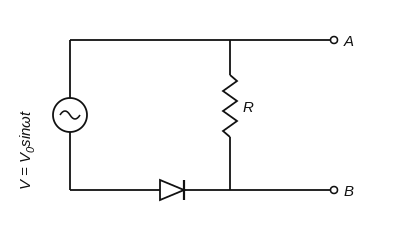
In the circuit shown here, assuming threshold voltage of diode is negligibly small, then voltage VAB is correctly represented by :

यहाँ दिखाए गए परिपथ में, डायोड की देहली वोल्टता (threshold voltage) को नगण्य मानते हुए, वोल्टता VAB को सही रूप में निरूपित करता है :
  1. AVAB would be zero at all timesVAB सभी समयों पर शून्य रहेगी
  2. B
  3. C
  4. D
Show answer

Concept: The diode conducts only when forward biased; VAB equals the drop across R (A and B are the terminals of the R branch). With no current, the drop across R is zero.

  1. During the half cycle with the top source terminal positive, the required current direction through the bottom wire is from B towards the source — opposite to the diode arrow. The diode is reverse biased, no current flows, so VAB=0.
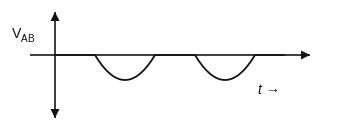
  2. During the other half cycle the diode is forward biased; current flows through R from B to A, making VA<VB, i.e. VAB=V0sin⁡ωt (negative).
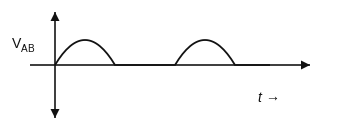
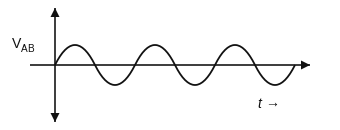
  3. So VAB is zero for one half cycle and reproduces the negative half-sine in the other: negative half-wave pulses. (A) is wrong since current does flow half the time; (B) has the wrong polarity; (C) would need the diode to conduct both ways.

Short trick: A series diode passes only one half cycle — check its arrow to pick the sign of the surviving humps.

Answer: (D) negative half-cycle pulses

अवधारणा: डायोड केवल अग्र अभिनति (forward bias) में चालन करता है; VAB, R के सिरों का विभवान्तर है (A और B, R शाखा के सिरे हैं)। धारा न बहे तो R पर विभव पात शून्य होता है।

  1. जिस अर्ध चक्र में स्रोत का ऊपरी सिरा धनात्मक होता है, उसमें नीचे के तार में आवश्यक धारा की दिशा B से स्रोत की ओर होती — जो डायोड के तीर के विपरीत है। डायोड पश्च अभिनत रहता है, धारा नहीं बहती, अतः VAB=0।
  2. दूसरे अर्ध चक्र में डायोड अग्र अभिनत होता है; धारा R में B से A की ओर बहती है, जिससे VA<VB, अर्थात VAB=V0sin⁡ωt (ऋणात्मक)।
  3. अतः VAB एक अर्ध चक्र में शून्य और दूसरे में ऋणात्मक अर्ध-ज्या: ऋणात्मक अर्ध-तरंग स्पंद। (A) गलत है क्योंकि आधे समय धारा बहती है; (B) में ध्रुवता उलटी है; (C) के लिए डायोड को दोनों दिशाओं में चालन करना पड़ता।

शॉर्ट ट्रिक: श्रेणी में लगा डायोड केवल एक अर्ध चक्र पारित करता है — बचे हुए स्पंदों का चिह्न डायोड के तीर से तय कीजिए।

उत्तर: (D) ऋणात्मक अर्ध-चक्र स्पंद

JEE Main 2025 (January) – Paper 1 (B.E./B.Tech)PhysicsSemiconductors – diode circuitJEE Main 2025 (January) – Paper 1 (B.E./B.Tech) 2025 · 28 Jan Shift 2 →
Q1846.
A thin transparent film with refractive index 1.4, is held on circular ring of radius 1.8 cm. The fluid in the film evaporates such that transmission through the film at wavelength 560 nm goes to a minimum every 12 seconds. Assuming that the film is flat on its two sides, the rate of evaporation is ____ π×10−13 m3/s.
1.4 अपवर्तनांक वाली एक पतली पारदर्शी फिल्म 1.8 cm त्रिज्या के वृत्ताकार छल्ले पर लगी है। फिल्म का द्रव इस प्रकार वाष्पित होता है कि 560 nm तरंगदैर्घ्य पर फिल्म से पारगमन (transmission) प्रत्येक 12 सेकंड में न्यूनतम हो जाता है। फिल्म को दोनों ओर से समतल मानते हुए, वाष्पन की दर ____ π×10−13 m3/s है।
Show answer

Concept: Successive transmission minima of a parallel film occur each time the optical path 2μt changes by one wavelength, i.e. the thickness changes by Δt=λ2μ.

  1. Δt=560×10−92×1.4=2×10⁻⁷ m, lost every 12 s.
  2. Film area =πr2=π(0.018)2=3.24×10⁻⁴π m2.
  3. Rate of evaporation =AΔt12=π×3.24×10−4×2×10−712.
  4. =π×6.48×10−1112=5.4×10⁻¹²π=54π×10−13 m3/s.

Short trick: Volume rate =πr2⋅λ2μT in one line.

Answer: 54

अवधारणा: समांतर फिल्म के क्रमागत पारगमन निम्निष्ठ तब आते हैं जब प्रकाशिक पथ 2μt एक तरंगदैर्घ्य से बदलता है, अर्थात मोटाई में परिवर्तन Δt=λ2μ हो।

  1. Δt=560×10−92×1.4=2×10⁻⁷ m, प्रत्येक 12 s में।
  2. फिल्म का क्षेत्रफल =πr2=π(0.018)2=3.24×10⁻⁴π m2।
  3. वाष्पन की दर =AΔt12=π×3.24×10−4×2×10−712।
  4. =π×6.48×10−1112=5.4×10⁻¹²π=54π×10−13 m3/s।

शॉर्ट ट्रिक: आयतन दर =πr2⋅λ2μT — एक ही पंक्ति में।

उत्तर: 54

JEE Main 2025 (January) – Paper 1 (B.E./B.Tech)PhysicsWave Optics – thin film interferenceJEE Main 2025 (January) – Paper 1 (B.E./B.Tech) 2025 · 28 Jan Shift 2 →
Q1847.
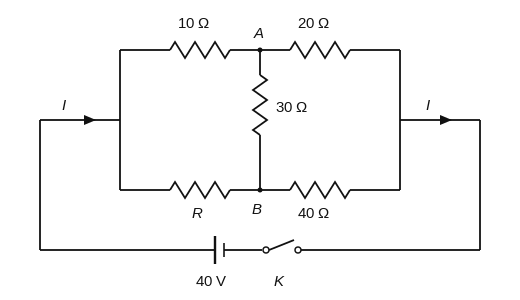
The value of current I in the electrical circuit as given below, when potential at A is equal to the potential at B,

will be ____ A.
नीचे दिए गए विद्युत परिपथ में, जब A का विभव B के विभव के बराबर है,

तब धारा I का मान ____ A होगा।
Show answer

Concept: With VA=VB no current flows through the 30 Ω branch (balanced-bridge condition), so the two horizontal branches carry independent currents from the same 40 V source.

  1. Let I1 flow in the top branch (10 Ω, 20 Ω) and I2 in the bottom branch (R, 40 Ω).
  2. VA=VB gives, from the left node: 10I1=RI2, and from the right node: 20I1=40I2⇒I1=2I2. Hence R=20 Ω.
  3. Branch resistances: top =30 Ω, bottom =60 Ω; parallel combination =30×6090=20 Ω.
  4. I=40 V20 Ω=2 A.

Short trick: Balanced bridge ⇒ delete the 30 Ω resistor; find R from the ratio condition, then it is one parallel combination.

Answer: 2

अवधारणा: VA=VB होने पर 30 Ω शाखा में धारा नहीं बहती (संतुलित सेतु की शर्त), अतः दोनों क्षैतिज शाखाएँ उसी 40 V स्रोत से स्वतंत्र धाराएँ लेती हैं।

  1. ऊपरी शाखा (10 Ω, 20 Ω) में I1 तथा निचली शाखा (R, 40 Ω) में I2 लीजिए।
  2. VA=VB से, बाएँ नोड से: 10I1=RI2, तथा दाएँ नोड से: 20I1=40I2⇒I1=2I2। अतः R=20 Ω।
  3. शाखा प्रतिरोध: ऊपरी =30 Ω, निचली =60 Ω; समांतर संयोजन =30×6090=20 Ω।
  4. I=40 V20 Ω=2 A।

शॉर्ट ट्रिक: संतुलित सेतु ⇒ 30 Ω प्रतिरोध हटा दीजिए; अनुपात शर्त से R निकालिए, फिर केवल एक समांतर संयोजन बचता है।

उत्तर: 2

JEE Main 2025 (January) – Paper 1 (B.E./B.Tech)PhysicsCurrent Electricity – Wheatstone bridgeJEE Main 2025 (January) – Paper 1 (B.E./B.Tech) 2025 · 28 Jan Shift 2 →
Q1848.
An electric dipole of dipole moment 6×10⁻⁶ Cm is placed in uniform electric field of magnitude 106 V/m. Initially, the dipole moment is parallel to electric field. The work that needs to be done on the dipole to make its dipole moment opposite to the field, will be ____ J.
6×10⁻⁶ Cm द्विध्रुव आघूर्ण का एक विद्युत द्विध्रुव 106 V/m परिमाण के एकसमान विद्युत क्षेत्र में रखा है। प्रारम्भ में द्विध्रुव आघूर्ण विद्युत क्षेत्र के समांतर है। द्विध्रुव आघूर्ण को क्षेत्र के विपरीत करने के लिए द्विध्रुव पर किया जाने वाला कार्य ____ J होगा।
Show answer

Concept: Potential energy of a dipole: U=−pEcos⁡θ. Work done by external agent =Uf−Ui.

  1. Initial (θ=0∘): Ui=−pE. Final (θ=180∘): Uf=+pE.
  2. W=Uf−Ui=2pE.
  3. W=2×6×10−6×106=12 J.

Short trick: Parallel → antiparallel always costs 2pE.

Answer: 12

अवधारणा: द्विध्रुव की स्थितिज ऊर्जा: U=−pEcos⁡θ। बाह्य कर्ता द्वारा किया गया कार्य =Uf−Ui।

  1. प्रारम्भिक (θ=0∘): Ui=−pE। अंतिम (θ=180∘): Uf=+pE।
  2. W=Uf−Ui=2pE।
  3. W=2×6×10−6×106=12 J।

शॉर्ट ट्रिक: समांतर → प्रतिसमांतर में सदैव 2pE कार्य लगता है।

उत्तर: 12

JEE Main 2025 (January) – Paper 1 (B.E./B.Tech)PhysicsElectrostatics – electric dipoleJEE Main 2025 (January) – Paper 1 (B.E./B.Tech) 2025 · 28 Jan Shift 2 →
Q1849.

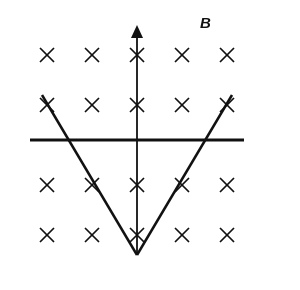
A conducting bar moves on two conducting rails as shown in the figure. A constant magnetic field B exists into the page. The bar starts to move from the vertex at time t=0 with a constant velocity. If the induced EMF is E ∝tn, then value of n is _.

एक चालक छड़ चित्रानुसार दो चालक पटरियों पर चलती है। एक नियत चुम्बकीय क्षेत्र B कागज के भीतर की ओर विद्यमान है। छड़ समय t=0 पर शीर्ष (vertex) से नियत वेग से चलना प्रारम्भ करती है। यदि प्रेरित विद्युत वाहक बल E ∝tn है, तो n का मान _ है।
Show answer

Concept: Motional EMF =Bℓv, where ℓ is the effective length of the bar between the rails.

  1. The rails form a 'V'. At time t the bar is at distance x=vt from the vertex.
  2. The separation between the rails there is ℓ=2xtan⁡θ=2vttan⁡θ (2θ = opening angle), so ℓ∝t.
  3. EMF =Bℓv=2Bv2tan⁡θt∝t1.
  4. Hence n=1.

Short trick: With constant v only ℓ grows, and it grows linearly with t on straight rails.

Answer: 1

अवधारणा: गतिक विद्युत वाहक बल =Bℓv, जहाँ ℓ पटरियों के बीच छड़ की प्रभावी लम्बाई है।

  1. पटरियाँ 'V' आकार बनाती हैं। समय t पर छड़ शीर्ष से x=vt दूरी पर है।
  2. वहाँ पटरियों के बीच दूरी ℓ=2xtan⁡θ=2vttan⁡θ (2θ = खुलने का कोण), अतः ℓ∝t।
  3. विद्युत वाहक बल =Bℓv=2Bv2tan⁡θt∝t1।
  4. अतः n=1।

शॉर्ट ट्रिक: नियत v पर केवल ℓ बढ़ती है, और सीधी पटरियों पर यह t के साथ रैखिक बढ़ती है।

उत्तर: 1

JEE Main 2025 (January) – Paper 1 (B.E./B.Tech)PhysicsElectromagnetic Induction – motional EMFJEE Main 2025 (January) – Paper 1 (B.E./B.Tech) 2025 · 28 Jan Shift 2 →
Q1850.
The volume contraction of a solid copper cube of edge length 10 cm, when subjected to a hydraulic pressure of 7×10⁶ Pa, would be ____ mm3. (Given bulk modulus of copper =1.4×10¹¹ N m−2)
10 cm भुजा वाले ठोस ताँबे के घन पर 7×10⁶ Pa का द्रवचालित दाब लगाने पर उसके आयतन में संकुचन ____ mm3 होगा। (दिया है : ताँबे का आयतन प्रत्यास्थता गुणांक =1.4×10¹¹ N m−2)
Show answer

Concept: Bulk modulus B=PΔV/V, so ΔV=PVB.

  1. V=(0.1)3=10−3 m3.
  2. ΔV=7×106×10−31.4×1011=5×10⁻⁸ m3.
  3. 1 m3=109 mm3, so ΔV=5×10−8×109=50 mm3.

Short trick: 71.4=5; keep track of the 109 factor for mm3.

Answer: 50

अवधारणा: आयतन प्रत्यास्थता गुणांक B=PΔV/V, अतः ΔV=PVB।

  1. V=(0.1)3=10−3 m3।
  2. ΔV=7×106×10−31.4×1011=5×10⁻⁸ m3।
  3. 1 m3=109 mm3, अतः ΔV=5×10−8×109=50 mm3।

शॉर्ट ट्रिक: 71.4=5; mm3 के लिए 109 गुणक का ध्यान रखिए।

उत्तर: 50

JEE Main 2025 (January) – Paper 1 (B.E./B.Tech)PhysicsMechanical Properties of Solids – bulk modulusJEE Main 2025 (January) – Paper 1 (B.E./B.Tech) 2025 · 28 Jan Shift 2 →
Q1851.
Concentrated nitric acid is labelled as 75% by mass. The volume in mL of the solution which contains 30 g of nitric acid is ____. Given : Density of nitric acid solution is 1.25 g/mL.
सान्द्र नाइट्रिक अम्ल पर द्रव्यमान अनुसार 75% लेबल लगा है। उस विलयन का mL में आयतन, जिसमें 30 g नाइट्रिक अम्ल है, ____ है। दिया गया है : नाइट्रिक अम्ल विलयन का घनत्व 1.25 g/mL है।
  1. A40
  2. B32
  3. C45
  4. D55
Show answer

Concept: Mass % gives mass of solute per 100 g of solution; volume = mass of solution / density.

  1. 75% by mass ⇒ 75 g HNO3 is present in 100 g solution.
  2. Mass of solution containing 30 g HNO3 = 300.75=40 g.
  3. Volume = 401.25=32 mL.

Short trick: V=msolute(%/100)×d=300.75×1.25=32 mL.

Answer: (B) 32 mL

अवधारणा: द्रव्यमान % से 100 g विलयन में विलेय का द्रव्यमान मिलता है; आयतन = विलयन का द्रव्यमान / घनत्व।

  1. द्रव्यमान अनुसार 75% ⇒ 100 g विलयन में 75 g HNO3 है।
  2. 30 g HNO3 वाले विलयन का द्रव्यमान = 300.75=40 g।
  3. आयतन = 401.25=32 mL।

शॉर्ट ट्रिक: V=mविलेय(%/100)×d=300.75×1.25=32 mL।

उत्तर: (B) 32 mL

JEE Main 2025 (January) – Paper 1 (B.E./B.Tech)ChemistrySolutions – concentration termsJEE Main 2025 (January) – Paper 1 (B.E./B.Tech) 2025 · 28 Jan Shift 2 →
Q1852.
Given below are two statements :
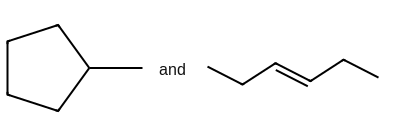
Statement (I) : are isomeric compounds.
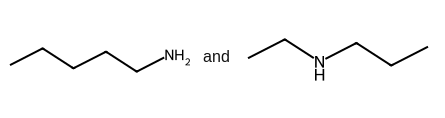
Statement (II) : are functional group isomers.
नीचे दो कथन दिए गए हैं :
कथन (I) : समावयवी यौगिक हैं।
कथन (II) : क्रियात्मक समूह समावयवी हैं।
  1. ABoth Statement (I) and Statement (II) are false.कथन (I) और कथन (II) दोनों असत्य हैं।
  2. BBoth Statement (I) and Statement (II) are true.कथन (I) और कथन (II) दोनों सत्य हैं।
  3. CStatement (I) is false but Statement (II) is true.कथन (I) असत्य है परन्तु कथन (II) सत्य है।
  4. DStatement (I) is true but Statement (II) is false.कथन (I) सत्य है परन्तु कथन (II) असत्य है।
Show answer

Concept: Isomers have the same molecular formula; functional (group) isomers additionally belong to different classes of compounds.

  1. Statement (I): methylcyclopentane and hex-3-ene both have the molecular formula C6H12 → they are isomers. Statement (I) is true.
  2. Statement (II): pentan-1-amine (a 1° amine) and N-ethylpropan-1-amine (a 2° amine) both have the formula C5H13N but contain different amine functional classes (–NH2 vs >NH) → functional group isomers. Statement (II) is true.

Short trick: A ring is "one degree of unsaturation", just like one C=C – so cycloalkanes and alkenes of equal carbon count are always isomers (CnH2n).

Answer: (B) Both statements are true.

अवधारणा: समावयवियों का अणुसूत्र समान होता है; क्रियात्मक समूह समावयवी इसके साथ-साथ भिन्न वर्गों के यौगिक होते हैं।

  1. कथन (I): मेथिलसाइक्लोपेन्टेन तथा हेक्स-3-ईन दोनों का अणुसूत्र C6H12 है → ये समावयवी हैं। कथन (I) सत्य है।
  2. कथन (II): पेन्टेन-1-ऐमीन (1° ऐमीन) तथा N-एथिलप्रोपेन-1-ऐमीन (2° ऐमीन) दोनों का सूत्र C5H13N है, परन्तु ऐमीन के भिन्न वर्ग (–NH2 बनाम >NH) हैं → क्रियात्मक समूह समावयवी। कथन (II) सत्य है।

शॉर्ट ट्रिक: वलय (ring) भी एक असंतृप्तता कोटि है, C=C की तरह – अतः समान कार्बन संख्या वाले साइक्लोऐल्केन और ऐल्कीन सदैव समावयवी होते हैं (CnH2n)।

उत्तर: (B) दोनों कथन सत्य हैं।

JEE Main 2025 (January) – Paper 1 (B.E./B.Tech)ChemistryOrganic chemistry – isomerismJEE Main 2025 (January) – Paper 1 (B.E./B.Tech) 2025 · 28 Jan Shift 2 →
Q1853.
Identify product [A], [B] and [C] in the following reaction sequence.
CH3−C≡CH →H2Pd/C [A] →(ii) Zn, H2O(i) O3 [B] + [C]
निम्नलिखित अभिक्रिया अनुक्रम में उत्पाद [A], [B] तथा [C] को पहचानिए।
CH3−C≡CH →H2Pd/C [A] →(ii) Zn, H2O(i) O3 [B] + [C]
  1. A[A] : CH2=CH2, [B] : H3C−CO−CH3, [C] : HCHO
  2. B[A] : CH3−CH=CH2, [B] : CH3CHO, [C] : CH3CH2OH
  3. C[A] : CH3−CH=CH2, [B] : CH3CHO, [C] : HCHO
  4. D[A] : CH3CH2CH3, [B] : CH3CHO, [C] : HCHO
Show answer

Concept: Addition of one mole of H2 converts an alkyne to an alkene; reductive ozonolysis (O3; Zn, H2O) cleaves the C=C bond to two carbonyl compounds.

  1. Propyne + H2/Pd-C (one mole of H2 adds across C≡C) → [A] = propene, CH3–CH=CH2. The next step is ozonolysis, so [A] must contain a C=C bond.
  2. Ozonolysis cleaves CH3–CH=CH2 at the double bond: CH3CH= gives [B] = CH3CHO and =CH2 gives [C] = HCHO.
  3. (A) is wrong: ethene would mean a carbon is lost. (B) is wrong: Zn/H2O work-up gives aldehydes, not ethanol. (D) is wrong: propane has no C=C, so it cannot undergo ozonolysis.

Short trick: Replace C=C by two C=O to write ozonolysis products instantly.

Answer: (C)

अवधारणा: एक मोल H2 जुड़ने पर ऐल्काइन ऐल्कीन बनता है; अपचायी ओज़ोनी-अपघटन (O3; Zn, H2O) C=C आबंध को तोड़कर दो कार्बोनिल यौगिक देता है।

  1. प्रोपाइन + H2/Pd-C (C≡C पर एक मोल H2 जुड़ता है) → [A] = प्रोपीन, CH3–CH=CH2। अगला चरण ओज़ोनी-अपघटन है, अतः [A] में C=C होना आवश्यक है।
  2. ओज़ोनी-अपघटन CH3–CH=CH2 को द्विआबंध पर तोड़ता है: CH3CH= से [B] = CH3CHO तथा =CH2 से [C] = HCHO।
  3. (A) गलत: एथीन बनने पर एक कार्बन लुप्त हो जाता। (B) गलत: Zn/H2O से ऐल्डिहाइड मिलते हैं, एथेनॉल नहीं। (D) गलत: प्रोपेन में C=C नहीं है, अतः ओज़ोनी-अपघटन संभव नहीं।

शॉर्ट ट्रिक: C=C को दो C=O से बदल दीजिए – ओज़ोनी-अपघटन के उत्पाद तुरंत लिख जाते हैं।

उत्तर: (C)

JEE Main 2025 (January) – Paper 1 (B.E./B.Tech)ChemistryHydrocarbons – hydrogenation & ozonolysisJEE Main 2025 (January) – Paper 1 (B.E./B.Tech) 2025 · 28 Jan Shift 2 →
Q1854.
The total number of compounds from below when treated with hot KMnO4 giving benzoic acid is :
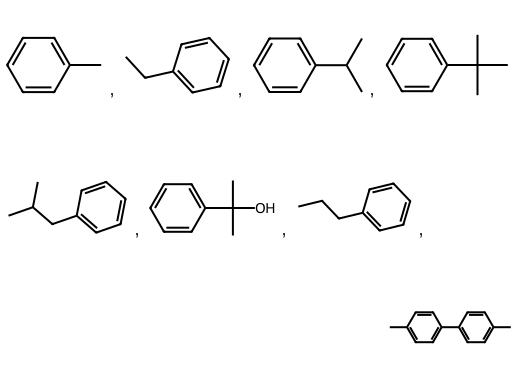
नीचे दिए गए यौगिकों में से गर्म KMnO4 के साथ अभिकृत करने पर बेन्जोइक अम्ल देने वाले यौगिकों की कुल संख्या है :
  1. A6
  2. B3
  3. C5
  4. D4
Show answer

Concept: Hot KMnO4 oxidises any alkyl side chain to –COOH, but only if the benzylic carbon carries at least one H.

  1. Give benzoic acid (benzylic H present): toluene, ethylbenzene, isopropylbenzene (cumene), isobutylbenzene (PhCH2CH(CH3)2) and n-propylbenzene → 5 compounds.
  2. tert-Butylbenzene: benzylic carbon has no H → resistant, no benzoic acid.
  3. 2-Phenylpropan-2-ol, PhC(CH3)2OH: again no benzylic H → no benzoic acid.
  4. 4,4′-Dimethylbiphenyl: oxidation gives biphenyl-4,4′-dicarboxylic acid, not benzoic acid.

Short trick: "No benzylic H → no oxidation"; and the aromatic core always survives, so a biphenyl can never shrink to benzoic acid.

Answer: (C) 5

अवधारणा: गर्म KMnO4 किसी भी ऐल्किल पार्श्व-शृंखला को –COOH में ऑक्सीकृत करता है, परन्तु तभी जब बेन्जाइलिक कार्बन पर कम से कम एक H हो।

  1. बेन्जोइक अम्ल देते हैं (बेन्जाइलिक H उपस्थित): टॉलूईन, एथिलबेन्जीन, आइसोप्रोपिलबेन्जीन (क्यूमीन), आइसोब्यूटिलबेन्जीन (PhCH2CH(CH3)2) तथा n-प्रोपिलबेन्जीन → 5 यौगिक।
  2. tert-ब्यूटिलबेन्जीन: बेन्जाइलिक कार्बन पर H नहीं → ऑक्सीकरण नहीं होता।
  3. 2-फेनिलप्रोपेन-2-ऑल, PhC(CH3)2OH: बेन्जाइलिक H नहीं → बेन्जोइक अम्ल नहीं।
  4. 4,4′-डाइमेथिलबाइफेनिल: ऑक्सीकरण से बाइफेनिल-4,4′-डाइकार्बोक्सिलिक अम्ल बनता है, बेन्जोइक अम्ल नहीं।

शॉर्ट ट्रिक: "बेन्जाइलिक H नहीं → ऑक्सीकरण नहीं"; ऐरोमैटिक वलय सुरक्षित रहता है, अतः बाइफेनिल कभी बेन्जोइक अम्ल नहीं दे सकता।

उत्तर: (C) 5

JEE Main 2025 (January) – Paper 1 (B.E./B.Tech)ChemistryHydrocarbons – side-chain oxidation of arenesJEE Main 2025 (January) – Paper 1 (B.E./B.Tech) 2025 · 28 Jan Shift 2 →
Q1855.
Match List - I with List - II.
List - I
(Complex)
List - II
(Hybridisation of central metal ion)
(A)[CoF6]3−(I)d2sp3
(B)[NiCl4]2−(II)sp3
(C)[Co(NH3)6]3+(III)sp3d2
(D)[Ni(CN)4]2−(IV)dsp2
Choose the correct answer from the options given below :
सूची-I का सूची-II से मिलान कीजिए।
सूची - I
(संकुल)
सूची - II
(केंद्रीय धातु आयन का संकरण)
(A)[CoF6]3−(I)d2sp3
(B)[NiCl4]2−(II)sp3
(C)[Co(NH3)6]3+(III)sp3d2
(D)[Ni(CN)4]2−(IV)dsp2
नीचे दिए गए विकल्पों में से सही उत्तर चुनिए :
  1. A(A)-(I), (B)-(IV), (C)-(III), (D)-(II)
  2. B(A)-(I), (B)-(II), (C)-(III), (D)-(IV)
  3. C(A)-(III), (B)-(IV), (C)-(I), (D)-(II)
  4. D(A)-(III), (B)-(II), (C)-(I), (D)-(IV)
Show answer

Concept: Weak-field ligands give high-spin (outer-orbital) complexes, strong-field ligands give low-spin (inner-orbital) complexes; for d8 ions strong-field CN− forces square-planar dsp2.

  1. (A) [CoF6]3−: Co3+ (d6) with weak F− → high-spin, outer d orbitals used → sp3d2 = (III).
  2. (B) [NiCl4]2−: Ni2+ (d8) with weak Cl− → tetrahedral sp3 = (II).
  3. (C) [Co(NH3)6]3+: strong-field NH3 on Co3+ → low-spin, inner d2sp3 = (I).
  4. (D) [Ni(CN)4]2−: Ni2+ (d8) with strong CN− → square planar dsp2 = (IV).

Short trick: F−/Cl− → outer (sp3d2/sp3); NH3/CN− → inner (d2sp3/dsp2).

Answer: (D)

अवधारणा: दुर्बल क्षेत्र लिगन्ड उच्च-चक्रण (बाह्य-कक्षक) संकुल देते हैं, प्रबल क्षेत्र लिगन्ड निम्न-चक्रण (आंतरिक-कक्षक); d8 आयन पर प्रबल CN− वर्ग-समतलीय dsp2 देता है।

  1. (A) [CoF6]3−: Co3+ (d6), दुर्बल F− → उच्च-चक्रण, बाह्य d कक्षक → sp3d2 = (III)।
  2. (B) [NiCl4]2−: Ni2+ (d8), दुर्बल Cl− → चतुष्फलकीय sp3 = (II)।
  3. (C) [Co(NH3)6]3+: Co3+ पर प्रबल NH3 → निम्न-चक्रण, आंतरिक d2sp3 = (I)।
  4. (D) [Ni(CN)4]2−: Ni2+ (d8), प्रबल CN− → वर्ग-समतलीय dsp2 = (IV)।

शॉर्ट ट्रिक: F−/Cl− → बाह्य (sp3d2/sp3); NH3/CN− → आंतरिक (d2sp3/dsp2)।

उत्तर: (D)

JEE Main 2025 (January) – Paper 1 (B.E./B.Tech)ChemistryCoordination compounds – VBT hybridisationJEE Main 2025 (January) – Paper 1 (B.E./B.Tech) 2025 · 28 Jan Shift 2 →
Q1856.
Identify correct statements : (A) Primary amines do not give diazonium salts when treated with NaNO2 in acidic condition. (B) Aliphatic and aromatic primary amines on heating with CHCl3 and ethanolic KOH form carbylamines. (C) Secondary and tertiary amines also give carbylamine test. (D) Benzenesulfonyl chloride is known as Hinsberg's reagent. (E) Tertiary amines reacts with benzenesulfonyl chloride very easily. Choose the correct answer from the options given below :
सही कथनों को पहचानिए : (A) प्राथमिक ऐमीन अम्लीय माध्यम में NaNO2 के साथ अभिकृत करने पर डाइऐज़ोनियम लवण नहीं देते। (B) ऐलिफैटिक तथा ऐरोमैटिक प्राथमिक ऐमीन CHCl3 और एथेनॉलिक KOH के साथ गर्म करने पर कार्बिलऐमीन बनाते हैं। (C) द्वितीयक और तृतीयक ऐमीन भी कार्बिलऐमीन परीक्षण देते हैं। (D) बेन्जीनसल्फोनिल क्लोराइड हिन्सबर्ग अभिकर्मक के नाम से जाना जाता है। (E) तृतीयक ऐमीन बेन्जीनसल्फोनिल क्लोराइड से बहुत सरलता से अभिक्रिया करते हैं। नीचे दिए गए विकल्पों में से सही उत्तर चुनिए :
  1. A(A) and (B) onlyकेवल (A) और (B)
  2. B(D) and (E) onlyकेवल (D) और (E)
  3. C(B) and (D) onlyकेवल (B) और (D)
  4. D(B) and (C) onlyकेवल (B) और (C)
Show answer

Concept: Diazotisation and the carbylamine (isocyanide) test are reactions of primary amines; Hinsberg's reagent is C6H5SO2Cl.

  1. (A) False – primary amines DO give diazonium salts with NaNO2/HCl (aromatic ones give stable salts at 273–278 K; aliphatic ones give unstable salts).
  2. (B) True – all primary amines (aliphatic and aromatic) heated with CHCl3 + ethanolic KOH give foul-smelling carbylamines (isocyanides).
  3. (C) False – 2° and 3° amines do not give the carbylamine test; it is specific for 1° amines.
  4. (D) True – benzenesulfonyl chloride is Hinsberg's reagent, used to distinguish 1°, 2° and 3° amines.
  5. (E) False – tertiary amines have no N–H, so they do not react with benzenesulfonyl chloride.

Answer: (C) (B) and (D) only

अवधारणा: डाइऐज़ोटीकरण तथा कार्बिलऐमीन (आइसोसायनाइड) परीक्षण प्राथमिक ऐमीनों की अभिक्रियाएँ हैं; हिन्सबर्ग अभिकर्मक C6H5SO2Cl है।

  1. (A) असत्य – प्राथमिक ऐमीन NaNO2/HCl से डाइऐज़ोनियम लवण देते ही हैं (ऐरोमैटिक 273–278 K पर स्थायी लवण; ऐलिफैटिक अस्थायी लवण)।
  2. (B) सत्य – सभी प्राथमिक ऐमीन (ऐलिफैटिक तथा ऐरोमैटिक) CHCl3 + एथेनॉलिक KOH के साथ गर्म करने पर दुर्गंधयुक्त कार्बिलऐमीन (आइसोसायनाइड) देते हैं।
  3. (C) असत्य – 2° और 3° ऐमीन कार्बिलऐमीन परीक्षण नहीं देते; यह केवल 1° ऐमीनों के लिए विशिष्ट है।
  4. (D) सत्य – बेन्जीनसल्फोनिल क्लोराइड ही हिन्सबर्ग अभिकर्मक है, जिससे 1°, 2°, 3° ऐमीनों में भेद किया जाता है।
  5. (E) असत्य – तृतीयक ऐमीन में N–H नहीं होता, अतः वे बेन्जीनसल्फोनिल क्लोराइड से अभिक्रिया नहीं करते।

उत्तर: (C) केवल (B) और (D)

JEE Main 2025 (January) – Paper 1 (B.E./B.Tech)ChemistryAmines – reactions and testsJEE Main 2025 (January) – Paper 1 (B.E./B.Tech) 2025 · 28 Jan Shift 2 →
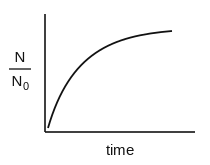
Q1857.
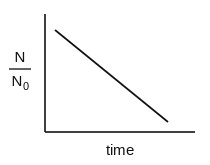
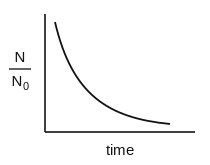
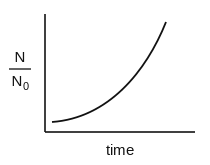
For bacterial growth in a cell culture, growth law is very similar to the law of radioactive decay. Which of the following graphs is most suitable to represent bacterial colony growth ? Where N - Number of Bacteria at any time, N0 - Initial number of Bacteria.
कोशिका संवर्धन (cell culture) में जीवाणु वृद्धि का नियम रेडियोऐक्टिव क्षय के नियम से अत्यंत मिलता-जुलता है। जीवाणु कॉलोनी की वृद्धि को निरूपित करने के लिए निम्नलिखित में से कौन-सा ग्राफ सर्वाधिक उपयुक्त है? जहाँ N - किसी समय जीवाणुओं की संख्या, N0 - जीवाणुओं की प्रारंभिक संख्या।
  1. A
  2. B
  3. C
  4. D
Show answer

Concept: Radioactive decay is first order: N=N0e−λt. Growth follows the same law with a positive exponent: N=N0e+kt.

  1. For growth, NN0=ekt: it starts at 1 at t=0 and rises faster and faster – an upward, concave-up exponential curve.
  2. (A) shows a linear decrease and (B) an exponential decay – both describe loss, not growth.
  3. (D) shows saturation (levelling off), which ekt never does.
  4. Only (C) shows the ever-steepening exponential rise.

Answer: (C)

अवधारणा: रेडियोऐक्टिव क्षय प्रथम कोटि का है: N=N0e−λt। वृद्धि उसी नियम से, परन्तु धनात्मक घातांक के साथ होती है: N=N0e+kt।

  1. वृद्धि के लिए NN0=ekt: t=0 पर मान 1 से प्रारंभ होकर उत्तरोत्तर तेज़ी से बढ़ता है – ऊपर की ओर अवतल (concave-up) चरघातांकी वक्र।
  2. (A) रैखिक कमी तथा (B) चरघातांकी क्षय दर्शाते हैं – दोनों ह्रास हैं, वृद्धि नहीं।
  3. (D) संतृप्ति (समतल होना) दर्शाता है, जो ekt में कभी नहीं होता।
  4. केवल (C) निरंतर तीव्र होती चरघातांकी वृद्धि दर्शाता है।

उत्तर: (C)

JEE Main 2025 (January) – Paper 1 (B.E./B.Tech)ChemistryChemical kinetics – exponential growth lawJEE Main 2025 (January) – Paper 1 (B.E./B.Tech) 2025 · 28 Jan Shift 2 →
Q1858.
The amphoteric oxide among V2O3, V2O4 and V2O5, upon reaction with alkali leads to formation of an oxide anion. The oxidation state of V in the oxide anion is :
V2O3, V2O4 तथा V2O5 में से उभयधर्मी ऑक्साइड, क्षार से अभिक्रिया करने पर एक ऑक्साइड ऋणायन बनाता है। इस ऑक्साइड ऋणायन में V की ऑक्सीकरण अवस्था है :
  1. A+3
  2. B+4
  3. C+7
  4. D+5
Show answer

Concept: Basic character of transition-metal oxides falls and acidic character rises with oxidation state; V2O5 is amphoteric.

  1. V2O3 is basic, VO2 (V2O4) is largely basic/weakly amphoteric, while V2O5 is the amphoteric oxide (dissolves in both acid and alkali).
  2. With alkali: V2O5 + 6NaOH → 2Na3VO4 + 3H2O, giving the vanadate ion VO43−.
  3. In VO43−: x + 4(−2) = −3 ⇒ x = +5.

Short trick: The oxidation state of V does not change in an acid–base reaction; V2O5 is already +5.

Answer: (D) +5

अवधारणा: ऑक्सीकरण अवस्था बढ़ने के साथ संक्रमण धातु ऑक्साइडों का क्षारकीय गुण घटता तथा अम्लीय गुण बढ़ता है; V2O5 उभयधर्मी है।

  1. V2O3 क्षारकीय है, VO2 (V2O4) मुख्यतः क्षारकीय/अल्प उभयधर्मी, जबकि V2O5 उभयधर्मी ऑक्साइड है (अम्ल और क्षार दोनों में घुलता है)।
  2. क्षार के साथ: V2O5 + 6NaOH → 2Na3VO4 + 3H2O, अर्थात् वैनेडेट आयन VO43− बनता है।
  3. VO43− में: x + 4(−2) = −3 ⇒ x = +5।

शॉर्ट ट्रिक: अम्ल–क्षार अभिक्रिया में V की ऑक्सीकरण अवस्था नहीं बदलती; V2O5 में वह पहले से +5 है।

उत्तर: (D) +5

JEE Main 2025 (January) – Paper 1 (B.E./B.Tech)Chemistryd-block – oxides of vanadiumJEE Main 2025 (January) – Paper 1 (B.E./B.Tech) 2025 · 28 Jan Shift 2 →
Q1859.
Arrange the following in increasing order of solubility product : Ca(OH)2, AgBr, PbS, HgS
निम्नलिखित को विलेयता गुणनफल के बढ़ते क्रम में व्यवस्थित कीजिए : Ca(OH)2, AgBr, PbS, HgS
  1. AHgS < AgBr < PbS < Ca(OH)2
  2. BCa(OH)2 < AgBr < HgS < PbS
  3. CPbS < HgS < Ca(OH)2 < AgBr
  4. DHgS < PbS < AgBr < Ca(OH)2
Show answer

Concept: Ksp measures how far a sparingly soluble salt dissolves; metal sulphides of soft heavy metals are the least soluble.

  1. Approximate Ksp values: HgS ≈ 10−54 (one of the most insoluble salts known).
  2. PbS ≈ 10−28; AgBr ≈ 5 × 10⁻¹³; Ca(OH)2 ≈ 5.5 × 10⁻⁶ (noticeably soluble, lime water).
  3. Increasing Ksp: HgS < PbS < AgBr < Ca(OH)2.

Short trick: Softer cation + S2− → more covalent, less soluble: HgS < PbS; halides come next and hydroxides of alkaline-earth metals are the most soluble of such sets.

Answer: (D)

अवधारणा: Ksp बताता है कि अल्प-विलेय लवण कितना घुलता है; भारी (soft) धातुओं के सल्फाइड सबसे कम विलेय होते हैं।

  1. लगभग Ksp मान: HgS ≈ 10−54 (ज्ञात सबसे अविलेय लवणों में से एक)।
  2. PbS ≈ 10−28; AgBr ≈ 5 × 10⁻¹³; Ca(OH)2 ≈ 5.5 × 10⁻⁶ (चूने का पानी, पर्याप्त विलेय)।
  3. बढ़ता Ksp: HgS < PbS < AgBr < Ca(OH)2।

शॉर्ट ट्रिक: नरम धनायन + S2− → अधिक सहसंयोजी, कम विलेय: HgS < PbS; फिर हैलाइड, और क्षारीय-मृदा धातुओं के हाइड्रॉक्साइड ऐसे समुच्चय में सबसे अधिक विलेय।

उत्तर: (D)

JEE Main 2025 (January) – Paper 1 (B.E./B.Tech)ChemistryIonic equilibrium – solubility productJEE Main 2025 (January) – Paper 1 (B.E./B.Tech) 2025 · 28 Jan Shift 2 →
Q1860.
The purification method based on the following physical transformation is :

Solid (X)  —Heat→  Vapour (X)  —Cool→  Solid (X)

निम्नलिखित भौतिक रूपांतरण पर आधारित शोधन विधि है :

ठोस (X)  —ऊष्मा (Heat)→  वाष्प (X)  —शीतलन (Cool)→  ठोस (X)

  1. ADistillationआसवन
  2. BExtractionनिष्कर्षण
  3. CSublimationऊर्ध्वपातन
  4. DCrystallizationक्रिस्टलीकरण
Show answer

Concept: Sublimation is the direct conversion of a solid to vapour on heating, and of the vapour back to solid on cooling, without passing through the liquid state.

  1. The given change is Solid → Vapour → Solid, with no liquid stage anywhere – this is exactly sublimation.
  2. It purifies sublimable solids (naphthalene, camphor, benzoic acid) from non-volatile impurities.
  3. (A) Distillation involves liquid → vapour → liquid; (B) extraction uses a solvent; (D) crystallization separates a solid from its saturated solution – none of them match.

Answer: (C) Sublimation

अवधारणा: ऊर्ध्वपातन में ठोस गर्म करने पर सीधे वाष्प में तथा वाष्प ठंडा करने पर सीधे ठोस में बदलता है, बीच में द्रव अवस्था नहीं आती।

  1. दिया गया परिवर्तन ठोस → वाष्प → ठोस है, कहीं भी द्रव अवस्था नहीं – यही ऊर्ध्वपातन है।
  2. इससे ऊर्ध्वपातनीय ठोस (नैफ्थैलीन, कपूर, बेन्जोइक अम्ल) अवाष्पशील अशुद्धियों से शुद्ध किए जाते हैं।
  3. (A) आसवन में द्रव → वाष्प → द्रव होता है; (B) निष्कर्षण में विलायक प्रयुक्त होता है; (D) क्रिस्टलीकरण संतृप्त विलयन से ठोस पृथक् करता है – कोई भी मेल नहीं खाता।

उत्तर: (C) ऊर्ध्वपातन

JEE Main 2025 (January) – Paper 1 (B.E./B.Tech)ChemistryPurification of organic compounds – sublimationJEE Main 2025 (January) – Paper 1 (B.E./B.Tech) 2025 · 28 Jan Shift 2 →