JEE Main 2025 (January) – Paper 1 (B.E./B.Tech) 2025 · Shift 2

JEE Main 2025 (January) – Paper 1 (B.E./B.Tech) 29 Jan 2025 Shift 2 – Question Paper

75 questions · 300 marks · 180 minutes · +4 for a correct answer, −1 for a wrong one. Free PDF with answer key.

Library – airGurukul

Paper pattern

SectionQuestionsMarks
Mathematics25100
Physics25100
Chemistry25100

Sample questions from this paper

Q1.
Let f(x)=∫0xt(t2−9t+20)dt, 1≤x≤5. If the range of f is [α,β], then 4(α+β) equals :
माना f(x)=∫0xt(t2−9t+20)dt, 1≤x≤5 है। यदि f का परिसर [α,β] है, तो 4(α+β) बराबर है :
  1. A253
  2. B154
  3. C125
  4. D157
Show answer

Concept: For f(x)=∫0xg(t)dt, f′(x)=g(x); extreme values on a closed interval occur at critical points or end points.

  1. f′(x)=x(x2−9x+20)=x(x−4)(x−5). On [1,5]: f′(x)≥0 for x∈[1,4] and f′(x)≤0 for x∈[4,5], so f increases up to x=4, then decreases.
  2. f(x)=x44−3x3+10x2, so f(1)=294, f(4)=32, f(5)=1254.
  3. Maximum β=f(4)=32; minimum α=min(294,1254)=294.
  4. 4(α+β)=4(294+32)=29+128=157.

Short trick: Don't integrate first — the sign chart of x(x−4)(x−5) instantly tells you the max is at x=4 and the min at an end point.

Answer: (D) 157

अवधारणा: f(x)=∫0xg(t)dt के लिए f′(x)=g(x); संवृत अंतराल पर उच्चिष्ठ/निम्निष्ठ मान क्रांतिक बिंदुओं या सिरों पर मिलते हैं।

  1. f′(x)=x(x2−9x+20)=x(x−4)(x−5)। [1,5] पर: x∈[1,4] के लिए f′(x)≥0 तथा x∈[4,5] के लिए f′(x)≤0, अतः f पहले x=4 तक वर्धमान, फिर ह्रासमान है।
  2. f(x)=x44−3x3+10x2, अतः f(1)=294, f(4)=32, f(5)=1254।
  3. उच्चिष्ठ β=f(4)=32; निम्निष्ठ α=min(294,1254)=294।
  4. 4(α+β)=4(294+32)=29+128=157।

शॉर्ट ट्रिक: पहले समाकलन न करें — x(x−4)(x−5) का चिह्न-चार्ट तुरंत बता देता है कि उच्चिष्ठ x=4 पर और निम्निष्ठ किसी सिरे पर है।

उत्तर: (D) 157
JEE Main 2025 (January) – Paper 1 (B.E./B.Tech)MathematicsDefinite Integration – function defined by an integral
Q26.
Given below are two statements. One is labelled as Assertion (A) and the other is labelled as Reason (R).

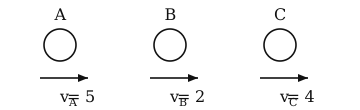
Assertion (A) : Three identical spheres of same mass undergo one dimensional motion as shown in figure with initial velocities vA=5 m/s, vB=2 m/s, vC=4 m/s. If we wait sufficiently long for elastic collision to happen, then vA=4 m/s, vB=2 m/s, vC=5 m/s will be the final velocities.
Reason (R) : In an elastic collision between identical masses, two objects exchange their velocities.
In the light of the above statements, choose the correct answer from the options given below :
नीचे दो कथन दिए गए हैं। एक को अभिकथन (A) तथा दूसरे को तर्क (R) कहा गया है।

अभिकथन (A) : समान द्रव्यमान के तीन सर्वसम गोले चित्रानुसार प्रारंभिक वेगों vA=5 m/s, vB=2 m/s, vC=4 m/s के साथ एकविमीय गति करते हैं। यदि प्रत्यास्थ संघट्ट (elastic collision) होने के लिए हम पर्याप्त लंबे समय तक प्रतीक्षा करें, तो अंतिम वेग vA=4 m/s, vB=2 m/s, vC=5 m/s होंगे।
तर्क (R) : सर्वसम द्रव्यमानों के बीच प्रत्यास्थ संघट्ट में दोनों वस्तुएँ अपने वेगों का विनिमय कर लेती हैं।
उपर्युक्त कथनों के आलोक में, नीचे दिए गए विकल्पों में से सही उत्तर चुनिए :
  1. A(A) is false but (R) is true(A) असत्य है परन्तु (R) सत्य है
  2. BBoth (A) and (R) are true but (R) is NOT the correct explanation of (A)(A) और (R) दोनों सत्य हैं परन्तु (R), (A) की सही व्याख्या नहीं है
  3. CBoth (A) and (R) are true and (R) is the correct explanation of (A)(A) और (R) दोनों सत्य हैं तथा (R), (A) की सही व्याख्या है
  4. D(A) is true but (R) is false(A) सत्य है परन्तु (R) असत्य है
Show answer

Concept: In a 1-D elastic collision between equal masses the two bodies simply exchange velocities. Keep applying this until the velocities, read from left to right, are non-decreasing (then no further collision occurs).

  1. A (5 m/s) catches up with B (2 m/s): exchange → vA=2, vB=5 m/s.
  2. B (5 m/s) now catches up with C (4 m/s): exchange → vB=4, vC=5 m/s.
  3. Final set: vA=2, vB=4, vC=5 m/s — increasing to the right, so no more collisions.
  4. Assertion claims vA=4, vB=2, vC=5 m/s, which is wrong; the Reason is a correct standard result.

Short trick: With equal-mass elastic chase collisions the final velocities are just the initial set {5, 2, 4} rearranged in increasing order left to right: 2, 4, 5.

Answer: (A)

अवधारणा: समान द्रव्यमानों के एकविमीय प्रत्यास्थ संघट्ट में दोनों पिंड केवल अपने वेगों का विनिमय करते हैं। यह तब तक दोहराएँ जब तक बाएँ से दाएँ पढ़ने पर वेग अह्रासमान (non-decreasing) न हो जाएँ (तब कोई और संघट्ट नहीं होगा)।

  1. A (5 m/s), B (2 m/s) को पकड़ता है: विनिमय → vA=2, vB=5 m/s।
  2. अब B (5 m/s), C (4 m/s) को पकड़ता है: विनिमय → vB=4, vC=5 m/s।
  3. अंतिम वेग: vA=2, vB=4, vC=5 m/s — दाईं ओर बढ़ते क्रम में, अतः अब कोई संघट्ट नहीं।
  4. अभिकथन में vA=4, vB=2, vC=5 m/s कहा गया है, जो गलत है; तर्क एक सही मानक परिणाम है।

शॉर्ट ट्रिक: समान द्रव्यमान वाले प्रत्यास्थ पीछा-संघट्टों में अंतिम वेग, प्रारंभिक वेगों {5, 2, 4} को बाएँ से दाएँ बढ़ते क्रम में सजाने से मिलते हैं: 2, 4, 5।

उत्तर: (A)

JEE Main 2025 (January) – Paper 1 (B.E./B.Tech)PhysicsWork, Energy & Collisions – elastic collisions
Q51.
Consider the equilibrium CO(g) + 3H2(g) ⇌ CH4(g) + H2O(g)
If the pressure applied over the system increases by two fold at constant temperature then
(A) Concentration of reactants and products increases.
(B) Equilibrium will shift in forward direction.
(C) Equilibrium constant increases since concentration of products increases.
(D) Equilibrium constant remains unchanged as concentration of reactants and products remain same.
Choose the correct answer from the options given below :
साम्य CO(g) + 3H2(g) ⇌ CH4(g) + H2O(g) पर विचार कीजिए।
यदि स्थिर ताप पर निकाय पर लगाया गया दाब दोगुना कर दिया जाए, तो
(A) अभिकारकों तथा उत्पादों की सांद्रता बढ़ती है।
(B) साम्य अग्र दिशा में विस्थापित होगा।
(C) साम्य स्थिरांक बढ़ता है क्योंकि उत्पादों की सांद्रता बढ़ती है।
(D) साम्य स्थिरांक अपरिवर्तित रहता है क्योंकि अभिकारकों तथा उत्पादों की सांद्रता समान रहती है।
नीचे दिए गए विकल्पों में से सही उत्तर चुनिए :
  1. A(A), (B) and (C) onlyकेवल (A), (B) और (C)
  2. B(A) and (B) onlyकेवल (A) और (B)
  3. C(A), (B) and (D) onlyकेवल (A), (B) और (D)
  4. D(B) and (C) onlyकेवल (B) और (C)
Show answer

Concept: Doubling the pressure at constant temperature halves the volume, so every concentration (mol/V) rises. Le Chatelier then pushes the equilibrium toward the side with fewer gas moles; the equilibrium constant depends only on temperature.

  1. Volume is halved → concentration of every species doubles instantly → (A) is correct.
  2. Moles of gas: reactants 1+3=4, products 1+1=2. Fewer moles on the product side → equilibrium shifts forward → (B) is correct.
  3. (C) is wrong: K never changes with pressure or concentration, only with temperature.
  4. (D) gives the right fact (K unchanged) but a wrong reason – the concentrations do not remain the same, they change until the ratio again equals K. So (D) as a statement is incorrect.

Short trick: Δng<0 + pressure increase → forward shift; K = f(T) only.

Answer: (B)

अवधारणा: स्थिर ताप पर दाब दोगुना करने से आयतन आधा हो जाता है, अतः प्रत्येक सांद्रता (mol/V) बढ़ जाती है। ला शातेलिए के अनुसार साम्य कम गैसीय मोल वाली दिशा में विस्थापित होता है; साम्य स्थिरांक केवल ताप पर निर्भर करता है।

  1. आयतन आधा → प्रत्येक स्पीशीज़ की सांद्रता तुरंत दोगुनी → (A) सही।
  2. गैसीय मोल: अभिकारक 1+3=4, उत्पाद 1+1=2। उत्पाद की ओर मोल कम → साम्य अग्र दिशा में → (B) सही।
  3. (C) गलत: K दाब या सांद्रता से कभी नहीं बदलता, केवल ताप से बदलता है।
  4. (D) में तथ्य सही है (K अपरिवर्तित) पर कारण गलत है – सांद्रताएँ समान नहीं रहतीं, वे तब तक बदलती हैं जब तक अनुपात फिर से K के बराबर न हो जाए। अतः कथन (D) गलत है।

शॉर्ट ट्रिक: Δng<0 + दाब वृद्धि → अग्र विस्थापन; K केवल T का फलन।

उत्तर: (B)

JEE Main 2025 (January) – Paper 1 (B.E./B.Tech)ChemistryChemical Equilibrium – Le Chatelier's principle

See all 75 solutions

More JEE Main 2025 (January) – Paper 1 (B.E./B.Tech) papers