Q41.Two point charges and are placed at points and respectively. Force on charge is _________ N.
दो बिंदु आवेश तथा क्रमशः बिंदुओं और पर रखे हैं। आवेश पर बल _________ N है।
- A
- B
- C
- D
Show answer
Concept: . Opposite charges attract, so points from towards .
- , m.
- .
- N.
- (D) is the force on (opposite direction); (A), (C) have the wrong magnitude.
Short trick: Magnitude N along unit vector (towards ).
Answer: (B) N
अवधारणा: । विपरीत आवेश आकर्षित करते हैं, अतः की दिशा से की ओर है।
- , m।
- ।
- N।
- (D) पर बल है (विपरीत दिशा); (A), (C) का परिमाण गलत है।
शॉर्ट ट्रिक: परिमाण N, एकांक सदिश (q1 की ओर) के अनुदिश।
उत्तर: (B) N
JEE Main 2026 (April) – Paper 1 (B.E./B.Tech)PhysicsElectrostatics – Coulomb force in vector formJEE Main 2026 (April) – Paper 1 (B.E./B.Tech) 2026 · 8 Apr Shift 2
Q42.Light ray incident along a vector
emerges out along vector
as shown in the figure below. The value of
is _________.
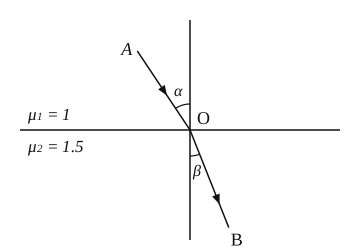
सदिश
के अनुदिश आपतित प्रकाश किरण, सदिश
के अनुदिश निर्गत होती है, जैसा नीचे चित्र में दर्शाया गया है।
का मान _________ है।
- A1.6
- B0.16
- C11.6
- D16
Show answer
Concept: The normal is along (vertical). Angle with the normal: . Apply .
- ; .
- ⇒ .
- ⇒ ⇒ .
Short trick: Ray bends towards the normal, so ⇒ ; of the options only 1.6 and 0.16 fit, and 0.16 is far too small.
Answer: (A) 1.6
अवधारणा: अभिलंब (ऊर्ध्वाधर) के अनुदिश है। अभिलंब से कोण: । लगाएँ।
- ; ।
- ⇒ ।
- ⇒ ⇒ ।
शॉर्ट ट्रिक: किरण अभिलंब की ओर मुड़ती है, अतः ⇒ ; विकल्पों में केवल 1.6 और 0.16 उपयुक्त हैं, और 0.16 बहुत छोटा है।
उत्तर: (A) 1.6
JEE Main 2026 (April) – Paper 1 (B.E./B.Tech)PhysicsRay Optics – Snell's law in vector formJEE Main 2026 (April) – Paper 1 (B.E./B.Tech) 2026 · 8 Apr Shift 2
Q43. and be the maximum kinetic energies of photoelectrons emitted from a surface of a given material for the light of wavelength and , respectively. If then the work function of material is given by :
किसी दिए गए पदार्थ के पृष्ठ से तरंगदैर्ध्य और के प्रकाश के लिए उत्सर्जित प्रकाश-इलेक्ट्रॉनों की अधिकतम गतिज ऊर्जाएँ क्रमशः और हैं। यदि है, तो पदार्थ का कार्य फलन है :
- A
- B
- C
- D
Show answer
Concept: Einstein: .
- ⇒ .
- .
- .
Short trick: Photon energy doubles: ⇒ .
Answer: (D)
अवधारणा: आइंस्टीन समीकरण: ।
- ⇒ ।
- ।
- ।
शॉर्ट ट्रिक: फोटॉन ऊर्जा दोगुनी: ⇒ ।
उत्तर: (D)
JEE Main 2026 (April) – Paper 1 (B.E./B.Tech)PhysicsDual nature – photoelectric equationJEE Main 2026 (April) – Paper 1 (B.E./B.Tech) 2026 · 8 Apr Shift 2
Q44.Two radioactive substances A and B of mass numbers 200 and 212 respectively, shows spontaneous -decay with same value of 1 MeV. The ratio of energies of -rays produced by A and B is __________.
द्रव्यमान संख्याओं 200 और 212 वाले दो रेडियोऐक्टिव पदार्थ A और B क्रमशः, समान मान 1 MeV के साथ स्वतः -क्षय दर्शाते हैं। A और B द्वारा उत्पन्न -किरणों की ऊर्जाओं का अनुपात __________ है।
- A
- B
- C
- D
Show answer
Concept: Momentum conservation in -decay of a nucleus at rest: .
- , .
- .
- Dividing by 16: .
Short trick: Ratio is just below 1 (lighter parent gives slightly less KE to ); only (C) fits.
Answer: (C)
अवधारणा: विरामावस्था वाले नाभिक के -क्षय में संवेग संरक्षण से: ।
- , ।
- ।
- 16 से भाग देने पर: ।
शॉर्ट ट्रिक: अनुपात 1 से थोड़ा कम है (हल्का जनक नाभिक को थोड़ी कम गतिज ऊर्जा देता है); केवल (C) उपयुक्त है।
उत्तर: (C)
JEE Main 2026 (April) – Paper 1 (B.E./B.Tech)PhysicsNuclei – kinetic energy of alpha particleJEE Main 2026 (April) – Paper 1 (B.E./B.Tech) 2026 · 8 Apr Shift 2
Q45.The output
for the given inputs
and
to the circuit is :
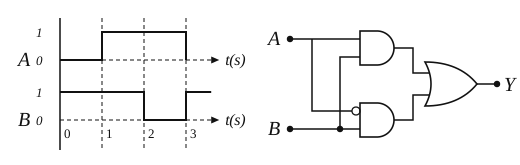
परिपथ में दिए गए निवेशों
और
के लिए निर्गत
है :
- A
- B
- C
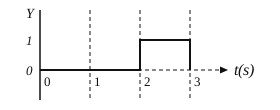
- D
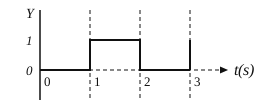
Show answer
Concept: Upper AND gate receives and ; lower AND gate receives (bubble) and ; the OR gate adds them.
- .
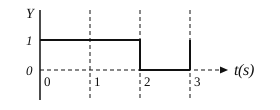
- So simply copies : for s, for s, rising to 1 at s.
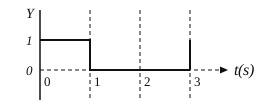
- (A) is high only for 0–1 s, (C) is , (D) is high only for 1–2 s – none equal .
Short trick: Factor out → output waveform = waveform.
Answer: (B) the waveform that is 1 from 0 to 2 s, 0 from 2 to 3 s
अवधारणा: ऊपरी AND गेट को और मिलते हैं; निचले AND गेट को (बबल) और मिलते हैं; OR गेट इन्हें जोड़ता है।
- ।
- अतः केवल की नकल है: s में , s में , तथा s पर पुनः 1।
- (A) केवल 0–1 s में उच्च है, (C) है, (D) केवल 1–2 s में उच्च है – इनमें से कोई के बराबर नहीं।
शॉर्ट ट्रिक: उभयनिष्ठ लें → निर्गत तरंगरूप = का तरंगरूप।
उत्तर: (B) वह तरंगरूप जो 0 से 2 s तक 1 और 2 से 3 s तक 0 है
JEE Main 2026 (April) – Paper 1 (B.E./B.Tech)PhysicsSemiconductors – logic gate circuit with waveformsJEE Main 2026 (April) – Paper 1 (B.E./B.Tech) 2026 · 8 Apr Shift 2
Q46.A parallel plate capacitor is having separation between plates 0.885 mm. It has a capacitance of 1 F when the space between the plates is filled with an insulating material of resistivity m and resistance . Relative permittivity of the insulating material is . The value of is _________.
(Take permittivity of free space F/m)
एक समांतर पट्टिका संधारित्र की पट्टिकाओं के बीच की दूरी 0.885 mm है। जब पट्टिकाओं के बीच का स्थान m प्रतिरोधकता तथा प्रतिरोध वाले एक विद्युतरोधी पदार्थ से भरा जाता है, तब इसकी धारिता 1 F है। विद्युतरोधी पदार्थ की आपेक्षिक विद्युतशीलता है। का मान _________ है।
(मुक्त आकाश की विद्युतशीलता F/m लीजिए)
Show answer
Concept: The filling material gives both (leakage resistance) and . Find from , then from .
- m2.
- .
- Hence .
Short trick: ⇒ .
Answer: 2
अवधारणा: भरा गया पदार्थ क्षरण प्रतिरोध तथा धारिता दोनों देता है। से ज्ञात करें, फिर से ।
- m2।
- ।
- अतः ।
शॉर्ट ट्रिक: ⇒ ।
उत्तर: 2
JEE Main 2026 (April) – Paper 1 (B.E./B.Tech)PhysicsCapacitance – dielectric with leakage resistanceJEE Main 2026 (April) – Paper 1 (B.E./B.Tech) 2026 · 8 Apr Shift 2
Q47.Some distant star is to be observed by some telescope of diameter of objective lens , at an angular resolution of radian. If the wavelength of light from the star reaching the telescope is 500 nm, the minimum diameter of the objective lens of the telescope is _________ cm. (nearest interger)
किसी दूरस्थ तारे को व्यास के अभिदृश्यक लेंस वाले एक दूरदर्शी द्वारा रेडियन के कोणीय विभेदन पर देखा जाना है। यदि दूरदर्शी तक पहुँचने वाले तारे के प्रकाश की तरंगदैर्ध्य 500 nm है, तो दूरदर्शी के अभिदृश्यक लेंस का न्यूनतम व्यास _________ cm है। (निकटतम पूर्णांक)
Show answer
Concept: Rayleigh criterion for a circular aperture: ⇒ .
- m.
- m cm.
- Nearest integer: 203 cm.
Short trick: m; multiply by 1.22 → 2.033 m.
Answer: 203
अवधारणा: वृत्ताकार द्वारक के लिए रैले मापदंड: ⇒ ।
- m।
- m cm।
- निकटतम पूर्णांक: 203 cm।
शॉर्ट ट्रिक: m; 1.22 से गुणा → 2.033 m।
उत्तर: 203
JEE Main 2026 (April) – Paper 1 (B.E./B.Tech)PhysicsWave Optics – resolving power of a telescopeJEE Main 2026 (April) – Paper 1 (B.E./B.Tech) 2026 · 8 Apr Shift 2
Q48.A 5 mg particle carrying a charge of C is moving with velocity of m/s in a region having magnetic field Wb/m2. It moves a distance of meter along when it completes 5 revolutions. The value of is __________.
C आवेश वाला एक 5 mg का कण m/s वेग से एक ऐसे क्षेत्र में गतिमान है जहाँ चुंबकीय क्षेत्र Wb/m2 है। 5 परिक्रमाएँ पूरी करने पर यह के अनुदिश मीटर दूरी तय करता है। का मान __________ है।
Show answer
Concept: Velocity component along is unaffected; the perpendicular component gives circular motion with . Distance along = (number of revolutions ).
- mg kg, m/s.
- s.
- Pitch m.
- For 5 revolutions: m.
Short trick: s; .
Answer: 2
अवधारणा: के अनुदिश वेग घटक अप्रभावित रहता है; लंबवत घटक से वृत्तीय गति होती है जिसका । के अनुदिश दूरी = (परिक्रमाओं की संख्या )।
- mg kg, m/s।
- s।
- चूड़ी अंतराल (pitch) m।
- 5 परिक्रमाओं के लिए: m।
शॉर्ट ट्रिक: s; ।
उत्तर: 2
JEE Main 2026 (April) – Paper 1 (B.E./B.Tech)PhysicsMagnetism – helical motion of a charged particleJEE Main 2026 (April) – Paper 1 (B.E./B.Tech) 2026 · 8 Apr Shift 2
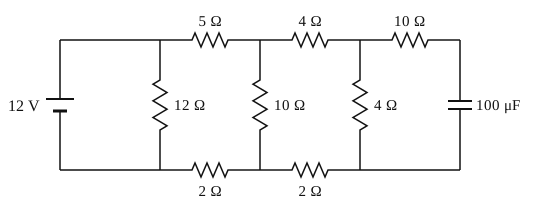
Q49.The stored charge in the capacitor in steady state of the following circuit is _________
C.
निम्नलिखित परिपथ की स्थायी अवस्था में संधारित्र में संचित आवेश _________
C है।
Show answer
Concept: In steady state no current flows through the capacitor branch, so no drop occurs across the 10 Ω in series with it; the capacitor voltage equals the voltage across the last 4 Ω resistor.
- Last section: Ω (top 4 Ω, shunt 4 Ω, bottom 2 Ω) in parallel with the 10 Ω shunt ⇒ 5 Ω.
- Add the 5 Ω (top) and 2 Ω (bottom): Ω. (The 12 Ω across the battery does not affect this branch.)
- Current into the ladder from 12 V: A ⇒ voltage across 10 Ω shunt V.
- Current in the right branch A ⇒ V .
- C.
Short trick: Halving at each 10 Ω junction: 12 V → 5 V → V → C.
Answer: 200
अवधारणा: स्थायी अवस्था में संधारित्र वाली शाखा में धारा नहीं बहती, अतः उसके श्रेणी में लगे 10 Ω पर कोई विभवपात नहीं होता; संधारित्र का विभवांतर अंतिम 4 Ω प्रतिरोधक के विभवांतर के बराबर है।
- अंतिम भाग: Ω (ऊपरी 4 Ω, शंट 4 Ω, निचला 2 Ω), 10 Ω शंट के समांतर ⇒ 5 Ω।
- 5 Ω (ऊपरी) तथा 2 Ω (निचला) जोड़ें: Ω। (बैटरी के सीधे पार लगा 12 Ω इस शाखा को प्रभावित नहीं करता।)
- 12 V से सीढ़ी में धारा: A ⇒ 10 Ω शंट पर विभवांतर V।
- दाईं शाखा में धारा A ⇒ V ।
- C।
शॉर्ट ट्रिक: 12 V → 5 V → V → C।
उत्तर: 200
JEE Main 2026 (April) – Paper 1 (B.E./B.Tech)PhysicsCurrent Electricity – capacitor in a resistor ladder (steady state)JEE Main 2026 (April) – Paper 1 (B.E./B.Tech) 2026 · 8 Apr Shift 2
Q50.Two masses of 3.4 kg and 2.5 kg are accelerated from an initial speed of 5 m/s and 12 m/s, respectively. The distances traversed by the masses in the 5th second are 104 m and 129 m, respectively. The ratio of their momenta after 10 s is . The value of is _________.
3.4 kg तथा 2.5 kg के दो द्रव्यमान क्रमशः 5 m/s और 12 m/s की प्रारंभिक चाल से त्वरित किए जाते हैं। 5वें सेकंड में द्रव्यमानों द्वारा तय की गई दूरियाँ क्रमशः 104 m और 129 m हैं। 10 s के बाद उनके संवेगों का अनुपात है। का मान _________ है।
Show answer
Concept: Distance in the th second: . Then and .
- Mass 1: ⇒ m/s2; Mass 2: ⇒ m/s2.
- After 10 s: m/s, m/s.
- kg m/s, kg m/s.
- ⇒ .
Short trick: gives instantly; .
Answer: 9
अवधारणा: -वें सेकंड में तय दूरी: । फिर तथा ।
- द्रव्यमान 1: ⇒ m/s2; द्रव्यमान 2: ⇒ m/s2।
- 10 s के बाद: m/s, m/s।
- kg m/s, kg m/s।
- ⇒ ।
शॉर्ट ट्रिक: से तुरंत; ।
उत्तर: 9
JEE Main 2026 (April) – Paper 1 (B.E./B.Tech)PhysicsKinematics – distance in nth second and momentumJEE Main 2026 (April) – Paper 1 (B.E./B.Tech) 2026 · 8 Apr Shift 2
Q51.Match List - I with List - II.
| List - I
Mass of substance | | List - II
Number of atoms |
|---|
| A. | 1.8 mg water | I. | 2 × 10⁻⁴ × NA |
| B. | 9.8 mg sulphuric acid | II. | 1.5 × 10⁻⁴ × NA |
| C. | 1.8 mg carbon | III. | 3 × 10⁻⁴ × NA |
| D. | 5.85 mg salt (NaCl) | IV. | 7 × 10⁻⁴ × NA |
Choose the correct answer from the options given below :
सूची - I का सूची - II से मिलान कीजिए।
| सूची - I
पदार्थ का द्रव्यमान | | सूची - II
परमाणुओं की संख्या |
|---|
| A. | 1.8 mg जल | I. | 2 × 10⁻⁴ × NA |
| B. | 9.8 mg सल्फ्यूरिक अम्ल | II. | 1.5 × 10⁻⁴ × NA |
| C. | 1.8 mg कार्बन | III. | 3 × 10⁻⁴ × NA |
| D. | 5.85 mg लवण (NaCl) | IV. | 7 × 10⁻⁴ × NA |
नीचे दिए गए विकल्पों में से सही उत्तर चुनिए :
- AA-IV, B-III, C-I, D-II
- BA-III, B-II, C-IV, D-I
- CA-III, B-IV, C-II, D-I
- DA-III, B-IV, C-I, D-II
Show answer
Concept: Number of atoms = moles × atoms per formula unit × NA.
- A: 1.8 mg H2O = 1.8 × 10⁻³/18 = 10−4 mol; 3 atoms each → 3 × 10⁻⁴ NA → III.
- B: 9.8 mg H2SO4 = 9.8 × 10⁻³/98 = 10−4 mol; 7 atoms each → 7 × 10⁻⁴ NA → IV.
- C: 1.8 mg C = 1.8 × 10⁻³/12 = 1.5 × 10⁻⁴ mol of atoms → II.
- D: 5.85 mg NaCl = 5.85 × 10⁻³/58.5 = 10−4 mol; 2 ions (atoms) each → 2 × 10⁻⁴ NA → I.
- So A-III, B-IV, C-II, D-I. (A) mismatches A and B; (B) mismatches B and C; (D) swaps C and D.
Short trick: Water, H2SO4 and NaCl are all exactly 10−4 mol, so just count atoms: 3, 7, 2.
Answer: (C) A-III, B-IV, C-II, D-I
अवधारणा: परमाणुओं की संख्या = मोल × प्रति सूत्र इकाई परमाणु × NA।
- A: 1.8 mg H2O = 1.8 × 10⁻³/18 = 10−4 mol; प्रत्येक में 3 परमाणु → 3 × 10⁻⁴ NA → III।
- B: 9.8 mg H2SO4 = 9.8 × 10⁻³/98 = 10−4 mol; प्रत्येक में 7 परमाणु → 7 × 10⁻⁴ NA → IV।
- C: 1.8 mg C = 1.8 × 10⁻³/12 = 1.5 × 10⁻⁴ mol परमाणु → II।
- D: 5.85 mg NaCl = 5.85 × 10⁻³/58.5 = 10−4 mol; प्रत्येक में 2 आयन (परमाणु) → 2 × 10⁻⁴ NA → I।
- अतः A-III, B-IV, C-II, D-I। (A) में A तथा B गलत हैं; (B) में B तथा C गलत हैं; (D) में C और D आपस में बदल दिए गए हैं।
शॉर्ट ट्रिक: जल, H2SO4 तथा NaCl तीनों ठीक 10−4 mol हैं, अतः केवल परमाणु गिनें: 3, 7, 2।
उत्तर: (C) A-III, B-IV, C-II, D-I
JEE Main 2026 (April) – Paper 1 (B.E./B.Tech)ChemistryMole Concept – number of atomsJEE Main 2026 (April) – Paper 1 (B.E./B.Tech) 2026 · 8 Apr Shift 2
Q52.Given below are two statements :
Given : Molar mass of C, H, O, Cl are 12, 1, 16 and 35.5 g mol−1, respectively
| Statement I : | In 30% (w/w) solution of methanol in CCl4(at T K), the mole fraction of CCl4 is equal to 0.33. |
| Statement II : | Mixture of methanol and CCl4 shows positive deviation from Raoult’s law. |
In the light of the above statements, choose the correct answer from the options given below :
नीचे दो कथन दिए गए हैं :
दिया है : C, H, O, Cl के मोलर द्रव्यमान क्रमशः 12, 1, 16 तथा 35.5 g mol−1 हैं
| कथन I : | CCl4 में मेथेनॉल के 30% (w/w) विलयन (T K पर) में CCl4 का मोल अंश 0.33 के बराबर है। |
| कथन II : | मेथेनॉल तथा CCl4 का मिश्रण राउल्ट नियम से धनात्मक विचलन (positive deviation) दर्शाता है। |
उपरोक्त कथनों के आलोक में, नीचे दिए गए विकल्पों में से सही उत्तर चुनिए :
- ABoth Statement I and Statement II are trueकथन I और कथन II दोनों सत्य हैं
- BBoth Statement I and Statement II are falseकथन I और कथन II दोनों असत्य हैं
- CStatement I is true but Statement II is falseकथन I सत्य है परन्तु कथन II असत्य है
- DStatement I is false but Statement II is trueकथन I असत्य है परन्तु कथन II सत्य है
Show answer
Concept: Mole fraction x = ni/Σn; breaking of H-bonds of methanol by non-polar CCl4 gives positive deviation.
- Take 100 g solution: methanol = 30 g → mol; CCl4 (M = 154) = 70 g → mol.
- x(CCl4) = → Statement I is true.
- CCl4 molecules come between methanol molecules and break their H-bonds; A–B attractions are weaker than A–A, so vapour pressure is higher than ideal → positive deviation. Statement II is true.
Short trick: Alcohol + non-polar solvent (CCl4, hexane) → H-bonds broken → always positive deviation.
Answer: (A) Both Statement I and Statement II are true
अवधारणा: मोल अंश x = ni/Σn; अध्रुवीय CCl4 द्वारा मेथेनॉल के H-आबंध टूटने से धनात्मक विचलन होता है।
- 100 g विलयन लें: मेथेनॉल = 30 g → mol; CCl4 (M = 154) = 70 g → mol।
- x(CCl4) = → कथन I सत्य है।
- CCl4 के अणु मेथेनॉल अणुओं के बीच आकर उनके H-आबंध तोड़ देते हैं; A–B आकर्षण A–A से दुर्बल होते हैं, अतः वाष्प दाब आदर्श से अधिक → धनात्मक विचलन। कथन II सत्य है।
शॉर्ट ट्रिक: ऐल्कोहॉल + अध्रुवीय विलायक (CCl4, हेक्सेन) → H-आबंध टूटते हैं → सदैव धनात्मक विचलन।
उत्तर: (A) कथन I और कथन II दोनों सत्य हैं
JEE Main 2026 (April) – Paper 1 (B.E./B.Tech)ChemistrySolutions – mole fraction and Raoult's law deviationJEE Main 2026 (April) – Paper 1 (B.E./B.Tech) 2026 · 8 Apr Shift 2
Q53.Bromine trifluoride autoionizes to form BrF2⊕ and BrF4⊖. The shapes of the cation and anion are respectively ________, and ________.
ब्रोमीन ट्राइफ्लुओराइड स्वतः आयनन (autoionization) द्वारा BrF2⊕ तथा BrF4⊖ बनाता है। धनायन तथा ऋणायन की आकृतियाँ क्रमशः ________, तथा ________ हैं।
- Abent, square planarबंकित (bent), वर्ग समतलीय (square planar)
- Blinear, square planarरैखिक (linear), वर्ग समतलीय (square planar)
- Cbent, see-sawबंकित (bent), सी-सॉ (see-saw)
- Dlinear, tetrahedralरैखिक (linear), चतुष्फलकीय (tetrahedral)
Show answer
Concept: Steric number = bond pairs + lone pairs on the central atom (VSEPR).
- BrF2+: Br has 7 − 1 = 6 valence electrons; 2 used in bonds → 2 lone pairs. 2 bp + 2 lp = sp3 → bent (like H2O).
- BrF4−: Br has 7 + 1 = 8 electrons; 4 used in bonds → 2 lone pairs. 4 bp + 2 lp = sp3d2 → square planar (like XeF4).
- (B)/(D) wrongly call the cation linear (that would need 3 lone pairs); (C) see-saw needs 4 bp + 1 lp.
Short trick: BrF2+ is isoelectronic (valence) with SCl2 → bent; BrF4− with XeF4 → square planar.
Answer: (A) bent, square planar
अवधारणा: त्रिविम संख्या = केन्द्रीय परमाणु पर आबंधी युग्म + एकाकी युग्म (VSEPR)।
- BrF2+: Br के पास 7 − 1 = 6 संयोजी इलेक्ट्रॉन; 2 आबंधों में प्रयुक्त → 2 एकाकी युग्म। 2 bp + 2 lp = sp3 → बंकित (H2O की भाँति)।
- BrF4−: Br के पास 7 + 1 = 8 इलेक्ट्रॉन; 4 आबंधों में प्रयुक्त → 2 एकाकी युग्म। 4 bp + 2 lp = sp3d2 → वर्ग समतलीय (XeF4 की भाँति)।
- (B)/(D) धनायन को रैखिक बताते हैं (इसके लिए 3 एकाकी युग्म चाहिए); (C) सी-सॉ के लिए 4 bp + 1 lp चाहिए।
शॉर्ट ट्रिक: BrF2+ संयोजी रूप से SCl2 के समइलेक्ट्रॉनी → बंकित; BrF4− XeF4 के समान → वर्ग समतलीय।
उत्तर: (A) बंकित, वर्ग समतलीय
JEE Main 2026 (April) – Paper 1 (B.E./B.Tech)ChemistryChemical Bonding – VSEPR shapes of interhalogen ionsJEE Main 2026 (April) – Paper 1 (B.E./B.Tech) 2026 · 8 Apr Shift 2
Q54.Which of the following statements are not correct ?
| A. | For water, magnitude of Kb is more than the magnitude of Kf. |
| B. | The elevation in boiling point of water when a non-volatile solute is added to it is larger in magnitude than its depression in freezing point. |
| C. | Osmotic pressure measurement is preferred over any other colligative property to determine molar mass of proteins and polymers. |
| D. | The dimerised form of benzoic acid in benzene is 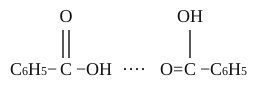 |
Choose the correct answer from the options given below :
निम्नलिखित में से कौन-से कथन सही नहीं हैं ?
| A. | जल के लिए Kb का परिमाण Kf के परिमाण से अधिक है। |
| B. | जल में अवाष्पशील विलेय मिलाने पर क्वथनांक में उन्नयन का परिमाण हिमांक में अवनमन से अधिक होता है। |
| C. | प्रोटीन तथा बहुलकों का मोलर द्रव्यमान ज्ञात करने के लिए परासरण दाब मापन को अन्य किसी भी अणुसंख्य गुणधर्म पर वरीयता दी जाती है। |
| D. | बेन्ज़ीन में बेन्ज़ोइक अम्ल का द्वितयित (dimerised) रूप है |
नीचे दिए गए विकल्पों में से सही उत्तर चुनिए :
- AA and B onlyकेवल A और B
- BA and D onlyकेवल A और D
- CA, B and D onlyकेवल A, B और D
- DA, C and D onlyकेवल A, C और D
Show answer
Concept: For water Kb = 0.52 K kg mol−1, Kf = 1.86 K kg mol−1; benzoic acid dimerises in benzene through two H-bonds (cyclic dimer).
- A: Kb (0.52) < Kf (1.86) → A is not correct.
- B: for the same molality ΔTb = 0.52 m < ΔTf = 1.86 m → B is not correct.
- C: osmotic pressure is measured at room temperature and gives a large measurable value even for very dilute solutions → preferred for proteins/polymers. C is correct.
- D: the dimer is a cyclic eight-membered ring with two O–H···O=C hydrogen bonds, not the open single-H-bond structure shown → D is not correct.
- Not correct = A, B and D. (A), (B) miss one of them; (D) wrongly includes C.
Short trick: Water: Kf ≈ 3.6 × Kb, so both A and B are false together.
Answer: (C) A, B and D only
अवधारणा: जल के लिए Kb = 0.52 K kg mol−1, Kf = 1.86 K kg mol−1; बेन्ज़ीन में बेन्ज़ोइक अम्ल दो H-आबंधों द्वारा (चक्रीय द्वितय) द्वितयित होता है।
- A: Kb (0.52) < Kf (1.86) → A सही नहीं है।
- B: समान मोललता पर ΔTb = 0.52 m < ΔTf = 1.86 m → B सही नहीं है।
- C: परासरण दाब कमरे के ताप पर मापा जाता है तथा अत्यंत तनु विलयनों में भी मापने योग्य बड़ा मान देता है → प्रोटीन/बहुलकों हेतु वरीय। C सही है।
- D: द्वितय दो O–H···O=C हाइड्रोजन आबंधों वाला आठ-सदस्यीय चक्रीय वलय है, न कि दर्शाई गई एक H-आबंध वाली खुली संरचना → D सही नहीं है।
- सही नहीं = A, B तथा D। (A), (B) में इनमें से एक छूट जाता है; (D) में C गलत रूप से शामिल है।
शॉर्ट ट्रिक: जल: Kf ≈ 3.6 × Kb, अतः A और B दोनों एक साथ असत्य हैं।
उत्तर: (C) केवल A, B और D
JEE Main 2026 (April) – Paper 1 (B.E./B.Tech)ChemistrySolutions – colligative propertiesJEE Main 2026 (April) – Paper 1 (B.E./B.Tech) 2026 · 8 Apr Shift 2
Q55.Consider the following reactions in which all the reactants and products are present in gaseous state
The value of K3 for the equilibrium is :
निम्नलिखित अभिक्रियाओं पर विचार कीजिए जिनमें सभी अभिकारक तथा उत्पाद गैसीय अवस्था में उपस्थित हैं
साम्य के लिए K3 का मान है :
- A
- B
- C
- D
Show answer
Concept: Reversing a reaction inverts K; multiplying by a factor raises K to that power; adding reactions multiplies K's.
- Reverse eq. 1 and halve it: , .
- Add eq. 2: .
- .
Short trick: .
Answer: (C)
अवधारणा: अभिक्रिया उलटने पर K व्युत्क्रम हो जाता है; किसी गुणक से गुणा करने पर K उसकी घात में; अभिक्रियाएँ जोड़ने पर K गुणा होते हैं।
- समीकरण 1 को उलटकर आधा करें: , ।
- समीकरण 2 जोड़ें: ।
- ।
शॉर्ट ट्रिक: ।
उत्तर: (C)
JEE Main 2026 (April) – Paper 1 (B.E./B.Tech)ChemistryChemical Equilibrium – combining equilibrium constantsJEE Main 2026 (April) – Paper 1 (B.E./B.Tech) 2026 · 8 Apr Shift 2
Q56.Given at 298 K :
Volt
Volt
The in Volt at 298 K is given by :
298 K पर दिया है :
Volt
Volt
298 K पर का मान (Volt में) होगा :
- A2X − 3Y
- B3Y − 2X
- C3Y + 2X
- DY + X
Show answer
Concept: Electrode potentials are not additive, but ΔG° = −nFE° is.
- Fe3+ + 3e− → Fe: ΔG°1 = −3FY.
- Fe2+ + 2e− → Fe: ΔG°2 = −2FX; reverse it: Fe → Fe2+ + 2e−, +2FX.
- Add: Fe3+ + e− → Fe2+, ΔG°3 = −3FY + 2FX = −1·F·E°3.
- E°3 = 3Y − 2X.
Short trick: n3E3 = n1E1 − n2E2 → 1·E = 3Y − 2X.
Answer: (B) 3Y − 2X
अवधारणा: इलेक्ट्रोड विभव योज्य नहीं होते, परन्तु ΔG° = −nFE° योज्य है।
- Fe3+ + 3e− → Fe: ΔG°1 = −3FY।
- Fe2+ + 2e− → Fe: ΔG°2 = −2FX; इसे उलटें: Fe → Fe2+ + 2e−, +2FX।
- जोड़ें: Fe3+ + e− → Fe2+, ΔG°3 = −3FY + 2FX = −1·F·E°3।
- E°3 = 3Y − 2X।
शॉर्ट ट्रिक: n3E3 = n1E1 − n2E2 → 1·E = 3Y − 2X।
उत्तर: (B) 3Y − 2X
JEE Main 2026 (April) – Paper 1 (B.E./B.Tech)ChemistryElectrochemistry – combining electrode potentialsJEE Main 2026 (April) – Paper 1 (B.E./B.Tech) 2026 · 8 Apr Shift 2
Q57.Given below are two statements :
R = 8.314 J K−1 mol−1 and 1 cal = 4.2 J
| Statement I : | When Ea = 12.6 kcal/mol, the room temperature rate constant is doubled by a 10 °C increase in temperature (298 K to 308 K) |
| Statement II : | For a first order reactions A → B,
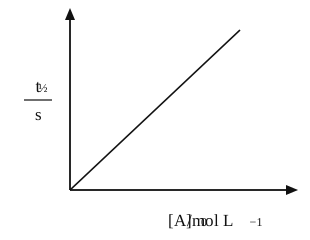 |
Here [A]o is the initial concentration of A and t½ is half life of reaction.
In the light of the above statements, choose the correct answer from the options given below :
नीचे दो कथन दिए गए हैं :
R = 8.314 J K−1 mol−1 तथा 1 cal = 4.2 J
| कथन I : | जब Ea = 12.6 kcal/mol है, तो ताप में 10 °C वृद्धि (298 K से 308 K) करने पर कमरे के ताप का वेग स्थिरांक दोगुना हो जाता है |
| कथन II : | प्रथम कोटि की अभिक्रिया A → B के लिए,
|
यहाँ [A]o, A की प्रारंभिक सांद्रता है तथा t½ अभिक्रिया की अर्ध-आयु है।
उपरोक्त कथनों के आलोक में, नीचे दिए गए विकल्पों में से सही उत्तर चुनिए :
- ABoth Statement I and Statement II are trueकथन I और कथन II दोनों सत्य हैं
- BBoth Statement I and Statement II are falseकथन I और कथन II दोनों असत्य हैं
- CStatement I is true but Statement II is falseकथन I सत्य है परन्तु कथन II असत्य है
- DStatement I is false but Statement II is trueकथन I असत्य है परन्तु कथन II सत्य है
Show answer
Concept: ; for first order , independent of [A]0.
- Ea = 12.6 × 4.2 = 52.92 kJ mol−1 = 52920 J mol−1.
- K−1.
- → k2 = 2k1. Statement I is true.
- The graph shows t½ increasing linearly with [A]0 (t½ ∝ [A]0) – that is zero-order behaviour. For first order, t½ vs [A]0 is a horizontal line. Statement II is false.
Short trick: The textbook rule ‘rate doubles per 10 °C near room temperature’ corresponds to Ea ≈ 53 kJ ≈ 12.6 kcal.
Answer: (C) Statement I is true but Statement II is false
अवधारणा: ; प्रथम कोटि के लिए , जो [A]0 पर निर्भर नहीं करती।
- Ea = 12.6 × 4.2 = 52.92 kJ mol−1 = 52920 J mol−1।
- K−1।
- → k2 = 2k1। कथन I सत्य है।
- ग्राफ में t½, [A]0 के साथ रैखिक रूप से बढ़ रही है (t½ ∝ [A]0) – यह शून्य कोटि का व्यवहार है। प्रथम कोटि के लिए t½ बनाम [A]0 क्षैतिज रेखा होती है। कथन II असत्य है।
शॉर्ट ट्रिक: ‘कमरे के ताप के निकट प्रति 10 °C पर वेग दोगुना’ वाला नियम Ea ≈ 53 kJ ≈ 12.6 kcal के संगत है।
उत्तर: (C) कथन I सत्य है परन्तु कथन II असत्य है
JEE Main 2026 (April) – Paper 1 (B.E./B.Tech)ChemistryChemical Kinetics – Arrhenius equation and half-lifeJEE Main 2026 (April) – Paper 1 (B.E./B.Tech) 2026 · 8 Apr Shift 2
Q58.Match List - I with List - II.
| List - I
Electronic configuration of neutral atom (where n = 2) | | List - II
1st Ionization Energy (kJ mol−1) |
|---|
| A. | ns2 | I. | 2080 |
| B. | ns2np1 | II. | 899 |
| C. | ns2np3 | III. | 800 |
| D. | ns2np6 | IV. | 1402 |
Choose the correct answer from the options given below :
सूची - I का सूची - II से मिलान कीजिए।
| सूची - I
उदासीन परमाणु का इलेक्ट्रॉनिक विन्यास (जहाँ n = 2) | | सूची - II
प्रथम आयनन ऊर्जा (kJ mol−1) |
|---|
| A. | ns2 | I. | 2080 |
| B. | ns2np1 | II. | 899 |
| C. | ns2np3 | III. | 800 |
| D. | ns2np6 | IV. | 1402 |
नीचे दिए गए विकल्पों में से सही उत्तर चुनिए :
- AA-II, B-III, C-IV, D-I
- BA-IV, B-III, C-II, D-I
- CA-III, B-II, C-IV, D-I
- DA-III, B-II, C-I, D-IV
Show answer
Concept: With n = 2: 2s2 = Be, 2s22p1 = B, 2s22p3 = N, 2s22p6 = Ne.
- Be (899) > B (800): the 2p electron of B is shielded by 2s and is removed more easily → A-II, B-III.
- N (1402): stable half-filled 2p3 → C-IV.
- Ne (2080): noble-gas configuration, highest in the period → D-I.
- (B) gives Be the value of N; (C), (D) swap Be and B.
Short trick: Period 2 order: Ne > N > Be > B – just sort the four values.
Answer: (A) A-II, B-III, C-IV, D-I
अवधारणा: n = 2 के साथ: 2s2 = Be, 2s22p1 = B, 2s22p3 = N, 2s22p6 = Ne।
- Be (899) > B (800): B का 2p इलेक्ट्रॉन 2s द्वारा परिरक्षित होता है तथा आसानी से निकलता है → A-II, B-III।
- N (1402): स्थायी अर्धपूरित 2p3 → C-IV।
- Ne (2080): उत्कृष्ट गैस विन्यास, आवर्त में सर्वाधिक → D-I।
- (B) में Be को N का मान दिया गया है; (C), (D) में Be और B आपस में बदल दिए गए हैं।
शॉर्ट ट्रिक: आवर्त 2 का क्रम: Ne > N > Be > B – चारों मानों को क्रम में रखें।
उत्तर: (A) A-II, B-III, C-IV, D-I
JEE Main 2026 (April) – Paper 1 (B.E./B.Tech)ChemistryPeriodic Properties – ionization enthalpy of period 2JEE Main 2026 (April) – Paper 1 (B.E./B.Tech) 2026 · 8 Apr Shift 2
Q59.Find the correct statements related to group 15 hydrides.
| A. | Reducing nature increases from NH3 to BiH3 |
| B. | Tendency to donate lone pair of electrons decreases from NH3 to BiH3 |
| C. | The stability of hydrides decreases from NH3 to BiH3 |
| D. | HEH bond angle decreases from NH3 to SbH3 (E = Elements of group 15) |
Choose the correct answer from the options given below :
वर्ग 15 के हाइड्राइडों से संबंधित सही कथन ज्ञात कीजिए।
| A. | NH3 से BiH3 तक अपचायक प्रकृति बढ़ती है |
| B. | NH3 से BiH3 तक एकाकी इलेक्ट्रॉन युग्म दान करने की प्रवृत्ति घटती है |
| C. | NH3 से BiH3 तक हाइड्राइडों का स्थायित्व घटता है |
| D. | NH3 से SbH3 तक HEH आबंध कोण घटता है (E = वर्ग 15 के तत्व) |
नीचे दिए गए विकल्पों में से सही उत्तर चुनिए :
- AA and B onlyकेवल A और B
- BB and C onlyकेवल B और C
- CA, B, C and DA, B, C और D
- DA, C and D Onlyकेवल A, C और D
Show answer
Concept: Down group 15 the E–H bond becomes longer and weaker, and the central atom becomes larger and less electronegative.
- A: weaker E–H bond → H is given up easily → reducing character NH3 < … < BiH3. True.
- B: lone pair spreads over a larger, more diffuse orbital → Lewis basicity NH3 > PH3 > … > BiH3. True.
- C: bond dissociation enthalpy falls → thermal stability decreases NH3 → BiH3. True.
- D: NH3 107.8°, PH3 93.6°, AsH3 91.8°, SbH3 91.3° → decreases. True.
- All four are correct, so (A), (B), (D) are incomplete.
Short trick: Only boiling point breaks the trend in group 15 hydrides; every other listed property changes steadily down the group.
Answer: (C) A, B, C and D
अवधारणा: वर्ग 15 में नीचे जाने पर E–H आबंध लंबा तथा दुर्बल होता है, तथा केन्द्रीय परमाणु बड़ा एवं कम विद्युतऋणात्मक होता जाता है।
- A: दुर्बल E–H आबंध → H आसानी से निकलता है → अपचायक गुण NH3 < … < BiH3। सत्य।
- B: एकाकी युग्म बड़े, विसरित कक्षक में फैल जाता है → लूइस क्षारकता NH3 > PH3 > … > BiH3। सत्य।
- C: आबंध वियोजन एन्थैल्पी घटती है → तापीय स्थायित्व NH3 → BiH3 घटता है। सत्य।
- D: NH3 107.8°, PH3 93.6°, AsH3 91.8°, SbH3 91.3° → घटता है। सत्य।
- चारों कथन सही हैं, अतः (A), (B), (D) अपूर्ण हैं।
शॉर्ट ट्रिक: वर्ग 15 के हाइड्राइडों में केवल क्वथनांक प्रवृत्ति तोड़ता है; सूचीबद्ध अन्य सभी गुण वर्ग में नीचे क्रमशः बदलते हैं।
उत्तर: (C) A, B, C और D
JEE Main 2026 (April) – Paper 1 (B.E./B.Tech)Chemistryp-Block – group 15 hydridesJEE Main 2026 (April) – Paper 1 (B.E./B.Tech) 2026 · 8 Apr Shift 2
Q60.Given below are two statements :
| Statement I : | The number of pairs among [Ti4+, V2+], [V2+, Mn2+], [Mn2+, Fe3+] and [V2+, Cr2+] in which both ions are coloured is 3. |
| Statement II : | The number of pairs among [La3+, Yb2+], [Lu3+, Ce4+] and [Ac3+, Lr3+] ions in which both are diamagnetic is 3. |
In the light of the above statements, choose the correct from the options given below :
नीचे दो कथन दिए गए हैं :
| कथन I : | युग्मों [Ti4+, V2+], [V2+, Mn2+], [Mn2+, Fe3+] तथा [V2+, Cr2+] में से ऐसे युग्मों की संख्या, जिनमें दोनों आयन रंगीन हैं, 3 है। |
| कथन II : | युग्मों [La3+, Yb2+], [Lu3+, Ce4+] तथा [Ac3+, Lr3+] आयनों में से ऐसे युग्मों की संख्या, जिनमें दोनों प्रतिचुंबकीय (diamagnetic) हैं, 3 है। |
उपरोक्त कथनों के आलोक में, नीचे दिए गए विकल्पों में से सही चुनिए :
- ABoth Statement I and Statement II are correctकथन I और कथन II दोनों सही हैं
- BBoth Statement I and Statement II are incorrectकथन I और कथन II दोनों गलत हैं
- CStatement I is correct but Statement II is incorrectकथन I सही है परन्तु कथन II गलत है
- DStatement I is incorrect but Statement II is correctकथन I गलत है परन्तु कथन II सही है
Show answer
Concept: d0/d10 ions are colourless; ions with f0/f14 (and no unpaired d) are diamagnetic.
- Statement I: Ti4+ (3d0) colourless → pair 1 fails. V2+ (3d3, violet), Mn2+ (3d5, pink), Fe3+ (3d5, yellow), Cr2+ (3d4, blue) are all coloured → pairs 2, 3, 4 qualify = 3. True.
- Statement II: La3+ 4f0, Yb2+ 4f14; Lu3+ 4f14, Ce4+ 4f0; Ac3+ 5f0, Lr3+ 5f14 – every ion has no unpaired electron → all 3 pairs diamagnetic. True.
Short trick: Lanthanoid/actinoid ions that are isoelectronic with La3+/Lu3+ (f0 or f14) are always diamagnetic.
Answer: (A) Both Statement I and Statement II are correct
अवधारणा: d0/d10 आयन रंगहीन होते हैं; f0/f14 वाले (तथा बिना अयुग्मित d) आयन प्रतिचुंबकीय होते हैं।
- कथन I: Ti4+ (3d0) रंगहीन → युग्म 1 असफल। V2+ (3d3, बैंगनी), Mn2+ (3d5, गुलाबी), Fe3+ (3d5, पीला), Cr2+ (3d4, नीला) सभी रंगीन हैं → युग्म 2, 3, 4 = 3। सत्य।
- कथन II: La3+ 4f0, Yb2+ 4f14; Lu3+ 4f14, Ce4+ 4f0; Ac3+ 5f0, Lr3+ 5f14 – किसी आयन में अयुग्मित इलेक्ट्रॉन नहीं → तीनों युग्म प्रतिचुंबकीय। सत्य।
शॉर्ट ट्रिक: f0 या f14 वाले लैन्थेनॉयड/ऐक्टिनॉयड आयन सदैव प्रतिचुंबकीय होते हैं।
उत्तर: (A) कथन I और कथन II दोनों सही हैं
JEE Main 2026 (April) – Paper 1 (B.E./B.Tech)Chemistryd- and f-Block – colour and magnetic behaviour of ionsJEE Main 2026 (April) – Paper 1 (B.E./B.Tech) 2026 · 8 Apr Shift 2

