JEE Main 2026 (April) – Paper 1 (B.E./B.Tech) · 675 questions

JEE Main 2026 (April) – Paper 1 (B.E./B.Tech) 2026 PYQs

Real previous year questions, subject-wise. Try the question, then open the answer and the explanation in Hindi & English – free, no login.

Courses – airGurukul

675 questions.

Q661.

Which of the following sets includes all the species that will change the orange colour of K2Cr2O7 in acidic medium ?

निम्नलिखित में से कौन सा सेट उन सभी स्पीशीज़ को सम्मिलित करता है जो अम्लीय माध्यम में K2Cr2O7 के नारंगी रंग को परिवर्तित कर देंगी ?

  1. AFe2+, Sn2+, I−, S2−
  2. BS2−, Fe3+, I−, C2O42−
  3. CFe2+, NO2−, SO2, Sn4+
  4. DFe3+, SO42−, S2−, Sn4+
Show answer

Concept: Acidified K2Cr2O7 is a strong oxidant; its orange colour changes to green (Cr3+) only when a reducing species is present: Cr2O72− + 14H+ + 6e− → 2Cr3+ + 7H2O.

  1. (A): Fe2+ → Fe3+, Sn2+ → Sn4+, I− → I2, S2− → S — all four are reducing agents, so each changes the colour. Correct set.
  2. (B) is wrong: Fe3+ is already in its higher state and cannot reduce dichromate.
  3. (C) is wrong: Sn4+ is not a reducing agent (Fe2+, NO2−, SO2 are).
  4. (D) is wrong: Fe3+, SO42− and Sn4+ cannot be oxidised by dichromate.

Answer: (A)

अवधारणा: अम्लीकृत K2Cr2O7 प्रबल ऑक्सीकारक है; इसका नारंगी रंग केवल अपचायक स्पीशीज़ की उपस्थिति में हरे (Cr3+) में बदलता है: Cr2O72− + 14H+ + 6e− → 2Cr3+ + 7H2O।

  1. (A): Fe2+ → Fe3+, Sn2+ → Sn4+, I− → I2, S2− → S — चारों अपचायक हैं, अतः प्रत्येक रंग बदल देगा। सही सेट।
  2. (B) गलत है: Fe3+ पहले से उच्चतर अवस्था में है और डाइक्रोमेट का अपचयन नहीं कर सकता।
  3. (C) गलत है: Sn4+ अपचायक नहीं है (Fe2+, NO2−, SO2 हैं)।
  4. (D) गलत है: Fe3+, SO42− तथा Sn4+ का डाइक्रोमेट द्वारा ऑक्सीकरण संभव नहीं।

उत्तर: (A)
JEE Main 2026 (April) – Paper 1 (B.E./B.Tech)ChemistryRedox – dichromate as oxidantJEE Main 2026 (April) – Paper 1 (B.E./B.Tech) 2026 · 2 Apr Shift 1
Q662.

Match List - I with List - II.

List - I
Chromium (III) Complexes
(en = ethylene diamine)
List - II
Δ0(cm−1)
A.[Cr(CN)6]3−I.15,060
B.[CrF6]3−II.17,400
C.[Cr(H2O)6]3+III.22,300
D.[Cr(en)3]3+IV.26,600

Choose the correct answer from the options given below :

सूची-I का सूची-II से मिलान कीजिए।

सूची-I
क्रोमियम (III) संकुल
(en = एथिलीन डाइऐमीन)
सूची-II
Δ0(cm−1)
A.[Cr(CN)6]3−I.15,060
B.[CrF6]3−II.17,400
C.[Cr(H2O)6]3+III.22,300
D.[Cr(en)3]3+IV.26,600

नीचे दिए गए विकल्पों में से सही उत्तर चुनिए :

  1. AA-I, B-II, C-III, D-IV
  2. BA-II, B-III, C-IV, D-I
  3. CA-III, B-IV, C-I, D-II
  4. DA-IV, B-I, C-II, D-III
Show answer

Concept: For the same metal ion Cr3+, Δ0 increases with ligand field strength along the spectrochemical series: F− < H2O < en < CN−.

  1. Weakest ligand F− → smallest Δ0: B-I (15,060 cm−1).
  2. H2O next: C-II (17,400 cm−1).
  3. en (strong field chelate): D-III (22,300 cm−1).
  4. Strongest ligand CN− → largest Δ0: A-IV (26,600 cm−1).

Short trick: Just rank the ligands on the spectrochemical series and pair smallest-with-smallest.

Answer: (D) A-IV, B-I, C-II, D-III

अवधारणा: एक ही धातु आयन Cr3+ के लिए, Δ0 स्पेक्ट्रमरासायनिक श्रेणी में लिगैंड क्षेत्र सामर्थ्य के साथ बढ़ता है: F− < H2O < en < CN−।

  1. सबसे दुर्बल लिगैंड F− → न्यूनतम Δ0: B-I (15,060 cm−1)।
  2. इसके बाद H2O: C-II (17,400 cm−1)।
  3. en (प्रबल क्षेत्र कीलेट): D-III (22,300 cm−1)।
  4. सबसे प्रबल लिगैंड CN− → अधिकतम Δ0: A-IV (26,600 cm−1)।

शॉर्ट ट्रिक: लिगैंडों को स्पेक्ट्रमरासायनिक श्रेणी में क्रमबद्ध कर सबसे छोटे को सबसे छोटे से मिलाइए।

उत्तर: (D) A-IV, B-I, C-II, D-III

JEE Main 2026 (April) – Paper 1 (B.E./B.Tech)ChemistryCoordination Compounds – crystal field splittingJEE Main 2026 (April) – Paper 1 (B.E./B.Tech) 2026 · 2 Apr Shift 1
Q663.

Given below are two statements :

Statement (I) : 1,2,3-Trihydroxypropane can be separated from water by simple distillation.

Statement (II) : An azeotropic mixture cannot be separated by fractional distillation.

In the light of the above statements, choose the correct answer from the options given below :

नीचे दो कथन दिए गए हैं :

कथन (I) : 1,2,3-ट्राइहाइड्रॉक्सीप्रोपेन को जल से साधारण आसवन (simple distillation) द्वारा पृथक् किया जा सकता है।

कथन (II) : स्थिरक्वाथी मिश्रण (azeotropic mixture) को प्रभाजी आसवन द्वारा पृथक् नहीं किया जा सकता।

उपर्युक्त कथनों के आलोक में, नीचे दिए गए विकल्पों में से सही उत्तर चुनिए :

  1. ABoth Statement I and Statement II are trueकथन I और कथन II दोनों सत्य हैं
  2. BBoth Statement I and Statement II are falseकथन I और कथन II दोनों असत्य हैं
  3. CStatement I is true but Statement II is falseकथन I सत्य है परन्तु कथन II असत्य है
  4. DStatement I is false but Statement II is trueकथन I असत्य है परन्तु कथन II सत्य है
Show answer

Concept: 1,2,3-trihydroxypropane is glycerol; liquids that decompose at or below their boiling points are distilled under reduced pressure, while azeotropes boil at a constant composition.

  1. Statement I: glycerol boils near 290 °C and decomposes at its boiling point, so it cannot be recovered by simple distillation; it is separated (e.g. from spent-lye) by distillation under reduced pressure. False.
  2. Statement II: an azeotrope boils like a pure liquid — vapour and liquid have the same composition — so fractional distillation cannot change its composition or separate its components. True.

Answer: (D) Statement I is false but Statement II is true

अवधारणा: 1,2,3-ट्राइहाइड्रॉक्सीप्रोपेन ग्लिसरॉल है; जो द्रव अपने क्वथनांक पर या उससे पहले अपघटित हो जाते हैं उनका आसवन कम दाब पर किया जाता है, जबकि स्थिरक्वाथी मिश्रण स्थिर संघटन पर उबलते हैं।

  1. कथन I: ग्लिसरॉल लगभग 290 °C पर उबलता है और अपने क्वथनांक पर अपघटित हो जाता है, अतः इसे साधारण आसवन से प्राप्त नहीं किया जा सकता; इसे (जैसे स्पेंट-लाई से) कम दाब पर आसवन द्वारा पृथक् किया जाता है। असत्य।
  2. कथन II: स्थिरक्वाथी मिश्रण शुद्ध द्रव की भाँति उबलता है — वाष्प और द्रव का संघटन समान रहता है — अतः प्रभाजी आसवन से न संघटन बदलता है, न घटक अलग होते हैं। सत्य।

उत्तर: (D) कथन I असत्य है परन्तु कथन II सत्य है

JEE Main 2026 (April) – Paper 1 (B.E./B.Tech)ChemistryPurification of Organic Compounds – distillationJEE Main 2026 (April) – Paper 1 (B.E./B.Tech) 2026 · 2 Apr Shift 1
Q664.

Given below are two statements :

Statement (I) : Benzyl chloride reacts faster in SN1 mechanism than ethyl chloride.

Statement (II) : Ethyl carbocation intermediate is less stabilized by hyperconjugation than benzyl carbocation by resonance.

In the light of the above statements, choose the correct answer from the options given below :

नीचे दो कथन दिए गए हैं :

कथन (I) : बेन्ज़िल क्लोराइड, एथिल क्लोराइड की तुलना में SN1 क्रियाविधि में अधिक तीव्रता से अभिक्रिया करता है।

कथन (II) : एथिल कार्बोधनायन मध्यवर्ती, अतिसंयुग्मन (hyperconjugation) द्वारा उतना स्थायी नहीं होता जितना बेन्ज़िल कार्बोधनायन अनुनाद (resonance) द्वारा होता है।

उपर्युक्त कथनों के आलोक में, नीचे दिए गए विकल्पों में से सही उत्तर चुनिए :

  1. ABoth Statement I and Statement II are trueकथन I और कथन II दोनों सत्य हैं
  2. BBoth Statement I and Statement II are falseकथन I और कथन II दोनों असत्य हैं
  3. CStatement I is true but Statement II is falseकथन I सत्य है परन्तु कथन II असत्य है
  4. DStatement I is false but Statement II is trueकथन I असत्य है परन्तु कथन II सत्य है
Show answer

Concept: The rate of SN1 depends on the stability of the carbocation formed in the slow ionisation step.

  1. Benzyl chloride ionises to the benzyl cation, C6H5CH2+, whose positive charge is delocalised over the ring by resonance — a highly stabilised cation — so benzyl chloride is much faster in SN1 than ethyl chloride. Statement I is true.
  2. The ethyl cation CH3CH2+ is stabilised only by weak hyperconjugation (3 α-C–H bonds), which is far less effective than the resonance stabilisation of the benzyl cation. Statement II is true — and it is the very reason for Statement I.

Answer: (A) Both Statement I and Statement II are true

अवधारणा: SN1 की दर मंद आयनन चरण में बनने वाले कार्बोधनायन के स्थायित्व पर निर्भर करती है।

  1. बेन्ज़िल क्लोराइड आयनित होकर बेन्ज़िल धनायन C6H5CH2+ देता है, जिसका धनावेश अनुनाद द्वारा वलय पर विस्थानीकृत रहता है — अत्यधिक स्थायी धनायन — अतः SN1 में बेन्ज़िल क्लोराइड, एथिल क्लोराइड से कहीं तीव्र है। कथन I सत्य है।
  2. एथिल धनायन CH3CH2+ केवल दुर्बल अतिसंयुग्मन (3 α-C–H आबंध) से स्थायी होता है, जो बेन्ज़िल धनायन के अनुनाद स्थायीकरण से बहुत कम प्रभावी है। कथन II सत्य है — और यही कथन I का कारण भी है।

उत्तर: (A) कथन I और कथन II दोनों सत्य हैं

JEE Main 2026 (April) – Paper 1 (B.E./B.Tech)ChemistryHaloalkanes – SN1 mechanismJEE Main 2026 (April) – Paper 1 (B.E./B.Tech) 2026 · 2 Apr Shift 1
Q665.

In IUPAC nomenclature, the correct order of decreasing priority of functional group is :

IUPAC नामपद्धति में, क्रियात्मक समूहों की घटती प्राथमिकता का सही क्रम है :

  1. A−CONH2, >C=O, −CHO, −NH2, −C≡C−
  2. B−CONH2, −COOCH3, −CHO, −NH2, −OH
  3. C−CONH2, −CHO, >C=O, −NH2, −C≡C−
  4. D−CONH2, −CHO, −CN, −NH2, −C≡C−
Show answer

Concept: IUPAC priority of principal characteristic groups (decreasing): −COOH > sulphonic acid > ester > acid halide > amide > nitrile > aldehyde > ketone > alcohol > amine > alkyne/alkene.

  1. (C): amide (−CONH2) > aldehyde (−CHO) > ketone (>C=O) > amine (−NH2) > alkyne (−C≡C−) — matches the standard order exactly.
  2. (A) is wrong: it places ketone (>C=O) above aldehyde (−CHO).
  3. (B) is wrong: ester (−COOCH3) ranks above amide, and −OH ranks above −NH2.
  4. (D) is wrong: nitrile (−CN) ranks above aldehyde (−CHO), not below.

Answer: (C)

अवधारणा: IUPAC में मुख्य अभिलक्षणिक समूहों की प्राथमिकता (घटते क्रम में): −COOH > सल्फोनिक अम्ल > एस्टर > अम्ल हैलाइड > ऐमाइड > नाइट्राइल > ऐल्डिहाइड > कीटोन > ऐल्कोहॉल > ऐमीन > ऐल्काइन/ऐल्कीन।

  1. (C): ऐमाइड (−CONH2) > ऐल्डिहाइड (−CHO) > कीटोन (>C=O) > ऐमीन (−NH2) > ऐल्काइन (−C≡C−) — मानक क्रम से पूर्णतः मेल खाता है।
  2. (A) गलत है: इसमें कीटोन (>C=O) को ऐल्डिहाइड (−CHO) से ऊपर रखा गया है।
  3. (B) गलत है: एस्टर (−COOCH3) ऐमाइड से ऊपर आता है, तथा −OH, −NH2 से ऊपर आता है।
  4. (D) गलत है: नाइट्राइल (−CN) ऐल्डिहाइड (−CHO) से ऊपर आता है, नीचे नहीं।

उत्तर: (C)

JEE Main 2026 (April) – Paper 1 (B.E./B.Tech)ChemistryIUPAC Nomenclature – functional group priorityJEE Main 2026 (April) – Paper 1 (B.E./B.Tech) 2026 · 2 Apr Shift 1
Q666.

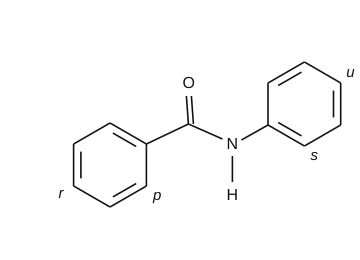
For the given molecule, "x", the preferred site for the attack of the electrophile is :

दिए गए अणु "x" के लिए, इलेक्ट्रॉनस्नेही (electrophile) के आक्रमण हेतु अधिमान्य स्थान है :

  1. APredominantly at "r"मुख्यतः "r" पर
  2. B"r" and "u""r" तथा "u"
  3. C"p" and "s""p" तथा "s"
  4. DPredominantly at "u"मुख्यतः "u" पर
Show answer

Concept: The molecule is benzanilide, C6H5CONHC6H5. The −NHCOC6H5 group is an activating, ortho/para-director for the ring attached to N, while the ring attached to the C=O group is deactivated.

  1. The nitrogen lone pair is delocalised into the N-attached (anilide) ring, raising electron density at its ortho (s) and para (u) positions; so the electrophile attacks this ring, not the benzoyl ring (r, p).
  2. The bulky −NHCOC6H5 group sterically shields the ortho position (s), so substitution occurs predominantly at the para position, i.e. at "u" (as in the nitration/bromination of acetanilide, which gives mainly the para product).
  3. (A) and (B) are wrong because r lies on the deactivated benzoyl ring; (C) is wrong because p is also on the deactivated ring and s is sterically hindered.

Answer: (D) Predominantly at "u"

अवधारणा: अणु बेन्ज़ैनिलाइड C6H5CONHC6H5 है। −NHCOC6H5 समूह, N से जुड़ी वलय के लिए सक्रियक तथा ऑर्थो/पैरा-निर्देशक है, जबकि C=O से जुड़ी वलय निष्क्रियित होती है।

  1. नाइट्रोजन का एकाकी इलेक्ट्रॉन युग्म N-संलग्न (ऐनिलाइड) वलय में विस्थानीकृत होकर उसकी ऑर्थो (s) तथा पैरा (u) स्थितियों पर इलेक्ट्रॉन घनत्व बढ़ाता है; अतः इलेक्ट्रॉनस्नेही इसी वलय पर आक्रमण करता है, बेन्ज़ॉयल वलय (r, p) पर नहीं।
  2. स्थूल −NHCOC6H5 समूह ऑर्थो स्थिति (s) को त्रिविम रूप से अवरुद्ध करता है, अतः प्रतिस्थापन मुख्यतः पैरा स्थिति अर्थात् "u" पर होता है (जैसे ऐसीटैनिलाइड के नाइट्रीकरण/ब्रोमीनीकरण में मुख्यतः पैरा उत्पाद बनता है)।
  3. (A) तथा (B) गलत हैं क्योंकि r निष्क्रियित बेन्ज़ॉयल वलय पर है; (C) गलत है क्योंकि p भी निष्क्रियित वलय पर है तथा s त्रिविम रूप से बाधित है।

उत्तर: (D) मुख्यतः "u" पर

JEE Main 2026 (April) – Paper 1 (B.E./B.Tech)ChemistryAromatic Compounds – electrophilic substitutionJEE Main 2026 (April) – Paper 1 (B.E./B.Tech) 2026 · 2 Apr Shift 1
Q667.

Match List - I with List - II.

List - I
Mixture of Compounds
List - II
Reagent used to distinguish
A.Diethyl amine + Ethyl amineI.Bromine water
B.Acetaldehyde + AcetoneII.CHCl3 + KOH, Δ
C.Ethanol + PhenolIII.Neutral FeCl3
D.Benzoic acid + Cinnamic acidIV.Ammonical silver nitrate

Choose the correct answer from the options given below :

सूची-I का सूची-II से मिलान कीजिए।

सूची-I
यौगिकों का मिश्रण
सूची-II
विभेदन हेतु प्रयुक्त अभिकर्मक
A.डाइएथिल ऐमीन + एथिल ऐमीनI.ब्रोमीन जल
B.ऐसीटैल्डिहाइड + ऐसीटोनII.CHCl3 + KOH, Δ
C.एथेनॉल + फ़ीनॉलIII.उदासीन FeCl3
D.बेन्ज़ोइक अम्ल + सिनैमिक अम्लIV.अमोनियामय सिल्वर नाइट्रेट

नीचे दिए गए विकल्पों में से सही उत्तर चुनिए :

  1. AA-IV, B-II, C-I, D-III
  2. BA-IV, B-II, C-III, D-I
  3. CA-II, B-IV, C-I, D-III
  4. DA-II, B-IV, C-III, D-I
Show answer

Concept: Pick the reagent that reacts with only one member of each pair.

  1. A-II: carbylamine test (CHCl3 + KOH, Δ) — only the primary amine (ethyl amine) gives a foul-smelling isocyanide; diethyl amine (2°) does not.
  2. B-IV: ammoniacal silver nitrate (Tollens' reagent) — only the aldehyde (acetaldehyde) gives the silver mirror; acetone does not.
  3. C-III: neutral FeCl3 — phenol gives a violet colouration; ethanol does not.
  4. D-I: bromine water — cinnamic acid (C6H5CH=CHCOOH) decolourises it by addition across its C=C bond; benzoic acid does not.

Answer: (D) A-II, B-IV, C-III, D-I

अवधारणा: वही अभिकर्मक चुनिए जो प्रत्येक युग्म के केवल एक सदस्य से अभिक्रिया करे।

  1. A-II: कार्बिलऐमीन परीक्षण (CHCl3 + KOH, Δ) — केवल प्राथमिक ऐमीन (एथिल ऐमीन) दुर्गंधयुक्त आइसोसायनाइड देती है; डाइएथिल ऐमीन (2°) नहीं।
  2. B-IV: अमोनियामय सिल्वर नाइट्रेट (टॉलेन अभिकर्मक) — केवल ऐल्डिहाइड (ऐसीटैल्डिहाइड) रजत दर्पण देता है; ऐसीटोन नहीं।
  3. C-III: उदासीन FeCl3 — फ़ीनॉल बैंगनी रंग देता है; एथेनॉल नहीं।
  4. D-I: ब्रोमीन जल — सिनैमिक अम्ल (C6H5CH=CHCOOH) अपने C=C आबंध पर योगज अभिक्रिया द्वारा इसका रंग उड़ा देता है; बेन्ज़ोइक अम्ल नहीं।

उत्तर: (D) A-II, B-IV, C-III, D-I

JEE Main 2026 (April) – Paper 1 (B.E./B.Tech)ChemistryOrganic Chemistry – distinguishing testsJEE Main 2026 (April) – Paper 1 (B.E./B.Tech) 2026 · 2 Apr Shift 1
Q668.

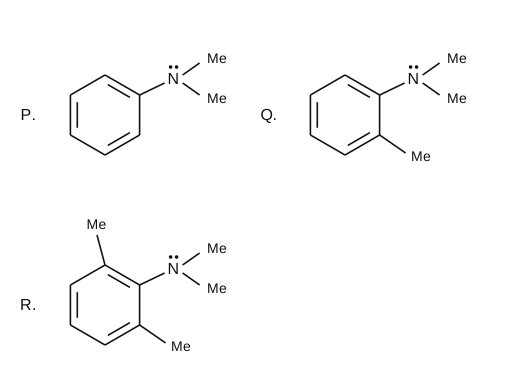
Consider the three aromatic molecules (P, Q and R) whose structures have been given below :

The correct order regarding the reactivity of these compounds with Ph–N+≡N Cl− under optimum but slightly acidic medium is :

नीचे दी गई संरचनाओं वाले तीन ऐरोमैटिक अणुओं (P, Q तथा R) पर विचार कीजिए :

अनुकूलतम परन्तु हल्के अम्लीय माध्यम में इन यौगिकों की Ph–N+≡N Cl− के साथ अभिक्रियाशीलता के संबंध में सही क्रम है :

  1. AP > Q > R
  2. BR > P > Q
  3. CR > Q > P
  4. DP > R > Q
Show answer

Concept: Azo coupling of benzenediazonium chloride is an electrophilic aromatic substitution at the para position of N,N-dimethylaniline; it needs the −NMe2 lone pair to stay conjugated with the ring. ortho-Methyl groups twist −NMe2 out of the ring plane (steric inhibition of resonance), cutting the ring's activation.

  1. P (no ortho methyl): −NMe2 fully planar with the ring → ring maximally activated → fastest coupling.
  2. Q (one ortho methyl): −NMe2 partially twisted → weaker conjugation → slower.
  3. R (two ortho methyls): −NMe2 almost perpendicular to the ring → lone pair hardly delocalises → slowest.
  4. Hence reactivity P > Q > R.

Answer: (A) P > Q > R

अवधारणा: बेन्ज़ीनडाइऐज़ोनियम क्लोराइड का ऐज़ो युग्मन, N,N-डाइमेथिलऐनिलीन की पैरा स्थिति पर इलेक्ट्रॉनस्नेही ऐरोमैटिक प्रतिस्थापन है; इसके लिए −NMe2 का एकाकी युग्म वलय से संयुग्मित रहना आवश्यक है। ऑर्थो-मेथिल समूह −NMe2 को वलय-तल से बाहर घुमा देते हैं (अनुनाद का त्रिविम निरोध), जिससे वलय का सक्रियण घट जाता है।

  1. P (कोई ऑर्थो मेथिल नहीं): −NMe2 वलय के साथ पूर्णतः समतलीय → वलय अधिकतम सक्रियित → सबसे तीव्र युग्मन।
  2. Q (एक ऑर्थो मेथिल): −NMe2 आंशिक रूप से घूमा हुआ → दुर्बल संयुग्मन → धीमा।
  3. R (दो ऑर्थो मेथिल): −NMe2 वलय के लगभग लंबवत → एकाकी युग्म का विस्थानीकरण नगण्य → सबसे धीमा।
  4. अतः अभिक्रियाशीलता P > Q > R।

उत्तर: (A) P > Q > R

JEE Main 2026 (April) – Paper 1 (B.E./B.Tech)ChemistryDiazonium Salts – azo couplingJEE Main 2026 (April) – Paper 1 (B.E./B.Tech) 2026 · 2 Apr Shift 1
Q669.

Match List - I with List - II.

List - I
Vitamin
List - II
Name
A.Vitamin B1I.Pyridoxine
B.Vitamin B2II.Ascorbic acid
C.Vitamin B6III.Thiamine
D.Vitamin CIV.Riboflavin

Choose the correct answer from the options given below :

सूची-I का सूची-II से मिलान कीजिए।

सूची-I
विटामिन
सूची-II
नाम
A.विटामिन B1I.पिरिडॉक्सिन (Pyridoxine)
B.विटामिन B2II.एस्कॉर्बिक अम्ल
C.विटामिन B6III.थायमीन (Thiamine)
D.विटामिन CIV.राइबोफ्लेविन (Riboflavin)

नीचे दिए गए विकल्पों में से सही उत्तर चुनिए :

  1. AA-II, B-I, C-III, D-IV
  2. BA-IV, B-III, C-II, D-I
  3. CA-III, B-IV, C-I, D-II
  4. DA-I, B-III, C-II, D-IV
Show answer

Concept: Chemical names of common vitamins (NCERT Biomolecules).

  1. Vitamin B1 = Thiamine → A-III.
  2. Vitamin B2 = Riboflavin → B-IV.
  3. Vitamin B6 = Pyridoxine → C-I.
  4. Vitamin C = Ascorbic acid → D-II.

Short trick: B1-Thiamine, B2-Riboflavin, B6-Pyridoxine, B12-Cyanocobalamin, C-Ascorbic acid.

Answer: (C) A-III, B-IV, C-I, D-II

अवधारणा: सामान्य विटामिनों के रासायनिक नाम (NCERT जैव-अणु)।

  1. विटामिन B1 = थायमीन → A-III।
  2. विटामिन B2 = राइबोफ्लेविन → B-IV।
  3. विटामिन B6 = पिरिडॉक्सिन → C-I।
  4. विटामिन C = एस्कॉर्बिक अम्ल → D-II।

शॉर्ट ट्रिक: B1-थायमीन, B2-राइबोफ्लेविन, B6-पिरिडॉक्सिन, B12-सायनोकोबालैमिन, C-एस्कॉर्बिक अम्ल।

उत्तर: (C) A-III, B-IV, C-I, D-II

JEE Main 2026 (April) – Paper 1 (B.E./B.Tech)ChemistryBiomolecules – vitaminsJEE Main 2026 (April) – Paper 1 (B.E./B.Tech) 2026 · 2 Apr Shift 1
Q670.

A salt with few drops of conc. HCl gives apple green colour in flame test. The group precipitate of the salt is dissolved in acetic acid and treated with K2CrO4 to give yellow precipitate. When the sodium carbonate extract of the salt solution is heated with conc. HNO3 and ammonium molybdate, it resulted a canary yellow precipitate. The cation and anion present in the salt are respectively,

एक लवण सान्द्र HCl की कुछ बूँदों के साथ ज्वाला परीक्षण में सेब जैसा हरा (apple green) रंग देता है। लवण के समूह अवक्षेप को ऐसीटिक अम्ल में घोलकर K2CrO4 से उपचारित करने पर पीला अवक्षेप प्राप्त होता है। जब लवण विलयन के सोडियम कार्बोनेट निष्कर्ष को सान्द्र HNO3 तथा अमोनियम मॉलिब्डेट के साथ गर्म किया जाता है, तो कैनरी पीला अवक्षेप प्राप्त होता है। लवण में उपस्थित धनायन तथा ऋणायन क्रमशः हैं,

  1. ACa2+ and SO42−Ca2+ तथा SO42−
  2. BBa2+ and PO43−Ba2+ तथा PO43−
  3. CMn2+ and PO43−Mn2+ तथा PO43−
  4. DBa2+ and SO42−Ba2+ तथा SO42−
Show answer

Concept: Flame colours and confirmatory tests of salt analysis.

  1. Apple-green flame with conc. HCl → Ba2+ (Ca2+ gives brick red, Sr2+ crimson; Mn2+ gives no such flame).
  2. Group (V) precipitate dissolved in acetic acid + K2CrO4 → yellow BaCrO4 precipitate — confirms Ba2+.
  3. Sodium carbonate extract + conc. HNO3 + ammonium molybdate, heated → canary-yellow precipitate of ammonium phosphomolybdate, (NH4)3PO4·12MoO3 — confirms PO43−.
  4. So the salt contains Ba2+ and PO43−; options with Ca2+, Mn2+ or SO42− contradict these observations.

Answer: (B) Ba2+ and PO43−

अवधारणा: लवण विश्लेषण के ज्वाला रंग तथा पुष्टिकारक परीक्षण।

  1. सान्द्र HCl के साथ सेब जैसी हरी ज्वाला → Ba2+ (Ca2+ ईंट जैसा लाल, Sr2+ गहरा लाल देता है; Mn2+ ऐसी ज्वाला नहीं देता)।
  2. समूह (V) अवक्षेप को ऐसीटिक अम्ल में घोलकर K2CrO4 मिलाने पर → पीला BaCrO4 अवक्षेप — Ba2+ की पुष्टि।
  3. सोडियम कार्बोनेट निष्कर्ष + सान्द्र HNO3 + अमोनियम मॉलिब्डेट, गर्म करने पर → अमोनियम फॉस्फोमॉलिब्डेट (NH4)3PO4·12MoO3 का कैनरी पीला अवक्षेप — PO43− की पुष्टि।
  4. अतः लवण में Ba2+ तथा PO43− हैं; Ca2+, Mn2+ अथवा SO42− वाले विकल्प इन प्रेक्षणों के विरुद्ध हैं।

उत्तर: (B) Ba2+ तथा PO43−

JEE Main 2026 (April) – Paper 1 (B.E./B.Tech)ChemistryQualitative Analysis – cation and anion testsJEE Main 2026 (April) – Paper 1 (B.E./B.Tech) 2026 · 2 Apr Shift 1
Q671.

5.33 g of CrCl3·6H2O, which is a 1 : 3 electrolyte, is dissolved in water and is passed through a cation exchanger. The chloride ions in the eluted solution, on treatment with AgNO3 results in 8.61 g of AgCl. The ratio of moles of complex reacted and moles of AgCl formed is __________ ×10−2. (Nearest integer)

[Molar mass in g mol−1 Cr : 52, Ag : 108, Cl : 35.5, H : 1, O : 16]

5.33 g CrCl3·6H2O, जो एक 1 : 3 विद्युत्-अपघट्य है, को जल में घोलकर धनायन विनिमयक (cation exchanger) से प्रवाहित किया जाता है। निर्गत विलयन में उपस्थित क्लोराइड आयनों की AgNO3 से अभिक्रिया के फलस्वरूप 8.61 g AgCl प्राप्त होता है। अभिकृत संकुल के मोल तथा बने AgCl के मोलों का अनुपात __________ ×10−2 है। (निकटतम पूर्णांक)

[g mol−1 में मोलर द्रव्यमान Cr : 52, Ag : 108, Cl : 35.5, H : 1, O : 16]

Show answer

Concept: A 1 : 3 electrolyte [Cr(H2O)6]Cl3 has all three chlorides ionisable; each ionised Cl− precipitates as AgCl.

  1. Molar mass of CrCl3·6H2O = 52+3(35.5)+6(18)=266.5 g mol−1.
  2. Moles of complex = 5.33266.5=0.02 mol.
  3. Moles of AgCl = 8.61143.5=0.06 mol (consistent: 3×0.02=0.06).
  4. Ratio = 0.020.06=13=0.3333=33.33×10⁻²≈33×10−2.

Answer: 33

अवधारणा: 1 : 3 विद्युत्-अपघट्य [Cr(H2O)6]Cl3 में तीनों क्लोराइड आयनित होने योग्य हैं; प्रत्येक आयनित Cl−, AgCl के रूप में अवक्षेपित होता है।

  1. CrCl3·6H2O का मोलर द्रव्यमान = 52+3(35.5)+6(18)=266.5 g mol−1।
  2. संकुल के मोल = 5.33266.5=0.02 मोल।
  3. AgCl के मोल = 8.61143.5=0.06 मोल (संगत: 3×0.02=0.06)।
  4. अनुपात = 0.020.06=13=0.3333=33.33×10⁻²≈33×10−2।

उत्तर: 33

JEE Main 2026 (April) – Paper 1 (B.E./B.Tech)ChemistryCoordination Compounds – ionisable chlorideJEE Main 2026 (April) – Paper 1 (B.E./B.Tech) 2026 · 2 Apr Shift 1
Q672.

Consider the isomers of hydrocarbon with molecular formula C5H10. These isomers do not decolourise KMnO4 solution. These isomers are subjected to chlorination with chlorine in presence of light to give monochloro compounds. The total number of monochloro compounds (structural isomers only) formed is __________.

अणुसूत्र C5H10 वाले हाइड्रोकार्बन के समावयवियों पर विचार कीजिए। ये समावयवी KMnO4 विलयन का रंग नहीं उड़ाते। इन समावयवियों का प्रकाश की उपस्थिति में क्लोरीन से क्लोरीनीकरण करने पर मोनोक्लोरो यौगिक प्राप्त होते हैं। बनने वाले मोनोक्लोरो यौगिकों (केवल संरचनात्मक समावयवियों) की कुल संख्या __________ है।

Show answer

Concept: C5H10 isomers that do not decolourise KMnO4 are the cycloalkanes (alkenes would decolourise it). Count the distinct types of hydrogens in each ring for monochlorination.

  1. The five cycloalkane isomers: cyclopentane, methylcyclobutane, ethylcyclopropane, 1,1-dimethylcyclopropane, 1,2-dimethylcyclopropane.
  2. Cyclopentane: all H equivalent → 1 product (chlorocyclopentane).
  3. Methylcyclobutane: CH3, C1, C2(=C4), C3 → 4 products.
  4. Ethylcyclopropane: terminal CH3, side-chain CH2, ring C1, ring C2(=C3) → 4 products.
  5. 1,1-Dimethylcyclopropane: equivalent CH3 groups, equivalent ring CH2 → 2 products.
  6. 1,2-Dimethylcyclopropane: equivalent CH3, equivalent C1/C2, ring CH2 (C3) → 3 products.
  7. Total structural isomers = 1+4+4+2+3=14 (all distinct).

Answer: 14

अवधारणा: C5H10 के वे समावयवी जो KMnO4 का रंग नहीं उड़ाते, चक्रीय ऐल्केन हैं (ऐल्कीन रंग उड़ा देते)। मोनोक्लोरीनीकरण के लिए प्रत्येक वलय में भिन्न प्रकार के हाइड्रोजनों की गणना कीजिए।

  1. पाँच चक्रीय ऐल्केन समावयवी: साइक्लोपेन्टेन, मेथिलसाइक्लोब्यूटेन, एथिलसाइक्लोप्रोपेन, 1,1-डाइमेथिलसाइक्लोप्रोपेन, 1,2-डाइमेथिलसाइक्लोप्रोपेन।
  2. साइक्लोपेन्टेन: सभी H समतुल्य → 1 उत्पाद (क्लोरोसाइक्लोपेन्टेन)।
  3. मेथिलसाइक्लोब्यूटेन: CH3, C1, C2(=C4), C3 → 4 उत्पाद।
  4. एथिलसाइक्लोप्रोपेन: अंतिम CH3, पार्श्व-श्रृंखला CH2, वलय C1, वलय C2(=C3) → 4 उत्पाद।
  5. 1,1-डाइमेथिलसाइक्लोप्रोपेन: समतुल्य CH3 समूह, समतुल्य वलय CH2 → 2 उत्पाद।
  6. 1,2-डाइमेथिलसाइक्लोप्रोपेन: समतुल्य CH3, समतुल्य C1/C2, वलय CH2 (C3) → 3 उत्पाद।
  7. कुल संरचनात्मक समावयवी = 1+4+4+2+3=14 (सभी भिन्न)।

उत्तर: 14

JEE Main 2026 (April) – Paper 1 (B.E./B.Tech)ChemistryIsomerism – free radical chlorinationJEE Main 2026 (April) – Paper 1 (B.E./B.Tech) 2026 · 2 Apr Shift 1
Q673.

One mole of an alkane (x) requires 8 mole oxygen for complete combustion. Sum of number of carbon and hydrogen atoms in the alkane (x) is __________.

एक ऐल्केन (x) के एक मोल के पूर्ण दहन के लिए 8 मोल ऑक्सीजन की आवश्यकता होती है। ऐल्केन (x) में कार्बन तथा हाइड्रोजन परमाणुओं की संख्या का योग __________ है।

Show answer

Concept: Combustion of an alkane: CnH2n+2+3n+12O2→nCO2+(n+1)H2O.

  1. Given moles of O2 = 8, so 3n+12=8⇒3n+1=16⇒n=5.
  2. The alkane is C5H12 (pentane).
  3. Sum of atoms = 5+12=17.

Answer: 17

अवधारणा: ऐल्केन का दहन: CnH2n+2+3n+12O2→nCO2+(n+1)H2O।

  1. दिया है O2 के मोल = 8, अतः 3n+12=8⇒3n+1=16⇒n=5।
  2. ऐल्केन C5H12 (पेन्टेन) है।
  3. परमाणुओं का योग = 5+12=17।

उत्तर: 17

JEE Main 2026 (April) – Paper 1 (B.E./B.Tech)ChemistryHydrocarbons – combustion stoichiometryJEE Main 2026 (April) – Paper 1 (B.E./B.Tech) 2026 · 2 Apr Shift 1
Q674.

For reaction A → P, rate constant k=1.5×10³ s−1 at 27°C

If activation energy for the above reaction is 60 kJ mol−1, then the temperature (in °C) at which rate constant, k=4.5×10³ s−1 is __________. (Nearest integer)

Given : log 2 = 0.30, log 3 = 0.48, R = 8.3 J K−1 mol−1, ln 10 = 2.3

अभिक्रिया A → P के लिए, 27°C पर वेग स्थिरांक k=1.5×10³ s−1 है

यदि उपर्युक्त अभिक्रिया की सक्रियण ऊर्जा 60 kJ mol−1 है, तो वह ताप (°C में) जिस पर वेग स्थिरांक k=4.5×10³ s−1 होगा, __________ है। (निकटतम पूर्णांक)

दिया है : log 2 = 0.30, log 3 = 0.48, R = 8.3 J K−1 mol−1, ln 10 = 2.3

Show answer

Concept: Two-temperature Arrhenius equation: ln⁡k2k1=EaR(1T1−1T2).

  1. k2k1=4.5×1031.5×103=3; ln⁡3=(ln⁡10)(log⁡3)=2.3×0.48=1.104.
  2. T1=27+273=300 K; EaR=600008.3=7228.9 K.
  3. 1300−1T2=1.1047228.9=1.527×10⁻⁴
  4. 1T2=3.3333×10⁻³−1.527×10−4=3.1806×10⁻³ K−1 → T2=314.4 K.
  5. Temperature in °C = 314.4−273=41.4≈41 °C.

Answer: 41

अवधारणा: दो तापों के लिए आरेनियस समीकरण: ln⁡k2k1=EaR(1T1−1T2)।

  1. k2k1=4.5×1031.5×103=3; ln⁡3=(ln⁡10)(log⁡3)=2.3×0.48=1.104।
  2. T1=27+273=300 K; EaR=600008.3=7228.9 K।
  3. 1300−1T2=1.1047228.9=1.527×10⁻⁴
  4. 1T2=3.3333×10⁻³−1.527×10−4=3.1806×10⁻³ K−1 → T2=314.4 K।
  5. ताप °C में = 314.4−273=41.4≈41 °C।

उत्तर: 41

JEE Main 2026 (April) – Paper 1 (B.E./B.Tech)ChemistryChemical Kinetics – Arrhenius equationJEE Main 2026 (April) – Paper 1 (B.E./B.Tech) 2026 · 2 Apr Shift 1
Q675.

At the transition temperature T, A ⇌ B and ΔG0=105−35log⁡T where A and B are two states of substance X. The transition temperature in °C when pressure is 1 atm is __________. (Nearest integer)

संक्रमण ताप T पर, A ⇌ B तथा ΔG0=105−35log⁡T, जहाँ A तथा B पदार्थ X की दो अवस्थाएँ हैं। 1 atm दाब पर संक्रमण ताप °C में __________ है। (निकटतम पूर्णांक)

Show answer

Concept: At the transition temperature the two states A and B are in equilibrium, so ΔG0=0.

  1. Set 105−35log⁡T=0⇒log⁡T=10535=3.
  2. T=103=1000 K.
  3. In °C: 1000−273=727 °C.

Answer: 727

अवधारणा: संक्रमण ताप पर दोनों अवस्थाएँ A तथा B साम्य में होती हैं, अतः ΔG0=0।

  1. 105−35log⁡T=0⇒log⁡T=10535=3 रखिए।
  2. T=103=1000 K।
  3. °C में: 1000−273=727 °C।

उत्तर: 727

JEE Main 2026 (April) – Paper 1 (B.E./B.Tech)ChemistryThermodynamics – Gibbs energy and equilibriumJEE Main 2026 (April) – Paper 1 (B.E./B.Tech) 2026 · 2 Apr Shift 1