Q621.If the domain of the function is , then the value of is _________ .
यदि फलन का प्रांत है, तो का मान _________ है।
Show answer
Concept: For the square root, ; since the base , this means .
- With : .
- So (where ) or , i.e. or .
- Exclusions: (denominator) — both lie outside the above sets since and ; and (there , log undefined).
- Domain , so .
- .
Answer: 4
अवधारणा: वर्गमूल के लिए ; आधार होने से इसका अर्थ है ।
- लेने पर: ।
- अतः (जहाँ ) अथवा , अर्थात् या ।
- वर्जित मान: (हर शून्य) — दोनों उपर्युक्त समुच्चयों से बाहर हैं क्योंकि तथा ; तथा (वहाँ , लघुगणक अपरिभाषित)।
- प्रांत , अतः ।
- ।
उत्तर: 4
JEE Main 2026 (April) – Paper 1 (B.E./B.Tech)MathematicsFunctions – domain with logarithmic inequalityJEE Main 2026 (April) – Paper 1 (B.E./B.Tech) 2026 · 2 Apr Shift 1
Q622.If , then is equal to _________ .
यदि है, तो बराबर _________ है।
Show answer
Concept: where .
- .
- .
- , so the sum .
Answer: 91
अवधारणा: , जहाँ ।
- ।
- ।
- , अतः योग ।
उत्तर: 91
JEE Main 2026 (April) – Paper 1 (B.E./B.Tech)MathematicsSequences & Series – nth term from sumJEE Main 2026 (April) – Paper 1 (B.E./B.Tech) 2026 · 2 Apr Shift 1
Q623.Let . If the probability, that for all , is , , then is equal to _________ .
माना हैं। यदि सभी के लिए होने की प्रायिकता है, जहाँ है, तो बराबर _________ है।
Show answer
Concept: for all real iff (always true here) and discriminant .
- . Total equally likely triples .
- : need ; out of 16 pairs only fail, so 13 pairs work.
- : need ; pairs — 4 pairs.
- : need — impossible (max 16); : need — impossible.
- Favourable , so probability with ; .
Answer: 81
अवधारणा: सभी वास्तविक के लिए होगा यदि और केवल यदि (यहाँ सदैव सत्य) तथा विविक्तकर हो।
- । कुल समसंभाव्य त्रिक ।
- : चाहिए; 16 युग्मों में केवल असफल, अतः 13 युग्म अनुकूल।
- : चाहिए; युग्म — 4 युग्म।
- : — असंभव (अधिकतम 16); : — असंभव।
- अनुकूल , अतः प्रायिकता तथा ; ।
उत्तर: 81
JEE Main 2026 (April) – Paper 1 (B.E./B.Tech)MathematicsProbability – positive definite quadraticJEE Main 2026 (April) – Paper 1 (B.E./B.Tech) 2026 · 2 Apr Shift 1
Q624.Let a circle C have its centre in the first quadrant, intersect the coordinate axes at exactly three points and cut off equal intercepts from the coordinate axes. If the length of the chord of C on the line is , then the square of the radius of C is _________ .
माना एक वृत्त C का केंद्र प्रथम चतुर्थांश में है, यह निर्देशांक अक्षों को ठीक तीन बिंदुओं पर प्रतिच्छेद करता है तथा निर्देशांक अक्षों से बराबर अंतःखंड काटता है। यदि रेखा पर C की जीवा की लंबाई है, तो C की त्रिज्या का वर्ग _________ है।
Show answer
Concept: Exactly three axis points with equal (non-zero) intercepts the circle passes through the origin and cuts both axes; half-chord.
- If the circle merely touched one axis, that intercept would be , and equal intercepts would force both to be — only two axis points. So C passes through and meets the axes again at and , (three distinct points).
- Circle through : , centre (first quadrant), .
- Distance of centre from : . Half-chord: .
- (centre in the first quadrant, as required).
Answer: 8
अवधारणा: ठीक तीन अक्ष-बिंदु तथा बराबर (अशून्य) अंतःखंड वृत्त मूल बिंदु से होकर जाता है और दोनों अक्षों को काटता है; अर्ध-जीवा।
- यदि वृत्त किसी अक्ष को केवल स्पर्श करता, तो वह अंतःखंड होता और बराबर अंतःखंडों से दोनों हो जाते — तब अक्षों पर केवल दो बिंदु मिलते। अतः C मूल बिंदु से होकर जाता है तथा अक्षों को पुनः व , पर काटता है (तीन भिन्न बिंदु)।
- से जाने वाला वृत्त: , केंद्र (प्रथम चतुर्थांश), ।
- केंद्र से की दूरी: । अर्ध-जीवा: ।
- (केंद्र प्रथम चतुर्थांश में, जैसा अपेक्षित)।
उत्तर: 8
JEE Main 2026 (April) – Paper 1 (B.E./B.Tech)MathematicsCircle – chord length conditionJEE Main 2026 (April) – Paper 1 (B.E./B.Tech) 2026 · 2 Apr Shift 1
Q625.If , then is equal to _________ .
यदि है, तो बराबर _________ है।
Show answer
Concept: For an increasing : .
- Let , increasing on with and .
- Its inverse: — exactly the second integrand, over .
- Hence .
- .
Short trick: Whenever the two integrands are inverses and the limits correspond, the sum is just the rectangle area .
Answer: 192
अवधारणा: वर्धमान के लिए: ।
- माना , जो पर वर्धमान है तथा , ।
- इसका प्रतिलोम: — यही दूसरा समाकल्य है, पर।
- अतः ।
- ।
शॉर्ट ट्रिक: जब दोनों समाकल्य परस्पर प्रतिलोम हों और सीमाएँ संगत हों, तो योग केवल आयत का क्षेत्रफल होता है।
उत्तर: 192
JEE Main 2026 (April) – Paper 1 (B.E./B.Tech)MathematicsDefinite Integration – inverse function propertyJEE Main 2026 (April) – Paper 1 (B.E./B.Tech) 2026 · 2 Apr Shift 1
Q626.The dimensional formula of ( = permittivity of vacuum and = electric field) is . The value of = ________.
( = निर्वात की विद्युतशीलता (permittivity) तथा = विद्युत क्षेत्र) का विमीय सूत्र है। का मान = ________।
- A0
- B1
- C
- D2
Show answer
Concept: is the energy density of an electric field, i.e. energy per unit volume.
- .
- So .
- .
Short trick: Energy density always has the same dimensions as pressure: .
Answer: (B) 1
अवधारणा: विद्युत क्षेत्र का ऊर्जा घनत्व है, अर्थात् प्रति एकांक आयतन ऊर्जा।
- ।
- अतः ।
- ।
शॉर्ट ट्रिक: ऊर्जा घनत्व की विमाएँ सदैव दाब की विमाओं के समान होती हैं।
उत्तर: (B) 1
JEE Main 2026 (April) – Paper 1 (B.E./B.Tech)PhysicsUnits & Dimensions – dimensional formulaJEE Main 2026 (April) – Paper 1 (B.E./B.Tech) 2026 · 2 Apr Shift 1
Q627.The diameter of a wire measured by a screw gauge of least count 0.001 cm is 0.08 cm. The length measured by a scale of least count 0.1 cm is 150 cm. When a weight of 100 N is applied to the wire, the extension in length is 0.5 cm, measured by a micrometer of least count 0.001 cm. The error in the measured Young's modulus is N/m. The value of is ________.
(Ignore the contribution of the load to Young's modulus error calculation)
0.001 cm अल्पतमांक (least count) वाले पेंचमापी (screw gauge) से मापा गया एक तार का व्यास 0.08 cm है। 0.1 cm अल्पतमांक वाले पैमाने से मापी गई लम्बाई 150 cm है। जब तार पर 100 N का भार लगाया जाता है, तो लम्बाई में विस्तार 0.5 cm होता है, जिसे 0.001 cm अल्पतमांक वाले माइक्रोमीटर से मापा गया है। मापे गए यंग गुणांक (Young's modulus) में त्रुटि N/m है। का मान ________ है।
(यंग गुणांक की त्रुटि गणना में भार के योगदान की उपेक्षा कीजिए)
- A1.3
- B1.65
- C0.13
- D0.25
Show answer
Concept: , so (load error ignored).
- .
- .
- .
Short trick: The diameter term dominates: of already gives .
Answer: (B) 1.65
अवधारणा: , अतः (भार की त्रुटि उपेक्षित)।
- ।
- ।
- ।
शॉर्ट ट्रिक: व्यास वाला पद सबसे बड़ा है: का पर मान ही दे देता है।
उत्तर: (B) 1.65
JEE Main 2026 (April) – Paper 1 (B.E./B.Tech)PhysicsUnits & Measurement – error analysisJEE Main 2026 (April) – Paper 1 (B.E./B.Tech) 2026 · 2 Apr Shift 1
Q628.The velocity of a particle is given as m/s. The magnitude of acceleration at point (1, 2, 4) is ________ m/s.
एक कण का वेग m/s से दिया जाता है। बिन्दु (1, 2, 4) पर त्वरण का परिमाण ________ m/s है।
- A
- B9
- C
- D0
Show answer
Concept: When velocity depends on position, , and similarly for and (chain rule).
- m/s.
- m/s.
- m/s.
- m/s.
Answer: (B) 9
अवधारणा: जब वेग स्थिति पर निर्भर करता है, तो , इसी प्रकार तथा के लिए (श्रृंखला नियम)।
- m/s।
- m/s।
- m/s।
- m/s।
उत्तर: (B) 9
JEE Main 2026 (April) – Paper 1 (B.E./B.Tech)PhysicsKinematics – velocity field & accelerationJEE Main 2026 (April) – Paper 1 (B.E./B.Tech) 2026 · 2 Apr Shift 1
Q629.The position of an object having mass 0.1 kg as a function of time is given as m. At s, which of the following statements are correct?
A. The linear momentum kg·m/s.
B. The force acting on the object N.
C. The angular momentum of the object about its origin J·s.
D. The torque acting on the object about its origin N·m.
Choose the correct answer from the options given below :
0.1 kg द्रव्यमान की किसी वस्तु की स्थिति, समय के फलन के रूप में m दी गई है। s पर, निम्नलिखित में से कौन-से कथन सही हैं?
A. रेखीय संवेग kg·m/s।
B. वस्तु पर कार्यरत बल N।
C. मूल बिन्दु के परितः वस्तु का कोणीय संवेग J·s।
D. मूल बिन्दु के परितः वस्तु पर कार्यरत बल आघूर्ण N·m।
नीचे दिए गए विकल्पों में से सही उत्तर चुनिए :
- AA, B and C onlyकेवल A, B और C
- BB, C and D onlyकेवल B, C और D
- CA, C and D onlyकेवल A, C और D
- DA, B and D onlyकेवल A, B और D
Show answer
Concept: , , , , .
- ; at s: , so kg·m/s — A is correct.
- ; at s: N — B is correct.
- ; J·s, not — C is wrong.
- N·m — D is correct.
Answer: (D) A, B and D only
अवधारणा: , , , , ।
- ; s पर: , अतः kg·m/s — A सही है।
- ; s पर: N — B सही है।
- ; J·s, नहीं — C गलत है।
- N·m — D सही है।
उत्तर: (D) केवल A, B और D
JEE Main 2026 (April) – Paper 1 (B.E./B.Tech)PhysicsSystem of particles – momentum, torque & angular momentumJEE Main 2026 (April) – Paper 1 (B.E./B.Tech) 2026 · 2 Apr Shift 1
Q630.A planet (P) is moving around the star of mass in the orbit of radius . Another planet (P) is moving around another star of mass in a orbit of radius . Ratio of time periods of revolution of P and P is ________.
एक ग्रह (P), द्रव्यमान के तारे के चारों ओर त्रिज्या की कक्षा में गति कर रहा है। दूसरा ग्रह (P), द्रव्यमान के दूसरे तारे के चारों ओर त्रिज्या की कक्षा में गति कर रहा है। P तथा P के परिक्रमण आवर्तकालों का अनुपात ________ है।
- A
- B2
- C4
- D
Show answer
Concept: For a circular orbit around a star of mass : , i.e. .
- .
- .
Answer: (B) 2
अवधारणा: द्रव्यमान के तारे के चारों ओर वृत्तीय कक्षा के लिए: , अर्थात् ।
- ।
- ।
उत्तर: (B) 2
JEE Main 2026 (April) – Paper 1 (B.E./B.Tech)PhysicsGravitation – Kepler's third lawJEE Main 2026 (April) – Paper 1 (B.E./B.Tech) 2026 · 2 Apr Shift 1
Q631.A particle is rotating in a circular path and at any instant its motion can be described as . The angular acceleration of the particle after 10 seconds is ________ rad/s.
एक कण वृत्तीय पथ पर घूम रहा है और किसी भी क्षण इसकी गति द्वारा व्यक्त की जा सकती है। 10 सेकण्ड पश्चात् कण का कोणीय त्वरण ________ rad/s है।
- A150
- B120
- C130
- D170
Show answer
Concept: and .
- .
- .
- At s: rad/s.
Answer: (C) 130
अवधारणा: तथा ।
- ।
- ।
- s पर: rad/s।
उत्तर: (C) 130
JEE Main 2026 (April) – Paper 1 (B.E./B.Tech)PhysicsRotational motion – angular kinematicsJEE Main 2026 (April) – Paper 1 (B.E./B.Tech) 2026 · 2 Apr Shift 1
Q632.A parallel plate air capacitor has a capacitance C. When it is half filled as show in figure with a dielectric constant
, the percentage increase in the capacitance is ________.
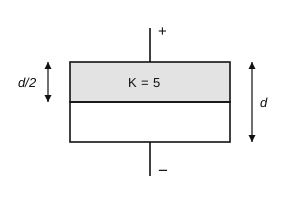
एक समान्तर पट्टिका वायु संधारित्र की धारिता C है। जब इसे चित्र में दर्शाए अनुसार परावैद्युतांक
वाले परावैद्युत से आधा भर दिया जाता है, तो धारिता में प्रतिशत वृद्धि ________ है।
- A33.34
- B66.67
- C200
- D400
Show answer
Concept: The dielectric fills half the gap () over the full plate area, so the system is two capacitors in series, each of plate separation .
- (dielectric part), (air part), where .
- .
- Percentage increase .
Short trick: Half-gap dielectric: ; for , .
Answer: (B) 66.67
अवधारणा: परावैद्युत पूरी पट्टिका के क्षेत्रफल पर अन्तराल का आधा भाग () भरता है, अतः निकाय पट्टिका-अन्तराल वाले दो श्रेणीक्रम संधारित्रों के समान है।
- (परावैद्युत भाग), (वायु भाग), जहाँ ।
- ।
- प्रतिशत वृद्धि ।
शॉर्ट ट्रिक: आधे अन्तराल में परावैद्युत: ; के लिए ।
उत्तर: (B) 66.67
JEE Main 2026 (April) – Paper 1 (B.E./B.Tech)PhysicsCapacitance – dielectric partially filledJEE Main 2026 (April) – Paper 1 (B.E./B.Tech) 2026 · 2 Apr Shift 1
Q633.Heat is supplied to a diatomic gas at constant pressure. Then the ratio of is ______.
एक द्विपरमाणुक गैस को नियत दाब पर ऊष्मा दी जाती है। तब का अनुपात ______ है।
- A2 : 3 : 5
- B5 : 3 : 2
- C2 : 5 : 7
- D7 : 5 : 2
Show answer
Concept: At constant pressure, , , .
- For a diatomic gas: , .
- .
- Options (A), (B) and (C) do not match for a diatomic gas, and in every process must hold, which only satisfies with the correct order.
Answer: (D) 7 : 5 : 2
अवधारणा: नियत दाब पर , , ।
- द्विपरमाणुक गैस के लिए: , ।
- ।
- विकल्प (A), (B) तथा (C) द्विपरमाणुक गैस के से मेल नहीं खाते, और प्रत्येक प्रक्रम में होना चाहिए, जो सही क्रम में केवल ही सन्तुष्ट करता है।
उत्तर: (D) 7 : 5 : 2
JEE Main 2026 (April) – Paper 1 (B.E./B.Tech)PhysicsThermodynamics – first law at constant pressureJEE Main 2026 (April) – Paper 1 (B.E./B.Tech) 2026 · 2 Apr Shift 1
Q634.Two charged conducting spheres S and S of radii 8 cm and 18 cm are connected to each other by a wire. After equilibrium is established, the ratio of electric fields on S and S spheres are E and E respectively. The value of is ________.
8 cm तथा 18 cm त्रिज्याओं के दो आवेशित चालक गोले S तथा S एक तार द्वारा परस्पर जोड़े गए हैं। साम्यावस्था स्थापित होने के पश्चात्, S तथा S गोलों पर विद्युत क्षेत्र क्रमशः E तथा E हैं। का मान ________ है।
- A
- B
- C
- D
Show answer
Concept: Spheres connected by a wire come to the same potential . At the surface, , so .
- .
- .
Short trick: After connection, surface field is inversely proportional to radius — the smaller sphere has the stronger field.
Answer: (D)
अवधारणा: तार से जुड़े गोले समान विभव पर आ जाते हैं। पृष्ठ पर , अतः ।
- ।
- ।
शॉर्ट ट्रिक: जोड़ने के पश्चात् पृष्ठीय क्षेत्र त्रिज्या के व्युत्क्रमानुपाती होता है — छोटे गोले पर क्षेत्र प्रबल होता है।
उत्तर: (D)
JEE Main 2026 (April) – Paper 1 (B.E./B.Tech)PhysicsElectrostatics – connected conducting spheresJEE Main 2026 (April) – Paper 1 (B.E./B.Tech) 2026 · 2 Apr Shift 1
Q635.The equation of a plane progressive wave is given by where and are in cm and is in second. The velocity of the wave is ________ m/s.
एक समतल प्रगामी तरंग का समीकरण है, जहाँ तथा cm में और सेकण्ड में हैं। तरंग का वेग ________ m/s है।
- A120
- B150
- C200
- D300
Show answer
Concept: For , wave speed .
- rad/s, rad/cm.
- cm/s.
- m/s.
Short trick: = (coefficient of ) ÷ (coefficient of ) cm/s; just convert the unit.
Answer: (D) 300
अवधारणा: के लिए तरंग चाल ।
- rad/s, rad/cm।
- cm/s।
- m/s।
शॉर्ट ट्रिक: = ( का गुणांक) ÷ ( का गुणांक) cm/s; बस मात्रक बदलिए।
उत्तर: (D) 300
JEE Main 2026 (April) – Paper 1 (B.E./B.Tech)PhysicsWaves – progressive wave speedJEE Main 2026 (April) – Paper 1 (B.E./B.Tech) 2026 · 2 Apr Shift 1
Q636.Two short electric dipoles A and B having dipole moment p
and p
respectively are placed with their axis mutually perpendicular as shown in the figure. The resultant electric field at a point
is making an angle of 60° with the line joining points O and
. The ratio of the dipole moments p
/p
is ________.
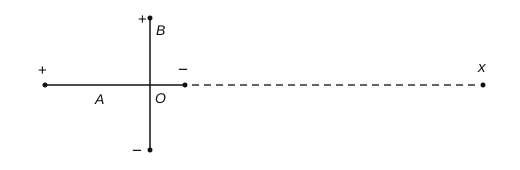
दो लघु विद्युत द्विध्रुव A तथा B, जिनके द्विध्रुव आघूर्ण क्रमशः p
तथा p
हैं, चित्र में दर्शाए अनुसार अपने अक्ष परस्पर लम्बवत् रखकर रखे गए हैं। बिन्दु
पर परिणामी विद्युत क्षेत्र, बिन्दुओं O तथा
को मिलाने वाली रेखा से 60° का कोण बनाता है। द्विध्रुव आघूर्णों का अनुपात p
/p
________ है।
- A
- B
- C
- D
Show answer
Concept: Point lies on the axis of dipole A (axial field , along Ox) and on the equatorial line of dipole B (equatorial field , perpendicular to Ox).
- Field along Ox: ; field perpendicular to Ox: .
- .
- .
Short trick: Axial field is twice the equatorial field at the same distance, so directly.
Answer: (B)
अवधारणा: बिन्दु द्विध्रुव A की अक्षीय स्थिति में है (अक्षीय क्षेत्र , Ox के अनुदिश) तथा द्विध्रुव B की निरक्षीय स्थिति में है (निरक्षीय क्षेत्र , Ox के लम्बवत्)।
- Ox के अनुदिश क्षेत्र: ; Ox के लम्बवत् क्षेत्र: ।
- ।
- ।
शॉर्ट ट्रिक: समान दूरी पर अक्षीय क्षेत्र, निरक्षीय क्षेत्र का दोगुना होता है, अतः सीधे ।
उत्तर: (B)
JEE Main 2026 (April) – Paper 1 (B.E./B.Tech)PhysicsElectrostatics – field of short dipolesJEE Main 2026 (April) – Paper 1 (B.E./B.Tech) 2026 · 2 Apr Shift 1
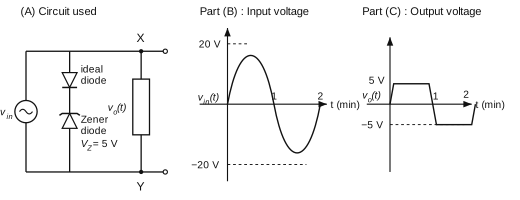
Q637.For the given circuit (shown in part (A)) the time dependent input voltage
and corresponding output
are shown in part (B) and part (C), respectively. Identify the components that are used in the circuit between points X and Y.
दिए गए परिपथ (भाग (A) में दर्शाया गया) के लिए समय पर निर्भर निवेशी वोल्टता
तथा संगत निर्गत
क्रमशः भाग (B) तथा भाग (C) में दर्शाए गए हैं। परिपथ में बिन्दुओं X तथा Y के बीच प्रयुक्त अवयवों को पहचानिए।
- A

- B

- C

- D

Show answer
Concept: The output is a ±5 V clipped wave. A series combination of an ordinary diode and a Zener diode ( V) clamps one half-cycle at 5 V (diode forward + Zener in breakdown). The branch already shown clips the positive half at +5 V, so the branch between X and Y must clip the negative half at −5 V.
- Positive half: shown branch conducts (ideal diode forward, Zener in breakdown) when V → output held at +5 V.
- Negative half: required branch must conduct when V → a diode and a Zener diode connected with polarity opposite to the shown pair (back-to-back), as in option (B).
- Option (A): resistor + diode contains no Zener, so nothing holds the negative half at −5 V. Option (C): this Zener is forward biased in the positive half (current from X to Y), so it would pull the positive half down to about 0 V instead of +5 V. Option (D): the diode and Zener point the same way, so in the negative half both conduct forward and clamp near 0 V.
Answer: (B)
अवधारणा: निर्गत ±5 V पर कर्तित (clipped) तरंग है। साधारण डायोड तथा जेनर डायोड ( V) का श्रेणी संयोजन एक अर्ध-चक्र को 5 V पर सीमित करता है (डायोड अग्र + जेनर भंजन में)। दर्शाई गई शाखा धनात्मक अर्ध-चक्र को +5 V पर काटती है, अतः X तथा Y के बीच की शाखा को ऋणात्मक अर्ध-चक्र को −5 V पर काटना चाहिए।
- धनात्मक अर्ध-चक्र: दर्शाई गई शाखा V पर चालन करती है (आदर्श डायोड अग्र, जेनर भंजन में) → निर्गत +5 V पर स्थिर।
- ऋणात्मक अर्ध-चक्र: आवश्यक शाखा को V पर चालन करना चाहिए → दर्शाए गए युग्म के विपरीत ध्रुवता में जुड़े एक डायोड तथा एक जेनर डायोड, जैसा विकल्प (B) में है।
- विकल्प (A): प्रतिरोध + डायोड में कोई जेनर नहीं है, अतः ऋणात्मक अर्ध-चक्र को −5 V पर कोई सीमित नहीं करता। विकल्प (C): यह जेनर धनात्मक अर्ध-चक्र में (X से Y की ओर धारा) अग्र अभिनत होता है, अतः धनात्मक अर्ध-चक्र को +5 V के बजाय लगभग 0 V तक गिरा देगा। विकल्प (D): डायोड तथा जेनर एक ही दिशा में हैं, अतः ऋणात्मक अर्ध-चक्र में दोनों अग्र दिशा में चालन कर 0 V के निकट सीमित करेंगे।
उत्तर: (B)
JEE Main 2026 (April) – Paper 1 (B.E./B.Tech)PhysicsSemiconductors – Zener clipping circuitJEE Main 2026 (April) – Paper 1 (B.E./B.Tech) 2026 · 2 Apr Shift 1
Q638.When a coil is placed in a time dependent magnetic field the power dissipated in it is . The number of turns, area of the coil and radius of the coil wire are , and respectively. For a second coils number of turns, area of the coil and radius of the coil wire are , and respectively. When the first coil is replaced with second coil the power dissipated in it is . The value of is ______.
जब एक कुण्डली को समय पर निर्भर चुम्बकीय क्षेत्र में रखा जाता है, तो उसमें क्षयित शक्ति है। कुण्डली के फेरों की संख्या, क्षेत्रफल तथा कुण्डली के तार की त्रिज्या क्रमशः , तथा हैं। दूसरी कुण्डली के फेरों की संख्या, क्षेत्रफल तथा तार की त्रिज्या क्रमशः , तथा हैं। जब पहली कुण्डली को दूसरी कुण्डली से बदल दिया जाता है, तो उसमें क्षयित शक्ति है। का मान ______ है।
- A36
- B
- C16
- D64
Show answer
Concept: with emf , and resistance where the turn length .
- .
- .
- .
Short trick: Doubling the area raises emf by 4 but resistance only by , giving the factor ; the wire radius enters squared through .
Answer: (A) 36
अवधारणा: , जहाँ विद्युत वाहक बल , तथा प्रतिरोध जिसमें प्रति फेरा लम्बाई ।
- ।
- ।
- ।
शॉर्ट ट्रिक: क्षेत्रफल दोगुना करने पर emf चार गुना परन्तु प्रतिरोध केवल गुना बढ़ता है, जिससे गुणक मिलता है; तार की त्रिज्या के द्वारा वर्ग रूप में आती है।
उत्तर: (A) 36
JEE Main 2026 (April) – Paper 1 (B.E./B.Tech)PhysicsElectromagnetic induction – power dissipated in coilJEE Main 2026 (April) – Paper 1 (B.E./B.Tech) 2026 · 2 Apr Shift 1
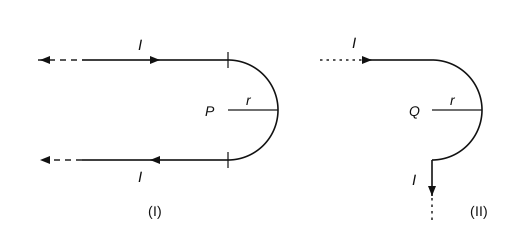
Q639.Two identical long current carrying wires are bent into the shapes shown in the following figures. If the magnitude of magnetic fields at the centres P and Q of a semicircular arc are B
and B
respectively, then the ratio
is ______.
दो एकसमान लम्बे धारावाही तारों को निम्न चित्रों में दर्शाई गई आकृतियों में मोड़ा गया है। यदि अर्धवृत्ताकार चाप के केन्द्रों P तथा Q पर चुम्बकीय क्षेत्रों के परिमाण क्रमशः B
तथा B
हैं, तो अनुपात
______ है।
- A
- B
- C
- D
Show answer
Concept: Semicircular arc at its centre: . A semi-infinite straight wire whose end is in line with the centre (perpendicular distance ): . A wire lying along a line passing through the point gives zero field.
- Shape (I): arc + two semi-infinite straight wires, all fields at P in the same direction: .
- Shape (II): the horizontal semi-infinite wire gives at Q; the vertical outgoing wire lies along the line through Q, giving zero: .
- .
Answer: (A)
अवधारणा: अर्धवृत्ताकार चाप के केन्द्र पर: । वह अर्ध-अनन्त सीधा तार जिसका सिरा केन्द्र की सीध में हो (लम्बवत् दूरी ): । बिन्दु से गुजरने वाली रेखा के अनुदिश रखा तार शून्य क्षेत्र देता है।
- आकृति (I): चाप + दो अर्ध-अनन्त सीधे तार, P पर सभी क्षेत्र एक ही दिशा में: ।
- आकृति (II): क्षैतिज अर्ध-अनन्त तार Q पर देता है; ऊर्ध्वाधर निर्गामी तार Q से गुजरने वाली रेखा के अनुदिश है, अतः शून्य देता है: ।
- ।
उत्तर: (A)
JEE Main 2026 (April) – Paper 1 (B.E./B.Tech)PhysicsMoving charges – field at centre of bent wiresJEE Main 2026 (April) – Paper 1 (B.E./B.Tech) 2026 · 2 Apr Shift 1
Q640.For a thin symmetric prism made of glass (refractive index 1.5), the ratio of incident angle and minimum deviation will be ________.
काँच (अपवर्तनांक 1.5) के बने एक पतले सममित प्रिज्म के लिए, आपतन कोण तथा न्यूनतम विचलन का अनुपात ________ होगा।
- A3 : 4
- B3 : 2
- C2 : 1
- D1 : 2
Show answer
Concept: For a thin prism, , and at minimum deviation .
- .
- .
- , i.e. 3 : 2.
Answer: (B) 3 : 2
अवधारणा: पतले प्रिज्म के लिए , तथा न्यूनतम विचलन पर ।
- ।
- ।
- , अर्थात् 3 : 2।
उत्तर: (B) 3 : 2
JEE Main 2026 (April) – Paper 1 (B.E./B.Tech)PhysicsRay optics – thin prismJEE Main 2026 (April) – Paper 1 (B.E./B.Tech) 2026 · 2 Apr Shift 1

